
Telco Cloud Managed Services Market Size and Share
Market Overview
| Study Period | 2020 - 2031 |
|---|---|
| Market Size (2026) | USD 38.89 Billion |
| Market Size (2031) | USD 90.14 Billion |
| Growth Rate (2026 - 2031) | 18.31 % |
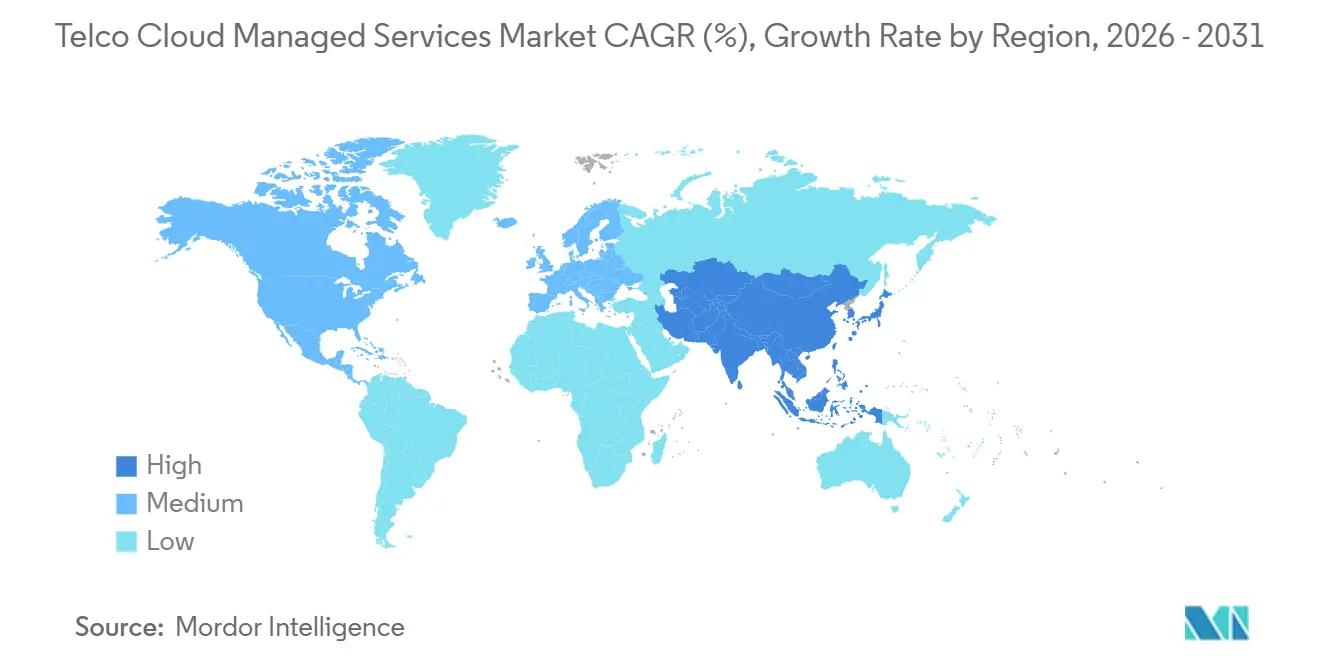
| Fastest Growing Market | Asia-Pacific |
| Largest Market | North America |
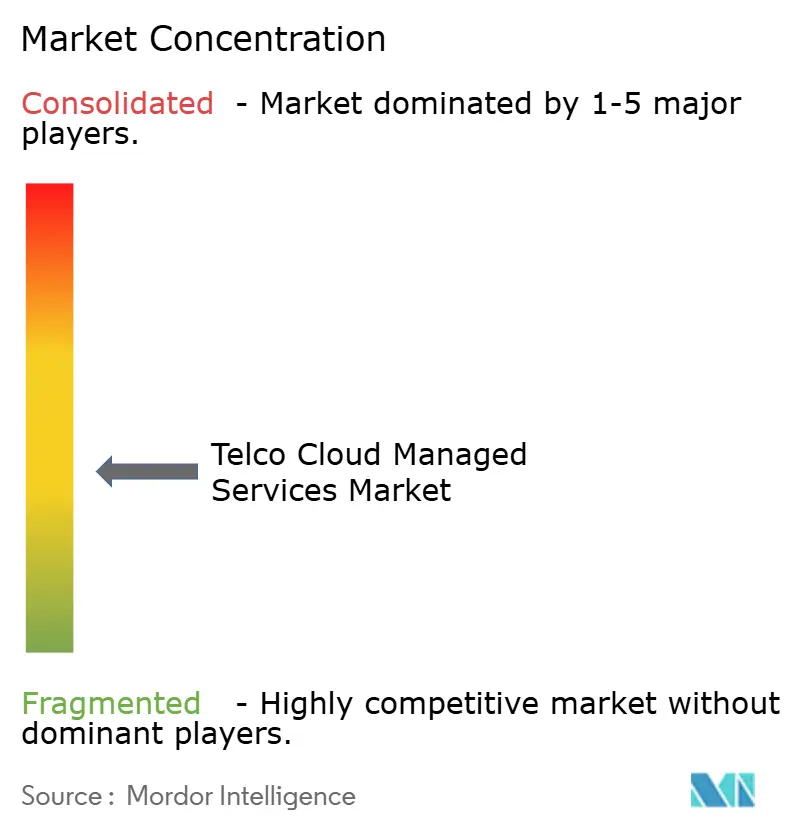
| Market Concentration | Medium |
Major Players *Disclaimer: Major Players sorted in no particular order Image © Mordor Intelligence. Reuse requires attribution under CC BY 4.0. | |
Telco Cloud Managed Services Market Analysis by Mordor Intelligence
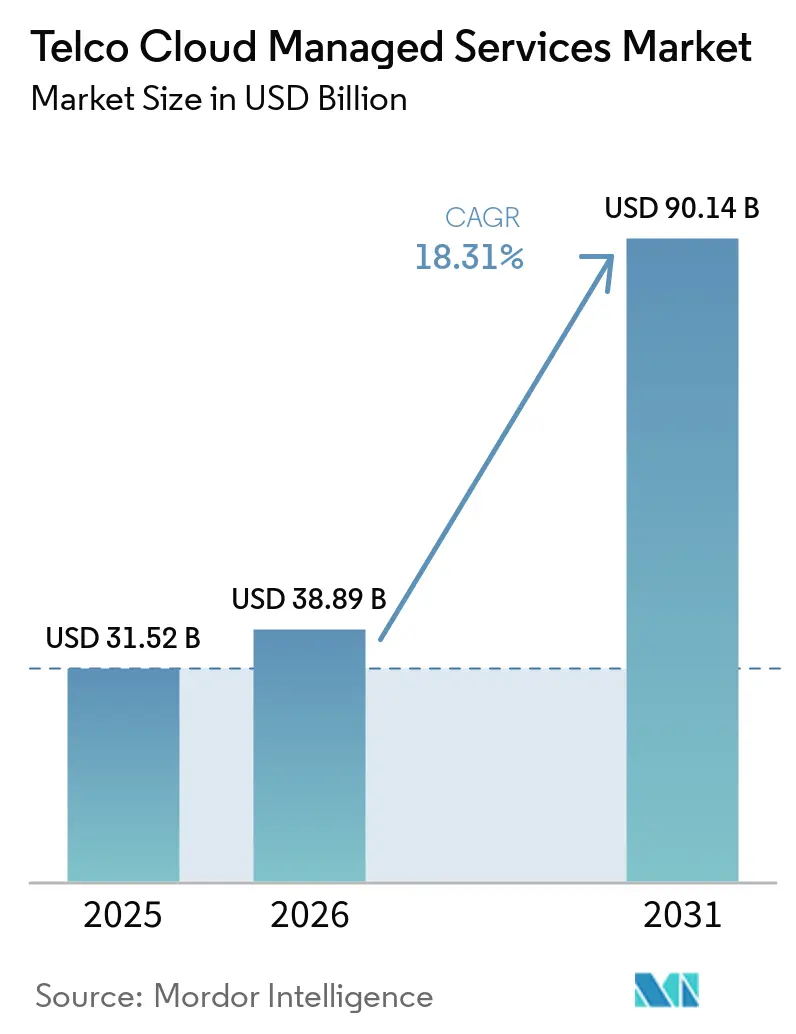
The Telco cloud managed services market size was valued at USD 31.52 billion in 2025 and is estimated to grow from USD 38.89 billion in 2026 to reach USD 90.14 billion by 2031, at a CAGR of 18.31% during the forecast period 2026-2031. The Telco cloud managed services market is expanding as 5G Standalone deployments require cloud-native skills that many communication service providers do not maintain internally. AI-assisted operations are also changing the cost of operating infrastructure, which favors contracts linked to service outcomes. Cloud spending, automation, and 5G investment are increasing the work that providers can place under managed contracts. Vendors are responding through partnerships that combine network platforms, cloud infrastructure, and operational software. The Telco cloud managed services market also has room to grow, as operators need to maintain control of sensitive workloads while using external computing capacity.
Key Report Takeaways
- By managed service type, Network Services led with 20.22% share of the telco cloud managed services market size in 2025, while Cloud Infrastructure Services is projected to expand at a 18.46% CAGR through 2031.
- By deployment model, Private Cloud held 71.56% revenue share in 2025, while Hybrid Cloud is projected to expand at a 19.01% CAGR through 2031.
- By cloud service model, Network as a Service held 66.67% share of the telco cloud managed services market size in 2025, while Infrastructure as a Service is projected to expand at a 19.21% CAGR through 2031.
- By NFV software, VNF/CNF held 36.25% revenue share in 2025, while NFVI is projected to expand at a 18.48% CAGR through 2031.
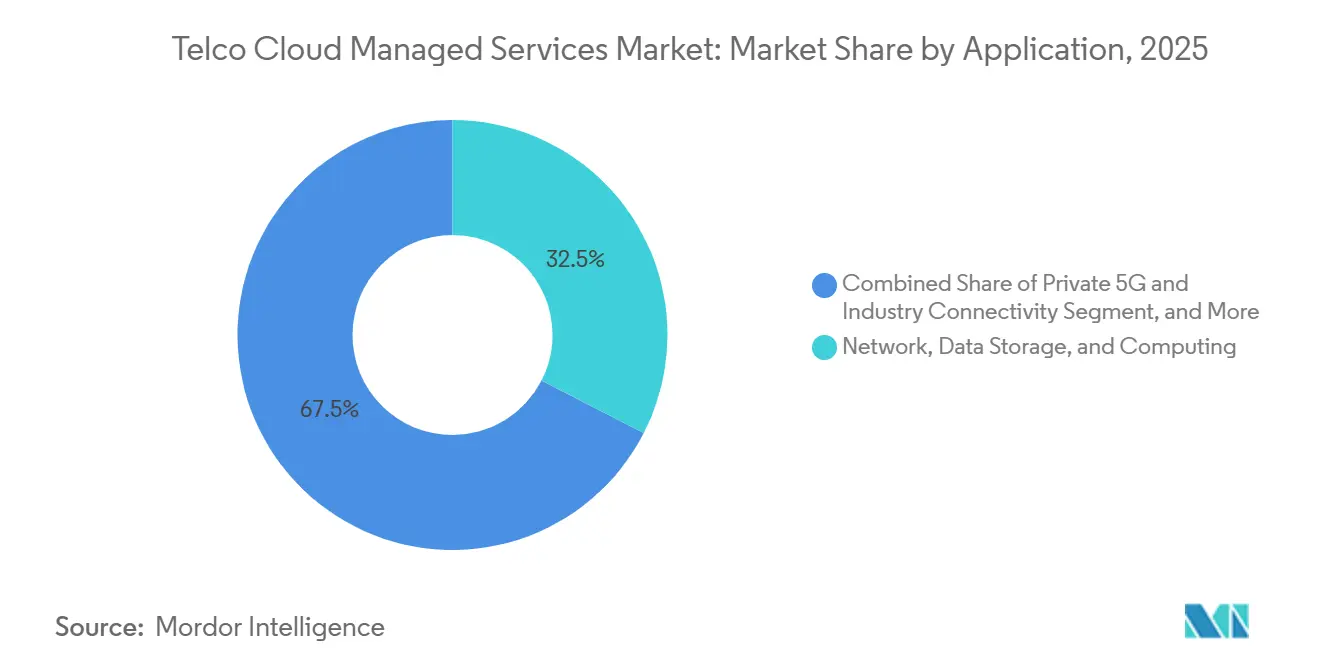
- By application, Network, Data Storage, and Computing held 32.54% share of the telco cloud managed services market size in 2025, while Cloud Migration and Transformation is projected to expand at a 18.56% CAGR through 2031.
- By enterprise size, Large Enterprises held 37.45% revenue share in 2025, while SMEs are projected to expand at a 18.51% CAGR through 2031.
- By geography, North America held 37.45% share of the telco cloud managed services market size in 2025, while Asia-Pacific is projected to expand at a 18.51% CAGR through 2031.
Note: Market size and forecast figures in this report are generated using Mordor Intelligence’s proprietary estimation framework, updated with the latest available data and insights as of January 2026.
Market Trends and Insights
Drivers Impact Analysis of Telco Cloud Managed Services Market*
| Driver | (~) % Impact on CAGR Forecast | Geographic Relevance | Impact Timeline |
|---|---|---|---|
| 5G Standalone and Cloud-Native Network Rollouts | +4.8% | Global, concentrated in Asia-Pacific, North America, and Europe | Short term (≤ 2 years) |
| Enterprise Demand for Hybrid and Multi-Cloud Operations | +3.9% | Global, highest intensity in North America and Europe | Medium term (2-4 years) |
| AI-Enabled Network Automation and Predictive Operations | +3.2% | Global, early gains in Japan, Germany, and United States | Medium term (2-4 years) |
| Edge Computing and Low-Latency Workloads | +2.4% | Asia-Pacific and North America core, spill-over to Europe | Long term (≥ 4 years) |
| Open RAN and Network Function Virtualization Adoption | +1.8% | Europe, Japan, and early majority adopters in North America | Medium term (2-4 years) |
| Telco Cloud Operating-Model Outsourcing by Capacity-Constrained CSPs | +1.5% | Global, with early gains in South America, Middle East, and Africa | Long term (≥ 4 years) |
| Source: Mordor Intelligence | |||
5G Standalone And Cloud-Native Network Rollouts
The Telco cloud managed services market benefits as 5G Standalone deployments move from trials into production operations. NTT DOCOMO launched commercial 5G Core services on a hybrid AWS environment in March 2026, using agentic AI to cut deployment time by 80% and incident-response time by 50%.[1] The deployment shows that production cloud cores create continuing requirements for engineering, monitoring, and incident management. O2 Telefónica also moved production-scale 5G core functions to AWS Outposts in its own data center, combining cloud scalability with onsite data controls. ETSI standards provide a shared interoperability framework for network functions that run across multi-vendor cloud environments. ETSI These conditions increase demand for providers that can manage technical operations through the full network lifecycle.
Enterprise Demand For Hybrid And Multi-Cloud Operations
Enterprise customers increasingly expect telecommunications providers to coordinate connectivity, edge capacity, cloud resources, and security through a single operating model. The GSMA stated in 2025 that operators could address close to USD 1 trillion of enterprise technology-services spending by embedding cloud and security services into connectivity offerings. The Telco cloud managed services market gains where service providers package hybrid operations as a managed offering rather than leaving customers to integrate separate vendors. Network as a Service platforms support that approach because they can link network performance to broader service delivery. European compliance obligations also require enterprises to document multi-cloud risks, which raises the value of managed architectures with clear operational accountability. The result is a larger role for providers that can manage cloud operations without separating them from the underlying network.
AI-Enabled Network Automation And Predictive Operations
The Telco cloud managed services market is supported by the wider use of AI for network monitoring and operational decision-making. NTT DOCOMO began commercial deployment of an agentic AI system in February 2026 that analyzes real-time data from more than 1 million network devices and reduces complex incident-resolution time by 50%.[2] Huawei introduced AUTINOps in March 2026 with risk prediction accuracy above 80% and diagnosis accuracy above 90% for autonomous network maintenance. These deployments show that automation is becoming part of live carrier operations rather than a future design objective. Providers with established operational data, network expertise, and automation tools can offer faster service restoration. Contracts can therefore place greater weight on autonomous resolution and service assurance, alongside traditional availability targets.
Edge Computing And Low-Latency Workloads
The Telco cloud managed services market is gaining further demand from edge computing and workloads that need low latency. Nokia has described how central-office capacity released by fiber migration can be used for distributed colocation, including rack space, power, cooling, and secure fiber for cloud builders and enterprises. China published MEC edge cloud platform capability requirements that took effect in June 2026, providing a technical framework for 5G edge cloud investment. NTT East offers Gigaraku 5G as a managed local 5G service that includes design, construction, and IT outsourcing for manufacturing and construction users. These models extend managed operations from centralized cores to customer locations and distributed sites. They also create work that requires local infrastructure support, remote monitoring, and application-level coordination.
Restraints Impact Analysis of Telco Cloud Managed Services Market*
| Restraint | (~) % Impact on CAGR Forecast | Geographic Relevance | Impact Timeline |
|---|---|---|---|
| Legacy Network Integration Complexity | -1.7% | Global, highest friction in Europe and South America | Medium term (2-4 years) |
| Data Sovereignty and Cross-Border Compliance Costs | -1.3% | EU, China, and global | Medium term (2-4 years) |
| Multi-Vendor Interoperability and Portability Gaps | -0.9% | Global, concentrated in multi-vendor Open RAN deployments | Short term (≤ 2 years) |
| Shortage of Cloud-Native Telecom Engineering Talent | -0.6% | Global, acute in South America, Middle East, and Africa | Long term (≥ 4 years) |
| Source: Mordor Intelligence | |||
Legacy Network Integration Complexity
The Telco cloud managed services market faces a constraint because many operators must run virtual and cloud-native network functions at the same time. This mixed environment complicates service scope, data flows, and the coordination of network operations. Many communications providers also retain traditional data tools and monolithic operational systems, which makes real-time automation more difficult. Providers must review OSS, BSS, and enterprise resource planning connections before defining a managed-services operating model. That work can lengthen negotiations and delay implementation where the customer estate is highly customized. The integration burden also favors providers with strong transformation and systems-integration capabilities.
Data Sovereignty And Cross-Border Compliance Costs
Data sovereignty has become an architectural issue for the Telco cloud managed services market, especially in regulated sectors and national telecommunications networks. The European Commission published its Cloud Sovereignty Framework in October 2025, setting 8 objectives for EU institutions that procure cloud services. Deutsche Telekom built a sovereign data platform on Google Cloud with external key management to retain cryptographic control over call-detail records and network telemetry. China also formalized cloud-native technical requirements for telecommunications networks, with the standard taking effect in September 2026. These requirements increase design and compliance costs, while making sovereign-managed offerings more relevant to buyers that cannot use cross-border operating models.
*Our forecasts treat driver/restraint impacts as directional, not additive. The impact forecasts reflect baseline growth, mix effects, and variable interactions.
Telco Cloud Managed Services Market Segment Analysis
By Managed Service Type:
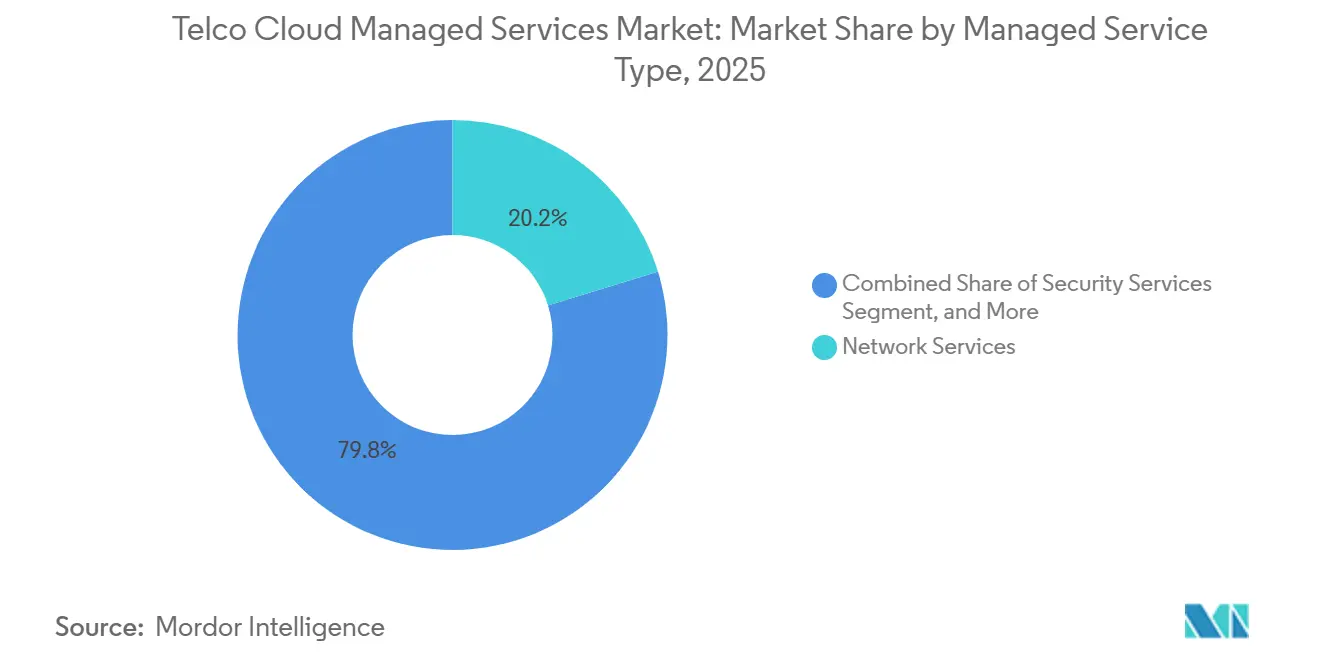
Network Services Anchor Revenue While Infrastructure ScalesNetwork Services held 20.22% of the Telco cloud managed services market share in 2025, making it the largest managed-service type. The position reflects operators’ dependence on external support for connectivity lifecycle management as network estates become more complex. Cloud Infrastructure Services is forecast to grow at a 18.46% CAGR from 2026 to 2031. This growth follows the shift toward infrastructure platforms that service providers consume instead of fully owning. Security Services are also becoming more relevant as suppliers bundle network and security management into one offering. Data Center and Backup Services support operators that are consolidating distributed systems under centralized management.
Orchestration and Service Assurance are expanding because multi-cloud environments require visibility across infrastructure and network layers. Professional and Support Services also benefit from the work needed to modernize OSS and BSS environments. Amdocs and Lumen Technologies extended their managed-services collaboration in August 2026 across AWS, Google Cloud, and Microsoft Azure using the aOS operating system.[3]The agreement illustrates how a single program can cover orchestration, order management, network operations, and transformation services. ETSI’s NFV architecture provides a standards reference for interoperability across those service areas. ETSI The Telco cloud managed services industry is therefore moving toward broader contracts that combine operational and transformation responsibilities.

By Deployment Model:
Private Cloud Dominates, but Hybrid Changes EconomicsPrivate Cloud accounted for 71.56% of the deployment-model segment in 2025. Its lead is primarily related to data-residency obligations that limit the use of shared public-cloud capacity for sensitive network functions. Hybrid Cloud is forecast to grow at a 19.01% CAGR from 2026 to 2031. Operators use this model to retain regulated workloads in sovereign environments while placing elastic computing tasks in cloud regions. O2 Telefónica’s production 5G core deployment on AWS Outposts used this approach within its own data center. The Telco cloud managed services market needs providers that can operate both sides of this hybrid design.
Public Cloud is becoming more relevant for smaller operators that cannot finance proprietary cloud infrastructure. Citymesh launched a commercial 5G Core SaaS service in February 2026 with Nokia and AWS for enterprise users at airports, hospitals, and venues. Distributed and Edge Cloud have a longer implementation path because they depend on distributed facilities, cloud-native software, and local hardware. These models are suited to deployments where applications need computing resources close to the user. They also add operational tasks across many locations rather than concentrating them in a few central sites. The Telco cloud managed services market can address this complexity through remote management, lifecycle support, and localized service assurance.
By Cloud Service Model:
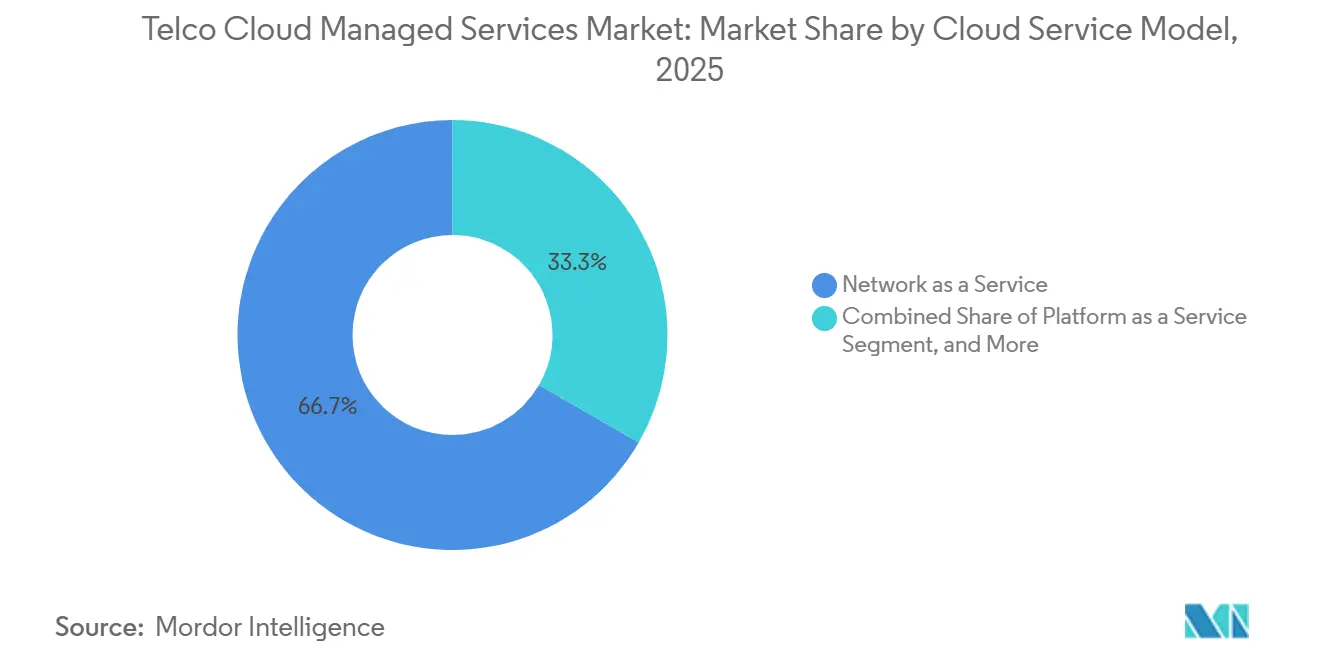
NaaS Leads, IaaS Accelerates on AI Computing DemandNetwork as a Service held 66.67% of the cloud service-model segment in 2025. The leading position reflects the established model of selling network access and performance as a service. Infrastructure as a Service is forecast to grow at a 19.21% CAGR from 2026 to 2031. Its momentum is linked to demand for AI inference capacity at metro-edge locations, where latency can limit the use of distant data centers. Operators can use these locations to provide computing capacity with network connectivity. Platform as a Service is also gaining relevance as cloud-native networks expose internal and external application programming interfaces.
Software as a Service is expanding as OSS and BSS platforms move to service-based delivery. Ericsson launched its On-Demand platform with Google Cloud in June 2025, enabling a full 5G core to be deployed in minutes with consumption-based billing. The launch shows how service-based delivery is entering network functions that previously required dedicated infrastructure. IaaS and SaaS can gain ground as operators seek flexible capacity and lower maintenance burdens. NaaS is still expected to remain the largest model because it is closely linked to the core service that operators sell. The Telco cloud managed services industry will need to support each model without losing operational visibility across them.
By NFV Software:
VNF/CNF Leads While NFVI Investment AcceleratesVNF/CNF held 36.25% of the NFV software segment in 2025. This layer includes core, IMS, RAN, and security functions that remain central to 5G deployments. NFVI is forecast to grow at a 18.48% CAGR from 2026 to 2031. Operators need upgraded compute, storage, and network foundations to run cloud-native workloads efficiently. Older infrastructure designed around VNF workloads may not meet those requirements. ETSI has outlined an NFV architecture for 6G telco cloud networks that links infrastructure, platform services, and orchestration.
Orchestration and Lifecycle Management are gaining importance, as operators must coordinate several vendors and software environments. Nokia and Ericsson announced cooperation in 2026 through their SMO Marketplace and rApp Ecosystem to improve interoperability across open and cloud RAN environments. The move can reduce vendor lock-in and simplify multi-vendor operations. Policy, Assurance, and Analytics Software also matters more as AI systems require current network data and real-time policy enforcement. These systems support the service assurance work that managed providers perform for operators. The Telco cloud managed services market is likely to see greater demand for providers that can manage infrastructure, software, and policy tools as one operational environment.
By Application:
Core Operations Anchor Spend, Cloud Migration Drives GrowthNetwork, Data Storage, and Computing held 32.54% of the Telco cloud managed services market size in 2025. The segment covers core operations, distributed storage, and computing coordination that form the foundation of managed service engagements. Cloud Migration and Transformation is forecast to grow at a 18.56% CAGR from 2026 to 2031. Many CSPs need to replace virtual network-function stacks with cloud-native network functions without disrupting service. This work requires planning, systems integration, testing, and operational support. It can therefore create durable demand for migration specialists and managed-service providers.
Traffic Management and Service Assurance are expanding as 5G network slicing requires real-time handling of service commitments. Cybersecurity and secure access service edge services are also included in broader network-security packages. NTT DATA and Ericsson formed a partnership in February 2026 for globally delivered private 5G and edge AI managed services. The partnership demonstrates how private 5G is being delivered with operational support rather than as a standalone network installation. Edge Computing and IoT Operations provide another application area as operators support industrial automation and local AI workloads. These use cases widen the range of applications covered by the Telco cloud managed services market.
By Enterprise Size:
Large Enterprises Anchor Contracts, SMEs Accelerate GrowthLarge Enterprises held 37.45% of the enterprise-size segment in 2025. Their position reflects higher spending, complex multi-site networks, and established relationships with managed-service providers. SMEs are forecast to grow at a 18.51% CAGR from 2026 to 2031. Consumption-based managed services can reduce the upfront capital requirement for smaller customers. They can also provide cloud-native skills that an SME may not employ internally. This model helps providers deliver managed connectivity, security, and cloud capabilities through standardized packages.
Citymesh’s Nokia-based 5G Core SaaS deployment shows how a service-based core can support enterprise clients without extensive internal telecommunications engineering. Standardized delivery can allow providers to add customers without recreating the operational setup for every deployment. This creates a stronger commercial case for packages that serve smaller organizations. AI-enabled service assurance may make these packages more appealing because it can provide quicker monitoring and incident handling. Providers still need clear support models that meet the needs of customers with limited technical capacity. The Telco cloud managed services market can expand with SMEs when services remain simple to buy, operate, and scale.
Geography Analysis
North America Telco Cloud Managed Services Market
North America accounted for 37.45% of the Telco cloud managed services market share in 2025. The region has deep hyperscaler infrastructure and mature operator cloud-transformation programs. U.S. funding for rural 5G broadband is extending managed service needs beyond major metropolitan locations, creating demand in regions where operators have limited engineering resources. Mexico is undergoing mobile-network modernization, and regional operators are seeking partners to advance 5G deployment within capital constraints. Canada also adds growing demand as operators broaden their cloud and managed-service programs.
APAC Telco Cloud Managed Services Market
Asia-Pacific is forecast to advance at an 18.51% CAGR from 2026 to 2031. Japan is a key contributor, with NTT DOCOMO’s hybrid AWS 5G Core deployment serving more than 91 million subscribers. South Korea is expanding private 5G managed services for manufacturing applications, while India presents a growth opportunity as managed services move into enterprise verticals beyond tier-1 operators. China’s cloud-native telecommunications requirements and MEC edge-cloud standard provide formal frameworks for cloud-native managed-service investment.[4] The Telco cloud managed services market benefits as regional providers need support with more structured deployments.
EMEA and South America Telco Cloud Managed Services Market
Europe is shaped by Germany, the United Kingdom, and France, where privacy and cybersecurity requirements influence service design. The European Commission’s Cloud Sovereignty Framework supports the development of sovereign cloud procurement requirements. Deutsche Telekom’s sovereign platform on Google Cloud shows how external key management can protect call-detail records and network telemetry. South America, the Middle East, and Africa are longer-term areas for the Telco cloud managed services market, with Brazil, Saudi Arabia, and South Africa as the primary contributors. Outsourcing is especially relevant where regional operators cannot fund cloud-native transformations at the speed required by 5G competition.
Competitive Landscape
The Telco cloud managed services market has active competition, with the 5 largest companies holding 45% combined share in 2025. AWS competes through partnerships with network equipment and software providers, including Nokia, Ericsson, and Amdocs. These relationships combine cloud infrastructure with network automation and lifecycle management capabilities. Nokia and AWS expanded their collaboration in June 2026 to run Nokia Autonomous Networks Fabric on AWS, targeting Level 4 autonomous operations for communication service providers. This strategy positions AWS in network operations rather than infrastructure delivery alone.
Ericsson partnered with Google Cloud in June 2025 to offer a managed 5G core service with consumption-based billing and 24/7 site-reliability engineering. The model shifts some customer spending away from multiyear infrastructure projects and toward recurring service payments. Amdocs and AWS announced a multiyear collaboration in February 2026 that combines the aOS operating system with AWS cloud and AI technology for CSP transformation programs. Mavenir and Wind River compete through open and disaggregated cloud-native network software, while IT service providers compete where contracts require deep OSS and BSS transformation work. The Telco cloud managed services market therefore includes cloud companies, equipment vendors, software providers, and systems integrators with distinct strengths.
Niche suppliers are developing capabilities in AI-based network analytics, zero-trust orchestration, and private 5G operations. Nokia’s acquisition of Infinera strengthened its optical and packet-network capabilities, while the ATSG and Evolve IP merger created XTIUM, combining managed IT and telecommunications services. Opportunities remain in sovereign cloud services for regulated users, AI-supported edge operations, and outcome-linked service agreements for SMEs. These areas require proven product design and operational capability rather than scale alone, and specialist providers can address local regulations and specific network architectures.
Telco Cloud Managed Services Industry Leaders
-
Telefonaktiebolaget LM Ericsson
-
Huawei Technologies Co., Ltd.
-
Nokia Corporation
-
Amazon Web Services, Inc.
-
Amdocs Limited
- *Disclaimer: Major Players sorted in no particular order
Telco Cloud Managed Services Market Companies Covered in this Report
- Amazon Web Services, Inc.
- Microsoft Corporation
- Google LLC
- International Business Machines Corporation
- Telefonaktiebolaget LM Ericsson
- Nokia Corporation
- Huawei Technologies Co., Ltd.
- Cisco Systems, Inc.
- Oracle Corporation
- Broadcom Inc.
- Hewlett Packard Enterprise Company
- Rakuten Symphony, Inc
- ZTE Corporation
- Amdocs Limited
- Mavenir Systems, Inc.
- Wind River Systems, Inc.
- Red Hat, Inc.
- Accenture plc
- Capgemini SE
- Tata Consultancy Services Limited
- NTT DATA Corporation
- Tech Mahindra Limited
Recent Industry Developments in Telco Cloud Managed Services Market
- August 2026: Amdocs and Lumen Technologies extended their multi-cloud managed services collaboration to AWS, building on prior migrations to Google Cloud and Microsoft Azure. Amdocs’ aOS agentic operating system now orchestrates enterprise service orchestration and order management on AWS, expected to reduce manual operational effort and accelerate zero-touch operations for Lumen’s enterprise customer base.
- June 2026: Nokia and AWS announced an expanded collaboration to run Nokia’s Autonomous Networks Fabric on AWS, targeting Level 4 autonomous operations for communication service providers. The partnership combines Nokia’s telecom-trained AI models with AWS AI services, with commercial availability expected later in 2026.
- March 2026: Ericsson and SoftBank Corp. signed a multiyear framework agreement for next-generation cloud-native core network solutions to accelerate SoftBank’s 5G SA adoption using Ericsson’s dual-mode 5G Core on Cloud Native Infrastructure Solution.
- February 2026: Amdocs and AWS announced a multiyear strategic collaboration to advance AI-driven telco modernization, combining Amdocs’ aOS agentic operating system with AWS cloud and AI technologies for CSP digital transformation programs.
Global Telco Cloud Managed Services Market Report Scope
The Telco Cloud Managed Services Market Report is Segmented by Managed Service Type (Network Services, Cloud Infrastructure Services, Security Services, Data Center and Backup Services, Orchestration and Service Assurance, and Professional and Support Services), Deployment Model (Public Cloud, Private Cloud, Hybrid Cloud, and Distributed and Edge Cloud), Cloud Service Model (Infrastructure as a Service, Platform as a Service, Software as a Service, and Network as a Service), NFV Software (Virtual Network Functions and Cloud-Native Network Functions, Network Functions Virtualization Infrastructure, Orchestration and Lifecycle Management, and Policy, Assurance, and Analytics Software), Application (Network, Data Storage, and Computing, Traffic Management and Service Assurance, Cloud Migration and Transformation, Cybersecurity and Secure Access Service Edge, Private 5G and Industry Connectivity, and Edge Computing and IoT Operations), Enterprise Size (Large Enterprises, and Small and Medium-Sized Enterprises) and Geography(North America, South America, Europe, Asia-Pacific, Middle East, and Africa). The Market Forecasts are Provided in Terms of Value (USD).
Segmentation Overview
| Network Services |
| Cloud Infrastructure Services |
| Security Services |
| Data Center and Backup Services |
| Orchestration and Service Assurance |
| Professional and Support Services |
| Public Cloud |
| Private Cloud |
| Hybrid Cloud |
| Distributed and Edge Cloud |
| Infrastructure as a Service |
| Platform as a Service |
| Software as a Service |
| Network as a Service |
| Virtual Network Functions and Cloud-Native Network Functions |
| Network Functions Virtualization Infrastructure |
| Orchestration and Lifecycle Management |
| Policy, Assurance, and Analytics Software |
| Network, Data Storage, and Computing |
| Traffic Management and Service Assurance |
| Cloud Migration and Transformation |
| Cybersecurity and Secure Access Service Edge |
| Private 5G and Industry Connectivity |
| Edge Computing and IoT Operations |
| Large Enterprises |
| Small and Medium-Sized Enterprises |
| North America | United States |
| Canada | |
| Mexico | |
| South America | Brazil |
| Argentina | |
| Rest of South America | |
| Europe | Germany |
| United Kingdom | |
| France | |
| Russia | |
| Rest of Europe | |
| Asia-Pacific | China |
| Japan | |
| India | |
| South Korea | |
| Australia | |
| Rest of Asia-Pacific | |
| Middle East | Saudi Arabia |
| United Arab Emirates | |
| Turkey | |
| Rest of Middle East | |
| Africa | South Africa |
| Nigeria | |
| Kenya | |
| Rest of Africa |
| By Managed Service Type | Network Services | |
| Cloud Infrastructure Services | ||
| Security Services | ||
| Data Center and Backup Services | ||
| Orchestration and Service Assurance | ||
| Professional and Support Services | ||
| By Deployment Model | Public Cloud | |
| Private Cloud | ||
| Hybrid Cloud | ||
| Distributed and Edge Cloud | ||
| By Cloud Service Model | Infrastructure as a Service | |
| Platform as a Service | ||
| Software as a Service | ||
| Network as a Service | ||
| By NFV Software | Virtual Network Functions and Cloud-Native Network Functions | |
| Network Functions Virtualization Infrastructure | ||
| Orchestration and Lifecycle Management | ||
| Policy, Assurance, and Analytics Software | ||
| By Application | Network, Data Storage, and Computing | |
| Traffic Management and Service Assurance | ||
| Cloud Migration and Transformation | ||
| Cybersecurity and Secure Access Service Edge | ||
| Private 5G and Industry Connectivity | ||
| Edge Computing and IoT Operations | ||
| By Enterprise Size | Large Enterprises | |
| Small and Medium-Sized Enterprises | ||
| By Geography | North America | United States |
| Canada | ||
| Mexico | ||
| South America | Brazil | |
| Argentina | ||
| Rest of South America | ||
| Europe | Germany | |
| United Kingdom | ||
| France | ||
| Russia | ||
| Rest of Europe | ||
| Asia-Pacific | China | |
| Japan | ||
| India | ||
| South Korea | ||
| Australia | ||
| Rest of Asia-Pacific | ||
| Middle East | Saudi Arabia | |
| United Arab Emirates | ||
| Turkey | ||
| Rest of Middle East | ||
| Africa | South Africa | |
| Nigeria | ||
| Kenya | ||
| Rest of Africa | ||
Key Questions Answered in the Report
What is the Telco cloud managed services market size?
The Telco cloud managed services market was valued at USD 31.52 billion in 2025, is valued at USD 38.89 billion in 2026, and is forecast to reach USD 90.14 billion by 2031.
What is driving demand for telco cloud managed services?
Production 5G Standalone deployments, hybrid cloud operations, AI-enabled automation, and distributed edge workloads are increasing the need for specialist operational support.
Which managed service type leads revenue?
Network Services led the managed-service type segment with 20.22% share in 2025, while Cloud Infrastructure Services has the highest forecast growth rate at 18.46% CAGR.
Why does private cloud remain important for telecommunications providers?
Private Cloud held 71.56% of the deployment segment in 2025 because data residency, network control, and sovereignty requirements limit the use of shared public-cloud environments.
Which region is expanding fastest?
Asia-Pacific is forecast to grow at a 18.51% CAGR through 2031, supported by digitalization programs, private 5G deployments, and cloud-native network investment.
How are AI tools changing managed network operations?
AI tools can support incident resolution, risk identification, network quality optimization, and service assurance, allowing providers to offer more automated operational models.