
Table Eggs Market Size and Share
Market Overview
| Study Period | 2021 - 2031 |
|---|---|
| Market Size (2026) | USD 263.62 Billion |
| Market Size (2031) | USD 337.57 Billion |
| Growth Rate (2026 - 2031) | 5.07 % |
| Fastest Growing Market | Asia-Pacific |
| Largest Market | Asia-Pacific |
| Market Concentration | Low |
Major Players
*Disclaimer: Major Players sorted in no particular order Image © Mordor Intelligence. Reuse requires attribution under CC BY 4.0. |
|
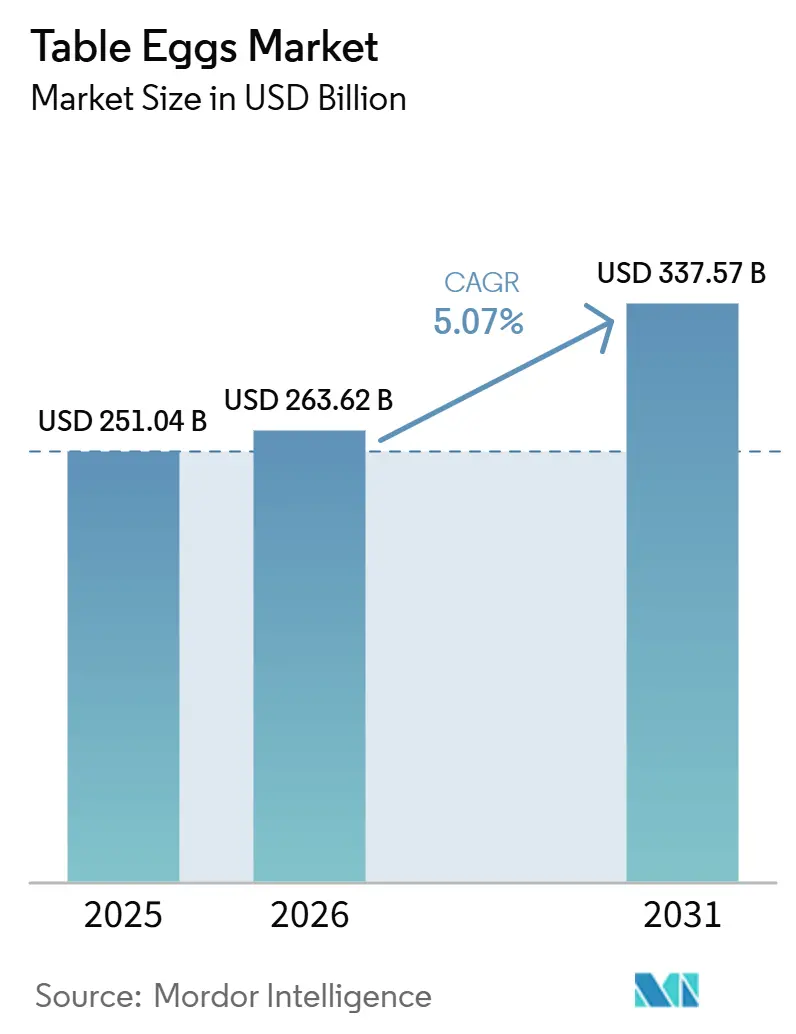
Table Eggs Market Analysis by Mordor Intelligence
The table eggs market size is expected to grow from USD 251.04 billion in 2025 to USD 263.62 billion in 2026 and is forecast to reach USD 337.57 billion by 2031 at a 5.07% CAGR over 2026-2031. The table eggs market is experiencing steady growth, driven by rising demand for affordable, high-quality protein and increasing consumption across households, foodservice, and food processing industries. Growing consumer preference for specialty eggs, including organic, cage-free, free-range, and nutrient-enriched varieties, is driving product premiumization and expanding the value-added segment. The expansion of modern retail and e-commerce channels is improving product accessibility, while advancements in automation, traceability, and commercial egg production technologies are enhancing operational efficiency and product quality. These factors continue to support the market's long-term growth and product innovation.
Key Report Takeaways
- By product type, brown eggs led with a 48.01% share in 2025 across Europe and parts of Asia, and specialty eggs are forecast to expand at a 7.79% CAGR through 2031.
- By category, conventional eggs held a 68.98% share in 2025 across high-volume emerging markets, and organic eggs are projected to grow at a 6.93% CAGR through 2031.
- By distribution channel, retail accounted for a 78.02% share in 2025 across global household purchases, and foodservice is expected to grow at a 6.21% CAGR through 2031 as out-of-home egg demand expands.
- By geography, Asia-Pacific held 58.81% of the egg market share in 2025 and is forecast to grow at a 6.95% CAGR through 2031, making it both the largest and fastest-growing regional block.
Note: Market size and forecast figures in this report are generated using Mordor Intelligence’s proprietary estimation framework, updated with the latest available data and insights as of January 2026.
Market Trends and Insights
Drivers Impact Analysis of Table Eggs Market*
| Driver | (~) % Impact on CAGR Forecast | Geographic Relevance | Impact Timeline |
|---|---|---|---|
| Rising demand for affordable animal protein | +1.2% | Global, concentrated in South and Southeast Asia, Sub-Saharan Africa, Latin America | Medium term (2–4 years) |
| Growing consumer demand for cage-free and specialty eggs | +1.0% | North America and Europe primary; Asia-Pacific emerging | Long term (≥ 4 years) |
| Increasing demand from foodservice, bakery, and processed food manufacturers | +0.9% | Global, led by Asia-Pacific, Middle East and Africa, and Latin America | Short term (≤ 2 years) |
| Retail preimunization through organic, free-range, and functional eggs | +0.8% | North America and Europe, spill-over to urban Asia-Pacific | Medium term (2–4 years) |
| Expansion of retail and e-commerce distribution for fresh eggs | +0.6% | Asia-Pacific core, spill-over to Middle East and Africa and Latin America | Short term (≤ 2 years) |
| Automation and traceability advancements in commercial egg production | +0.4% | Global, early gains in North America, Europe, and urban Asia-Pacific | Long term (≥ 4 years) |
| Source: Mordor Intelligence | |||
Rising demand for affordable animal protein
Growing demand for affordable, nutrient-dense animal protein is supporting the growth of the table eggs market. Eggs provide a cost-effective source of high-quality protein compared with many other animal-based foods. Rising incomes, urbanization, and dietary diversification in emerging economies are driving greater consumption of animal-derived foods. According to the Organisation for Economic Co-operation and Development (OECD) Agricultural Outlook 2024–2033, global per capita protein intake is projected to increase from 76.6 grams per day in 2024 to 79.8 grams per day by 2033, driven by higher consumption in emerging economies[1]Source: Organisation for Economic Co-operation and Development, " OECD‑FAO Agricultural Outlook 2024‑2033.", oecd.org. As consumers seek accessible protein sources to meet changing dietary needs, eggs are expected to benefit from their affordability, nutritional profile, and widespread availability across both developed and developing markets.
Growing consumer demand for cage-free and specialty eggs
Consumer preferences are increasingly shifting toward cage-free and specialty eggs, driven by animal welfare concerns, demand for production transparency, and interest in premium product attributes. Growing awareness of ethical sourcing and demand for differentiated products are supporting the adoption of alternative production systems. Corporate sourcing commitments across global food supply chains are also supporting the transition toward cage-free production. A 2026 study by Michigan State University reported that 52 companies in India have committed to sourcing cage-free eggs by 2025, with an additional 18 companies targeting 2030[2]Source: Michigan State University, " GLOBAL CAGE-FREE MARKETS: Opportunities and Challenges for The Hospitality Industry.", canr.msu.edu. In Japan, the same study found that 157 companies have adopted cage-free sourcing commitments, including 129 companies targeting 2025 and 26 companies targeting 2030, reflecting growing commercial demand for higher-welfare egg products across major Asian markets[3]Source: Michigan State University, " GLOBAL CAGE-FREE MARKETS: Opportunities and Challenges for The Hospitality Industry.", canr.msu.edu.
Increasing demand from foodservice, bakery, and processed food manufacturers
The expanding foodservice, bakery, and processed food industries are driving demand for table eggs as a functional ingredient in baked goods, confectionery, ready-to-eat meals, sauces, and processed foods, owing to their binding, emulsifying, foaming, and texturizing properties. The growth of quick-service restaurants, cafés, institutional catering, and commercial bakeries is supporting consistent egg consumption across both developed and emerging markets. Rising consumer preference for convenience foods and away-from-home dining is encouraging food manufacturers and foodservice operators to increase egg procurement for diverse product applications. Additionally, innovations in bakery products, packaged foods, and protein-rich meal offerings, along with the expansion of modern food processing facilities, are expected to sustain long-term demand for table eggs across industrial and foodservice channels.
Retail premiumization through organic, free-range, and functional eggs
Consumers are increasingly willing to pay premium prices for eggs that offer added value through enhanced nutrition, ethical production practices, and improved quality. This is driving demand for organic, free-range, pasture-raised, and functional eggs enriched with nutrients such as omega-3 fatty acids and vitamin D. Growing awareness of health, sustainability, animal welfare, transparency, and traceability is encouraging retailers and producers to expand premium egg portfolios across supermarkets, specialty stores, and online retail channels. Producers are investing in differentiated production systems, certifications, and value-added innovations to meet evolving consumer expectations and strengthen product positioning. As purchasing preferences shift toward premium and specialty food products, retail premiumization is expected to support sustained growth in the global table eggs market.
Restraints Impact Analysis of Table Eggs Market*
| Restraint | (~) % Impact on CAGR Forecast | Geographic Relevance | Impact Timeline |
|---|---|---|---|
| Bird flu outbreaks disrupting egg production | -1.1% | Global; North America and Europe most severely affected | Short term (≤ 2 years) |
| Feed cost volatility and margin compression | -0.8% | Global, particularly South and Southeast Asia, Latin America | Medium term (2–4 years) |
| Stricter animal welfare regulations and cage-free production requirements | -0.6% | North America and Europe primary; Asia-Pacific emerging | Long term (≥ 4 years) |
| Growing competition from alternative protein sources | -0.4% | North America, Europe, urban Asia-Pacific | Long term (≥ 4 years) |
| Source: Mordor Intelligence | |||
Bird flu outbreaks disrupting egg production
Avian influenza outbreaks continue to pose a significant challenge to the table eggs market by disrupting egg production, reducing laying hen populations, and creating supply chain uncertainties. Outbreaks typically require the culling of affected flocks and the implementation of movement restrictions to control disease spread, limiting egg availability across domestic and international markets. Recurring outbreaks also increase operational pressures on producers through higher investments in biosecurity measures, disease surveillance, and flock health management. These disruptions contribute to supply fluctuations and price volatility, making it difficult for food manufacturers, foodservice operators, and retailers to maintain stable egg supplies. As avian influenza continues to affect major egg-producing regions, it remains a key restraint on the long-term growth of the global table eggs market.
Feed cost volatility and margin compression
Feed costs represent a major challenge for egg producers, as feed constitutes a significant portion of total production expenses. Fluctuations in the prices of key feed ingredients, including corn and soybean meal, can increase operating costs, reduce profitability, and create uncertainty in pricing strategies, particularly for producers with limited ability to pass higher costs on to consumers. Sustained pressure on production margins may restrict investments in flock expansion, facility upgrades, and efficiency improvements, especially among smaller and independent producers. While larger producers may have greater cost-management capabilities, prolonged feed price volatility can still affect profitability and operational planning. As feed cost uncertainty continues to influence production decisions, it remains a key restraint on the growth of the global table eggs market.
*Our forecasts treat driver/restraint impacts as directional, not additive. The impact forecasts reflect baseline growth, mix effects, and variable interactions.
Table Eggs Market Segment Analysis
By Product Type:
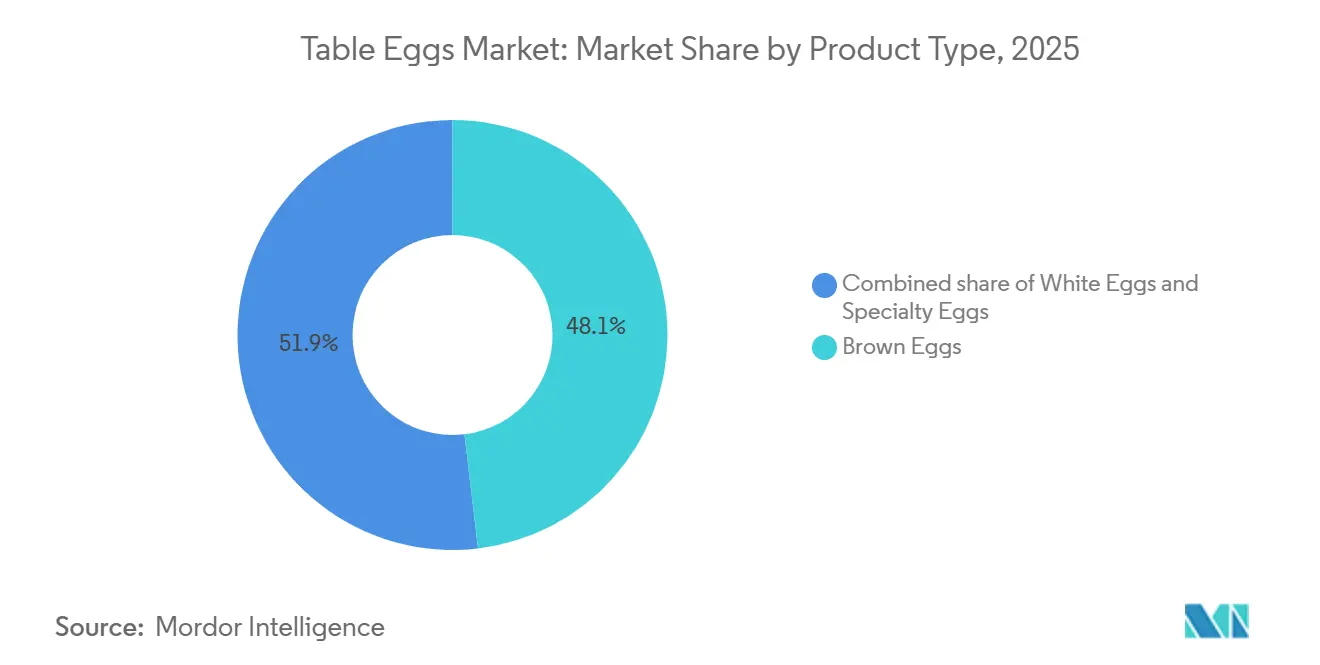
Specialty Eggs Redefine the Margin EquationBrown eggs accounted for 48.01% of the global table eggs market by value in 2025, making them the largest product type segment. Their dominance is driven by strong consumer preference in several regions, where brown eggs are widely perceived as fresher and more natural. Broad availability through retail channels, established production systems, and consistent household demand further support the segment's position. Brown eggs also benefit from high consumer familiarity, as they are commonly associated with traditional egg consumption patterns across many markets. Continued consumer acceptance and widespread availability are expected to sustain demand over the forecast period.
Specialty eggs are projected to register the fastest CAGR of 7.79% during 2026–2031. Growth is driven by increasing consumer demand for premium egg products such as organic, cage-free, free-range, pasture-raised, and nutrient-enriched eggs. Rising awareness of animal welfare, health, and food transparency, along with expanding availability across modern retail channels, is encouraging greater adoption of specialty eggs. Growing consumer willingness to pay higher prices for differentiated food products is also supporting the expansion of this segment. Continued product innovation and premiumization are expected to sustain the segment's growth throughout the forecast period.



By Category:
Organic Growth Accelerates as Conventional Holds ValueConventional egg production accounted for 68.98% of the global table eggs market by value in 2025, making it the dominant category. The segment benefits from well-established production systems, lower production costs, and widespread availability across both developed and emerging markets. Its strong presence across retail, foodservice, and food processing applications continues to support consistent demand. Established supply chains and large-scale commercial production further reinforce the segment's market position.
Organic egg production is projected to register the fastest CAGR of 6.93% during 2026–2031. Growth is driven by increasing consumer preference for sustainably produced and chemical-free food products, along with rising awareness of health, animal welfare, and environmental sustainability. Expanding availability of certified organic eggs through modern retail channels and growing consumer willingness to pay premium prices for high-quality food products are expected to support continued growth. Increasing investments in organic farming practices and premium egg offerings are further strengthening the segment's market outlook.
By Distribution Channel:
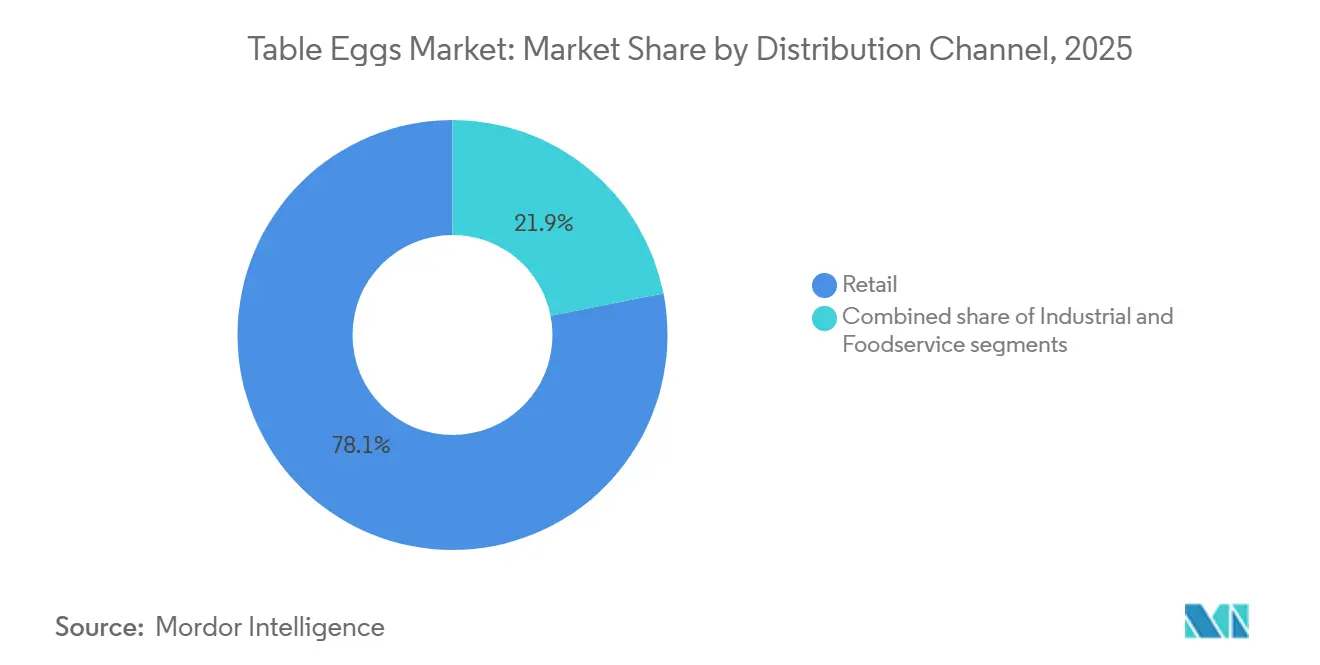
Foodservice Acceleration Reshapes Value EconomicsRetail accounted for 78.02% of the global table eggs market by value in 2025, making it the largest distribution channel. This dominance is supported by the widespread presence of supermarkets, hypermarkets, convenience stores, and other retail outlets that provide consumers with easy access to fresh eggs. Strong household demand, frequent purchase patterns, and the expansion of organized retail networks continue to reinforce the segment's position. Growing product availability across both physical stores and online retail platforms further supports market growth.
Foodservice is projected to register the fastest CAGR of 6.21% during 2026–2031. Growth is driven by the continued expansion of restaurants, cafés, bakeries, hotels, institutional catering, and quick-service restaurants, where eggs are widely used across a variety of menu offerings. Rising demand for away-from-home dining and convenience foods is increasing egg consumption across commercial establishments. The growing use of eggs in prepared meals, bakery products, and other foodservice applications is expected to support sustained growth throughout the forecast period.
Geography Analysis
APAC Table Eggs Market
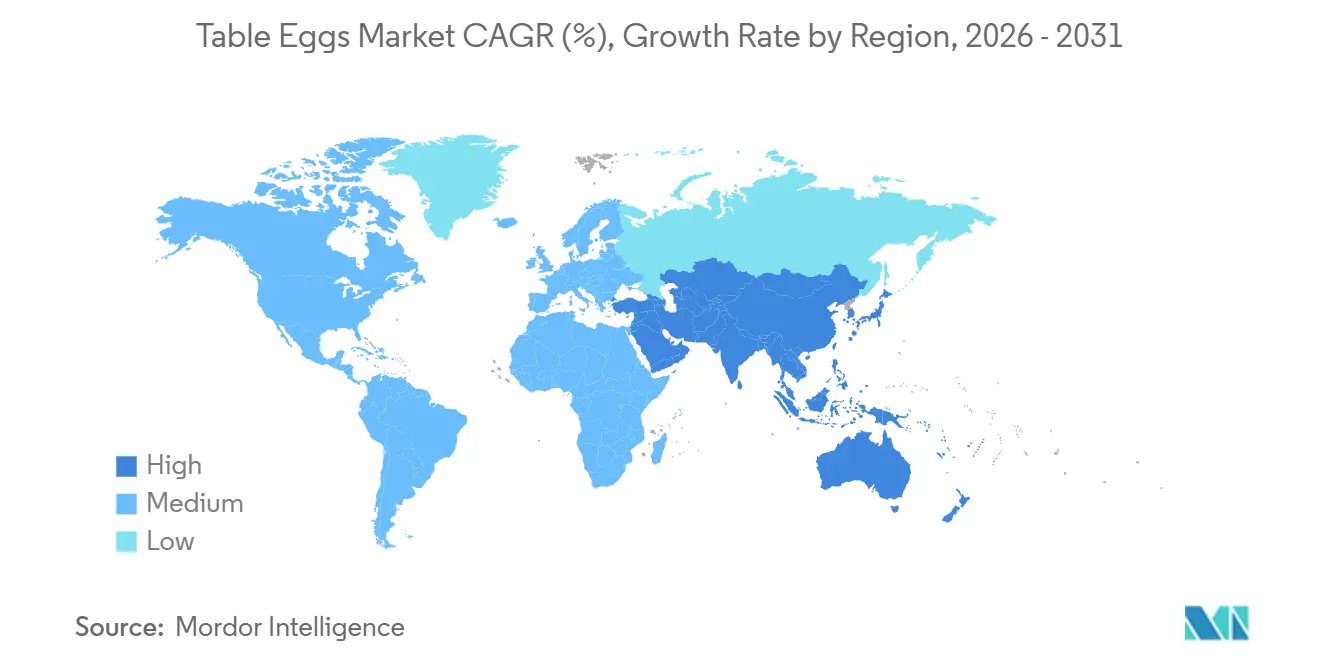
Asia-Pacific accounted for 58.81% of the global table eggs market by value in 2025 and is projected to register the fastest CAGR of 6.95% during 2026–2031. The region's position is supported by its large consumer base, expanding poultry production, and increasing demand for affordable animal protein. Rising urbanization, improving disposable incomes, and the expansion of organized retail and foodservice sectors continue to drive egg consumption. Continued investments in commercial poultry farming and production efficiency are expected to further strengthen the region's market position.
North America and Europe Table Eggs Market
North America and Europe represent mature markets with well-established egg production and distribution networks. Consumer preference for premium, cage-free, organic, and other specialty eggs continues to support market development, while ongoing product innovation and strong retail penetration contribute to steady demand. The widespread use of eggs across households, foodservice, and food manufacturing also reinforces the market outlook in these regions.
MEA and South America Table Eggs Market
South America and the Middle East and Africa are emerging markets, supported by rising population, urbanization, and increasing awareness of the nutritional benefits of eggs. Growing investments in commercial poultry farming, expanding retail infrastructure, and improving food security initiatives are encouraging higher egg production and consumption. These factors are expected to create new growth opportunities and support the long-term expansion of the global table eggs market.

Competitive Landscape
The global table eggs market is highly fragmented, with numerous regional and international producers competing across retail, foodservice, and food processing channels. No single company holds a dominant global market share. Cal-Maine Foods, Inc., Charoen Pokphand Foods PCL, Rose Acre Farms, Interovo Egg Group B.V., and Noble Foods are among the prominent participants, supported by their extensive production capacity, established distribution networks, and diversified product portfolios. Market competition is driven by production efficiency, product quality, supply reliability, and growing demand for premium and specialty eggs.
Leading companies are focusing on expanding production capacity, strengthening supply chains, and broadening their specialty egg portfolios through strategic acquisitions, facility expansions, and investments in value-added products. Many producers are increasing their offerings of cage-free, organic, free-range, and nutrient-enriched eggs to align with evolving consumer preferences and retailer sourcing requirements. Companies are also investing in automation, traceability, and advanced flock management technologies to improve operational efficiency and product quality.
Emerging players are strengthening their market presence by expanding regional production capabilities and introducing differentiated specialty egg products targeting premium market segments. Many smaller producers are focusing on organic, pasture-raised, and welfare-certified eggs to address changing consumer preferences and build brand recognition. As demand for premium eggs continues to grow, regional companies are expected to expand their distribution networks and invest in sustainable production practices, further increasing competition within the global table eggs market.
Table Eggs Industry Leaders
-
Cal-Maine Foods, Inc.
-
Charoen Pokphand Foods PCL
-
Rose Acre Farms
-
Noble Foods
-
Interovo Egg Group B.V.
- *Disclaimer: Major Players sorted in no particular order
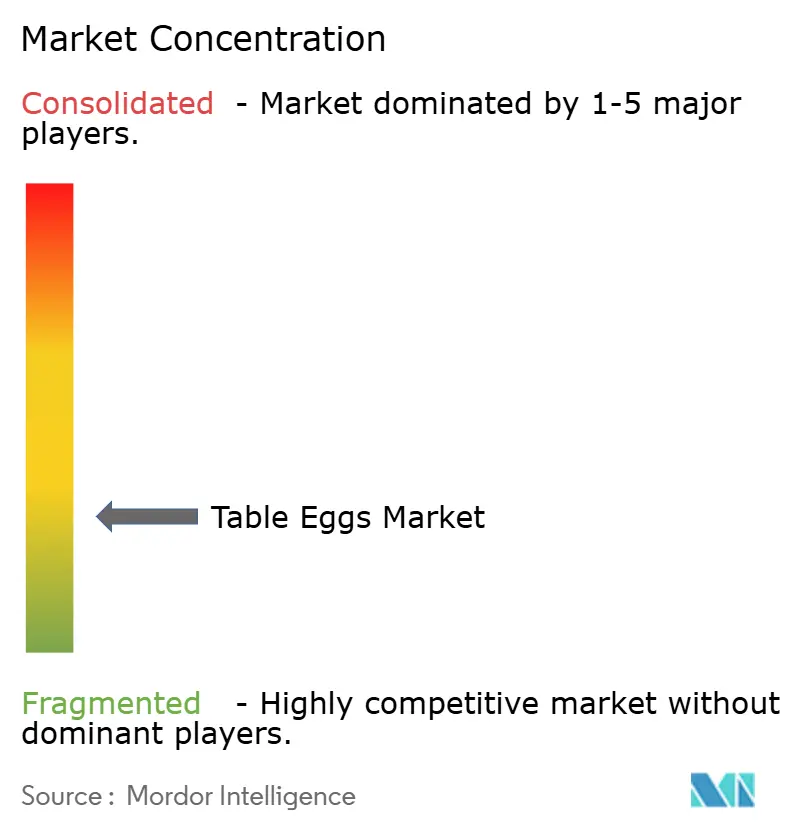
Table Eggs Market Companies Covered in this Report
- Cal-Maine Foods, Inc.
- Rose Acre Farms
- Hillandale Farms
- Versova Management Cooperative
- Daybreak Foods, Inc.
- Michael Foods, Inc.
- Rembrandt Foods
- Eggland's Best, LLC
- Vital Farms
- TM Ovostar
- Agroholding Avangard
- Charoen Pokphand Foods PCL
- Interovo Egg Group B.V.
- Arab Company for Livestock Development (ACOLID)
- Center Fresh Group
- Mantiqueira Brasil
- Huevo El Calvario
- MPS Egg Farms
- Noble Foods
- Venky's (India) Ltd.
- DAVA Foods Denmark A/S

Recent Industry Developments in Table Eggs Market
- March 2026: Cal-Maine Foods, Inc. acquired the shell egg, egg products, and prepared foods assets of Creighton Brothers LLC and Crystal Lake LLC for approximately USD 128.5 million. The acquisition expanded Cal-Maine's production capacity, strengthened its specialty and conventional egg portfolio, and enhanced its presence in the US foodservice and egg products market.
- March 2026: Global Eggs secured an investment of up to USD 1 billion from Warburg Pincus to support its next phase of growth. The investment is expected to accelerate the company's expansion across existing and new markets while strengthening its vertically integrated table egg production and distribution operations across the United States, South America, and Europe.
- March 2025: Global Eggs agreed to acquire Hillandale Farms for approximately USD 1.1 billion, expanding its presence in the United States table eggs market. The acquisition strengthened the company's global production footprint and supported its strategy to expand through international acquisitions and integrated egg operations.


Global Table Eggs Market Report Scope
The table eggs market refers to the global market for fresh eggs produced primarily for direct human consumption through household, foodservice, and industrial applications. The table eggs market is segmented by product type, including white eggs, brown eggs, and specialty eggs; category, comprising conventional and organic eggs; distribution channel, covering industrial, foodservice, and retail channels; and geography, including North America, Europe, Asia-Pacific, South America, and Middle East and Africa.
| White Eggs |
| Brown Eggs |
| Specialty Eggs |
| Conventional |
| Organic |
| Industrial | |
| Foodservice | |
| Retail | Supermarkets/Hypermarkets |
| Convenience/Grocery Stores | |
| Online Retail Stores | |
| Other Distribution Channels |
| North America | United States |
| Canada | |
| Mexico | |
| Rest of North America | |
| Europe | Germany |
| United Kingdom | |
| Italy | |
| France | |
| Spain | |
| Netherlands | |
| Poland | |
| Belgium | |
| Sweden | |
| Rest of Europe | |
| Asia-Pacific | China |
| India | |
| Japan | |
| Australia | |
| Indonesia | |
| South Korea | |
| Thailand | |
| Singapore | |
| Rest of Asia-Pacific | |
| South America | Brazil |
| Argentina | |
| Colombia | |
| Chile | |
| Peru | |
| Rest of South America | |
| Middle East and Africa | South Africa |
| Saudi Arabia | |
| United Arab Emirates | |
| Nigeria | |
| Egypt | |
| Morocco | |
| Turkey | |
| Rest of Middle East and Africa |
| By Product Type | White Eggs | |
| Brown Eggs | ||
| Specialty Eggs | ||
| By Category | Conventional | |
| Organic | ||
| By Distribution Channel | Industrial | |
| Foodservice | ||
| Retail | Supermarkets/Hypermarkets | |
| Convenience/Grocery Stores | ||
| Online Retail Stores | ||
| Other Distribution Channels | ||
| By Geography | North America | United States |
| Canada | ||
| Mexico | ||
| Rest of North America | ||
| Europe | Germany | |
| United Kingdom | ||
| Italy | ||
| France | ||
| Spain | ||
| Netherlands | ||
| Poland | ||
| Belgium | ||
| Sweden | ||
| Rest of Europe | ||
| Asia-Pacific | China | |
| India | ||
| Japan | ||
| Australia | ||
| Indonesia | ||
| South Korea | ||
| Thailand | ||
| Singapore | ||
| Rest of Asia-Pacific | ||
| South America | Brazil | |
| Argentina | ||
| Colombia | ||
| Chile | ||
| Peru | ||
| Rest of South America | ||
| Middle East and Africa | South Africa | |
| Saudi Arabia | ||
| United Arab Emirates | ||
| Nigeria | ||
| Egypt | ||
| Morocco | ||
| Turkey | ||
| Rest of Middle East and Africa | ||


Key Questions Answered in the Report
What is the current size of the global egg market?
The egg market size stands at USD 263.62 billion in 2026 and is projected to reach USD 337.57 billion by 2031 at a 5.07% CAGR.
Which region leads global egg demand and growth?
Asia-Pacific led with 58.81% share in 2025 and is projected to grow at a 6.95% CAGR through 2031, making it the largest and fastest-growing region.
Why do conventional eggs still dominate sales?
Conventional eggs held 68.98% share in 2025 because they remain the most scalable and cost-efficient format for mass retail, foodservice, and value-oriented household demand.
What is the biggest risk affecting egg producers today?
Bird flu remains the largest operating risk because it disrupts flock size, delays recovery, and increases biosecurity costs across the supply chain.
Page last updated on:





