
Synthetic Paper Market Size and Share
Market Overview
| Study Period | 2021 - 2031 |
|---|---|
| Market Size (2026) | USD 1.18 Billion |
| Market Size (2031) | USD 1.59 Billion |
| Growth Rate (2026 - 2031) | 6.15 % |
| Fastest Growing Market | Asia-Pacific |
| Largest Market | Asia-Pacific |
| Market Concentration | Medium |
Major Players *Disclaimer: Major Players sorted in no particular order Image © Mordor Intelligence. Reuse requires attribution under CC BY 4.0. | |
Synthetic Paper Market Analysis by Mordor Intelligence
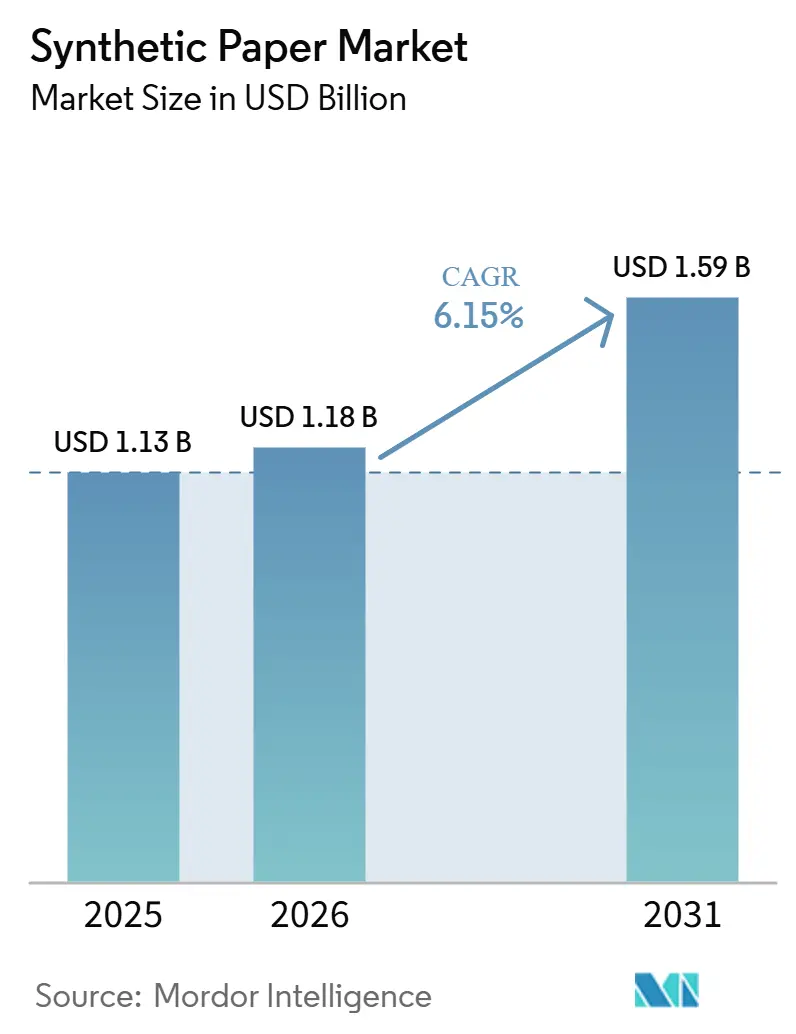
The Synthetic Paper Market size was estimated at USD 1.13 billion in 2025 and is estimated to grow from USD 1.18 billion in 2026 to reach USD 1.59 billion by 2031, at a CAGR of 6.15% during the forecast period (2026-2031). The category offers advantages over ordinary paper, which fails due to moisture exposure, chemical contact, repeated handling, or demanding logistics conditions. Buyers increasingly weigh the higher initial substrate cost against replacement work, printing disruption, and the cost of unreadable labels or documents. Suppliers are responding with grades that support recyclability, digital printing, and shorter product development cycles. The EU Packaging and Packaging Waste Regulation applies from August 12, 2026, and its 2030 recyclability requirement increases the value of mono-material polypropylene solutions while raising the risk for difficult-to-sort multilayer constructions. The synthetic paper market is therefore moving toward technically specific substrates rather than standardized grades designed primarily for offset printing.
Key Report Takeaways
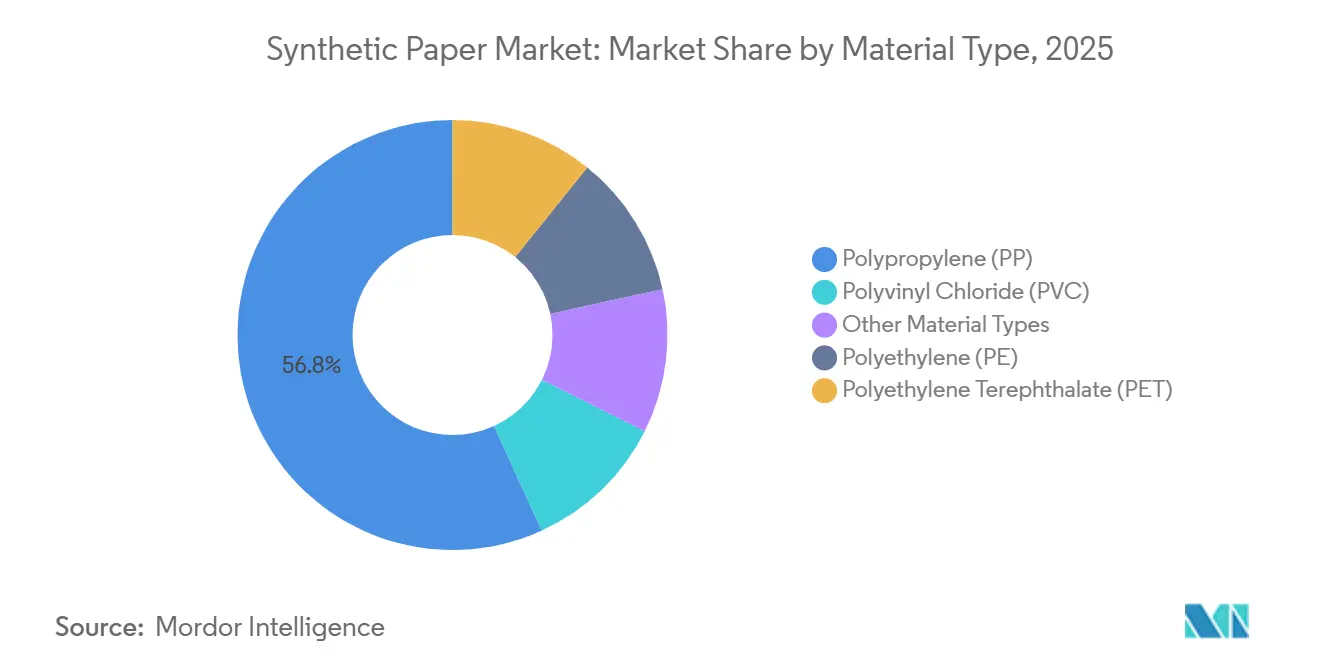
- By material type, polypropylene (PP) held 56.82% of the synthetic paper market share in 2025, while polyethylene terephthalate (PET) is projected to grow at a 6.93% CAGR through 2031.
- By thickness, medium grades held 41.33% of the synthetic paper market share in 2025, while thin grades are forecast to expand at a 6.57% CAGR through 2031.
- By application, labels accounted for 45.67% of the synthetic paper market size in 2025, while packaging is projected to advance at a 6.95% CAGR through 2031.
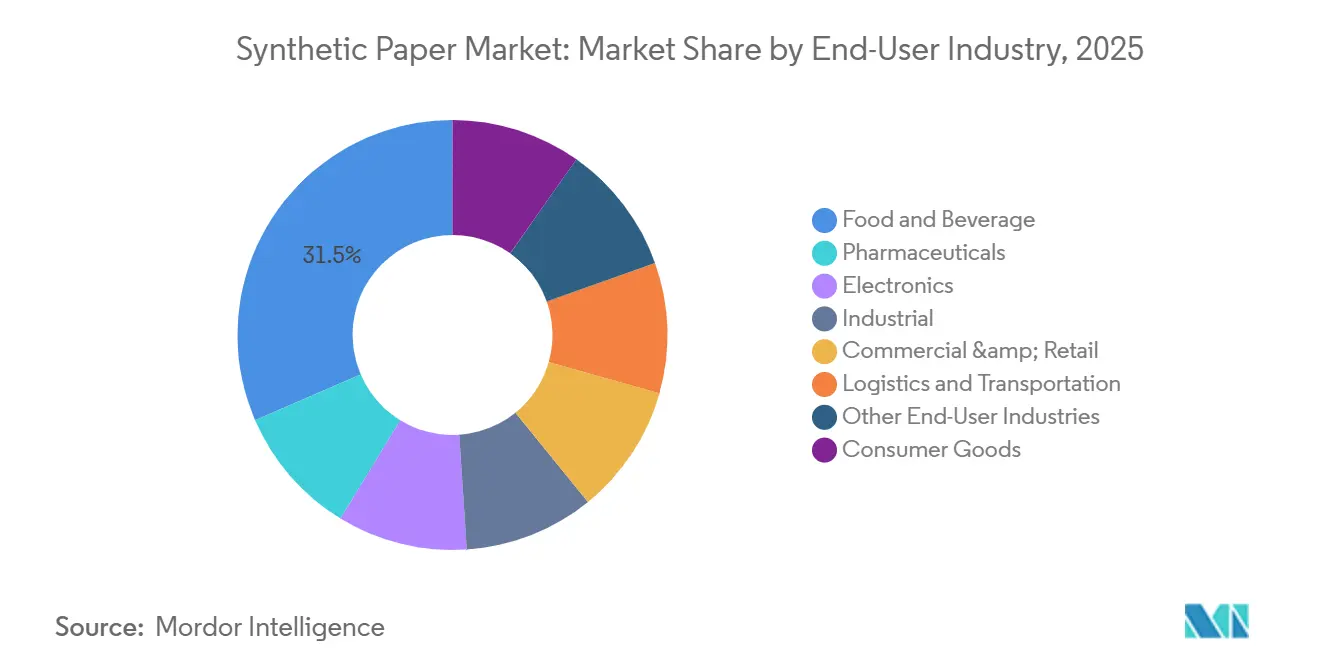
- By end-user industry, food and beverage held 31.48% of the synthetic paper market share in 2025, while logistics and transportation are expected to grow at a 7.11% CAGR through 2031.
- By geography, Asia-Pacific accounted for 43.61% of the synthetic paper market size in 2025 and is forecast to grow at a 7.03% CAGR through 2031.
Note: Market size and forecast figures in this report are generated using Mordor Intelligence’s proprietary estimation framework, updated with the latest available data and insights as of January 2026.
Global Synthetic Paper Market Trends and Insights
Drivers Impact Analysis*
| Drivers | (~) % Impact on CAGR Forecast | Geographic Relevance | Impact Timeline |
|---|---|---|---|
| Shift to Waterproof and Chemical-Resistant Substrates | +1.8% | Global, with the highest intensity in Asia-Pacific manufacturing hubs and North American food and industrial processing | Medium term (2-4 years) |
| Premium Labels in Consumer Packaging | +1.5% | Global, concentrated in Asia-Pacific, North America, and Western Europe | Medium term (2-4 years) |
| Outdoor, Industrial, and Harsh-Environment Use | +0.9% | North America, Europe, and the Asia-Pacific industrial corridors, with spillover to the Middle-East and Africa infrastructure projects | Long term (≥ 4 years) |
| Sustainable and Polyvinyl Chloride (PVC)-Free Solutions | +0.7% | European Union, North America, and early-stage adoption in Asia-Pacific and South America | Medium term (2-4 years) |
| Digital and Short-Run Customized Printing | +0.8% | North America and Europe, with rapid adoption in China, India, and Southeast Asia | Short term (≤ 2 years) |
| Source: Mordor Intelligence | |||
Increasing Shift from Conventional Paper to Waterproof and Chemical-Resistant Synthetic Substrates
Conventional cellulose paper becomes unsuitable when labels are exposed to moisture, mechanical wear, or chemical contact. Polypropylene and high-density polyethylene grades are used in settings that require durable print and stable adhesion during cold-chain handling, chemical processing, and outdoor use. The synthetic paper market benefits when buyers consider the cost of a failed label rather than the facestock purchase price alone. Replacement printing, rework, delayed shipment, and compliance risk can make a more durable material commercially justified. Avery Dennison offers Fasson synthetic paper products for applications including slaughterhouse tags, horticultural loop-around tags, and gas bottle identification, demonstrating the breadth of applications that require durable labeling. These requirements are strongest in industrial supply chains where legibility must remain intact through transport, storage, and repeated handling.
Rising Adoption of Premium Labels in Food, Beverage, Personal Care, and Consumer Goods Packaging
Food and beverages account for high label use per product and face challenging distribution conditions. Refrigerated goods are exposed to condensation, temperature changes, and handling friction, which can weaken paper labels and reduce barcode readability. Synthetic substrates support visual quality and practical performance in packaging for food, beverages, personal care, and household goods. The need is particularly clear when a label must remain readable from production through warehouse handling and retail display. Cosmo First introduced HP Indigo-printable synthetic paper for photo album applications in Fiscal Year (FY) 2025, indicating that demand for enhanced print quality also extends to photo-realistic consumer formats[1]Cosmo First, “Annual Report FY2024-25,” Cosmo First Limited, cosmofirst.com. The synthetic paper market also benefits from brand owners seeking premium finishes that remain durable on containers exposed to moisture.
Expanding Use of Synthetic Paper in Outdoor, Industrial, and Harsh Environmental Applications
Outdoor signage, infrastructure asset tags, and industrial documents create demand that is often served through specialized converters. These applications require resistance to water, tearing, dirt, and frequent handling rather than low material cost alone. PPG describes its Teslin substrate as a microporous, single-layer polyolefin material used in products such as waterproof menus, tear-resistant maps, and Radio Frequency Identification (RFID)-enabled hazardous-material labels. The material can also support embedded RFID components, which are relevant for traceability, asset tracking, and anti-counterfeiting applications. PPG entered into an authorized distributor partnership with GPA in August 2025 to expand Teslin across the commercial printing and pressure-sensitive label markets. These use cases give the synthetic paper market exposure to industrial tracking needs that do not align with typical packaging demand cycles.
Increasing Adoption of Digital Printing and Short-Run Customized Printing Applications
Digital printing supports shorter runs, regional versions, promotional changes, and personalized labels. These requirements are shifting demand toward grades compatible with HP Indigo, UV inkjet, and electrophotographic equipment. The synthetic paper market is adapting because standard offset-focused surfaces do not always meet the ink and coating requirements of digital presses. Digital-ready products can reduce printer workflow constraints and enable converters to take on more customized work. Cosmo First reported the development of HP Indigo-printable synthetic paper and UV inkjet-compatible coated label grades in FY2025. This shift also favors thin grades, as they can provide a film-like appearance while controlling substrate use in labels and wraps.
Restraints Impact Analysis*
| Restraints | (~) % Impact on CAGR Forecast | Geographic Relevance | Impact Timeline |
|---|---|---|---|
| Higher Production Costs Than Conventional Paper | -1.2% | Global, especially price-sensitive markets in South Asia, Southeast Asia, and Sub-Saharan Africa | Short term (≤ 2 years) |
| Limited Recyclability of Some Polymer Grades | -0.7% | European Union, North America, and growing concern in the Asia-Pacific | Medium term (2-4 years) |
| Lower-Cost Conventional Paper and Plastic Alternatives | -0.9% | Global, with strong pressure in South America, Middle-East, and Africa markets | Short term (≤ 2 years) |
| Source: Mordor Intelligence | |||
Higher Production Costs Compared with Conventional Paper Products
Synthetic paper carries a production cost premium of 2x to 4x over comparable-weight coated cellulose paper. This difference reflects energy-intensive biaxial orientation, petrochemical resin inputs, and surface treatments required for printing. This constraint is most significant in South Asia, Southeast Asia, and Sub-Saharan Africa, where converters often operate with narrow margins and buyers focus closely on unit prices. A total-cost review can narrow the apparent premium when it accounts for replacement labels, rework, and failure costs. However, many procurement processes still compare materials before those operational costs are considered. Avery Dennison identified trade-policy uncertainty and related effects as potential risks in its FY2025 filing, further complicating resin procurement planning.
Limited Recyclability of Certain Polymer-Based Synthetic Paper Grades
Multilayer grades that combine a polypropylene (PP) or polyethylene terephthalate (PET) base with incompatible coatings, adhesives, or metalized finishes may not be compatible with available sorting and recycling systems. This limits the addressable use of some synthetic papers, even where their durability is valuable. Regulation (EU) 2025/40 requires packaging placed on the EU market to be recyclable by 2030, with the detailed recyclability framework to be defined by 2028[2]European Parliament and Council, “Regulation (EU) 2025/40 on Packaging and Packaging Waste,” Official Journal of the European Union, eur-lex.europa.eu. This regulation creates a stronger commercial case for grades that can meet the required recyclability performance. Nekoosa states that its PET-based SYNAPS OM product is PVC-free and contains at least 15% recycled polyester, as certified under RecyClass. However, certification and reformulation require time and investment that can be more difficult for smaller specialty suppliers to absorb.
*Our forecasts treat driver/restraint impacts as directional, not additive. The impact forecasts reflect baseline growth, mix effects, and variable interactions.
Segment Analysis
By Material Type: PP Remains the Broadest Platform While PET Grows in Premium Uses
Polypropylene accounted for 56.82% of the synthetic paper market revenue in 2025, making it the largest material category. Its position is supported by wide familiarity among converters across offset, flexographic, and digital printing formats. PP also aligns with the growing preference for polypropylene recycling streams in packaging applications. Nan Ya Plastics offers PEPA and CAPA PP synthetic paper grades across thicknesses from 35 μm to 800 μm. The company holds ISO 9001, ISO 14001, and ISO 45001 certifications. This range allows a single material platform to serve labels, sheets, industrial documents, and heavier applications.
PET is projected to grow at a 6.93% CAGR through 2031, the highest rate among material types in the synthetic paper market. It is suited to pharmaceutical serialization, automotive underhood tags, and luxury labels where dimensional stability under heat is essential. TOYOBO, LINTEC, and Polyart address PET-based specialty applications through coated products that improve ink adhesion. PE remains relevant for soft-squeezed container labels and low-temperature cold-chain use. PVC faces pressure as customers seek PVC-free alternatives; Cosmo First introduced static-free and block-free PVC-free synthetic paper grades in FY2025. Other materials, including multilayer hybrids, continue to serve narrow security and industrial applications where performance justifies a price premium.



By Thickness: Thin Grades Gain from Digital Printing Requirements
Medium grades held 41.33% of the synthetic paper market share in 2025. Their position reflects a balance of strength, runnability, and cost for cut-and-stack labels, pressure-sensitive facestocks, and sheet-fed commercial print. They can withstand mechanical die-cutting without substantial distortion and limit material use per square meter in high-volume food and beverage labeling. Thick grades are used for outdoor signage, laminated security documents, and industrial job cards. PPG Teslin and Polyart are associated with specification-driven applications where higher material thickness supports the required performance.
Thin grades are forecast to expand at a 6.57% CAGR through 2031. Digital printing adoption and demand for a film-like appearance at lower substrate weight support this growth. Grades below 60 μm are used for no-label-look wine, spirits, and personal care packaging, where surface appearance and conformance to curved containers are important. They also support shelf-ready formats used in retail and food service. This trend places pressure on medium grades that were optimized for conventional sheet and label formats. Product development in the synthetic paper market is accordingly focused on coatings and surfaces that support thin materials on contemporary printing equipment.
By Application: Labels Retain Scale While Packaging Records the Fastest Growth
Labels accounted for 45.67% of the synthetic paper market revenue in 2025. The category has been built on the substitution of glassine and coated paper facestocks in food, beverage, household chemical, and pharmaceutical labels. Label formats require moisture resistance, print quality, and reliable adhesion on varied surfaces. YUPO Corporation reports a production capacity of 28,000 metric tons (MT) per year at its Kashima factory, with distribution in more than 70 countries. That scale is important for customers who require consistent materials across multiple geographies. Qualification costs also reinforce the label segment, as regulated food and pharmaceutical applications require extensive testing before a facestock change is approved.
Packaging is forecast to grow at a 6.95% CAGR through 2031, the fastest rate among applications in the synthetic paper market. The opportunity includes flexible pouch windows, wraparound sleeves, and direct-contact food-grade inner liners. These formats require barrier performance, heat-sealability, and printability simultaneously. Food-contact review can extend qualification cycles to 18 to 24 months, which favors suppliers with established materials libraries. Printing applications such as maps, outdoor advertising, and commercial documentation remain smaller but active uses. Stationery applications include reusable hospitality items and write-on, wipe-off educational products, where polyethylene terephthalate (PET)-based materials can command higher prices due to their dimensional stability.
By End-User Industry: Logistics and Transportation Grows Faster Than the Food-Led Base
Food and beverages held 31.48% of the synthetic paper market revenue in 2025. The segment has high label intensity per stock-keeping unit and requires dependable labels in refrigerated and frozen distribution. A failed label can affect handling, traceability, and shelf presentation, which makes material reliability a practical requirement. Food-label requirements in India and Europe make consistent legibility a compliance consideration. Consumer goods, pharmaceuticals, and electronics remain important secondary end-user industries. Pharmaceutical serialization and anti-counterfeiting requirements also support demand for tamper-evident synthetic materials where traceability is critical.
Logistics and transportation are forecast to grow at a 7.11% CAGR through 2031. Automated sorting systems subject shipping labels to abrasion and mechanical stress that standard thermal paper may not sustain. Synthetic thermal labels use PP or PET bases with thermal imaging coatings to improve barcode durability through multi-node transport. This demand is tied to e-commerce shipment volumes and operational traceability requirements, rather than solely to consumer packaging activity. Industrial uses include gas-cylinder tags, lumber-yard traceability, and metal-component tracking. Commercial and retail use also benefits from the broader shift toward transparent and reliable supply-chain information.
Geography Analysis
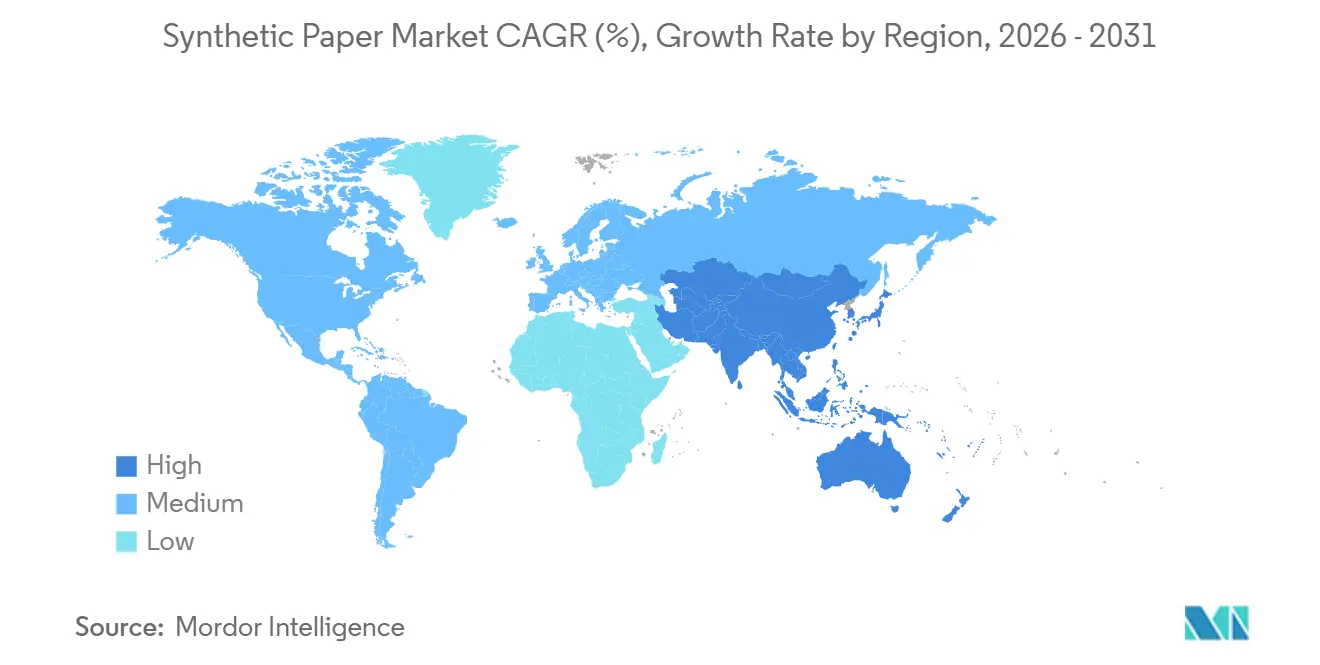
Asia-Pacific accounted for 43.61% of the synthetic paper market revenue in 2025 and is projected to expand at a 7.03% CAGR through 2031. China is central to regional demand due to its BOPP and HDPE film manufacturing base, extensive e-commerce activity, cold-chain development, and high consumer-goods label volumes. India is growing through compliance labeling, food labeling, and pharmaceutical export requirements that demand print-quality, durable materials. These factors drive demand beyond what broad economic growth alone would indicate. Cosmo First reported that exports accounted for 52% of total FY2025 sales, underscoring the region's role as both a manufacturing center and an export platform.
North America and Europe are the second- and third-largest regions, with a more premium application mix and greater regulatory complexity. North American demand for RFID-enabled labels is supported by retail inventory visibility requirements and pharmaceutical serialization requirements. Avery Dennison's Materials Group reported net sales of USD 6,093.3 million in FY2025 and invested in manufacturing capacity across the United States, Europe, and Asia-Pacific during 2024 and 2025. The opening of an RFID inlay and label production site in India in November 2025 reflects efforts to serve growing label demand in the region. In Europe, the Packaging and Packaging Waste Regulation (PPWR) has a dual effect: it limits non-recyclable multilayer options while supporting recyclable PP-grade synthetic substrates.
South America, the Middle East, and Africa represent smaller demand bases, though their applications can be strategically significant. Brazil drives South American consumption through food processing, consumer goods, and agricultural-product labeling. Higher resin import costs and the availability of local cellulose alternatives constrain regional growth. The Middle East and Africa rely more heavily on infrastructure-related applications, including oil and gas asset tags, construction documents, and port logistics labels. Outdoor durability is central to these applications, as labels may be exposed to heat, abrasion, and difficult handling conditions. Logistics programs in Saudi Arabia and the expansion of cold-chain systems across African urban centers create conditions for future adoption of durable labeling materials.

Competitive Landscape
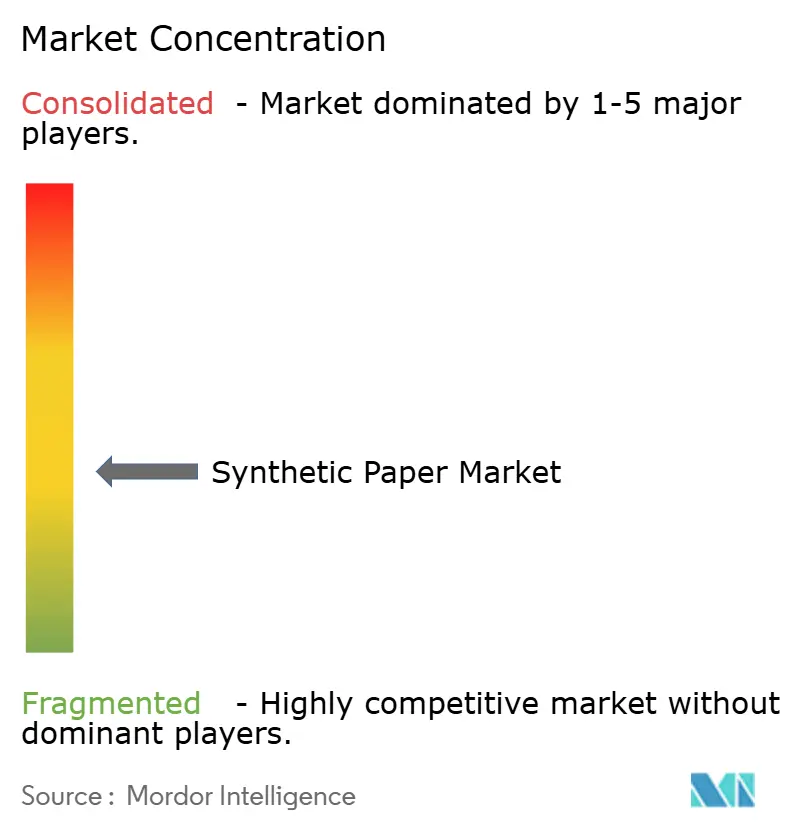
The synthetic paper market is moderately fragmented, with YUPO Corporation, Nan Ya Plastics, Cosmo First, and Avery Dennison holding positions through material capabilities, distributor networks, and existing approval status with brand owners. Their strengths stem from integrated materials platforms and the ability to support varied printing and conversion requirements. Cosmo First commissioned an 81,200 MT-per-year Biaxially Oriented Polypropylene (BOPP) line in Aurangabad in June 2025, increasing its total BOPP capacity by 40% to 277,000 MT. Suppliers are also differentiating through distribution agreements, digital-print compatibility, and sustainability credentials. PPG's August 2025 agreement with GPA expanded commercial access to the Teslin portfolio without requiring new manufacturing investment. Avery Dennison reported capital expenditure of approximately USD 200 million in 2025, partly directed at Materials Group capacity in the United States, Europe, and Asia-Pacific. Cosmo First's FY2025 development of HP Indigo-printable and UV inkjet-compatible grades is another example of product development targeting digital conversion. These actions aim to strengthen supplier positions in applications where technical approval can be more valuable than a low material price.
Digital-ready, recyclable thin grades for premium no-label-look packaging remain a key area of competition. Commodity BOPP suppliers have scale, but specialized grades require reliable print surfaces, suitable recycling pathways, and converter qualification. PET products with recycled content and PVC-free alternatives give suppliers additional ways to address buyer requirements. Nekoosa's RecyClass-certified SYNAPS OM combines recycled PET content with a PVC-free proposition. European recyclability requirements will make these product attributes more important as 2030 approaches. Competitive outcomes will depend on which suppliers can scale with compliant material design and technical service for converters.
Synthetic Paper Industry Leaders
YUPO Co., Ltd.
PPG Industries, Inc.
Seiko Epson Corporation
Cosmo Films
Agfa-Gevaert Group
- *Disclaimer: Major Players sorted in no particular order

Recent Industry Developments
- August 2025: PPG Industries entered an authorized distributor partnership with GPA for PPG Teslin synthetic paper, expanding the substrate's commercial reach across commercial printing and pressure-sensitive label segments globally.
- March 2025: Cosmo First commissioned its Cast Polypropylene (CPP) line, diversifying its substrate offerings into packaging laminates and soft-touch synthetic paper grades.


Global Synthetic Paper Market Report Scope
Synthetic paper is a tear-resistant, waterproof material made from plastic resins such as polypropylene (PP) or high-density polyethylene (HDPE), rather than wood pulp. It replicates the feel and printability of traditional paper while offering durability against moisture, chemicals, and environmental conditions, making it suitable for applications such as outdoor signage, menus, and ID cards.
The synthetic paper market is segmented by material type, thickness, application, end-user industry, and geography. By material type, the market is segmented into polypropylene (PP), polyethylene (PE), polyethylene terephthalate (PET), polyvinyl chloride (PVC), and other material types. By thickness, the market is segmented into thin, medium, thick, and ultra-thick. By application, the market is segmented into labels, packaging, printing, stationery, and other applications. By end-user industry, the market is segmented into food and beverage, consumer goods, pharmaceuticals, electronics, industrial, commercial & retail, logistics and transportation, and other end-user industries. The report also covers market size and forecasts for synthetic paper across 16 countries in major regions. The market sizes and forecasts are provided in terms of value (USD).
| Polypropylene (PP) |
| Polyethylene (PE) |
| Polyethylene Terephthalate (PET) |
| Polyvinyl Chloride (PVC) |
| Other Material Types |
| Thin |
| Medium |
| Thick |
| Ultra-Thick |
| Labels |
| Packaging |
| Printing |
| Stationery |
| Other Applications |
| Food and Beverage |
| Consumer Goods |
| Pharmaceuticals |
| Electronics |
| Industrial |
| Commercial & Retail |
| Logistics and Transportation |
| Other End-User Industries |
| Asia-Pacific | China |
| India | |
| Japan | |
| South Korea | |
| Rest of Asia-Pacific | |
| North America | United States |
| Canada | |
| Mexico | |
| Europe | Germany |
| United Kingdom | |
| France | |
| Italy | |
| Russia | |
| Rest of Europe | |
| South America | Brazil |
| Argentina | |
| Rest of South America | |
| Middle-East and Africa | Saudi Arabia |
| South Africa | |
| Rest of Middle-East and Africa |
| By Material Type | Polypropylene (PP) | |
| Polyethylene (PE) | ||
| Polyethylene Terephthalate (PET) | ||
| Polyvinyl Chloride (PVC) | ||
| Other Material Types | ||
| By Thickness | Thin | |
| Medium | ||
| Thick | ||
| Ultra-Thick | ||
| By Application | Labels | |
| Packaging | ||
| Printing | ||
| Stationery | ||
| Other Applications | ||
| By End-User Industry | Food and Beverage | |
| Consumer Goods | ||
| Pharmaceuticals | ||
| Electronics | ||
| Industrial | ||
| Commercial & Retail | ||
| Logistics and Transportation | ||
| Other End-User Industries | ||
| By Geography | Asia-Pacific | China |
| India | ||
| Japan | ||
| South Korea | ||
| Rest of Asia-Pacific | ||
| North America | United States | |
| Canada | ||
| Mexico | ||
| Europe | Germany | |
| United Kingdom | ||
| France | ||
| Italy | ||
| Russia | ||
| Rest of Europe | ||
| South America | Brazil | |
| Argentina | ||
| Rest of South America | ||
| Middle-East and Africa | Saudi Arabia | |
| South Africa | ||
| Rest of Middle-East and Africa | ||


Key Questions Answered in the Report
What is current market size of Synthetic Paper Market?
The Synthetic Paper Market size was estimated at USD 1.13 billion in 2025 and is estimated to grow from USD 1.18 billion in 2026 to reach USD 1.59 billion by 2031, at a CAGR of 6.15% during the forecast period (2026-2031).
Which material type drives synthetic paper demand?
Polypropylene led with 56.82% of revenue in 2025 because it serves a wide range of printing, labeling, and recycling-stream requirements.
Which application is expected to grow fastest through 2031?
Packaging is expected to grow at 6.95% CAGR as synthetic substrates move into wraps, sleeves, windows, and food-contact inner liners.
Why do logistics companies use synthetic paper labels?
PP- and PET-based thermal labels can preserve barcode readability during abrasion, handling, and multi-node shipment tracking.
Page last updated on:





