
Switzerland Responsible Tourism Market Size and Share
Market Overview
| Study Period | 2021 - 2031 |
|---|---|
| Forecast Data Period | 2026 - 2031 |
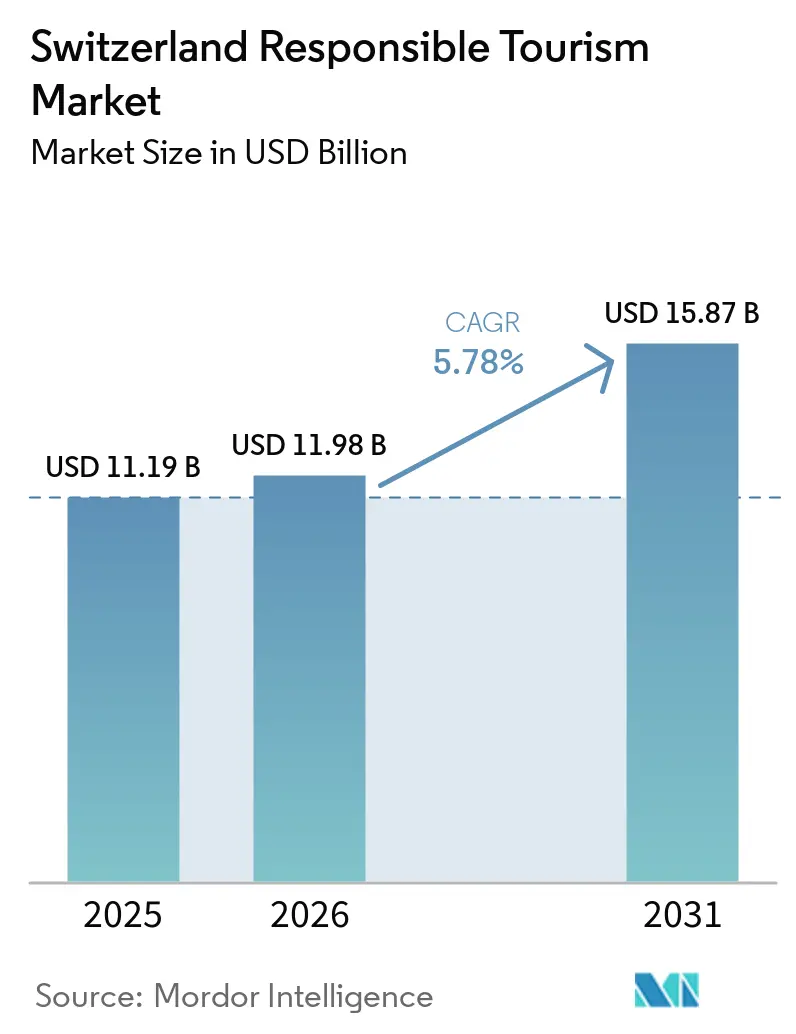
| Base Year Market Size (2025) | USD 11.19 Billion |
| Market Size (2026) | USD 11.98 Billion |
| Market Size (2031) | USD 15.87 Billion |
| Growth Rate (2026 - 2031) | 5.78 % |
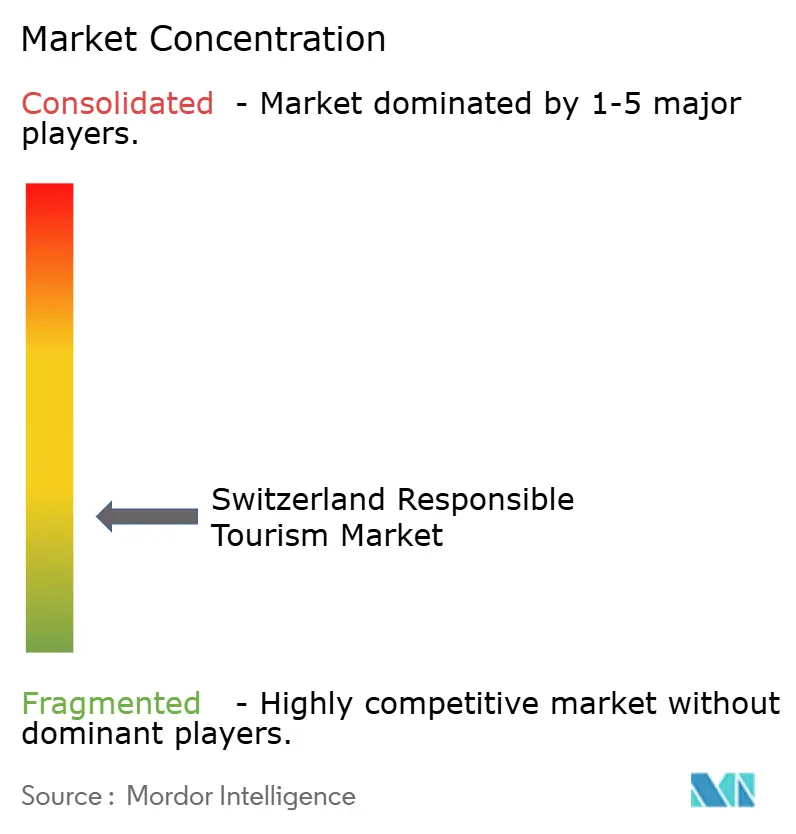
| Market Concentration | Low |
Major Players *Disclaimer: Major Players sorted in no particular order Image © Mordor Intelligence. Reuse requires attribution under CC BY 4.0. | |
Switzerland Responsible Tourism Market Analysis by Mordor Intelligence
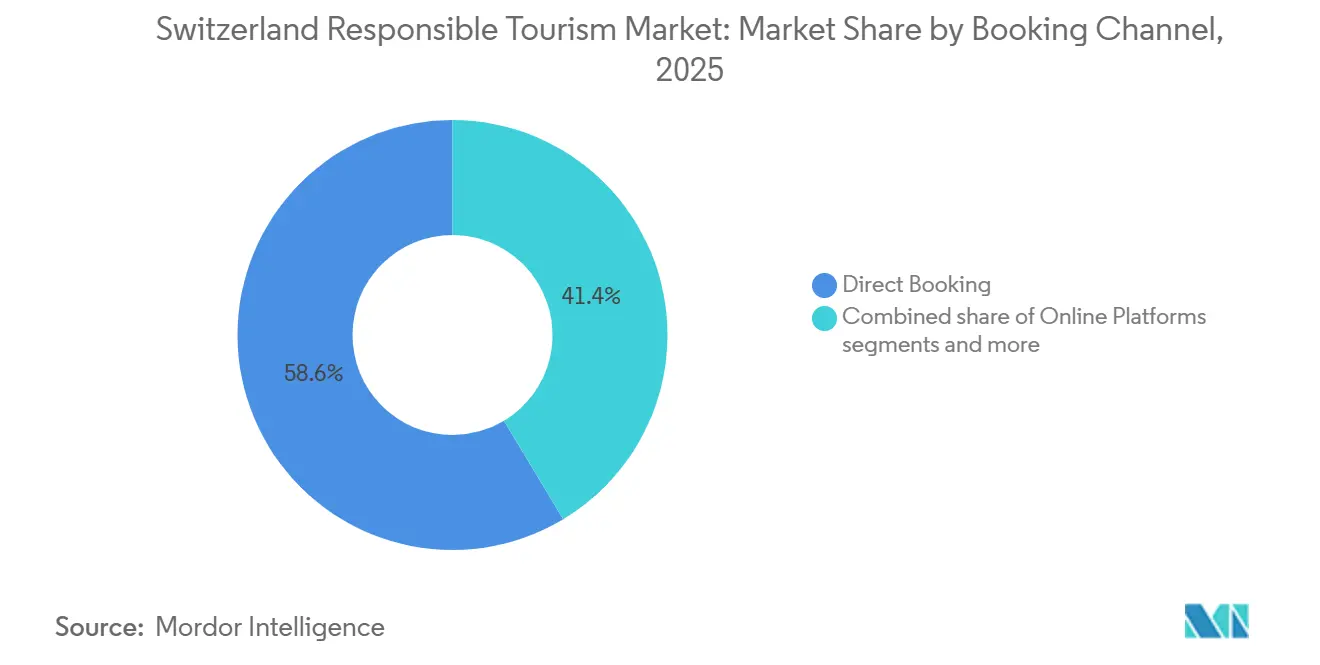
The Switzerland Responsible Tourism Market was valued at USD 11.19 billion in 2025 and estimated to grow from USD 11.98 billion in 2026 to reach USD 15.87 billion by 2031, at a CAGR of 5.78% during the forecast period (2026-2031). Swiss hotels recorded 43.9 million overnight stays in 2025, surpassing 42.8 million in 2024[1]. Foreign visitors accounted for 22.0 million stays in 2024, reflecting strong tourism demand. By November 2024, Swisstainable certified 2,779 businesses, transitioning certification into a key commercial tool for hotels, destinations, and travel sellers. SBB shifted to 100% renewable electricity for rail traction in January 2025. Rail operations, 15% higher than in 2010, used 5% less energy and contributed only 0.3% of national CO2 emissions, supporting low-carbon rail-based leisure circuits. Switzerland Tourism’s "Travel Better" strategy, based on data from over 20,000 travelers across 147 source markets, helps direct visitors toward certified services and away from congestion points while maintaining spending levels. The competitive landscape remains fragmented, with direct bookings accounting for 58.61% of volume in 2025 and the top five operators holding a combined 38%. Opportunities favor operators focusing on direct demand capture, unique accommodations, and rail-linked itineraries.
Key Report Takeaways
- By booking channel, Direct Bookings held 58.61% of the Switzerland Responsible Tourism Market in 2025, while Online Platforms recorded the fastest projected CAGR at 6.14% through 2031.
- By tourist type, Domestic Tourists accounted for 51.42% of the Switzerland Responsible Tourism Market in 2025, while International Visitors are forecast to grow at the highest CAGR of 5.28% through 2031.
- By accommodation format, Eco-certified Hotels commanded 34.53% share of the Switzerland Responsible Tourism Market in 2025, while Campsites and Glamping posted the fastest forecast CAGR at 5.43% through 2031.
- By tourism type, Cultural and Heritage Tourism led with a 30.83% share of the Switzerland Responsible Tourism Market in 2025, while Nature and Wildlife Tourism is expected to expand at the highest CAGR of 5.86% through 2031.
- By geography, Eastern Switzerland captured 30.46% share of the Switzerland Responsible Tourism Market in 2025, while Western Switzerland is forecast to record the fastest CAGR of 5.91% through 2031.
Note: Market size and forecast figures in this report are generated using Mordor Intelligence’s proprietary estimation framework, updated with the latest available data and insights as of January 2026.
Switzerland Responsible Tourism Market Trends and Insights
Drivers Impact Analysis*
| Driver | (~) % Impact on CAGR Forecast | Geographic Relevance | Impact Timeline |
|---|---|---|---|
| Swisstainable certification visibility | +1.0% | Global, priority marketing to long haul United States, India, and Asia-Pacific source markets | Short term (≤ 2 years) |
| Record inbound demand for low-impact travel | +1.2% | Global, strongest pull from the Americas and Asia-Pacific | Short term (≤ 2 years) |
| Rail-led low-carbon accessibility | +0.8% | Pan European and domestic rail corridors, strongest in Central and Eastern Switzerland | Medium term (2-4 years) |
| Growth in nature-led stay formats | +0.6% | Eastern Switzerland, Southern Switzerland, and Western Switzerland | Medium term (2-4 years) |
| Off-season dispersal and lesser-known destinations | +0.5% | National, with early gains in Ticino, Valais, and Jura regions | Medium term (2-4 years) |
| Park-based regional product ecosystems | +0.4% | Eastern and Central Switzerland, including Engadin, Graubünden, and Bernese Oberland | Long term (≥ 4 years) |
| Source: Mordor Intelligence | |||
Swisstainable certification visibility
Swisstainable's three-tier structure - committed, engaged, and leading - has evolved from an awareness tool to a key filter for visibility in Switzerland's Responsible Tourism market. Switzerland Tourism prioritizes higher certification tiers in marketing and trade distribution, influencing which businesses gain visibility among intermediaries and travelers[2]. By November 2024, 2,779 businesses had joined the program, while over 40,000 tourism suppliers remained uncertified, indicating significant potential for certification-driven market shifts. Swiss Travel System AG relaunched travelswitzerland.com in February 2026 as a B2B platform for the global travel trade, adding a procurement layer to facilitate early discovery of certified suppliers across 40 transport partner markets. Switzerland Tourism, holding TourCert Level III certification, is driving investments toward measurable sustainability improvements, aligning with advanced certification requirements for the highest destination tier. This approach emphasizes tangible upgrades over superficial marketing claims, reinforcing sustainability efforts in the Switzerland Responsible Tourism market.
Record inbound demand for low-impact travel
Switzerland recorded over 25.1 million hotel overnight stays during the summer of 2025, with foreign visitors contributing 13.4 million stays. Demand growth continues to support the Switzerland Responsible Tourism market. Overnight stays by United States travelers rose 13.9% in 2024 to 3.49 million, while Indian visitors increased by 10.6%, reflecting the influence of long-haul markets focused on structured destination quality. Switzerland Tourism, in 2024, emphasized qualitative growth through longer stays and stronger local value creation rather than maximizing visitor numbers. Its 2026-2028 strategy forecasts an 80% increase in travel activity from Asia Pacific over the next decade and 40% growth from Europe and the Americas, offering certified operators a clear demand pipeline if intent converts into bookings. The market benefits when higher-spending guests stay longer in certified destinations, as careful management of transport, lodging, and local activities allows revenue to grow faster than ecological pressure per trip.
Rail-led low-carbon accessibility
SBB transitioned to 100% renewable traction electricity in early 2025, strengthening rail's role in Switzerland's Responsible Tourism market. Rail contributed just 0.3% of the country’s total transport CO2 emissions while operating 15% more trains than in 2010 with 5% less energy, demonstrating scalability with low carbon intensity. Swiss E-Car added an electric last-mile solution powered by certified green electricity in Aargau, Bern, and Fribourg, enabling visitors to access rural farms, nature retreats, and smaller communities beyond train routes. Rail Europe, in partnership with Swiss Travel System AG and SBB, expanded access to low-carbon alpine itineraries through global booking systems, moving beyond niche sellers. SBB’s targets include reducing operational GHG emissions by 60% by 2030 (compared to 2018) and achieving a 93% reduction by 2040. These goals provide a credible foundation for operators in Switzerland's Responsible Tourism market to develop rail-based travel packages with reduced concerns about infrastructure reliability.
Growth in nature-led stay formats
Nature stays have transitioned from seasonal trends to a key investment area in Switzerland's Responsible Tourism market. Approximately 925,000 overnight stays were recorded in 2025, marking the third-best season, with foreign guests accounting for 31% of the total. This indicates demand is both international and not weather dependent. Projects like Prau La Selva in Flims and the La Tène glamping village under construction reflect long-term investments in camping and glamping. By late 2024, 10 additional TCS campsites achieved ECOCamping certification and Swisstainable Level II status, enhancing their marketing position and emphasizing sustainability in this lodging category. Farm-based accommodations are expanding through networks such as myFarm, where agritourism can contribute nearly half of farm income. This growth integrates rural income support with increased visitor stays, further strengthening Switzerland's Responsible Tourism market.
Restraints Impact Analysis*
| Restraint | (~) % Impact on CAGR Forecast | Geographic Relevance | Impact Timeline |
|---|---|---|---|
| High cost base and price sensitivity | -0.7% | National, with sharper impact on rural and alpine mid market operators | Medium term (2-4 years) |
| OTA concentration and commission pressure | -0.6% | National, concentrated in urban and alpine resort supply | Short term (≤ 2 years) |
| Capacity limits in sensitive alpine zones | -0.5% | Eastern and Central Switzerland, including Appenzell, Lauterbrunnen, and Engadin | Medium term (2-4 years) |
| Retrofit burden for older properties | -0.4% | National, with the highest exposure in pre 1980 mountain hotel stock | Long term (≥ 4 years) |
| Source: Mordor Intelligence | |||
High cost base and price sensitivity
Switzerland's high structural costs limit the growth of its Responsible Tourism market. Sustainable operators face higher compliance and sourcing expenses compared to standard properties. Elevated wages, land values in alpine areas, and the strong Swiss franc increase baseline costs, compounded by certification fees, energy retrofits, and organic procurement premiums. This challenge is significant in the mid-market segment, where travelers value sustainability but often choose lower-cost certified options in nearby alpine regions. Research by Switzerland Tourism shows that cost perceptions and infrastructure pressures are key concerns for Swiss residents, affecting both local acceptance and operator margins. If the franc strengthens further against the euro or United States dollar, growth in the Responsible Tourism market is expected to favor higher-end segments and longer-stay travelers rather than widespread mid-market expansion.
OTA Commission Pressure Distorts Direct Relationship Economics
Online travel agencies (OTAs) are vital for visibility in the Switzerland Responsible Tourism market but significantly impact profit margins. OTA penetration among Swiss hotels rose despite the 2022 Lex Booking ban on parity clauses, with Booking.com commissions remaining between 12% and 20% per transaction. This creates challenges for eco-certified properties with higher operating costs. The Swiss Federal Price Supervisor ordered a 25% reduction in Booking.com’s commission rates, but enforcement is delayed due to an ongoing appeal. In May 2026, 26 European hotel associations pursued financial claims tied to parity clause usage, highlighting unresolved channel power issues. Data ownership remains a core concern, as heavy reliance on OTAs limits operators’ ability to build loyalty and preference profiles, hindering repeat business in the Switzerland Responsible Tourism market.
*Our forecasts treat driver/restraint impacts as directional, not additive. The impact forecasts reflect baseline growth, mix effects, and variable interactions.
Segment Analysis
By Booking Channel: Direct Relationships Anchor Responsible Travel Economics
Direct bookings held 58.61% of the market share in 2025, reflecting strong guest loyalty for independent operators in Switzerland's Responsible Tourism sector. This high share highlights the reliance of small hotels, farm stays, chalets, and glamping operators on their own websites, phone inquiries, repeat customers, and local referrals. The direct model supports responsible travel by allowing operators to explain transport options, local conduct, and sustainability features before arrival. Many smaller providers, constrained by limited budgets and staffing, prefer curated selling and relationship-driven conversions over OTA optimization. As a result, the Switzerland Responsible Tourism market retains more value at the operator level compared to other European leisure markets with higher platform dependency.
Online platforms are growing at a 6.14% CAGR through 2031, emphasizing the importance of digital discovery even in a relationship-driven market. Major platforms now prominently display eco labels, sustainability badges, and certification markers, improving the visibility of Swisstainable-aligned listings. Switzerland Travel Centre enhances this channel by bundling rail, hiking, and sustainable stays into structured packages for domestic and international travelers. While direct bookings accounted for 58.61% of the market in 2025, OTA commission policies, rate visibility, and data access rules continue to influence conversion decisions. The market is expected to balance platform use for reach with direct bookings to preserve margins and guest loyalty[3].

By Tourist Type: International Demand Brings Revenue Upside And Concentration Risk
Domestic tourists accounted for 51.42% of the Switzerland Responsible Tourism market in 2025, reflecting a stronger reliance on residents than foreign travelers. Swiss residents maintained high in-country travel habits after 2021-2022, with domestic overnight stays reaching 20.9 million in 2024. This domestic base stabilized occupancy across seasons and regions, supporting year-round travel to lakes, mountains, and rural areas. Domestic travel fosters dispersed travel patterns and repeat visits to smaller regions, offsetting the seasonal nature of international demand. KOF ETH Zurich predicts a gradual shift toward long-haul travel as cross-border tourism normalizes, likely softening the domestic share without sharp declines.
International visitors are growing faster, with a projected 5.28% CAGR through 2031. This growth brings revenue opportunities but also concentration risks. In 2024, American arrivals increased by 13.9% to 3.49 million overnight stays, while Indian arrivals grew by 10.6%, highlighting the impact of long-haul demand. Switzerland Tourism targets travelers with sustainable travel intent and a willingness to stay longer, enhancing local value creation per trip. Asia Pacific travel activity is expected to grow 80% over the next decade, offering a larger pool of potential visitors. Effective distribution management can direct these travelers toward certified and rail-linked products. While international demand reshapes the market, dispersal strategies are essential to mitigate pressure on crowded alpine corridors driven by rapid growth from specific source markets.
By Accommodation Format: Certified Hotels Lead, Glamping Rewrites The Investment Case
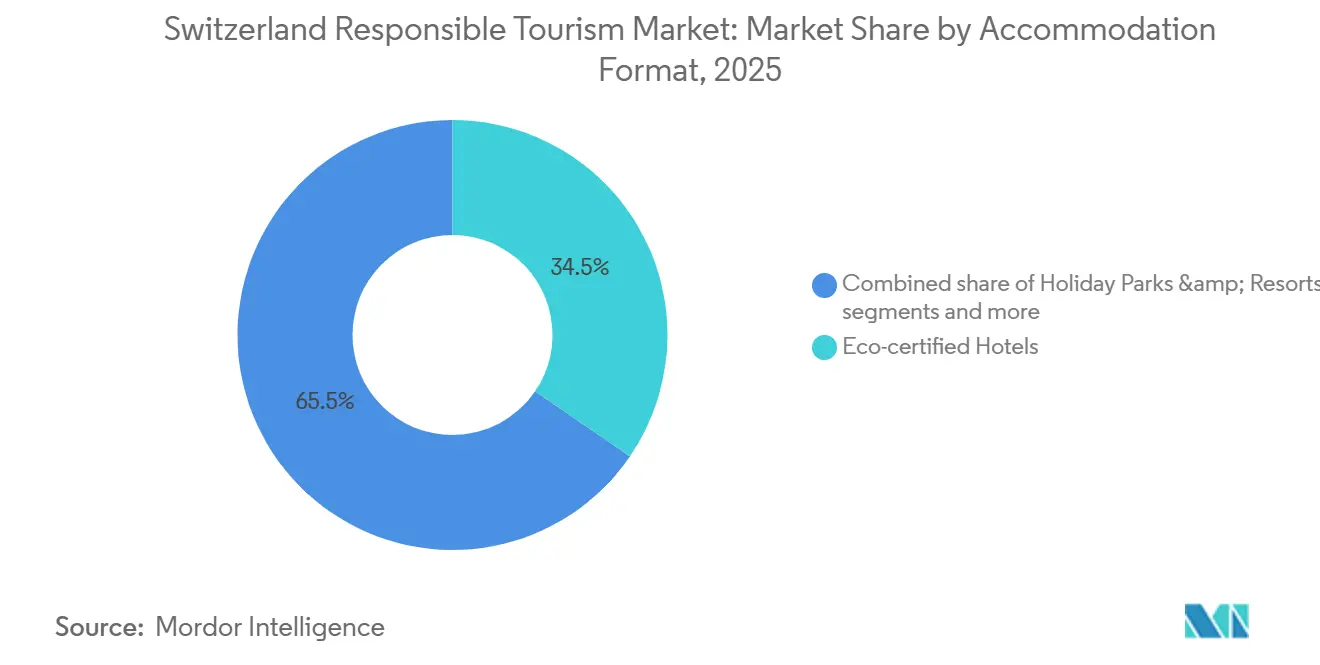
Eco-certified hotels held 34.53% of the market in 2025, emphasizing the importance of formal hotel supply in Switzerland's responsible tourism market. Switzerland's certification framework, including Swisstainable, EarthCheck, and TourCert, converts sustainability efforts into recognized quality standards. These hotels dominate the accommodation sector due to scalability across trade partnerships, urban demand, and year-round operations. Zurich's EarthCheck recertification in 2025 strengthened trust in certified urban supply, critical as city stays often bookend Swiss itineraries. However, energy retrofit requirements for historic hotels may slow room expansion despite favorable demand[4].
Campsites and glamping are projected to grow at a 5.43% CAGR through 2031, shifting investor perspectives on open-air lodging. TCS Camping recorded about 925,000 overnight stays in 2025, its third-best season, with foreign guests accounting for 31%, reflecting increased international interest. Developments such as Prau La Selva in Flims and the La Tène glamping village demonstrate operators' focus on enhancing camping experiences. Holiday homes, hostels, and farm stays further diversify the market by catering to various budgets, group sizes, and rural preferences. The accommodation mix indicates that Switzerland's responsible tourism sector is expanding beyond certified hotels, with nature-focused and community-linked stays gaining prominence.
By Tourism Type: Culture Anchors Volume, Nature Commands The Highest Growth Premium
Cultural and Heritage Tourism held a 30.83% share of the Switzerland Responsible Tourism market in 2025, making it the largest segment. This was driven by Switzerland's UNESCO sites, urban destinations, and traditions in watchmaking, cheese, textiles, and regional culture, all packaged for visitors. Zurich Tourism renewed its EarthCheck certification in 2025 and achieved Swisstainable Level III, enhancing its role as a responsible urban gateway. Cultural travel benefited from European demand for city breaks and itineraries combining heritage with rail, food, and lakeside travel. While culture remained the largest segment, growth shifted toward nature-focused products.
Nature and Wildlife Tourism is forecast to grow at a 5.86% CAGR through 2031, showing strong momentum. The Swiss National Park’s LiveAlpsNature project is developing visitor management tools for sensitive recreation areas, supporting growth in wildlife tours, hiking, and alpine observation. Agritourism is also expanding, with networks like myFarm connecting organic farms to overnight visitors across cantons. Some operators report agritourism contributes nearly half of farm income. Smaller segments, such as community-based tourism and ecotourism, have lower volumes but align with certifications and local engagement. While cultural tourism leads in volume, Nature and Wildlife Tourism is growing from a smaller base within the Switzerland Responsible Tourism market.
Geography Analysis
Eastern Switzerland accounted for 30.46% of the market in 2025, making it the largest contributor to the Switzerland Responsible Tourism market. This position stems from a strong asset base combining alpine scenery, rail access, protected areas, and high-quality lodging. The Swiss National Park in Engadin plays a key role by guiding visitors through marked trails and enforcing strict non-intervention policies, aligning with low-impact destination management principles. The LiveAlpsNature project enhances this approach with open-source visitor management tools and biodiversity datasets, improving Eastern Switzerland’s ability to manage demand growth in the coming years.
Western Switzerland is the fastest-growing region, with a 5.91% CAGR projected through 2031. This growth reflects a mix of eco-accommodation, cultural attractions, and year-round travel initiatives. Whitepod in Valais exemplifies this trend by combining eco-friendly pods with renewable heating and regional sourcing. The Geneva-Lausanne-Montreux corridor adds urban and lake-linked demand, supported by rail travel and certified lodging. Southern Switzerland complements this shift through the Ticino365 plan, which promotes lesser-known attractions and extends travel into spring and autumn. Campsite overnight stays in Ticino reached approximately 1.04 million in 2025, a 4.5% increase, demonstrating the success of deseasonalized travel demand.
National coordination is becoming critical as growth depends on spreading demand across time and locations. The April 2026 "Travel with care. Leave with memories." initiative introduced a unified visitor conduct framework, addressing challenges at high-footprint sites. Central Switzerland maintains stability through Lucerne and its lakes district, supported by public transport and domestic travel patterns. These regional strategies indicate that future growth in the Switzerland Responsible Tourism market will focus on geographic distribution rather than expanding saturated areas.
Competitive Landscape
The Switzerland Responsible Tourism market remained fragmented, with direct bookings dominating market volume and the top five operators holding a combined share. Booking.com led, followed by Expedia Group, Hotelplan Suisse, Switzerland Travel Centre, and DERTOUR Suisse. This distribution highlights the market's reliance on independent hotels, campsites, hostels, farm stays, and local operators, which convert demand outside major platforms. The market offers opportunities for specialized players to grow through unique product designs, certification depth, and direct customer relationships rather than scale.
DERTOUR Group completed its acquisition of the Hotelplan Group after regulatory clearance, consolidating brands like Hotelplan, Kuoni, and Helvetic Tours. Hotelplan introduced a real-time carbon footprint feature on its platform and expanded its certified accommodation portfolio through FAIRWEG. These developments reflect a shift in sustainability merchandising from brand messaging to mainstream selling tools. Swiss Travel System AG relaunched travelswitzerland.com as a B2B platform for global travel trade buyers, strengthening the distribution framework for rail-based packages. These actions indicate a focus on transparent product design, integrated transport, and certified supply visibility.
Opportunities remain in rail-based slow travel, eco-glamping, and community-linked rural stays, where national-scale ownership is limited. Whitepod has established a position in eco-lodging, TCS Camping is formalizing glamping as an investment avenue, and myFarm connects agritourism supply that larger intermediaries cannot standardize. The market rewards companies combining sustainability signals with authentic local product depth. Competitive pressures are expected to persist, but independent operators will continue shaping customer experiences and capturing value in this distributed market.
Switzerland Responsible Tourism Industry Leaders
-
Booking.com
-
Expedia Group
-
Hotelplan Suisse
-
Switzerland Travel Centre
-
DERTOUR Suisse
- *Disclaimer: Major Players sorted in no particular order
Recent Industry Developments
- April 2026: Switzerland Tourism, the Regional Tourism Alliance (VSTM), and the Swiss Tourism Federation launched "Travel with care. Leave with memories." This national initiative combines a guest-awareness campaign with a free industry toolbox offering strategies, communication plans, and stakeholder engagement protocols. It represents a shift from voluntary sustainability efforts to a structured, sector-wide behavioral standard.
- February 2026: Swiss Travel System AG has relaunched travelswitzerland.com as a B2B platform for global travel trade professionals. It consolidates Swiss public transport products, including the Grand Train Tour, Swiss Travel Pass, Day Discoveries, and offerings from 40 transport partners, into a single hub to integrate zero-emission rail itineraries into international tour operator programs.
- August 2025: DERTOUR Group acquired Hotelplan Group, excluding Interhome, after receiving unconditional approval from COMCO. The regulatory investigation, which lasted three months, initially raised concerns about market dominance. This acquisition establishes DERTOUR as the largest domestic tour operator in Switzerland.
- September 2025: FSO reported a record-breaking summer season in Switzerland from May to October 2025, with hotel overnight stays surpassing 25 million for the first time. Foreign visitors contributed 13.4 million stays, while domestic demand increased by 2.8% to 11.7 million.
Switzerland Responsible Tourism Market Report Scope
| Direct Booking |
| Online Platforms |
| Travel Agencies & Tour Operators |
| Domestic |
| International |
| Eco-certified Hotels |
| Holiday Parks & Resorts |
| Hostels |
| B&Bs and Guesthouses |
| Holiday Homes and Nature Stays |
| Campsites and Glamping |
| Ecotourism |
| Cultural & Heritage Tourism |
| Rural & Agritourism |
| Community-Based Tourism |
| Nature & Wildlife Tourism |
| Central Switzerland |
| Eastern Switzerland |
| Western Switzerland |
| Southern Switzerland |
| By Booking Channel | Direct Booking |
| Online Platforms | |
| Travel Agencies & Tour Operators | |
| By Tourist Type | Domestic |
| International | |
| By Accommodation Format | Eco-certified Hotels |
| Holiday Parks & Resorts | |
| Hostels | |
| B&Bs and Guesthouses | |
| Holiday Homes and Nature Stays | |
| Campsites and Glamping | |
| By Tourism Type | Ecotourism |
| Cultural & Heritage Tourism | |
| Rural & Agritourism | |
| Community-Based Tourism | |
| Nature & Wildlife Tourism | |
| By Geography | Central Switzerland |
| Eastern Switzerland | |
| Western Switzerland | |
| Southern Switzerland |
Key Questions Answered in the Report
What is the projected value of Switzerland responsible tourism by 2031?
The Switzerland Responsible Tourism market is forecast to reach USD 15.87 billion by 2031 from USD 11.98 billion in 2026, with a CAGR of 5.78% over 2026 to 2031.
Which tourism type leads Switzerland responsible travel demand?
Cultural and Heritage Tourism held the largest share at 30.83% in 2025, supported by Switzerland’s UNESCO assets, certified urban destinations, and strong short haul cultural demand.
Which segment is growing fastest in Switzerland responsible travel?
Nature and Wildlife Tourism is the fastest growing tourism type at 5.86% CAGR through 2031, while Online Platforms lead booking channel growth at 6.14% CAGR.
Why are direct bookings so important in Switzerland?
Direct bookings absorbed 58.61% of market volume in 2025, which helps independent operators protect margins, explain sustainability features better, and reduce dependence on OTA commissions.
Which region leads the Switzerland responsible tourism landscape?
Eastern Switzerland led with 30.46% share in 2025 because it combines the Swiss National Park, strong rail access, premium alpine stays, and concentrated sustainable destination assets.
What are the main risks facing responsible travel operators in Switzerland?
The main restraints are the high national cost base, OTA commission pressure, capacity limits in sensitive alpine zones, and retrofit costs for older hotel stock.