
SWIR Line-Scan Imaging Systems Market Size and Share
Market Overview
| Study Period | 2020 - 2031 |
|---|---|
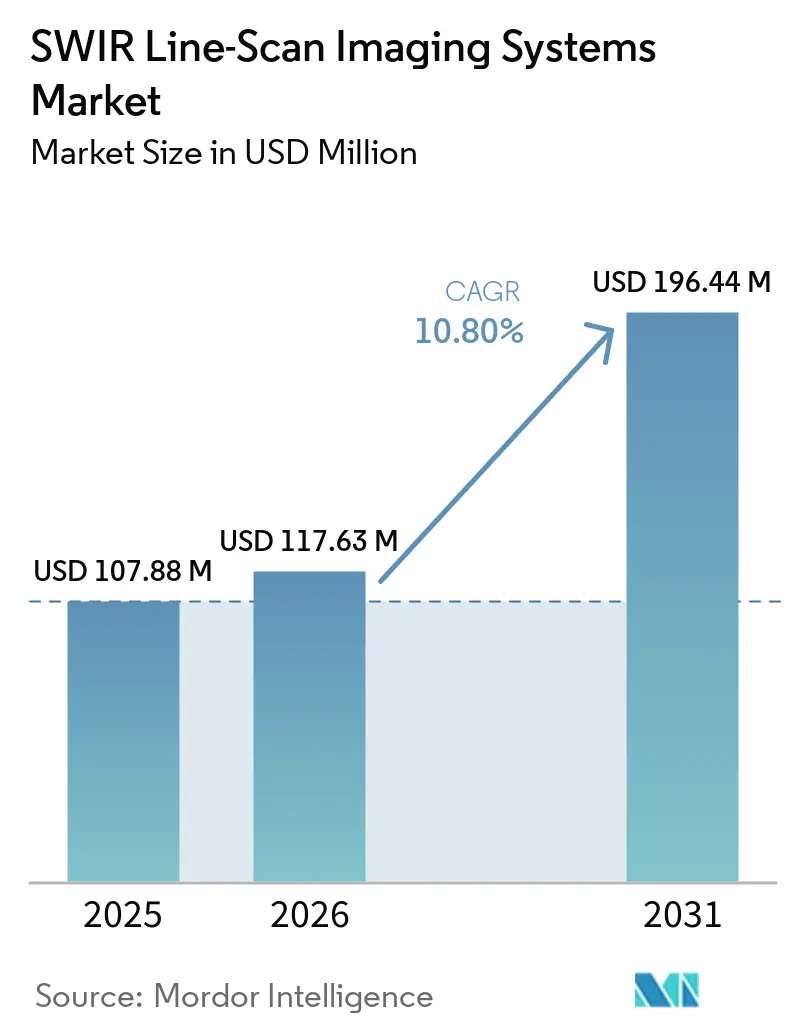
| Market Size (2026) | USD 117.63 Million |
| Market Size (2031) | USD 196.44 Million |
| Growth Rate (2026 - 2031) | 10.80 % |
| Fastest Growing Market | Asia-Pacific |
| Largest Market | Asia-Pacific |
| Market Concentration | Medium |
Major Players *Disclaimer: Major Players sorted in no particular order Image © Mordor Intelligence. Reuse requires attribution under CC BY 4.0. | |
SWIR Line-Scan Imaging Systems Market Analysis by Mordor Intelligence
The SWIR Line-Scan Imaging Systems Market size was valued at USD 107.88 million in 2025 and is forecast to reach USD 196.44 million by 2031, growing at a CAGR of 10.80% during 2026-2031. SWIR line-scan cameras detect material and structural differences that visible silicon sensors cannot. They can image through silicon substrates, distinguish polymers through molecular absorption, and capture photovoltaic electroluminescence and photoluminescence signals. These functions are shifting inspection from sample-based checks to continuous production-line coverage across semiconductor fabrication, solar manufacturing, sorting, and surveillance. The SWIR Line-Scan Imaging Systems Market benefits where manufacturers need faster inspection without reduced defect sensitivity. Established photonics suppliers are broadening application coverage, while CQD camera specialists are widening competition in lower-cost and extended-SWIR designs.
Key Report Takeaways
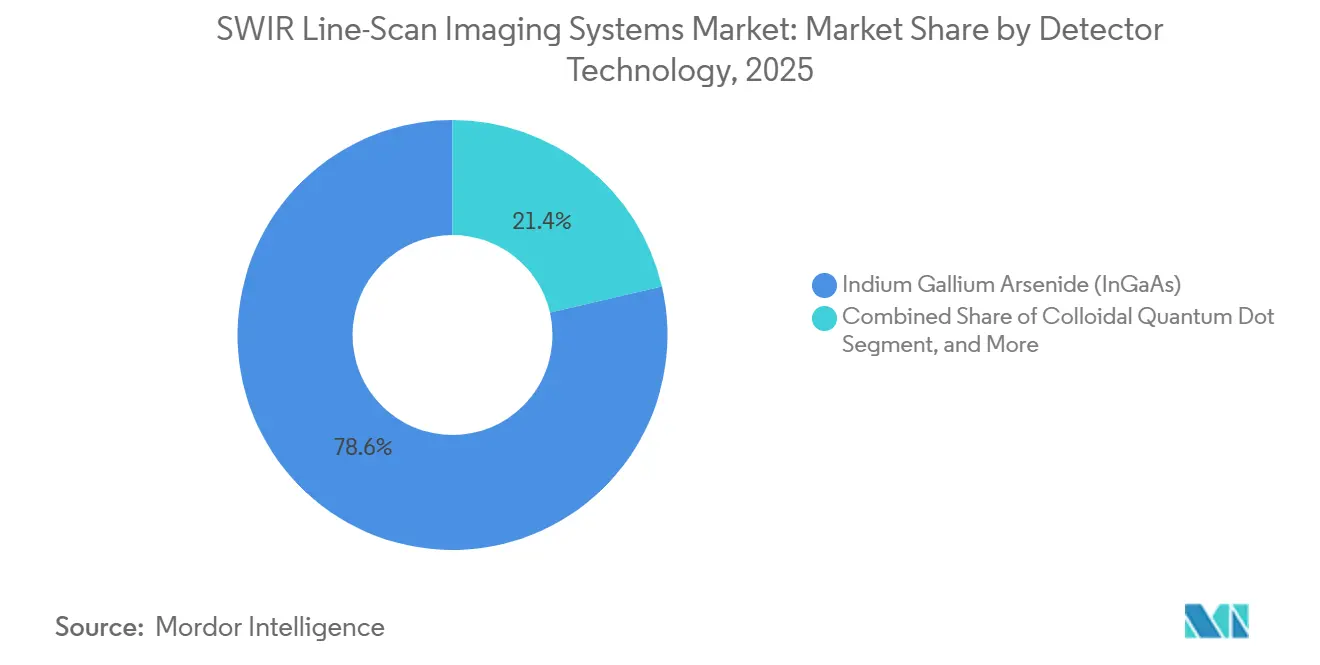
- By detector technology, InGaAs held 78.63% of the SWIR Line-Scan Imaging Systems Market share in 2025, while CQD detectors are forecast to grow at a 12.87% CAGR through 2031.
- By cooling technology, thermoelectrically cooled systems held 51.47% revenue share in 2025, while cryogenically cooled systems are forecast to grow at a 12.39% CAGR through 2031.
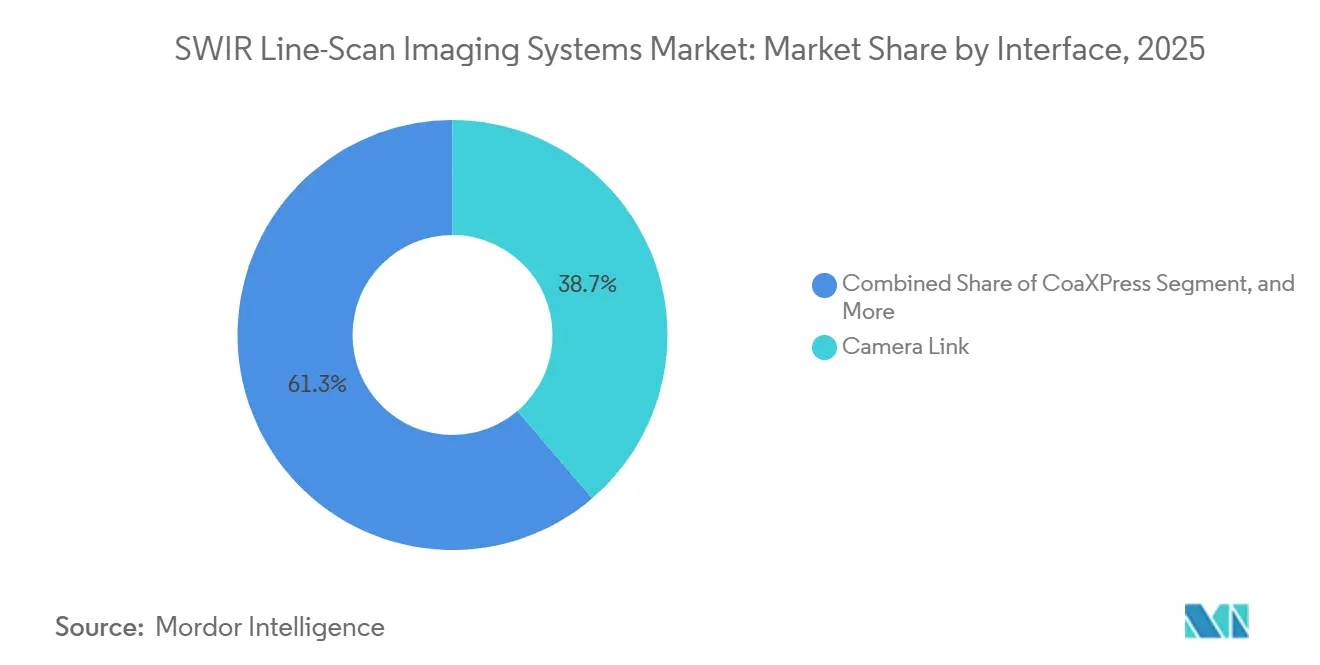
- By interface, Camera Link held 38.73% SWIR Line-Scan Imaging Systems Market revenue share in 2025, while CoaXPress is forecast to grow at a 13.57% CAGR through 2031.
- By end-user industry, semiconductor and electronics held 27.83% revenue share in 2025, while renewable energy is forecast to grow at a 13.31% CAGR through 2031.
- By geography, Asia-Pacific accounted for 39.67% of the SWIR Line-Scan Imaging Systems Market revenue share in 2025 and is forecast to grow at a 12.27% CAGR through 2031.
Note: Market size and forecast figures in this report are generated using Mordor Intelligence’s proprietary estimation framework, updated with the latest available data and insights as of January 2026.
Market Trends and Insights
Drivers Impact Analysis of SWIR Line-Scan Imaging Systems Market*
| Driver | (~) % Impact on CAGR Forecast | Geographic Relevance | Impact Timeline |
|---|---|---|---|
| Semiconductor Wafer and Photovoltaic Inspection Expansion | +3.5% | Asia-Pacific core, spillover to North America and Europe | Medium term (2-4 years) |
| Automated Food, Seed and Recycling Sorting Adoption | +2.5% | Global, with early gains in Europe and North America | Short term (≤ 2 years) |
| Rising Demand for High-Speed Web and Surface Inspection | +2.0% | North America and Europe | Short term (≤ 2 years) |
| Defense and Security Night-Scene Imaging Upgrades | +1.5% | North America, Europe, Middle East | Long term (≥ 4 years) |
| SWIR Penetration of Silicon and Opaque Materials | +0.8% | Global | Medium term (2-4 years) |
| Line-Rate Gains From Onboard Processing and High-Speed Interfaces | +0.5% | Global, with early adoption in Asia-Pacific and North America | Short term (≤ 2 years) |
| Source: Mordor Intelligence | |||
Semiconductor Wafer and Photovoltaic Inspection Expansion
For the SWIR Line-Scan Imaging Systems Market, sub-3 nm semiconductor fabrication requires defect sensitivity beyond conventional visible-light inspection. Silicon becomes optically transparent beyond 1,100 nm, allowing InGaAs cameras to identify cracks, alignment marks, voids, and bonding defects without destructive testing.[1]Sony Semiconductor Solutions Group, “SenSWIR Short-Wavelength InfraRed Image Sensor Technology,” Sony Semiconductor Solutions Group, sony-semicon.com. This capability supports the inspection of 3D-stacked devices and through-silicon-via architectures. The same platform can inspect silicon substrates and capture electroluminescence or photoluminescence images of solar cells. A 2025 study reported a 35.3% improvement in signal-to-noise ratio for InGaAs SWIR imaging under controlled polarization currents using the IEC TS 60904-13 procedure. Semiconductor and solar manufacturing additions in the United States and Europe broaden demand beyond Asia-Pacific, while equipment qualification and cleanroom requirements favor vendors with established support capabilities.
Automated Food, Seed and Recycling Sorting Adoption
Within the SWIR Line-Scan Imaging Systems Market, SWIR imaging distinguishes materials by molecular absorption rather than by surface color or shape. This allows PET, HDPE, and polypropylene to be identified at conveyor speeds, supporting food-grade recycling operations.[2]Hamamatsu Photonics, “New High-Speed InGaAs Linear Image Sensors G17225 Series for Advanced Foreign Object Detection,” Hamamatsu Photonics, hamamatsu.com. EU Regulation 2022/1616 limits food-contact recycling to packaging that previously came into contact with food, thereby increasing the value of reliable material sorting. Extended-SWIR systems can identify fire-retardant polymers and bioplastics with spectral features that overlap at shorter wavelengths. In food inspection, 1,450 nm imaging can reveal subsurface moisture and bruising, while 1,650 nm illumination can separate stones from coffee or grain. Exosens documented the use of SWIR systems in food and industrial inspection, supporting upgrades at facilities that already use near-infrared sorting equipment.
Rising Demand for High-Speed Web and Surface Inspection
In the SWIR Line-Scan Imaging Systems Market, manufacturers of films, flexible electronics, coated metals, blister packs, and paper are increasing inspection coverage as tolerance windows narrow. Hamamatsu’s G17225 series, launched in July 2025, supported a maximum line rate of 50 kHz for advanced foreign-object detection.[3]Steinert Global, “STEINERT AI Enables Food-Grade Tray Recycling at Cirrec,” Steinert Global, steinertglobal.com. Such systems can sustain line speeds that previously required sampling at the end of production. SWIR imaging can identify coating nonuniformity and lamination defects without stopping the web or applying test media. JAI’s Wave Series added onboard correction functions and a 40 kHz, 2K GigE Vision option, which reduces integration work for system builders. CoaXPress and 10 GigE connections also support direct analysis of high-volume image streams, which is relevant for automated inspection of thinner and multimaterial packaging.
Defense and Security Night-Scene Imaging Upgrades
Defense upgrades add an important demand stream to the SWIR Line-Scan Imaging Systems Market. The 900 nm to 1,700 nm SWIR range can use starlight or covert laser illumination and retain scene detail that supports identification in difficult conditions.[4]Sensors Unlimited, “Night Vision Systems,” Sensors Unlimited, sensorsinc.com. L3Harris received a 7-year U.S. Army contract worth up to USD 465 million in April 2026 for NOVA night-vision goggle systems under the BiNOD program. In August 2026, Photonis Defense received its first order for 1,600 BiNOD systems under a USD 352.6 million IDIQ contract. Exosens is also developing compact quantum-dot SWIR sensors for air-defense use through the European Commission-backed QuantumSight project. Long procurement cycles remain, but active programs support a sustained need for high-performance imaging components.
Restraints Impact Analysis of SWIR Line-Scan Imaging Systems Market*
| Restraint | (~) % Impact on CAGR Forecast | Geographic Relevance | Impact Timeline |
|---|---|---|---|
| High InGaAs Detector and Camera System Costs | -2.5% | Global | Short term (≤ 2 years) |
| Export Controls on Dual-Use Infrared Imaging Technologies | -1.5% | North America, Europe, Asia-Pacific | Long term (≥ 4 years) |
| Application-Specific Illumination and Calibration Complexity | -0.8% | Global | Medium term (2-4 years) |
| Limited Availability of SWIR-Skilled System Integrators | -0.5% | South America, Middle East and Africa, emerging Asia-Pacific | Medium term (2-4 years) |
| Source: Mordor Intelligence | |||
High InGaAs Detector and Camera System Costs
For the SWIR Line-Scan Imaging Systems Market, InGaAs detector and camera costs remain a material barrier for price-sensitive applications and emerging geographies. Manufacturing requires epitaxial growth on indium phosphide substrates, using MBE or MOCVD processes that add cost and limit high-performance array yields. Entry-level VGA line-scan modules were priced at USD 4,000 to USD 6,000 in 2025, compared with less than USD 200 for comparable visible-light CMOS cameras. The price difference confines many deployments to uses where avoided defects clearly justify the investment. CQD deposition on CMOS readout circuits offers a route that avoids the epitaxial process used for InGaAs detectors. Wafer-level packaging and automated probe testing can lower assembly costs, although their benefits are concentrated among manufacturers able to fund those capabilities.
Export Controls on Dual-Use Infrared Imaging Technologies
The SWIR Line-Scan Imaging Systems Market faces export requirements when high-performance infrared cameras are classified under Export Control Classification Number 6A003. In February 2026, the Bureau of Industry and Security imposed a USD 1 million civil penalty on Teledyne FLIR for 10 unauthorized transfers of thermal cameras to China and Hong Kong. This action demonstrates that compliance failures can create financial and operational risks throughout the infrared imaging supply chain. Defense-grade systems are subject to ITAR requirements, while commercial-grade products may be subject to EAR controls. China’s role in manufacturing photovoltaics and semiconductors creates demand in a region where compliance can be restrictive. New U.S. export-declaration rules for EO/IR modules on UAVs became effective on June 30, 2026, moving product and end-use documentation earlier in the order process.
*Our forecasts treat driver/restraint impacts as directional, not additive. The impact forecasts reflect baseline growth, mix effects, and variable interactions.
SWIR Line-Scan Imaging Systems Market Segment Analysis
By Detector Technology:
InGaAs Remains Established as CQD ScalesInGaAs detectors held 78.63% of the SWIR Line-Scan Imaging Systems Market share in 2025. Their position reflects long-standing use in the 900 nm to 1,700 nm inspection range and an installed ecosystem of compatible optics, illumination, and software. Hamamatsu Photonics, Lynred, and Teledyne DALSA provide vertically integrated detector-to-camera platforms that simplify qualification for system integrators. MCT detectors extend their spectral response into the mid-wave infrared but incur higher costs and cooling requirements, while T2SL detectors are a defense-focused alternative. Raptor Photonics launched its Kestrel 640 eSWIR camera in April 2026 with an IRNova T2SL sensor, Stirling cooling to 170 K, and 0.9-2.5 µm spectral coverage.
CQD detectors are forecast to expand at a 12.87% CAGR through 2031, making them the fastest-growing detector category. Solution-processed lead sulfide CQD layers can be deposited on CMOS readout integrated circuits, supporting large-wafer manufacturing without InGaAs epitaxial infrastructure. A 2026 IEEE paper described a 2,048 × 2,048-pixel CQD SWIR image sensor made in a 0.18 µm mixed-signal CMOS process, with a 10 µm pixel pitch and 30 frames per second operation. SWIR Vision Systems reported quantum efficiency above 50% at 940 nm and extended response to 2,100 nm for its eSWIR CQD imagers. The SWIR Line-Scan Imaging Systems Market may therefore retain InGaAs for established 1.7 µm industrial systems while CQD technology gains new designs seeking room-temperature operation and lower system cost.



By Cooling Technology:
Thermoelectric Systems Lead, While Cryogenic Systems Grow FasterCooling choices within the SWIR Line-Scan Imaging Systems Market are led by thermoelectrically cooled systems, which accounted for 51.47% of revenue in 2025. They provide a performance-cost balance for inline applications requiring detector temperatures between −20 °C and −40 °C. TEC cooling supports compact camera designs without specialized cooling infrastructure, and major InGaAs platforms from Teledyne DALSA, Hamamatsu, Xenics, and NIT use single-stage or multistage versions. Uncooled systems remain relevant where ambient operation is sufficient, including moderate-speed food sorting and wide-area recycling inspection. Their simpler maintenance and lower system costs support deployments where peak-detector sensitivity is not required.
Cryogenically cooled systems are forecast to grow at a 12.39% CAGR through 2031. Extended InGaAs, MCT, and T2SL detectors need temperatures below 150 K to control dark current at wavelengths beyond 1.7 µm, aligning the segment with defense intelligence, surveillance, airborne hyperspectral surveys, and scientific imaging. Raptor Photonics’ Ninox eSWIR 640 used vacuum-sealed deep cooling to −100 °C and achieved dark current below 200 fA. It also reported peak quantum efficiency of 76% at 1,600 nm and readout noise below 90 electrons in low-gain mode. Stirling-cooled products suit rugged field use, while vacuum-cooled designs serve laboratory-grade systems in the SWIR Line-Scan Imaging Systems Market.
By Interface:
Camera Link Retains the Installed Base, While CoaXPress Gains SpeedInterface choices in the SWIR Line-Scan Imaging Systems Market still include Camera Link, which accounted for 38.73% of revenue in 2025. It remains common in wafer and flat-panel-display lines with installed frame-grabber infrastructure and long equipment replacement cycles. The full Camera Link configuration supports data rates up to 6.8 Gbps. That ceiling constrains 2K and 4K SWIR line-scan cameras running above 40 kHz. GigE Vision serves food, recycling, and pharmaceutical applications that prioritize plant-network integration, while USB3 Vision supports compact inspection tools and space-constrained OEM deployments.
CoaXPress is forecast to grow at a 13.57% CAGR through 2031. It provides 12.5 Gbps per channel, deterministic low-latency triggering, and power over the coaxial connection, while version 3.0 is expected to offer 25 Gbps per link and include CoaXPress over Fiber. Fiber can extend the camera-to-host distance for larger solar and recycling facilities. Raptor Photonics’ Owl 2560 supported 60 Hz at full resolution over a single-wire CoaXPress connection. The SWIR Line-Scan Imaging Systems Market is likely to favor this interface as camera resolution and inspection-line output increase.
By End-User Industries:
Semiconductor and Electronics Lead, While Renewable Energy ExpandsSemiconductor and electronics accounted for 27.83% of the SWIR Line-Scan Imaging Systems Market in 2025. Wafer-level inspection, chiplet interconnects, hybrid bonding, and integrated-circuit failure analysis require a noncontact method that can see through silicon, while safety and fabrication requirements increase qualification needs for new suppliers. Renewable energy is forecast to grow at a 13.31% CAGR through 2031 as solar-cell production and photovoltaic fleet inspection expand. Lynred’s NIT subsidiary launched LiSaSWIR in June 2025 for silicon wafer, solar-panel, and industrial sorting applications. Its Integration While Read function delivered more than 100% higher operational speed than its predecessor.
Food and beverage applications use line-scan systems to detect stones in coffee, bones in meat, glass in packaged products, and moisture variation in grains and baked foods, while recycling operators use similar polymer-differentiation capabilities. Teledyne DALSA launched the Kaleido SWIR hyperspectral camera in May 2026, featuring an integrated sensor, spectrograph, and 10 GigE Vision interface, targeting applications in recycling, food safety, pharmaceuticals, and waste sorting. Pharmaceutical and healthcare users inspect tablet coatings, blister-pack seals, fill levels, and moisture-related packaging defects without destructive tests. Defense and government agencies purchase high-value systems, but their procurement cycles are longer, and ITAR and EAR requirements are more restrictive. These diverse uses give the SWIR Line-Scan Imaging Systems Market exposure to multiple inspection budgets rather than a single manufacturing vertical.
Geography Analysis
APAC SWIR Line-Scan Imaging Systems Market
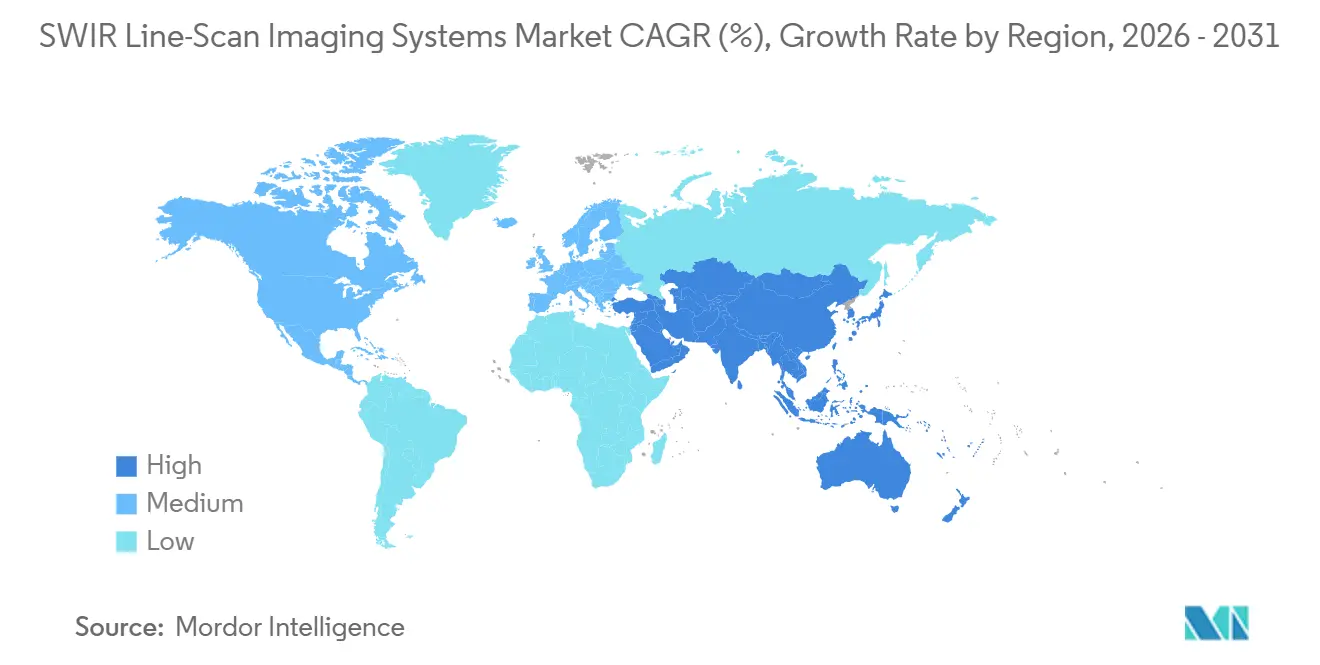
Asia-Pacific held 39.67% of the SWIR Line-Scan Imaging Systems Market size in 2025 and is forecast to grow at a 12.27% CAGR through 2031. China, South Korea, Japan, and Taiwan combine semiconductor fabrication, photovoltaic manufacturing, and consumer-electronics assembly. This production base supports the ongoing demand for inline inspection equipment. Japan also supplies imaging components, including Hamamatsu’s G17225 series, with a maximum line rate of 50 kHz and a data rate of 20 MHz for food screening, semiconductor inspection, and plastics sorting. India and the rest of Asia-Pacific are earlier-stage areas where semiconductor and solar investment is expected to support first deployments during 2027-2031.
North America SWIR Line-Scan Imaging Systems Market
North America is the second-largest regional market. The United States combines defense contractors with advanced semiconductor packaging facilities. The 2026 U.S. Army BiNOD awards included an Exosens contract worth USD 352.6 million and an L3Harris award worth up to USD 465 million, sustaining demand for high-performance night-imaging components. BIS scrutiny also affects international distribution decisions for North American infrared-imaging vendors. Teledyne DALSA’s operations in Waterloo, Ontario, support an export-oriented Canadian base for recycling, food, and pharmaceutical inspection systems.
EMEA and South America SWIR Line-Scan Imaging Systems Market
Europe is the third-largest regional market in the SWIR Line-Scan Imaging Systems Market and plays an influential role in technological development and food safety inspection. Lynred in Grenoble and NIT in the Paris area supply InGaAs arrays and cameras, while German recycling investment and EU packaging rules increase the use of SWIR sorting lines. The Middle East, Africa, and South America remain early-stage opportunities, supported by solar projects in Saudi Arabia and the United Arab Emirates, as well as Brazil’s semiconductor assembly activity. Limited local access to trained SWIR integrators moderates near-term adoption across these regions.

Competitive Landscape
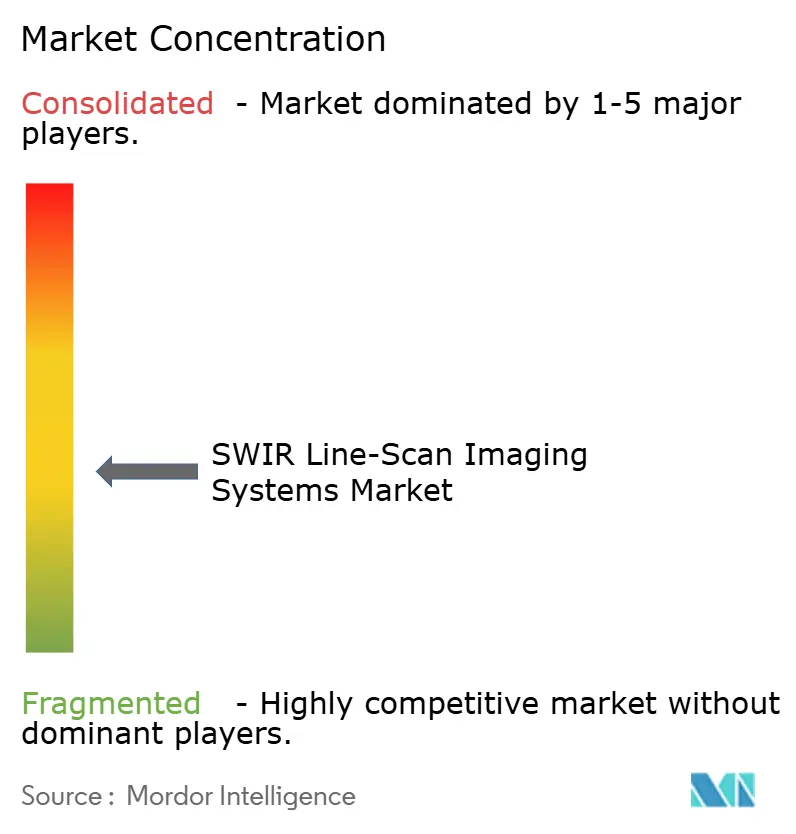
The SWIR Line-Scan Imaging Systems Market is moderately fragmented among Teledyne DALSA, Hamamatsu Photonics, Exosens, Xenics, and Lynred. Their vertically integrated detector-to-camera capabilities reduce dependence on external components and support application-specific customization. Teledyne DALSA broadened its sorting offering in May 2026 with Kaleido, which combines the sensor, spectrograph, and 10 GigE Vision interface into a single platform. Hamamatsu serves the OEM layer with its G17225 sensor family, while Exosens combines imaging-system offerings with defense-related programs through Photonis Defense.
JAI, Raptor Photonics, Princeton Infrared Technologies, Allied Vision Technologies, SWIR Vision Systems, and Emberion compete in focused parts of the SWIR Line-Scan Imaging Systems Market. Their offerings differentiate through updated interfaces, smaller pixel pitches, extended spectral coverage, or CQD sensing. JAI expanded its Wave Series with 1K and 2K InGaAs cameras offering 14-bit output and a GigE Vision interface. Raptor introduced the Kestrel 640 eSWIR in April 2026 for laser detection, defense intelligence, surveillance, and scientific imaging. SWIR Vision Systems is positioning CQD products in the extended-SWIR range with a response to 2,100 nm.
Lower-cost line-scan modules remain an opening in food sorting and other cost-sensitive applications. Drone-mounted systems for solar farm and infrastructure inspection are another area of opportunity. Extended-SWIR cameras covering 1.7-2.5 µm can improve discrimination among complex polymers, but current product availability remains limited. TriEye Technologies, now part of Renesas, is pursuing standard CMOS SWIR for automotive perception, which could put pressure on entry-level InGaAs products if manufacturing yields scale. Export licensing and cleanroom-compatible equipment qualification favor suppliers with established compliance and support resources in the SWIR Line-Scan Imaging Systems Market.
SWIR Line-Scan Imaging Systems Industry Leaders
Teledyne Technologies Incorporated
Hamamatsu Photonics K.K.
Exosens
Allied Vision Technologies GmbH
Sensors Unlimited, Inc.
- *Disclaimer: Major Players sorted in no particular order
SWIR Line-Scan Imaging Systems Market Companies Covered in this Report
- Teledyne Technologies Incorporated
- Hamamatsu Photonics K.K.
- Exosens
- Allied Vision Technologies GmbH
- JAI A/S
- New Imaging Technologies SAS
- Sensors Unlimited, Inc.
- Raptor Photonics Limited
- Princeton Infrared Technologies, Inc.
- Lynred S.A.S.
- Xenics NV
- Leonardo DRS, Inc.
- Excelitas Technologies Corp.
- Opgal Optronic Industries Ltd.
- New Imaging Technologies SAS
- Imperx, Inc.
- Active Silicon Limited
- Vieworks Co., Ltd.
- Nippon Electro-Sensory Devices Ltd.
- Chunghwa Leading Photonics Tech Co., Ltd.
- TriEye Technologies Ltd.

Recent Industry Developments in SWIR Line-Scan Imaging Systems Market
- August 2026: Photonis Defense, the U.S. subsidiary of Exosens, received the first delivery order for 1,600 complete BiNOD systems under a USD 352.6 million IDIQ contract with the U.S. Army, starting the Low-Rate Initial Production phase. First deliveries are expected by the end of 2026, and Exosens is supplying image intensifier tubes from France.
- May 2026: Teledyne DALSA launched Kaleido, a SWIR hyperspectral line-scan camera that combines the sensor, spectrograph, and 10 GigE Vision interface in a single platform. The camera provides up to 1,280-pixel spatial resolution and line rates exceeding 2.3 kHz for recycling, food safety, pharmaceutical, and waste-management sorting.
- April 2026: MKS Instruments announced the Ophir SWIR 50-1000 mm f/5.5-9.5 continuous zoom lens for long-range defense surveillance. It covers 0.6 µm to 1.7 µm and supports vehicle detection beyond 35 km on 10 µm-pitch SXGA detectors.
- April 2026: Raptor Photonics introduced the Kestrel 640 eSWIR camera, using an IRNova T2SL sensor and Stirling cooling to 170 K. Its 0.9 µm to 2.5 µm coverage supports laser detection, defense intelligence, surveillance, and scientific imaging.


Global SWIR Line-Scan Imaging Systems Market Report Scope
The SWIR Line-Scan Imaging Systems Market refers to high-speed imaging solutions that utilize short-wave infrared light to capture continuous, high-resolution images of fast-moving materials or webs. These systems use specialized detectors, such as InGaAs or MCT, often paired with cooling technologies to reduce sensor noise, and connect via high-speed data interfaces. They are essential for non-destructive inspection, material sorting, and defect detection in industries like semiconductor manufacturing, food processing, recycling, and solar panel production, where identifying subsurface defects or chemical composition is critical.
The SWIR Line-Scan Imaging Systems Market Report is Segmented by Detector Technology (Indium Gallium Arsenide (InGaAs), Mercury Cadmium Telluride (MCT), Colloidal Quantum Dot, and Type-II Superlattice), Cooling Technology (Uncooled Systems, Thermoelectrically Cooled Systems, and Cryogenically Cooled Systems), Interface (GigE Vision, Camera Link, CoaXPress, USB3 Vision, and Other Interfaces), End-User Industries (Semiconductor and Electronics, Renewable Energy, Food and Beverage, Recycling and Waste-Management, Automotive, Pharmaceutical and Healthcare, Defense and Government Agencies, Research Institutions and Laboratories, and Other End-User Industries), and Geography (North America, South America, Europe, Asia-Pacific, and Middle East and Africa). The Market Forecasts are Provided in Terms of Value (USD).
| Indium Gallium Arsenide (InGaAs) |
| Mercury Cadmium Telluride (MCT) |
| Colloidal Quantum Dot |
| Type-II Superlattice |
| Uncooled Systems |
| Thermoelectrically Cooled Systems |
| Cryogenically Cooled Systems |
| GigE Vision |
| Camera Link |
| CoaXPress |
| USB3 Vision |
| Other Interfaces |
| Semiconductor and Electronics |
| Renewable Energy |
| Food and Beverage |
| Recycling and Waste-Management |
| Automotive |
| Pharmaceutical and Healthcare |
| Defense and Government Agencies |
| Research Institutions and Laboratories |
| Other End-User Industries |
| North America | United States | |
| Canada | ||
| Mexico | ||
| South America | Brazil | |
| Argentina | ||
| Rest of South America | ||
| Europe | Germany | |
| United Kingdom | ||
| France | ||
| Italy | ||
| Spain | ||
| Rest of Europe | ||
| Asia-Pacific | China | |
| Japan | ||
| India | ||
| South Korea | ||
| Rest of Asia-Pacific | ||
| Middle East and Africa | Middle East | Saudi Arabia |
| United Arab Emirates | ||
| Turkey | ||
| Rest of the Middle East | ||
| Africa | South Africa | |
| Nigeria | ||
| Rest of Africa | ||
| By Detector Technology | Indium Gallium Arsenide (InGaAs) | ||
| Mercury Cadmium Telluride (MCT) | |||
| Colloidal Quantum Dot | |||
| Type-II Superlattice | |||
| By Cooling Technology | Uncooled Systems | ||
| Thermoelectrically Cooled Systems | |||
| Cryogenically Cooled Systems | |||
| By Interface | GigE Vision | ||
| Camera Link | |||
| CoaXPress | |||
| USB3 Vision | |||
| Other Interfaces | |||
| By End-User Industries | Semiconductor and Electronics | ||
| Renewable Energy | |||
| Food and Beverage | |||
| Recycling and Waste-Management | |||
| Automotive | |||
| Pharmaceutical and Healthcare | |||
| Defense and Government Agencies | |||
| Research Institutions and Laboratories | |||
| Other End-User Industries | |||
| By Geography | North America | United States | |
| Canada | |||
| Mexico | |||
| South America | Brazil | ||
| Argentina | |||
| Rest of South America | |||
| Europe | Germany | ||
| United Kingdom | |||
| France | |||
| Italy | |||
| Spain | |||
| Rest of Europe | |||
| Asia-Pacific | China | ||
| Japan | |||
| India | |||
| South Korea | |||
| Rest of Asia-Pacific | |||
| Middle East and Africa | Middle East | Saudi Arabia | |
| United Arab Emirates | |||
| Turkey | |||
| Rest of the Middle East | |||
| Africa | South Africa | ||
| Nigeria | |||
| Rest of Africa | |||


Key Questions Answered in the Report
What is the size of the SWIR Line-Scan Imaging Systems Market?
The SWIR Line-Scan Imaging Systems Market was valued at USD 107.88 million in 2025 and is forecast to reach USD 196.44 million by 2031 at a 10.80% CAGR. The forecast period runs from 2026 to 2031, with 2025 used as the base year.
Which detector technology leads SWIR line-scan imaging systems?
InGaAs held 78.63% share in 2025 because it is well established for 900 nm to 1,700 nm inspection. CQD detectors are the fastest-growing technology category.
Which end-user application is growing fastest?
Renewable energy is forecast to grow at a 13.31% CAGR through 2031 as solar manufacturing and photovoltaic inspection expand. It supports both factory and field inspection demand.
Why are CoaXPress interfaces gaining use in SWIR cameras?
CoaXPress is forecast to grow at a 13.57% CAGR because it combines high data rates, deterministic triggering, and power delivery through one coaxial connection. Version 3.0 is expected to increase per-link capacity.
Which region leads demand for SWIR line-scan systems?
Asia-Pacific held 39.67% share in 2025 and is forecast to grow at a 12.27% CAGR through 2031, supported by semiconductor and photovoltaic production. Japan also remains an important component supplier.
What limits wider adoption of SWIR line-scan imaging?
InGaAs system cost and export-control requirements remain important constraints, especially in price-sensitive and internationally supplied applications. Application-specific illumination, calibration requirements, and limited availability of skilled system integrators can also delay deployment decisions, particularly in emerging and export-focused markets.
Page last updated on:





