
Surface Cleaning Chemicals Market Size and Share
Market Overview
| Study Period | 2021 - 2031 |
|---|---|
| Market Size (2026) | USD 16.11 Billion |
| Market Size (2031) | USD 21.58 Billion |
| Growth Rate (2026 - 2031) | 6.03 % |
| Fastest Growing Market | Asia-Pacific |
| Largest Market | Asia-Pacific |
| Market Concentration | Low |
Major Players *Disclaimer: Major Players sorted in no particular order Image © Mordor Intelligence. Reuse requires attribution under CC BY 4.0. | |
Surface Cleaning Chemicals Market Analysis by Mordor Intelligence
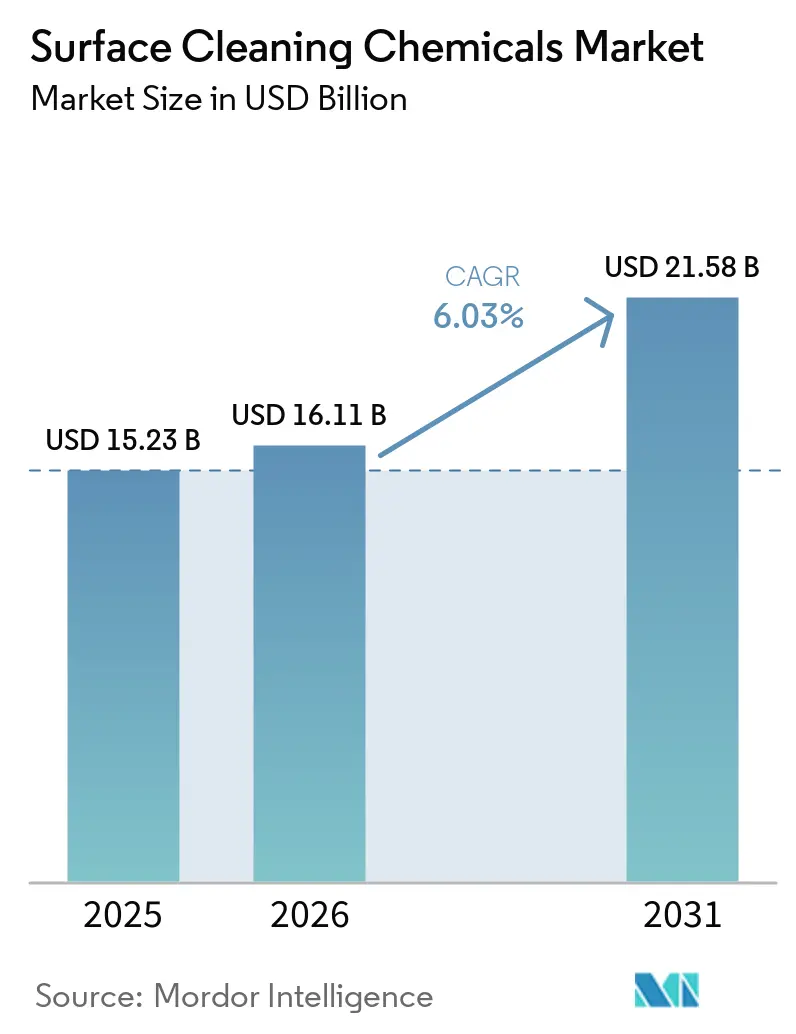
The surface cleaning chemicals market size was estimated at USD 15.23 billion in 2025 and is estimated to grow from USD 16.11 billion in 2026 to USD 21.58 billion by 2031, at a CAGR of 6.03% during the forecast period (2026-2031). The surface cleaning chemicals market is developing along two paths: high-volume formulations serving routine cleaning needs and specialized chemistries addressing applications where performance, documentation, and surface compatibility are more critical. Recurring hygiene requirements in healthcare, foodservice, and commercial facilities support regular purchasing, while semiconductor, food processing, and manufacturing activities drive demand for more precise formulations. Within the same facility, buyers use basic products for routine floor and washroom cleaning while requiring validated, residue-controlled products for high-risk production areas. Regulatory changes are increasing the importance of ingredient selection, product registration, and environmental claims in supplier decisions. Digital dosing and automated cleaning systems can reduce chemical overuse, but they also favor concentrated, validated products that deliver higher value per use. As a result, companies compete on formulation capability, regulatory readiness, application support, and distribution systems rather than on product availability alone, while maintaining dependable results and clear operating instructions across both standard and specialized cleaning applications in facilities with varying staffing levels, cleaning frequencies, and documentation requirements.
Key Report Takeaways
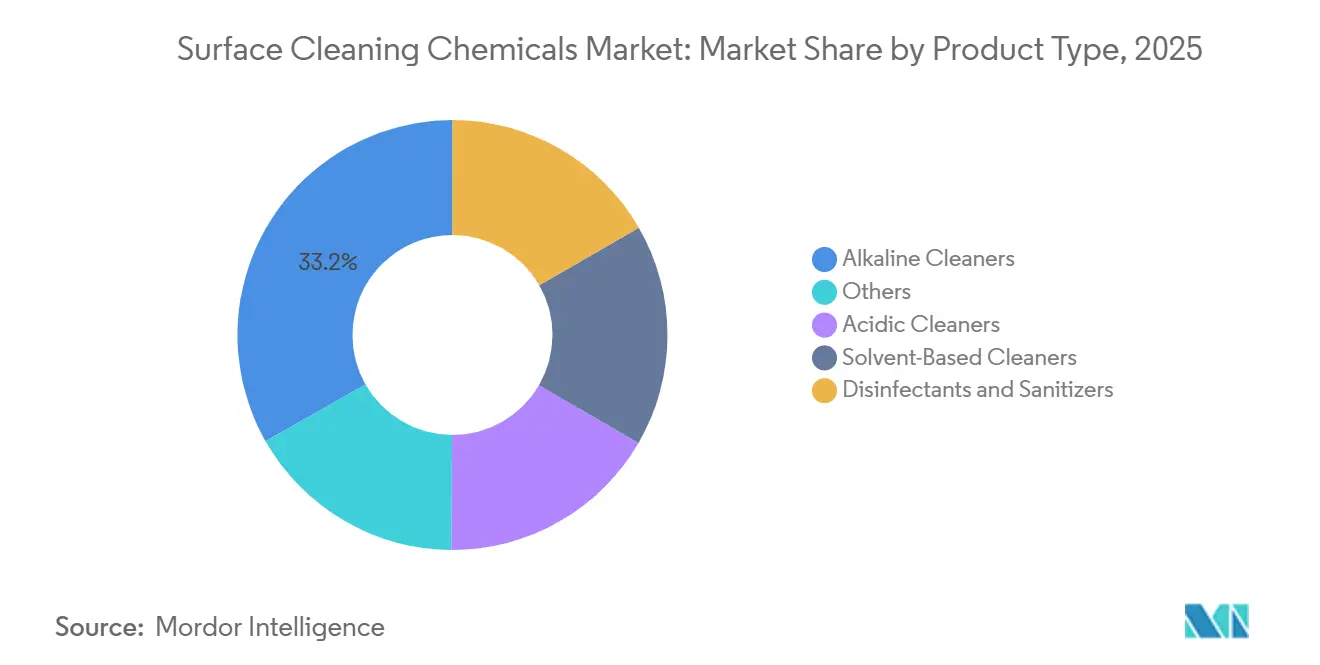
- By product type, alkaline cleaners held 33.23% of global revenue in 2025, while disinfectants and sanitizers are forecast to grow at a CAGR of 7.12% through 2031.
- By surface type, metal surfaces accounted for 37.14% of global revenue in 2025, while plastic surfaces are forecast to grow at a CAGR of 6.78% through 2031.
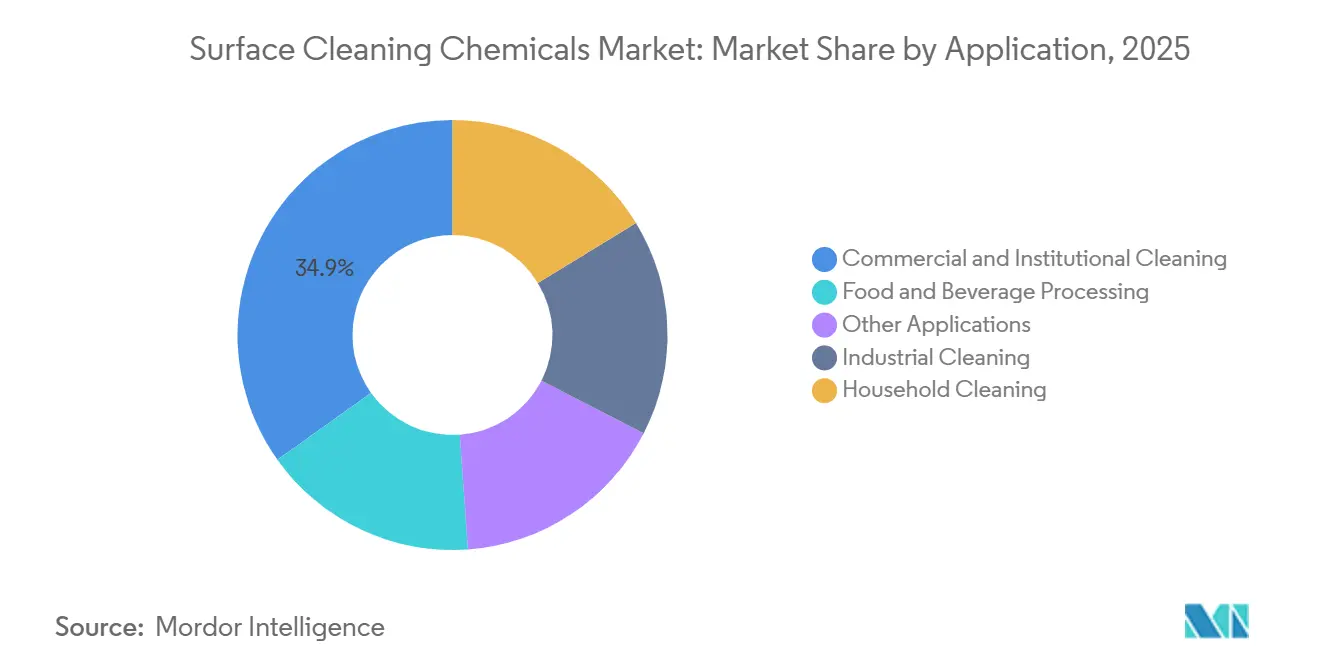
- By application, commercial and institutional cleaning held 34.86% of global revenue in 2025, while industrial cleaning is projected to expand at a CAGR of 7.31% through 2031.
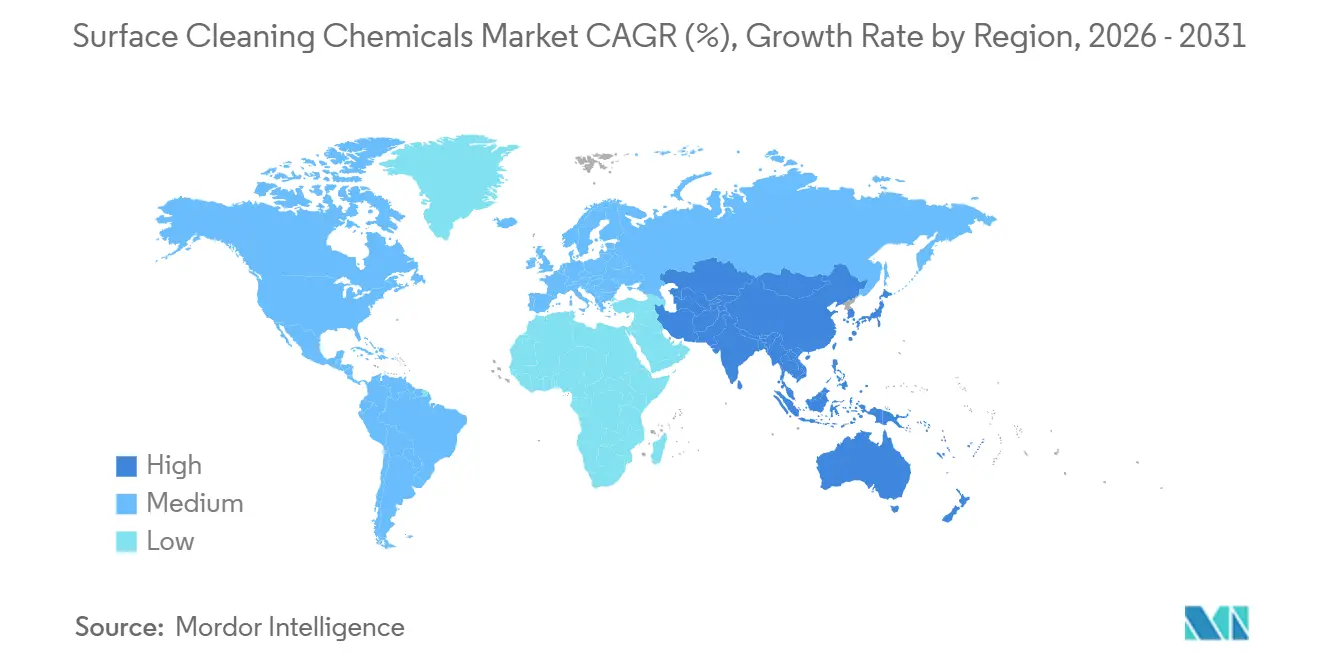
- By geography, Asia-Pacific held 35.78% of global revenue in 2025 and is forecast to grow at a CAGR of 6.84% through 2031.
Note: Market size and forecast figures in this report are generated using Mordor Intelligence’s proprietary estimation framework, updated with the latest available data and insights as of January 2026.
Market Trends and Insights
Drivers Impact Analysis of Surface Cleaning Chemicals Market*
| Drivers | (~) % Impact on CAGR Forecast | Geographic Relevance | Impact Timeline |
|---|---|---|---|
| Rising Hygiene and Infection-Control Standards | +1.5% | Global, with stronger gains in North America, Europe, and the Asia-Pacific healthcare networks | Short term (≤ 2 years) |
| Expansion of Food Processing and Clean-in-Place Systems in Asia-Pacific | +1.2% | Asia-Pacific, led by China, India, and ASEAN, with spillover to the Middle East and Africa | Medium term (2-4 years) |
| Sustainability-Led Shift Toward Bio-Based and Concentrated Formulations | +0.8% | Europe and North America, with increasing adoption in the Asia-Pacific | Long term (≥ 4 years) |
| Healthcare, Hospitality, Foodservice, and Commercial Facility Expansion | +0.9% | Global, with strong contributions from Asia-Pacific, the Middle East, and Africa | Medium term (2-4 years) |
| Digital Dosing, Dispensing, and Robotic Cleaning Adoption | +0.5% | North America and Europe, with early adoption in Japan and South Korea | Medium term (2-4 years) |
| Precision Cleaning Demand from Semiconductor and Electronics Manufacturing | +0.4% | Asia-Pacific, especially China, South Korea, Taiwan, and Japan, with emerging demand in Europe | Long term (≥ 4 years) |
| Source: Mordor Intelligence | |||
Rising Hygiene and Infection-Control Standards
Institutional hygiene requirements create a stable demand base for the surface-cleaning chemicals market, as facilities cannot defer cleaning activities integral to patient safety, operating procedures, or routine public health management. The World Health Organization identifies environmental cleaning and disinfection as core elements of infection prevention and control programs in acute healthcare facilities. The U.S. Centers for Disease Control and Prevention provides environmental infection control guidance for healthcare settings, including requirements for surface cleaning and disinfection[1]. These requirements tie chemical purchasing for cleaning more closely to operating activity in hospitals, clinics, foodservice sites, and public facilities, rather than to discretionary budgets alone. Product selection depends on verified efficacy, safe handling practices, compliance documentation, and instructions that staff can follow consistently during busy operating periods. Health Canada's biocide framework, effective in 2025, affects sanitizer specifications for relevant applications and adds to qualification requirements in North America.
Expansion of Food Processing and Clean-in-Place Systems in Asia-Pacific
Food and beverage production drives demand for alkaline and acidic chemistries in the surface cleaning chemicals market, as process equipment requires regular cleaning cycles and plants need products that fit established sanitation routines. Clean-in-place systems use defined cleaning steps, concentration levels, temperatures, and contact periods, making formulation consistency important for operators and limiting the scope for uncontrolled substitution. PMMI, The Association for Packaging and Processing Technologies, reported that food and beverage manufacturers focus on digital sanitation monitoring and more formalized sanitation procedures. This approach shifts purchasing toward products that can be documented, used within a controlled process, and reviewed by quality teams when investigating deviations or auditing results. Digital records for dispensing and sanitation help plants track consumption, confirm completed cycles, identify deviations before they affect production, and verify that cleaning procedures meet standard operating requirements. The result is a stronger role for purpose-built cleaning formulations, even where the underlying cleaning task remains routine.
Sustainability-Led Shift Toward Bio-Based and Concentrated Formulations
Environmental criteria influence material choices and package formats in the surface cleaning chemicals market, as buyers assess ingredient profiles, packaging use, waste handling, and the ability to dilute products accurately. The U.S. Environmental Protection Agency's Safer Choice program provides a framework for identifying products with safer chemical ingredients. BASF introduced Trilon G in April 2025 as a partially bio-based chelating agent for cleaning applications, based on readily biodegradable glutamic acid diacetate (GLDA) chemistry. Nouryon introduced FinnFix PB MAX in 2026 as a carboxymethylcellulose product with a 100% renewable carbon index for cleaning-related uses. Concentrated products reduce packaging, transport, and storage requirements when users have reliable dilution equipment and clear procedures for filling, labeling, and using dispensing containers. These factors encourage suppliers to pair renewable or biodegradable inputs with dosing systems that ensure concentrates are used correctly and deliver the expected performance at the point of use.
Healthcare, Hospitality, Foodservice, and Commercial Facility Expansion
Commercial and institutional sites remain important demand centers for the surface cleaning chemicals market, as they require frequent cleaning across large areas, shared surfaces, restrooms, food-preparation areas, and customer-facing spaces. Healthcare facilities need products that fit infection-control protocols, while hospitality and foodservice operations need products that support everyday cleaning without disrupting service. Ecolab introduced its ReadyDose Cleaning Program for restaurants and cafes in Southeast Asia in July 2025, demonstrating how suppliers use premeasured formats to reduce preparation errors in commercial settings. Unilever launched Cif Infinite Clean in April 2025, introducing microbiome-based technology to provide continued surface protection between cleaning events. These offerings address the need for products that are straightforward for staff to use, credible for facility managers to adopt, and supported by instructions applicable across shifts and sites. Suppliers with training, dispensing, and support capabilities can strengthen account relationships and reduce the risk of inconsistent product use.
Restraints Impact Analysis of Surface Cleaning Chemicals Market*
| Restraints | (~) % Impact on CAGR Forecast | Geographic Relevance | Impact Timeline |
|---|---|---|---|
| Stricter Chemical, Volatile Organic Compound (VOC), Per- and Polyfluoroalkyl Substances (PFAS), and Biocidal Regulations | -0.7% | Primarily North America and Europe, with pressure extending to Canada and select Asia-Pacific markets | Short term (≤ 2 years) |
| Petrochemical Feedstock and Surfactant Price Volatility | -0.6% | Global, with exposure in North America and the Asia-Pacific | Medium term (2-4 years) |
| Water Scarcity and Rinse-Reduction Constraints | -0.3% | Europe, Asia-Pacific, and the Middle East | Medium term (2-4 years) |
| Surface-Compatibility and Validated Contact-Time Requirements | -0.2% | Global, with greater relevance in semiconductor and medical device cleaning | Long term (≥ 4 years) |
| Source: Mordor Intelligence | |||
Stricter Chemical, VOC, PFAS, and Biocidal Regulations
Stricter requirements for chemical ingredients increase development, testing, documentation, and product transition costs in the surface cleaning chemicals market, particularly when a supplier sells similar product lines across several regulated jurisdictions. Regulation (EU) 2026/405 addresses detergents and surfactants and includes provisions affecting ingredient controls and phosphorus-related assessments. Canada's 2025 regulations on certain toxic substances restrict specified Per- and Polyfluoroalkyl Substances (PFAS)-related substances from June 30, 2026. The European Union granted a 10-year authorization in February 2026 for a family of hydrogen peroxide-based biocidal products. As a result, legacy ingredients may need replacement while some alternative chemistries gain a clearer regulatory path, requiring manufacturers to manage timing, labeling, and customer approvals carefully. Smaller formulators face greater difficulty, as they often have fewer resources to manage registrations, safety documentation, reformulation, and customer transition plans across jurisdictions.
Petrochemical Feedstock and Surfactant Price Volatility
Raw material cost changes remain a constraint for the surface cleaning chemicals market, as surfactants and disinfectant ingredients are central to many formulations, while customers expect stable pricing and reliable product availability. The U.S. Producer Price Index for bulk surfactants reached 406.334 in June 2026, compared with 378.281 in February 2026[2]. This places pressure on supplier margins, particularly where customer contracts limit the speed of price adjustments, or buyers require suppliers to hold prices for defined periods. Ecolab identified raw material volatility as a continuing business consideration in its Form 10-Q for the quarter ended June 30, 2026. Higher input costs encourage customers to seek concentrated products with predictable dilution and lower cost per completed cleaning task. However, this shift reduces the quantity of chemicals purchased, affecting the balance between value growth and physical consumption.
*Our forecasts treat driver/restraint impacts as directional, not additive. The impact forecasts reflect baseline growth, mix effects, and variable interactions.
Surface Cleaning Chemicals Market Segment Analysis
By Product Type:
Disinfectants Record Fastest Growth While Alkaline Cleaners Lead by ShareAlkaline cleaners held 33.23% of the surface cleaning chemicals market share in 2025, making them the largest product category. Their use is closely linked to cleaning cycles in dairy, beverage, and food manufacturing, where protein and fat residues must be removed from process equipment before the next production run begins. Demand is recurring because cleaning consumption follows production throughput, sanitation schedules, equipment design, soil load, water conditions, and the operating rules used by each facility. Acidic cleaners hold an important position in descaling equipment, cleaning water systems, and treating mineral deposits on food-contact surfaces, particularly where alkaline cycles alone cannot control scale formation. Solvent-based cleaners remain relevant in automotive, metalworking, and electronics settings where organic residues require higher cleaning strength, controlled evaporation, or carefully managed residue removal. Regulatory and worker-safety requirements are encouraging the development of lower-solvent, water-miscible, and enzyme-supported alternatives in the surface cleaning chemicals industry.
Disinfectants and sanitizers are forecast to grow at a 7.12% CAGR through 2031, the highest rate among product types. Their use is supported by sustained infection-control requirements in healthcare, food processing, and institutional facilities, where cleaning instructions often distinguish between soil removal, cleaning, sanitizing, and disinfection. BASF expanded its Lavergy liquid enzyme portfolio in July 2025 for laundry and cleaning applications, including low-temperature cleaning cycles that support cleaning performance under lower-energy operating conditions. The 10-year European authorization for hydrogen peroxide-based biocidal products gives formulators greater certainty for selected peroxide-based product families. Enzyme-based specialty cleaners are used in applications where residue control, process validation, and compatibility with surfaces or equipment are central to the purchasing decision. Product innovation, therefore, extends beyond disinfection claims to include lower-temperature cleaning, material compatibility, documented use procedures, and formulations designed for defined operating environments.

By Surface Type:
Metal Surfaces Lead, Plastics Gain from Electronics GrowthMetal surfaces accounted for 37.14% of the surface cleaning chemicals market share in 2025, reflecting their use in manufacturing, food processing, and healthcare equipment. These surfaces often require degreasing, passivation, disinfection, or rinse steps that occur frequently in operating environments and must fit defined production schedules. Alkaline degreasers and biocidal rinses are used where cleanliness affects production quality, equipment reliability, food safety, or the safe return of equipment to service. Metalworking and manufacturing applications may also require products that remove oils without causing corrosion, staining, residue, or downstream coating problems. The need to meet material-specific performance requirements supports differentiated formulations rather than broad, general-purpose products. This gives suppliers an opportunity to combine chemical products with technical guidance on concentration, contact time, rinsing, equipment compatibility, and safer handling procedures.
Plastic surfaces are projected to expand at a 6.78% CAGR through 2031, making them the fastest-growing surface-type segment. Electronics, semiconductor packaging, food-contact equipment, and healthcare interiors increase the range of polymer substrates that must be cleaned without damage, discoloration, cracking, or loss of surface properties. Plastic materials can be sensitive to aggressive solvents and high-pH chemistries, increasing the need for neutral or mildly acidic formulations that remove residues while limiting effects on the polymer matrix. Henkel introduced Bonderite C-AD 20202 in February 2026 for low-temperature dip degreasing of complex parts. Glass surfaces remain relevant in pharmaceutical manufacturing, precision optics, and food processing, where residue-free results and controlled contact times are important. Ceramic, composite, and hybrid surfaces add further demand for products designed around substrate sensitivity and validated cleaning outcomes.
By Application:
Industrial Cleaning Leads Growth, Commercial Base Stays LargestCommercial and institutional cleaning accounted for 34.86% of global revenue in 2025, supported by regular purchasing across healthcare, hospitality, contract cleaning, and foodservice operations. These buyers require products that are easy for staff to use, available through established channels, and suitable for a range of surfaces. Industrial cleaning is forecast to grow at a 7.31% CAGR through 2031, supported by semiconductor fabrication, electronics assembly, food processing, and metal manufacturing. The semiconductor sector requires controlled surface preparation as feature sizes and production requirements change. The surface cleaning chemicals market size for industrial applications benefits when suppliers meet performance standards for specific processes rather than offer general-purpose products.
Household cleaning continues to benefit from consumer interest in professional-style cleaning performance. Procter & Gamble introduced the Mr. Clean PRO portfolio in April 2026, including all-purpose, degreasing, and deep-cleaning formulations. Food and beverage processing remains demanding because cleaning products must meet food safety requirements and support documented sanitation practices. Validated efficacy, residue management, and defined contact periods influence product qualification in this application. Other uses include automotive maintenance, data center facility cleaning, and pharmaceutical manufacturing, each with distinct needs for pathogen control, surface compatibility, and residue management.
Geography Analysis
APAC Surface Cleaning Chemicals Market
Asia-Pacific held 35.78% of global revenue in 2025 and is forecast to grow at a 6.84% CAGR through 2031. The region is characterized by large food-processing operations, expanding electronics production, healthcare investment, demand for commercial facilities, and diverse local cleaning practices. China drives demand across food processing, semiconductor manufacturing, and contract cleaning. India's demand is linked to healthcare infrastructure and institutional purchasing. Japan and South Korea contribute to the demand for high-purity chemistries used in electronics and semiconductor production.
ASEAN Surface Cleaning Chemicals Market
ASEAN markets, including Vietnam, Indonesia, and Thailand, generate demand through food and beverage export processing and hospitality development. Suppliers in the Asia-Pacific surface cleaning chemicals market must balance value products for routine cleaning with higher-specification products for industrial applications, which often require different sales channels and application support.
North America and Europe Surface Cleaning Chemicals Market
North America's market is shaped by healthcare requirements, product registration, and ingredient compliance. The U.S. Environmental Protection Agency maintains List N as a reference for disinfectants that meet its criteria for use against SARS-CoV-2 when used according to label directions. In Europe, environmental standards and detergent regulations support demand for biodegradable, low-impact, and documented formulations. Germany and France support European industrial cleaning demand through their manufacturing bases. Rinse reduction and material efficiency remain relevant in European food processing, as water management affects operating practices, cleaning cycle design, and the choice between conventional and concentrated formats.
South America and MEA Surface Cleaning Chemicals Market
South America and the Middle East and Africa are smaller markets, though food processing, hospitality investment, and healthcare projects support demand in both regions. Brazil and Argentina contribute through meat processing and beverage production, while the Middle East and Africa generate institutional demand from hospitality and healthcare facilities. Across these regions, market size depends on suppliers' ability to offer compliant formulations, reliable distribution, application support, and products suited to local operating conditions.
Competitive Landscape
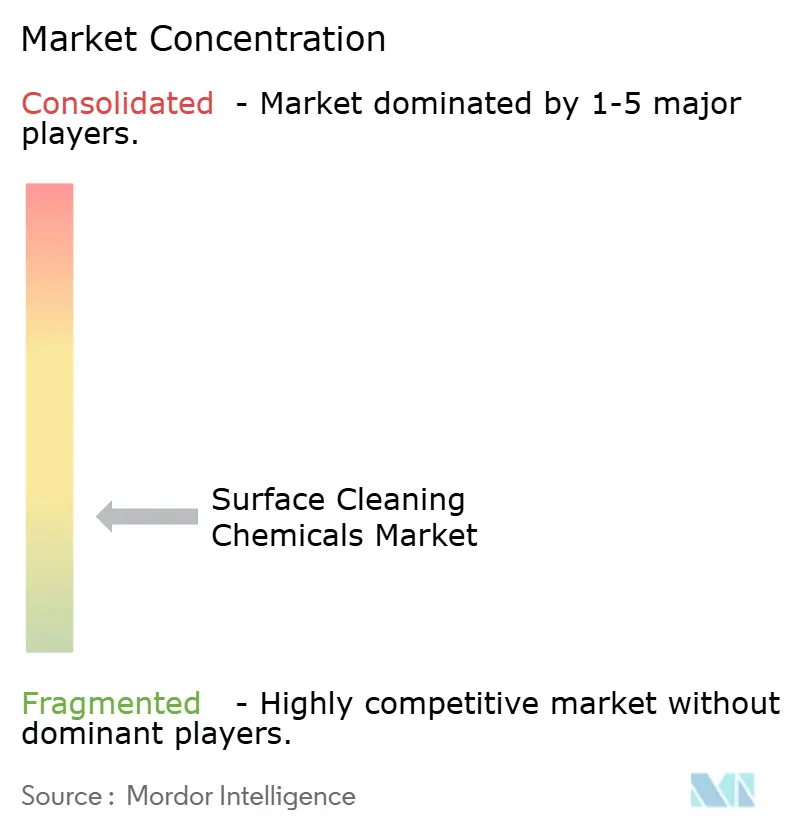
The surface cleaning chemicals market is fragmented, with Ecolab, Reckitt, Procter & Gamble, Henkel, and Unilever holding significant positions across commercial, institutional, and consumer applications. Regional companies, including Betco, Zep, Godrej Chemicals, and Kao Corporation, compete across product categories and geographic markets using local distribution networks or specialized customer knowledge. Large suppliers are expanding sustainable formulations to meet procurement standards, ingredient restrictions, packaging expectations, and environmental product claim requirements. They are also investing in dispensing, dosing, usage monitoring, and service tools that integrate chemical products into customer operations. Ecolab highlighted its digital water and cleaning management capabilities in its 2026 quarterly filing, reflecting the importance of service-linked relationships with institutional accounts.
The Clorox Company completed its acquisition of GOJO Industries in April 2026 for USD 2.25 billion, combining Clorox's cleaning products with GOJO's professional hand hygiene platform and business-to-business distribution network. This increased competitive pressure on suppliers with a narrow route to market, a limited hygiene portfolio, or customer relationships lacking service and training. Diversey sold Zenith Hygiene Group and Shorrock Trichem to Lyreco in 2025, focusing on streamlining distribution activities. These transactions indicate that channel strength, customer access, service capability, and coordinated program delivery can be as important as formulation development in this market.
Mid-tier suppliers are using sustainability and convenience to differentiate their offerings. Betco introduced a Green Seal-certified, PFAS-free multi-surface floor finish in May 2026 and launched its SnapMix mobile dilution system in March 2026 to improve dispensing convenience for facility users. White-space opportunities exist in rinse-free products for water-constrained locations, bio-enzyme systems for food-contact cleaning, and ultra-pure chemistries for electronics manufacturing. Market concentration is limited by the range of applications, local distribution requirements, and the need for technical specialization. The market concentration score is 4 out of 10, reflecting the presence of several global leaders and regional specialists across different applications, without a combined market share figure available.
Surface Cleaning Chemicals Industry Leaders
-
Ecolab Inc.
-
Procter & Gamble
-
Reckitt
-
Solenis
-
The Clorox Company
- *Disclaimer: Major Players sorted in no particular order
Surface Cleaning Chemicals Market Companies Covered in this Report
- 3M
- BASF
- Betco Corporation
- Colgate-Palmolive Company
- Diversey, Inc.
- Ecolab Inc.
- Godrej Chemicals
- GOJO Industries, Inc.
- Henkel AG & Co. KGaA
- Kao Corporation
- Procter & Gamble
- Reckitt
- S.C. Johnson & Son, Inc.
- Solenis
- The Clorox Company
- Unilever
- Zep Inc.
Recent Industry Developments in Surface Cleaning Chemicals Market
- June 2026: Diversey (Solenis) launched ecoSTORM, a bio-based automated drain maintenance program that uses activated bacteria to break down fats, oils, grease, and organic buildup in commercial kitchens, hospitality, retail, and healthcare settings. The program expands Diversey's institutional cleaning portfolio to include preventive facility maintenance and incorporates NCH Corporation's drain-care technology, which Solenis acquired through its prior acquisition of NCH.
- April 2026: The Clorox Company completed the USD 2.25 billion acquisition of GOJO Industries, forming Clorox Purell. The transaction combines Clorox's surface disinfecting products with GOJO's professional hand hygiene platform and business-to-business distribution network across North America. Management is targeting at least USD 50 million in run-rate cost synergies.
Global Surface Cleaning Chemicals Market Report Scope
Surface cleaning chemicals are specialized formulations designed to break down dirt, grease, and pathogens on hard and soft surfaces. Common types include neutral detergents for daily maintenance, alkaline degreasers for heavy fats, acid-based cleaners for mineral scale, and disinfectants that use active agents such as quaternary ammonium compounds or hydrogen peroxide.
The surface cleaning chemicals market is segmented by product type, surface type, application, and geography. By product type, the market is segmented into alkaline cleaners, acidic cleaners, solvent-based cleaners, disinfectants and sanitizers, and others. By surface type, the market is segmented into metal surfaces, glass surfaces, plastic surfaces, and other surface types. By application, the market is segmented into industrial cleaning, commercial and institutional cleaning, household cleaning, food and beverage processing, and other applications. The report also covers market size and forecasts for surface cleaning chemicals across 16 countries in major regions. The market sizes and forecasts are provided in terms of value (USD).
Segmentation Overview
| Alkaline Cleaners |
| Acidic Cleaners |
| Solvent-Based Cleaners |
| Disinfectants and Sanitizers |
| Others |
| Metal Surfaces |
| Glass Surfaces |
| Plastic Surfaces |
| Other Surface Types |
| Industrial Cleaning |
| Commercial and Institutional Cleaning |
| Household Cleaning |
| Food and Beverage Processing |
| Other Applications |
| Asia-Pacific | China |
| India | |
| Japan | |
| South Korea | |
| ASEAN Countries | |
| Rest of Asia-Pacific | |
| North America | United States |
| Canada | |
| Mexico | |
| Europe | Germany |
| United Kingdom | |
| France | |
| Italy | |
| Russia | |
| Rest of Europe | |
| South America | Brazil |
| Argentina | |
| Rest of South America | |
| Middle East and Africa | Saudi Arabia |
| South Africa | |
| Rest of Middle East and Africa |
| By Product Type | Alkaline Cleaners | |
| Acidic Cleaners | ||
| Solvent-Based Cleaners | ||
| Disinfectants and Sanitizers | ||
| Others | ||
| By Surface Type | Metal Surfaces | |
| Glass Surfaces | ||
| Plastic Surfaces | ||
| Other Surface Types | ||
| By Application | Industrial Cleaning | |
| Commercial and Institutional Cleaning | ||
| Household Cleaning | ||
| Food and Beverage Processing | ||
| Other Applications | ||
| By Geography | Asia-Pacific | China |
| India | ||
| Japan | ||
| South Korea | ||
| ASEAN Countries | ||
| Rest of Asia-Pacific | ||
| North America | United States | |
| Canada | ||
| Mexico | ||
| Europe | Germany | |
| United Kingdom | ||
| France | ||
| Italy | ||
| Russia | ||
| Rest of Europe | ||
| South America | Brazil | |
| Argentina | ||
| Rest of South America | ||
| Middle East and Africa | Saudi Arabia | |
| South Africa | ||
| Rest of Middle East and Africa | ||
Key Questions Answered in the Report
What is current market size of Surface Cleaning Chemicals Market?
The surface cleaning chemicals market size was estimated at USD 15.23 billion in 2025 and is estimated to grow from USD 16.11 billion in 2026 to USD 21.58 billion by 2031, at a CAGR of 6.03% during the forecast period (2026-2031).
Which product category is growing fastest through 2031?
Disinfectants and sanitizers are the fastest-growing product type, with a projected CAGR of 7.12% through 2031. In the surface cleaning chemicals market, demand is driven by healthcare, food processing, and institutional cleaning requirements.
Which region leads in global demand?
Asia-Pacific held 35.78% of global demand in 2025 and is expected to record the highest regional CAGR at 6.84% through 2031. The surface-cleaning chemicals market benefits from demand across food processing, electronics, and healthcare.
Which application has the highest growth rate?
Industrial cleaning is forecast to grow at a 7.31% CAGR through 2031, supported by activity in semiconductors, electronics, food processing, and metal manufacturing.