
Styrene Butadiene Latex Market Size and Share
Market Overview
| Study Period | 2021 - 2031 |
|---|---|
| Market Size (2026) | USD 7.88 Billion |
| Market Size (2031) | USD 9.79 Billion |
| Growth Rate (2026 - 2031) | 4.43 % |
| Fastest Growing Market | Asia-Pacific |
| Largest Market | Asia-Pacific |
| Market Concentration | Medium |
Major Players *Disclaimer: Major Players sorted in no particular order Image © Mordor Intelligence. Reuse requires attribution under CC BY 4.0. | |
Styrene Butadiene Latex Market Analysis by Mordor Intelligence
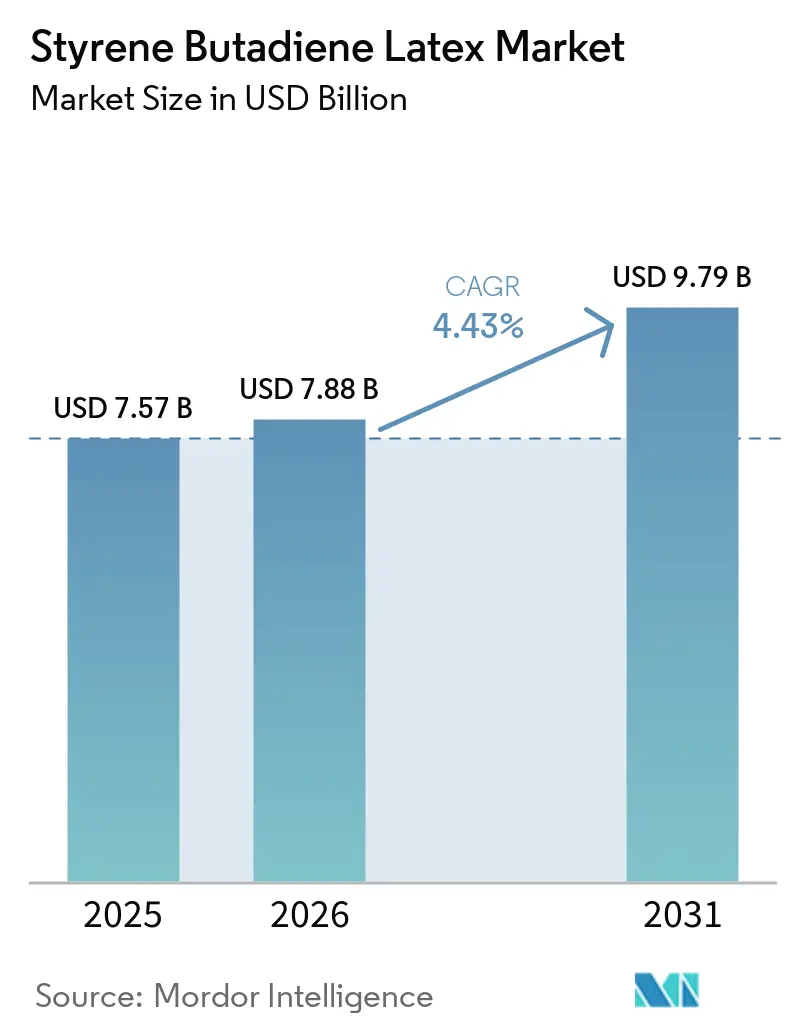
The Styrene Butadiene Latex market size was valued at USD 7.57 billion in 2025 and is estimated to grow from USD 7.88 billion in 2026 to reach USD 9.79 billion by 2031, at a CAGR of 4.43% during the forecast period (2026-2031). The styrene butadiene latex market is supported by demand from the paper and packaging, construction, and textile industries, where water-based chemistry remains relevant amid increasingly stringent environmental requirements. Paper and paperboard coatings represent a key demand segment, while construction and nonwoven applications expand the market’s application base. Producers are developing specialty grades for applications requiring stronger adhesion or specific formulation performance. Asia-Pacific combines conversion activity with demand for construction and hygiene products, supporting regional demand for styrene-butadiene latex. Competitive dynamics vary by application, with technical qualification and certification playing a more significant role in paper coating applications than in price-sensitive end uses.
Key Report Takeaways
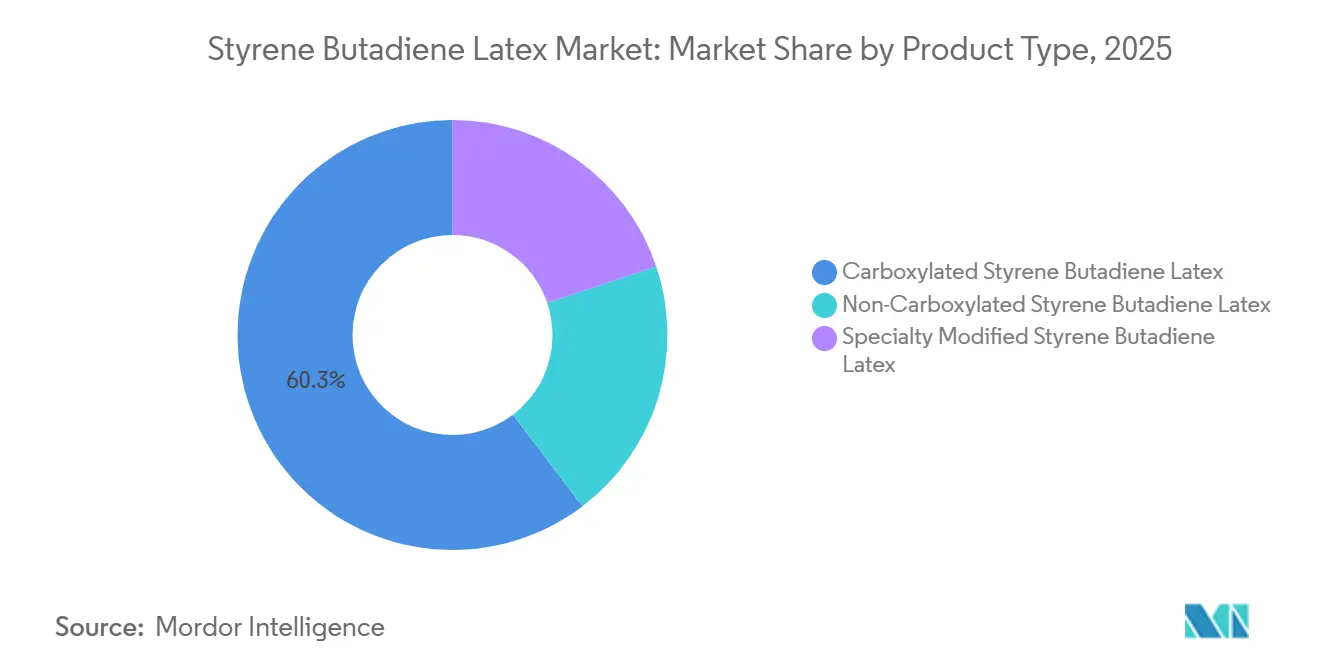
- By product type, carboxylated styrene butadiene latex held 60.34% revenue share in 2025, while non-carboxylated styrene butadiene latex is forecast to expand at a CAGR of 4.78% through 2031.
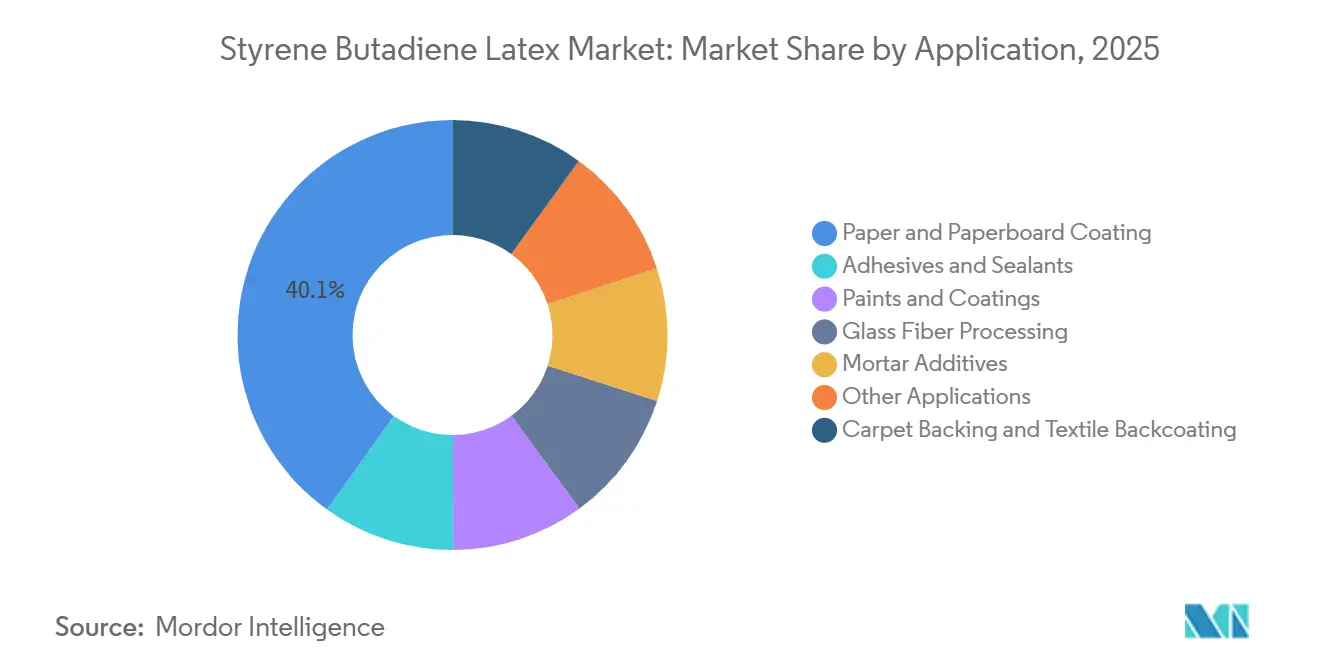
- By application, paper and paperboard coating accounted for 40.07% of revenue in 2025, while mortar additives are forecast to expand at a 5.12% CAGR through 2031.
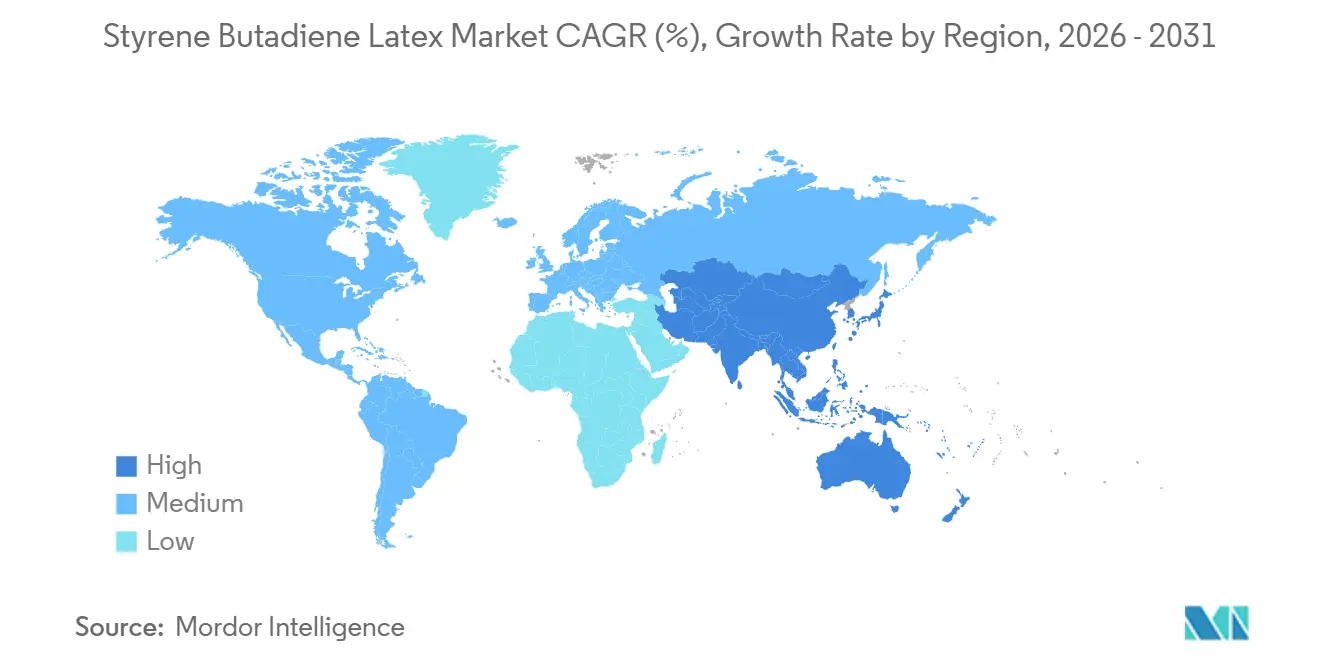
- By geography, Asia-Pacific held 44.18% of revenue in 2025 and is forecast to grow at the highest regional CAGR of 4.81% through 2031.
Note: Market size and forecast figures in this report are generated using Mordor Intelligence’s proprietary estimation framework, updated with the latest available data and insights as of January 2026.
Global Styrene Butadiene Latex Market Trends and Insights
Drivers Impact Analysis*
| Drivers | (~) % Impact on CAGR Forecast | Geographic Relevance | Impact Timeline |
|---|---|---|---|
| Paper and Paperboard Packaging Conversion | +1.5% | Global, concentrated in Asia-Pacific and Europe | Long term (≥ 4 years) |
| Water-Based, Low-VOC Binder Substitution | +0.8% | Europe, North America, and China | Medium term (2-4 years) |
| Infrastructure, Waterproofing, and Repair-Mortar Demand | +0.6% | Asia-Pacific, the Middle East and Africa, and South America | Long term (≥ 4 years) |
| Growth of Carpet, Textile, and Nonwoven Backcoating | +0.7% | Asia-Pacific, North America, and Europe | Long term (≥ 4 years) |
| High-Solids Formulations Reducing Dryer Energy Intensity | +0.4% | Europe and North America | Medium term (2-4 years) |
| Source: Mordor Intelligence | |||
Paper and Paperboard Packaging Conversion Drives Structural Demand
The shift from single-use plastics to fiber-based packaging supports demand for paper-coating binders in the styrene-butadiene latex market. Coated paperboard used in food, beverage, and e-commerce applications requires gloss, pigment holdout, and water resistance in a single formulation. Carboxylated styrene-butadiene latex (SBL) provides these properties while supporting repulpable packaging requirements. Paper and board recycling rates in Europe remain above 70%, reinforcing the use of water-based binder systems that align with circular packaging objectives. The same requirements driving coated-paperboard production also favor water-based systems over less compatible alternatives. BASF modernized its Hamina dispersion site in 2024 and expanded the facility in 2025 to support Nordic paper and board customers with Styronal and Basonal XSB binders.
Water-Based, Low-VOC Binder Substitution and High-Solids Formulations Support Qualification
The styrene-butadiene latex market benefits as coating and adhesive formulators pursue binder systems with lower volatile organic compound (VOC) content. Commission Decision (EU) 2025/2607 established updated EU Ecolabel criteria for decorative paints, varnishes, and related products in December 2025. These criteria differentiate VOC emission limits and restrict certain substances in formulations. Water-based SBL aligns with the shift toward low-VOC products, while some alternative systems may require reformulation. Registration, Evaluation, Authorization and Restriction of Chemicals (REACH)-related supplier qualification can lengthen approval timelines for specialty latex grades, potentially favoring established suppliers with compliant products. High-solids formulations can also reduce dryer energy intensity, linking product development with operational efficiency across European and North American coating lines.
Infrastructure, Waterproofing, and Repair-Mortar Demand Opens a High-Growth Application Niche
Mortar additives represent the fastest-growing application in the styrene-butadiene latex market. Infrastructure rehabilitation in South and Southeast Asia, combined with waterproofing requirements for coastal commercial buildings, supports the use of polymer-modified cementitious formulations. These products are increasingly used in projects that previously relied on cement-only or acrylic-modified mixes. SBL-modified mortars can be applied at lower temperatures than polyurethane alternatives and prepared through on-site batching. India’s National Infrastructure Pipeline, a government-backed commitment of USD 1.4 trillion, supports construction activity that can increase local demand for mortar additives[1]Government of India, “National Infrastructure Pipeline,” NITI Aayog, niti.gov.in.. Wacker’s 2026 Fact Book identifies polymer-modified dry-mix mortars as a route to reducing CO₂ emissions by up to 50% through the use of composite cements.
Growth of Carpet, Textile, and Nonwoven Backcoating Sustains Demand in Asia
SBL maintains an established position in carpet-backing applications because carpet manufacturers have long optimized their formulations around its performance characteristics. The styrene-butadiene latex market also benefits from nonwoven production for diapers and feminine-care products in India and Southeast Asia. Latex-bonded nonwovens can provide tensile performance at a given basis weight, supporting their use in absorbent hygiene products. These performance characteristics remain relevant alongside SBL’s cost position in fiber-binding applications. However, recyclability concerns related to SBL-backed carpets are driving interest in alternative thermoplastic backings in North America and Europe. Producers are also allocating product development resources to specialty applications that expand their latex portfolios beyond mature carpet applications.
Restraints Impact Analysis*
| Restraints | (~) % Impact on CAGR Forecast | Geographic Relevance | Impact Timeline |
|---|---|---|---|
| Styrene and Butadiene Price Volatility | -0.8% | Global | Short term (≤ 2 years) |
| Substitution by Acrylic, Vinyl, Polyurethane, and Bio-Based Binders | -0.6% | Europe and North America, followed by Asia-Pacific | Long term (≥ 4 years) |
| Dispersion Stability and High-Speed Coating-Line Qualification | -0.4% | Global, especially Europe and North America | Medium term (2-4 years) |
| Source: Mordor Intelligence | |||
Styrene and Butadiene Price Volatility Compresses Margins and Complicates Qualification
Feedstock volatility limits producers’ ability to plan margins in the styrene-butadiene latex market. Butadiene prices fell to cyclical lows by the end of 2025 and rose in Q2 2026, as Middle East tensions and concerns regarding the Strait of Hormuz affected the availability of naphtha-cracking feedstock. Producers operating under fixed-price contracts with paper mills and carpet manufacturers may face cost pressures during these price movements. Contracts spanning 12 to 24 months can hinder timely price pass-through. Dispersion stability requirements and high-speed coating-line qualification present additional constraints, as customers must validate latex performance under demanding operating conditions. These constraints are particularly relevant in Europe and North America, where established coating lines operate within narrow performance tolerances and supplier approval processes are lengthy.
Substitution by Acrylic, Vinyl, Polyurethane, and Bio-Based Binders Erodes Select Uses
Alternative binder systems pose a long-term challenge for the styrene-butadiene latex market, particularly in applications where their performance is improving. Bio-based acrylic latexes are gaining approval for coating applications in Europe, where renewable carbon content influences procurement decisions. Polyurethane dispersions can provide enhanced adhesion to fabric substrates in high-performance commercial carpet applications. Synthomer reported a partnership with Neste and PCS to manufacture bio-based nitrile latexes, indicating that established latex suppliers are also developing bio-based platforms[2]Synthomer plc, “Annual Report 2025,” Synthomer plc, synthomer.com.. Substitution risk varies by end use, as paper coatings and cementitious products remain established applications for styrene-butadiene latex (SBL). However, carpet, paints, and coatings applications require continued investment in formulation as alternative binder systems gain acceptance.
*Our forecasts treat driver/restraint impacts as directional, not additive. The impact forecasts reflect baseline growth, mix effects, and variable interactions.
Segment Analysis
By Product Type: Carboxylated Chemistry Retains a Specification Advantage
Carboxylated styrene-butadiene latex accounted for 60.34% of the styrene-butadiene latex market in 2025. Its position reflects established specifications in the two largest applications. Carboxyl groups support pigment binding, mechanical stability at high coating solids, and adhesion to polar substrates. These properties support consistent operating performance on high-speed paper-coating lines. BASF expanded its Hamina site in 2025, adding ISCC PLUS-certified capacity for Styronal and Basonal XSB grades used in sustainable fiber-based packaging. The expansion indicates how certification can differentiate carboxylated grades in specification-driven procurement.
Non-carboxylated SBL is expected to be the fastest-growing product type, with a CAGR of 4.78% through 2031. Its adoption is increasing in applications where simple, low-cost processing outweighs the additional functionality provided by carboxylation. General-purpose paper treatment, lower-performance adhesives, and select textile-finishing applications align with this profile. Specialty-modified SBL also serves smaller applications, including glass-fiber sizing, battery binders, and specialty textile finishes. BASF markets Licity XSBL for lithium-ion battery applications, and the Hamina site produces these materials alongside paper-coating grades. These specialty applications have technical specification requirements that differ from those of established paper-coating and adhesive applications.



By Application: Paper Coating Supports Demand While Mortar Additives Grow Faster
Paper and paperboard coatings accounted for 40.07% of the styrene-butadiene latex market in 2025. This application benefits from the shift from plastic to fiber-based packaging. Consumer preferences and regulations in Europe and parts of Asia support demand for coated paperboard. Repulpable, water-based binder systems are relevant for liquid packaging board and lightweight coated paper grades. European paper and board recycling rates exceeding 70% support the commercial role of compatible binder systems. Growing e-commerce activity in China and India is also increasing demand for coated corrugated packaging.
Mortar additives are expected to record the highest application CAGR, at 5.12% through 2031, supported by infrastructure rehabilitation and waterproofing projects. Carpet backing and textile backcoating represent the next-largest application cluster, where SBL remains a widely used binder. Growth in hygiene nonwovens across Asia supports demand in this cluster. Adhesives and sealants benefit from water-based formulations as volatile organic compound (VOC) requirements become more stringent in construction and woodworking applications. Paints and coatings represent a moderate-growth application, with acrylic dispersions maintaining a higher-priced position in Europe and North America. Glass-fiber processing and battery binders remain smaller revenue-generating applications but are expected to grow faster and require more demanding technical specifications.
Geography Analysis
Asia-Pacific accounted for 44.18% of the styrene butadiene latex market in 2025 and is projected to register the highest CAGR of 4.81% through 2031. China’s base of coated-paperboard production and consumption supports regional demand. Packaging converters in Guangdong, Jiangsu, and Shandong are expanding coated-board production to support e-commerce fulfillment. India is a source of regional growth across paper, mortar, and nonwoven textile applications. The National Infrastructure Pipeline supports construction demand through its USD 1.4 trillion commitment. Japan and South Korea drive demand for specialty battery-binder and glass-fiber-sizing grades, where technical performance is a key purchasing criterion.
North America and Europe are established regions with stringent specification requirements. Europe’s REACH regulations and updated EU Ecolabel criteria support demand for certified, low-VOC styrene butadiene latex (SBL) grades. These requirements can create qualification barriers for suppliers. In May 2025, Trinseo announced an increase of USD 0.04 per dry lb for styrene-butadiene latex products sold to the North American carpet market, effective July 1, 2025. The company cited rising raw material and transportation costs as the basis for the increase. Established logistics relationships and supplier qualification histories continue to influence purchasing decisions in the region.
South America is a developing region, with Brazil’s paper and packaging industry and construction activity forming its demand base. The Middle East and Africa are emerging consumption regions for construction mortar applications. Saudi Arabia and the UAE are expanding infrastructure projects, which can increase demand for polymer-modified cementitious formulations. The region’s exposure to Hormuz-related feedstock disruptions can affect local SBL pricing. This exposure may create short-term incentives to consider locally produced acrylic alternatives.

Competitive Landscape
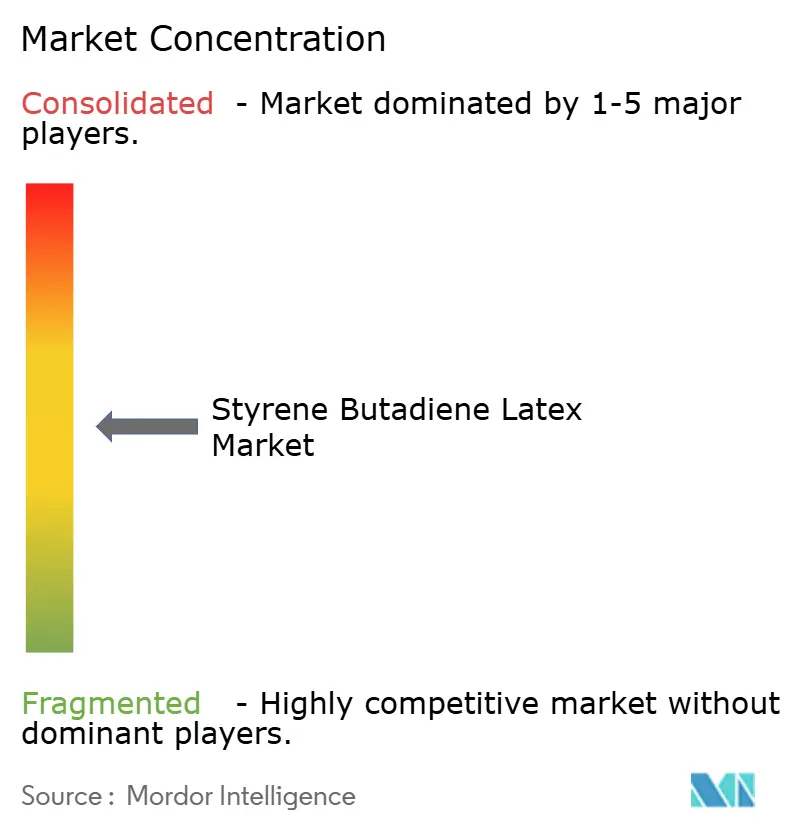
The styrene butadiene latex market is moderately fragmented. BASF, Dow, Synthomer, Trinseo, LG Chem, Kumho Petrochemical, and JSR hold production capacity positions, while regional specialists serve country-level demand. Apcotex in India, NANTEX in Taiwan, and Mallard Creek Polymers in the United States compete in applications such as carpet backing and general-purpose adhesives. Competitive conditions vary by application. Paper coating requires lengthy supplier qualification processes and established technical relationships. Qualified paper-coating suppliers can have customer lock-in periods of up to 36 months. In contrast, carpet backing has narrower margins, and small cost changes can affect sourcing decisions.
BASF expanded certified XSBL capacity at its Hamina site in 2025 and developed XSB binders under the Licity brand for lithium-ion battery applications. This strategy combines sustainability certification with participation in specialized applications. The company also increased North American carpet latex prices by USD 0.04 per dry lb in May 2025. These actions reflect the use of product development, certification, and pricing strategies across applications.
Kumho Petrochemical is diversifying into solution styrene-butadiene rubber (SSBR) for EV tires and exploring recycled styrene monomer as a sustainability initiative. Commercially available bio-based styrene-butadiene latex remains under development, as European pilot grades containing 30% renewable carbon have not achieved cost parity in mainstream applications. This supports product differentiation as purchasers increasingly consider renewable content. The styrene butadiene latex market favors scale and certified products in paper-coating tenders, while cost control and local logistics remain important in carpet backing and commodity adhesive applications.
Styrene Butadiene Latex Industry Leaders
Synthomer plc
Trinseo
Dow
BASF
LG Chem
- *Disclaimer: Major Players sorted in no particular order

Recent Industry Developments
- December 2025: Trinseo launched Voltabond 109, a latex binder under its fourth-generation styrene-butadiene rubber (SBR) battery-binder platform, for lithium-ion batteries used in electric vehicle (EV) and energy storage system (ESS) applications. Developed in collaboration with global battery manufacturers, the platform provides up to 30% higher peel strength than conventional SBR binders, supporting electrode adhesion and coating operations.
- May 2025: Trinseo announced a price increase of USD 0.04 per dry pound for all styrene-butadiene latex products sold to the North American carpet market, effective July 1, 2025. The company attributed the increase to higher raw material and transportation costs. The increase applied to both indexed and non-indexed customers, where permitted by contracts.


Global Styrene Butadiene Latex Market Report Scope
Styrene butadiene latex is a water-based synthetic rubber emulsion produced through the polymerization of styrene and butadiene monomers. Manufacturers use it in applications such as paper coating, carpet backing, adhesives, sealants, and construction materials.
The styrene butadiene latex market is segmented by product type, application, and geography. By product type, the market is segmented into carboxylated styrene butadiene latex, non-carboxylated styrene butadiene latex, and specialty modified styrene butadiene latex. By application, the market is segmented into paper and paperboard coating, carpet backing and textile backcoating, adhesives and sealants, paints and coatings, glass fiber processing, mortar additives, and other applications. The report also covers market size and forecasts for styrene butadiene latex across 15 countries in major regions. The market sizes and forecasts are provided in terms of value (USD).
| Carboxylated Styrene Butadiene Latex |
| Non-Carboxylated Styrene Butadiene Latex |
| Specialty Modified Styrene Butadiene Latex |
| Paper and Paperboard Coating |
| Carpet Backing and Textile Backcoating |
| Adhesives and Sealants |
| Paints and Coatings |
| Glass Fiber Processing |
| Mortar Additives |
| Other Applications |
| Asia-Pacific | China |
| India | |
| Japan | |
| South Korea | |
| ASEAN Countries | |
| Rest of Asia-Pacific | |
| North America | United States |
| Canada | |
| Mexico | |
| Europe | Germany |
| United Kingdom | |
| France | |
| Italy | |
| NORDIC Countries | |
| Rest of Europe | |
| South America | Brazil |
| Argentina | |
| Rest of South America | |
| Middle East and Africa | Saudi Arabia |
| South Africa | |
| Rest of Middle East and Africa |
| By Product Type | Carboxylated Styrene Butadiene Latex | |
| Non-Carboxylated Styrene Butadiene Latex | ||
| Specialty Modified Styrene Butadiene Latex | ||
| By Application | Paper and Paperboard Coating | |
| Carpet Backing and Textile Backcoating | ||
| Adhesives and Sealants | ||
| Paints and Coatings | ||
| Glass Fiber Processing | ||
| Mortar Additives | ||
| Other Applications | ||
| By Geography | Asia-Pacific | China |
| India | ||
| Japan | ||
| South Korea | ||
| ASEAN Countries | ||
| Rest of Asia-Pacific | ||
| North America | United States | |
| Canada | ||
| Mexico | ||
| Europe | Germany | |
| United Kingdom | ||
| France | ||
| Italy | ||
| NORDIC Countries | ||
| Rest of Europe | ||
| South America | Brazil | |
| Argentina | ||
| Rest of South America | ||
| Middle East and Africa | Saudi Arabia | |
| South Africa | ||
| Rest of Middle East and Africa | ||


Key Questions Answered in the Report
What is current market size of Styrene Butadiene Latex Market?
The Styrene Butadiene Latex market size was valued at USD 7.57 billion in 2025 and is estimated to grow from USD 7.88 billion in 2026 to reach USD 9.79 billion by 2031, at a CAGR of 4.43% during the forecast period (2026-2031).
Which product type drove styrene-butadiene latex demand in 2025?
Carboxylated styrene butadiene latex led product demand with a 60.34% share in 2025, supported by pigment binding and coating-line stability.
Which application is growing the fastest through 2031?
Mortar additives are forecast to grow at a 5.12% CAGR, supported by infrastructure rehabilitation and waterproofing construction.
Which region leads styrene butadiene latex demand?
Asia-Pacific led demand with a 44.18% share in 2025 and is projected to expand at a 4.81% CAGR through 2031.
Page last updated on:


 Your data is secure and never sold or shared.


