
Struvite Fertilizers Market Size and Share
Market Overview
| Study Period | 2021 - 2031 |
|---|---|
| Market Size (2026) | USD 650 Million |
| Market Size (2031) | USD 940 Million |
| Growth Rate (2026 - 2031) | 7.80 % |
| Fastest Growing Market | Asia-Pacific |
| Largest Market | North America |
| Market Concentration | Medium |
Major Players *Disclaimer: Major Players sorted in no particular order Image © Mordor Intelligence. Reuse requires attribution under CC BY 4.0. | |
Struvite Fertilizers Market Analysis by Mordor Intelligence
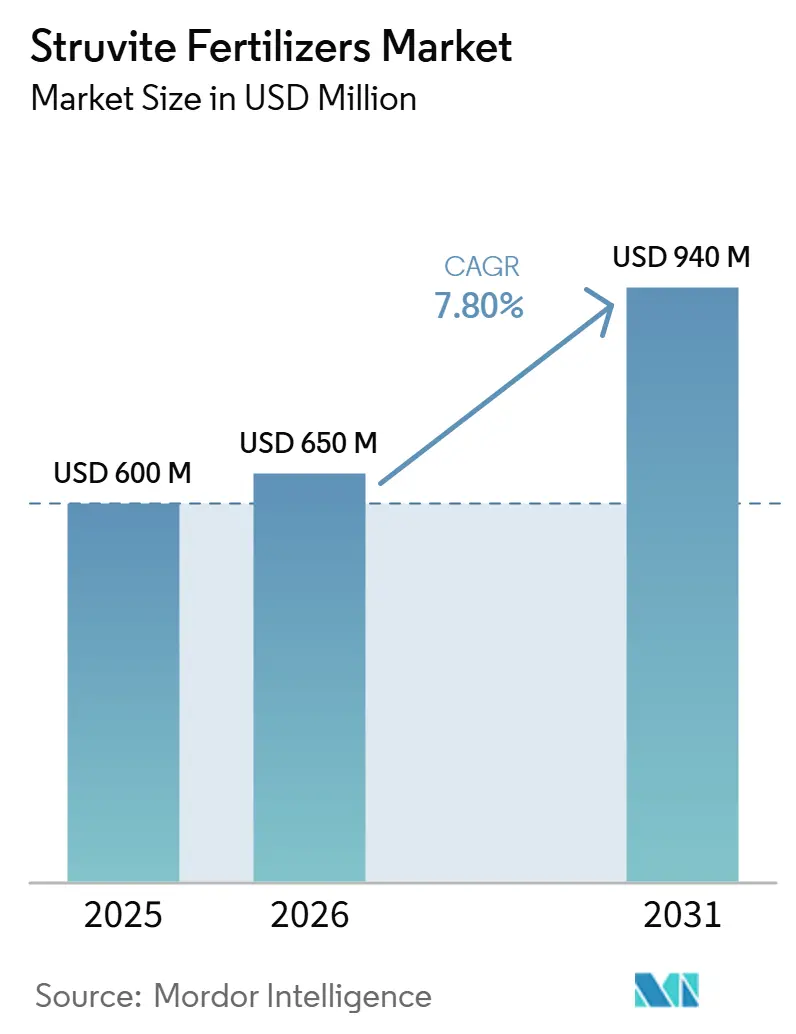
The Struvite Fertilizers Market size was valued at USD 600 million in 2025 and is estimated to grow from USD 650 million in 2026 to reach USD 940 million by 2031, at a CAGR of 7.80% during the forecast period (2026-2031). The struvite fertilizers market is benefiting from a steady shift in phosphorus sourcing as wastewater utilities and fertilizer buyers seek alternatives to mined phosphate. Supply concentration among a small group of phosphate-producing countries is keeping import-dependent regions focused on securing recovered nutrients. Struvite, which is magnesium ammonium phosphate recovered from wastewater streams, is gaining support due to its slow-release nutrient profile and a more controlled supply route compared to mined rock phosphate. The market is also attracting buyers seeking products aligned with circular-economy goals, low runoff, and clearer traceability. Regulatory support in Europe and parts of Asia, along with growing farmer interest in lower-carbon inputs, is keeping the struvite fertilizers market on a firm growth path through 2031.
Key Report Takeaways
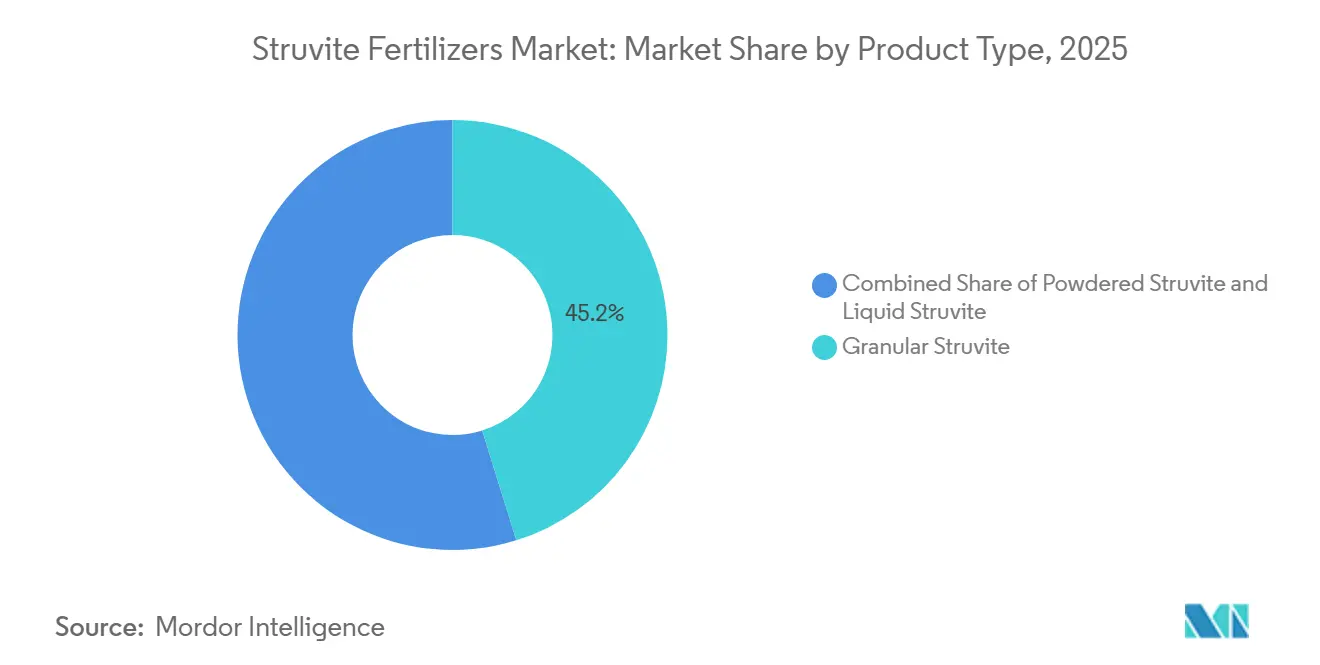
- By product type, granular struvite accounted for 45.2% of the struvite fertilizers market size in 2025, while liquid struvite is forecast to expand at an 8.8% CAGR through 2031.
- By application, agriculture accounted for 38.5% of the struvite fertilizers market share in 2025, while horticulture recorded the highest projected CAGR of 8.6% through 2031.
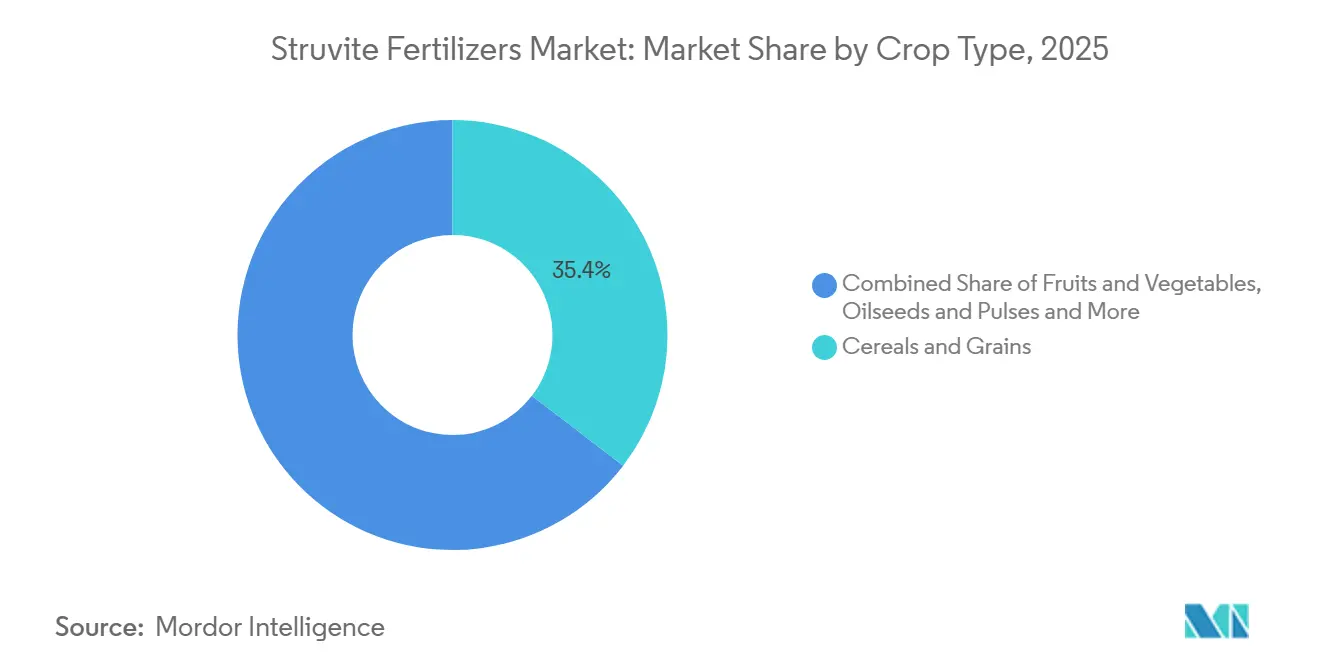
- By crop type, cereals and grains led with a 35.4% share in 2025, while fruits and vegetables are projected to advance at an 8.1% CAGR through 2031.
- By geography, North America led with 35.8% share in 2025, while Asia-Pacific is forecast to grow at a 9.5% CAGR through 2031.
Note: Market size and forecast figures in this report are generated using Mordor Intelligence’s proprietary estimation framework, updated with the latest available data and insights as of January 2026.
Global Struvite Fertilizers Market Trends and Insights
Drivers Impact Analysis*
| Driver | (~) % Impact on CAGR Forecast | Geographic Relevance | Impact Timeline |
|---|---|---|---|
| Phosphorus Scarcity and Import Dependency | +2.5% | Global, strongest in Europe, Japan, South Korea, and India | Long term (≥ 4 years) |
| Regulatory Nutrient Recovery Mandates | +2.2% | Europe, North America, and Asia-Pacific, strongest in Germany, the Netherlands, and Belgium | Medium term (2-4 years) |
| Circular Economy Adoption in Wastewater Recovery | +1.6% | Europe first, followed by North America and Asia-Pacific | Medium term (2-4 years) |
| Premium Demand for Low-Carbon and Organic-Approved Inputs | +1.1% | Europe and North America, with early gains in Germany, the Netherlands, and the United States's Pacific Northwest | Short term (≤ 2 years) |
| Process Integration Gains From Automated Nutrient Recovery | +0.8% | Asia-Pacific first, followed by North America and Europe | Medium term (2-4 years) |
| Recovered Nutrient Standardization Opening New Procurement Channels | +0.5% | North America, Europe, and selected markets in the Middle East and South Korea | Long term (≥ 4 years) |
| Source: Mordor Intelligence | |||
Phosphorus Scarcity and Import Dependency
Phosphorus is treated as a strategic raw material in Europe because fertilizer supply remains tied to a narrow group of producing countries. In 2025, Around 85% of economically recoverable reserves are concentrated in Morocco and Western Sahara, while China controls a large share of mine-to-market supply. This concentration exposes import-dependent regions to policy shifts and trade disruptions. For Japan, South Korea, Europe, and India, disruptions in mined phosphate flows can quickly affect procurement planning for both utilities and agricultural buyers. Japan has moved toward domestic recovery through its revised Fertilizer Control Act, which established end-of-waste criteria for recovered phosphorus products and supported wastewater-based nutrient recovery systems. The Tokyo Metropolitan Government commissioned a phosphorus recovery facility at its Eastern Sludge Plant in January 2024, and Kobe City expanded its recycled phosphorus project with a third recovery unit planned for fiscal 2027. These developments indicate that the shift is moving beyond policy discussion into physical capacity buildout. The struvite fertilizers market is benefiting from this trend, as each additional ton of recovered phosphorus reduces reliance on imported rock phosphate throughout a project's life. This supply security consideration is becoming more important in long-term offtake decisions, particularly in regions without stable domestic phosphate mining.
Regulatory Nutrient Recovery Mandates
The struvite fertilizers market is also advancing as nutrient recovery shifts from a voluntary practice to a compliance requirement in several major wastewater systems. Germany's revised Sewage Sludge Ordinance requires wastewater treatment plants above 50,000 population equivalents to either reduce phosphorus content in sewage sludge by at least 50% or recover 80% of phosphorus from sewage sludge ash by 2029. This requirement creates a direct path for struvite recovery technologies by making phosphorus extraction a project necessity rather than a discretionary upgrade. At the European level, the EU Fertilising Products Regulation and Delegated Regulation (EU) 2021/2086 allow struvite under Component Material Category 12, enabling CE-marked material to move across the single market with fewer national barriers[1]Source: EUR-Lex, “Consolidated Text 32019R1009,” EUR-Lex, eur-lex.europa.eu. South Korea's 2025 legislative revision created an end-of-waste route for recovered phosphorus and required large municipal wastewater plants to install phosphorus recovery systems by 2030. The struvite fertilizers market benefits from these regulations as wastewater operators can manage sludge handling economics while generating a secondary revenue stream from fertilizer output. When regulatory deadlines align with plant investment cycles, adoption tends to progress in defined steps rather than small trials, supporting more predictable capacity growth.
Circular Economy Adoption in Wastewater Recovery
The circular economy trend is strengthening the struvite fertilizers market as utilities increasingly treat wastewater plants as resource recovery facilities rather than disposal sites. Mature deployments are pushing payback periods below 7 years, as inline monitoring, automated magnesium dosing, and integration with anaerobic digestion improve operating efficiency. The NPower project under Horizon Europe, with Veolia Water Technologies among the participants, is deploying multiple nutrient recovery technologies at Spanish wastewater treatment plants between 2025 and 2028 to produce 8 commercial fertilizer products, including struvite. Such demonstrations are significant because they reduce the gap between pilot validation and routine commercial procurement. Utilities using struvite recovery can also reduce phosphorus return loads to biological treatment trains by 80%, thereby improving plant efficiency and reducing equipment wear, broadening the business case beyond fertilizer sales alone. AquaMinerals reported in 2026 that the Netherlands already has spare struvite recovery capacity that could be better utilized through improved process management, indicating that parts of the supply base are now ahead of downstream demand. The struvite fertilizers market is therefore being shaped by both supply-side infrastructure growth and the need to develop stronger offtake channels for material already being recovered.
Premium Demand for Low-Carbon and Organic-Approved Inputs
Premium crop systems are supporting growth in the struvite fertilizers market, as buyers in these segments are more willing to pay for traceable, lower-impact nutrient inputs. A significant development came in April 2024 when Ostara secured the first EU organic certification for Crystal Green Pearl and registered the product in Germany, Spain, Denmark, Austria, and the Netherlands for use in certified organic farming. This approval is significant because it gives struvite access to a channel that many conventional phosphate products cannot enter. Life cycle assessments conducted across more than 20 universities in the United States and Canada showed that struvite-based fertilizers can reduce global warming potential by up to 11% and freshwater eutrophication by up to 50% compared with conventional phosphate inputs. These environmental performance claims are becoming more relevant as retailers and food brands increase pressure on farm supply chains to document lower scope 3 emissions. Horticulture is showing the clearest response, as premium fruit, vegetable, and specialty crop systems can more readily absorb the price premium when sustainability claims are measurable. The struvite fertilizers market is therefore seeing faster uptake in segments where buyers value product identity, organic compliance, and reduced runoff as part of a broader crop positioning strategy.
Restraints Impact Analysis*
| Restraint | (~) % Impact on CAGR Forecast | Geographic Relevance | Impact Timeline |
|---|---|---|---|
| Higher Unit Cost Versus Conventional Phosphate Fertilizers | -1.8% | Global, most acute in Asia-Pacific and South America where conventional fertilizers are subsidized | Long term (≥ 4 years) |
| Limited Farmer Familiarity and Distribution Depth | -0.9% | Asia-Pacific, Africa, and South America, with a smaller effect in North America and Europe | Medium term (2-4 years) |
| Product Quality Variability and Contamination Concerns | -0.7% | Global, strongest in the EU and North America where contaminant thresholds are explicit | Medium term (2-4 years) |
| Municipal Budget Constraints and Slow Procurement Cycles | -0.5% | North America and Europe, with spillover effects in early stage Middle East and Africa markets | Short term (≤ 2 years) |
| Source: Mordor Intelligence | |||
Higher Unit Cost Versus Conventional Phosphate Fertilizers
The struvite fertilizers market faces a clear pricing challenge when competing against conventional phosphate fertilizers in large-volume crop systems. A 2025 Ohio State University field observation cited struvite at USD 0.60 per pound compared with USD 0.40 to USD 0.45 per pound for monoammonium phosphate, even though the same study indicated that lower application rates could support comparable soybean yields over time. This price gap is rooted in crystallization equipment costs, magnesium input requirements, and freight burdens, as many recovery plants are located at wastewater sites rather than near crop demand centers. The barrier is more pronounced in countries where conventional phosphate fertilizers receive public subsidies, as these widen the cost gap at the point of sale. The slow-release profile of struvite can improve cost effectiveness over multiple seasons, as part of the phosphorus remains available after the first crop cycle, but this value is difficult to communicate within an annual procurement process. Commodity buyers typically compare invoice prices rather than season-by-season nutrient efficiency, which slows adoption. The struvite fertilizers market is therefore advancing first in applications where performance, certification, or runoff reduction can justify a higher upfront price. Wider adoption in broadacre crop systems will likely depend on either stronger agronomic proof at scale or a reduction in the delivered cost gap.
Limited Farmer Familiarity and Distribution Depth
Limited farmer awareness of recovered nutrient products remains a practical barrier for the struvite fertilizers market. Many growers have limited experience with these products, and knowledge of trial results tends to remain localized around extension networks and demonstration areas. For example, a soybean trial at Smits Farms in Illinois reported a 5 bushel per acre yield gain in 2024, but awareness of such results has not spread widely beyond regional extension networks. In many parts of Asia, Africa, and South America, input decisions are shaped more by dealer relationships and village-level distributors than by formal agronomic advisory systems. This slows new product introduction, as local channels tend to prefer materials with established financing structures, known storage practices, and familiar application methods. Conventional phosphate fertilizers are already embedded in strong cooperative and dealer networks, giving them a distribution advantage that recovered nutrients still lack in many regions. Struvite suppliers require multi-season field support, co-marketing arrangements with distributors, and clearer application guidance to move beyond niche adoption. The struvite fertilizers market has potential for broader expansion, but only if channel development keeps pace with production capacity and regulatory acceptance. Without this effort, technical suitability will continue to outpace commercial uptake in several promising regions.
*Our forecasts treat driver/restraint impacts as directional, not additive. The impact forecasts reflect baseline growth, mix effects, and variable interactions.
Segment Analysis
By Product Type: Granular Format Dominates While Liquid Grade Accelerates
Granular struvite held 45.2% of the market in 2025, making it the largest product format in the struvite fertilizers market. Its dominant position stems from direct compatibility with existing spreaders, seed-safe placement near germinating crops, and the fact that commercial production systems have been built primarily around pellet output. Granular adoption has also been supported by field research from Ohio State University and the University of Illinois, which demonstrated equivalent crop yields to monoammonium phosphate at lower application rates in cereal systems. This combination of equipment compatibility and agronomic familiarity gives granular struvite a strong position in broadacre settings and explains why early market volume has been built through farm systems that require no changes in handling practices.
Liquid struvite is the fastest-growing format, with this segment projected to expand at an 8.8% CAGR through 2031. Growth is being driven by fertigation-based horticulture, where soluble nutrient delivery via drip systems is standard, while solid granules are less practical. Powdered struvite occupies a position between these two formats, suited to specialty applications such as nursery substrate blending and turf establishment mixes where fine, even coverage is required. Product regulation is also becoming more important across all formats, as Europe's harmonized fertilizer framework reduces uncertainty around quality definitions and labeling requirements. As a result, the struvite fertilizers market is seeing a clearer separation between granular large-scale applications, liquid precision uses, and powdered specialty niches.



By Application: Agriculture Anchors Volume but Horticulture Commands Margin
Agriculture accounted for 38.5% of demand in 2025, giving it the largest application base in the struvite fertilizers market. This reflects broad potential for use in row crops across North America and in cereal-heavy farming systems across Europe and South Asia. Slow-release phosphorus is well suited to corn and wheat production systems where surface-applied nutrients can be lost through runoff. Life cycle assessments for Crystal Green reported freshwater eutrophication reductions of up to 50% compared with conventional phosphate inputs, which supports adoption where watershed nutrient management plans are in place. This environmental performance helps the struvite fertilizers market maintain its value proposition beyond a simple nutrient price comparison.
Horticulture is the fastest-growing application, with a projected CAGR of 8.6% through 2031, and this segment has been more able to sustain premium pricing in the struvite fertilizers market. Fruit and vegetable growers can justify higher input costs when retailer sustainability requirements, organic certification, or traceable sourcing create direct commercial value. Ostara's 2024 EU organic certification for Crystal Green Pearl added a practical route into certified organic horticulture in several European countries[2]Source: Ostara Nutrient Recovery Technologies Inc., “Ostara Inc. Launches CG P2X in Western Canada, Phosphorus, Perfected,” Ostara, ostara.com. Turf and ornamental remains a smaller segment, but its controlled-release profile, reduced runoff risk, and lower application frequency keep it relevant for professional landscape managers. Other applications, including aquaculture nutrient use and biorefinery-related pathways, remain limited in volume but indicate how the struvite fertilizers market can expand its use base where specialized nutrient control is valued.
By Crop Type: Cereals Hold Scale While Fruits and Vegetables Drive Innovation
Cereals and grains held 35.4% of the market in 2025, making them the largest crop segment in the struvite fertilizers market. This position reflects the dominance of row crop agriculture in North America and Europe, where soil phosphorus management and runoff control are established agronomic concerns. This segment is tied to corn, wheat, and canola systems, where slow-release phosphorus can be integrated into existing nutrient programs. Soybean trial results from Illinois in 2024 indicated a 5-bushel-per-acre yield increase, suggesting that controlled phosphorus release can support rotation systems under demanding field conditions. This positions cereals and grains as central to long-term volume potential, even as early adoption has not yet reached all commodity growers.
Fruits and vegetables are the fastest-growing crop segment, with struvite fertilizers market share for these crops projected to rise at an 8.1% CAGR through 2031. Protected cultivation in Asia-Pacific and the Middle East is a key growth factor, as greenhouse, polytunnel, and hydroponic systems require precise water and nutrient management. Premium produce markets reward input traceability more directly than bulk grain markets, which is driving faster adoption of struvite fertilizers in these crops. Oilseeds and pulses represent an additional growth area, as sustainability programs increasingly require stronger input documentation in soybean and rapeseed supply chains. A 2025 RSC Advances study reported 97.42% phosphorus recovery from swine wastewater using fluidized bed homogeneous crystallization, which is relevant to livestock-linked nutrient loops in major oilseed and pulse producing regions. Overall, the struvite fertilizers market shows a clear pattern in crop use, with cereals and grains maintaining scale while fruits, vegetables, and selected rotation crops drive higher-value adoption.
Geography Analysis
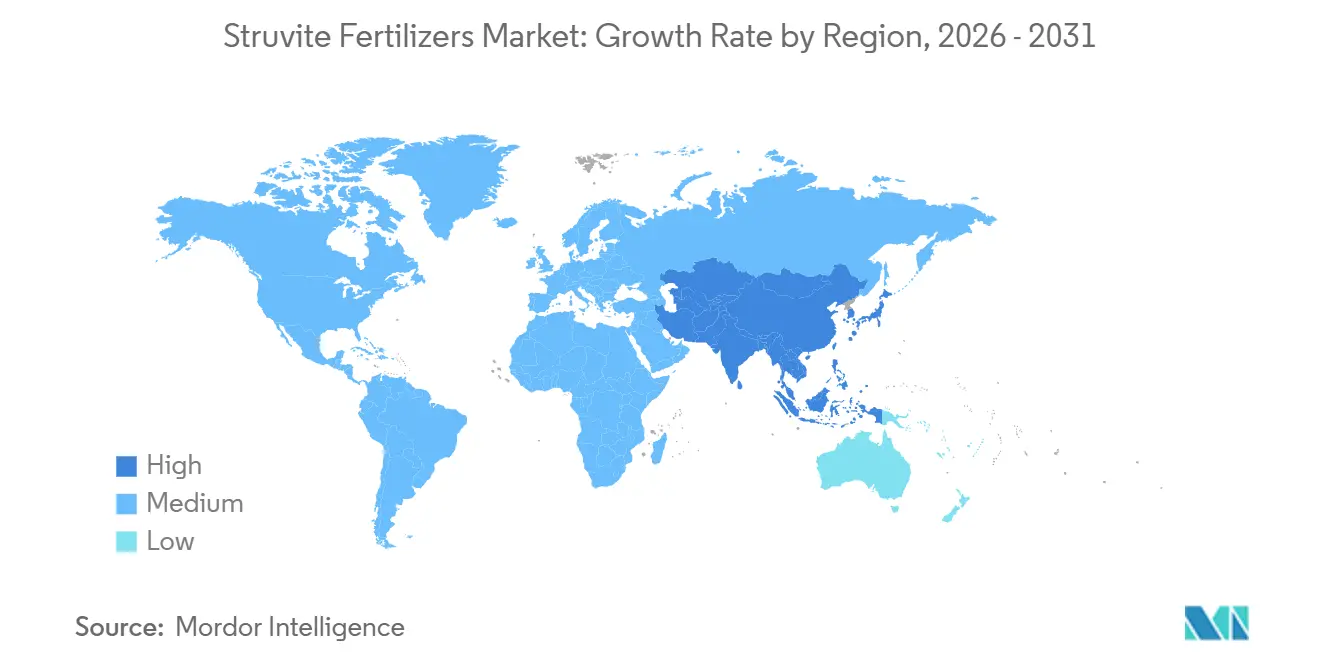
North America held a 35.8% share in 2025, maintaining its position as the largest regional market for struvite fertilizers. The region is projected to expand at a CAGR of 7.0% to 8.0% through 2031, supported by established commercial production and clearer regulatory treatment for recovered phosphorus products. The United States has the most developed commercial base, with Ostara's St. Louis facility supplying CG P2X to retailers across the Midwest and Pacific Northwest under a domestic production model that reduced tariff exposure in 2025. Canada also remains active, with wastewater upgrades such as Winnipeg's incorporating struvite extraction for commercial output. South America represents a smaller market at present, but large-scale agriculture and expanding wastewater infrastructure are anticipated to create a new supply of recovered nutrients over time.
Europe is projected to grow, with regulation remaining the primary driver of market expansion. Germany's 2029 phosphorus recovery deadline is driving municipal investment, and the P-Net project at Braunschweig and Gifhorn is testing optimized precipitation to meet future sludge limits. Belgium produces an estimated 16% to 20% of Europe's commercial struvite, with NuReSys and AirPrex holding strong positions in the production landscape. The Netherlands, with around 50 full-scale recovery installations and some spare capacity, demonstrates that supply development can advance faster than offtake unless agronomic marketing and procurement channels also improve.
Asia-Pacific is the fastest-growing region in the struvite fertilizers market, with a projected CAGR of 9.5% through 2031. Japan leads the region in regulatory and commercial maturity, as its 2020 Fertilizer Control Act revision established clear contaminant limits for recovered phosphorus and supported domestic recovery projects. Kobe City expanded its recycled phosphorus project and planned an additional recovery unit for fiscal 2027, confirming that municipal-scale recovery is already operational in Japan. India is also building domestic capability, with Thermax opening a new water and waste solutions manufacturing facility in Pune in April 2024, tied to an order book target of INR 1,000 crore (USD 120 million) for the business. The Middle East and Africa are expanding supported by large wastewater projects such as WABAG's 60 MLD Ajman Sewage Biorefinery Plant Phase 3, awarded in June 2026, which illustrates the scale of infrastructure that can eventually support nutrient recovery co-location[3]Source: WABAG, “Ajman Sewage Biorefinery Plant Phase 3 Contract in UAE,” WABAG, wabag.com .

Competitive Landscape
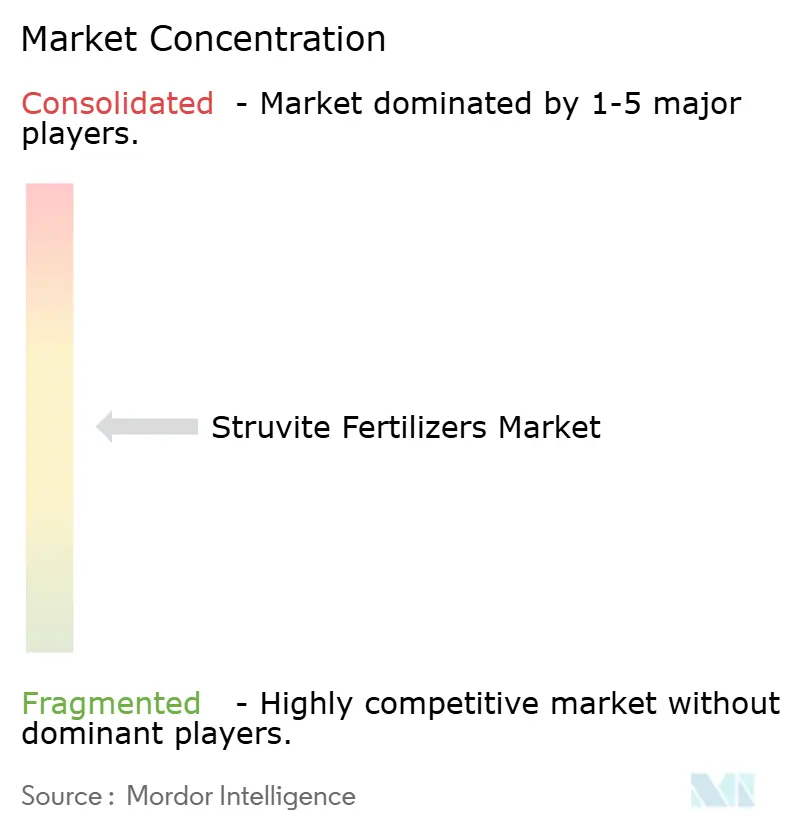
The global struvite fertilizers market is moderately fragmented in 2025. Ostara Nutrient Recovery Technologies Inc., Veolia Water Technologies, and SUEZ Water Technologies and Solutions formed the leading tier in 2025. Competition is divided between broad wastewater technology integrators and more focused nutrient recovery companies. Integrators such as Veolia, SUEZ, Xylem, WABAG, and Thermax can incorporate struvite recovery into larger municipal infrastructure programs. Specialists such as Ostara, NuReSys, Multiform Harvest, and AirPrex compete more directly on fertilizer output quality, agronomic performance support, and access to downstream offtake.
A gap remains in the struvite fertilizers market between wastewater technology deployment and fertilizer channel development. Some utilities install recovery systems through engineering contractors but lack strong commercial routes to sell fertilizer output, which reduces the value captured from recovered phosphorus. Licensing and partnership models are one response to this gap. Xylem's licensing partnership with Ostara around the Pearl recovery system illustrates how technology and commercialization can be linked across deployments. Patent protection in reactor design, automated dosing, and granule conditioning also favors firms with an established technology base, making it harder for smaller entrants to scale quickly even when they have promising process ideas.
The competitive landscape is also shaped by adjacent suppliers whose products support recovery operations without owning the core struvite process. Ecolab and Solenis are positioned to benefit as larger output volumes increase demand for water treatment chemistry, precipitation reagents, and process control support. Solenis expanded its position through the acquisition of NCH Corporation in November 2025, which widened its industrial water and hygiene platform across more than 160 countries. Ostara's June 2025 launch of CG P2X in Western Canada through Taurus Agricultural Marketing demonstrated how companies are investing in stronger downstream distribution rather than relying solely on technology sales. WABAG's large wastewater awards in the UAE and Georgia during 2026 further illustrate how engineering firms are building future nutrient recovery options through broader water infrastructure expansion. The struvite fertilizers market is therefore competitive in both technology and route to market, and success depends on linking wastewater recovery with reliable fertilizer offtake.
Struvite Fertilizers Industry Leaders
Ostara Nutrient Recovery Technologies Inc.
Veolia Water Technologies
SUEZ Water Technologies and Solutions
CNP - Technology Water and Biosolids Corporation
Nijhuis Saur Industries
- *Disclaimer: Major Players sorted in no particular order

Recent Industry Developments
- July 2026: Yara International ASA agreed to acquire Gulf Coast Ammonia's Texas City production facility for USD 1.3 billion, adding 1.3 million metric tons of ammonia capacity and positioning the company to deepen downstream integration of phosphorus and multi-nutrient fertilizers in North America, with implications for struvite offtake agreements given the company's crop nutrition scale.
- June 2026: WABAG was awarded the design-and-build contract for the Ajman Sewage Biorefinery Plant Phase 3 in the United Arab Emirates. The facility has a capacity of 60 MLD (Million Liters per Day) and includes advanced sludge management systems, with completion anticipated within 24 months. This contract marks WABAG's entry into the United Arab Emirates market and the GCC (Gulf Cooperation Council) wastewater infrastructure sector.
- January 2026: Ecolab and Yara International ASA renewed a 10-year partnership at Yara's Le Havre fertilizer facility, building on a prior collaboration that reduced water consumption by 14% and electricity consumption by 21%, demonstrating how integrated water management directly reduces the operating cost of large-scale fertilizer production


Global Struvite Fertilizers Market Report Scope
Struvite fertilizer is a slow-release, eco-friendly mineral fertilizer made of magnesium ammonium phosphate hexahydrate.
The Struvite Fertilizers Market Report is segmented by product type (granular struvite, powdered struvite, and liquid struvite), by application (agriculture, horticulture, turf and ornamental, and others), by crop type (cereals and grains, fruits and vegetables, oilseeds and pulses, and others), and by geography (North America, South America, Europe, Asia-Pacific, the Middle East, and Africa). The market forecasts are provided in terms of value in USD.
| Granular Struvite |
| Powdered Struvite |
| Liquid Struvite |
| Agriculture |
| Horticulture |
| Turf and Ornamental |
| Other Applications |
| Cereals and Grains |
| Fruits and Vegetables |
| Oilseeds and Pulses |
| Other Crop Types |
| North America | United States |
| Canada | |
| Mexico | |
| Rest of North America | |
| South America | Brazil |
| Argentina | |
| Rest of South America | |
| Europe | Germany |
| France | |
| United Kingdom | |
| Italy | |
| Spain | |
| Russia | |
| Turkey | |
| Rest of Europe | |
| Asia-Pacific | China |
| Japan | |
| India | |
| South Korea | |
| Rest of Asia-Pacific | |
| Middle East | Saudi Arabia |
| United Arab Emirates | |
| Rest of Middle East | |
| Africa | South Africa |
| Egypt | |
| Rest of Africa |
| By Product Type | Granular Struvite | |
| Powdered Struvite | ||
| Liquid Struvite | ||
| By Application | Agriculture | |
| Horticulture | ||
| Turf and Ornamental | ||
| Other Applications | ||
| By Crop Type | Cereals and Grains | |
| Fruits and Vegetables | ||
| Oilseeds and Pulses | ||
| Other Crop Types | ||
| By Region | North America | United States |
| Canada | ||
| Mexico | ||
| Rest of North America | ||
| South America | Brazil | |
| Argentina | ||
| Rest of South America | ||
| Europe | Germany | |
| France | ||
| United Kingdom | ||
| Italy | ||
| Spain | ||
| Russia | ||
| Turkey | ||
| Rest of Europe | ||
| Asia-Pacific | China | |
| Japan | ||
| India | ||
| South Korea | ||
| Rest of Asia-Pacific | ||
| Middle East | Saudi Arabia | |
| United Arab Emirates | ||
| Rest of Middle East | ||
| Africa | South Africa | |
| Egypt | ||
| Rest of Africa | ||


Key Questions Answered in the Report
What is the projected value of struvite fertilizers by 2031?
The struvite fertilizers market is projected to reach USD 0.94 billion by 2031, rising from USD 0.65 billion in 2026 at a 7.8% CAGR.
Which region leads global demand for struvite fertilizers?
North America led in 2025 with a 35.8% share, supported by established commercial production and clearer treatment of recovered phosphorus products.
Which region is projected to grow the fastest through 2031?
Asia-Pacific is the fastest growing region, with a projected CAGR of 9.5% through 2031, driven by regulatory action and expanding wastewater recovery systems.
Which product format is most widely used today?
Granular struvite led with 45.2% share in 2025 because it fits existing fertilizer spreading equipment and established pellet production systems.
Which application is growing the fastest?
Horticulture is projected to grow at an 8.6% CAGR through 2031 because premium crop systems place higher value on traceability, organic approval, and low runoff performance.
Page last updated on:





