
String Cheese Market Size and Share
Market Overview
| Study Period | 2022 - 2032 |
|---|---|
| Market Size (2027) | USD 22.30 Billion |
| Market Size (2032) | USD 27.87 Billion |
| Growth Rate (2027 - 2032) | 4.56 % |
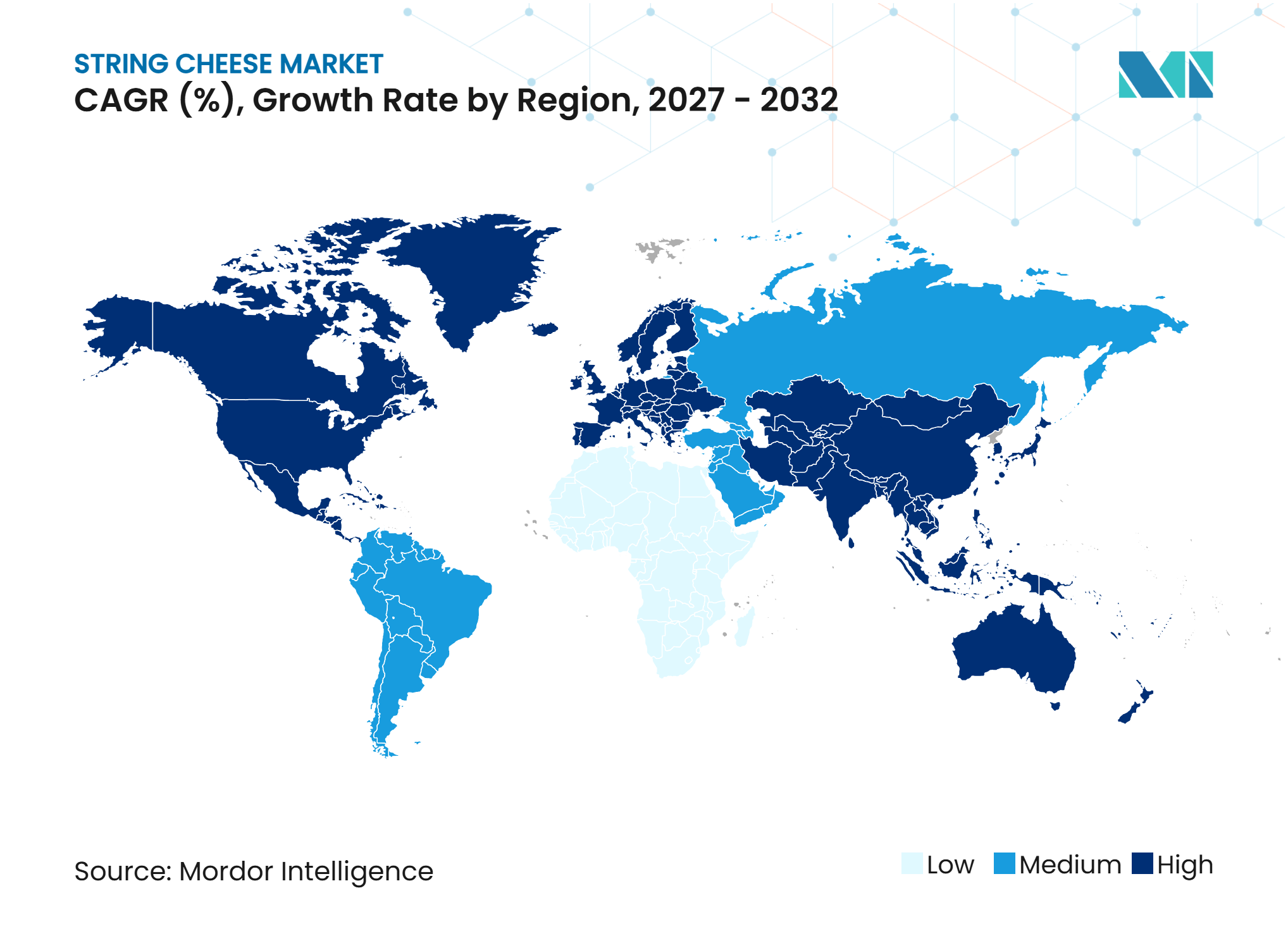
| Fastest Growing Market | Middle East and Africa |
| Largest Market | Asia-Pacific |
| Market Concentration | Low |
Major Players *Disclaimer: Major Players sorted in no particular order Image © Mordor Intelligence. Reuse requires attribution under CC BY 4.0. | |
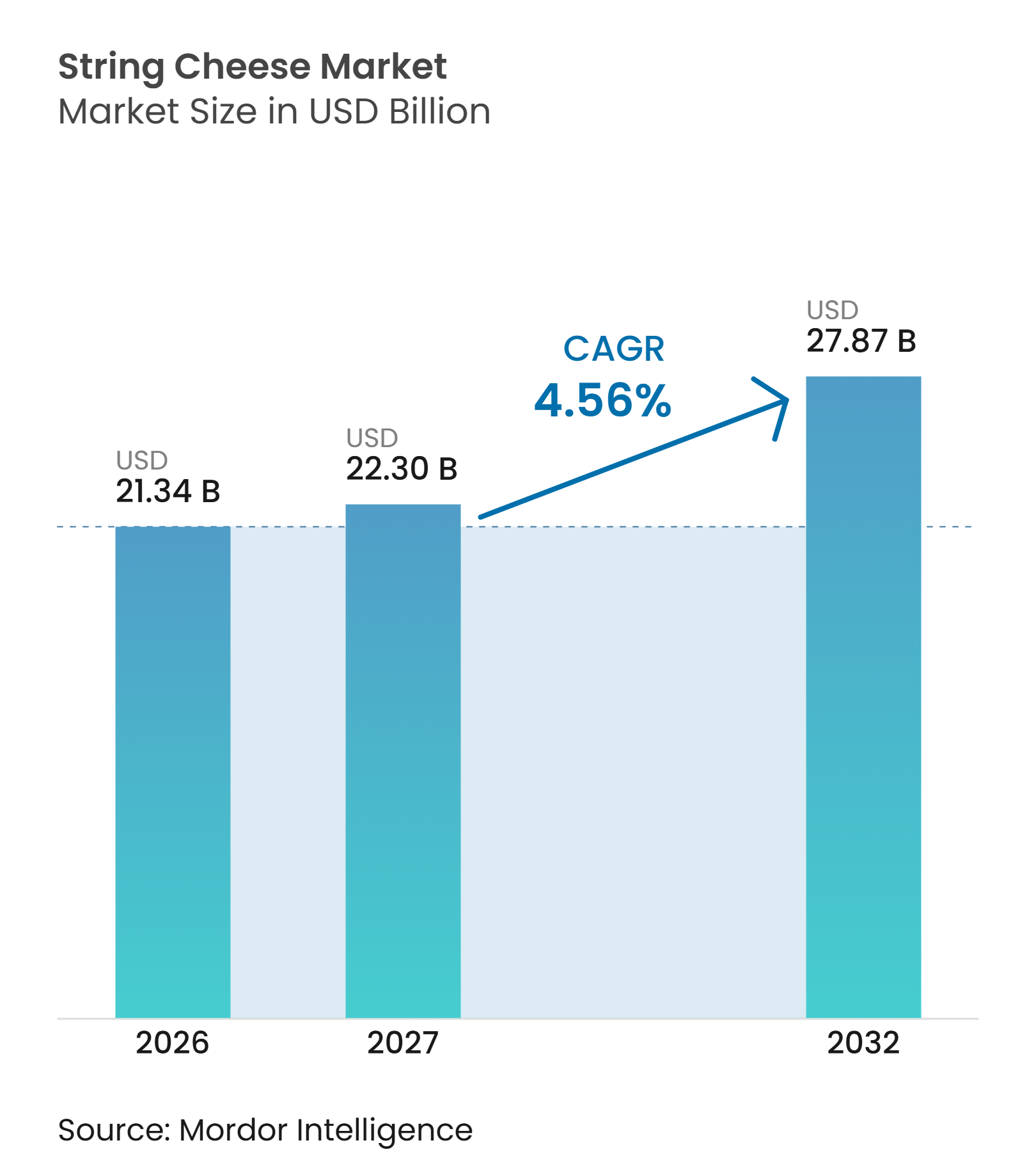
String Cheese Market Analysis by Mordor Intelligence
The string cheese market size was valued at USD 5.35 billion in 2026 and is forecast to reach USD 7.03 billion by 2032, at a CAGR of 4.69% during 2027-2032. The string cheese market benefits from demand for portable dairy snacks that combine protein, calcium, portion control, and refrigerated convenience in one familiar product. Natural formats remain important because shoppers and institutional buyers value straightforward ingredient lists, known dairy inputs, and a taste profile that works across household, school, and foodservice occasions. Manufacturers are widening usage occasions through flavored products, cheddar-mozzarella blends, and pack formats designed for lunchboxes, adult snacking, commuting, and planned household shopping. Established dairy companies are pairing product development with capacity investment, while regional processors continue to serve local retail and foodservice demand through established milk collection and distribution relationships. Cold-chain costs, milk-price changes, and dietary restrictions remain practical limits on the string cheese market, especially where refrigeration networks are less developed and value-oriented products have limited room for price increases.
Key Report Takeaways
-
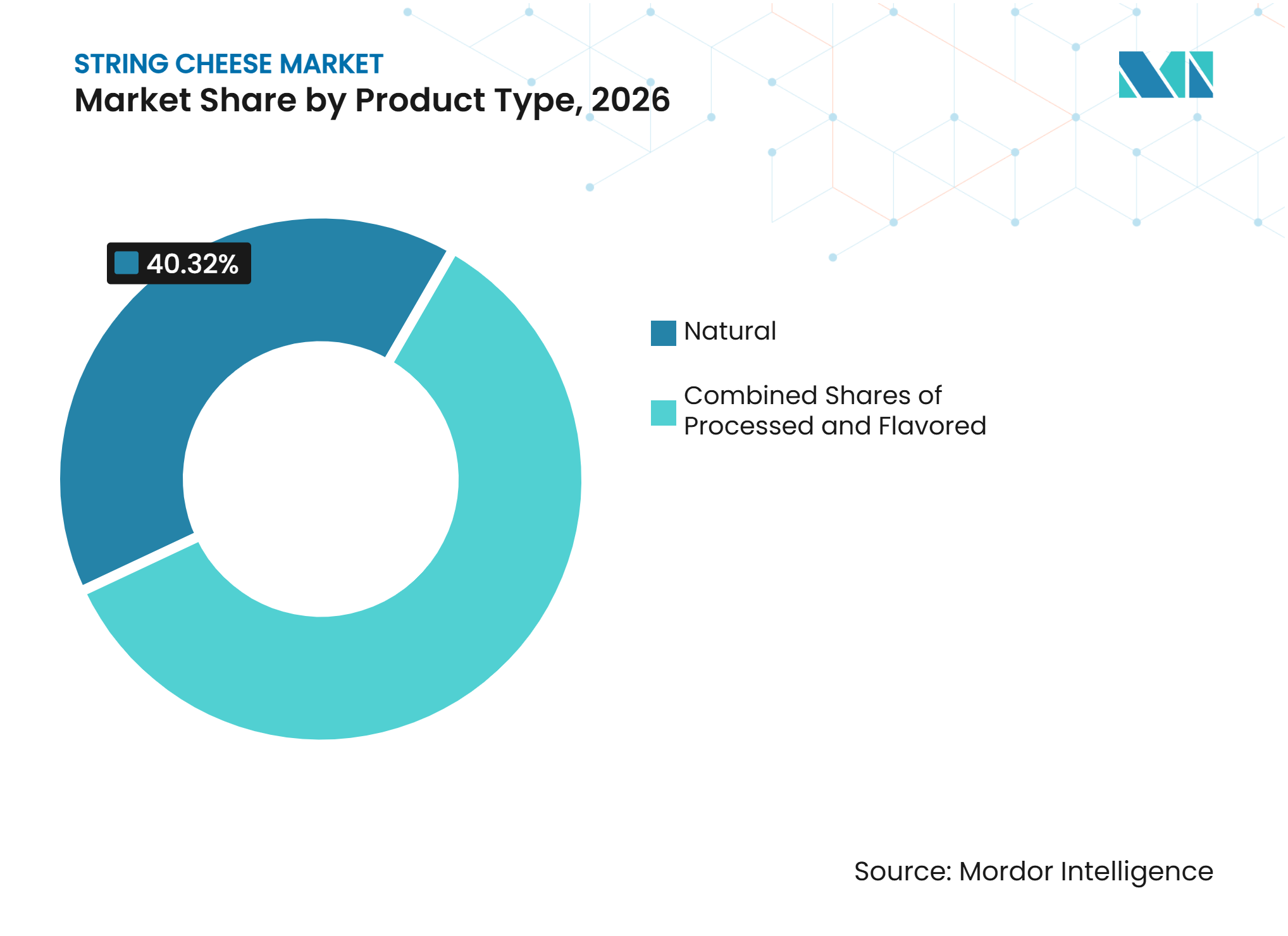
By product type, natural string cheese held 40.32% of the string cheese market share in 2026, while flavored string cheese is projected to grow at a 6.02% CAGR through 2032.
-
By cheese type, mozzarella accounted for 38.26% of the string cheese market share in 2026, while cheddar is projected to grow at a 5.72% CAGR through 2032.
-
By milk source, cow milk held 61.26% of the string cheese market share in 2026, while goat milk is projected to grow at a 5.68% CAGR through 2032.
-
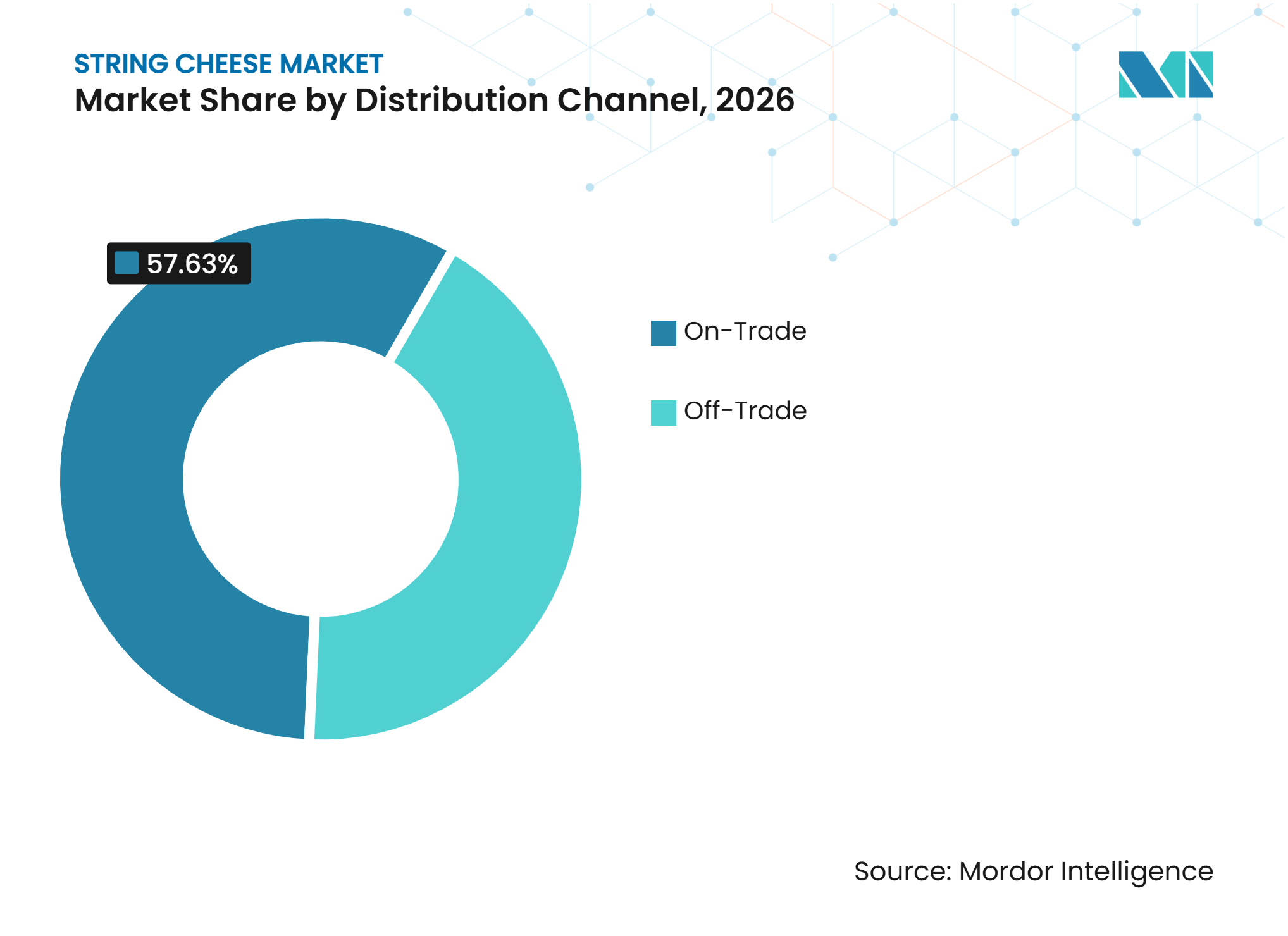
By distribution channel, off-trade held 42.37% of the string cheese market share in 2026, while on-trade is projected to grow at a 5.68% CAGR through 2032.
-
By geography, Europe accounted for 43.72% of the string cheese market share in 2026, while Asia-Pacific is projected to grow at a 6.23% CAGR through 2032.
Note: Market numbers in this report are based on Mordor Intelligence's proprietary estimation framework, which combines nine months of actuals with Q4 projections for base year 2026.
Market Trends and Insights
Drivers Impact Analysis of String Cheese Market*
| Driver | (~) % Impact on CAGR Forecasts | Geographic Relevance | Impact Timeline |
|---|---|---|---|
| Growing consumer preference for high-protein and calcium-rich food products | +1.1% | Global, with stronger gains in North America and Europe | Medium term (2-4 years) |
| Rising popularity of cheese-based snacks among children and young adults | +0.9% | North America, Europe, and urban Asia-Pacific | Medium term (2-4 years) |
| Expansion of organized retail and supermarket distribution networks | +0.6% | China, India, Vietnam, and Middle East and Africa | Long term (≥ 4 years) |
| Growing adoption of string cheese in school lunchboxes and institutional foodservice | +0.5% | North America and Western Europe | Short term (≤ 2 years) |
| Product innovation through the introduction of flavoured and specialty string cheese varieties | +0.8% | Global, led by North America and Asia-Pacific | Medium term (2-4 years) |
| Rising demand for individually packaged and portion-controlled snack products | +0.6% | Global, especially urban North America, Europe, and East Asia | Short term (≤ 2 years) |
| Source: Mordor Intelligence | |||
Growing Consumer Preference for High-Protein and Calcium-Rich Food Products
String cheese commonly provides 6-8 grams of protein per stick, making it suitable for consumers seeking filling snack portions without preparing a meal or choosing a more heavily processed alternative. Its calcium content also supports its role within the refrigerated dairy snack aisle, where the product can be placed alongside yogurt, sliced cheese, and other everyday foods. The format fits consumer interest in foods that provide nutritional value while remaining convenient, familiar, easy to pack, and easy to portion. This position is relevant across the string cheese market because the product can serve children, adults, and institutional meal programs without a major change in the core formulation or method of consumption. Natural mozzarella formats are particularly suited to this demand because they keep the ingredient proposition simple and allow buyers to understand the product quickly. The preference gives manufacturers a reason to develop products that retain the basic nutritional profile while improving flavor choice, texture, package count, and suitability for different retail price points.
Rising Popularity of Cheese-Based Snacks Among Children and Young Adults
String cheese combines an interactive pull-apart format with a controlled serving size, which supports regular use in children’s lunchboxes and helps parents manage snack portions. The same features can appeal to young adults who want portable snacks for work, travel, study, and short breaks without requiring utensils or preparation. Sargento’s Balanced Breaks combines cheese, nuts, and dried fruit, showing how cheese snacks can be included in multi-item snack packs that offer different textures and food groups. In June 2025, Binggrae introduced its mozzarella with cheddar string cheese in South Korea with high-calcium, high-protein, zero-sugar, zinc, and vitamin D messaging. The launch shows how a local brand can position a Western-style cheese snack for domestic health-focused consumption, rather than relying only on the product’s novelty or imported image. This broad customer relevance supports the string cheese market because the format can remain part of household purchasing as consumers move through different life stages and as snack needs change during the day.
Product Innovation Through Flavored and Specialty String Cheese Varieties
Flavored string cheese is moving beyond limited seasoning changes toward products that combine different cheese types, recognizable flavor names, and more distinct taste profiles for shoppers who want variety. In July 2025, Saputo USA introduced Frigo Cheese Heads Cheddarella, a product that combines real cheddar with low-moisture part-skim mozzarella and was distributed through Albertsons, Whole Foods Market, Food Lion, and Hy-Vee. Saputo expanded the same portfolio in October 2025 with Sharp Cheddar and Pepper Jack Snack Sticks in 12-count packs, alongside Colby Jack and Gouda options. These products give retailers a way to offer stronger flavors without abandoning the familiar snack-stick format, which may reduce the need to explain a new product format on the shelf. They also support premium positioning where plain mozzarella has limited differentiation and where consumers are willing to choose between flavors within a trusted refrigerated snack category. New flavored products must still meet food safety and labeling requirements, which can make formulation, ingredient sourcing, and approval processes more demanding for smaller producers.
Growing Adoption in School Lunchboxes and Institutional Foodservice
The individually wrapped format supports use in school lunchboxes because it provides a defined serving size, travels easily in a chilled pack, and can be handled without preparation. Retailers are also using the back-to-school period to place string cheese within value-focused family shopping, where multipacks can be positioned as a practical purchase for repeated weekday use. Target featured Good & Gather string cheese in its August 2025 school lunch and snack selection, where the product was offered in multipacks for routine household use. This use case links grocery demand with institutional meal patterns, even when the purchase is made by households rather than schools, because both settings value defined portions and simple handling. U.S. food labeling rules and nutrition requirements are relevant to products used in formal meal settings because they influence protein, calcium, allergen, and ingredient claims that buyers can communicate to families. The string cheese market therefore benefits when manufacturers can meet retail convenience expectations and institutional compliance needs while maintaining a consistent product quality through refrigerated storage and distribution.
Restraints Impact Analysis of String Cheese Market*
| Restraint | (~) % Impact on CAGR Forecasts | Geographic Relevance | Impact Timeline |
|---|---|---|---|
| Fluctuations in raw milk prices and dairy ingredient costs | -0.7% | Global, most acute in North America and Europe | Short term (≤ 2 years) |
| High production and processing costs associated with cheese manufacturing | -0.6% | Global, especially markets with legacy infrastructure | Long term (≥ 4 years) |
| Short shelf life and dependence on refrigerated storage and transportation | -0.4% | Asia-Pacific, Middle East and Africa, and South America | Medium term (2-4 years) |
| Growing prevalence of lactose intolerance and dairy-related dietary restrictions | -0.3% | Asia-Pacific, with spillover to North America | Long term (≥ 4 years) |
| Source: Mordor Intelligence | |||
Fluctuations in Raw Milk Prices and Dairy Ingredient Costs
Milk remains the main cost input for string cheese, so changes in farm-gate milk, feed, energy, and dairy ingredient prices can quickly affect processor margins and create uncertainty for retail planning. Producers cannot always pass those changes through to retailers at the same pace because grocery buyers may resist frequent price changes in staple family snack products. This creates pressure in value-oriented product lines, promotional programs, and supply contracts with large grocery customers that are negotiated before cost conditions become clear. Saputo identified milk price volatility as a short- to medium-term variable in its fiscal 2026 first-quarter results, while also discussing the effects of the updated U.S. federal milk marketing order formula. Larger processors can use procurement planning, product mix, automation, and operational scale to manage some of this exposure while retaining service levels for retailers. Smaller manufacturers may have less flexibility when prices change quickly, which can restrict investment in product launches, flavor extensions, wider distribution, or the packaging upgrades needed for longer refrigerated delivery routes.
Short Shelf Life and Dependence on Refrigerated Storage and Transportation
String cheese requires continuous refrigeration from production to retail display, which raises energy, warehousing, transport, and quality-control costs across the distribution chain. A 2025 review in Applied Sciences identifies energy use as a major issue in cheese production and discusses opportunities to improve processing efficiency[1]. The challenge is more pronounced where electricity supply, refrigerated warehousing, temperature-controlled transport, and store-level refrigeration are inconsistent or expensive. Individual vacuum packs and modified-atmosphere packaging can protect quality during distribution and can make the product easier to handle in lunchboxes, but they increase material and production complexity. These requirements create a barrier to entry for small processors while also limiting access in emerging regions with weak cold-chain coverage, where even a suitable product may not reach retail shelves in reliable condition. Lactose intolerance and other dairy restrictions add another constraint, encouraging companies to consider lactose-free formats, goat milk products, or adjacent alternatives where the economics, milk supply, and refrigerated distribution model permit.
*Our forecasts treat driver/restraint impacts as directional, not additive. The impact forecasts reflect baseline growth, mix effects, and variable interactions.
String Cheese Market Segment Analysis
By Product Type:
Natural Formats Lead While Flavored Products ExpandNatural string cheese held 40.32% of the market share in 2026, reflecting continued demand for recognizable dairy products with limited additives. It remains central to grocery private-label ranges and institutional use because its mozzarella-based proposition is familiar to households. The format also aligns with shoppers who prioritize clean labels and simple ingredient lists. Processed products occupy a separate value-oriented position, particularly where foodservice buyers prioritize consistent cost and availability. The natural segment benefits from broad use across lunchboxes, household snacking, and basic meal preparation.
Flavored products are projected to grow at a 6.02% CAGR through 2032, the highest rate within product type segmentation. The string cheese market size for flavored products is supported by smoked, chili, barbecue, herb, cheddar, and pepper-based offerings that extend the string cheese market beyond plain mozzarella. Saputo’s 2025 launches of Frigo Cheese Heads show how large producers are using cheddar and pepper flavors to create a more differentiated snack experience[2]. Flavored formats can be used as a standalone snack or with crackers, sandwiches, and other light meals. This broader usage helps producers reach consumers who may not select plain mozzarella.



By Cheese Type:
Mozzarella Retains the Core Position as Cheddar GrowsMozzarella accounted for 38.26% of the market share in 2026 because its structure supports the pull-apart texture associated with the string cheese market. The cheese type remains the core base for most traditional string cheese products. Its mild flavor gives producers flexibility to serve children, families, and institutional customers. Mozzarella also fits established dairy processing systems that are designed for large-volume snack and foodservice production. Its familiarity keeps it relevant even as manufacturers introduce more specialty products.
Cheddar is forecast to grow at a 5.72% CAGR through 2032, supported by products that combine cheddar flavor with mozzarella texture. Cheddarella is a clear example of this approach because it uses real cheddar with low-moisture part-skim mozzarella in a string cheese format. Cheddar has a stronger flavor profile than plain mozzarella and can support premium price points in grocery and convenience channels. Colby and other varieties have smaller roles, often as blend components rather than standalone string formats. Their relevance is more visible in regions where local cheese preferences are well established.
By Milk Source:
Cow Milk Provides Scale While Goat Milk Builds a Premium PositionCow milk held 61.26% of the market share in 2026, supported by large dairy herds, mature collection systems, and widely available cheesemaking capacity. It remains the principal input for high-volume mozzarella production. Manufacturers can produce cow milk products at scale for supermarkets, private labels, foodservice, and institutional buyers. This supply base helps manufacturers maintain broad geographic availability. The segment is therefore likely to remain the foundation of the string cheese market even as other milk sources develop.
Goat milk is projected to grow at a 5.68% CAGR through 2032, supported by specialty positioning and perceived digestive benefits among some consumers. Agrial’s 2035 Goat Plan is designed to add 35 million liters of goat milk collection capacity over the next decade, indicating longer-term supply investment in the sector[3]. Goat milk string cheese can appeal to consumers seeking a differentiated dairy option and to specialty retailers looking for premium products. Buffalo milk has a smaller but relevant role in markets with established buffalo dairy traditions and premium mozzarella production. These alternatives cannot match cow milk supply scale, but they give producers a way to serve specific regional and premium demand.
By Distribution Channel:
Off-Trade Leads While On-Trade Adds New OccasionsOff-trade channels held 42.37% of the market share in 2026, supported by supermarkets and hypermarkets. Grocery stores give shoppers regular access to multipacks, family formats, and private-label products. The school lunch occasion also strengthens supermarket demand because households can purchase string cheese as part of weekly food shopping. Retail visibility remains important because the product competes with other refrigerated snacks in a crowded dairy aisle. Online grocery and convenience platforms are increasingly relevant for premium, organic, and specialty cheese selections.
On-trade channels are expected to grow at a 5.68% CAGR through 2032 as restaurants, workplace catering, and institutional foodservice use individually portioned dairy snacks. These channels can offer controlled servings within snack programs, prepared meals, and foodservice menus. The format may be particularly useful where operators need consistent portions and minimal preparation. Institutional demand also helps create stable volumes that are less tied to short-term changes in retail promotions. Companies that meet food labeling and foodservice requirements can address these channels alongside their consumer retail business.

Geography Analysis
Europe
Europe accounted for 43.72% of the global category share in 2026, supported by high cheese consumption, organized retail, and established dairy cooperatives. The region has long-standing cheese traditions across daily meals and snacking, which give portable cheese formats a stable consumer base. Producers can rely on developed milk collection networks, refrigerated logistics, and a broad supermarket presence. Arla announced a EUR 300 million investment in a new cheese dairy at Götene, Sweden in February 2026, with planned processing capacity of 1 billion kilograms of milk per year by 2030. The investment points to continued confidence in European cheese production capacity, including mozzarella and specialty products. Sweden also saw the introduction of cheddar snack strings in 2025, showing that flavor-led product development is reaching markets where plain mozzarella has been more familiar. European food safety and labeling requirements shape product formulation and packaging, particularly for products sold through schools and major retailers.
Asia-Pacific
Asia-Pacific is projected to grow at a 6.23% CAGR through 2032, the fastest rate among geographic segments in the string cheese market. The region combines rising dairy familiarity with expanding organized retail and growing interest in convenient foods. Consumer adoption differs by country, but local companies are adapting the format to regional tastes and nutrition preferences. Binggrae’s June 2025 mozzarella with cheddar product in South Korea included high-protein, zero-sugar, calcium, zinc, and vitamin D positioning. This localized approach can make string cheese more relevant than a direct copy of Western mozzarella products.
North America, South America, and Middle East and Africa
North America remains a mature base for the string cheese market because the format is widely used in household snacks and lunchboxes. Product innovation is particularly visible in the United States, where Frigo Cheese Heads introduced Cheddarella in July 2025 and expanded Snack Sticks flavors in October 2025. Retail programs such as Target’s school lunch offering also keep the string cheese market visible during key family-shopping periods. In South America, dairy processing expansion can create a stronger base for mozzarella and related cheese formats, although cold-chain reliability remains important. Middle East and Africa demand is at an earlier stage and is concentrated in organized retail markets, including the United Arab Emirates and Saudi Arabia. Urbanization, younger consumer groups, and expanding refrigeration infrastructure can support broader adoption over time. Local production and distribution capabilities will determine whether the product moves from an imported premium item to a more accessible mainstream snack.
Competitive Landscape
Market Concentration
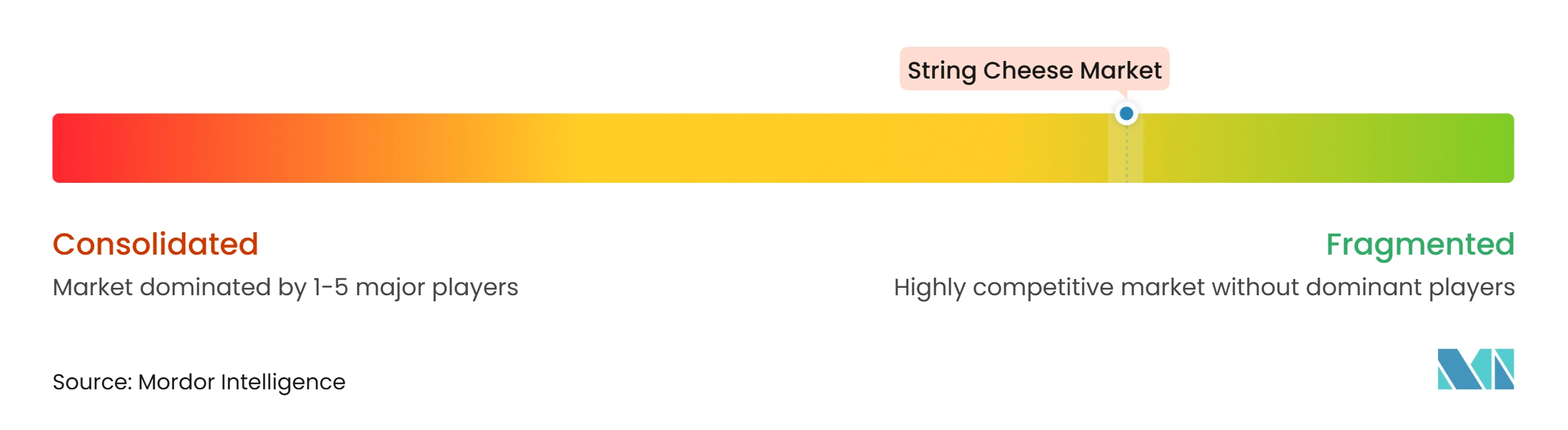
The string cheese market has a broad set of regional producers, dairy cooperatives, and multinational dairy companies. Saputo is a major competitor in the United States through Frigo Cheese Heads, where it has used flavor and format development to support its product range. The company launched Cheddarella in July 2025 as a cheddar-mozzarella hybrid. It then expanded Frigo Snack Sticks with Sharp Cheddar and Pepper Jack flavors in October 2025. These moves show how a leading supplier can seek differentiation in a category historically centered on plain mozzarella.
Lactalis and Arla remain important European dairy suppliers because of their scale, cheese portfolios, and investment capacity. Arla’s Götene project demonstrates the role of manufacturing investment in maintaining supply capability for cheese categories in Europe. Larger companies can compete through procurement scale, automation, wide retail access, and the ability to supply institutional customers. Smaller processors can compete through regional brand familiarity, specialty milk sources, fresh mozzarella products, and local retail relationships. Compliance with food safety, labeling, and customer specifications is a practical requirement for both groups. This creates a market where operating discipline matters alongside brand building and product innovation.
New product formats are shaping competition more directly than price alone in many retail settings. Cheddar-mozzarella blends, flavored snack sticks, and premium goat milk products give companies ways to reach consumers who may not select standard mozzarella. Bel Groupe entered the Australian category with Babybel Mini Rolls in September 2025, using a spiral-shaped string cheese format and Disney Pixar branding in Coles supermarkets. Retailers also retain influence through private-label products that target family value and lunchbox use. Companies able to combine dependable cold-chain execution with targeted product development are better placed to win repeat purchases. The result is a competitive setting in which established scale and regional specialization can coexist.
String Cheese Industry Leaders
-
The Kraft Heinz Company
-
Saputo Inc.
-
Sargento Foods Inc.
-
Dairy Farmers of America, Inc.
-
Arla Foods amba
- *Disclaimer: Major Players sorted in no particular order
String Cheese Market Companies Covered in this Report
- The Kraft Heinz Company
- Lactalis Group
- Saputo Inc.
- Sargento Foods Inc.
- Leprino Foods Company
- BelGioioso Cheese, Inc.
- Tillamook County Creamery Association
- Dairy Farmers of America, Inc.
- Organic Valley, CROPP Cooperative
- Arla Foods amba
- FrieslandCampina
- Fonterra Co-operative Group Limited
- Danone North America
- Crystal Farms Dairy Company
- Borden Dairy Company
- Land O’Lakes, Inc.
- Great Lakes Cheese
- Schreiber Foods, Inc.
- Baker Cheese Inc.
- Hiland Dairy Foods
- Parag Milk Foods Limited
Recent Industry Developments in String Cheese Market
- September 2026: Arla Foods broke ground on a new cheese dairy at its Götene, Sweden site. The EUR 300 million project was announced in February 2026 and represents the company’s largest single-facility investment. It will process 1 billion kilograms of milk per year upon completion in 2030, roughly doubling the site’s current capacity.
- September 2025: Bel Groupe entered the Australian string cheese segment with Babybel Mini Rolls, a spiral-shaped format featuring Disney Pixar branding, in Coles supermarkets. It targeted a format designed for children and family snacking while extending the Babybel brand into a new product shape.
- July 2025: Saputo USA launched Cheddarella string cheese, a hybrid combining real cheddar with low-moisture part-skim mozzarella, through Albertsons, Whole Foods Market, Food Lion, and Hy-Vee. The product brought a cheddar-forward taste to a format traditionally centered on plain mozzarella. The rollout demonstrated that the company was using product-line development as a central route to compete in the premium tier.
Global String Cheese Market Report Scope
String cheese is a semi-soft cheese produced through a pasta filata (stretched-curd) process, in which heated cheese curds are stretched and folded to develop a characteristic fibrous texture that can be peeled into thin strands.
The string cheese market report analyses the market based on product type, cheese type, milk source, distribution channel, and geography. By product type, the market is segmented into natural, processed, and flavoured string cheese, with flavoured varieties further categorised into smoked, chili, barbecue, herbed, and other flavours. Based on cheese type, the market covers mozzarella, cheddar, Colby, and other cheese varieties. By milk source, the market includes cow milk, goat milk, and buffalo milk. Based on distribution channels, the market is divided into on-trade and off-trade channels, with the latter further segmented into supermarkets/hypermarkets, convenience stores, online retail channels, and other distribution channels. Geographically, the report covers North America, Europe, Asia-Pacific, South America, and the Middle East and Africa. The market sizing has been done in value terms in USD for all the abovementioned segments.
Segmentation Overview
| Natural | |
| Processed | |
| Flavored | Smoked |
| Chili | |
| Barbeque | |
| Herbed | |
| Others |
| Mozerella |
| Cheddar |
| Colby |
| Others |
| Cow Milk |
| Goat Milk |
| Buffalo Milk |
| On-Trade | |
| Off-Trade | Supermarkets/Hypermarkets |
| Convenience Stores | |
| Online Retail Channels | |
| Other Distribution Channels |
| North America | United States |
| Canada | |
| Mexico | |
| Rest of North America | |
| Europe | Germany |
| United Kingdom | |
| France | |
| Italy | |
| Spain | |
| Netherlands | |
| Sweden | |
| Poland | |
| Belgium | |
| Rest of Europe | |
| Asia-Pacific | China |
| India | |
| Japan | |
| Australia | |
| South Korea | |
| Vietnam | |
| Indonesia | |
| Rest of Asia-Pacific | |
| South America | Brazil |
| Argentina | |
| Chile | |
| Peru | |
| Colombia | |
| Rest of South America | |
| Middle East and Africa | United Arab Emirates |
| Saudi Arabia | |
| South Africa | |
| Nigeria | |
| Rest of Middle East and Africa |
| Product Type | Natural | |
| Processed | ||
| Flavored | Smoked | |
| Chili | ||
| Barbeque | ||
| Herbed | ||
| Others | ||
| Cheese Type | Mozerella | |
| Cheddar | ||
| Colby | ||
| Others | ||
| Milk Source | Cow Milk | |
| Goat Milk | ||
| Buffalo Milk | ||
| Distribution Channels | On-Trade | |
| Off-Trade | Supermarkets/Hypermarkets | |
| Convenience Stores | ||
| Online Retail Channels | ||
| Other Distribution Channels | ||
| Geography | North America | United States |
| Canada | ||
| Mexico | ||
| Rest of North America | ||
| Europe | Germany | |
| United Kingdom | ||
| France | ||
| Italy | ||
| Spain | ||
| Netherlands | ||
| Sweden | ||
| Poland | ||
| Belgium | ||
| Rest of Europe | ||
| Asia-Pacific | China | |
| India | ||
| Japan | ||
| Australia | ||
| South Korea | ||
| Vietnam | ||
| Indonesia | ||
| Rest of Asia-Pacific | ||
| South America | Brazil | |
| Argentina | ||
| Chile | ||
| Peru | ||
| Colombia | ||
| Rest of South America | ||
| Middle East and Africa | United Arab Emirates | |
| Saudi Arabia | ||
| South Africa | ||
| Nigeria | ||
| Rest of Middle East and Africa | ||
Key Questions Answered in the Report
What is the projected size of the string cheese market by 2032?
The string cheese market is forecast to reach USD 7.03 billion by 2032, from USD 5.35 billion in 2026, with a projected CAGR of 4.69% during 2027-2032.
What is driving demand for string cheese products?
Demand is supported by protein and calcium positioning, convenient portions, school lunch use, and flavored product development.
Which product type leads the string cheese market?
Natural string cheese leads product type segmentation with a 40.32% share in 2026.
Which cheese type is growing fastest in string cheese?
Cheddar is projected to grow at a 5.72% CAGR through 2032, supported by cheddar-mozzarella blends.