
Steam Trap Market Size and Share
Market Overview
| Study Period | 2022 - 2032 |
|---|---|
| Market Size (2027) | USD 4.20 Billion |
| Market Size (2032) | USD 5.18 Billion |
| Growth Rate (2027 - 2032) | 4.28 % |
| Fastest Growing Market | Europe |
| Largest Market | Asia-Pacific |
| Market Concentration | Medium |
Major Players *Disclaimer: Major Players sorted in no particular order Image © Mordor Intelligence. Reuse requires attribution under CC BY 4.0. | |
Steam Trap Market Analysis by Mordor Intelligence
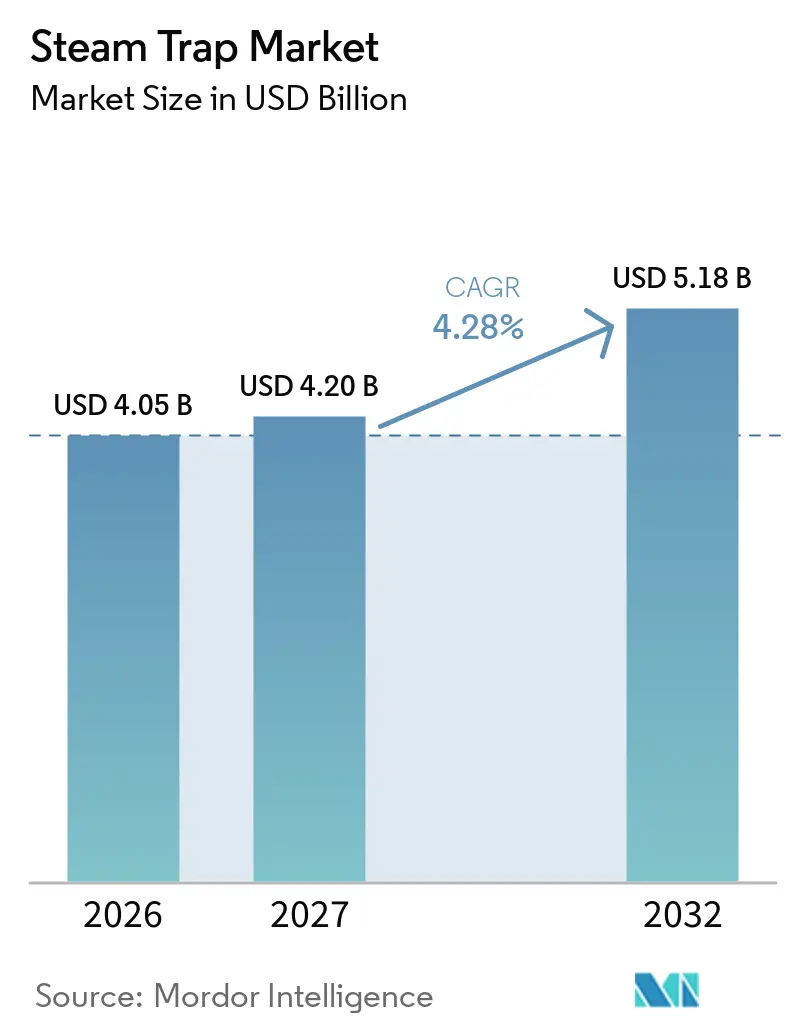
The Steam Trap Market size is expected to grow from USD 4.05 billion in 2026 to USD 4.20 billion in 2027 and is forecast to reach USD 5.18 billion by 2032 at 4.28% CAGR over 2027-2032. The global steam trap market benefits from the essential role of condensate removal in industrial steam systems, where failed traps can waste energy and disrupt process control. Replacement demand is likely to remain more stable than greenfield demand because maintenance teams need to address leakage, blocked discharge, and declining trap performance. Energy management rules, steam-loss economics, and digital monitoring are making trap conditions more visible to plant managers. Suppliers are responding by pairing hardware with monitoring, diagnostics, and service contracts, which can widen the value delivered from each unit installed. The global steam trap market also has room for integrated offers that combine wireless monitoring, condensate recovery, and energy accounting for operators managing large steam estates.
Key Report Takeaways
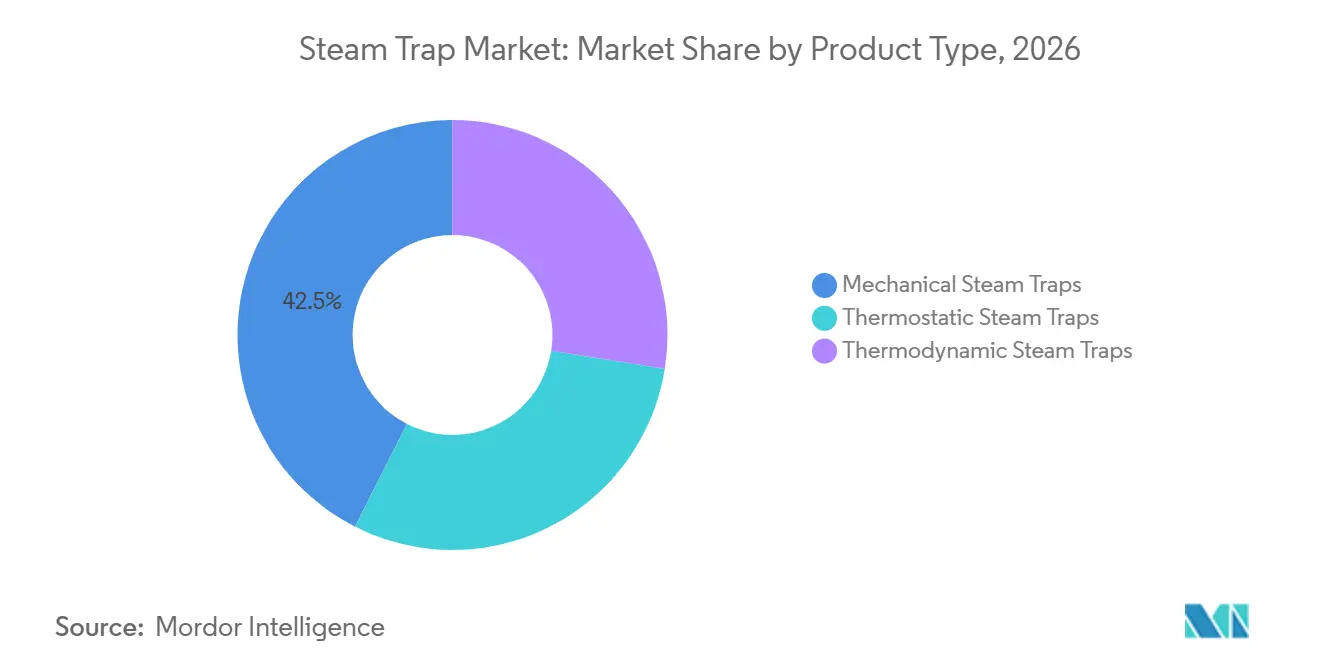
- By product type, mechanical traps held 42.5% of the global steam trap market share in 2026 and are projected to grow at a 4.6% CAGR through 2032.
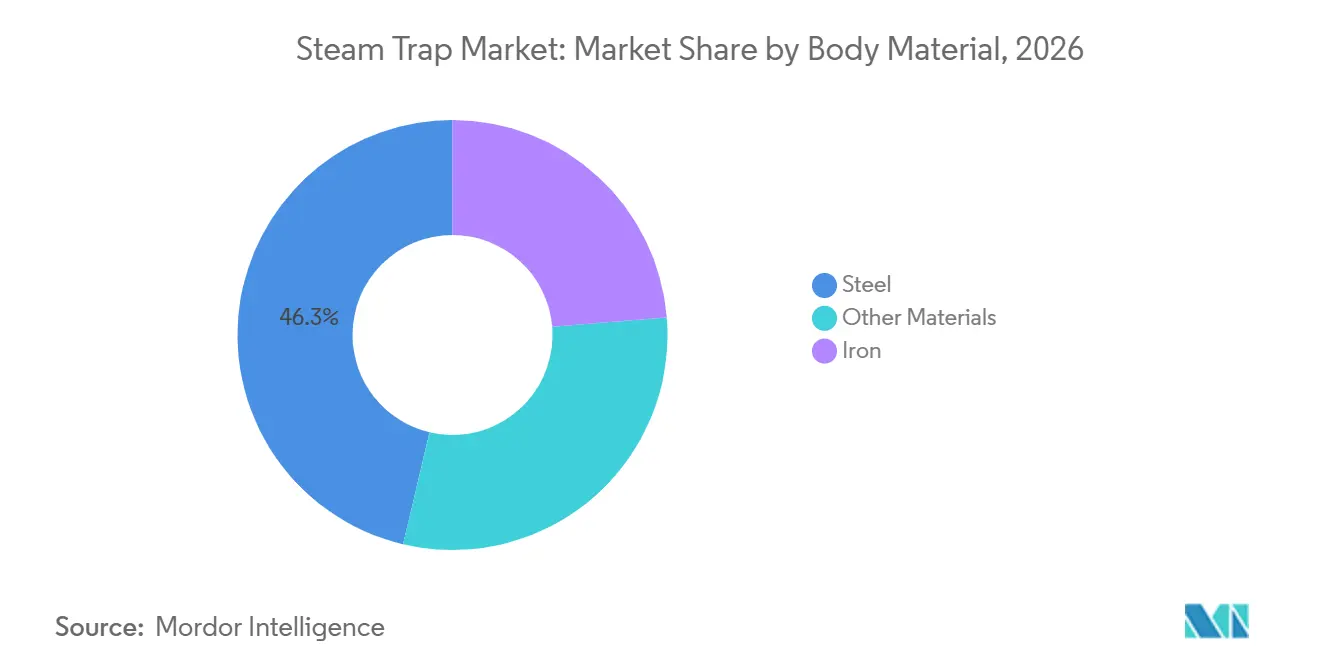
- By body material, steel traps held 46.3% share in 2026 and are forecast to grow at a 4.7% CAGR through 2032.
- By end-use industry, oil and gas accounted for 27.7% of the global steam trap market size in 2026 and is forecast to advance at a 4.9% CAGR through 2032.
- By geography, Asia-Pacific accounted for 32.8% of the global steam trap market share in 2026, while Europe is projected to grow at a 5.1% CAGR through 2032.
Note: Market numbers in this report are based on Mordor Intelligence's proprietary estimation framework, which combines nine months of actuals with Q4 projections for base year 2026.
Market Trends and Insights
Drivers Impact Analysis of Steam Trap Market*
| Driver | (~) % Impact on CAGR Forecast | Geographic Relevance | Impact Timeline |
|---|---|---|---|
| Industrial Demand for Energy-Efficient Steam Systems | +1.1% | Global | Medium term (2-4 years) |
| Industrial Plant Modernization and Aging Trap Replacement | +0.9% | North America, Europe, and core Asia-Pacific | Medium term (2-4 years) |
| Steam-Loss Reduction and Condensate-Recovery Economics | +0.7% | Global | Short term (≤ 2 years) |
| Industrial Internet of Things and Wireless Trap Monitoring | +0.6% | North America, Europe, and core Asia-Pacific | Medium term (2-4 years) |
| Water Scarcity Increasing the Value of Condensate Reuse | +0.3% | Asia-Pacific and Middle East and Africa | Long term (≥ 4 years) |
| Carbon Accounting and Heat-Process Electrification Readiness | +0.2% | Europe and North America | Long term (≥ 4 years) |
| Source: Mordor Intelligence | |||
Industrial Demand for Energy-Efficient Steam Systems
Energy costs are encouraging heavy-industry operators to inspect and replace poorly performing steam traps. Japan’s 2025 reporting guidance under the Act on the Rational Use of Energy requires designated energy users to establish management standards, including measures for steam equipment and monitoring.[1] This requirement raises the importance of documented steam-system management for affected facilities. California’s 2025 nonresidential energy-code research also assessed fault detection and diagnostic provisions for central steam traps in industrial facilities.[2] Requirements that make steam-system performance auditable can bring deferred maintenance into annual operating plans. These conditions support replacement demand in the global steam trap market where energy efficiency has become a measurable operating issue.
Industrial Plant Modernization and Aging Trap Replacement
Aging equipment creates a replacement opportunity in North America and Europe, where many industrial steam systems have long operating histories. Unmanaged mechanical trap estates can experience recurring failures, which makes periodic inspection important for controlling steam loss. ARI-Armaturen is offering a free steam-trap inspection campaign in Germany from October through December 2026, using ultrasound and temperature measurements for new and existing customers.[3] Armaturenwerk Halle, an ARI subsidiary, also announced a planned facility expansion in November 2025, reflecting expected demand tied to industrial retrofit work.[4] High-pressure applications in oil and gas and power generation can need more frequent replacement than lower-pressure installations in food and beverage plants. The global steam trap market therefore benefits from replacement cycles that differ by service conditions, pressure, and inspection practice.
Steam-Loss Reduction and Condensate-Recovery Economics
A failed-open trap can increase fuel use, makeup-water treatment needs, and emissions associated with steam generation. The U.S. Department of Energy’s Manufacturing Energy Assessment Software for Utility Reduction (MEASUR) tools help manufacturing sites assess energy use and identify efficiency opportunities, including steam-system improvements. Forbes Marshall reported that its EverSense deployment at a Rajasthan textile plant raised the condensate recovery factor from 55% to 75% and reduced steam consumption from 204 tons per day to 200 tons per day. This case supports the operational case for monitoring and condensate reuse where water and fuel costs matter. Water scarcity can further increase the value of recovered condensate because it can displace fresh boiler-feed water. Carbon accounting and heat-process planning also make avoidable steam losses more visible in industrial energy reviews across the global steam trap market.
Industrial Internet of Things and Wireless Trap Monitoring
Wireless monitoring is changing how operators manage steam traps by making condition data available without a manual inspection at every point. Spirax Group reported more than 2,000 connected sites in 2025 and high-double-digit growth in digital product and service revenue, while its Steam Thermal Solutions organic revenue grew 1%. Armstrong International and Yokogawa launched an ATmosphères EXplosibles (ATEX)-compliant wireless monitoring device in February 2025 that uses Long Range Wide Area Network (LoRaWAN) and can provide coverage up to 1 km from a single gateway. TLV’s risk-based steam-system methodology was referenced in the February 2025 fourth edition of API RP 581, giving engineers a structured method to prioritize inspection and replacement spending. Monitoring can extend the service life of units that receive timely attention while exposing failures in unmanaged estates, which shifts part of the global steam trap market toward diagnostics and service contracts.
Restraints Impact Analysis of Steam Trap Market*
| Restraint | (~) % Impact on CAGR Forecast | Geographic Relevance | Impact Timeline |
|---|---|---|---|
| Recurring Inspection, Repair, and Replacement Costs | -0.6% | Global | Short term (≤ 2 years) |
| High Capital Cost of Smart Monitoring Retrofits | -0.5% | Global, especially small and medium-sized enterprises in Asia-Pacific and Middle East and Africa | Medium term (2-4 years) |
| Application-Specific Sizing and Installation Complexity | -0.3% | Global | Short term (≤ 2 years) |
| Limited Diagnostic Interoperability Across Mixed Trap Estates | -0.3% | Europe and North America | Medium term (2-4 years) |
| Source: Mordor Intelligence | |||
Recurring Inspection, Repair, and Replacement Costs
The total cost of a managed steam-trap estate can exceed the purchase cost of individual traps. External surveys, handheld ultrasonic tools, operator training, spare parts, correct sizing, and installation work can place pressure on maintenance budgets. MIYAWAKI announced a 10%-15% price increase for selected steam traps, pressure-reducing valves, and related products effective October 1, 2025, citing raw-material and logistics costs. These cost pressures can cause plants to defer replacement during weaker demand periods. However, deferred maintenance does not remove the underlying need to repair or replace failed equipment. The resulting pattern can delay purchases in the global steam trap market and then concentrate on spending when inspection findings or production risks require action.
High Capital Cost of Smart Monitoring Retrofits
Complete monitoring retrofits can require sensors, gateways, software subscriptions, and integration with existing control or enterprise systems. This cost can be difficult for smaller industrial operators, particularly in Asia-Pacific and the Middle East and Africa. California Energy Commission research in 2025 found that smart monitoring requirements for existing steam systems were not yet recommended because third-party evaluations were limited and savings persistence remained uncertain. Hardware-only alternatives can lower the initial cost but leave data interpretation with the maintenance team. Mixed estates can also create interoperability problems when facilities use WirelessHART, LoRaWAN, or proprietary platforms. Application-specific sizing adds another barrier because traps must match pressure, load, and condensate conditions, making a simple equipment substitution unsuitable in many plants in the global steam trap market.
*Our forecasts treat driver/restraint impacts as directional, not additive. The impact forecasts reflect baseline growth, mix effects, and variable interactions.
Steam Trap Market Segment Analysis
By Product Type:
Mechanical Traps Lead Across Both Scale and GrowthMechanical traps held 42.5% of 2026 revenue and are forecast to grow at a 4.6% CAGR from 2027 to 2032. The global steam trap market size for mechanical products benefits from float, inverted-bucket, and pump-assisted designs that discharge condensate in response to load. These designs can limit life-steam loss and handle changing inlet conditions in demanding process applications. Thermodynamic disc traps remain useful where compact designs, lower maintenance, and many steam-main drip points matter. Thermostatic products serve clean-steam, sterilization, heat-tracing, and other applications where air removal and subcooling performance are important.
TLV expanded its range in July 2025 with the JLH15 large-capacity cast-steel float trap, the PowerTrap GT14L pump-integrated product, and other steam-trap models. These launches point to continued product development for high-pressure and continuous-process applications. ISO/DIS 6704, which remained under enquiry in late 2026, updates the classification of automatic steam traps. The revised definitions can provide clearer language for product specifications and purchasing documents. Mechanical designs retain their position in the steam trap industry because continuous discharge capability remains valuable where condensate loads change during operation.

By Body Material:
Steel Supports High-Pressure ServiceSteel traps accounted for 46.3% of the global steam trap market in 2026 and are expected to grow at a 4.7% CAGR through 2032. Carbon and alloy steel support the pressure, temperature, and corrosion requirements common in oil and gas, chemicals, and power generation. These requirements can limit the use of iron-body traps in high-pressure service. Velan delivered forged ASTM A182 Gr. F92 bi-metallic steam traps rated for 4,500 psi and 600°C to a thermal power plant in South Korea in June 2025. The delivery shows the specialized engineering required at the upper end of this segment.
Iron-body traps remain relevant in lower-pressure heating systems, district-heating networks, and building HVAC installations where operating conditions are less severe. Stainless steel and other materials serve applications that require cleanliness or stronger corrosion resistance. Pharmaceutical and food processing facilities can favor specialty materials for clean-steam and hygienic process conditions. MIYAWAKI established MIYAWAKI Korea Inc. in December 2024 to strengthen its presence in South Korea. The company’s regional expansion aligns with demand from semiconductor and pharmaceutical manufacturing clusters, where high-specification equipment is important for global steam trap market participants.
By End-Use Industry:
Oil and Gas Anchors Demand with Structural LongevityOil and gas accounted for 27.7% of 2026 demand and is forecast to expand at a 4.9% CAGR through 2032. The global steam trap market size in this segment reflects the large steam loads associated with refinery operations, gas processing, enhanced oil recovery, sulfur recovery, and pipeline heat tracing. Individual facilities may operate thousands of trap points, making inspection and condition management a recurring operating requirement. Forbes Marshall reported zero steam-trap leakage in the Naphtha Hydrotreater Gas Unit (NHGU) at Bharat Petroleum Corporation Limited (BPCL) Mumbai Refinery in August 2025. The case shows the value placed on systematic trap management in refinery operations.
Chemicals and petrochemicals form another important end-use area because process heat and temperature control affect both energy use and product quality. Energy and power facilities need reliable turbine-drain and high-pressure steam-line equipment that meets demanding inspection practices. Food and beverages and pharmaceuticals often need stainless steel or clean-steam designs and can have frequent replacement needs. Forbes Marshall launched the Multi-Utility Process Trap in September 2025 for pharmaceutical and chemical reactor applications and reported 5% lower steam consumption with condensate recovery above 80% in early installations. Pulp, paper, and textiles remain volume markets where buyers closely assess the payback from condensate recovery and reduced steam loss in the global steam trap market.
Geography Analysis
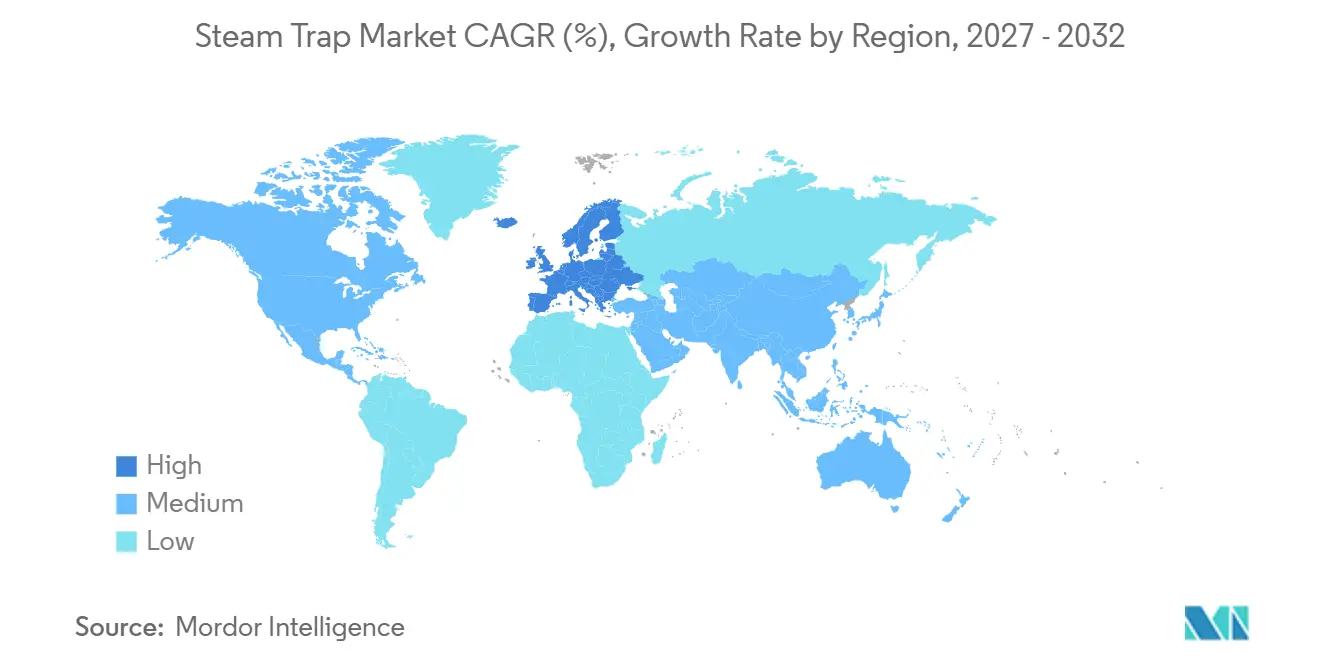
Asia-Pacific accounted for 32.8% of 2026 revenue, making it the largest regional contributor to the global steam trap market. China’s large process-industrial base supports demand across chemicals, paper, and textiles, where energy-efficiency programs can encourage equipment inspection and replacement. India adds demand through refining, chemicals, pharmaceuticals, and industrial energy-management programs. Japan and South Korea contribute demand for high-specification designs used in electronics and precision chemical manufacturing. Indonesia, Thailand, and Malaysia are expanding from smaller bases through refinery upgrades and agro-industrial investment across the global steam trap market.
Europe is projected to record the highest regional CAGR at 5.1% from 2027 to 2032. Directive (EU) 2023/1791 requires member states to implement energy-efficiency measures and strengthens energy management and audit obligations for enterprises. Germany’s energy-efficiency legislation also requires qualifying companies to avoid and reuse waste heat where technically and economically feasible. These requirements make steam loss and condensate recovery more relevant to industrial compliance programs. Germany leads regional demand, followed by Italy, France, and Poland, while sanctions and logistics restrictions continue to disrupt Russia’s normal commercial flows.
North America has a large installed base in refining, chemicals, food processing, and pharmaceutical production. The U.S. Department of Energy’s MEASUR toolset and California’s steam-trap research support more systematic energy assessments for new construction and major renovation projects. Canada also has demand for high-specification equipment in nuclear and other power applications, reflected in Velan’s October 2025 CAD 20 million-plus Pickering Nuclear Generation Station valve award. South America is concentrated in Brazil’s petroleum and ethanol processing sectors and Colombia’s refinery base. Middle East and Africa demand is supported by downstream petrochemical projects in Saudi Arabia and the UAE, alongside developing industrial markets in South Africa and Nigeria within the global steam trap market.
Competitive Landscape
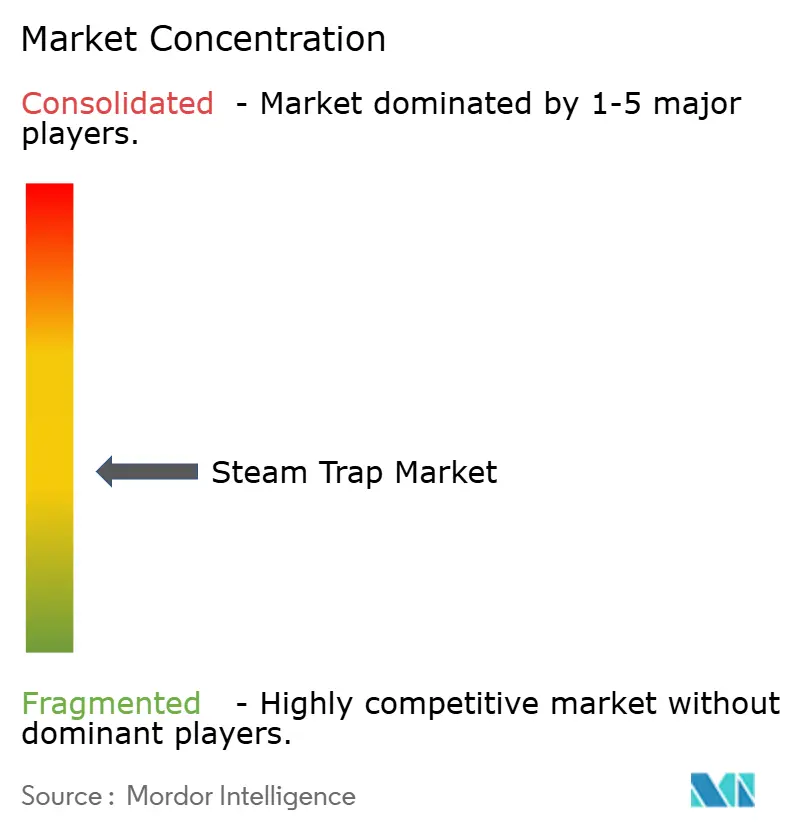
The global steam trap market is moderately consolidated among technology-focused suppliers and fragmented across regional manufacturers. Spirax Group and Armstrong International have strong positions in differentiated products, monitoring, and service-supported offerings. Spirax Group’s 2025 results show the strategic value of connected services, with more than 2,000 connected sites and high-double-digit digital revenue growth. This strategy reduces reliance on one-time hardware sales and increases the importance of recurring diagnostic and service income. TLV strengthened its technical position when its steam-system risk methodology was referenced in American Petroleum Institute (API) Recommended Practice (RP) 581’s fourth edition. Multi-vendor monitoring remains an opportunity because industrial sites often operate mixed trap estates and need data across different equipment brands.
Regional suppliers compete through local service coverage, installed-base knowledge, shorter lead times, and price. Forbes Marshall uses a service-led approach in India, supported by case work in refining, pharmaceuticals, textiles, and other process applications. Yoshitake offers Wi-Flo monitoring and expanded its high-pressure mechanical range in January 2025 with TSF-10CF and TSF-13CF models. MIYAWAKI supports its regional position with Dr. Trap diagnostic tools and expansion into South Korea. Local producers can be competitive in price-sensitive markets, although they may not offer the same depth of digital monitoring or aftermarket service.
New entrants face a higher barrier in heavy-industry applications because buyers depend on established performance records, approved specifications, and spare-parts availability. Food, beverage, and pharmaceutical projects may offer a more accessible route where clean-steam compliance and application-specific designs are assessed during new installations. Armstrong International expanded its thermal management portfolio through the January 2025 acquisition of HygroTemp B.V., adding capabilities relevant to pharmaceutical cleanrooms, data centers, and precision-climate applications. CIRCOR completed the September 2025 acquisition of Swelore Engineering Pvt. Ltd. and Hiro Nisha Systems Pvt. Ltd., extending its manufacturing and distribution reach in India’s process-industry flow-control markets. Competition is therefore moving beyond the trap itself toward service response, integration capability, and lifecycle support in the global steam trap market.
Steam Trap Industry Leaders
-
Spirax Sarco Engineering plc
-
Armstrong International
-
TLV Co., Ltd.
-
Emerson Electric Co.
-
Velan Inc.
- *Disclaimer: Major Players sorted in no particular order
Steam Trap Market Companies Covered in this Report
- ARI-Armaturen Albert Richter GmbH & Co. KG
- Armstrong International
- Bestobell Valves Limited
- CIRCOR International, Inc.
- Colton Industries
- Emerson Electric Co.
- Flowserve Corporation
- Forbes Marshall
- Hawa Engineers Ltd.
- MIYAWAKI Inc.
- Spence Engineering Company, Inc.
- Spirax Sarco Engineering plc
- Thermax Limited
- TLV Co., Ltd.
- Valsteam ADCA Engineering, S.A.
- Velan Inc.
- VENN Co., Ltd.
- Watson McDaniel Company
- Watts Water Technologies, Inc.
- Yoshitake Inc.
Recent Industry Developments in Steam Trap Market
- October 2026: ARI-Armaturen Albert Richter GmbH & Co. KG launched a free steam trap inspection campaign across Germany through December 2026, offering on-site assessment with ultrasound and temperature measurement for both new and existing customers, signaling aggressive field-service expansion in the European retrofit market.
- September 2025: Forbes Marshall unveiled the Multi-Utility Process Trap (MuPT), an electromechanical and digitally connected product designed for pharmaceutical and chemical API reactor applications, demonstrating 5% steam consumption reduction and over 80% condensate recovery in early installations.
- September 2025: CIRCOR International completed the acquisition of Swelore Engineering Pvt. Ltd. and Hiro Nisha Systems Pvt. Ltd., two Indian manufacturers of metering and reciprocating pumps, extending CIRCOR's Indian manufacturing and distribution footprint in process-industry flow-control markets.
- August 2025: Forbes Marshall achieved zero steam trap leakage in the Naphtha Hydrotreater Gas Unit (NHGU) at Bharat Petroleum Corporation Limited (BPCL) Mumbai Refinery, demonstrating systematic steam trap management capability in one of India's largest refining facilities, with direct implications for contract renewals across BPCL's broader refinery network.
Global Steam Trap Market Report Scope
A steam trap is a self-contained automatic valve that removes condensed water (condensate) and non-condensable gases (such as air) from a steam system without allowing live steam to escape.
The steam trap market is segmented into product type, body material, end-use industry, and geography. By product type, the market is segmented into mechanical steam traps, thermodynamic steam traps, and thermostatic steam traps. By body material, the market is divided into steel, iron, and other materials. By end-use industry, the market is segmented into oil and gas, chemicals and petrochemicals, energy and power, food and beverages, pharmaceuticals, pulp and paper, textiles, and other industries. The report also covers the market size and forecasts for the global steam trap market across 28 countries in key regions. For each segment, the market sizing and forecasts have been provided on the basis of value (USD).
Segmentation Overview
| Mechanical Steam Traps |
| Thermodynamic Steam Traps |
| Thermostatic Steam Traps |
| Steel |
| Iron |
| Other Materials |
| Oil and Gas |
| Chemicals and Petrochemicals |
| Energy and Power |
| Food and Beverages |
| Pharmaceuticals |
| Pulp and Paper |
| Textiles |
| Other Industries |
| North America | United States |
| Canada | |
| Mexico | |
| Europe | Germany |
| France | |
| Italy | |
| Spain | |
| United Kingdom | |
| Poland | |
| Netherlands | |
| Russia | |
| Rest of Europe | |
| Asia-Pacific | China |
| India | |
| Japan | |
| South Korea | |
| Australia | |
| Indonesia | |
| Malaysia | |
| Thailand | |
| Philippines | |
| Rest of Asia-Pacific | |
| South America | Brazil |
| Argentina | |
| Colombia | |
| Rest of South America | |
| Middle East and Africa | Saudi Arabia |
| United Arab Emirates | |
| South Africa | |
| Egypt | |
| Nigeria | |
| Rest of Middle East and Africa |
| By Product Type | Mechanical Steam Traps | |
| Thermodynamic Steam Traps | ||
| Thermostatic Steam Traps | ||
| By Body Material | Steel | |
| Iron | ||
| Other Materials | ||
| By End-Use Industry | Oil and Gas | |
| Chemicals and Petrochemicals | ||
| Energy and Power | ||
| Food and Beverages | ||
| Pharmaceuticals | ||
| Pulp and Paper | ||
| Textiles | ||
| Other Industries | ||
| By Geography | North America | United States |
| Canada | ||
| Mexico | ||
| Europe | Germany | |
| France | ||
| Italy | ||
| Spain | ||
| United Kingdom | ||
| Poland | ||
| Netherlands | ||
| Russia | ||
| Rest of Europe | ||
| Asia-Pacific | China | |
| India | ||
| Japan | ||
| South Korea | ||
| Australia | ||
| Indonesia | ||
| Malaysia | ||
| Thailand | ||
| Philippines | ||
| Rest of Asia-Pacific | ||
| South America | Brazil | |
| Argentina | ||
| Colombia | ||
| Rest of South America | ||
| Middle East and Africa | Saudi Arabia | |
| United Arab Emirates | ||
| South Africa | ||
| Egypt | ||
| Nigeria | ||
| Rest of Middle East and Africa | ||
Key Questions Answered in the Report
What is the projected value of the global steam trap market by 2032?
The global steam trap market is forecast to reach USD 5.18 billion by 2032, growing at a 4.28% CAGR from 2027 to 2032. Growth is supported by recurring replacement needs, energy-efficiency programs, condensate recovery priorities, and wider use of monitoring services at industrial sites.
Which product type leads steam trap demand?
Mechanical traps lead with a 42.5% share in 2026 and are also projected to record the highest product-type growth rate at 4.6% CAGR through 2032.
Why are smart steam-trap monitoring systems becoming important?
Wireless monitoring helps plants identify failed traps, prioritize maintenance, and improve steam-system visibility. Spirax Group reported more than 2,000 connected sites in 2025.
Which end-use sector has the strongest forecast growth?
Oil and gas is forecast to grow at a 4.9% CAGR through 2032, supported by steam-intensive refinery, gas-processing, and recovery operations.
Which region has the largest share and which is growing fastest?
Asia-Pacific holds the largest share at 32.8% in 2026, while Europe is expected to grow fastest at a 5.1% CAGR through 2032.
What is the main constraint on smart monitoring adoption?
Retrofit costs can be high because a full deployment may require sensors, gateways, software subscriptions, application-specific sizing, installation work, and integration with existing systems.