
Sports and Leisure Technical Textile Market Size and Share
Market Overview
| Study Period | 2021 - 2032 |
|---|---|
| Market Size (2027) | USD 52.74 Billion |
| Market Size (2032) | USD 67.31 Billion |
| Growth Rate (2027 - 2032) | 5.00 % |
| Fastest Growing Market | Middle East and Africa |
| Largest Market | Asia-Pacific |
| Market Concentration | Medium |
Major Players *Disclaimer: Major Players sorted in no particular order Image © Mordor Intelligence. Reuse requires attribution under CC BY 4.0. | |
Sports and Leisure Technical Textile Market Analysis by Mordor Intelligence
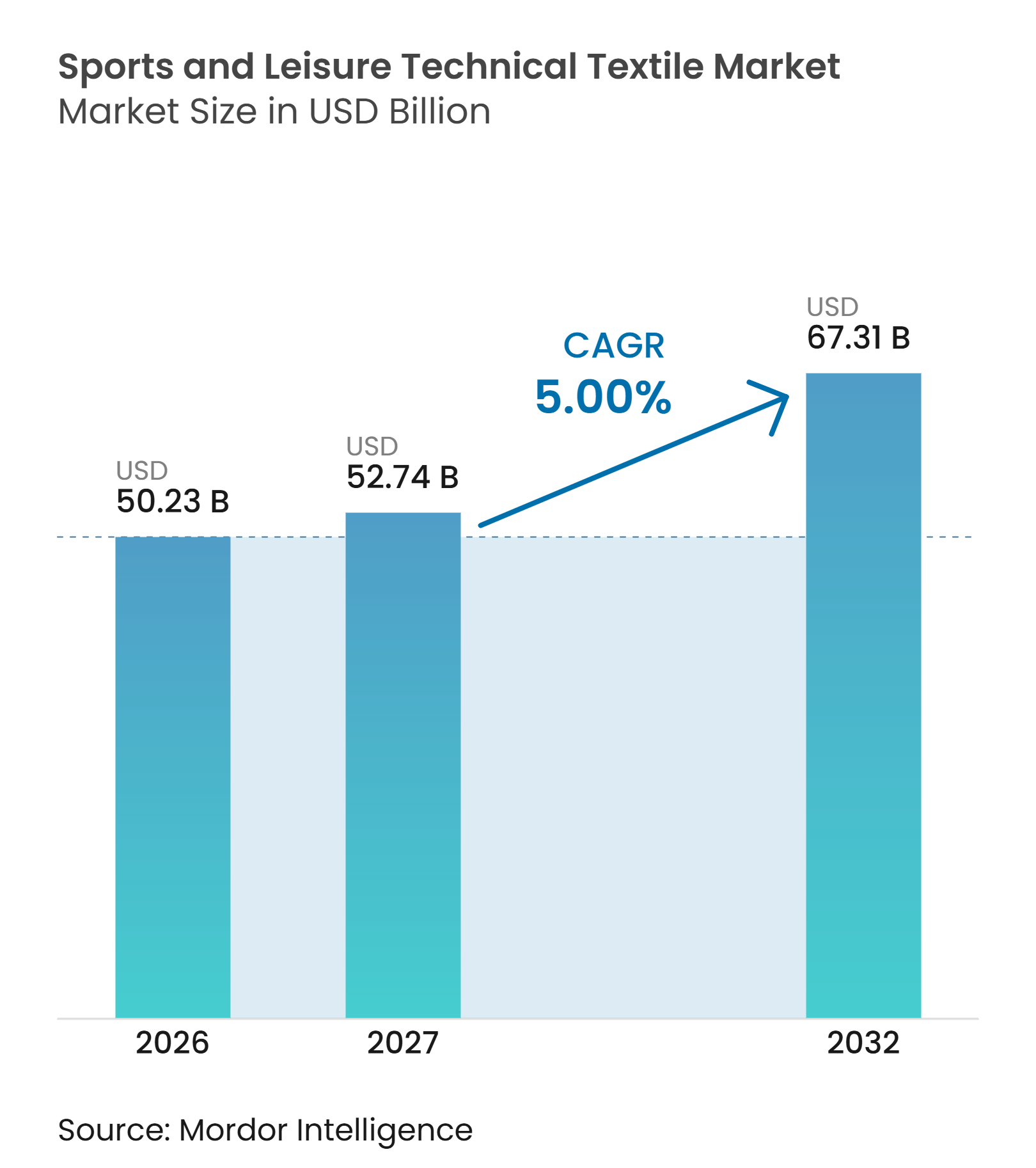
The Sports And Leisure Technical Textile Market size is expected to increase from USD 50.23 billion in 2026 to USD 52.74 billion in 2027 and reach USD 67.31 billion by 2032, growing at a CAGR of 5% over 2027-2032.
The market is supported by demand for technical activewear, footwear components, sports surfaces, and outdoor equipment. Product requirements increasingly combine moisture control, stretch recovery, durability, and lower environmental impact. Suppliers are responding with fluorine-free treatments, recycled feedstocks, and materials designed for demanding sports conditions. Manufacturing remains concentrated in Asia-Pacific, while sports infrastructure projects are broadening demand in other regions. Qualification standards and material costs continue to favor producers with established testing capability and specialized product knowledge.
Key Report Takeaways
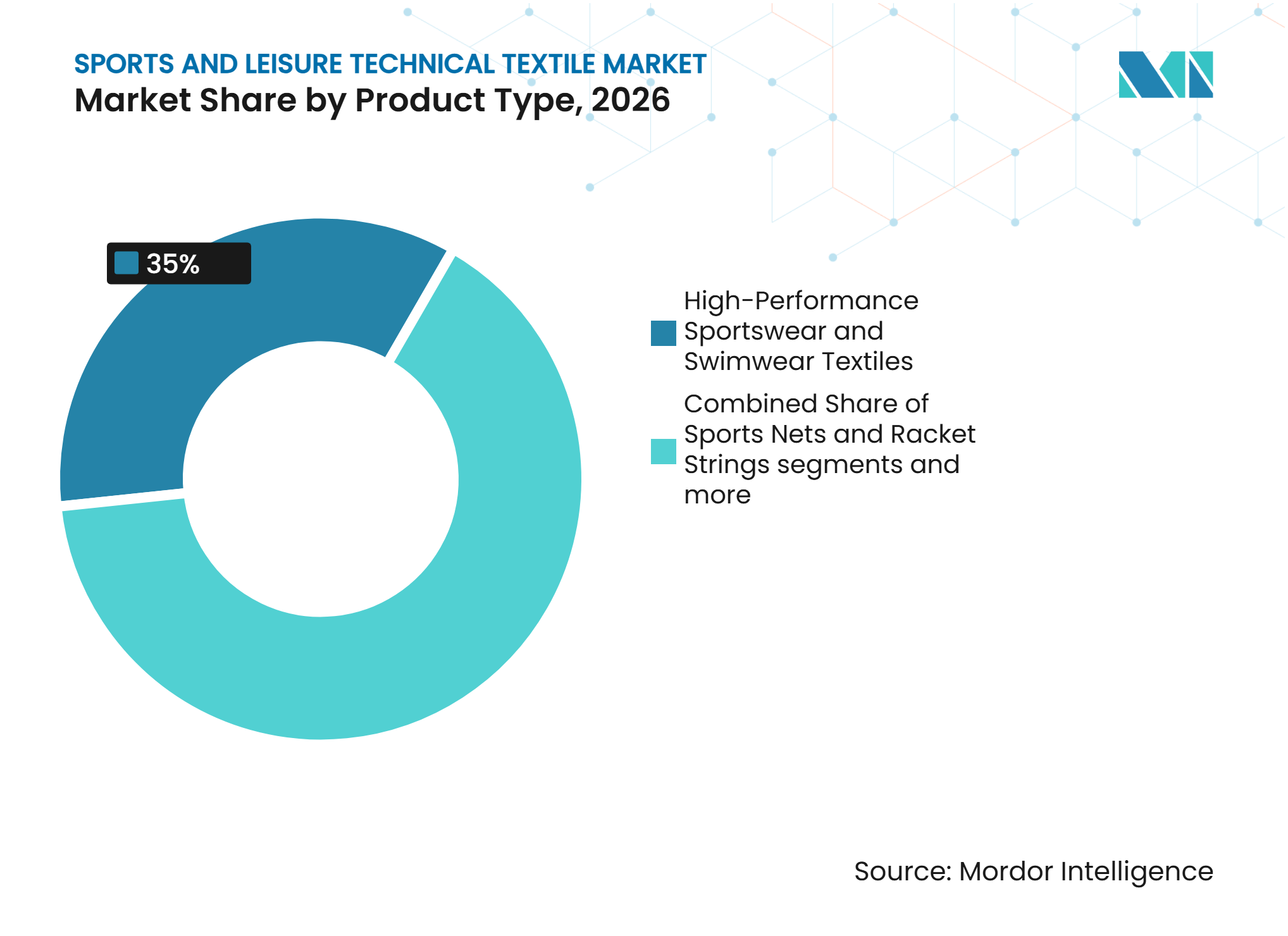
- By product type, high-performance sportswear and swimwear textiles accounted for 35% of the sports and leisure technical textile market share in 2026, while sports composite and equipment reinforcement textiles are projected to grow at a 7.2% CAGR through 2032.
- By material type, polyester accounted for 35% of the sports and leisure technical textile market size in 2026, while carbon fibers are projected to grow at an 8.5% CAGR through 2032.
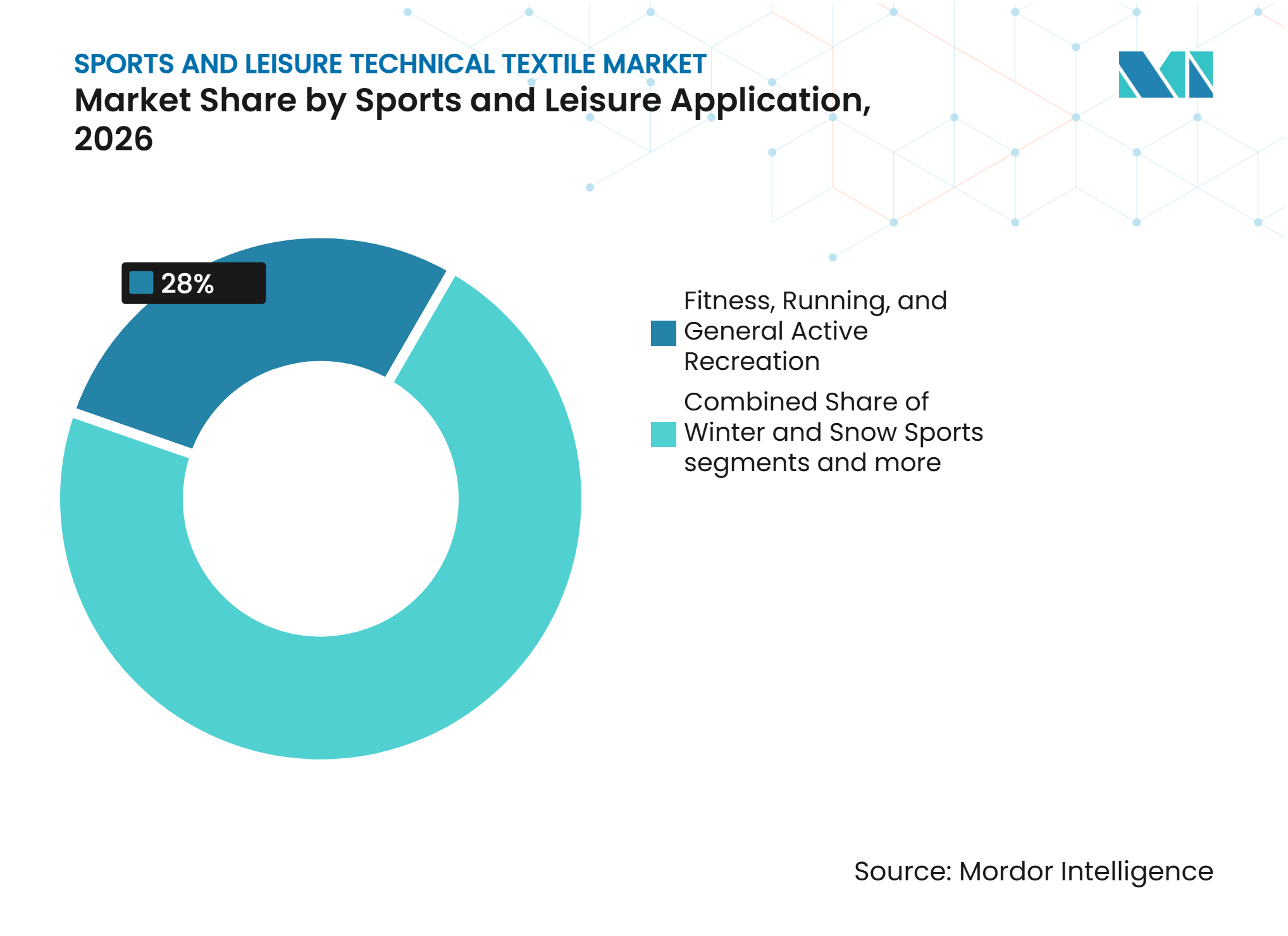
- By sports and leisure application, fitness, running, and general active recreation accounted for a 28% share in 2026, while mountaineering and adventure sports are projected to grow at a 7% CAGR through 2032.
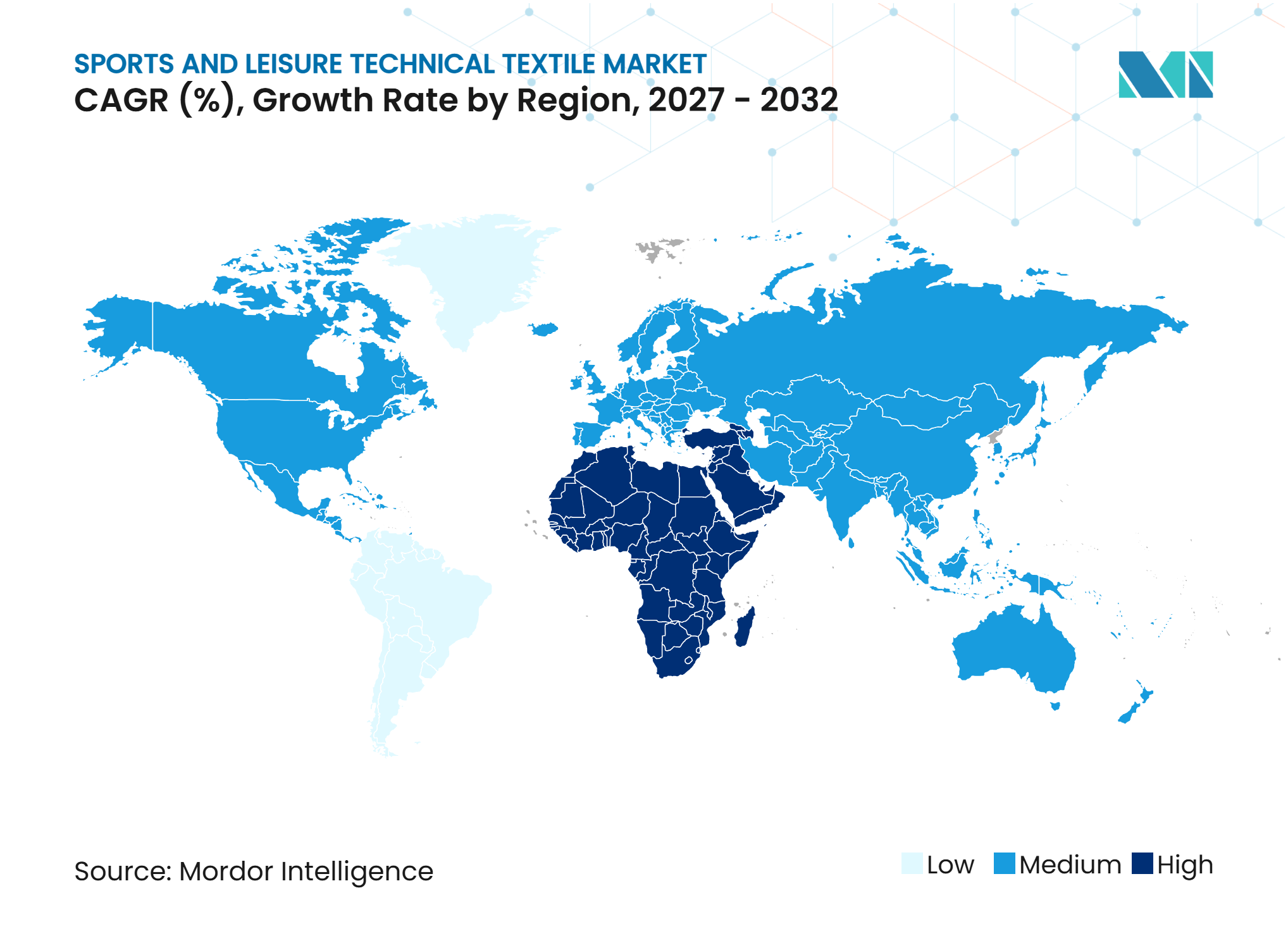
- By geography, Asia-Pacific accounted for a 37.4% share in 2026, while the Middle East and Africa are projected to grow at a 9.3% CAGR through 2032.
Note: Market numbers in this report are based on Mordor Intelligence's proprietary estimation framework, which combines nine months of actuals with Q4 projections for base year 2026.
Market Trends and Insights
Drivers Impact Analysis of Sports and Leisure Technical Textile Market*
| Driver | (~) % Impact on CAGR Forecast | Geographic Relevance | Impact Timeline |
|---|---|---|---|
| Growth in Performance Sportswear and Technical Activewear Demand | +1.5% | Global | Short term (≤ 2 years) |
| Expansion of Athletic Footwear Manufacturing | +0.8% | Asia-Pacific core, South America, and Southern Europe | Medium term (2-4 years) |
| Investment in Sports Infrastructure and Artificial Turf Facilities | +0.7% | Global, led by the Middle East and Africa and North America | Medium term (2-4 years) |
| Rising Adoption of Lightweight and High-Strength Sporting Materials | +0.6% | North America, Europe, and APAC high-performance markets | Long term (≥ 4 years) |
| Demand for Performance-Enhancing and Comfortable Sports Textiles | +0.5% | Global | Short term (≤ 2 years) |
| Growth in Camping, Trekking, Climbing, and Adventure Tourism | +0.4% | APAC and Europe | Medium term (2-4 years) |
| Source: Mordor Intelligence | |||
Growth in Performance Sportswear and Technical Activewear Demand
Demand for performance sportswear extends beyond formal athletic use and supports recurring replacement purchases. Cotton Incorporated found that moisture management and stretch were important activewear purchasing considerations, with 67% of surveyed consumers identifying moisture management as important in 2025. The same survey found that more than 80% of active consumers wore athletic apparel in multiple daily settings. This creates demand for fabrics that retain their fit and comfort through frequent use and laundering. Mid-tier apparel producers are therefore adopting properties once focused on elite products, including moisture management and stretch recovery. The Health & Fitness Association reported 81 million fitness facility memberships in the United States in 2025, which supports a broad demand base for activewear and footwear replacement.[1]
Expansion of Athletic Footwear Manufacturing
Global footwear production reached 24.6 billion pairs in 2025, and Asia accounted for 88.7% of this output. China produced 13.7 billion pairs and held 55.6% of global output, while Vietnam produced 1.7 billion pairs and held 6.7%. This scale sustains demand for engineered uppers, lining fabrics, reinforcement materials, and insoles. India’s quality requirements are also influencing local sourcing decisions, and ASICS stated in 2025 that it planned to raise local production to 40% of its India supply. New Balance opened an expanded USD 65 million footwear factory in Maine in September 2025, showing continued investment in regional production capacity.
Investment in Sports Infrastructure and Artificial Turf Facilities
Sports infrastructure investment is expanding the use of artificial turf, sports nets, protective textiles, and performance surfaces. Saudi Arabia’s FIFA World Cup 2034 program covers 15 stadiums and 134 training sites, creating a large pipeline for facilities-linked textile products. FIFA committed USD 5.3 million for 7 artificial pitches in Aruba in November 2026, indicating that field development also extends to smaller markets. TenCate introduced its Pivot Performance Turf system in 2025 with a 12-year warranty and testing under FIFA, NCAA, and NFL criteria. The product was designed to reduce plastic shedding by up to 99%, showing how environmental requirements are affecting product design. Public buyers increasingly assess performance, durability, environmental outcomes, and documented testing outcomes together when selecting sports surfaces for long-term use.
Rising Adoption of Lightweight and High-Strength Sporting Materials
Carbon and hybrid reinforcement materials are becoming more relevant in cycling, golf, snow sports, rackets, and marine equipment. Research on carbon fiber-reinforced thermoplastics documents their growing applications in these fields and their compatibility with modern production methods.[2] Manufacturers are working to reduce the cost barriers that restricted composites to specialized equipment. Serial production methods for carbon fiber bicycle frames show how automated processes can support more consistent production. The sports and leisure technical textile market gains from this shift because reinforcement fabrics supply a range of premium equipment categories. Material suppliers must still meet stringent requirements for strength, weight, fatigue behavior, and repeatability. This keeps technical qualification central to competition in composite applications.
Restraints Impact Analysis of Sports and Leisure Technical Textile Market*
| Restraint | (~) % Impact on CAGR Forecast | Geographic Relevance | Impact Timeline |
|---|---|---|---|
| Volatility in Polyester, Polyamide, and Specialty Polymer Prices | -0.8% | Global | Short term (≤ 2 years) |
| High Manufacturing Costs of Advanced Performance Textiles | -0.6% | North America and Europe | Long term (≥ 4 years) |
| Competition from Conventional Apparel Fabrics and Non-Textile Materials | -0.4% | Global | Short term (≤ 2 years) |
| Technical Performance, Weight, Comfort, and Durability Tradeoffs | -0.2% | Global | Long term (≥ 4 years) |
| Source: Mordor Intelligence | |||
Volatility in Polyester, Polyamide, and Specialty Polymer Prices
Raw-material price changes can affect margins across the technical textile supply chain. Celanese announced a polyamide price increase in January 2026, covering the Americas, Europe, the Middle East, and Africa. Eastman announced a price increase for specialty plastics, including polyester copolymers, effective April 2026. BASF also announced higher North American prices for caprolactam, polyamide polymer, and copolyamide in August 2026. Polyamide-intensive applications include footwear linings, compression apparel, swimwear, and climbing ropes. Cost exposure differs by material mix, so manufacturers must manage purchasing and product pricing by application rather than relying on one procurement approach.
High Manufacturing Costs of Advanced Performance Textiles
Advanced performance textiles require capital-intensive processing and costly product qualification. W. L. Gore & Associates introduced its GORE-TEX Pro Fabric with an ePE membrane in September 2025 after a lengthy development program.[3] Climbing ropes and parachute textiles must meet safety standards such as UIAA, EN, and TSO requirements, which involve testing and ongoing verification. These fixed compliance requirements can weigh more heavily on smaller suppliers. The resulting barriers protect established producers with recognized materials and testing systems. They can also limit the number of companies able to serve premium brands.
*Our forecasts treat driver/restraint impacts as directional, not additive. The impact forecasts reflect baseline growth, mix effects, and variable interactions.
Sports and Leisure Technical Textile Market Segment Analysis
By Product Type:
Performance Apparel Leads, Composites AccelerateHigh-performance sportswear and swimwear textiles held 35% of the sports and leisure technical textile market share in 2026. The segment includes performance apparel fabrics, technical swimwear, and textiles used in outdoor and winter sports. Its position reflects demand from training, exercise, and daily activewear use. Cotton Incorporated reported that active consumers commonly use athletic apparel in several everyday settings. Sports footwear textile components also contribute through knitted uppers, lining fabrics, structural reinforcements, and insoles. Artificial turf and sports surface textiles provide another stable product stream because they are linked to construction, maintenance, and replacement cycles.
Sports composite and equipment reinforcement textiles are projected to grow at a 7.2% CAGR through 2032. Carbon and hybrid fabrics are used in bicycles, rackets, skis, and marine products where low weight and strength are important. This growth supports opportunities for producers that can deliver consistent fiber placement and reliable resin compatibility. Climbing and adventure textiles are also changing as manufacturers reformulate products to reduce fluorinated chemistry. EDELRID completed its transition to PFAS-free UIAA water-repellent mountaineering ropes in 2026. Sioen Industries acquired Contender Sailcloth in July 2025 and brought it together with Dimension-Polyant within Sioen Sailcloth Technologies, strengthening its position in specialized sailcloth development.



By Material Type:
Polyester Dominant, Carbon Fibers Gaining GroundPolyester held 35% of the sports and leisure technical textile market share in 2026. It is used across artificial turf monofilaments, performance apparel, tents, and mesh nets because it combines adaptable processing with a broad cost base. Polyamide remains important in swimwear, compression apparel, footwear linings, and climbing ropes because it offers elasticity and durability. Polyethylene and polypropylene serve artificial turf and structural nonwoven uses. Aramid fibers support demanding applications such as rope sheaths and high-load sailcloth. Material selection depends on end-use requirements for strength, stretch, abrasion resistance, weight, and weather performance.
Carbon fibers are projected to grow at an 8.5% CAGR through 2032, the fastest rate among material types. As processing develops, composite producers can use carbon reinforcement in a wider range of sports equipment. The sports and leisure technical textile market size for carbon fiber applications is expanding, as manufacturers can reduce weight without compromising durability. Recycled and lower-impact fibers are becoming more relevant in apparel and outdoor materials. Toray introduced a polyester-polyamide composite fiber with at least 93% recycled raw material content in October 2026 under the Artirosa CX label. Lululemon and Samsara Eco announced a 10-year offtake agreement in June 2025 for enzymatically recycled nylon 6,6 and polyester that could cover up to 20% of Lululemon’s fiber portfolio.
By Sports and Leisure Application:
Fitness Anchors, Adventure Sports SurgesFitness, running, and general active recreation held 28% of the sports and leisure technical textile market share in 2026. The application supports recurring purchases of apparel fabrics, compression products, and engineered footwear uppers. Fitness memberships in the United States reached 81 million in 2025, supporting ongoing demand for products used in regular exercise. Team and field sports generate demand for artificial turf, training kits, nets, and protective materials. Water and sailing sports also support technical textiles through sails, wetsuits, and marine equipment. British Marine reported that 77% of UK adults took part in watersports or coastal activities in 2025, while 13% participated in sailing.
Mountaineering and adventure sports are projected to grow at a 7% CAGR from 2027 to 2032. This application requires lightweight fabrics, waterproof-breathable shells, climbing ropes, and durable equipment textiles. Nepal reported that expedition team membership rose 17.1% in 2025 and mountaineering royalties rose 36.4%. The activity base increases demand for textiles that perform under changes in temperature, moisture, and abrasion. Winter sports further require insulation, high-stretch base layers, and protective laminates. Aerial recreation products such as paragliding and parachuting remain specialized because their materials require EN and TSO safety qualification.

Geography Analysis
Asia-Pacific: Manufacturing Hub and Rising Domestic Demand
Asia-Pacific held 37.4% of the sports and leisure technical textile market share in 2026. The region combines high-volume production of synthetic sportswear fabrics, footwear components, and artificial turf yarns with growing local participation in fitness and outdoor activities. Asia produced 88.7% of the 24.6 billion footwear pairs made globally in 2025. India was the second-largest footwear producer with 3 billion pairs in 2025. Local quality requirements are influencing where international brands source and manufacture. ASICS's plan to increase its India production share demonstrates how compliance factors can alter regional textile demand. The region’s integrated manufacturing base supports shorter supply chains between textile makers, footwear factories, and consumer brands. Outdoor tourism is also broadening the market for trekking, camping, and protective apparel materials.
Middle East and Africa: Facilities Investment Supports Demand
The Middle East and Africa are projected to grow at a 9.3% CAGR through 2032. Sports projects in Saudi Arabia are creating demand for turf, sports surfaces, performance apparel, nets, and supporting construction textiles. The Saudi FIFA World Cup 2034 program includes 15 stadiums and 134 training sites. Dubai’s Sports Sector Strategic Plan 2033 seeks to raise the sector’s GDP contribution from AED 10.2 billion (USD 2.8 billion) to AED 18.3 billion (USD 5 billion) by 2033. Its focus includes padel, indoor climbing, and community running, which each require different technical product mixes. Public procurement requirements increasingly favor systems with clear durability and environmental documentation.
North America, Europe, and South America: Innovation and Localized Capacity
North America maintains demand through activewear consumption, footwear production, and sports facility investment. New Balance expanded its Maine factory with a USD 65 million investment in September 2025, adding 120,000 square feet of production space. Europe has a strong role in specialist performance materials, particularly fluorine-free membranes, sailcloth, climbing ropes, and circular material development. Toray Textiles Europe invested GBP 20 million (USD 27 million) in its Mansfield facility in 2025, reflecting continued investment in technical textile capability. Regulatory influence is stronger in Europe, where PFAS restrictions under REACH are encouraging alternatives in waterproof-breathable materials. South American demand is linked to Brazil’s footwear base, outdoor tourism, and sports field development. These regions differ in scale, but each offers demand for qualified technical products rather than undifferentiated commodity fabrics.
Competitive Landscape
Market Concentration
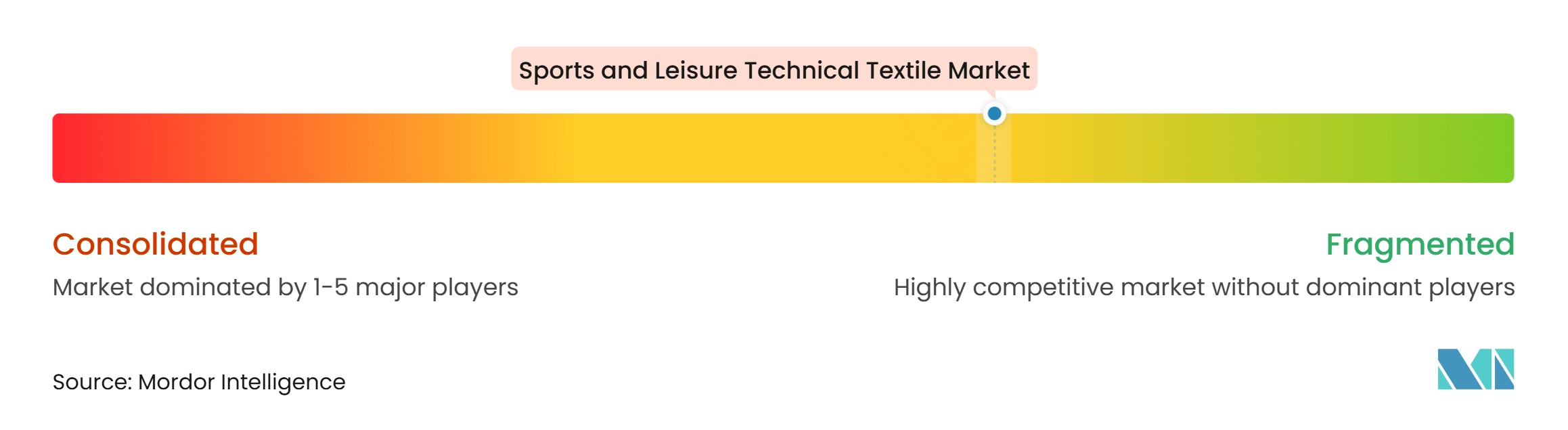
The sports and leisure technical textile market exhibits a medium level of market concentration. TenCate Grass and CCGrass compete in artificial turf, while North Sails and Sioen Sailcloth Technologies serve the sailcloth. EDELRID and BEAL compete in climbing rope applications where safety performance and documented testing are essential. Toray Industries and Teijin Frontier provide performance sportswear and advanced fiber materials. Cost competition is stronger in high-volume performance apparel fabrics, where many Asian manufacturers are active.
Technology development is becoming more important in performance claims and environmental compliance. W. L. Gore & Associates launched its ePE GORE-TEX Pro Fabric in September 2025 without intentionally added PFAS and stated that it delivered up to 39% lower carbon footprint than the preceding generation. EDELRID and the German Institutes of Textile and Fiber Research completed the Rope Twin project in January 2026 to model rope production and improve fluorine-free impregnation processes. TenCate’s Pivot system is positioned around simultaneous performance testing and compliance with California Proposition 65, FIFA, NCAA, and NFL criteria. These developments show that product qualification increasingly combines technical, regulatory, and environmental requirements. Suppliers with strong testing records can use those requirements to protect their position.
Consolidation is selective rather than broad across the full market. Sioen Industries’ acquisition of Contender Sailcloth in July 2025 combined the business with Dimension-Polyant under Sioen Sailcloth Technologies. The transaction focused on specialized development capability in laminate and film-free sailcloth rather than production volume alone. Toray’s recycled composite fiber launch shows how large material suppliers are using product development to address brand requirements for recycled content. Triton Group, TenCate, and iSustain also formed a 2026 partnership to recycle retired synthetic turf into composite railroad ties.
Sports and Leisure Technical Textile Industry Leaders
-
Toray Industries Inc.
-
Teijin Frontier Co. Ltd.
-
Carvico S.p.A.
-
Sitip S.p.A.
-
Milliken & Company (Polartec)
- *Disclaimer: Major Players sorted in no particular order
Sports and Leisure Technical Textile Market Companies Covered in this Report
- Toray Industries Inc.
- Teijin Frontier Co. Ltd.
- Carvico S.p.A.
- Sitip S.p.A.
- Milliken & Company (Polartec)
- W. L. Gore & Associates Inc.
- Schoeller Textil AG
- Freudenberg Group (Performance Materials)
- Porcher Industries
- Sigmatex
- Sioen Industries NV (Sioen Sailcloth Technologies)
- North Sails
- TenCate Grass
- Tarkett Group (Tarkett Sports / FieldTurf)
- Sport Group Holding (Polytan / AstroTurf)
- Jiangsu Co-Creation Grass Co. Ltd. (CCGrass)
- Limonta Sport S.p.A.
- Manfred Huck GmbH
- Ashaway Line & Twine Manufacturing Co.
- EDELRID GmbH & Co. KG
Recent Industry Developments in Sports and Leisure Technical Textile Market
- October 2026: Toray Industries introduced a polyester-polyamide composite fiber carrying at least 93% recycled raw-material content by weight, targeting outerwear brands under the Artirosa CX fabric label for fall/winter 2027, with initial-year sales targeted at 200,000 m. The fiber is produced without intentionally added PFAS in its water-repellent chemistry, addressing both sustainability and regulatory requirements.
- October 2026: Triton Group, TenCate, and iSustain announced a recycling partnership to convert retired synthetic turf fields into composite railroad ties, with a five-year capacity to process up to 21 million pounds of recovered turf plastic for the production of more than 300,000 Triton Ties.
- September 2026: North Sails, Gatti shipyard, and Genova Sea Service opened a new EUR 12 million (USD 14.1 million) integrated facility in the Port of Genoa, Italy, combining 16,000 m² of land area, a 140-tonne travel lift, and 3,500 m² of sail-making space accommodating sails up to 75 m in length.
- January 2026: EDELRID announced the complete elimination of PFAS from all UIAA water-repellent mountaineering ropes from 2026, expanding its fluorine-free Eco Dry treatment across its full range of dry-treated climbing ropes.
Global Sports and Leisure Technical Textile Market Report Scope
The Sports and Leisure Technical Textile Market is segmented by Product (Sports Footwear Technical Textile Components, Sports Nets and Racket Strings, and more), by Material (Polyester, Polyamide, and more), by Sports and Leisure Application (Winter and Snow Sports, Water and Sailing Sports, and more), and by Geography (North America, Europe, Asia-Pacific, and more). The Market Forecasts are Provided in Terms of Value (USD).
Segmentation Overview
| High-Performance Sportswear and Swimwear Textiles | Performance Sportswear Fabrics |
| Technical Swimwear Fabrics | |
| Outdoor and Winter Sports Apparel Textiles | |
| Sports Footwear Technical Textile Components | Engineered Sports Shoe Upper Textiles |
| Sports Footwear Lining and Spacer Textiles | |
| Sports Footwear Structural and Reinforcement Textiles | |
| Technical Textile Insole and Footbed Components | |
| Other Specialized Sports Footwear Textiles | |
| Artificial Turf and Sports Surface Textiles | |
| Sports Nets and Racket Strings | |
| Sports Composite and Equipment Reinforcement Textiles | Carbon Fiber Sports Reinforcement Fabrics |
| Glass, Aramid, and Hybrid Sports Reinforcement Fabrics | |
| Inflatable Sports Ball Textile Materials | |
| Other Sports Composite Textile Preforms and Reinforcements | |
| Camping, Sleeping Bag, and Outdoor Recreation Textiles | |
| Sailcloth and Water Sports Textiles | |
| Parachute, Paragliding, and Ballooning Textiles | |
| Climbing and Adventure Sports Textiles |
| Polyester |
| Polyamide |
| Polyethylene |
| Polypropylene |
| Carbon Fibers |
| Glass Fibers |
| Aramid and Other High-Performance Synthetic Fibers |
| Natural and Regenerated Cellulosic Fibers |
| Other Materials |
| Fitness, Running, and General Active Recreation |
| Team and Field Sports (Football, Rugby, Cricket, etc.) |
| Racket and Court Sports (Tennis, Badminton, Squash, etc.) |
| Outdoor Camping, Hiking, and Trekking |
| Mountaineering and Adventure Sports |
| Water and Sailing Sports |
| Winter and Snow Sports |
| Aerial and Aviation Recreation Sports |
| Other Specialized Sports and Leisure Activities |
| North America | United States |
| Canada | |
| Mexico | |
| Europe | Germany |
| United Kingdom | |
| France | |
| Italy | |
| Spain | |
| Netherlands | |
| Belgium | |
| Austria | |
| Switzerland | |
| Poland | |
| Sweden | |
| Rest of Europe | |
| Asia-Pacific | China |
| India | |
| Japan | |
| South Korea | |
| Taiwan | |
| Vietnam | |
| Indonesia | |
| Thailand | |
| Bangladesh | |
| Australia | |
| Rest of Asia-Pacific | |
| Middle East and Africa | Saudi Arabia |
| United Arab Emirates | |
| South Africa | |
| Egypt | |
| Rest of Middle East and Africa | |
| South America | Brazil |
| Argentina | |
| Chile | |
| Colombia | |
| Rest of South and Central America |
| By Product Type | High-Performance Sportswear and Swimwear Textiles | Performance Sportswear Fabrics |
| Technical Swimwear Fabrics | ||
| Outdoor and Winter Sports Apparel Textiles | ||
| Sports Footwear Technical Textile Components | Engineered Sports Shoe Upper Textiles | |
| Sports Footwear Lining and Spacer Textiles | ||
| Sports Footwear Structural and Reinforcement Textiles | ||
| Technical Textile Insole and Footbed Components | ||
| Other Specialized Sports Footwear Textiles | ||
| Artificial Turf and Sports Surface Textiles | ||
| Sports Nets and Racket Strings | ||
| Sports Composite and Equipment Reinforcement Textiles | Carbon Fiber Sports Reinforcement Fabrics | |
| Glass, Aramid, and Hybrid Sports Reinforcement Fabrics | ||
| Inflatable Sports Ball Textile Materials | ||
| Other Sports Composite Textile Preforms and Reinforcements | ||
| Camping, Sleeping Bag, and Outdoor Recreation Textiles | ||
| Sailcloth and Water Sports Textiles | ||
| Parachute, Paragliding, and Ballooning Textiles | ||
| Climbing and Adventure Sports Textiles | ||
| By Material Type | Polyester | |
| Polyamide | ||
| Polyethylene | ||
| Polypropylene | ||
| Carbon Fibers | ||
| Glass Fibers | ||
| Aramid and Other High-Performance Synthetic Fibers | ||
| Natural and Regenerated Cellulosic Fibers | ||
| Other Materials | ||
| By Sports and Leisure Application | Fitness, Running, and General Active Recreation | |
| Team and Field Sports (Football, Rugby, Cricket, etc.) | ||
| Racket and Court Sports (Tennis, Badminton, Squash, etc.) | ||
| Outdoor Camping, Hiking, and Trekking | ||
| Mountaineering and Adventure Sports | ||
| Water and Sailing Sports | ||
| Winter and Snow Sports | ||
| Aerial and Aviation Recreation Sports | ||
| Other Specialized Sports and Leisure Activities | ||
| By Geography | North America | United States |
| Canada | ||
| Mexico | ||
| Europe | Germany | |
| United Kingdom | ||
| France | ||
| Italy | ||
| Spain | ||
| Netherlands | ||
| Belgium | ||
| Austria | ||
| Switzerland | ||
| Poland | ||
| Sweden | ||
| Rest of Europe | ||
| Asia-Pacific | China | |
| India | ||
| Japan | ||
| South Korea | ||
| Taiwan | ||
| Vietnam | ||
| Indonesia | ||
| Thailand | ||
| Bangladesh | ||
| Australia | ||
| Rest of Asia-Pacific | ||
| Middle East and Africa | Saudi Arabia | |
| United Arab Emirates | ||
| South Africa | ||
| Egypt | ||
| Rest of Middle East and Africa | ||
| South America | Brazil | |
| Argentina | ||
| Chile | ||
| Colombia | ||
| Rest of South and Central America | ||
Key Questions Answered in the Report
What is the projected growth rate for sports and leisure technical textiles?
The sector is projected to grow at a 5.00% CAGR from 2027 to 2032, increasing from USD 52.74 billion in 2027 to USD 67.31 billion by 2032.
Which product category leads sports and leisure technical textiles?
High-performance sportswear and swimwear textiles lead with a 35% share in 2026.
Which material is growing fastest in sports equipment textiles?
Carbon fibers are projected to grow at an 8.5% CAGR through 2032 as use expands in lightweight reinforcement applications.
What is driving demand for technical sportswear fabrics?
Frequent activewear use, fitness participation, moisture management, and stretch requirements support demand for more durable performance fabrics.
Which application is growing fastest for technical sports textiles?
Mountaineering and adventure sports are projected to grow at a 7% CAGR through 2032, supporting demand for ropes, shells, and durable outdoor textiles.
Which region has the strongest projected growth through 2032?
The Middle East and Africa are projected to grow at a 9.3% CAGR, supported by major sports infrastructure programs.