
Specialty Polyamides Market Size and Share
Market Overview
| Study Period | 2021 - 2031 |
|---|---|
| Market Size (2026) | USD 4.34 Billion |
| Market Size (2031) | USD 6.17 Billion |
| Growth Rate (2026 - 2031) | 7.29% CAGR |
| Fastest Growing Market | Asia-Pacific |
| Largest Market | Asia-Pacific |
| Market Concentration | Low |
Major Players *Disclaimer: Major Players sorted in no particular order Image © Mordor Intelligence. Reuse requires attribution under CC BY 4.0. | |
Specialty Polyamides Market Analysis by Mordor Intelligence
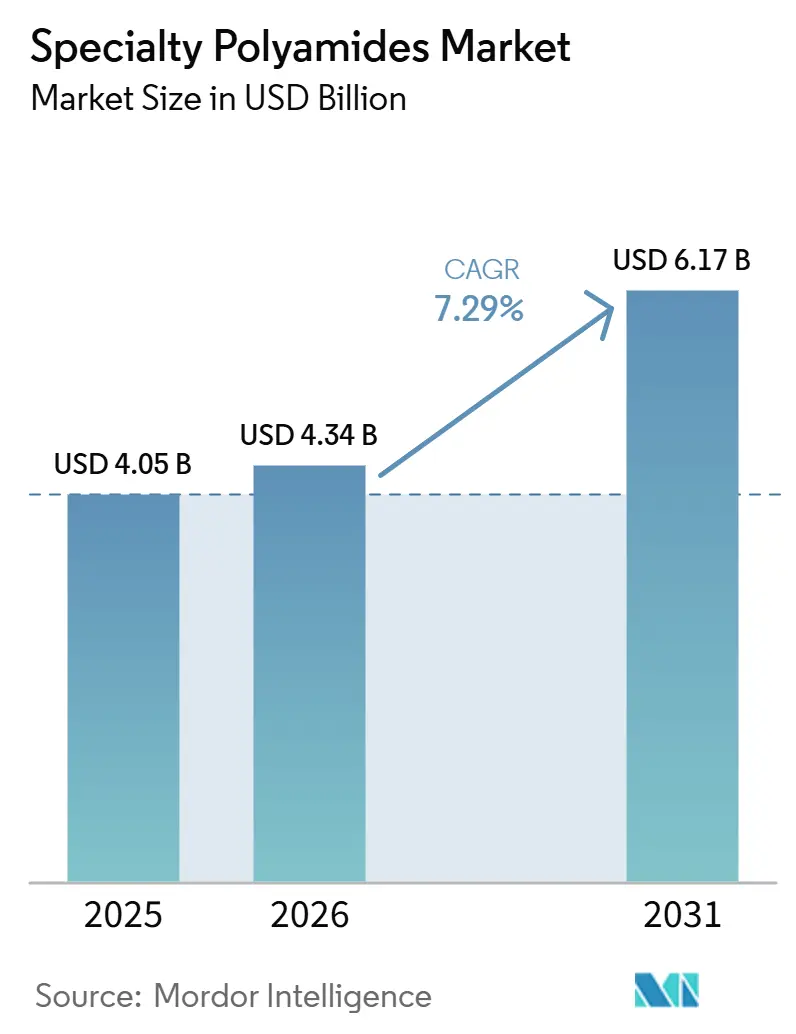
The specialty polyamides market size was valued at USD 4.05 billion in 2025 and is estimated to grow from USD 4.34 billion in 2026 to reach USD 6.17 billion by 2031, at a CAGR of 7.29% during the forecast period (2026-2031). The specialty polyamides market is benefiting from growth in electric vehicle production, miniaturization of electronic components, and increasing thermal and electrical performance requirements in advanced applications. Standard polyamide grades do not meet all performance requirements for high-voltage connectors, battery housings, and thermal management systems. Electric car sales exceeded 20 million units in 2025, representing 25% of global car sales, and exceeded 23 million units in 2026. This shift is driving demand for high-temperature polyphthalamide and long-chain grades capable of operating in demanding electrical and thermal environments. Suppliers are responding through application-specific compounds, certified lower-carbon materials, and local production capacity in the Asia-Pacific region. The specialty polyamides market also faces higher qualification costs and greater exposure to raw material volatility, which favor suppliers with established technical support and resilient supply chains.
Key Report Takeaways
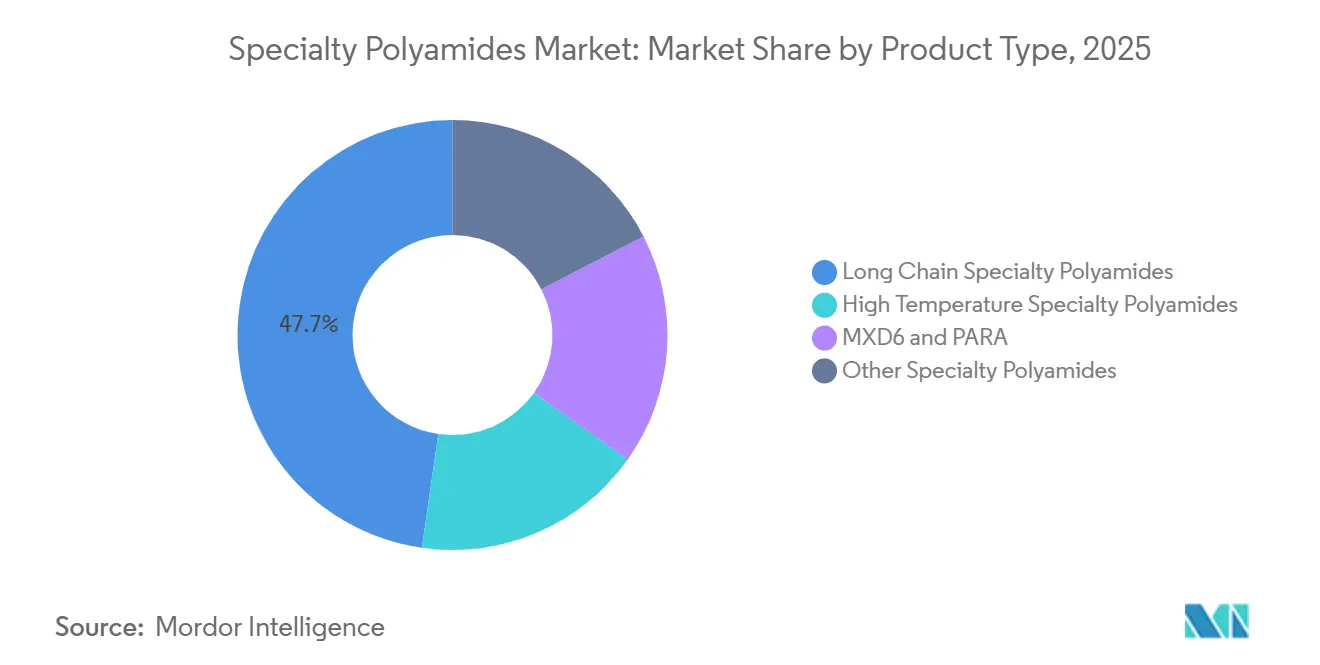
- By product type, Long Chain Specialty Polyamides held 47.74% of the category share in 2025 and are forecast to grow at an 8.15% CAGR through 2031.
- By form, Compounds and Reinforced Grades accounted for 43.77% of the category share in 2025 and are projected to expand at an 8.26% CAGR through 2031.
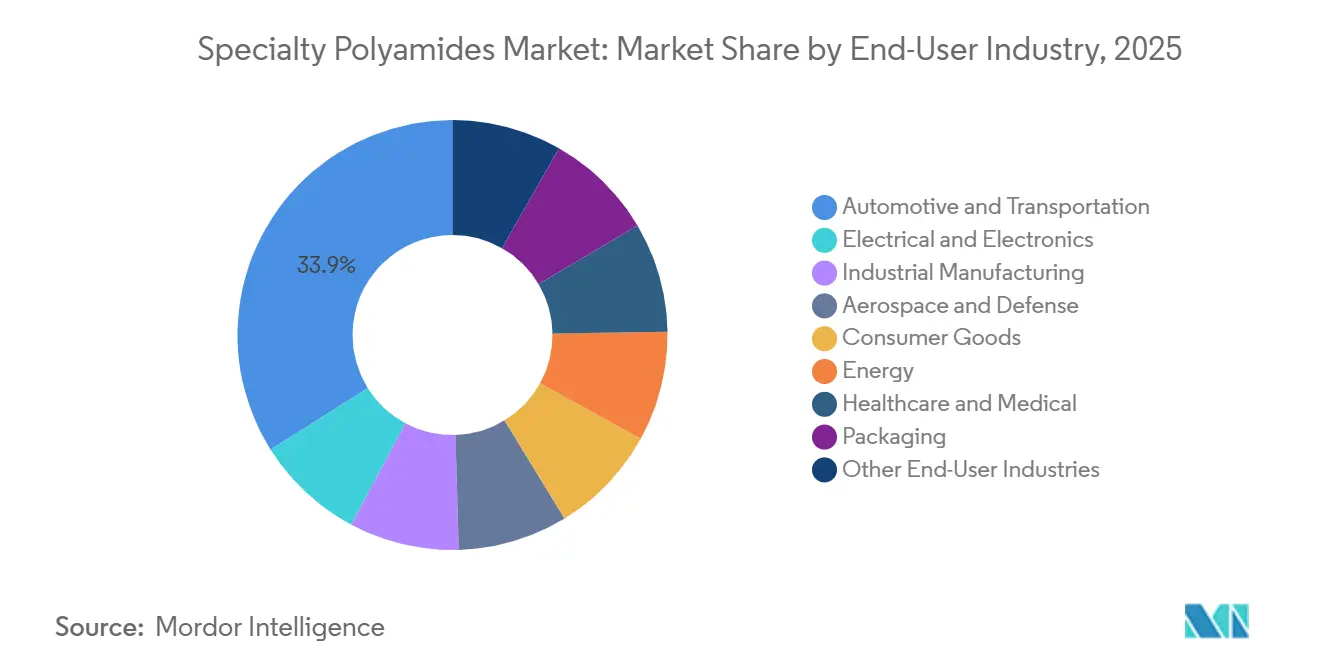
- By end-user industry, Automotive and Transportation held a 33.94% share in 2025, while Electrical and Electronics is forecast to record the highest CAGR of 8.93% through 2031.
- By geography, Asia-Pacific accounted for a 45.87% share in 2025 and is forecast to grow at an 8.11% CAGR through 2031.
Note: Market size and forecast figures in this report are generated using Mordor Intelligence’s proprietary estimation framework, updated with the latest available data and insights as of January 2026.
Global Specialty Polyamides Market Trends and Insights
Drivers Impact Analysis*
| Drivers | (~) % Impact on CAGR Forecast | Geographic Relevance | Impact Timeline |
|---|---|---|---|
| Increasing Adoption of Lightweight Specialty Polyamides in Automotive and Transportation | +1.8% | Global | Medium term (2-4 years) |
| Rising Demand for High-Performance Thermal and Electrical Insulation in Electrified Vehicles | +1.6% | Global, with Asia-Pacific core | Medium term (2-4 years) |
| Growing Miniaturization of Electronic Devices and Demand for High-Temperature Components | +1.4% | Asia-Pacific core, with North America and Europe | Medium term (2-4 years) |
| Expanding Adoption of Bio-Based and Sustainable Specialty Polyamides | +0.7% | Europe and North America primarily | Long term (≥ 4 years) |
| Increasing Demand from Semiconductor, Connector, and Battery Component Manufacturing | +1.1% | Asia-Pacific core, including Taiwan, South Korea, Japan, and China | Medium term (2-4 years) |
| Source: Mordor Intelligence | |||
Increasing Adoption of Lightweight Specialty Polyamides in Automotive and Transportation
Specialty polyamides now support load-bearing functions in electrified powertrain designs, rather than only peripheral under-hood applications. Glass-fiber-reinforced PA66/6T compounds are used in battery module carriers and power electronics enclosures. These materials can reduce component weight by 20-50% compared with metallic alternatives, supporting vehicle range. The shift toward 800 V electric vehicle systems has increased the need to requalify connectors and housings from standard PA66 to polyphthalamide (PPA) grades. BASF offers more than 50 compounded Ultramid Advanced N grades for high-voltage automotive applications, reflecting the depth of original equipment manufacturer (OEM) material requirements for 800 V systems. Global electric car production exceeded 22 million units in 2025, supporting procurement demand across the specialty polyamides market.
Rising Demand for High-Performance Thermal and Electrical Insulation in Electrified Vehicles
Battery-electric vehicles require materials that maintain performance above 150°C in humid operating conditions. This combination excludes many conventional engineering plastics from high-voltage component specifications. BASF launched Ultramid Advanced N3U42G6, a PA9T grade, in June 2025 with a heat distortion temperature of 265°C and UL 94 V-0 performance at a 0.25 mm wall thickness. KOSTAL adopted the grade for its KS22 Class 4 high-current high-voltage connector module. European halide-free requirements limit the use of flame-retardant additives that may cause electrocorrosion of metal contacts. Asahi Kasei states that its Leona PN series has a comparative tracking index of 600 V, which can permit shorter creepage distances in high-voltage inductors. These requirements raise the technical threshold for suppliers entering the specialty polyamides market.
Growing Miniaturization of Electronic Devices and Demand for High-Temperature Components
Smaller electronic devices require thin walls, heat resistance, and flame-retardant performance within the same component. Connector wall thicknesses in portable consumer electronics are moving toward 0.4 mm, where polyphthalamide (PPA) and comparable grades can meet UL 94 V-0 requirements. Syensqo launched Kalix LD-4850 BK000 in October 2025, a low-density high-performance polyphthalamide (HPPA) that delivers more than 30% weight reduction compared with conventional structural polyamides and polycarbonates. Smartphone manufacturers adopted the material upon its commercial release. Semiconductor fabrication also uses high-purity PPA and polyamide-imide grades in wafer-handling components and plasma chamber fixtures, supporting demand for high-purity materials[1]Semiconductor Industry Association, “Global Semiconductor Sales Increase 19.1% in 2024, Double-Digit Growth Projected in 2025,” Semiconductor Industry Association, semiconductors.org. This demand supports the specialty polyamides market as electronic and semiconductor production clusters expand.
Expanding Adoption of Bio-Based and Sustainable Specialty Polyamides
Sustainability credentials have become an important procurement requirement for specialty polyamide suppliers. Arkema states that Rilsan PA11 Gen2 is derived from castor oil and contains 100% renewable carbon. The company reports a 20–30% reduction in carbon footprint per finished part compared with the prior PA11 generation. Evonik reports that VESTAMID eCO PA12 can reduce CO₂ emissions by up to 70% compared with petroleum-derived polyamide produced using coal-generated electricity. DOMO Chemicals introduced DOMAMID MBB in May 2025, with up to 69% bio-attributed content under ISCC PLUS certification. Mass-balance certifications can enable customers to adopt bio-attributed grades without repeating extensive downstream material approvals.
Restraints Impact Analysis*
| Restraints | (~) % Impact on CAGR Forecast | Geographic Relevance | Impact Timeline |
|---|---|---|---|
| Volatility in Specialty Monomer and Raw Material Prices | -0.9% | Global | Short term (≤ 2 years) |
| High Processing Complexity and Product Qualification Costs | -0.7% | Global | Medium term (2-4 years) |
| Limited Recycling Infrastructure for Reinforced and Multi-Material Specialty Polyamides | -0.5% | Europe and North America | Long term (≥ 4 years) |
| Source: Mordor Intelligence | |||
Volatility in Specialty Monomer and Raw Material Prices
Specialty polyamide production relies on adipic acid, caprolactam, ω-laurolactam, and 11-aminoundecanoic acid. Each precursor carries distinct supply risks that can affect material costs for compounders and processors. The PA12 supply chain faces concentration risk, as Evonik's Marl Chemical Park hosts the largest laurolactam production cluster. A disruption at this site could affect PA12 supply for automotive and oil-and-gas applications. Castor oil feedstock for PA11 is concentrated in India, China, and Brazil, adding crop-yield variability to the material's supply conditions. Fixed-price agreements leave downstream compounders and OEM partners exposed when feedstock costs change before contracts can be renegotiated.
High Processing Complexity and Product Qualification Costs
Semi-aromatic and polyphthalamide (PPA) grades require more demanding processing conditions than standard nylon materials. PPA grades need melt temperatures of 290-330°C, precise pre-drying control, and careful management of shear sensitivity. Existing PA66 molding infrastructure may require capital investment before it can reliably process these materials. Automotive and electronics suppliers can require 12-24 months for OEM approval processes, including PPAP and thermal-aging validation. BASF introduced Ultramid T6000 in July 2025 with processability at standard PA66 mold temperatures of 90-110°C, reducing the need for mold-tool upgrades[2]BASF SE, “High Flowability, Easy Processing and Good Colorability, PPA for Small and Color-Stable E&E Parts,” BASF Media Release, basf.com. The time between a grade's commercial launch and its approved use can slow revenue growth in the specialty polyamides market.
*Our forecasts treat driver/restraint impacts as directional, not additive. The impact forecasts reflect baseline growth, mix effects, and variable interactions.
Segment Analysis
By Product Type: Long Chain Grades Anchor Value as High-Temperature Demand Rises
Long-chain specialty polyamides accounted for 47.74% of the specialty polyamides market in 2025 and are forecast to grow at a 8.15% CAGR through 2031. The segment is established in fluid handling, automotive tubing, additive manufacturing, and electric vehicle thermal management. PA11 and PA12 are the major commercial grades within this group. Arkema's Rilsan and Evonik's VESTAMID platforms hold positions in these long-chain applications. PA12 has low moisture absorption and stable dimensions, making it suitable for hydrogen fuel lines and electric coolant channels. These characteristics are important when components experience pressure cycling and thermal change. These grades are used in the specialty polyamides market, where standard nylon materials do not provide adequate stability.
Evonik completed trial production at a second polyamide reactor in Shanghai in November 2025. The project doubled the company's long-chain polyamide production capacity in Asia. Commercial operations began in December 2025, targeting new energy vehicles and sports products. High-temperature specialty polyamides, including PA9T, PA6T, PA4T, and related PPA grades, occupy a smaller but expanding share of demand. These materials are used in 5G connector assemblies, high-voltage automotive components, and semiconductor packaging. Kuraray's GENESTAR PA9T targets advanced battery and connector applications. MXD6 and PARA grades serve barrier packaging and structural optical uses, while copolyamides, transparent grades, and PEBA elastomers address consumer electronics, medical devices, and performance footwear.



By Form: Compounds and Reinforced Grades Command the Market, Driven by OEM Specification Depth
Compounds and reinforced grades accounted for 43.77% of the specialty polyamides market in 2025 and are projected to grow at an 8.26% CAGR through 2031. This was both the largest and fastest-growing form segment. Automotive and electronics customers increasingly specify compounds tailored to a part's immediate performance requirements. This approach can reduce secondary compounding at the converter and shorten material development timelines. PPA compounds for structural automotive applications commonly use 30-50% glass-fiber reinforcement. Mineral-filled versions are used for dielectric components that require dimensional stability under load and elevated temperatures. The specialty polyamides market is moving toward compounds that combine polymer selection with application-specific formulation.
The segment also reflects demand for non-halogenated flame-retardant solutions in Europe and China. Compounders that replace halogenated systems with phosphorus-based or other non-halogenated alternatives can offer grades that align with evolving specifications. Resins and pellets remain the second-largest form segment for converters with in-house compounding capabilities. Powders benefit from powder bed fusion additive manufacturing. Arkema's HP 3D HR PA11 Gen2, launched in 2025 for industrial 3D printing, offers a 20-30% lower carbon footprint than the previous PA11 powder generation. Films and semi-finished shapes support specialty barrier packaging and technical membranes, where pharmaceutical and food-processing qualification requirements influence demand. The specialty polyamides market continues to require both base resin flexibility and tailored compound performance.
By End-User Industry: Automotive Leads, but Electronics Resizes the Growth Curve
Automotive and transportation captured 33.94% of the market in 2025, while electrical and electronics are forecast to grow at an 8.93% CAGR through 2031. Automotive demand is supported by established use in under-hood components and newer applications in electrified powertrains. Electrical and electronics demand reflects device miniaturization, 5G deployment, and semiconductor manufacturing capacity in Asia-Pacific. Electric vehicle onboard chargers, battery management systems, and motor control units add electronic material demand beyond direct powertrain components. This overlap explains why automotive electrification and electronics development reinforce each other in the specialty polyamides market. Industrial manufacturing, aerospace and defense, and energy also represent significant combined demand. Energy applications include PA11 flexible pipes in offshore oil and gas infrastructure and PA12 cable sheathing for renewable energy projects.
Healthcare and medical applications include imaging housing, sterilization-compatible surgical instrument components, and fluid-contact devices. These applications require grades with biocompatibility credentials and resistance to autoclave conditions. Consumer goods demand is linked to lighter electronic devices and advanced product form factors. Syensqo's Kalix LD-4850 BK000 was adopted by smartphone manufacturers in 2025, demonstrating the use of specialty polyamides in consumer electronics designs. Packaging demand is concentrated in food processing and pharmaceutical primary packaging, particularly for MXD6 and barrier-grade polyamides. Across these end uses, China and South Korea provide a concentrated manufacturing base for the specialty polyamides market, with their electronics clusters supporting demand across several end-user categories simultaneously.
Geography Analysis
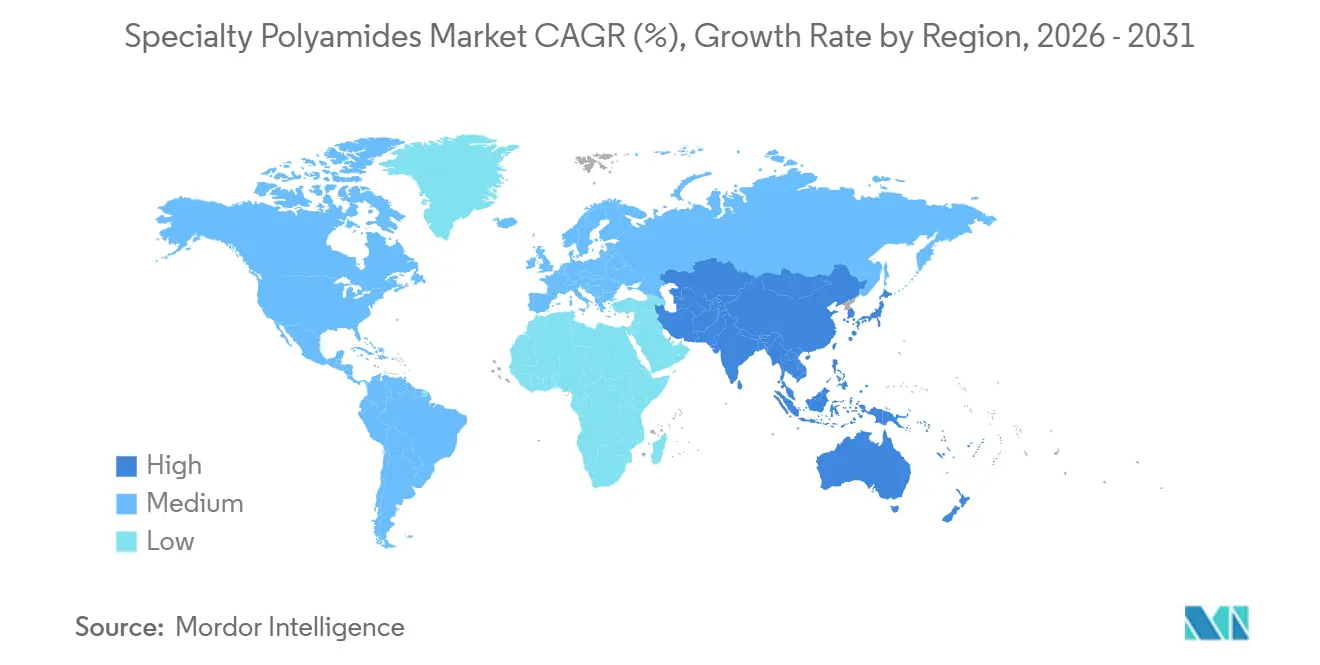
Asia-Pacific accounted for 45.87% of the specialty polyamides market in 2025 and is forecast to grow at an 8.11% CAGR through 2031. China is the largest demand center in the region due to its electric vehicle production and electronics manufacturing base. China accounted for 60% of global electric car sales in 2025. Chinese vehicle manufacturers are qualifying specialty polyamide composites to improve material efficiency across vehicle platforms. High-end applications for PA12, PA46, and semi-aromatic polyamides are emerging in connectors and battery structural components.
Evonik doubled capacity for long-chain polyamides at its Shanghai site through a second reactor project in 2025. Japan and South Korea support demand through precision connector manufacturing and semiconductor fabrication. Southeast Asian electric vehicle sales more than doubled in 2025 and approached 20% market share, creating an expanding material demand base that remains below its longer-term potential. Asia-Pacific's integrated supply chains make the region central to the specialty polyamides market.
North America and Europe are the second- and third-largest regional markets, with distinct demand patterns. North America is supported by automotive lightweighting, domestic semiconductor investment, and PA11 demand for flexible pipes in oil and gas infrastructure. U.S. electric vehicle sales were subdued in the first quarter of 2026 amid policy uncertainty, while European electric vehicle sales rose nearly 30% year on year during the same period. Europe's requirements for halogen-free, traceable, mass-balanced, and recycled-content supply chains are important factors in supplier selection. Germany, France, and Italy remain core European markets due to automotive procurement and integrated chemical production.
South America, the Middle-East, and Africa represent smaller but growing areas within the specialty polyamides market. Brazil leads South American demand through automotive assembly and local sourcing of engineering plastics. In the Middle-East and Africa, Saudi Arabia's Vision 2030 petrochemical diversification program could support a future role in higher-value polymer derivatives. South Africa has selective demand from mining equipment and industrial manufacturing. Both regions stand to benefit from infrastructure demand for cable sheathing, fluid-handling systems, and localized automotive supply chains, providing a foundation for the specialty polyamides market beyond the major manufacturing regions.

Competitive Landscape
The specialty polyamides market is fragmented. Arkema, BASF, Evonik Industries, EMS-Chemie, and Syensqo are the principal suppliers. Their portfolios cover PA11 and PA12, PPA and PA4T, PEBA, amorphous and semi-aromatic polyamides, and HPPA grades. Competition increasingly depends on application development with OEMs, supply-chain traceability, and regional production capabilities in the Asia-Pacific. In its 2025 full-year results, Arkema reported an investment in processes that recover caprolactam from automotive shredder residue. This work links end-of-life vehicle recycling with the supply of raw materials for specialty materials, offering a circular-material advantage that early-stage competitors may find difficult to replicate.
BASF broadened its automotive offering through the Ultramid Advanced portfolio of more than 50 PPA compounds for high-voltage applications. The company also introduced Ultramid T6000 in 2025, addressing processing barriers for converters that require higher performance without mold-tool upgrades. Evonik increased its long-chain polyamide capacity in Shanghai, positioning supply closer to Asian new-energy vehicle and sports-product customers. Chinese compounders, including ShanDong DongChen Engineering Plastic, expanded their technical capability in standard reinforced compounds. This development may reduce price premiums for global suppliers that lack differentiated intellectual property or access to premium applications.
Opportunities remain in ultra-high-purity grades for semiconductor applications, bio-circular long-chain materials for healthcare and electronics, and mass-balanced recycling systems connected with OEM take-back programs. Radici Novacips, Kuraray, and UBE Corporation are pursuing more focused strategies in these areas. Kuraray's GENESTAR PA9T targets advanced battery and connector applications. UBE Corporation has restructured its caprolactam and nylon operations to improve margins. Suppliers that can meet UL, IEC 60112, RoHS, and REACH requirements through a single compound formulation can shorten the path to OEM qualification. The specialty polyamides market remains moderately concentrated, as established platforms, approvals, and technical capability continue to create meaningful barriers to entry.
Specialty Polyamides Industry Leaders
BASF
Evonik Industries AG
Arkema
Envalior
Solvay
- *Disclaimer: Major Players sorted in no particular order


Recent Industry Developments
- January 2026: Arkema started up its new Rilsan Clear transparent polyamide production unit in Singapore, tripling its global production capacity for transparent polyamides. The USD 20 million investment, announced in July 2025, targeted the eyewear, consumer electronics, and healthcare device markets in Asia, creating the largest transparent polyamide production capacity in the region.
- November 2025: Evonik completed trial production of its second polyamide reactor at its Shanghai Multi-User-Site, doubling long-chain polyamide production capacity in Asia. The expansion targeted new energy vehicles and sports products, strengthening Evonik's position in high-performance long-chain polyamides for the Asia-Pacific market.


Global Specialty Polyamides Market Report Scope
Specialty polyamides are engineering plastics characterized by repeating amide chemical links. They include variants such as PA11, PA12, and polyphthalamides, which offer chemical resistance, low moisture absorption, and greater durability than standard nylons.
The specialty polyamides market is segmented by product type, form, end-user industry, and geography. By product type, the market is segmented into high temperature specialty polyamides, long chain specialty polyamides, MDX6 and para, and other specialty polyamides. By form, the market is segmented into resin and pellets, compounds and reinforced grades, powders, films, and semi-finished shapes. By end-user industry, the market is segmented into automotive and transportation, electrical and electronics, industrial manufacturing, aerospace and defense, consumer goods, energy, healthcare and medical, packaging, and other end-user industries. The report also covers market size and forecasts for specialty polyamides across 16 countries in major regions. The market sizes and forecasts are provided in terms of value (USD).
| High Temperature Specialty Polyamides |
| Long Chain Specialty Polyamides |
| MXD6 and PARA |
| Other Specialty Polyamides |
| Resin and Pellets |
| Compounds and Reinforced Grades |
| Powders |
| Films and Semi-Finished Shapes |
| Automotive and Transportation |
| Electrical and Electronics |
| Industrial Manufacturing |
| Aerospace and Defense |
| Consumer Goods |
| Energy |
| Healthcare and Medical |
| Packaging |
| Other End-User Industries |
| Asia-Pacific | China |
| India | |
| Japan | |
| South Korea | |
| Rest of Asia-Pacific | |
| North America | United States |
| Canada | |
| Mexico | |
| Europe | Germany |
| United Kingdom | |
| France | |
| Italy | |
| Russia | |
| Rest of Europe | |
| South America | Brazil |
| Argentina | |
| Rest of South America | |
| Middle-East and Africa | Saudi Arabia |
| South Africa | |
| Rest of Middle-East and Africa |
| By Product Type | High Temperature Specialty Polyamides | |
| Long Chain Specialty Polyamides | ||
| MXD6 and PARA | ||
| Other Specialty Polyamides | ||
| By Form | Resin and Pellets | |
| Compounds and Reinforced Grades | ||
| Powders | ||
| Films and Semi-Finished Shapes | ||
| By End-User Industry | Automotive and Transportation | |
| Electrical and Electronics | ||
| Industrial Manufacturing | ||
| Aerospace and Defense | ||
| Consumer Goods | ||
| Energy | ||
| Healthcare and Medical | ||
| Packaging | ||
| Other End-User Industries | ||
| By Geography | Asia-Pacific | China |
| India | ||
| Japan | ||
| South Korea | ||
| Rest of Asia-Pacific | ||
| North America | United States | |
| Canada | ||
| Mexico | ||
| Europe | Germany | |
| United Kingdom | ||
| France | ||
| Italy | ||
| Russia | ||
| Rest of Europe | ||
| South America | Brazil | |
| Argentina | ||
| Rest of South America | ||
| Middle-East and Africa | Saudi Arabia | |
| South Africa | ||
| Rest of Middle-East and Africa | ||


Key Questions Answered in the Report
What is current market size of Specialty Polyamides Market?
The specialty polyamides market size was valued at USD 4.05 billion in 2025 and is estimated to grow from USD 4.34 billion in 2026 to reach USD 6.17 billion by 2031, at a CAGR of 7.29% during the forecast period (2026-2031).
Which product category leads specialty polyamides sales?
Long-Chain Specialty Polyamides led with 47.74% share in 2025 and are projected to grow at an 8.15% CAGR through 2031.
Why are PPA grades used in electric vehicles?
PPA grades support high-voltage connectors and housings that require heat resistance, electrical insulation, and dimensional stability.
Which end-user sector is growing fastest for specialty polyamides?
Electrical and Electronics is forecast to grow at 8.93% CAGR through 2031, supported by miniaturization, 5G, and semiconductor fabrication.
Page last updated on:






