
Spatial Audio Software Market Size and Share
Market Overview
| Study Period | 2020 - 2031 |
|---|---|
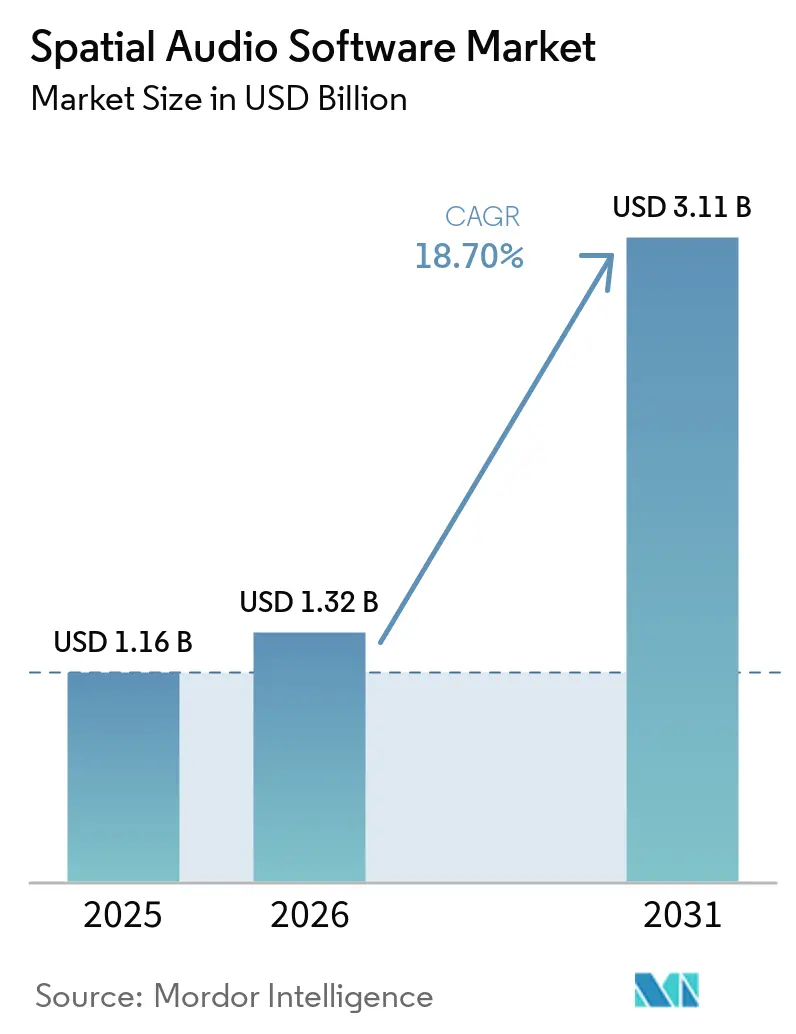
| Market Size (2026) | USD 1.32 Billion |
| Market Size (2031) | USD 3.11 Billion |
| Growth Rate (2026 - 2031) | 18.70 % |
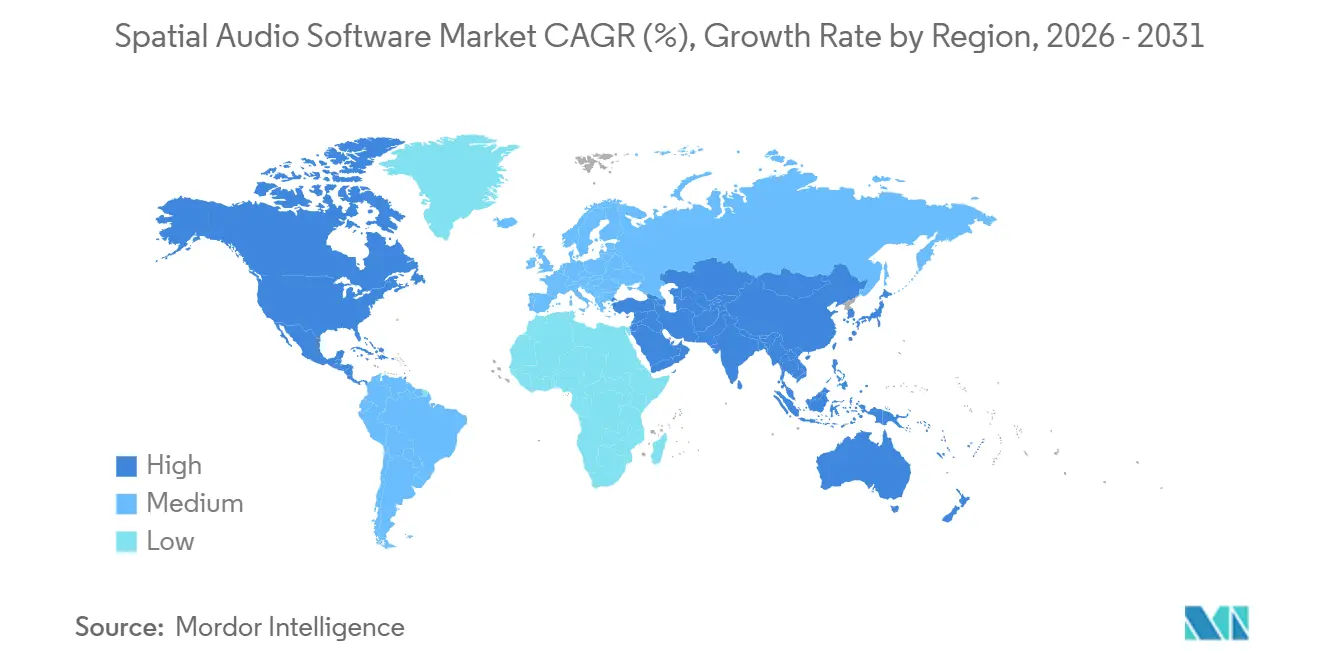
| Fastest Growing Market | Asia-Pacific |
| Largest Market | North America |
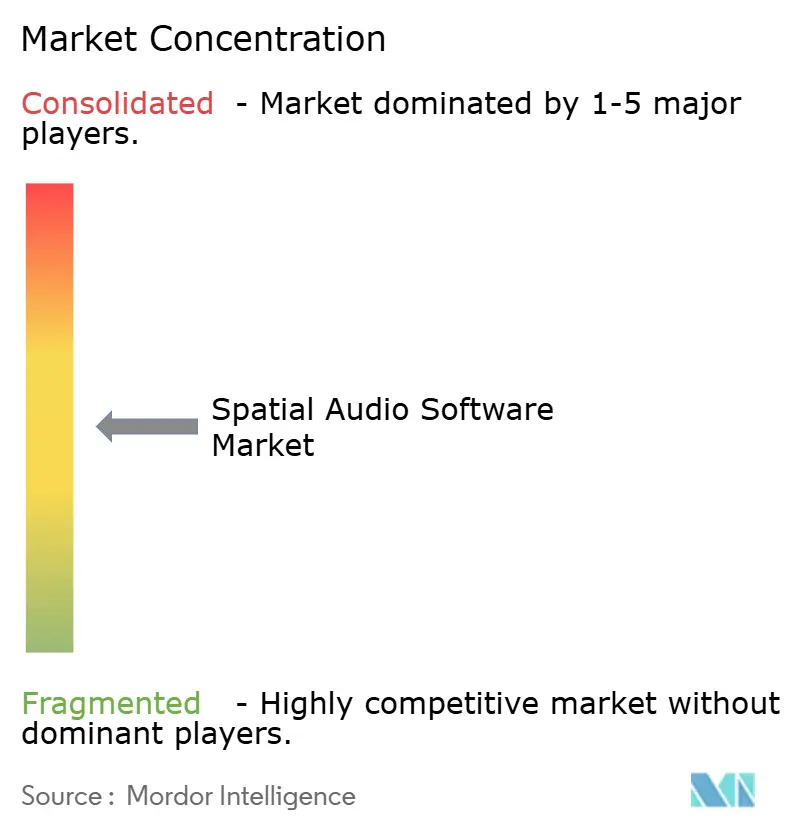
| Market Concentration | Medium |
Major Players *Disclaimer: Major Players sorted in no particular order Image © Mordor Intelligence. Reuse requires attribution under CC BY 4.0. | |
Spatial Audio Software Market Analysis by Mordor Intelligence
The Spatial audio software market size was valued at USD 1.16 billion in 2025 and is estimated to expand from USD 1.32 billion in 2026 to USD 3.11 billion by 2031, at a CAGR of 18.70% during the forecast period 2026-2031. Spatial sound has moved beyond specialist studio work as platforms, game engines, and vehicle manufacturers incorporate it into their products and content requirements. Platform specifications are changing the tools that creators must use, particularly where immersive video and music require defined delivery formats. Gaming, live sports, streaming, and connected vehicles are widening the settings in which producers need rendering, authoring, and conversion software. Vendors are responding with integrations, subscription tools, and workflow features that support more complex production environments. The Spatial audio software market also faces higher operating costs when studios must prepare material for several incompatible formats.
Key Report Takeaways
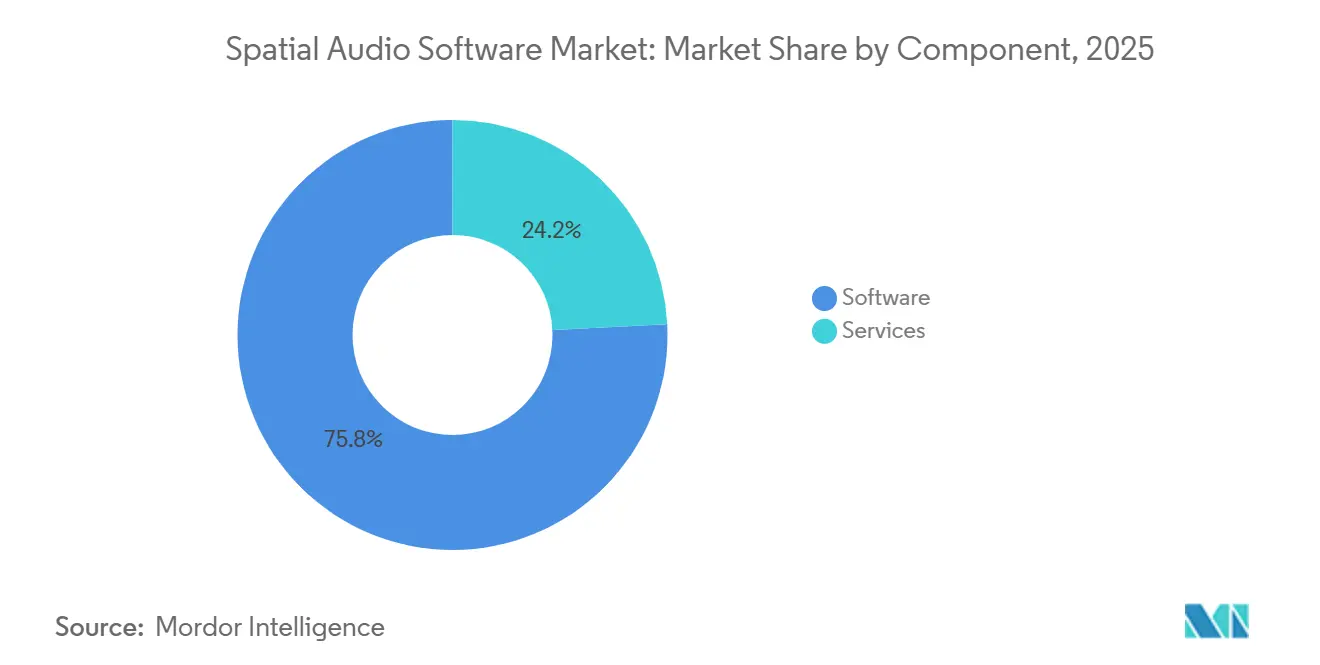
- By component, software held 75.80% of the Spatial audio software market share in 2025, while services are projected to expand at a 19.14% CAGR through 2031.
- By product type, spatial audio rendering software accounted for 35.40% of revenue in 2025, while binaural and HRTF plugins are projected to expand at a 19.42% CAGR through 2031.
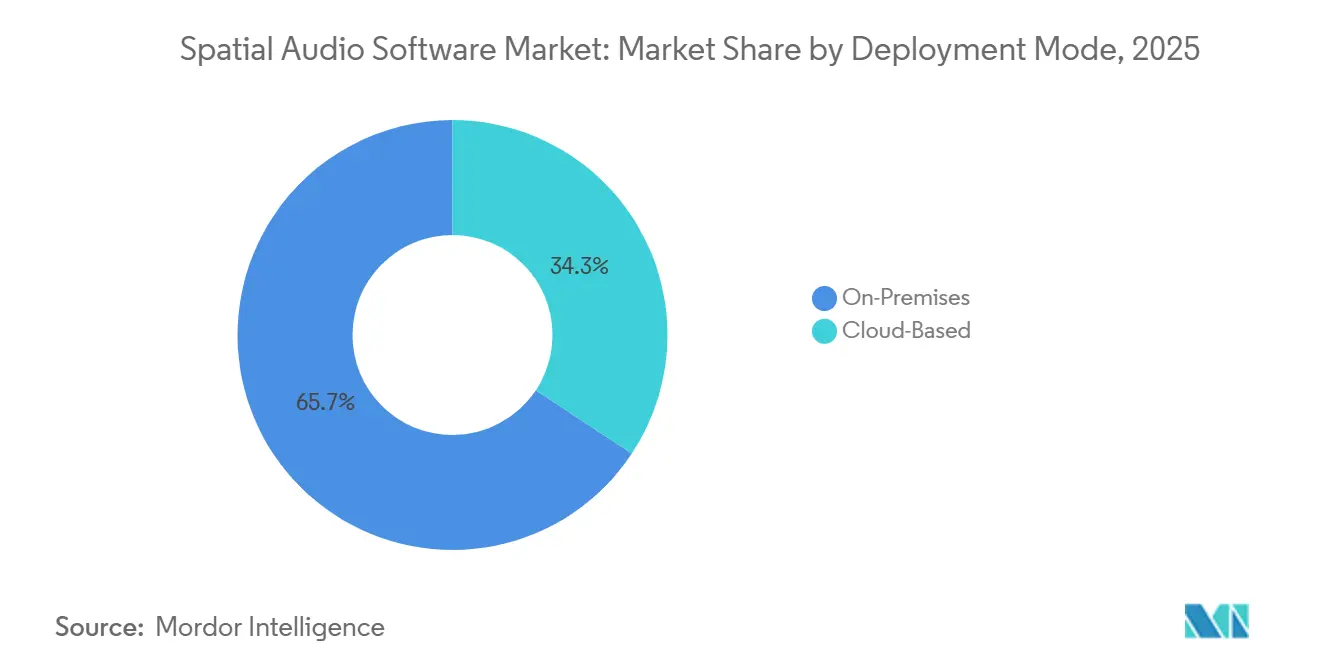
- By deployment mode, on-premises deployment accounted for 65.70% of revenue in 2025, while cloud-based deployment is projected to expand at a 19.22% CAGR through 2031.
- By application, gaming held 24.28% of revenue in 2025, while automotive is projected to expand at a 19.49% CAGR through 2031.
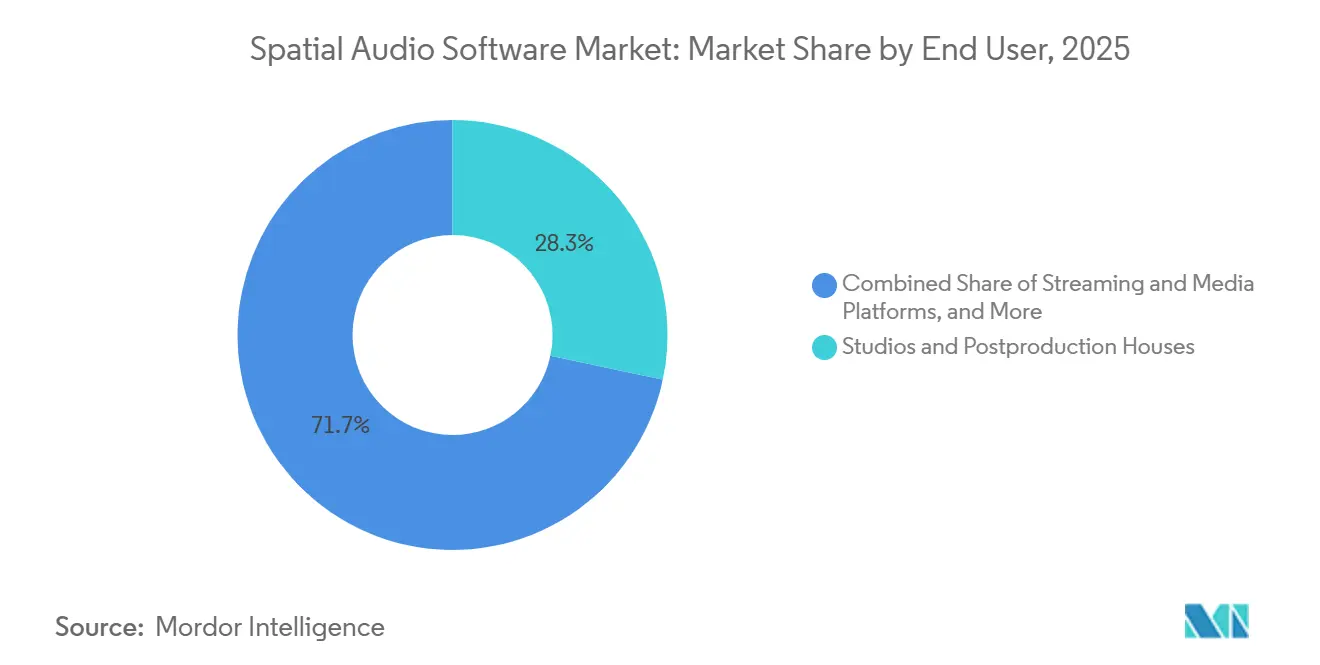
- By end user, studios and postproduction houses held 28.32% of revenue in 2025, while enterprises and educational institutions are projected to expand at a 19.76% CAGR through 2031.
- By geography, North America held 38.42% of revenue in 2025, while Asia-Pacific is projected to expand at a 19.64% CAGR through 2031.
Note: Market size and forecast figures in this report are generated using Mordor Intelligence’s proprietary estimation framework, updated with the latest available data and insights as of January 2026.
Market Trends and Insights
Drivers Impact Analysis of Spatial Audio Software Market*
| Driver | (~) % Impact on CAGR Forecast | Geographic Relevance | Impact Timeline |
|---|---|---|---|
| Immersive Gaming and XR Content Expansion | +4.5% | Global | Short term (≤ 2 years) |
| Streaming Platform Spatial-Audio Requirements | +3.7% | Global, with intensity in North America and Europe | Short term (≤ 2 years) |
| AI-Assisted Rendering and HRTF Personalization | +3.2% | Global | Medium term (2-4 years) |
| Cloud Production and Remote Collaboration | +2.4% | North America, Europe, and Asia-Pacific | Medium term (2-4 years) |
| Premium Device Spatial-Audio Standardization | +2.0% | Global | Short term (≤ 2 years) |
| Automotive and Enterprise Immersive-Audio Integration | +1.6% | Asia-Pacific core, spillover to Europe | Long term (≥ 4 years) |
| Source: Mordor Intelligence | |||
Immersive Gaming and XR Content Expansion
Spatial sound has become a standard technical capability in many AAA game development workflows, rather than an optional feature. Unreal Engine 5 and Unity include spatial audio capabilities, which shifts middleware providers toward acoustic modeling and advanced authoring functions. This change increases demand for specialized tools when engine-level functions cannot resolve detailed acoustic requirements. Head-tracked binaural rendering remains necessary to maintain spatial coherence in virtual environments. Research on graph neural field approaches shows continued work on HRTF personalization for these settings. Middleware providers continue to align their products with game-engine release cycles, which keeps spatial authoring tools closely tied to development workflows.
Streaming Platforms Mandating Spatial-Audio Deliverables
Platform requirements are making spatial delivery a production requirement for labels, studios, and independent creators. Apple Music requires Dolby Atmos submissions to come from genuine multichannel sessions rather than stereo upmixes.[1] Apple introduced the Apple Spatial Audio Format and mandated APAC for Apple Immersive Video at WWDC 2025. These requirements can make a Dolby Atmos workflow insufficient for Apple-native output. Studios may therefore maintain more than 1 toolchain and incur repeated upgrade costs. In June 2026, Peacock used Dolby AC-4 for its FIFA World Cup 2026 coverage, extending immersive delivery into live sports.
AI-Assisted Real-Time Rendering and HRTF Personalization
AI-supported HRTF personalization is reducing the distance between detailed acoustic output and scalable delivery. Traditional individual HRTF measurement depended on specialized rooms, lengthy calibration, and experienced staff. Mitsubishi Electric Research Laboratories described a neural-field approach that upsamples HRTFs from sparse measurements.[2] The IEEE Signal Processing Society reported that machine learning methods can help address the practical limits of conventional HRTF individualization. These methods may allow more personalized sound experiences without a measurement process for every user. They also support tools that fit into established production workflows rather than requiring separate specialist systems.
Cloud-Based Production and Remote Collaboration
Cloud production reduces the dependence on a small number of certified mixing facilities. Sony's 360 Virtual Mixing Environment lets engineers create and review spatial mixes through headphones without being in a calibrated multispeaker room.[3] That capability can bring remote contributors into a workflow that previously depended on facility access. Lawo integrated Waves Immersive Wrapper with its mc² consoles through SuperRack V15, connecting existing plugin workflows with immersive production. Subscription access can distribute facility costs across more users and bring smaller production houses into the Spatial audio software market. Final mixing still requires the reliability and low latency associated with professional studios.
Restraints Impact Analysis of Spatial Audio Software Market*
| Restraint | (~) % Impact on CAGR Forecast | Geographic Relevance | Impact Timeline |
|---|---|---|---|
| Fragmented Object-Based and Scene-Based Audio Standards | -2.8% | Global | Medium term (2-4 years) |
| High Cost of Certified Immersive-Audio Rooms | -2.1% | North America and Europe | Medium term (2-4 years) |
| Shortage of Spatial-Audio Engineering Talent | -1.7% | Global | Long term (≥ 4 years) |
| Platform Gatekeeping and Format-Conversion Dependency | -1.3% | Asia-Pacific and developing markets | Medium term (2-4 years) |
| Source: Mordor Intelligence | |||
Fragmented Object-Based and Scene-Based Audio Standards
Dolby Atmos, MPEG-H 3D Audio, Apple Spatial Audio Format, AURO-3D, and DTS:X require content teams to address multiple delivery paths. This raises the cost of encoding and validation compared with a single common production format. SMPTE 2110-41 supports Dolby AC-4 and MPEG-H metadata in broadcast pipelines, but device support is not consistent across formats. Recent television decisions by Samsung and LG to move away from DTS:X show that device support can change quickly. Studios may retain parallel digital audio workstations, plugins, and conversion systems to meet customer needs. The Spatial audio software market consequently carries extra licensing and engineering costs even as demand expands.
High Cost of Certified Immersive-Audio Rooms
Certified immersive rooms require calibrated speaker arrays, treated walls, and monitoring equipment. This investment can prevent new studios from entering immersive production, especially outside major media centers. The constraint is strongest in regions where the volume of immersive commissions does not support dedicated facility spending. Sony's headphone-based environment offers an alternative for production and review, although professionals continue to debate its suitability for final validation. The issue limits the supply of certified production capacity rather than consumer interest in immersive content. It can also lengthen delivery schedules and place pressure on project pricing.
*Our forecasts treat driver/restraint impacts as directional, not additive. The impact forecasts reflect baseline growth, mix effects, and variable interactions.
Spatial Audio Software Market Segment Analysis
By Component:
Services Gain Ground as Workflows Become More ComplexSoftware held 75.80% of the component segment in 2025. This position reflects the central role of plugins, middleware, and rendering engines in spatial production. Every workflow begins with a software license before it requires associated hardware or professional support. The Spatial audio software market size for the software component therefore rests on a durable entry point in the production chain. Services are projected to expand at a 19.14% CAGR through 2031. Integration, calibration, and workflow design are becoming more important alongside software purchases.
The need for services comes from multiformat delivery and digital audio workstation integration. Even experienced production teams may need help with format conversion and system configuration. Service work also becomes more valuable when a studio connects on-premises production with cloud access. Sony AI and Audiokinetic introduced an AI-powered Similar Sound Search capability in Wwise, bringing a workflow function into a professional authoring environment. This direction shows how recurring services can sit beside license revenue. The spatial audio software industry can therefore support software and expertise together rather than relying solely on perpetual software sales.
By Product Type:
Binaural and HRTF Plugins Benefit From Headphone DeliverySpatial audio rendering software held 35.40% of product-type revenue in 2025. It serves as the processing core for production pipelines in gaming, broadcast, and other immersive workflows. Binaural and HRTF plugins are projected to expand at a 19.42% CAGR through 2031. Headphone delivery can reach consumers without requiring dedicated speaker systems. This lowers the practical barrier for creators that want spatial output on common listening devices. The Spatial audio software market benefits when producers can deliver immersive sound without a specialized hardware installation.
Neural-field HRTF research may widen the role of these plugins by supporting individualized playback. Binaural tools are particularly relevant for remote listening, virtual reality, and consumer streaming. Ambisonics production plugins continue to serve virtual reality content and live-event workflows. Object-based mixing and authoring tools remain necessary for Dolby Atmos, MPEG-H, and Apple Spatial Audio Format delivery. Other products include AI-assisted tools and conversion functions that do not fit established categories. Product vendors must balance broad format coverage with tools that remain straightforward for production teams.
By Deployment Mode:
Cloud Expands Collaboration While On-Premises Remains ImportantOn-premises deployment accounted for 65.70% of revenue in 2025. Professional facilities continue to value its low latency, direct control, and reliable operation. Cloud-based deployment is projected to expand at a 19.22% CAGR through 2031. Collaboration, review, and approval stages can accept more latency than final mixing. This allows participants in different locations to work on the same project with less travel. The Spatial audio software market size for cloud delivery reflects this practical division of production tasks.
Cloud tools reduce geography as a barrier to creative and technical collaboration. They do not remove the need for studio-quality processing during final delivery. European studios also consider data residency when selecting cloud architecture. This favors providers that can support regional deployment needs. Lawo and Waves show how on-premises console environments can connect with cloud-compatible plugin and licensing systems. The 2 deployment approaches are therefore becoming connected parts of the Spatial audio software market rather than direct substitutes.
By Application:
Automotive Leads the Next Application WaveGaming held 24.28% of application revenue in 2025. Its position is linked to game-engine update cycles and the use of spatial sound in competitive and virtual reality titles. Automotive is projected to expand at a 19.49% CAGR through 2031. Software-defined vehicle architecture allows audio algorithms to be updated after sale. This turns spatial audio features into a possible source of recurring software revenue. The Spatial audio software market share held by gaming reflects an established demand base, while automotive carries the faster rate of expansion.
Dolby and BMW announced Dolby Atmos integration for the BMW 7 Series at Auto China 2026. The announced deployment uses up to 36 speakers and 1,965 watts. Music production, streaming, film, television, postproduction, live events, broadcast, and virtual reality continue to rely on format upgrades and platform requirements. Enterprise collaboration and training is also gaining relevance where organizations use immersive sound for simulation and remote work. Vendors can tailor product functions to these different environments without treating them as a single use case.
By End User:
Enterprises and Educational Institutions Broaden DemandStudios and postproduction houses held 28.32% of end-user revenue in 2025. They originate much of the content later distributed across streaming, broadcast, games, and other channels. Enterprises and educational institutions are projected to expand at a 19.76% CAGR through 2031. Their demand is based on practical uses in training, simulation, and remote collaboration. These users have different requirements from entertainment producers. The Spatial audio software market can address this group with focused binaural rendering and head-tracking functions.
Emergency-response simulations use spatial sound to support situational awareness. Technical training settings can use it to support spatial cognition. Remote collaboration systems can use it to reduce communication errors. These outcomes create a separate product opportunity from postproduction authoring. Game developers, publishers, streaming platforms, media companies, and individual professionals complete the end-user base. Apple Music delivery requirements continue to influence the software choices of streaming and media platforms.

Geography Analysis
North America and APAC Spatial Audio Software Market
North America held 38.42% of revenue in 2025. The region brings together major platform operators, game studios, and spatial-audio vendors. Requirements issued by North American technology companies can affect content producers worldwide. Apple’s APAC requirement for Immersive Video was a significant platform decision in the current cycle. ATSC 3.0 includes next-generation audio frameworks such as Dolby AC-4 and MPEG-H. This creates a compliance-related need for the Spatial audio software market in U.S. broadcast facilities.
APAC Spatial Audio Software Market
Asia-Pacific is projected to expand at a 19.64% CAGR through 2031. China, South Korea, and Japan each contribute through different demand patterns. In March 2026, QQ Music became the first major music platform to deploy the latest Dolby AC-4 enhancements. South Korea’s TTA standard requires MPEG-H Audio for next-generation television. Japan supports demand through gaming hardware, automotive relationships, and consumer electronics. Fraunhofer IDMT’s Audiofields entered series production in Mercedes-Benz vehicles in February 2026.
EMEA and South America Spatial Audio Software Market
Europe has a significant position in the Spatial audio software market because Fraunhofer-Gesellschaft contributes to MPEG-H standards development. Specialist suppliers in Germany and Poland also support the regional production base. The European Broadcasting Union’s Audio Definition Model supports channel-based, object-based, and scene-based audio workflows. Dolby and Audi completed Dolby Atmos integration for selected Audi models in July 2025. South America, the Middle East, and Africa remain smaller but emerging markets. Brazil’s SBTVD TV 3.0 standard includes MPEG-H Audio, while OTT investment and mobile-first content may add demand over time.
Competitive Landscape
The Spatial audio software market is moderately fragmented across codec licensors, game middleware providers, plugin specialists, and platform developers. No 1 company held an estimated majority of the market. Dolby Laboratories, Fraunhofer-Gesellschaft, and Audiokinetic hold distinct positions through codec licensing, standards work, and game middleware reach. Apple’s Apple Spatial Audio Format and Google’s Eclipsa can reduce device-makers’ reliance on incumbent codecs. Standards participation remains a durable advantage because it supports long-term format adoption. Fraunhofer IIS contributes to MPEG-H 3D Audio under ISO/IEC 23008-3, a position that supports licensing across compliant encoders and decoders.
SMPTE 2110-41 places Dolby AC-4 and MPEG-H metadata within professional broadcast workflows. This supports the role of both formats in high-value production work. Leaders are pursuing automotive licensing, AI-enabled workflow tools, and subscription plugin systems. Dolby’s BMW 7 Series work shows the value of automotive manufacturer relationships. Sony AI and Audiokinetic added Similar Sound Search to Wwise, placing AI-assisted discovery in the production workflow. Fraunhofer IDMT brought Audiofields into series production with Mercedes-Benz, extending its spatial technology into vehicles.
Enterprise training, simulation, and collaboration remain less served by tools built for entertainment production. This creates room for authoring stacks designed around enterprise requirements. AI-native tools may challenge established middleware if they can provide accurate scene-based rendering with simpler engineering requirements. Vendors with proprietary HRTF data or ear-measurement capabilities may be better placed to deliver personalized output. The RANF work at Mitsubishi Electric Research Laboratories illustrates the importance of sparse-measurement HRTF methods. Competition within the Spatial audio software market remains distributed across several technology positions, including codec licensing, standards work, middleware, plugins, and platform formats.
Spatial Audio Software Industry Leaders
-
Dolby Laboratories, Inc.
-
Xperi Holding Corporation
-
Goerdyna Group
-
Waves Audio Ltd.
-
Avid Technology, Inc.
- *Disclaimer: Major Players sorted in no particular order
Spatial Audio Software Market Companies Covered in this Report
- Dolby Laboratories, Inc.
- Xperi Holding Corporation
- Goerdyna Group
- Waves Audio Ltd.
- Dear Reality GmbH
- Avid Technology, Inc.
- Fraunhofer-Gesellschaft zur Förderung der angewandten Forschung e. V.
- Blue Ripple Sound Limited
- Sound Particles, Lda.
- Audiokinetic Inc.
- Firelight Technologies Pty Ltd
- VisiSonics Corporation
- Spatial Inc.
- G'Audio Lab, Inc.
- Mach1, Inc.
- Envelop VR, Inc.
- APL-HUD GmbH
- atmoky GmbH
- Ceva, Inc.
- Brandenburg Labs GmbH
- New Audio Technology GmbH
- Wave Arts, Inc.
- SoundField Limited
- Zylia Sp. z o.o.
Recent Industry Developments in Spatial Audio Software Market
- June 2026: Dolby Laboratories and NBCUniversal announced that Peacock streamed all 104 FIFA World Cup 2026 matches via Telemundo in Dolby Vision and Dolby Atmos, marking the first commercial deployment of Dolby AC-4 by a video streamer. The codec delivers Dolby Atmos at the highest achievable fidelity with up to 50% greater coding efficiency than traditional codecs, while enabling dialogue enhancement and audio personalization at scale.
- April 2026: Dolby Laboratories and BMW announced at Auto China 2026 in Beijing the debut of Dolby Atmos in the new BMW 7 Series and BMW iX3 Long Wheelbase, delivered through up to 36 high-performance speakers and 1,965 watts. Dolby Atmos via Apple CarPlay went live simultaneously in vehicles from Xiaomi, Lotus, BMW, and Hyundai, extending immersive audio into the in-car streaming ecosystem.
- March 2026: Dolby Laboratories and QQ Music, Tencent Music Entertainment, announced that QQ Music became the first major music streaming platform to deploy the latest Dolby AC-4 enhancements, advancing streaming fidelity and spatial precision for Dolby Atmos music on mobile and connected devices.
- February 2026: Fraunhofer IDMT, Mercedes-Benz, and Burmester Audiosysteme GmbH officially launched Audiofields, the production-ready version of the SpatialSound Wave 3D audio algorithm, in series production across Mercedes-Benz CLA, GLC, GLB, and S-Class models with fourth-generation MBUX infotainment. The algorithm spatializes conventional stereo content, including streaming music and audiobooks, throughout the vehicle cabin.
Global Spatial Audio Software Market Report Scope
The Spatial Audio Software Market comprises software platforms, rendering engines, digital audio workstations (DAWs), plugins, middleware, and processing tools designed to create, edit, encode, mix, render, and deliver immersive three-dimensional audio experiences.
The Spatial Audio Software Market Report is Segmented by Component (Software and Services), Product Type (Spatial Audio Rendering Software, Binaural and HRTF Plugins, Ambisonics Production Plugins, Object-Based Mixing and Authoring Tools, and Other Product Types), Deployment Mode (On-Premises and Cloud-Based), Application (Gaming, Music Production and Streaming, Film, Television, and Postproduction, Virtual Reality and Augmented Reality, Live Events and Broadcast, Automotive, and Enterprise Collaboration and Training), End User (Studios and Postproduction Houses, Game Developers and Publishers, Streaming and Media Platforms, Enterprises and Educational Institutions, and Individual Professionals), and Geography (North America, South America, Europe, Asia-Pacific, Middle East, and Africa). The Market Forecasts are Provided in Terms of Value (USD).
Segmentation Overview
| Software |
| Services |
| Spatial Audio Rendering Software |
| Binaural and HRTF Plugins |
| Ambisonics Production Plugins |
| Object-Based Mixing and Authoring Tools |
| Other Product Types |
| On-Premises |
| Cloud-Based |
| Gaming |
| Music Production and Streaming |
| Film, Television, and Postproduction |
| Virtual Reality and Augmented Reality |
| Live Events and Broadcast |
| Automotive |
| Enterprise Collaboration and Training |
| Studios and Postproduction Houses |
| Game Developers and Publishers |
| Streaming and Media Platforms |
| Enterprises and Educational Institutions |
| Individual Professionals |
| North America | United States |
| Canada | |
| Mexico | |
| South America | Brazil |
| Argentina | |
| Rest of South America | |
| Europe | Germany |
| United Kingdom | |
| France | |
| Russia | |
| Rest of Europe | |
| Asia-Pacific | China |
| Japan | |
| South Korea | |
| India | |
| Southeast Asia | |
| Oceania | |
| Rest of Asia-Pacific | |
| Middle East | United Arab Emirates |
| Saudi Arabia | |
| Turkey | |
| Rest of Middle East | |
| Africa | South Africa |
| Nigeria | |
| Rest of Africa |
| By Component | Software | |
| Services | ||
| By Product Type | Spatial Audio Rendering Software | |
| Binaural and HRTF Plugins | ||
| Ambisonics Production Plugins | ||
| Object-Based Mixing and Authoring Tools | ||
| Other Product Types | ||
| By Deployment Mode | On-Premises | |
| Cloud-Based | ||
| By Application | Gaming | |
| Music Production and Streaming | ||
| Film, Television, and Postproduction | ||
| Virtual Reality and Augmented Reality | ||
| Live Events and Broadcast | ||
| Automotive | ||
| Enterprise Collaboration and Training | ||
| By End User | Studios and Postproduction Houses | |
| Game Developers and Publishers | ||
| Streaming and Media Platforms | ||
| Enterprises and Educational Institutions | ||
| Individual Professionals | ||
| By Geography | North America | United States |
| Canada | ||
| Mexico | ||
| South America | Brazil | |
| Argentina | ||
| Rest of South America | ||
| Europe | Germany | |
| United Kingdom | ||
| France | ||
| Russia | ||
| Rest of Europe | ||
| Asia-Pacific | China | |
| Japan | ||
| South Korea | ||
| India | ||
| Southeast Asia | ||
| Oceania | ||
| Rest of Asia-Pacific | ||
| Middle East | United Arab Emirates | |
| Saudi Arabia | ||
| Turkey | ||
| Rest of Middle East | ||
| Africa | South Africa | |
| Nigeria | ||
| Rest of Africa | ||
Key Questions Answered in the Report
What is the size of the spatial audio software market?
The Spatial audio software market was estimated at USD 1.32 billion in 2026 and is forecast to reach USD 3.11 billion by 2031 at an 18.70% CAGR.
What is driving demand for spatial audio software?
Gaming and extended reality content, platform delivery requirements, AI-supported HRTF personalization, and remote production tools support the Spatial audio software market.
Which component generated the largest revenue share?
Software held 75.80% of the component segment in 2025 because plugins, middleware, and rendering engines are core tools in the Spatial audio software market.
Which application is expanding fastest?
Automotive is projected to expand at a 19.49% CAGR through 2031 as software-defined vehicles allow audio features to be updated after sale in the Spatial audio software market.
Which region is expanding fastest?
Asia-Pacific is projected to expand at a 19.64% CAGR through 2031, supported by streaming, broadcast, gaming, automotive, and consumer electronics activity in the Spatial audio software market.
Why do audio formats create challenges for content producers?
Dolby Atmos, MPEG-H, Apple Spatial Audio Format, AURO-3D, and DTS:X can require separate encoding, validation, and toolchains in the Spatial audio software market.