
Spain Sports Tourism Market Size and Share
Market Overview
| Study Period | 2021 - 2031 |
|---|---|
| Forecast Data Period | 2026 - 2031 |
| Base Year Market Size (2025) | USD 19.44 Billion |
| Market Size (2026) | USD 20.21 Billion |
| Market Size (2031) | USD 25.53 Billion |
| Growth Rate (2026 - 2031) | 4.79 % |
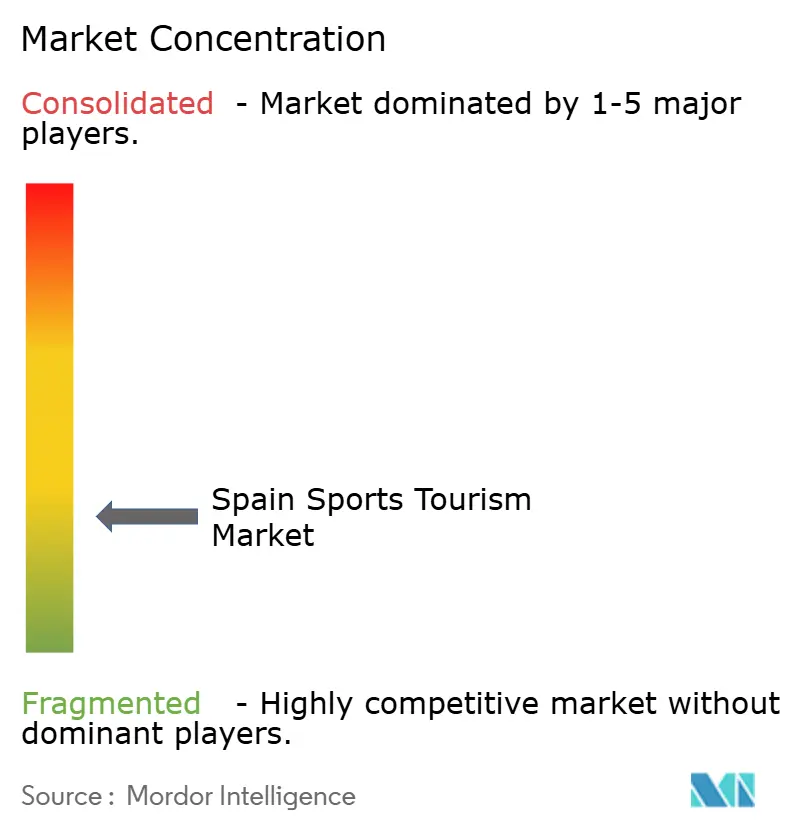
| Market Concentration | Low |
Major Players *Disclaimer: Major Players sorted in no particular order Image © Mordor Intelligence. Reuse requires attribution under CC BY 4.0. | |
Spain Sports Tourism Market Analysis by Mordor Intelligence
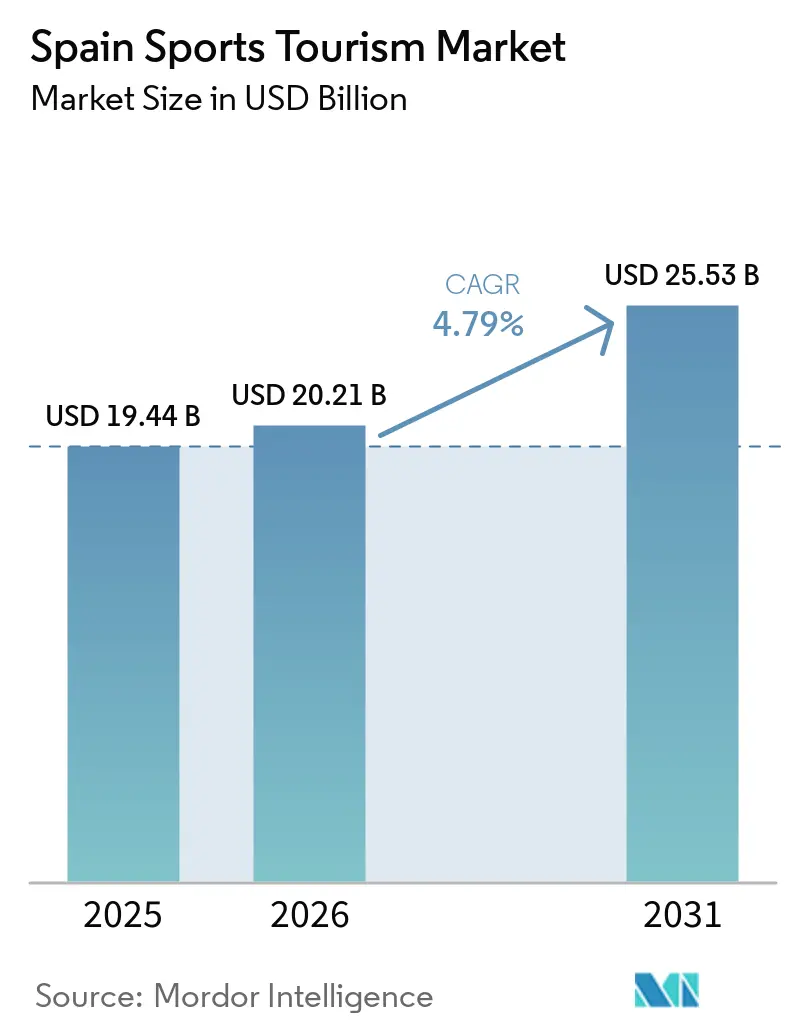
The Spain sports tourism market was valued at USD 19.44 billion in 2025 and is estimated to grow from USD 20.21 billion in 2026 to reach USD 25.53 billion by 2031, at a CAGR of 4.79% during the forecast period (2026–2031). Spain recorded 96.8 million international tourist arrivals in 2025, providing a large visitor base for event-led and participation-led trips[1]. In 2024, sports tourism spending across active and passive categories reached EUR 8,351 million (USD 9,823.4 million), a 14.3% increase from the previous year, with international visitors contributing 70.7% of the total. Growth is driven by a dense football and motorsport calendar, increased digital travel bookings, and public policies promoting travel beyond the summer peak. Rising interest in activities like padel and cycling extends demand into shoulder months and supports regional expansion.
Key Report Takeaways
- By sport type, football/soccer held 44.42% of the Spain Sports Tourism Market share in 2025, while other sport types are projected to expand at a 5.31% CAGR through 2031.
- By tourism type, passive sports tourism (spectator) accounted for 58.64% of the Spain Sports Tourism Market share in 2025, while active sports tourism (participation) is projected to record the highest CAGR at 5.64% through 2031.
- By traveler origin, the International - United Kingdom & Ireland combined represented 20.81% of the Spain Sports Tourism Market share in 2025, while International Markets are forecast to grow at a 5.05% CAGR through 2031.
- By booking channel, Online (Direct Booking and OTA Platforms) platforms led with 64.56% share of the Spain Sports Tourism Market in 2025 and are also projected to post the fastest CAGR at 5.98% through 2031.
- By destination region, Catalonia (Barcelona, Girona & Costa Brava) captured 28.23% of the Spain Sports Tourism Market share in 2025, while Andalusia (Seville, Málaga, Cádiz & Costa del Sol) is projected to expand at a 4.98% CAGR through 2031.
Note: Market size and forecast figures in this report are generated using Mordor Intelligence’s proprietary estimation framework, updated with the latest available data and insights as of January 2026.
Spain Sports Tourism Market Trends and Insights
Drivers Impact Analysis*
| Drivers | (~) % Impact on CAGR Forecast | Geographic Relevance | Impact Timeline |
|---|---|---|---|
| International sports events in Spain boost inbound tourism demand | +1.3% | Community of Madrid, Catalonia, Andalusia | Short term (≤ 2 years) |
| Government tourism strategies and sports funding enhance infrastructure development | +0.7% | National, with concentrated gains in Aragon, Andalusia, Catalonia | Medium term (2-4 years) |
| Global padel growth strengthens Spain’s niche sports tourism position | +0.8% | National, with highest density in Catalonia, Andalusia, Madrid | Medium term (2-4 years) |
| Year-round climate supports multi-season sports tourism across regions | +0.5% | Andalusia, Canary Islands, Valencian Community | Long term (≥ 4 years) |
| European demand grows for active travel combining sports, culture, and gastronomy | +0.6% | Broad national relevance, with gains in Basque Country, Galicia, Catalonia | Medium term (2-4 years) |
| Digital platforms and event packages increase bookings and visitor spending | +0.5% | National, with early concentration in Barcelona, Madrid, Seville | Short term (≤ 2 years) |
| Source: Mordor Intelligence | |||
International sports events in Spain boost inbound tourism demand
Spain maintains a robust sports tourism market through its diverse calendar of football, motorsport, and sailing events. A major international sailing competition held in Barcelona provided a significant boost to the economy, contributing to GDP and drawing many international visitors over its duration. This event also brought numerous superyachts and generated additional revenue for the port economy, demonstrating the wide-ranging economic benefits of such activities[2]. During the 2024 and 2025 seasons, top-tier professional football competitions in Spain attracted millions of stadium spectators and reported strong revenue figures, confirming football's role as a major driver of sports tourism in the country. These events collectively support consistent travel demand across various cities and sports in Spain.
Government tourism strategies and sports funding enhance infrastructure development
Public policy plays a crucial role in supporting Spain's sports tourism market, as tourism and sports planning have become more interconnected. The "Spain Tourism Strategy 2030" focuses on de-seasonalization, territorial balance, sustainability, and digital transformation to drive tourism development. As part of the recovery plan, significant funding has been allocated to advance the green transition of sports facilities and enhance the sector's digital capabilities. These initiatives aim to improve venue infrastructure, boost energy efficiency, and strengthen data tools, enabling destinations to manage sports-related demand beyond peak seasons[3]. Employment in the sports sector has also reached a record high, exceeding 250,000 workers, reflecting the growing alignment of supply with increasing demand.
Global padel growth strengthens Spain’s niche sports tourism position
Spain has become a prominent destination in the sports tourism market due to its strong connection with padel. The global padel governing body reported that the country accounted for a significant portion of the global total of courts in 2024, with thousands of courts spread across numerous clubs. Federated licenses in Spain have shown steady growth, reflecting a consistent increase over recent years. This trend reflects the sport's rising popularity among local players. Additionally, the global player base expanded significantly by 2025, further enhancing Spain’s attractiveness to travelers familiar with the sport. These factors position the country as an ideal destination for coaching holidays, club travel, and active short breaks that combine padel with urban and coastal experiences.
Year-round climate supports multi-season sports tourism across regions
Spain's favorable climate supports its sports tourism market by enabling outdoor activities throughout most of the year. The Ministry of Industry and Tourism highlighted that tourist arrivals during the shoulder and low seasons experienced faster growth compared to the high season between 2018 and 2025, with months like October, November, and February performing above the annual average. This trend benefits activities such as cycling camps, running events, golf trips, and open-water sports, which are more feasible outside the hottest periods. The Pedal Spain project enhanced this segment by creating a national cycling coordination center in partnership with 177 organizations and launching a digital marketplace to connect visitors with tailored routes and services. The combination of a supportive climate and structured product development has helped distribute demand more evenly across the year in Spain's sports tourism market.
Restraints Impact Analysis*
| Restraints | (~) % Impact on CAGR Forecast | Geographic Relevance | Impact Timeline |
|---|---|---|---|
| Seasonal concentration causes pricing volatility and capacity pressures | -0.7% | Coastal regions, especially Catalonia, Balearic Islands, Valencian Community | Short term (≤ 2 years) |
| Fragmented SME operators limit scalability and service standardization | -0.5% | National, with highest exposure in rural and mid-size markets | Medium term (2-4 years) |
| Environmental restrictions constrain outdoor tourism in protected areas | -0.3% | Andalusia, Catalonia, Canary Islands, Pyrenees corridor | Long term (≥ 4 years) |
| Economic uncertainty in source markets affects inbound travel stability | -0.4% | United Kingdom, Germany, France facing segments, especially premium travel | Short term (≤ 2 years) |
| Source: Mordor Intelligence | |||
Seasonal concentration causes pricing volatility and capacity pressures
Spain has extended its tourism season, but the sports tourism market continues to face challenges during peak weeks and school holidays. Coastal towns in Valencia experienced a significant drop in accommodation availability from November to February[4]. This reduction in room supply coincides with efforts to promote off-season activities such as camps, cycling breaks, and endurance events. During peak periods, these destinations often deal with fully booked hotels, limited transport options, and fluctuating room rates. This uneven capacity creates challenges for smaller operators, making it difficult to plan investments due to reliance on a short period of strong cash flow.
Fragmented SME operators limit scalability and service standardization
The supply side of the Spanish sports tourism market remains highly fragmented, limiting scalability across various sub-categories. A significant portion of sports enterprises in Spain consists of micro or small firms, with many operating without employees, as noted in the Spain Tourism Strategy 2030. This highlights the dominance of small-scale operations within the market. While these firms provide valuable local expertise and specialized access, they often lack multilingual services, integrated travel tools, and consistent booking standards. These shortcomings hinder the market's development, particularly in rural and second-tier destinations where demand exists but professional packaging remains inconsistent.
*Our forecasts treat driver/restraint impacts as directional, not additive. The impact forecasts reflect baseline growth, mix effects, and variable interactions.
Segment Analysis
By Sport Type: Football Anchors Revenue While Emerging Categories Lift Growth
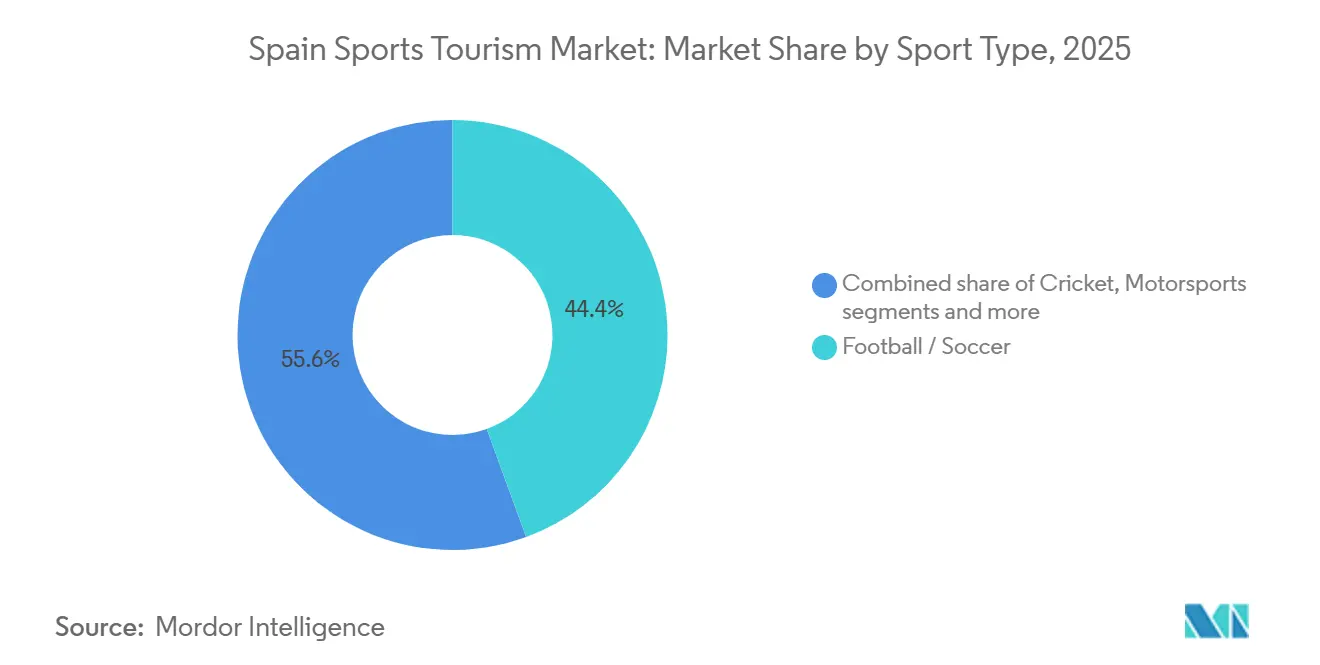
Football/Soccer accounted for the largest share of the Spain sports tourism market in 2025, holding 44.42%. LaLiga surpassed 17 million stadium spectators during the 2024 and 2025 seasons, marking a significant milestone. The league reported normalized revenue of EUR 5,464 million (USD 6,427.4 million) and commercial revenue exceeding EUR 1,500 million (USD 1,764.5 million), reflecting strong monetization of football. Major club brands, high stadium attendance, and frequent domestic matches have driven repeat city-break travel to urban centers such as Madrid, Barcelona, Seville, and Valencia. Football remains central to the Spain sports tourism market, even as other participation-driven categories gain momentum.
Other sport types are expected to grow at a compound annual growth rate of 5.31% through 2031, making them the fastest-growing segment in the industry. Padel has been a key contributor to this growth, with Spain hosting 17,000 courts and 4,500 clubs in 2024, alongside an increase in federated licenses in 2025. Motorsport also plays a significant role, with Circuit de Barcelona-Catalunya generating EUR 46 million (USD 54.11 million) in revenue and attracting 653,024 visitors in 2025, showcasing the scale of non-football spectator travel. Cycling further supports the sector through the Pedal Spain coordination network, which enhances route visibility and tourism packaging across regions. The Spain sports tourism industry is diversifying, reducing its reliance on stadium-led demand.

By Tourism Type: Spectator Demand Leads Revenue While Participation Supports Faster Growth
Passive sports tourism (spectator/event attendance) dominated Spain's sports tourism market in 2025, holding a 58.64% share, driven by the popularity of football and motorsport. LaLiga attracted over 17 million stadium spectators during the 2024 and 2025 seasons, while the Circuit de Barcelona-Catalunya hosted more than 653,000 visitors in 2025. Total sports tourism spending in Spain reached EUR 8,351 million (USD 9,823.4 million) in 2024, reflecting significant financial support for both spectators and participants. Spectator events are easier to scale due to fixed dates, visible club branding, and short stay travel planning, ensuring passive demand remains the largest segment of the market.
Active sports tourism (participation) is projected to grow at the fastest rate, with a compound annual growth rate of 5.64% through 2031. Spain's extensive padel infrastructure supports short trips, club camps, and training breaks, thanks to accessible courts, skilled coaching, and local competitions. Cycling is also gaining traction, supported by "Pedal Spain" and its network of 177 organizations, which enhance route coordination and service visibility. These trips often involve longer stays and additional spending on equipment rentals, coaching, guided services, and recovery, increasing the value per traveler. While passive tourism continues to lead in volume, active participation is steadily increasing its share in Spain's sports tourism market.
By Traveler Origin: The United Kingdom and Ireland Lead Current Demand While Non-European Travel Gains Pace
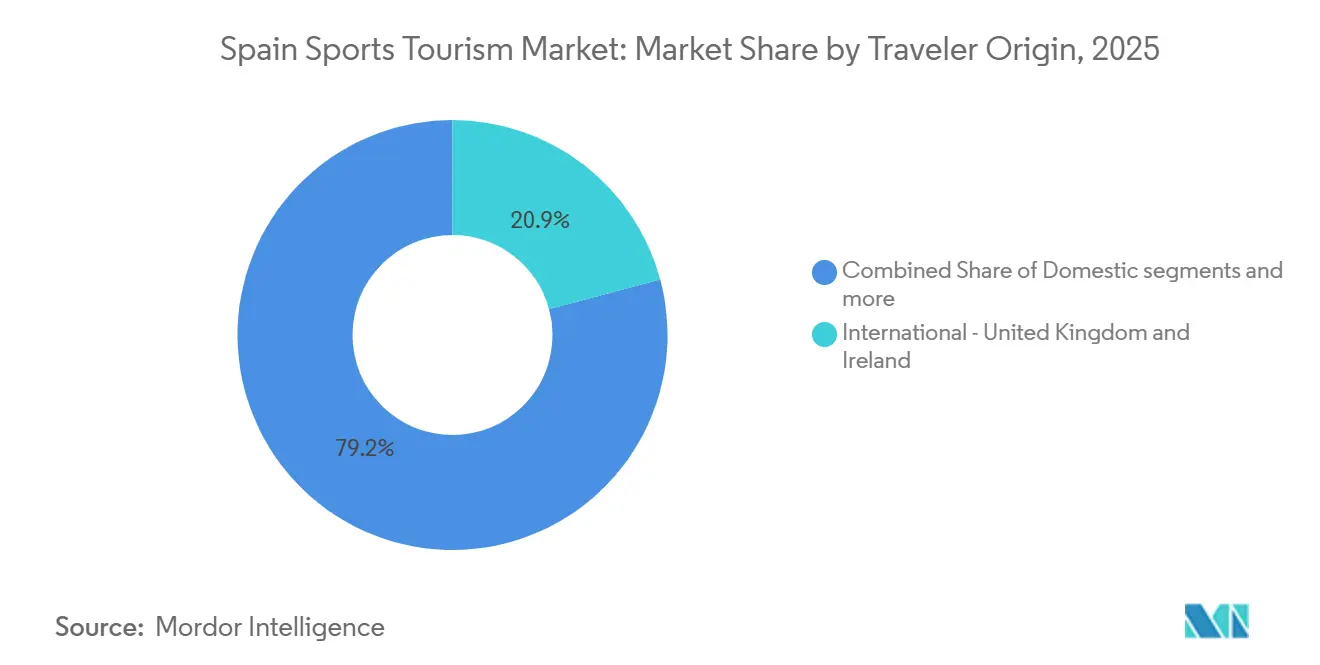
The International - United Kingdom & Ireland together formed the largest origin block for Spain's sports tourism market in 2025, contributing 20.81% of the market share. Spain recorded 19.1 million arrivals from the United Kingdom that year, with visitor spending increasing by 4.9% compared to 2024, reaching EUR 23,650 million (USD 27,819.7 million). Visitor flows from Ireland also remained strong, driving demand for activities such as golf, cycling, football, and coastal running. This corridor benefits from short flight durations, high repeat visitation, and the alignment of Spanish destinations with British and Irish travel preferences, both for spectators and participants. These factors make the United Kingdom and Ireland a stable base for the market in the near term.
International -non-European visitors are projected to grow at a CAGR of 5.05% through 2031, representing the fastest-growing origin segment. The global reach of Spanish football and LaLiga's commercial presence enhances visibility in international markets, supporting long-haul awareness. Domestic travel remains critical, as 88.8% of trips by Spanish residents in Q2 2025 were within Spain, providing a stable foundation even during periods of reduced international demand. The combination of strong domestic interest, extensive European access, and increasing long-haul demand diversifies the market for events and active travel. This diversification is expected to reduce reliance on any single source region over time.
By Booking Channel: Online Booking Leads and Continues to Deepen Its Advantage
Online platforms accounted for a significant share of the market in 2025, at 64.56%, and are expected to grow steadily at a notable CAGR of 5.98% through 2031. This growth reflects their strong position and rapid expansion within the segment. Tourism expenditure data from Q2 2025 indicates that most residents preferred self-planned travel over traditional packaged products. This behavior aligns with sports-related trips, where travelers often combine attending events like matches or races with separately arranged transport and lodging. The trend supports the use of direct operator websites and OTAs that provide real-time availability and cater to short booking windows. As a result, online booking has become the primary channel for accessing Spain's sports tourism market.
Digital platforms also enable smaller and regional operators to reach a broader audience beyond their local customer base. This is particularly relevant for services such as bike rentals, guided tours, stadium access, and club-organized training packages, which can be effectively marketed and booked online. Offline agents remain important for group travel, corporate programs, and complex itineraries requiring coordination across multiple services. However, public initiatives supporting digital transformation in the sports sector are enhancing tools for operators, further strengthening the role of online channels. This trend is expected to sustain the dominance of digital platforms in Spain's sports tourism market throughout the forecast period.
Catalonia held the largest share of Spain's sports tourism market in 2025, accounting for 28.23%. The region attracted 20.1 million international tourists and generated EUR 24,807 million (USD 29,180.7 million) in international visitor spending, the highest among Spain's autonomous communities. Circuit de Barcelona-Catalunya reported EUR 46 million (USD 54.11million) in revenue, 653,024 visitors, and a 94% occupancy rate, showcasing the impact of motorsport tourism. Barcelona also capitalized on the momentum of the 37th America's Cup, which contributed EUR 1,034 million (USD 1,216.3 million) to GDP and brought in 460,819 international visitors. These factors highlight Catalonia's diverse offerings in sports tourism.
Andalusia is projected to grow at a 4.98% CAGR through 2031, making it Spain's fastest-growing destination region. In 2025, the region welcomed 14.4 million international visitors, while the Community of Madrid received 9.1 million. Andalusia benefits from its coastline, mild climate, and strong padel presence, while Madrid leverages its football focus, air connectivity, and urban tourism appeal. Together with other regions, these areas are expanding Spain's sports tourism map, reducing reliance on specific clusters, and supporting long-term market resilience.
Geography Analysis
Catalonia held the largest share of Spain's sports tourism market in 2025, accounting for 28.23%. The region attracted 20.1 million international tourists and generated EUR 24,807 million (USD 29,180.7 million) in international visitor spending, the highest among Spain's autonomous communities.
Andalusia is projected to grow at a 4.98% CAGR through 2031, making it Spain's fastest-growing destination region. In 2025, the region welcomed 14.4 million international visitors, while the Community of Madrid received 9.1 million. Andalusia benefits from its coastline, mild climate, and strong padel presence, while Madrid leverages its football focus, air connectivity, and urban tourism appeal. Together with other regions, these areas are expanding Spain's sports tourism map, reducing reliance on specific clusters, and supporting long-term market resilience.
Other regions in Spain are gaining relevance in sports tourism. MotorLand Aragón has demonstrated the potential of event-led tourism with significant economic contributions, particularly during MotoGP events. The Pedal Spain network is enhancing the visibility of cycling routes and services in smaller regions. Domestic travel plays a crucial role, with most resident trips staying within Spain, supporting inland and secondary destinations. This broader regional participation is helping balance growth across major hubs and smaller areas in Spain's sports tourism market.
Competitive Landscape
The Spain sports tourism market is fragmented, with the top five operators accounting for a small share of total revenue in 2025. Intursports Travel Services, SportContact, CN Sports Tourism, Across Spain, and Bike Spain Tours collectively held less than one-third of the market. Most revenue remains distributed among smaller operators. Spain maintained tens of thousands of active sports businesses in 2024, the vast majority of which operated as small or micro-sized firm. A significant portion of these companies operated without employees, reflecting a fragmented supply base. This structure offers diverse products but limits standardization, bundled services, and nationwide scalability.
Competitive dynamics are increasingly driven by assets and platforms tied to travel products rather than intermediaries. LaLiga reported strong commercial revenue and high stadium attendance during the 2024 and 2025 seasons, highlighting the role of sports rights platforms in maintaining the appeal of football-related travel. Fira de Barcelona noted that Circuit de Barcelona-Catalunya generated significant revenue and visitor numbers in 2025, showcasing the importance of venue-backed motorsport demand. Nomadar Corp. disclosed plans for a large multipurpose event center in El Puerto de Santa María, signaling new supply focused on sports and event-led tourism. These developments show that leagues, venues, and destination projects are shaping the market alongside traditional operators.
Brand consistency and local network depth are becoming critical for competition. Telefónica extended its sponsorship of Movistar Team through 2029, ensuring visibility for Spain’s top WorldTour cycling platform. The 37th America's Cup demonstrated the value of large events in supporting local businesses, with most suppliers being local. Operators combining local access, digital booking, and reliable service are better positioned as the market evolves. Despite some potential for consolidation, the market remains low in concentration with a long tail of specialized providers.
Spain Sports Tourism Industry Leaders
-
Intursports Travel Services
-
SportContact
-
CN Sports Tourism
-
Across Spain
-
Bike Spain Tours
- *Disclaimer: Major Players sorted in no particular order
Recent Industry Developments
- May 2026: The Circuit de Barcelona-Catalunya reported record 2025 results with EUR 46 million (USD 54.11 million) in revenue, 653,024 visitors, and a 94% occupancy rate. The Formula 1 Spanish GP attracted 300,286 spectators, while the MotoGP Catalan GP drew 187,086 attendees.
- May 2026: Federación Española de Pádel official data showed that federated licenses reached a record 117,508 in 2025, up from 109,040 in 2024, strengthening Spain’s position as the leading hub for padel-led active travel.
- November 2025: Nomadar Corp. signed a lease with Sport City Cádiz S.L. for land in El Puerto de Santa María to develop a 110,000 m² multipurpose event center, part of the 291,000 m² Sportech City project, after receiving final urban approval from the Cádiz City Council.
- March 2025: The 37th America's Cup in Barcelona added EUR 1,034 million (USD 1,216.3million) to GDP and EUR 208.5 million (USD 245.3 million) in tax revenue, with 90% of 380 event suppliers sourced locally.
Spain Sports Tourism Market Report Scope
| Football/Soccer |
| Cricket |
| Motorsports |
| Basketball |
| Other Sport Types |
| Active Sports Tourism (Participation) |
| Passive Sports Tourism (Spectator/Event Attendance) |
| Domestic | |
| International | United Kingdom and Ireland |
| Germany, Austria, and Switzerland | |
| France | |
| Benelux and Nordic Countries | |
| Rest of Europe | |
| Non-European Markets |
| Online (Direct Booking and OTA Platforms) |
| Offline (Tour Operators, DMCs, and Travel Agents) |
| Catalonia (Barcelona, Girona & Costa Brava) |
| Andalusia (Seville, Málaga, Cádiz & Costa del Sol) |
| Community of Madrid (incl. metropolitan stadia cluster) |
| Rest of Spain |
| By Sport Type | Football/Soccer | |
| Cricket | ||
| Motorsports | ||
| Basketball | ||
| Other Sport Types | ||
| By Tourism Type | Active Sports Tourism (Participation) | |
| Passive Sports Tourism (Spectator/Event Attendance) | ||
| By Traveler Origin | Domestic | |
| International | United Kingdom and Ireland | |
| Germany, Austria, and Switzerland | ||
| France | ||
| Benelux and Nordic Countries | ||
| Rest of Europe | ||
| Non-European Markets | ||
| By Booking Channel | Online (Direct Booking and OTA Platforms) | |
| Offline (Tour Operators, DMCs, and Travel Agents) | ||
| By Destination Region/Geography | Catalonia (Barcelona, Girona & Costa Brava) | |
| Andalusia (Seville, Málaga, Cádiz & Costa del Sol) | ||
| Community of Madrid (incl. metropolitan stadia cluster) | ||
| Rest of Spain | ||
Key Questions Answered in the Report
What is the current size of Spain sports tourism in 2026?
The Spain sports tourism market is valued at USD 20.21 billion in 2026 and is forecast to reach USD 25.53 billion by 2031 at a 4.79% CAGR.
Which sport brings the most revenue in Spain?
Football / Soccer is the leading category, with 44.42% share in 2025, supported by LaLiga attendance above 17 million spectators.
Why is active participation growing faster than spectator travel in Spain?
Active Sports Tourism (Participation) is growing faster because padel, cycling, golf, and similar products can be sold across more months and usually support longer stays and higher ancillary spending.
Which region leads sports-led travel demand in Spain?
Catalonia (Barcelona & Costa Brava) leads with 28.23% in 2025, supported by strong arrivals, high tourism spending, Formula 1, MotoGP, sailing, and cycling demand.
How important are online bookings for sports-led trips in Spain?
Online (Direct + OTA) channels are the main route to market, holding 64.56% share in 2025 and benefiting from Spain's strong shift toward self-curated travel spending.