
Spain Lime Market Analysis by Mordor Intelligence
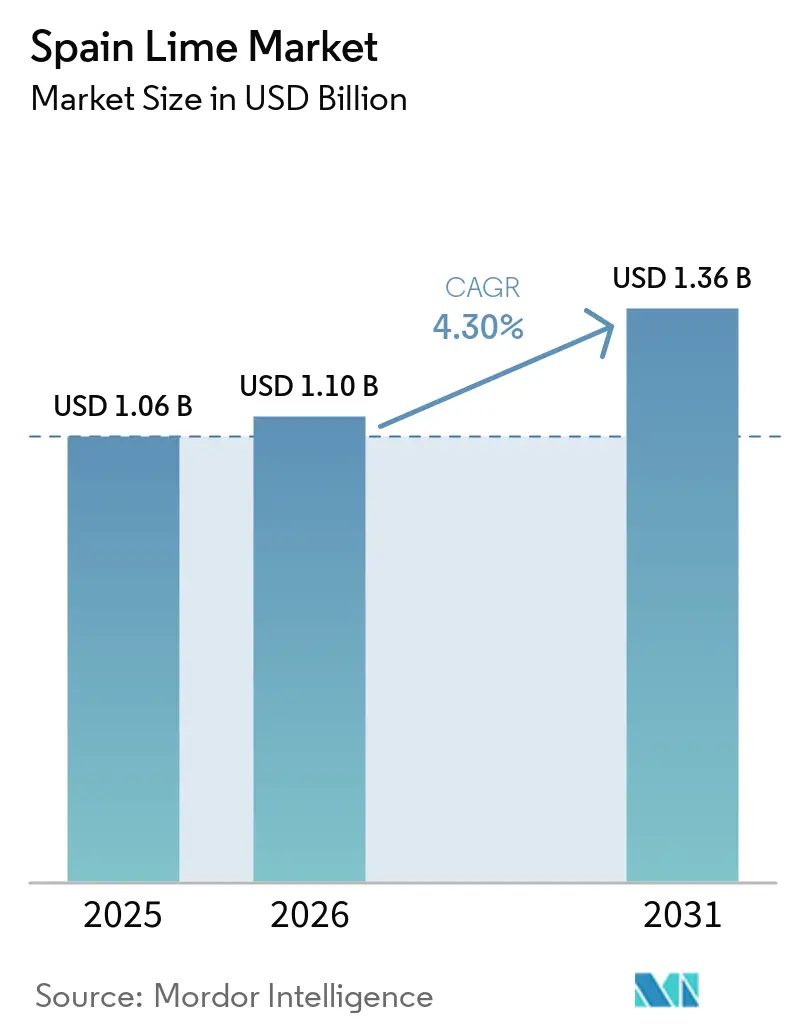
The Spain lime market is valued at USD 1.06 billion in 2025 and estimated to grow from USD 1.10 billion in 2026 to reach USD 1.36 billion by 2031, at a CAGR of 4.30% during the forecast period (2026-2031). Accelerating demand from vitamin-C-conscious consumers, steady tourism recovery, and yield gains from precision irrigation keep the growth trajectory intact, even as water tariffs and disease pressure weigh on margins. Lime production in Spain is growing due to increasing demand for food products that use lime as an ingredient, such as juices, jams, bakery items, and confectionery. The health benefits associated with lime consumption are projected to support market growth during the forecast period. Spain is a key supplier of lemons to the European Union, leveraging its strong production base to gain a geographic advantage in export markets. This strategic positioning allows Spanish producers to capitalize on favorable pricing conditions, especially during periods when competing countries like Turkey or Egypt experience weather-related supply challenges. Cooperative consolidation, private-equity-backed vertical integration, and supermarket long-term sourcing contracts reduce price risk, though off-season cold-storage shortages still trigger sharp swings between spring scarcity and autumn gluts.
Key Report Takeaways
- By geography, Andalusia commanded major share and Murcia is projected to expand at a rapid growth between 2026 and 2031.
Note: Market size and forecast figures in this report are generated using Mordor Intelligence’s proprietary estimation framework, updated with the latest available data and insights as of January 2026.
Spain Lime Market Trends and Insights
Drivers Impact Analysis*
| Driver | (~) % Impact on CAGR Forecast | Geographic Relevance | Impact Timeline |
|---|---|---|---|
| Rising demand for vitamin-C rich diets | +0.9% | Spain and the European Union export markets | Medium term (2–4 years) |
| Expanded use of fresh lemon in cocktails and gourmet cuisine | +0.7% | Madrid, Barcelona, and Valencia | Short term (≤2 years) |
| Growing export premiums for organic Spanish lemons | +0.8% | Murcia and Andalusia toward Germany, France, and Netherlands | Long term (≥4 years) |
| Retailer shift toward local-sourcing contracts | +0.5% | National, early adoption in Murcia and Valencia | Medium term (2–4 years) |
| Irrigation tech upgrades boosting yields in Murcia | +0.6% | Murcia with pilot sites in Andalusia | Medium term (2–4 years) |
| European Union-funded promotion campaigns for Mediterranean produce | +0.4% | European Union-wide with Spanish leadership | Long term (≥4 years) |
| Source: Mordor Intelligence | |||
Rising Demand for Vitamin-C Rich Diets
Consumer demand for immune-supporting nutrients has continued to grow beyond the acute phase of the pandemic, with lemon consumption increasing in Spain. This trend is especially prominent among younger consumers who associate citrus fruits with functional wellness. According to Citrus Industry, citrus consumption in the European Union reached 11 million metric tons in 2024, with Spain ranking second among the leading consuming countries, reflecting strong demand for vitamin-rich fruits like lemons and limes [1].
Expanded Use of Fresh Lemon in Cocktails and Gourmet Cuisine
Spain's hotel, restaurant, and catering (HoReCa) sector experienced significant growth in 2024, with international tourist arrivals reaching 66.8 million, a 13% increase compared to 2023, and domestic travel returning to pre-pandemic levels, according to the United States Department of Agriculture. Gourmet chefs have increasingly replaced imported Persian limes with Spanish Verna lemons in ceviche and tartare dishes, citing their superior acidity balance and enhanced traceability. The HoReCa channel's preference for daily deliveries and small-lot purchases has shifted demand toward regional cooperatives, creating an alternative supply chain that bypasses traditional wholesale markets.
Growing Export Premiums for Organic Spanish Lemons
Rising export prices are strengthening the premium positioning of Spanish lemons, enabling higher margins for organic variants. According to Fructidor, lemon prices in Spain reached €151 per 100 kg (USD 163 per 100 kg) in spring 2025, the highest among major European producers. Meanwhile, European Union prices increased by over 30% compared to historical averages, with a 22% year-on-year rise to €137 per 100 kg (USD 148 per 100 kg) in April 2025. This favorable pricing environment highlights strong export demand and supports additional premiums for organically certified lemons in international markets.
Retailer Shift Toward Long-Term Local-Sourcing Contracts
Spanish supermarket chains are moving away from spot-market procurement in favor of long-term agreements with producer organizations. This transition aims to stabilize farmgate prices and mitigate seasonal price volatility. The shift is driven by persistent pricing pressures across the food supply chain. Data from the Instituto Nacional de Estadística shows that the annual rate for food and non-alcoholic beverages increased by 0.2 percentage points to 3.0% in December 2025, highlighting ongoing upward pressure on consumer food prices. In response, retailers are focusing on strengthening sourcing partnerships, enhancing coordination with growers, and addressing the growing demand for traceability and price stability, thereby supporting the adoption of long-term supply agreements.
Restraints Impact Analysis*
| Restraint | (~) % Impact on CAGR Forecast | Geographic Relevance | Impact Timeline |
|---|---|---|---|
| Intensifying competition from Turkish and Egyptian lemons | -0.6% | European Union, Spain loses share in Germany, Poland, Romania | Short term (≤2 years) |
| Off-season price volatility due to limited cold-storage | -0.4% | National, acute in Andalusia and Valencia | Medium term (2–4 years) |
| Rising plant diseases such as Xylella fastidiosa | -0.5% | Andalusia, Valencia, with risk to Murcia | Long term (≥4 years) |
| Rising water tariffs in drought-prone regions | -0.7% | Murcia and Andalusia, spillover to Catalonia | Medium term (2–4 years) |
| Source: Mordor Intelligence | |||
Intensifying Competition from Turkish and Egyptian Lemons
Increasing competition from Turkey is posing a significant challenge to Spain's position in the lemon and lime export market. According to the World Bank, based on United Nations Comtrade data, Spain exported 673,465 metric tons of lemons and limes in 2024, while Turkey exported 576,431 metric tons, representing approximately 85.6% of Spain's export volume [2]. This trend underscores Turkey's growing production and export capabilities. With lower costs and competitive pricing, Turkish suppliers are strengthening their presence in key European markets, particularly in price-sensitive regions, putting continued pressure on Spain's market share and export margins.
Off-Season Price Volatility Due to Limited Cold-Storage
Insufficient cold-storage capacity poses a significant restraint on Spain's citrus market by limiting the ability to manage supply across harvest cycles. During peak harvest periods, producers are forced to sell large quantities immediately due to inadequate storage facilities, causing temporary oversupply and subsequent price declines. Conversely, during off-season periods, reduced availability leads to price increases. Specifically, during the Fino and Verna harvest cycles, the concentration of supply within short timeframes results in pronounced fluctuations in market availability. This structural challenge undermines pricing stability, discourages long-term contracts, and restricts the optimization of export timing, thereby hindering overall market efficiency.
*Our forecasts treat driver/restraint impacts as directional, not additive. The impact forecasts reflect baseline growth, mix effects, and variable interactions.
Geography Analysis
Andalusia maintains the largest regional footprint, encompassing the provinces of Málaga, Almería, and Huelva. Lemon orchards in this region benefit from an extended harvest period spanning October to June. However, the region lags behind the national average due to intensifying water scarcity and the need for replanting older groves. The Guadalquivir basin, which supplies most of Andalusia's agricultural water, was under a permanent drought alert in 2024. Agricultural water allocations were reduced by 30%, with further cuts anticipated in 2026 if reservoir levels remain below 40% of capacity. Murcia's cooperative network, including organizations such as Citri&Co and Murciana de Vegetales, has utilized European Union Common Agricultural Policy subsidies to modernize older orchards. These retrofitting efforts have achieved payback periods of three to four years, even at current lemon prices. Additionally, Murcia's proximity to the Port of Cartagena reduces export logistics costs by 10% to 15% compared to shipments from Andalusia.
Valencia is the fastest-growing region, supported by a diversified varietal portfolio that includes Fino, Verna, and niche cultivars like Eureka. This diversification enables growers to stagger harvests and maintain steady revenue throughout the year. The region's Mediterranean ports, such as Valencia and Sagunto, handle 35% of Spain's citrus exports. Their proximity to lemon-growing areas reduces transport time and helps preserve fruit quality, providing a competitive advantage in meeting Northern European retailers' shelf-life requirements. Excessive spring rainfall and hailstorms in Castellón and Valencia during the 2025/26 season damaged an estimated 8% to 10% of Verna blossoms. This reduced potential yields and tightened lemon availability from April to June. Smaller regions, including Extremadura and Castilla-La Mancha, face constraints due to limited irrigation infrastructure and an aging grower population, which discourages investment in yield-enhancing technologies.
Spain's regional dynamics highlight a broader strategic tension. While Murcia's efficiency improvements are replicable, they require significant upfront capital and cooperative coordination, which smaller, family-run farms in Andalusia and Catalonia often struggle to achieve. The European Union Common Agricultural Policy Strategic Plan for 2023-2027 allocates EUR 47,724 million (USD 50,110 million) in total support, with EUR 1,804 million (USD 1,894 million) designated for the fruit and vegetable sector[3]. Eco-schemes for permanent crops provide EUR 61.07 to EUR 165.17 (USD 64 to USD 173) per hectare, depending on slope gradient. Disbursement timelines extend to 2027, leaving growers vulnerable to near-term cost inflation. Andalusia's slower growth is also influenced by its scale. The region's significant market share makes incremental expansion more challenging, as new acreage competes with established olive and almond orchards for water and labor. In contrast, Murcia's smaller production base allows for higher percentage growth, even with modest absolute increases.
Competitive Landscape
The Spanish fresh lemon market comprises producers, exporters, importers, and other stakeholders, operating within a structure that combines cooperative scale with entrepreneurial flexibility. This approach helps avoid the oligopolistic tendencies observed in other European fresh-produce markets. Anecoop, the largest player in the market, is experiencing double-digit growth, supported by long-term contracts with Rewe in Germany and Albert Heijn in the Netherlands. Citri&Co, a mid-sized cooperative, has established a strong position in sustainability-certified lemons, dedicating 42% of its cultivated land to biodiversity-certified plots and achieving carbon-neutral operations. These credentials appeal to high-end buyers, such as Michelin-starred restaurants and boutique hotel chains, which are willing to pay a 15% to 20% premium for traceable products.
Opportunities in the market are concentrated around off-season supply and value-added processing. Spain's limited cold-storage capacity, estimated at 1.2 million cubic meters for citrus, forces growers to sell within narrow timeframes. Cooperatives that invest in modular refrigeration units can take advantage of price fluctuations, which range from 30% to 40% between peak and inter-seasonal periods. However, technology adoption remains inconsistent. For instance, Murcia has implemented subsurface drip irrigation systems across 40% of its commercial acreage, while Andalusia lags behind at 18%. This disparity presents an opportunity for smaller cooperatives to adopt precision agriculture, supported by European Union eco-scheme subsidies that cover up to 50% of installation costs.
Emerging disruptors in the market include organic-only cooperatives such as Agribio Terra Organic. These cooperatives cater to Northern European retailers that prioritize certified sustainable sourcing. By bypassing traditional wholesale markets and negotiating direct contracts, they capture 60% to 70% of the final retail price. However, the sector faces significant challenges, particularly price volatility. According to EL PAÍS, citing the Spanish agricultural union COAG in May 2024, approximately 400,000 metric tons of lemons remained unsold in Spain, leading to estimated losses of €120 million (USD 129 million). This highlights substantial market pressure, partly attributed to increased competition from imported lemons within the European Union.
Recent Industry Developments
- March 2025: The Andalusian government has officially launched a new series of IFAPA strategic projects to modernize the citrus industry, including lime. These projects include large-scale robotic harvesting and high-density plantation trials, and also incorporate AI-driven alert systems and specialized training programs to safeguard regional crops against emerging threats, such as Scirtothrips aurantii.
- May 2024: The Spanish Interprofessional Lemon and Grapefruit Association launched the "Good Move From Europe" campaign, a three-year, EU-backed initiative targeting Millennials and Generation Z with messaging that links lemon consumption to physical activity and mental wellness, sponsoring the Paris 2024 Olympics and partnering with elite Spanish athletes.
- February 2024: Bacardi innovatively introduced Bombay Sapphire Premier Cru Murcian Lemon, a new gin variant featuring Fino lemons from Spain's Murcia region. Bombay Sapphire Premier Cru Murcian Lemon is a small-batch, 47% ABV premium London Dry gin from Bacardi that highlights sustainably sourced, hand-peeled Fino lemons, mandarins, and sweet navel oranges from Murcia, Spain.
Spain Lime Market Report Scope
Limes are small, round, and green, while lemons are usually larger, oval-shaped, and bright yellow. Nutritionally, they're almost identical and share many of the same potential health benefits. The Spain lime market report includes production analysis (volume), consumption analysis (value and volume), import analysis (value and volume), export analysis (value and volume), wholesale price trend analysis and forecast, regulatory framework, logistics and infrastructure, and seasonality analysis. The market forecasts are provided in terms of value (USD) and volume (metric tons).
Production Analysis
| Production Volume |
| Area Harvested and Yield |
Trade Analysis (Value and Volume)
| Import Market Analysis | Import Value and Volume |
| Key Supplying Markets | |
| Export Market Analysis | Export Value and Volume |
| Key Destinations Markets |
| Production Analysis | Production Volume | |
| Area Harvested and Yield | ||
| Trade Analysis (Value and Volume) | Import Market Analysis | Import Value and Volume |
| Key Supplying Markets | ||
| Export Market Analysis | Export Value and Volume | |
| Key Destinations Markets | ||
Key Questions Answered in the Report
How large is the Spain lime market in 2026 and what growth is projected?
It is valued at USD 1.10 billion in 2026 and is forecast to grow at a 4.3% CAGR to reach USD 1.36 billion by 2031.
Why is Murcia growing faster than Andalusia?
Murcia adopted subsurface drip irrigation that raises yields by up to 20% and cuts water use by 30%.
How are retailers reducing price volatility for growers?
Chains like Mercadona and SPAR sign multi-year contracts with fixed volume and cost-indexed prices, ensuring a EUR 0.50 per kilogram floor.
What threat does Xylella fastidiosa pose?
If the bacterium infects orchards, quarantine zones could suspend harvests and cut supply, reducing Spain lime market size for several seasons.