
Space Food Market Size and Share
Market Overview
| Study Period | 2022 - 2032 |
|---|---|
| Market Size (2027) | USD 2.64 Billion |
| Market Size (2032) | USD 4.37 Billion |
| Growth Rate (2027 - 2032) | 10.60 % |
| Fastest Growing Market | Asia-Pacific |
| Largest Market | North America |
| Market Concentration | Low |
Major Players *Disclaimer: Major Players sorted in no particular order Image © Mordor Intelligence. Reuse requires attribution under CC BY 4.0. | |
Space Food Market Analysis by Mordor Intelligence
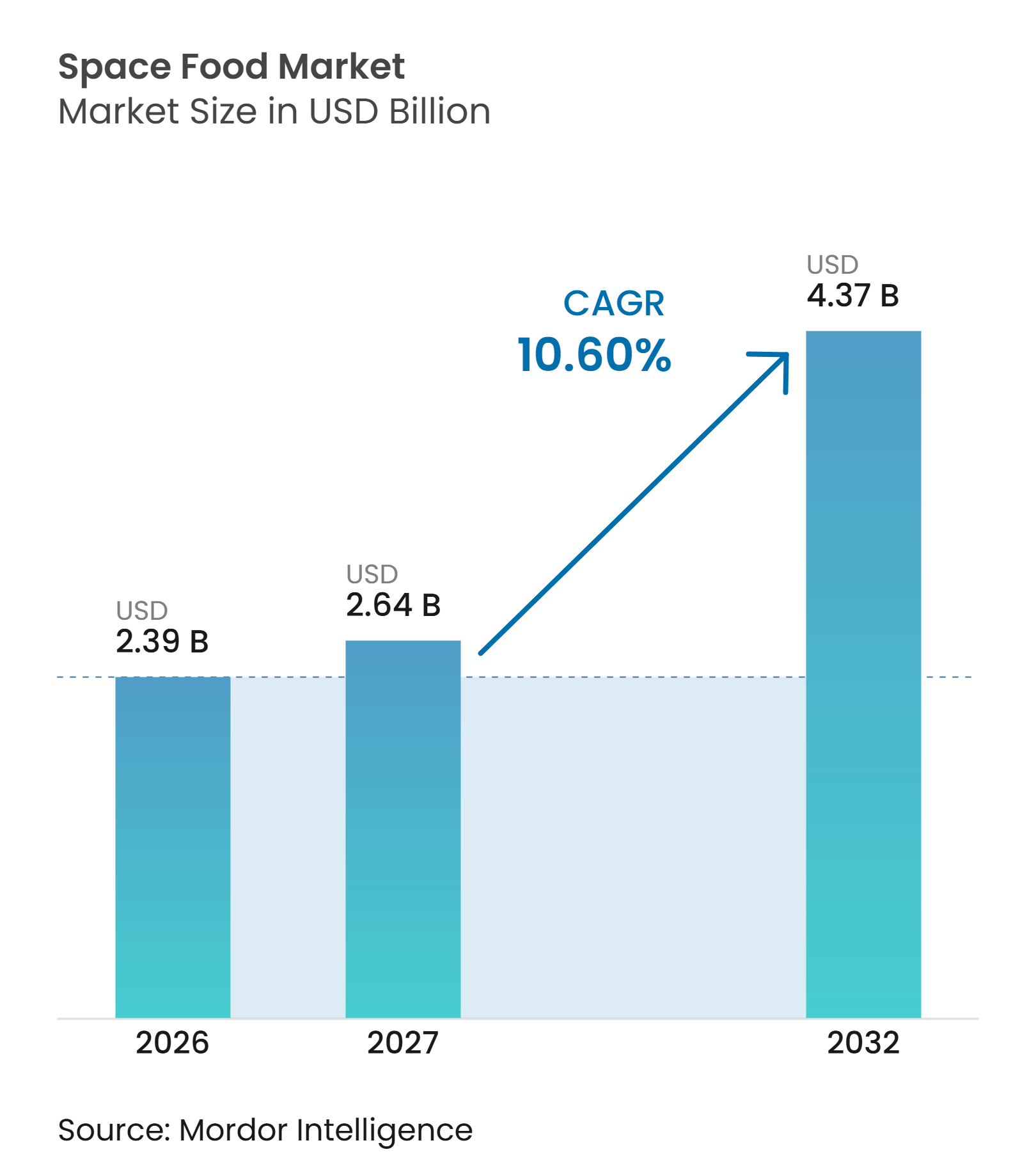
The space food market size is expected to grow from USD 2.39 billion in 2026 to USD 2.64 billion in 2027 and is forecast to reach USD 4.37 billion by 2032 at a 10.60% CAGR over 2027-2032. The space food market is benefiting from expanding opportunities across government space programs and commercial space-station development. Longer-duration missions are encouraging advancements in food products that maintain safety, nutritional value, quality, and acceptability over extended periods. Established national space programs provide a strong foundation for consistent demand, while increasing commercial participation broadens opportunities for specialized food suppliers. Evolving safety, quality, and certification standards are strengthening product innovation and supporting experienced manufacturers with proven capabilities.
Key Report Takeaways
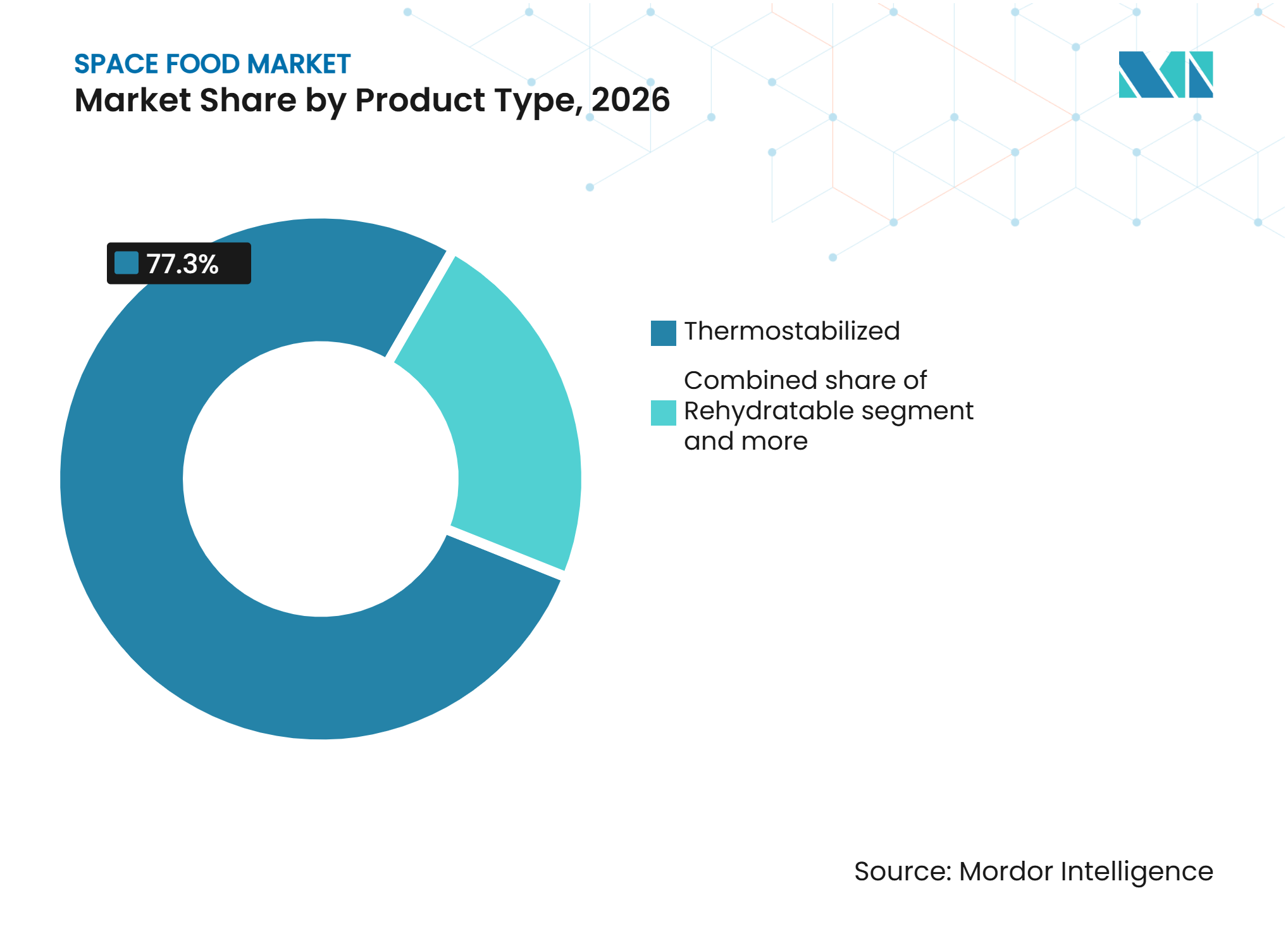
- By product type, thermostabilized food held 38.11% of the space food market share in 2026, while rehydratable food is forecast to expand at a CAGR of 11.21% through 2032.
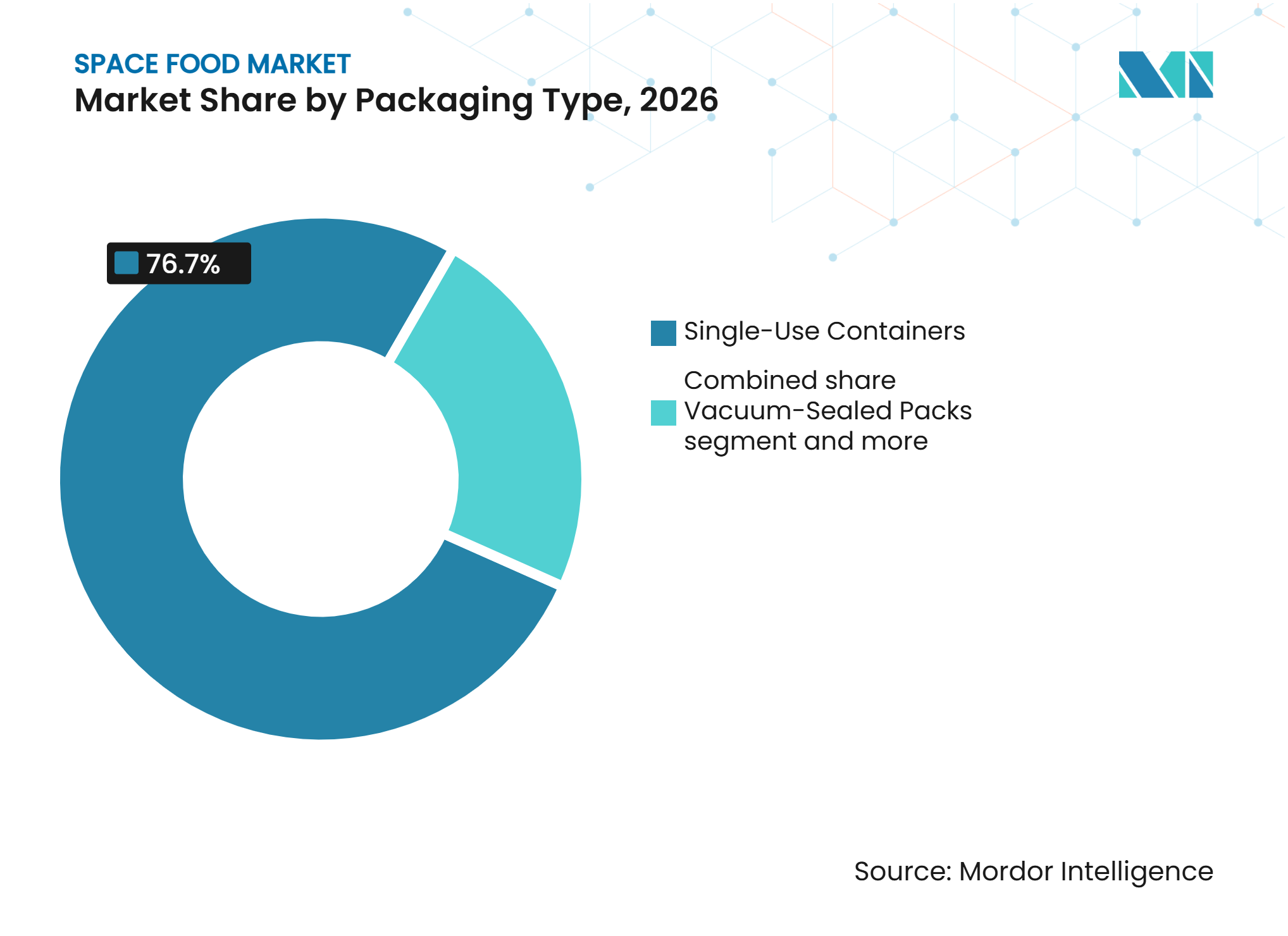
- By packaging type, single-use containers held 41.12% of the space food market share in 2026, while vacuum-sealed packs are forecast to expand at a CAGR of 12.51% through 2032.
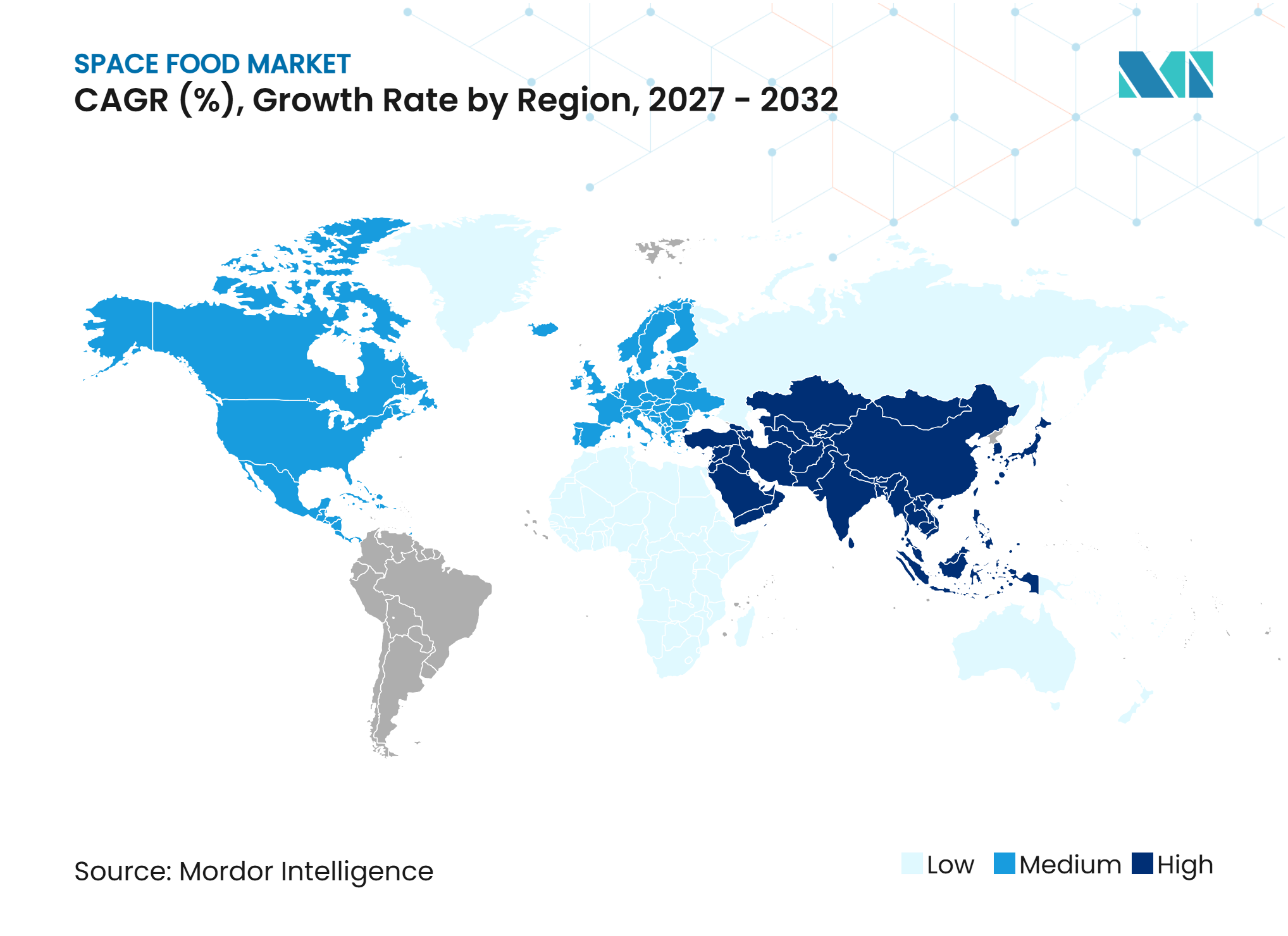
- By geography, North America held 42.51% of the space food market size in 2026, while Asia-Pacific is forecast to expand at a CAGR of 12.13% through 2032.
Note: Market numbers in this report are based on Mordor Intelligence's proprietary estimation framework, which combines nine months of actuals with Q4 projections for base year 2026.
Market Trends and Insights
Drivers Impact Analysis of Space Food Market*
| Driver | (~) % Impact on CAGR Forecast | Geographic Relevance | Impact Timeline |
|---|---|---|---|
| Expansion of commercial low Earth orbit missions | +2.8% | Global, with concentration in North America and East Asia | Short term (≤ 2 years) |
| Longer-duration Lunar and Mars mission planning | +1.9% | Global, with early gains in North America and Europe | Long term (≥ 4 years) |
| Rising demand for nutritionally complete, shelf-stable space food | +1.7% | Global | Medium term (2-4 years) |
| Increasing focus on crew wellness, morale and menu personalization | +1.3% | Asia-Pacific, with spillover to North America and Europe | Medium term (2-4 years) |
| Development of in-situ food production and fresh-food technologies | +1.1% | Global, with early activity in North America and Europe | Long term (≥ 4 years) |
| Increasing demand for mission-specific and culturally adapted space food | +1.0% | Asia-Pacific, with spillover to the Middle East, Africa, and South America | Medium term (2-4 years) |
| Source: Mordor Intelligence | |||
Expansion of Commercial Low Earth Orbit Missions
The expansion of low Earth orbit missions is increasing demand for reliable food provisioning and specialized space food products. For instance, in December 2025, according to the National Aeronautics and Space Administration, 25 people from six countries lived and worked aboard the International Space Station during 2025, supported by 12 visiting spacecraft and seven cargo missions that delivered more than 50,000 pounds of supplies and equipment. NASA also introduced 10 new astronaut candidates in September 2025, selected from more than 8,000 applicants, for nearly two years of training for future missions to low Earth orbit, the Moon, and Mars[1]. These developments are creating opportunities for specialized food manufacturers to supply nutritious, shelf-stable, and mission-compatible products.
Longer-Duration Lunar and Mars Mission Planning
Longer-duration lunar and Mars mission planning is encouraging the development of integrated food systems that can provide astronauts with safe, nutritious, and sustainable food during extended missions. For instance, in 2026, the Deep Space Food Consortium's Mars to Table Challenge invited teams to develop food systems for Mars surface habitats, with the objective of meeting 100% of daily nutritional requirements while limiting dependence on Earth-provisioned food to no more than 50%. The challenge also required a nutritionally complete 14-sol meal plan and integrated systems covering food production, processing, preparation, storage, and waste management [2]. These requirements are encouraging advancements in specialized food products, sustainable food production, and resource-efficient food technologies for future lunar and Martian missions.
Rising Demand for Nutritionally Complete, Shelf-Stable Space Food
The need for nutritionally adequate, safe, and shelf-stable food is encouraging the development of specialized food products for space missions. Food supplied to astronauts must maintain its quality and remain suitable for consumption over extended periods, as frequent resupply is not always practical. For instance, in July 2025, the European Space Agency stated that food delivered to the International Space Station must remain suitable for at least 24 months, supporting the use of preservation technologies such as freeze-drying and canning [3]. Freeze-drying helps preserve food properties and structure for years, while allowing astronauts to prepare meals by adding hot water. Supporting this, in August 2026, Super Garden launched two freeze-dried space snacks enriched with spirulina and chlorella, offering lightweight, nutrient-rich products with extended shelf life.
Increasing Focus on Crew Wellness, Morale and Menu Personalization
Increasing focus on crew wellness, morale, and menu personalization is encouraging the development of space food products that address both nutritional requirements and psychological well-being. Food plays an important role in maintaining crew satisfaction, providing comfort, and supporting a positive living environment during extended space missions. Greater attention to meal variety, familiar flavors, appealing textures, and individual dietary preferences is encouraging manufacturers to develop more diverse and adaptable food options. Personalized menus also help accommodate differences in nutritional needs and eating habits among crew members. These developments are strengthening the importance of taste, food quality, and menu flexibility in space food product development, supporting demand for more appealing and nutritionally balanced meal solutions.
Restraints Impact Analysis of Space Food Market*
| Restraint | (~) % Impact on CAGR Forecast | Geographic Relevance | Impact Timeline |
|---|---|---|---|
| Extreme mass, volume, water and waste constraints | -1.5% | Global | Short term (≤ 2 years) |
| Nutrient degradation during extended food storage | -0.9% | Global, with the greatest compliance burden in North America and Europe | Medium term (2-4 years) |
| Stringent food qualification, safety and microbial-control requirements | -0.8% | Global, most acute for lunar and Mars mission operators | Long term (≥ 4 years) |
| Limited flight heritage and operational reliability of in-situ food production | -0.6% | Global | Long term (≥ 4 years) |
| Source: Mordor Intelligence | |||
Extreme Mass, Volume, Water and Waste Constraints
Extreme mass, volume, water, and waste constraints are creating demand for space food solutions that optimize storage efficiency and resource utilization. Food products must be lightweight, compact, and easy to store while maintaining nutritional quality and food safety throughout missions. Limited water availability also increases the importance of efficient rehydration and preparation requirements. Manufacturers are focusing on reducing packaging weight, minimizing food waste, improving storage efficiency, and developing products that require fewer resources for preparation and consumption. These considerations are encouraging innovation in space food processing, packaging, and preservation technologies.
Nutrient Degradation During Extended Food Storage
Nutrient degradation during extended food storage is increasing the importance of advanced preservation technologies and improved space food formulations. Maintaining nutritional quality over prolonged storage periods is essential to ensure that astronauts receive adequate nourishment throughout their missions. Exposure to environmental conditions and prolonged storage can compromise the stability of vitamins, minerals, proteins, and other essential nutrients, necessitating improved processing, packaging, and preservation methods. Food manufacturers are focusing on enhancing nutrient retention, maintaining product quality, and extending shelf life to ensure that space food remains safe, nutritious, and suitable for consumption during long-duration missions.
*Our forecasts treat driver/restraint impacts as directional, not additive. The impact forecasts reflect baseline growth, mix effects, and variable interactions.
Space Food Market Segment Analysis
By Product Type:
Rehydratable Food Builds Demand Through Lower Launch MassThermostabilized food held 38.11% of the space food market in 2026. Thermostabilized food maintains a strong position in the space food market due to its established use in national space programs and proven suitability for spaceflight conditions. Thermal processing helps eliminate harmful microorganisms without requiring refrigeration, supporting food safety and predictable storage during missions. Its compatibility with existing preparation equipment and established handling procedures further strengthens its adoption. Extensive validation and familiarity with food safety requirements also make this format a reliable choice for planned crew provisioning. These advantages support the continued use of thermostabilized food as a core product category in the space food industry.
Rehydratable food is projected to expand at a CAGR of 11.21% through 2032. Rehydratable food is emerging as a fast-growing product format in the space food market due to its lightweight characteristics and efficient storage requirements. Freeze-drying reduces product weight while helping preserve nutritional quality, making these foods suitable for missions with limited payload capacity. Growing mission durations are further increasing the importance of compact food supplies that can be stored efficiently and prepared when required. Advances in protective packaging, moisture control, and nitrogen flushing are also supporting product stability during extended storage. The availability of compatible water systems and improvements in rehydration, texture, and taste are further influencing product development.



By Packaging Type:
Vacuum-Sealed Packs Advance Through Barrier PerformanceSingle-use containers accounted for 41.12% of the space food market share in 2026. Single-use containers maintain a leading position in the space food market due to their compatibility with established onboard food preparation and serving arrangements. Their individual portions support efficient food allocation, organized storage, and convenient consumption while simplifying meal preparation. Compatibility with existing heating and rehydration equipment further strengthens their adoption across space missions. These containers also offer advantages in portion control, food handling, and crew provisioning. Continued improvements in lightweight materials, packaging efficiency, and waste management are further enhancing their suitability for space applications. Their operational convenience and established use support their continued importance in the space food industry.
Vacuum-sealed packs are forecast to expand at a CAGR of 12.51%. Vacuum-sealed packs are expected to record strong growth in the space food market due to their ability to preserve food quality and support extended storage. Their packaging structures help control moisture and oxygen exposure, maintain sensory characteristics, and protect products from external contamination. Advances in multilayer barrier materials are further improving packaging performance for rehydratable food products. Their lightweight, flexible design enables efficient storage and payload utilization during long-duration missions. Growing demand for shelf-stable food and improved preservation is driving adoption of vacuum-sealed packaging for future space missions.

Geography Analysis
North America
North America held 42.51% of the space food market in 2026. North America maintains a strong position in the space food market, supported by established space agency operations, commercial cargo resupply activities, and a growing network of specialized food suppliers. Continued operations of the International Space Station (ISS) create demand for reliable food provisioning, while expanding commercial space activities are encouraging the development of specialized food production, testing, and validation capabilities. Collaboration among government agencies, private companies, research institutions, and food technology providers is further strengthening the regional industry. The development of commercial space stations and future exploration programs is also creating opportunities for innovative food products and packaging solutions. These developments support the region's continued role in space food research, production, and supply.
Asia-Pacific
Asia-Pacific is forecast to expand at a CAGR of 12.13% through 2032. Asia-Pacific is experiencing growing activity in the space food market, supported by expanding national space programs, increasing investment in space infrastructure, and advancements in crew food provisioning. Continued developments in China's space station operations and Japan's astronaut food certification system are strengthening regional capabilities in specialized food production and supply. Government agencies, research institutions, and food manufacturers are increasingly focusing on improving the variety of foods, nutritional quality, safety, and preparation methods for space missions. Growing investments in human spaceflight programs across the region are also creating opportunities for domestic suppliers to develop mission-compatible food products. These developments are supporting regional innovation and strengthening the Asia-Pacific space food industry's growth potential.
Europe, South America, and Middle East and Africa
Europe is strengthening its position in the space food market through space agency-supported research, specialized food development, and mission-specific provisioning programs. Collaboration between food technology companies, research institutions, and aerospace organizations is encouraging innovation in alternative protein production, preservation technologies, and sustainable food systems. European food manufacturers are also developing specialized products that meet astronaut requirements for nutritional quality, food safety, shelf stability, and convenient preparation. Growing participation in international space missions and continued investment in space research are creating opportunities for regional suppliers to expand their capabilities. These developments are supporting Europe's contribution to space food innovation and future mission provisioning.
Competitive Landscape
Market Concentration
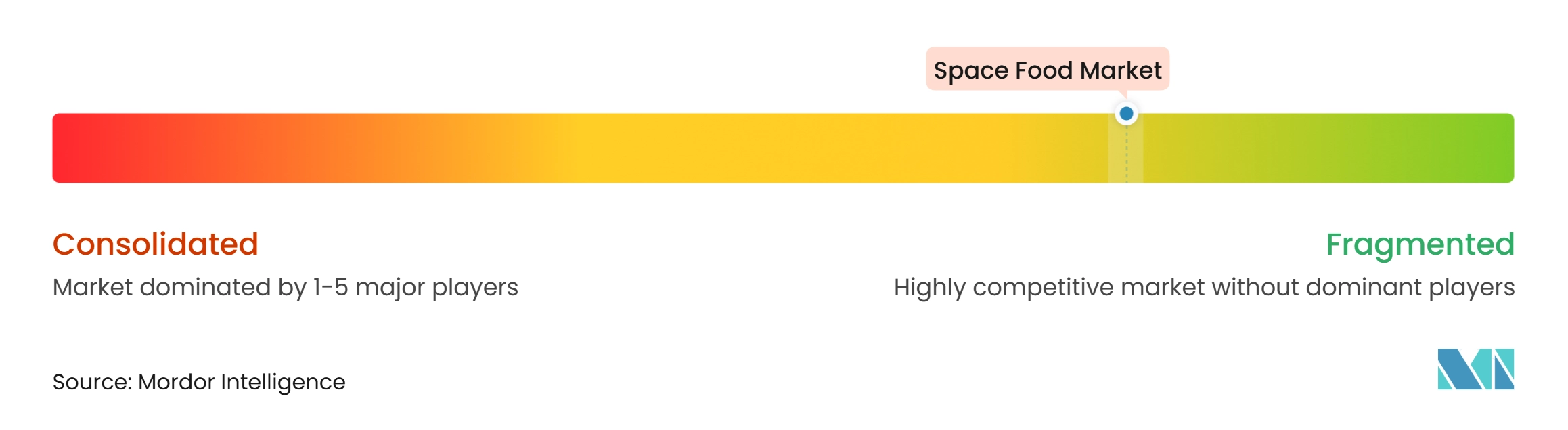
The space food market is fragmented, with established national suppliers and emerging food technology companies contributing to the competitive landscape. Established suppliers benefit from their experience in government space programs, astronaut food provisioning, and mission-specific product qualification. Their capabilities in food safety, preservation, packaging, and consistent production support their continued participation in space food supply. At the same time, specialized food technology companies are introducing innovative products and production approaches, broadening the range of solutions available to space programs.
Competition is strengthening through collaborations between food manufacturers, aerospace organizations, research institutions, and technology providers. These partnerships are encouraging advancements in food preservation, alternative protein production, fermentation, and integrated food systems. Companies are also focusing on improving nutritional quality, shelf stability, preparation convenience, and resource efficiency to meet the requirements of extended space missions. This growing collaboration is creating opportunities for both established suppliers and specialized technology developers to expand their capabilities.
The development of commercial space stations and future exploration programs is further broadening procurement opportunities across the market. Demand for reliable, nutritionally balanced, and mission-compatible food is creating opportunities for packaged food manufacturers and companies developing advanced food production systems. Suppliers with strong product validation, quality assurance, and technological capabilities are well-positioned to meet evolving mission requirements. These developments are supporting innovation, expanding supplier participation, and strengthening the competitive landscape of the space food market.
Space Food Industry Leaders
-
Goldys Food Corp.
-
THS Maple Holdings Ltd. (Turkey Hill Sugarbush Ltd.)
-
ACTIV Foods Inc. (Happy Yak)
-
Walcan Seafood Ltd. (SeaChange Seafoods)
-
Citadelle Maple Syrup Producers' Cooperative
- *Disclaimer: Major Players sorted in no particular order
Space Food Market Companies Covered in this Report
- Goldys Food Corp.
- THS Maple Holdings Ltd. (Turkey Hill Sugarbush Ltd.)
- ACTIV Foods Inc. (Happy Yak)
- Walcan Seafood Ltd. (SeaChange Seafoods)
- Citadelle Maple Syrup Producers' Cooperative
- PeakEATS
- Trails End Buffalo Stix
- Nomad Nutrition Ltd.
- Tootsi Impex Inc. (Elan)
- Whistler Chocolate Inc.
- GELIOS Group (Phytoproduct research and production complex)
- Galactika Dairy Plant
- Biryulyovo Experimental Plant (BEZ)
- Barilla Holding S.r.l. (Barilla G. e R. Fratelli S.p.A.)
- LYOFOOD Sp. z o.o.
- Groupe Jean Hénaff (Jean Hénaff SAS)
- gategroup Holding AG (Servair SA)
- Antarta JSC
- Nongshim Holdings Co., Ltd. (Nongshim Co., Ltd.)
- Daesang Holdings Co., Ltd. (Daesang Corporation)
Recent Industry Developments in Space Food Market
- April 2026: Astreas introduced its Performance Spheres aboard NASA’s Artemis II mission. The chocolate-based product combines dark chocolate with functional ingredients and was consumed by the crew during the mission, marking its use in a lunar mission food system
- December 2025: Super Garden presented its first collection of freeze-dried space snacks, developed in collaboration with the European Space Agency. The final recipes were approved for use in space missions, with a focus on balanced nutrition and astronaut requirements.
- July 2025: French chef Anne-Sophie Pic collaborated with astronaut Sophie Adenot to develop a specialized menu for a future International Space Station mission. Servair adapted and manufactured the dishes using sterilization in flexible bags to preserve taste and support long-term room-temperature storage.
Global Space Food Market Report Scope
The space food market includes specially developed food products and packaging solutions designed to meet the nutritional, safety, storage, and consumption requirements of astronauts during space missions. The market is segmented by Product Type, Packaging Type, and Geography. Based on Product Type, the market is segmented into Thermostabilized, Irradiated, Rehydratable, and Other Product Types. Based on Packaging Type, the market is segmented into Cans, Single-Use Containers, Vacuum-Sealed Packs, and Other Packaging Types. By geography, the market is segmented into North America, Europe, Asia-Pacific, South America, and the Middle East and Africa. For each segment, the market forecasts are provided in terms of value (USD).
Segmentation Overview
| Thermostabilized |
| Irradiated |
| Rehydratable |
| Other Product Types |
| Cans |
| Single-Use Containers |
| Vacuum-Sealed Packs |
| Other Packaging Types |
| North America | United States |
| Canada | |
| Mexico | |
| Rest of North America | |
| Europe | Germany |
| United Kingdom | |
| Italy | |
| France | |
| Spain | |
| Netherlands | |
| Poland | |
| Belgium | |
| Sweden | |
| Denmark | |
| Russia | |
| Rest of Europe | |
| Asia-Pacific | China |
| India | |
| Japan | |
| South Korea | |
| Malaysia | |
| Rest of Asia-Pacific | |
| South America | |
| Middle East and Africa |
| By Product Type | Thermostabilized | |
| Irradiated | ||
| Rehydratable | ||
| Other Product Types | ||
| By Packaging Type | Cans | |
| Single-Use Containers | ||
| Vacuum-Sealed Packs | ||
| Other Packaging Types | ||
| By Geography | North America | United States |
| Canada | ||
| Mexico | ||
| Rest of North America | ||
| Europe | Germany | |
| United Kingdom | ||
| Italy | ||
| France | ||
| Spain | ||
| Netherlands | ||
| Poland | ||
| Belgium | ||
| Sweden | ||
| Denmark | ||
| Russia | ||
| Rest of Europe | ||
| Asia-Pacific | China | |
| India | ||
| Japan | ||
| South Korea | ||
| Malaysia | ||
| Rest of Asia-Pacific | ||
| South America | ||
| Middle East and Africa | ||
Key Questions Answered in the Report
What is the market size of space food?
The space food market is estimated to reach USD 2.39 billion in 2026 and increase to USD 2.64 billion in 2027. The market is projected to reach USD 4.37 billion by 2032, growing at a CAGR of 10.60% during 2027–2032.
Which food format has the largest share?
Thermostabilized food held 38.11% in 2026 as it has established flight heritage and can be stored without refrigeration.
Why are vacuum-sealed packs gaining use?
Vacuum-sealed packs are forecast to expand at a CAGR of 12.51% through 2032 as flexible barriers help control moisture and oxidation during extended storage.
How are fresh food technologies changing mission planning?
Fermentation and plant-growth systems under development by Solar Foods and Interstellar Lab could reduce some food and water resupply needs in future habitats.