
Southeast Asia Crowdsourced (Gig Economy Couriers) Delivery Service Market Size and Share
Market Overview
| Study Period | 2021 - 2032 |
|---|---|
| Forecast Data Period | 2027 - 2032 |
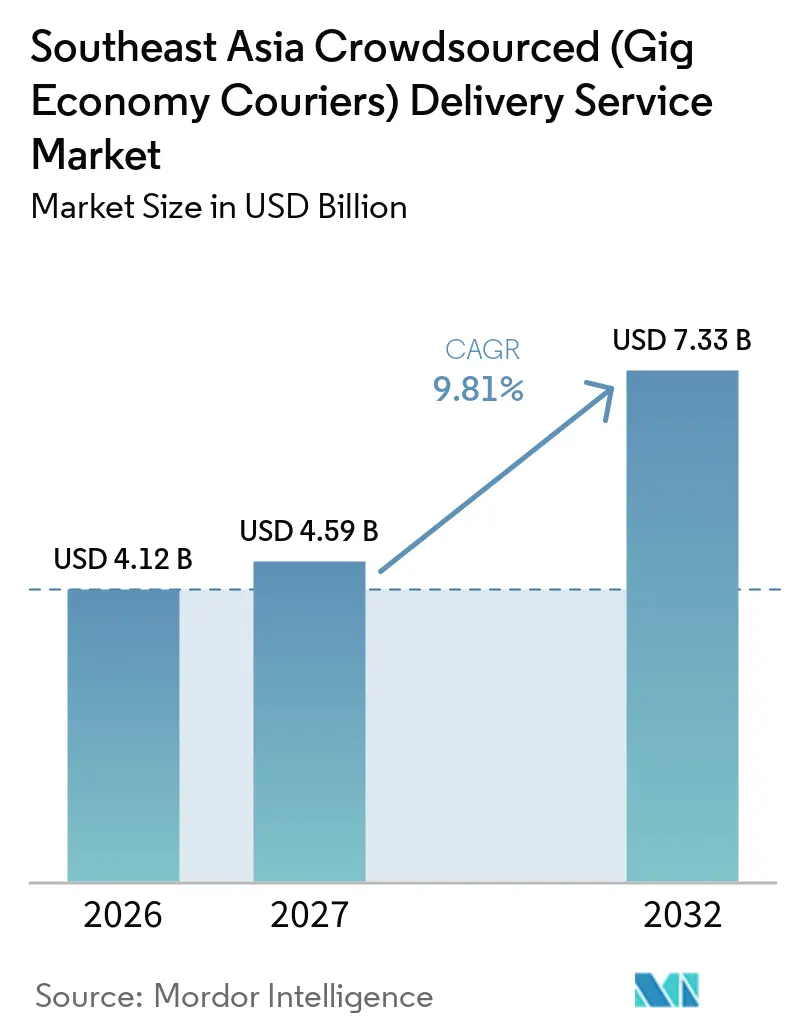
| Base Year Market Size (2026) | USD 4.12 Billion |
| Market Size (2027) | USD 4.59 Billion |
| Market Size (2032) | USD 7.33 Billion |
| Growth Rate (2027 - 2032) | 9.81 % |
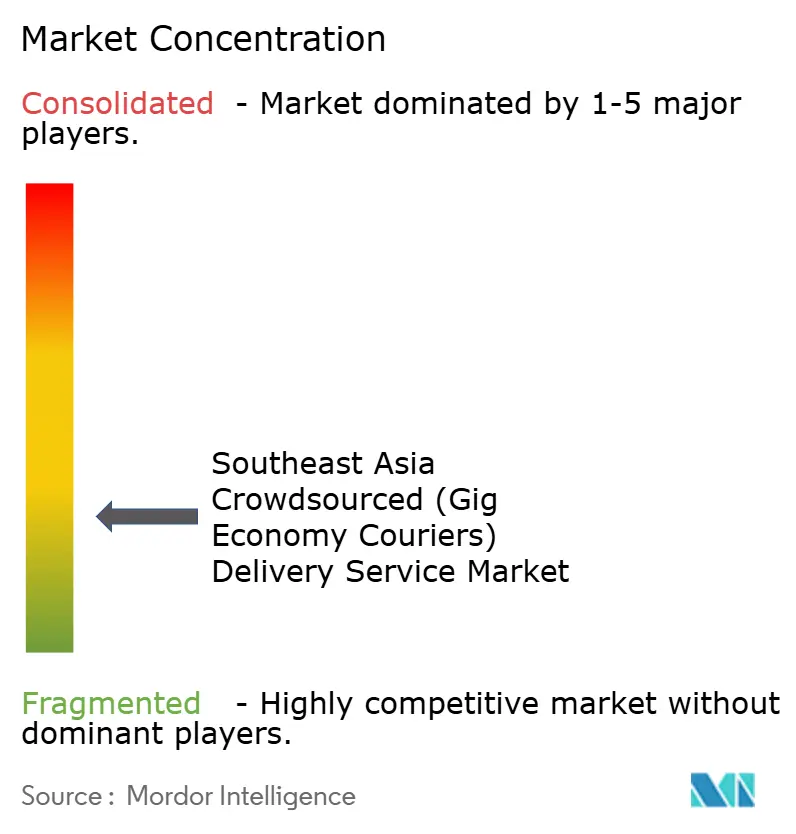
| Market Concentration | Low |
Major Players *Disclaimer: Major Players sorted in no particular order Image © Mordor Intelligence. Reuse requires attribution under CC BY 4.0. | |
Southeast Asia Crowdsourced (Gig Economy Couriers) Delivery Service Market Analysis by Mordor Intelligence
The Southeast Asia (gig economy couriers) delivery service market is valued at USD 4.12 billion in 2026 and is estimated to grow from USD 4.59 billion in 2027 to USD 7.33 billion by 2032, registering a CAGR of 9.81% between 2027 and 2032.
The regional digital economy has expanded the pool of orders that require flexible fulfillment, while two-wheelers give couriers a practical advantage in dense urban traffic and constrained street networks. Indonesia provides the largest demand base, while Vietnam combines fast online commerce activity with investment in delivery capacity and payment systems. The Southeast Asia (gig economy couriers) delivery service market is also moving toward more time-sensitive services as merchants seek coverage for retail peaks and shorter delivery windows. Competitive pressure remains significant because large parcel operators are building regional infrastructure while platform operators compete for rapid, nonstandard, and high-frequency orders. Regulation on pricing and worker welfare is becoming more relevant to the Southeast Asia (gig economy couriers) delivery service market because it affects courier earnings, operating costs, and service reliability.
Key Report Takeaways
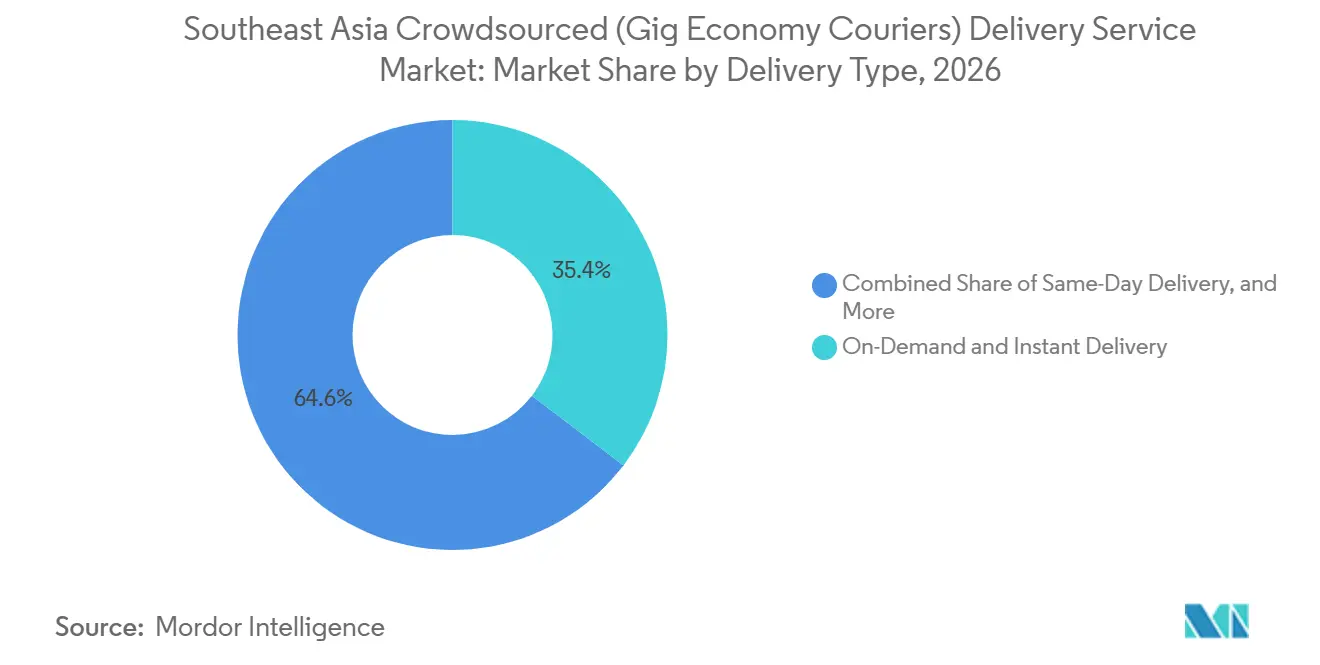
- By delivery type, on-demand and instant delivery held 35.37% of the Southeast Asia (gig economy couriers) delivery service market share in 2026, while same-day delivery is forecast to expand at a 12.24% CAGR through 2032.
- By business model, B2C held 62.57% of the Southeast Asia (gig economy couriers) delivery service market share in 2026 and is forecast to expand at a 10.12% CAGR through 2032.
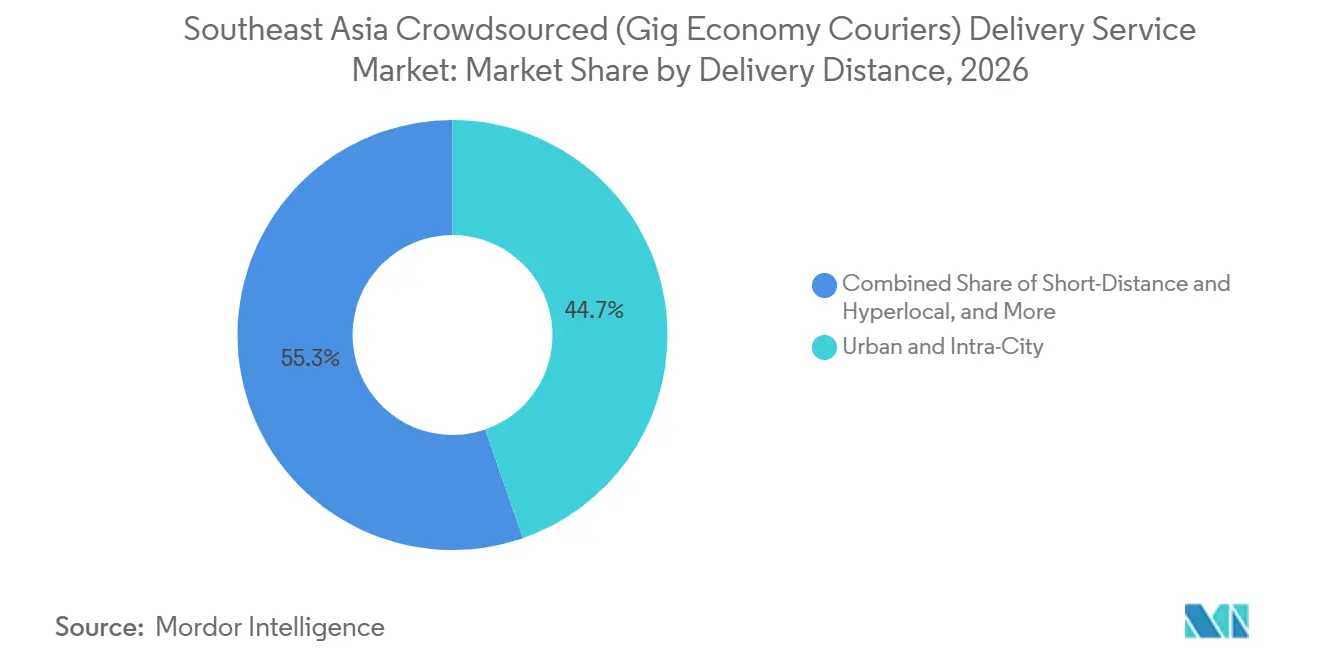
- By delivery distance, urban and intra-city deliveries held 44.69% of the Southeast Asia (gig economy couriers) delivery service market size in 2026, while extended urban and peri-urban deliveries are forecast to expand at an 11.90% CAGR through 2032.
- By courier engagement model, independent gig couriers held 59.97% of the Southeast Asia (gig economy couriers) delivery service market share in 2026, while part-time contracted drivers are forecast to expand at an 11.19% CAGR through 2032.
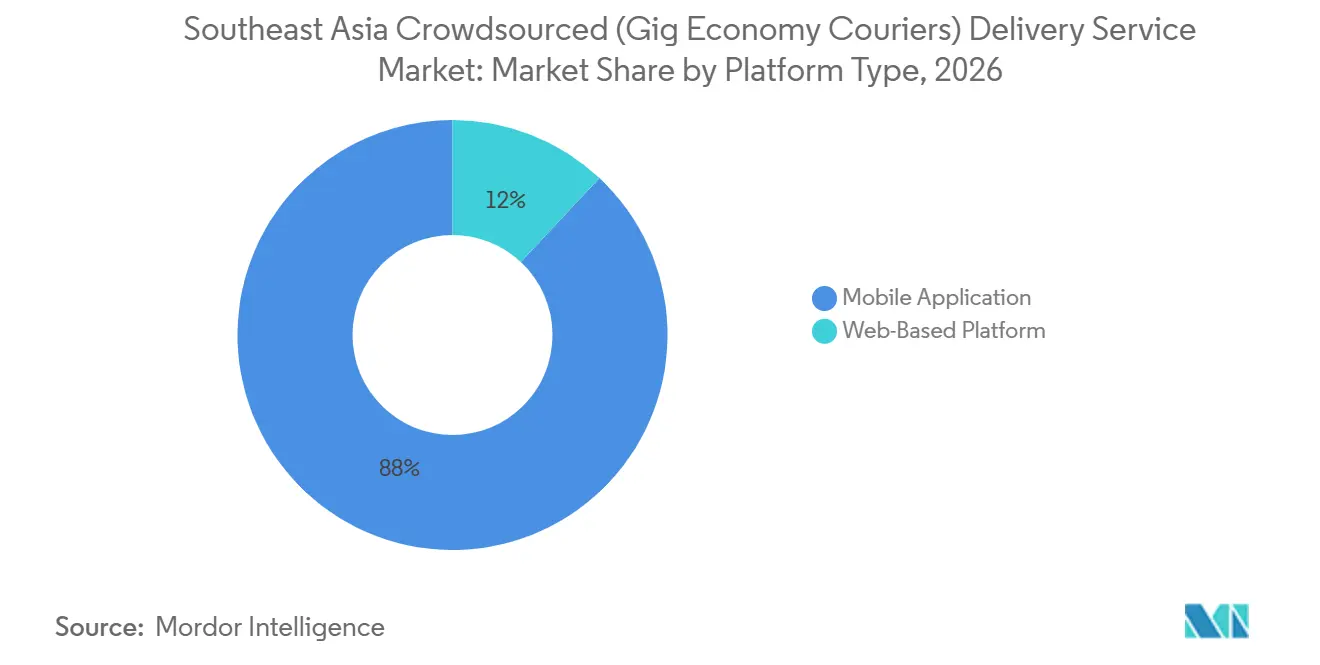
- By platform type, mobile application platforms held 88.03% of the Southeast Asia (gig economy couriers) delivery service market share in 2026, while web-based platforms are forecast to expand at a 10.47% CAGR through 2032.
- By vehicle type, two-wheelers held 73.44% of the Southeast Asia (gig economy couriers) delivery service market size in 2026, while drones and autonomous vehicles are forecast to expand at a 22.03% CAGR through 2032.
- By end user, e-commerce and online retail held 32.26% of the Southeast Asia (gig economy couriers) delivery service market share in 2026, while q-commerce is forecast to expand at a 16.57% CAGR through 2032.
- By geography, Indonesia held 36.72% of the Southeast Asia (gig economy couriers) delivery service market share in 2026, while Vietnam is forecast to expand at a 12.87% CAGR through 2032.
Note: Market numbers in this report are based on Mordor Intelligence's proprietary estimation framework, which combines nine months of actuals with Q4 projections for base year 2026.
Market Trends and Insights
Drivers Impact Analysis of Southeast Asia Crowdsourced (Gig Economy Couriers) Delivery Service Market*
| Driver | (~) % Impact on CAGR Forecast | Geographic Relevance | Impact Timeline |
|---|---|---|---|
| E-Commerce and Social-Commerce Parcel Growth | +3.2% | Regional, led by Indonesia, Vietnam, Thailand, Malaysia | Long term (≥ 4 years) |
| Instant and Same-Day Delivery Adoption | +2.1% | Metro corridors in Indonesia, Vietnam, Thailand, Philippines | Medium term (2-4 years) |
| Flexible Capacity for Demand Peaks and Secondary Cities | +1.4% | Indonesia, Philippines, Vietnam | Medium term (2-4 years) |
| Digital Payments and Real-Time Tracking Adoption | +0.8% | Vietnam, Thailand, Malaysia, Singapore | Medium term (2-4 years) |
| Two-Wheeler Density and Urban Route Flexibility | +1.0% | Indonesia, Vietnam, Philippines, Thailand | Short term (≤ 2 years) |
| Location Intelligence Beyond Conventional Addressing | +0.7% | Philippines, Indonesia | Long term (≥ 4 years) |
| Source: Mordor Intelligence | |||
E-Commerce and Social-Commerce Parcel Growth
The Southeast Asia (gig economy couriers) delivery service market benefits from rising online transactions because each sale creates a delivery requirement that platforms can fulfill with flexible rider capacity. Social commerce adds pressure during flash sales because its buyers often need fast delivery confirmation and reliable tracking. These orders increasingly reach secondary cities, where fixed courier networks have less dense coverage. The resulting gaps create a role for crowdsourced riders during promotional peaks and outside main metropolitan corridors. Vietnam’s online commerce activity has strengthened this pattern, although delivery pricing rules also shape how platforms translate volume into courier income. Indonesia’s Permenkomdigi No. 8 of 2025 limits discounts below actual shipping costs to 3 consecutive days in a month, which supports closer alignment between delivery pricing and costs.[1]
Instant and Same-Day Delivery Adoption
The Southeast Asia (gig economy couriers) delivery service market increasingly relies on rapid delivery tiers for food, grocery, pharmacy, and urgent retail orders. Q-Commerce services create recurring short-distance work that can improve rider utilization between broader retail assignments. Same-day services also allow merchants to offer a clear speed option without the highest cost of immediate delivery. Ahamove’s integration with SPX Express for Shopee Vietnam’s Express Same-Day service in August 2025 showed how established logistics networks could use flexible courier capacity for intraday requirements. This approach gives fixed networks additional reach during periods when their scheduled capacity is constrained. It also leaves platform operators competing on dispatch quality, customer visibility, and the availability of riders near merchant clusters.
Flexible Capacity for Demand Peaks and Secondary Cities
The Southeast Asia (gig economy couriers) delivery service market provides an alternative to permanently expanding fleets for short seasonal surges. Demand rises during year-end sales, Ramadan, and platform campaigns, yet fixed fleets can remain underused after these windows close. Indonesian delivery riders commonly travel 60-80 kilometers a day while navigating traffic and reaching areas with limited logistics infrastructure.[2] The fastest growth in extended urban and peri-urban services reflects this need for adaptable coverage beyond city centers. Last-mile delivery accounts for the majority of total logistics costs, making route efficiency and rider density central to operating performance. Fulfillment investments can extend order reach, but flexible couriers remain important where demand is irregular or geographically dispersed.
Digital Payments and Real-Time Tracking Adoption
Digital settlement supports the Southeast Asia gig economy delivery market by reducing cash reconciliation between merchants and couriers. More than 75% of e-commerce transactions in Vietnam are paid through digital wallets or QR codes, according to the State Bank of Vietnam, as cited by the Vietnam E-Commerce Association. Faster settlement can improve payment visibility for merchants and shorten payment cycles for riders. Real-time tracking also gives customers and business users more certainty about delivery status. GrabMaps supports fleet matching and routing across Southeast Asian cities. Grab’s 2025 agreements with autonomous technology companies showed the operational value of detailed location data. GoGoX’s April 2025 affiliate program in Vietnam similarly paired QR-based merchant referrals with real-time van tracking.
Restraints Impact Analysis of Southeast Asia Crowdsourced (Gig Economy Couriers) Delivery Service Market*
| Restraint | (~) % Impact on CAGR Forecast | Geographic Relevance | Impact Timeline |
|---|---|---|---|
| Courier Income Volatility and High Churn | -1.2% | Regional, most acute in Indonesia and Philippines | Short term (≤ 2 years) |
| Platform Price Wars and Margin Compression | -1.5% | Indonesia, Vietnam, Thailand | Medium term (2-4 years) |
| Uneven Road, Addressing, and Island Infrastructure | -0.9% | Philippines, Indonesia | Long term (≥ 4 years) |
| Worker-Protection Compliance and Multi-Platform Data Complexity | -0.6% | Malaysia, Singapore, Thailand | Medium term (2-4 years) |
| Source: Mordor Intelligence | |||
Courier Income Volatility and High Churn
Income volatility constrains the Southeast Asia gig economy delivery market because riders need predictable earnings to stay active on a platform. IDinsight’s March 2025 study of Indonesian drivers found that riders often could not predict per-order earnings when algorithms adjust payments by demand, service zone, and order type. A December 2025 scientific study also linked long working hours among Indonesian ride-hailing and delivery workers to fatigue and safety risks. Part-time contracted arrangements respond to this issue by offering more structured availability during merchant peaks. High workforce turnover increases recruitment and onboarding costs while reducing consistency for merchants and consumers.[3] Better pay transparency, workable rest practices, and clearer service terms can strengthen retention without removing the flexibility that attracts many couriers.
Platform Price Wars and Margin Compression
The Southeast Asia (gig economy couriers) delivery service market faces pricing pressure when online platforms subsidize shipping to gain merchants and customer orders. Couriers can absorb part of this pressure through lower delivery payments, while operators face limited room to recover costs through fees. Vietnam’s postal and delivery sector reported VND 38.3 trillion (USD 1.46 billion) in revenue in H1 2025, yet profit margins remained near 3%. Indonesia’s competition authority gave conditional approval to the TikTok-Tokopedia transaction in June 2025 and required open access to payment and logistics services while restricting predatory pricing. Operators with subscription, advertising, or data-related revenue can depend less on per-delivery commissions.[4] These additional revenue sources can help maintain service quality when shipping prices remain under pressure.
*Our forecasts treat driver/restraint impacts as directional, not additive. The impact forecasts reflect baseline growth, mix effects, and variable interactions.
Southeast Asia Crowdsourced (Gig Economy Couriers) Delivery Service Market Segment Analysis
By Delivery Type:
Rapid Delivery Services Set the Operating StandardOn-demand and instant delivery held 35.37% of the Southeast Asia (gig economy couriers) delivery service market size in 2026. Fashion, electronics, and fast-moving consumer goods merchants use same-day delivery to meet urban customer requirements without paying for the fastest available option. Next-day and express delivery address less urgent demand, including documents, replenishment, and larger consumer goods, while scheduled delivery lets riders handle lower-priority tasks between urgent assignments. The segment distinguishes gig platforms from scheduled express services.
Same-day delivery records the highest growth rate at a 12.24% CAGR through 2032. The delivery type mix requires distinct dispatch rules and pricing levels within a single application. Rapid orders need nearby rider availability, accurate maps, and clear customer communication, while scheduled work improves utilization across the day. The Southeast Asia (gig economy couriers) delivery service industry is supported by a tiered speed structure rather than a single delivery promise. Operators that match rider capacity to each tier can protect service quality while controlling payout costs. This balance matters as faster delivery becomes a regular expectation across retail categories.

By Business Model:
B2C Retains the Broadest Demand BaseB2C accounted for 62.57% of the Southeast Asia (gig economy couriers) delivery service market size in 2026 and also recorded a 10.12% CAGR through 2032. It is the only segment type in which the largest category is also the fastest-growing category, while retail platform fulfillment remains its primary order source. B2B work includes document services, inter-office shipments, samples, and retail replenishment, which require dependable tracking and clear handling records. C2C orders support rider utilization in smaller cities and during periods when merchant order density is lower.
B2G work is also emerging, as illustrated by GoTo Gojek’s July 2026 agreement with Indonesia’s Ngurah Rai Immigration Office for GoSend passport delivery. Enterprise clients create an opportunity for platforms that can provide application programming interface connections, volume pricing, and service-level agreements. Such capabilities can make B2B business more valuable even if it remains smaller than consumer delivery. The Southeast Asia (gig economy couriers) delivery service industry can expand its commercial base by using shared rider pools across consumer, enterprise, and public-service assignments. This approach also allows riders to serve demand with different urgency and handling requirements.
By Delivery Distance:
Dense Urban Routes Support ScaleUrban and intra-city deliveries accounted for 44.69% of the Southeast Asia (gig economy couriers) delivery service market share in 2026. Suburban expansion around Jabodetabek, Metro Manila, and Ho Chi Minh City is increasing the need for adaptable last-mile capacity. Short-distance and hyperlocal orders remain important for q-commerce and other urgent neighborhood deliveries, but their economics depend on micro-fulfillment sites and enough nearby orders to sustain rider earnings. These corridors support high rider utilization because merchants and customers are located close together.
Extended urban and peri-urban deliveries are forecast to grow at an 11.90% CAGR through 2032. Two-wheelers account for 80% of regional vehicle stock on average, giving motorcycle couriers a route and cost advantage in congested areas. The same advantage extends into suburban routes where four-wheel vehicles face traffic and parking constraints. Giao Hang Tiet Kiem’s use of mini hubs in suburban areas reflects efforts to shorten the final delivery leg, while fixed-network operators adapt infrastructure to compete where flexible couriers have been prominent. The Southeast Asia (gig economy couriers) delivery service market benefits when platforms can serve dense urban areas and expanding peripheral districts. Distance-based pricing and realistic delivery windows remain important for keeping these longer routes viable.
By Courier Engagement Model:
Independent Work Remains CentralIndependent gig couriers held 59.97% of the Southeast Asia (gig economy couriers) delivery service market size in 2026. Structured hourly arrangements can support merchant service commitments during high-demand periods. Full-time partnered drivers remain useful for cold chain, healthcare, and high-value documents, where insurance, controlled handling, and documented custody can be required. This model allows platforms to add capacity without maintaining a fully employed fleet.
Part-time contracted drivers are the fastest-growing model at an 11.19% CAGR through 2032. Income predictability is an important factor in whether drivers remain active. Hybrid engagement models can provide more reliable capacity while preserving flexibility for many riders. They can also help platforms respond to evolving worker protections in Malaysia, Singapore, and Thailand. The transition assigns more structured arrangements to services where timing and handling standards are stricter. The Southeast Asia (gig economy couriers) delivery service market may rely on this mix as delivery requirements become more varied.
By Platform Type:
Mobile Applications Lead Daily OperationsMobile application platforms held 88.03% of the Southeast Asia (gig economy couriers) delivery service market size in 2026. Enterprise merchants use browser-based dashboards for fleet management, application programming interface connections, and broader logistics oversight. Mobile tools remain more practical for riders who receive assignments and navigation guidance while moving. Consumer ordering and courier onboarding are largely managed through mobile devices.
Web-based platforms are forecast to grow at a 10.47% CAGR through 2032. The division between mobile and web is increasingly based on the user’s role rather than the underlying delivery network. Platform data strengthens matching, tracking, route selection, and fraud management. J&T Express’s 2025 integration of DeepSeek into routing and dispatch operations indicated that large logistics operators were also using digital tools to improve field execution. The Southeast Asia (gig economy couriers) delivery service market needs both interfaces to address consumer convenience and business administration. Interoperability can improve merchant visibility without slowing rider operations.
By Vehicle Type:
Two-Wheelers Carry Most DeliveriesTwo-wheelers held a 73.44% share of the Southeast Asia (gig economy couriers) delivery service market size in 2026. Their leading position reflects urban traffic conditions, low operating costs, and the prevalence of short last-mile routes, while four-wheelers, vans, and light commercial vehicles serve heavier goods, cold chain products, furniture, and appliances. This expansion starts from a limited commercial base and depends on regulatory approval, operational safety, parcel size, distance, and delivery urgency.
Drones and autonomous vehicles are forecast to grow at a 22.03% CAGR through 2032. Grab’s January 2026 drone delivery beta at Tanjong Rhu, Singapore, processed up to 28 deliveries a day during a 3-month controlled trial. Vietnam Post Corporation’s February 2026 sea-crossing UAV route carried a 2-kilogram parcel 12 kilometers from Can Gio to Vung Tau in 15 minutes. These projects show where aerial delivery can address access constraints rather than replace routine motorcycle work. Civil aviation frameworks may shape wider deployment. Until those frameworks mature, two-wheelers may remain the operational backbone of the Southeast Asia (gig economy couriers) delivery service market.
By End User:
E-Commerce Provides Volume and Q-Commerce Raises Speed NeedsE-commerce and online retail held 32.26% of the Southeast Asia (gig economy couriers) delivery service market size in 2026. Its short delivery promises increase demand for nearby riders and local fulfillment sites. Foodservice and restaurant delivery remains a high-frequency urban category, while grocery and traditional retail deliveries are expanding as consumers shift routine purchases online. This category provides a large, recurring order base for independent couriers.
Q-Commerce is forecast to grow at a 16.57% CAGR through 2032. Healthcare and pharmaceutical delivery is a higher-value niche because it may require temperature control and documented handling. A unified rider network can serve several end-user groups across the day, improving order density and supporting courier earnings and platform unit economics. Q-commerce also changes consumer expectations by normalizing shorter delivery windows across retail categories. The Southeast Asia (gig economy couriers) delivery service market gains from this service mix because no single order type fully supports rider utilization at every hour. Operators that keep quality standards consistent can retain merchants with different urgency and handling needs.
Geography Analysis
Indonesia held 36.72% of the Southeast Asia (gig economy couriers) delivery service market share in 2026. Its scale comes from a large consumer base, more than 7 million registered gig delivery and ride-hailing workers in 2025, and deep platform activity. The conditional TikTok-Tokopedia approval in June 2025 brought attention to open payment and logistics access, along with restrictions on predatory pricing. Permenkomdigi No. 8 of 2025 established delivery pricing parameters that could support more stable courier earnings. Island geography raises delivery costs outside the largest urban areas, so motorcycle couriers remain particularly relevant across congested Java corridors and areas with limited fixed networks.
Vietnam is forecast to grow at a 12.87% CAGR through 2032. Its postal and delivery sector generated VND 38.3 trillion (USD 1.46 billion) in H1 2025, while digital payment use supported cashless delivery workflows. Giao Hang Nhanh opened an 85,500 m² Hung Yen Transit Center in January 2026 with an automated capacity of 165,117 parcels an hour. SPX Express began work on a 170,000 m² automated sorting center in Hung Yen in October 2025. Vietnam’s UAV trial between Can Gio and Vung Tau also showed active testing of advanced delivery technology.
Thailand’s online commerce expansion broadens the customer base for the Southeast Asia gig economy delivery market. Wongnai became a consolidated subsidiary of LY Corporation in September 2025, increasing its access to strategic resources. Malaysia is testing autonomous logistics, while the Philippines faced inter-island constraints that made Grab’s June 2025 drone pilot relevant for time-sensitive routes. Singapore serves as a test setting for autonomous services, including Grab and WeRide’s Ai.R service in Punggol.
Competitive Landscape
The Southeast Asia (gig economy couriers) delivery service market is fragmented at the platform layer, while parcel infrastructure is becoming more concentrated. Grab, GoTo Gojek, Lalamove, and GoGoX compete more directly for speed-sensitive orders and services outside standard e-commerce parcels. Grab and GoTo Gojek can draw on mobility and fintech activity alongside delivery operations, which can make their delivery operations more resilient than those of single-service providers. J&T Express recorded a 57.9% increase in Southeast Asia parcel volume to 3.23 billion in H1 2025.
Companies are also seeking positions in enterprise delivery, where flexible capacity can be combined with clearer service standards. GoGoX’s Vietnam affiliate program connected merchants with on-demand delivery through QR-based referrals and tracking tools. Deliveree uses scheduled van matching to address a different set of business logistics requirements. Ninja Van exited Vietnam’s express delivery business in September 2025 after highlighting concentration risk from platform-linked logistics, illustrating pressure on independent providers when large online platforms use delivery pricing to attract merchants. Operators that provide reliable tracking, transparent courier terms, and enterprise service commitments can distinguish themselves from commodity parcel providers.
Grab has pursued autonomous technology partnerships as a longer-term operating strategy. It signed agreements with Autonomous A2Z, Motional, WeRide, and Zelos in March 2025 to study safety, commercial sustainability, and workforce transition issues. Grab then made a strategic equity investment in WeRide in August 2025 and agreed on a multi-year partnership with May Mobility in October 2025. Regulation on pricing and autonomous vehicle testing rewards companies with established compliance resources, although specialized players still have room to compete.
Southeast Asia Crowdsourced (Gig Economy Couriers) Delivery Service Industry Leaders
-
Lalamove
-
Foodpanda
-
Ahamove
-
Grab Holdings Limited
-
GoTo Gojek Tokopedia Tbk
- *Disclaimer: Major Players sorted in no particular order
Southeast Asia Crowdsourced (Gig Economy Couriers) Delivery Service Market Companies Covered in this Report
- Grab Holdings Limited
- GoTo Gojek Tokopedia Tbk
- Lalamove
- foodpanda
- Ahamove
- Ninja Van
- J&T Express
- SPX Express
- Lazada Logistics
- Flash Express
- LINE MAN Wongnai
- Giao Hang Nhanh
- Giao Hang Tiet Kiem
- Pickupp
- TheLorry
- BEST Express
- Be Group
- Maxim
- GoGoX
- Deliveree
Recent Industry Developments in Southeast Asia Crowdsourced (Gig Economy Couriers) Delivery Service Market
- October 2025: Grab and May Mobility announced a multi-year partnership and equity investment to bring May Mobility's autonomous vehicle technology to Southeast Asia, integrating May Mobility's autonomous driving system into Grab's fleet management, vehicle-matching, and routing ecosystem, with access to GrabMaps for regional road infrastructure training. The deal extends Grab's AV supply-chain strategy alongside its concurrent WeRide investment.
- October 2025: SPX Express and Frasers Property Vietnam held the groundbreaking ceremony for a 170,000 m² two-storey automated sorting center in Hung Yen Province, Vietnam, set for completion in Q4 2026, capable of processing 7 million parcels per day across 158 docks connected to over 700 sorting destinations. The agreement was signed in May 2025, positioning the facility as SPX Express's largest in Southeast Asia upon commissioning.
- September 2025: Grab committed to a strategic equity investment in WeRide in August 2025 to deploy Level 4 robotaxis and autonomous shuttles in Southeast Asia, integrating WeRide's technology into Grab's fleet management ecosystem. Singapore's Land Transport Authority subsequently selected the partnership in September 2025 to operate the AiR autonomous shuttle service on 2 designated routes in Punggol with an 11-vehicle fleet.
- September 2025: LY Corporation, a SoftBank Group consolidated subsidiary, completed the share acquisition to make LINE MAN Wongnai a consolidated subsidiary by September 2025, per SoftBank Group's press disclosure. The consolidation strengthened strategic collaboration with LMWN, Thailand's largest on-demand delivery and food platform serving over 10 million users, with LY targeting completion of a further share acquisition following Thai regulatory clearance.
Southeast Asia Crowdsourced (Gig Economy Couriers) Delivery Service Market Report Scope
Segmentation Overview
| On-Demand and Instant Delivery |
| Same-Day Delivery |
| Next-Day and Express Delivery |
| Scheduled Delivery |
| Other Delivery Types |
| Business-to-Business (B2B) |
| Business-to-Consumer (B2C) |
| Consumer-to-Consumer (C2C) |
| Short-Distance and Hyperlocal |
| Urban and Intra-City |
| Extended Urban and Peri-Urban |
| Independent Gig Couriers |
| Part-Time Contracted Drivers |
| Full-Time Partnered Drivers |
| Mobile Application |
| Web-Based Platform |
| Two-Wheelers |
| Four-Wheelers |
| Vans and Light Commercial Vehicles |
| Drones and Autonomous Vehicles |
| Other Vehicle Types |
| E-Commerce and Online Retail |
| Quick Commerce (Q-Commerce) |
| Foodservice and Restaurant |
| Grocery and Traditional Retail |
| Healthcare and Pharmaceuticals |
| Business, Document and Professional Courier Services |
| Other Commercial and Specialized Deliveries |
| Indonesia |
| Thailand |
| Vietnam |
| Philippines |
| Malaysia |
| Singapore |
| Rest of Southeast Asia |
| By Delivery Type | On-Demand and Instant Delivery |
| Same-Day Delivery | |
| Next-Day and Express Delivery | |
| Scheduled Delivery | |
| Other Delivery Types | |
| By Business Model | Business-to-Business (B2B) |
| Business-to-Consumer (B2C) | |
| Consumer-to-Consumer (C2C) | |
| By Delivery Distance | Short-Distance and Hyperlocal |
| Urban and Intra-City | |
| Extended Urban and Peri-Urban | |
| By Courier Engagement Model | Independent Gig Couriers |
| Part-Time Contracted Drivers | |
| Full-Time Partnered Drivers | |
| By Platform Type | Mobile Application |
| Web-Based Platform | |
| By Vehicle Type | Two-Wheelers |
| Four-Wheelers | |
| Vans and Light Commercial Vehicles | |
| Drones and Autonomous Vehicles | |
| Other Vehicle Types | |
| By End User | E-Commerce and Online Retail |
| Quick Commerce (Q-Commerce) | |
| Foodservice and Restaurant | |
| Grocery and Traditional Retail | |
| Healthcare and Pharmaceuticals | |
| Business, Document and Professional Courier Services | |
| Other Commercial and Specialized Deliveries | |
| By Geography | Indonesia |
| Thailand | |
| Vietnam | |
| Philippines | |
| Malaysia | |
| Singapore | |
| Rest of Southeast Asia |
Key Questions Answered in the Report
What is the value of the Southeast Asia (gig economy couriers) delivery service sector?
The Southeast Asia (gig economy couriers) delivery service market was valued at USD 4.12 billion in 2026 and is forecast to reach USD 7.33 billion by 2032, with a 9.81% CAGR during 2027-2032.
Which delivery service leads regional revenue?
On-demand and instant delivery led with 35.37% revenue share in 2026, while same-day delivery is the fastest-growing delivery type at a 12.24% CAGR through 2032.
Which country has the largest regional delivery base?
Indonesia held 36.72% revenue share in 2026, supported by its large consumer base, high platform activity, and extensive rider network.
Which country records the fastest growth through 2032?
Vietnam is forecast to expand at a 12.87% CAGR through 2032, supported by delivery infrastructure development and digital payment adoption.
Why are two-wheelers important for last-mile delivery?
Two-wheelers held 73.44% revenue share in 2026 and can navigate dense traffic at lower operating cost for short-distance delivery tasks.
What end user is expanding fastest?
Q-commerce is forecast to grow at a 16.57% CAGR through 2032 as consumers seek shorter delivery times for grocery, pharmacy, and convenience orders.