
South Korea Robotic Lawn Mower Market Size and Share
Market Overview
| Study Period | 2021 - 2031 |
|---|---|
| Forecast Data Period | 2026 - 2031 |
| Base Year Market Size (2025) | USD 93.76 Million |
| Market Size (2026) | USD 100.88 Million |
| Market Size (2031) | USD 145.44 Million |
| Growth Rate (2026 - 2031) | 7.59 % |
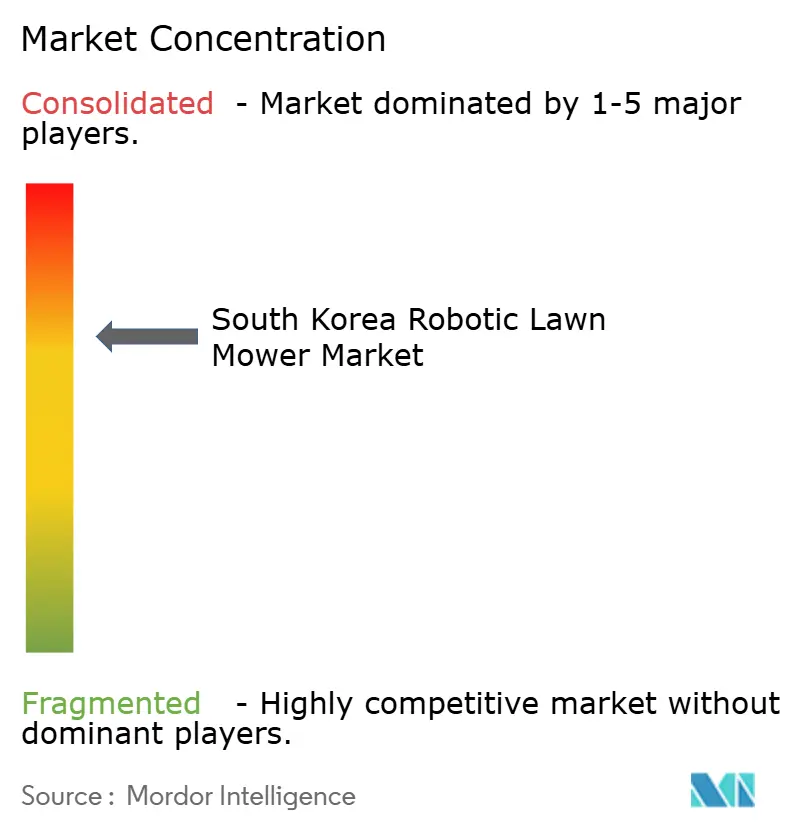
| Market Concentration | Medium |
Major Players *Disclaimer: Major Players sorted in no particular order Image © Mordor Intelligence. Reuse requires attribution under CC BY 4.0. | |
South Korea Robotic Lawn Mower Market Analysis by Mordor Intelligence
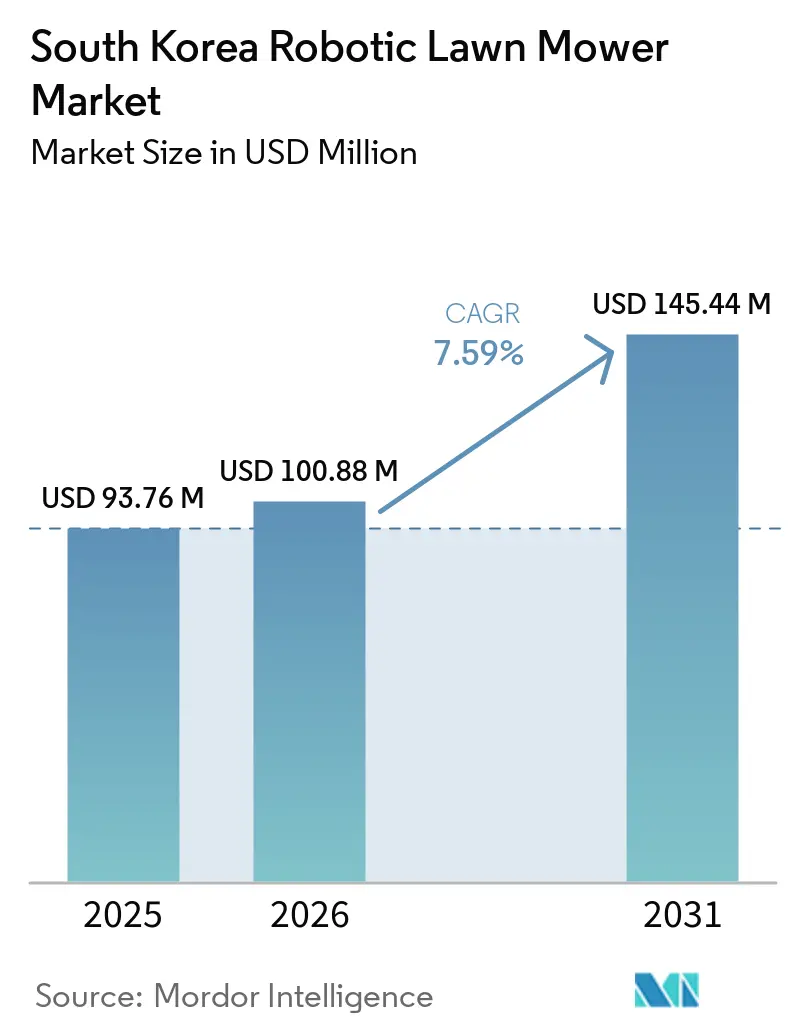
The South Korea robotic lawn mower market size was valued at USD 93.76 million in 2025 and is forecast to grow from USD 100.88 million in 2026 to reach USD 145.44 million by 2031, at a CAGR of 7.59% during the forecast period (2026-2031). The market is supported by the growing adoption of connected-home, rising landscaping labor costs, and the availability of wire-free navigation systems. Connected devices make app-based lawn maintenance more familiar for households that already use home automation. Commercial operators are also evaluating autonomous mowing to reduce repeated manual work across multiple sites. Suppliers are competing on local dealer coverage, installation support, and software updates. Key constraints to broader adoption include high purchase prices, wet weather, uneven terrain, and limited awareness among non-early-adopter groups.
Key Report Takeaways
- By range, the medium (501-2,000 m²) segment accounted for 42.9% of the South Korea robotic lawn mower market share in 2025, while the high (more than 2,000 m²) segment is forecast to grow at a CAGR of 9.2% from 2026 to 2031.
- By navigation technology, boundary-wire accounted for 64.8% of the South Korea robotic lawn mower market size in 2025, while vision/camera systems are forecast to grow at a CAGR of 11.8% from 2026 to 2031.
- By end user, residential accounted for 62.9% of the share in 2025, while commercial is forecast to grow at a CAGR of 10.4% from 2026 to 2031.
- By distribution channel, offline (DIY stores, specialty dealers) accounted for 70.4% of the share in 2025, while online (direct, marketplaces) are forecast to grow at a CAGR of 9.6% from 2026 to 2031.
Note: Market size and forecast figures in this report are generated using Mordor Intelligence’s proprietary estimation framework, updated with the latest available data and insights as of January 2026.
South Korea Robotic Lawn Mower Market Trends and Insights
Drivers Impact Analysis*
| Driver | (~) % Impact on CAGR Forecast | Geographic Relevance | Impact Timeline |
|---|---|---|---|
| Expansion of Smart-Home and Connected-Device Adoption | +1.8% | National, concentrated in the Seoul Capital Area and major metropolitan centers | Medium term (2-4 years) |
| Demand for Quiet, Low-Emission Lawn Maintenance in Dense Urban Areas | +1.5% | Seoul Capital Area, Busan and Southeast Region, and apartment-dense city zones | Short term (≤ 2 years) |
| Commercial Landscaping Labor Scarcity and Wage Pressure | +1.6% | National, with early gains in Gyeonggi and Jeju golf corridors and institutional grounds | Medium term (2-4 years) |
| Growth of Wire-Free RTK and Vision-Based Navigation | +1.9% | National, particularly technology-oriented residential and commercial customers | Short term (≤ 2 years) |
| Premiumization of Residential and Golf-Course Maintenance | +1.2% | Seoul Capital Area, Gyeonggi Province, villa areas, and golf resorts | Long term (≥ 4 years) |
| Korea-Specific Dealer and After-Sales Service Localization | +1% | National, with early gains in Seoul, Busan, Daejeon, and Gwangju | Medium term (2-4 years) |
| Source: Mordor Intelligence | |||
Expansion of Smart-Home and Connected-Device Adoption
South Korea's digital infrastructure supports app-controlled garden equipment. Samsung Electronics Co., Ltd. had more than 23 million users in South Korea in 2025, while 92% of Bespoke AI Steam robot vacuum purchasers connected their devices to the platform, highlighting strong adoption of SmartThings among AI appliance users[1]Samsung Electronics, “Samsung SmartThings Users Surpass 23 Million in Korea,” Samsung Newsroom, samsung.com.. Robotic mowers that work with SmartThings, Google Home, and related platforms fit established household routines. The South Korea robotic lawn mower market can therefore reach buyers who view automated mowing as another connected appliance. Each connected device makes automation of an adjacent household task more familiar. Suppliers with direct platform integration have an advantage over brands that rely on separate bridge applications, particularly when dealers recommend systems that align with existing household controls.
Demand for Quiet, Low-Emission Lawn Maintenance in Dense Urban Areas
Noise considerations are increasing the relevance of quieter lawn-maintenance equipment in South Korea’s dense residential and commercial environments. The Noise and Vibration Control Act provides the regulatory framework for noise management in the country[2]Ministry of Environment, “Enforcement Decree of the Noise and Vibration Control Act,” Korea Legislation Research Institute, elaw.klri.re.kr.. Battery-powered robotic mowers typically operate at relatively low noise levels of around 55 to 65 dB, making them suitable for applications where conventional mowing equipment may create greater disturbance. This is particularly relevant for apartment complexes, campuses, parks, hotels, and resorts, where property managers and facility operators need to maintain landscaped areas without disrupting residents, visitors, or daily activities. As noise reduction becomes an operational consideration rather than simply a product benefit, procurement teams can incorporate noise-related specifications into equipment tenders and facility-management requirements. This creates an additional demand pathway for robotic mowers, as their lower operating noise and autonomous capabilities enable facility operators to automate routine lawn maintenance while minimizing disturbance in densely populated and high-traffic locations.
Commercial Landscaping Labor Scarcity and Wage Pressure
Labor shortages and rising workforce costs are encouraging commercial landscaping operators to evaluate automation for recurring maintenance activities. South Korea set a seasonal-worker quota of 109,100 for 2026, up 14% from the previous year, reflecting continued demand for additional labor across labor-intensive sectors. Robotic mowers can reduce the amount of manual labor required for repetitive mowing tasks, allowing operators to redirect workers toward activities that require greater supervision or specialized skills. For example, Spring Hills Country Club in Goyang reported projected five-year maintenance savings of KRW 700 million (USD 500,000) from AI turf-management robots in 2026. Such cost-saving potential strengthens the business case for automation, particularly for golf courses, institutions, and multi-site commercial properties where mowing is frequent and labor requirements are high. As commercial users increasingly assess equipment based on operating costs and labor productivity, demand for robotic mowing solutions can expand across professional landscaping and managed-turf applications.
Growth of Wire-Free RTK and Vision-Based Navigation
Advances in RTK, AI vision, and simultaneous localization and mapping (SLAM) are reducing installation and navigation barriers for robotic mowers. Shenzhen Mammotion Technologies Co., Ltd. introduced the LUBA 3 AWD at CES 2026, featuring LiDAR, RTK, and AI vision in its Tri-Fusion system, with a claimed positioning precision of ±1 cm [3]MAMMOTION, “MAMMOTION Takes Stage at CES 2026 With Its Game-Changing Robotic Lawn Mowing Lineup,” PR Newswire, prnewswire.com.. Kress introduced EyePilot in July 2026 with RTK positioning, vision AI, and V-SLAM navigation, eliminating the need for a boundary wire or on-property antenna. These technologies simplify property mapping, improve positioning and obstacle detection, and reduce the need for physical installation work. The lower setup requirements can broaden the addressable customer base to households and commercial properties that may have avoided robotic mowers because of boundary-wire installation or concerns about navigating complex lawn layouts. As wire-free systems become more capable and easier to deploy, technology improvements can support wider adoption of robotic lawn mowers across South Korea.
Restraints Impact Analysis*
| Restraint | (~) % Impact on CAGR Forecast | Geographic Relevance | Impact Timeline |
|---|---|---|---|
| High Upfront Cost Versus Conventional Mowers | -1.8% | National, particularly secondary and tertiary cities with lower premium spending | Short term (≤ 2 years) |
| Limited Performance on Steep, Fragmented, or Wet Lawns | -1.2% | National, especially hillside neighborhoods and inland rural provinces | Medium term (2-4 years) |
| Low Brand Awareness Outside Premium Early Adopters | -0.7% | National, particularly Daejeon and Central Region, Gwangju and Southwest Region, and other regions | Medium term (2-4 years) |
| Dependence on RTK Coverage, Mapping Quality, and Property-Level Setup | -0.6% | National, with improvement in areas with dense 5G and NetRTK coverage | Short term (≤ 2 years) |
| Source: Mordor Intelligence | |||
High Upfront Cost Versus Conventional Mowers
The high upfront cost of robotic mowers remains a significant barrier to adoption in South Korea, particularly among residential buyers comparing automated equipment with conventional mowing solutions. Wire-free models equipped with RTK, AI vision, and LiDAR typically cost KRW 2 million to KRW 7 million (USD 1,430 to USD 5,000), compared with KRW 200,000 to KRW 500,000 (USD 143 to USD 357) for conventional gasoline mowers. This substantial price difference can make robotic mowers difficult to justify for homeowners with relatively small lawns, while installation, property mapping, and accessories can further increase the total purchase cost. Although autonomous operation can reduce recurring mowing effort and labor requirements, the financial benefits are realized over a longer period, while the purchase expense is incurred upfront. Financing options, total cost of ownership tools, and Robotics-as-a-Service offerings can help reduce this barrier by spreading costs or emphasizing long-term savings. However, until manufacturers offer more affordable wire-free models with practical everyday features, price sensitivity is likely to constrain adoption among cost-conscious residential customers and limit the expansion of robotic mowing beyond premium users.
Limited Performance on Steep, Fragmented, or Wet Lawns
South Korea’s varied terrain, fragmented residential layouts, and seasonal rainfall can limit the operating performance of robotic lawn mowers. Hillside properties, particularly in areas such as Busan and Gwangju, can include steep gradients that place greater demands on traction, navigation, and mowing stability. Narrow passages and separated lawn areas may also require more detailed mapping and multi-zone management, increasing deployment complexity. In addition, the Jangma season from June through September brings frequent rainfall and high humidity, creating challenges for traction, grass cutting, and electronic components when lawns remain wet. These conditions underscore the importance of water-resistant designs and reliable wet-grass operation, while products with weaker performance may lead to lower customer satisfaction, increased service requirements, and higher return risks. Consequently, the suitability of robotic mowers for South Korea’s local terrain and weather conditions can influence purchasing decisions and limit adoption where products cannot deliver consistent performance across challenging lawns.
*Our forecasts treat driver/restraint impacts as directional, not additive. The impact forecasts reflect baseline growth, mix effects, and variable interactions.
Segment Analysis
By Range: Medium Range Leads While High Range Records Faster Growth
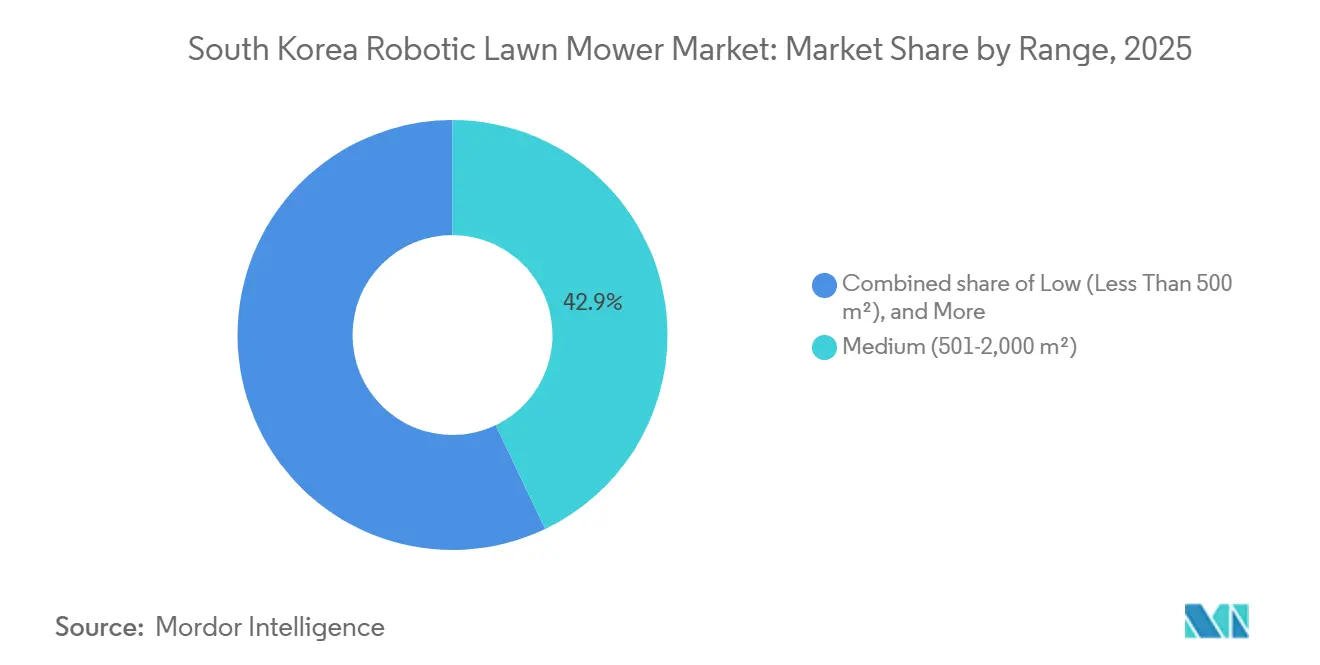
The medium (501-2,000 m²) range segment accounted for 42.9% of the South Korea robotic lawn mower market share in 2025. This range aligns with the lawn sizes of many suburban villa plots and detached homes in metropolitan peripheries, where users require sufficient coverage for private gardens without the higher capacity associated with large-area commercial equipment. Models in this range can therefore address a broad residential customer base while balancing coverage requirements with equipment cost and installation needs. The Low (Less Than 500 m²) segment serves more compact urban gardens and rooftop green spaces, limiting its addressable area but supporting demand in space-constrained residential settings. The broad fit with typical residential lawn sizes makes the Medium range the primary volume segment in South Korea.
The high (more than 2,000 m²) range segment is forecast to grow at a CAGR of 9.2% from 2026 to 2031, supported by increasing use of autonomous mowing across commercial properties and golf courses. Larger sites benefit more directly from automation because frequent mowing over extensive grounds can require substantial labor and equipment time. The Korea Golf Course Management Association published a 2025 course-management white paper addressing autonomous and precision turf practices, while Seowon Valley Country Club introduced an unmanned robotic mower on a South Korean golf fairway in 2025. Such deployments provide local examples of how autonomous equipment can be integrated into large-area turf management and may encourage other professional operators to evaluate similar solutions. This makes larger-area applications an important avenue for the market to expand beyond residential properties.



By Navigation Technology: Boundary-Wire Leads While Vision/Camera Records Faster Growth
The boundary-wire segment accounted for 64.8% of the South Korea robotic lawn mower market share in 2025, supported by its longer commercial presence, established dealer networks, and familiarity among residential users. These systems can provide reliable navigation on flat and regularly shaped lawns and generally require less advanced sensing technology, supporting their use among price-sensitive buyers. However, installation requires physical boundary wires to be laid around the mowing area, which can increase setup effort and make changes to the lawn layout more difficult. As wire-free technologies become easier to deploy, the established boundary-wire base is increasingly being challenged by systems that reduce installation requirements. Boundary-wire models therefore continue to provide the market’s existing technology base, but their relative share is likely to face pressure from newer navigation systems.
Vision/camera navigation is forecast to grow at a CAGR of 11.8% from 2026 to 2031 as improvements in AI-based perception and sensor integration expand the capabilities of wire-free robotic mowers. These platforms can combine AI cameras with RTK positioning and, in some cases, LiDAR sensing to identify lawn boundaries, obstacles, and changes in the operating environment without requiring buried wires. Husqvarna AB expanded its robotic lawn mower portfolio in 2026 with AI Vision technology for lawns ranging from 4,000 m² to 7,500 m², including the professional Automower 540 EPOS. GNSS/RTK-GPS systems also serve larger properties where precise positioning is important, while Radio Research Agency requirements for wireless equipment remain a compliance consideration for suppliers. The shift toward sensor-based, wire-free navigation is consequently broadening the range of properties that can adopt robotic mowing and supporting faster growth in vision/camera systems.
By End User: Residential Segment Leads While Commercial Segment Records Faster Growth
The residential segment accounted for 62.9% of the South Korea robotic lawn mower market share in 2025, supported by premium homeowner adoption and the larger number of private gardens compared with institutional properties. Demand is concentrated in the Seoul Capital Area, Gyeonggi Province, and higher-income suburban communities, where homeowners have greater capacity to invest in automated lawn-maintenance equipment. Low-noise operation, connected controls, and autonomous scheduling can further appeal to users seeking to reduce routine maintenance effort, provided their garden layouts are compatible with available systems. The residential segment therefore provides the market's primary customer base, particularly among households with suitable garden space and purchasing capacity.
The commercial segment is forecast to grow at a CAGR of 10.4% from 2026 to 2031 as golf courses, hotels, resorts, park authorities, and facilities-management companies increasingly assess robotic mowing based on labor productivity and operating costs. Spring Hills Country Club projected KRW 700 million (USD 500,000) in five-year maintenance savings from AI turf-management automation, illustrating the potential financial benefit for large managed properties. Fleet management, cloud diagnostics, and multi-mower coordination can further improve the practicality of deploying multiple autonomous units across commercial sites. Platforms such as Husqvarna AB EPOS, Kress Voyager, and Belrobotics Bigmow demonstrate how robotic mowing is extending beyond individual gardens into professional turf management. Commercial adoption is consequently creating a broader use case for robotic mowers, particularly where large grounds require frequent and consistent maintenance.
By Distribution Channel: Offline Channels Hold Share While Online Grows
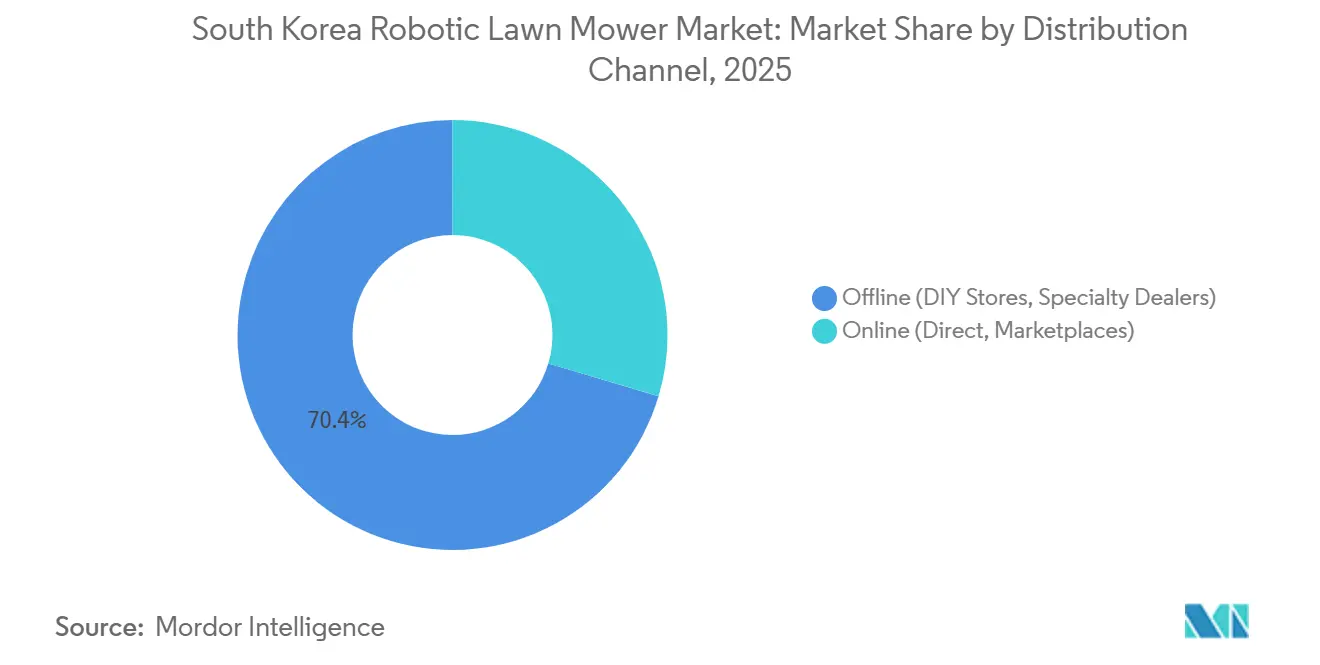
Offline channels (DIY Stores, Specialty Dealers) accounted for 70.4% of the South Korea robotic lawn mower market share in 2025. First-time buyers often require guidance on property mapping, installation, calibration, and seasonal maintenance, particularly when using boundary-wire or more complex navigation systems. Specialty dealers can provide these services alongside Korean-language product support, reducing the technical barriers associated with initial adoption. This service component gives offline channels an advantage for higher-involvement purchases, where buyers may prefer to assess equipment and receive installation assistance before committing to the product. Offline channels, therefore, remain central to first-time purchases, particularly for customers requiring installation and after-sales support.
Online channels (Direct, Marketplaces) are forecast to grow at a CAGR of 9.6% from 2026 to 2031 as improving product familiarity and wire-free navigation reduce the need for extensive dealer assistance. Direct-to-consumer websites and marketplaces such as Coupang and Naver Shopping provide digital-native brands with broader access to buyers and allow customers to compare coverage, navigation technology, and connectivity features before purchase. Shenzhen Mammotion Technologies Co., Ltd. has used direct online sales, app-guided self-installation, and mail-in service as part of its customer model, illustrating how manufacturers can reduce dependence on physical dealer networks. Existing robotic mower owners upgrading from boundary-wire systems may also require less onboarding, making online purchasing more practical. As self-installation becomes easier and consumers become more familiar with the technology, online channels can capture a growing share of robotic mower purchases in South Korea.
Geography Analysis
The Seoul Capital Area is the leading demand cluster in the South Korea robotic lawn mower market. It includes Seoul, Incheon, and the Gyeonggi Province ring. The region combines premium residential density, technology-oriented consumers, and a concentration of Gyeonggi golf courses. Dense urban development also increases the relevance of quiet, automated lawn maintenance for suitable private and commercial properties. The Seoul Capital Area therefore provides the market's strongest concentration of residential and premium-use demand.
Busan and the Southeast Region, Daejeon and the Central Region, and Gwangju and the Southwest Region are mid-tier demand clusters. Busan has premium homes and hotel-resort properties that suit commercial and high-end residential use. Daejeon has a technology-literate, higher-income population that can support early adoption following Seoul-based validation. Gwangju and the Southwest Region add demand from suburban households, sports facilities, parks, and regional golf venues.
Other parts of the country, including Daegu and Ulsan, Gangwon Province, Jeju, and areas of Chungcheong and Jeolla provinces outside the major clusters, offer additional opportunities for robotic mower adoption. These markets include resorts, pension-style lodging properties, golf courses, parks, religious compounds, and other sites with larger landscaped areas that can accommodate high-range robotic mowers. Labor availability is also a consideration in rural areas, with 86,633 participants in the 2025 seasonal-worker program allocated to agriculture. As dealer coverage, product awareness, and access to wire-free systems improve, these regional markets can gradually expand their contribution to overall demand. The wider regional market thus offers further scope for adoption as robotic mowing becomes more accessible and familiar to users outside the major urban centers.
Competitive Landscape
The South Korea robotic lawn mower market is moderately consolidated, with key suppliers including Husqvarna AB, Segway Inc, Shenzhen Mammotion Technologies Co., Ltd., Kress, and STIGA S.p.A. Husqvarna AB's position is supported by dealer services such as installation, mapping, seasonal recalibration, and local support. Segway Inc. benefits from the scale of its Navimow product line and international distribution. Service depth is becoming a major basis of competition. Brands with Korean-language training, software support, and tailored firmware can retain customers more effectively.
Shenzhen Mammotion Technologies Co., Ltd. and other Chinese suppliers compete through fast product updates and mid-range pricing. Kress introduced EyePilot in July 2026 with RTK, vision AI, and V-SLAM navigation that does not require a boundary wire or on-property antenna. Husqvarna AB introduced four Automower NERA models with integrated AI vision in October 2025. These developments indicate that established suppliers are expanding wire-free offerings while strengthening obstacle detection.
Commercial service models provide another competitive opportunity in the South Korea robotic lawn mower market. Robotics-as-a-Service can make equipment costs easier for commercial landscaping buyers to assess. Compact, quiet models also address villa and rooftop garden applications that many current products do not fully serve. Husqvarna AB's EPOS family provides a compliance reference for commercial and institutional purchasers. New entrants must also meet relevant wireless certification requirements before entering the market. Product performance, local support, and procurement readiness will shape competition alongside price.
South Korea Robotic Lawn Mower Industry Leaders
Husqvarna AB (Husqvarna Group)
Segway Inc. (Ninebot Ltd.)
Shenzhen Mammotion Technologies Co., Ltd.
Kress (Positec Group)
STIGA S.p.A. (3i Group plc)
- *Disclaimer: Major Players sorted in no particular order

Recent Industry Developments
- September 2026: Segway Navimow unveiled the Navimow H5 Pro at IFA 2026, featuring the EdgeMaestro extendable robotic arm for zero-edge mowing. The launch addresses grass left near borders and obstacles, strengthening the brand's offer for residential buyers seeking full-coverage automation.
- September 2026: Spring Hills Country Club in Goyang deployed AI self-driving topdressing robots and AI ball-mark repair robots developed by X-Up. It reported 92% divot-repair accuracy and projected five-year maintenance savings of KRW 700 million (USD 500,000).
- July 2025: Seowon Valley Country Club in Paju introduced South Korea's first unmanned robotic mower on a golf course fairway. The venue hosts KPGA and KLPGA Tour events, and the deployment demonstrated autonomous turf maintenance at a championship-grade site.


South Korea Robotic Lawn Mower Market Report Scope
The market covers robotic lawn mowers used for autonomous grass cutting and lawn maintenance across residential and commercial applications in South Korea. It includes robotic mowing systems differentiated by their operating range, navigation technology, end user, and distribution channel.
The South Korea Robotic Lawn Mower Report is Segmented by Range (Low (Less Than 500 m²), Medium (501-2,000 m²), and High (More Than 2,000 m²)), by Navigation Technology (Boundary-Wire, Vision/Camera, and GNSS/RTK-GPS), by End User (Residential and Commercial), and by Distribution Channel (Online (Direct, Marketplaces) and Offline (DIY Stores, Specialty Dealers)). The Market Forecasts are Provided in Terms of Value (USD).
| Low (Less Than 500 m²) |
| Medium (501-2,000 m²) |
| High (More Than 2,000 m²) |
| Boundary-Wire |
| Vision/Camera |
| GNSS/RTK-GPS |
| Residential |
| Commercial |
| Online (Direct, Marketplaces) |
| Offline (DIY Stores, Specialty Dealers) |
| By Range | Low (Less Than 500 m²) |
| Medium (501-2,000 m²) | |
| High (More Than 2,000 m²) | |
| By Navigation Technology | Boundary-Wire |
| Vision/Camera | |
| GNSS/RTK-GPS | |
| By End User | Residential |
| Commercial | |
| By Distribution Channel | Online (Direct, Marketplaces) |
| Offline (DIY Stores, Specialty Dealers) |


Key Questions Answered in the Report
What is the forecasted value of the South Korea robotic lawn mowers market?
The market is forecast to grow from USD 100.88 million in 2026 to USD 145.44 million by 2031, at a CAGR of 7.59% from 2026 to 2031.
Which robotic lawn mower range is growing fastest in South Korea?
The high (more than 2,000 m²) range segment is forecast to grow at a 9.2% CAGR through 2031, supported by commercial and golf-course demand.
What navigation technology is growing fastest in South Korea?
Vision/camera navigation is forecast to grow at an 11.8% CAGR through 2031 as wire-free systems reduce installation work.
Why are commercial segments adopting robotic lawn mowers?
Commercial segment is forecast to grow at a 10.4% CAGR, driven by labor savings, fleet management, and more predictable maintenance across golf courses, hotels, resorts, parks, and other facilities.
What limits the wider adoption of robotic lawn mowers in South Korea?
High upfront costs, difficult terrain, wet-season conditions, limited awareness, and RTK setup requirements can limit adoption. Dealer support and Korean-language setup assistance can help address these barriers.
Page last updated on:





