
South America Wireless Mesh Networking Market Size and Share
Market Overview
| Study Period | 2020 - 2031 |
|---|---|
| Forecast Data Period | 2026 - 2031 |
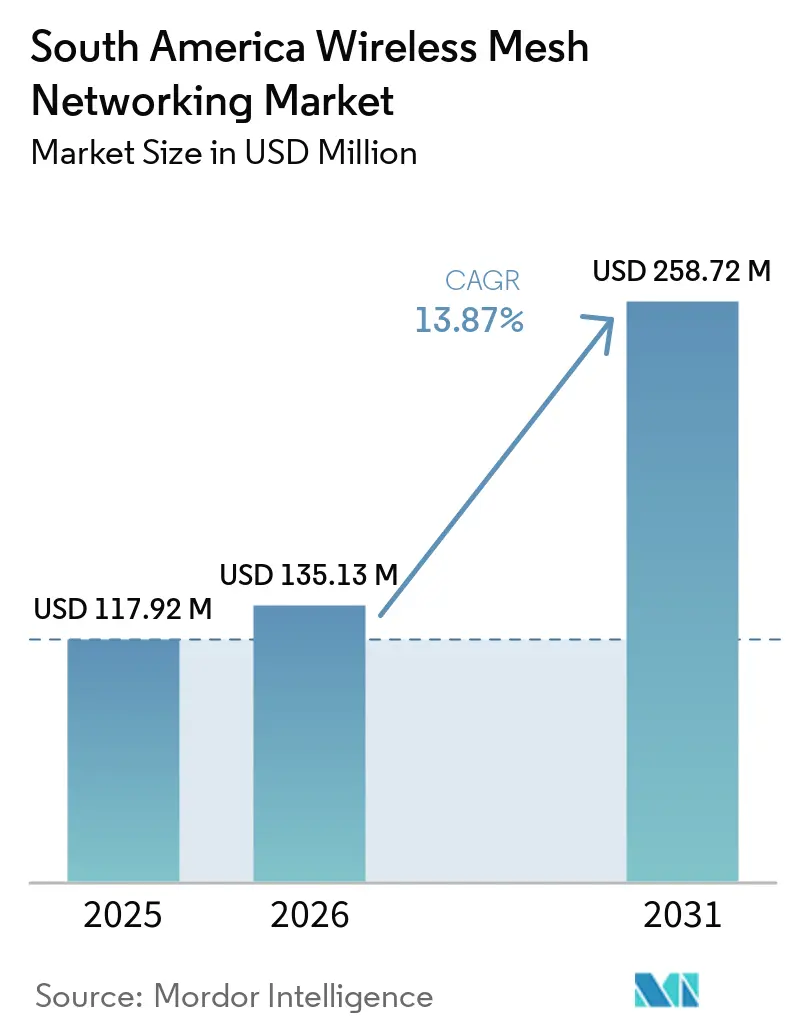
| Base Year Market Size (2025) | USD 117.92 Million |
| Market Size (2026) | USD 135.13 Million |
| Market Size (2031) | USD 258.72 Million |
| Growth Rate (2026 - 2031) | 13.87 % |
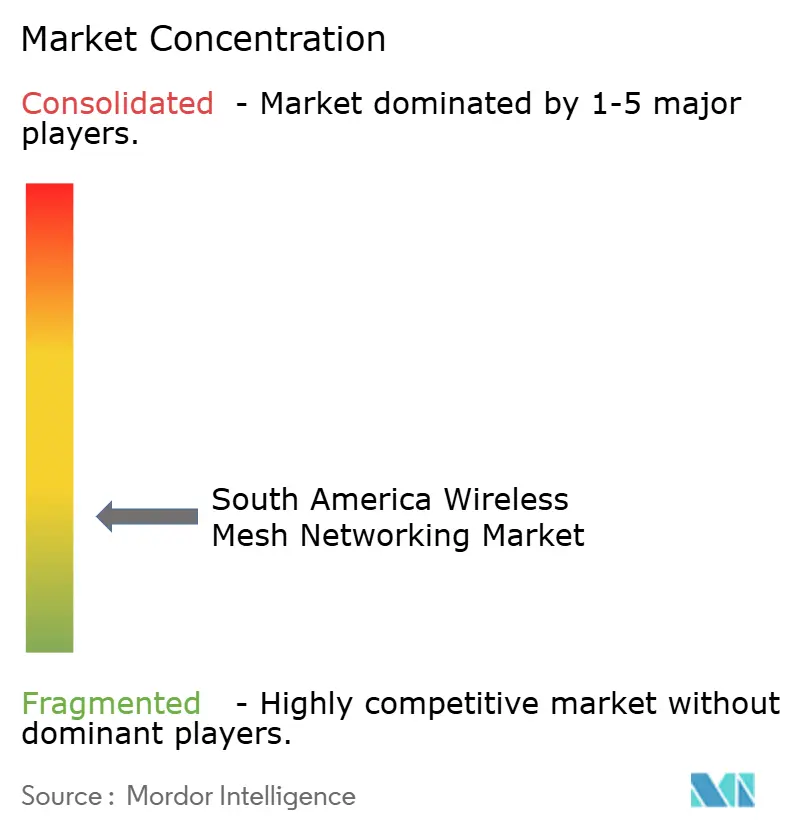
| Market Concentration | Low |
Major Players *Disclaimer: Major Players sorted in no particular order Image © Mordor Intelligence. Reuse requires attribution under CC BY 4.0. | |
South America Wireless Mesh Networking Market Analysis by Mordor Intelligence
The South America wireless mesh networking market size was valued at USD 117.92 million in 2025 and is estimated to reach USD 258.72 million by 2031, at a CAGR of 13.87% during the forecast period (2026-2031). The market is supported by difficult terrain, uneven broadband coverage, and operating sites that require dependable local connectivity. Utilities and municipalities are linking smart-grid and smart-city programs with longer procurement cycles for nodes, radios, and management platforms. Mining companies are also placing greater value on networks that can support mobile equipment, safety systems, and remote operations. The July 2026 ratification of Wi-SUN FAN as ISO/IEC/IEEE 32857:2026 reduces interoperability concerns in utility and municipal tenders. Vendors are therefore competing on certification, integration, local support, and equipment durability rather than on connectivity alone.
Key Report Takeaways
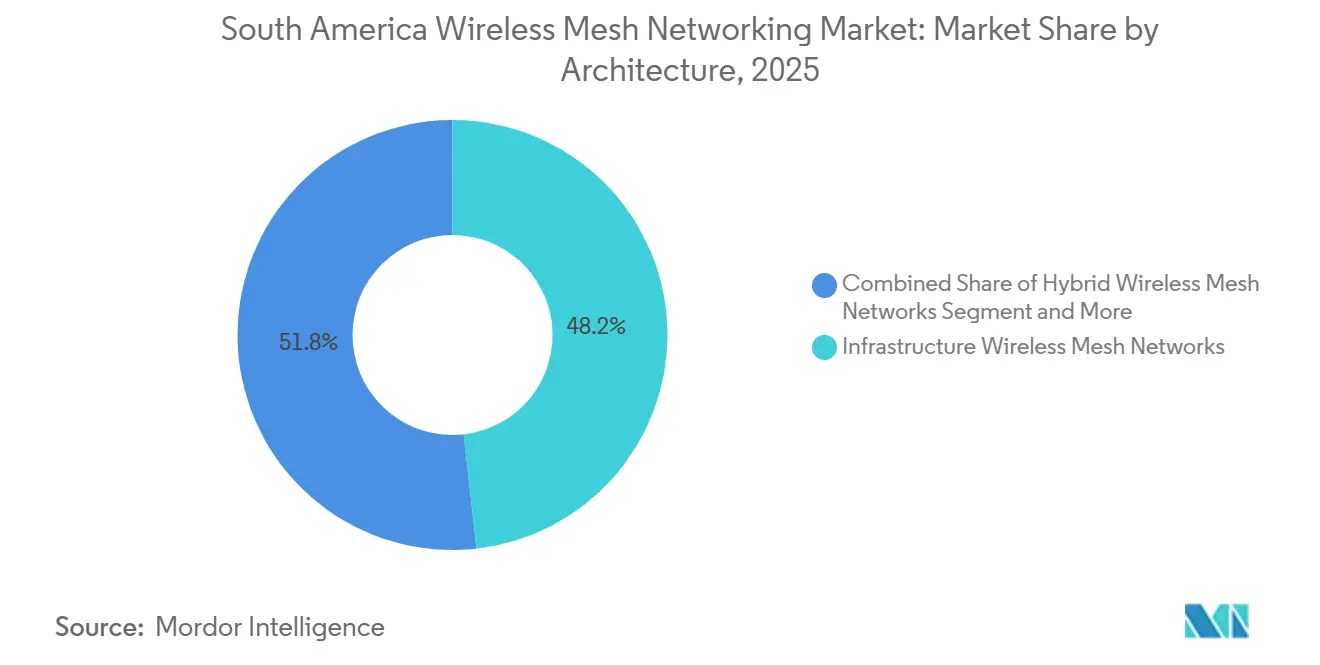
- By architecture, infrastructure wireless mesh networks held 48.22% of the South America wireless mesh networking market share in 2025, while hybrid wireless mesh networks are projected to expand at a 14.28% CAGR through 2031.
- By radio frequency, the 2.4 GHz band held 38.43% of the regional total in 2025, while the 5 GHz band is expected to expand at a 14.37% CAGR through 2031.
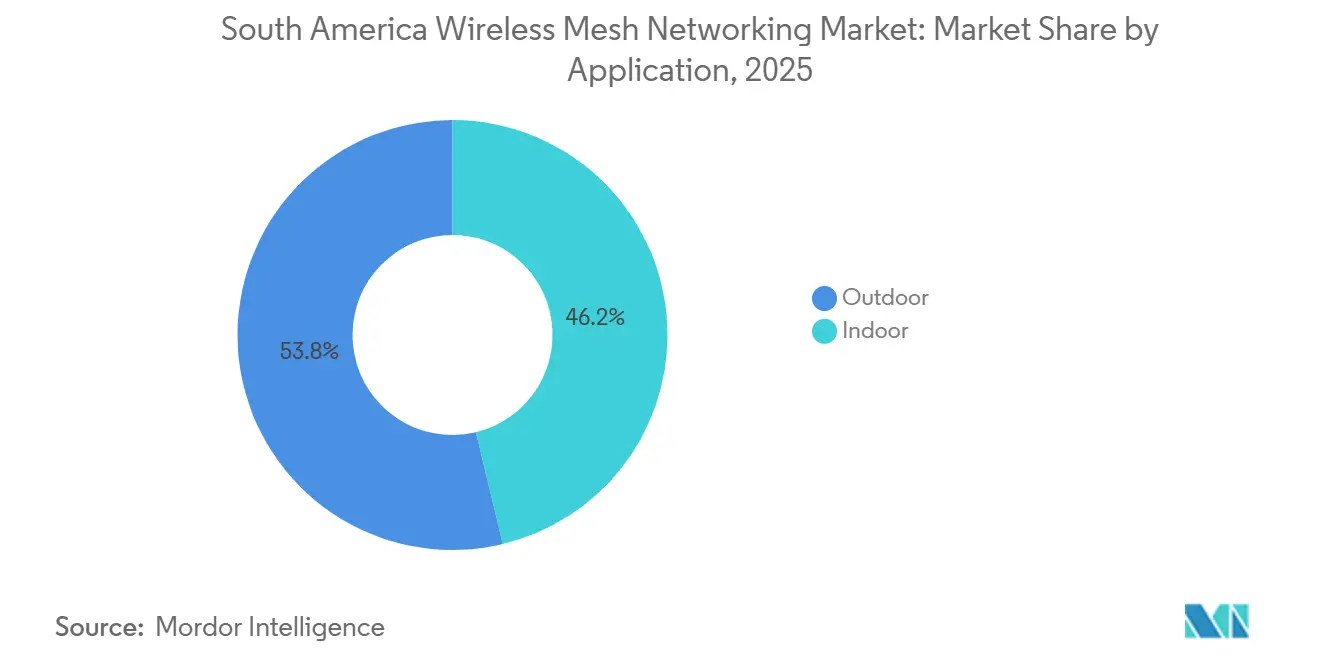
- By application, outdoor deployments accounted for 53.76% of the South America wireless mesh networking market size in 2025 and are projected to expand at a 14.82% CAGR through 2031.
- By end user, government held 20.14% of the regional total in 2025, while mining is expected to expand at a 14.72% CAGR through 2031.
- By geography, Brazil accounted for 52.56% of the regional total in 2025, while Chile is projected to expand at a 14.81% CAGR through 2031.
Note: Market size and forecast figures in this report are generated using Mordor Intelligence’s proprietary estimation framework, updated with the latest available data and insights as of January 2026.
South America Wireless Mesh Networking Market Trends and Insights
Drivers Impact Analysis*
| Driver | (~) % Impact on CAGR Forecast | Geographic Relevance | Impact Timeline |
|---|---|---|---|
| Expanding Smart-City and Smart-Grid Deployments | +3.5% | Brazil, Colombia, Chile, Peru, Argentina | Short term (≤ 2 years) |
| Growth of Industrial IoT and Remote Asset Monitoring | +2.8% | Chile, Peru, Brazil, Colombia | Medium term (2-4 years) |
| Demand for Resilient Connectivity in Remote and Challenging Terrain | +2.2% | Chile, Peru, Brazil, Colombia, Rest of South America | Long term (≥ 4 years) |
| Expansion of 5G, Broadband, and Edge-Connected Infrastructure | +1.8% | Brazil, Colombia, Chile, Argentina | Short term (≤ 2 years) |
| Brazil-Led Digital Infrastructure Modernization | +1.4% | Brazil, with spillover to Argentina and Uruguay | Medium term (2-4 years) |
| Multi-Protocol Mesh Integration for Utilities and Industrial Operations | +1.0% | Brazil, Chile, Colombia | Long term (≥ 4 years) |
| Source: Mordor Intelligence | |||
Expanding Smart-City and Smart-Grid Deployments
Smart-city and smart-grid programs are creating sustained purchasing activity for the South America wireless mesh networking market. SABESP entered a 14-year partnership with Vivo and IDEMIA in 2025 to deploy 4.4 million smart water meters in São Paulo. The project requires a field-area network that can manage millions of endpoint connections. Haixing has also deployed more than 1.3 million Wi-SUN smart meters across several Brazilian contract phases. These programs give suppliers clearer volume expectations and can support local service investments across the South America wireless mesh networking market. Wi-SUN FAN became ISO/IEC/IEEE 32857:2026 in July 2026, which gives buyers a common framework for multi-vendor procurement.[1]Wi-SUN Alliance, “Wi-SUN FAN Becomes First Wireless Mesh Network Standard Adopted by ISO/IEC,” Wi-SUN Alliance, wi-sun.org.
Growth of Industrial IoT and Remote Asset Monitoring
Industrial IoT and remote monitoring are increasing the demand for the South America wireless mesh networking market, especially at mine sites. Mining is the fastest-growing end-user category, with a projected CAGR of 14.72% through 2031. Rajant Kinetic Mesh BreadCrumb nodes used in Peruvian underground mining can support sub-10-millisecond handoffs for moving equipment. Wenco used a Rajant Kinetic Mesh network for a Chilean gold mine fleet-management installation. The deployment showed that a network can be introduced in weeks rather than months. Buyers are consequently assessing whether a supplier can connect teleoperation, fleet systems, and positioning tools within one operating environment.
Demand for Resilient Connectivity in Remote and Challenging Terrain
Remote terrain remains a basic demand factor for the South America wireless mesh networking market. Mining sites, energy corridors, river-basin infrastructure, and isolated communities often lack economical fixed-network alternatives. Rajant reported sustained mesh connectivity across 160 km of interconnected underground mine tunnels in Brazil during 2025. Taara announced more than 20 wireless optical mesh links in Rio de Janeiro, with each link designed to provide 20 Gbps over 20 km.[2]Taara, “Connecting Rio With the World’s First Wireless Optical Mesh Network,” Taara, taaraconnect.com. These conditions make redundancy and quick rerouting important operational requirements. The South America wireless mesh networking market can benefit where operators need connectivity beyond the reach of dense cellular or fiber networks.
Expansion of 5G, Broadband, and Edge-Connected Infrastructure
5G, broadband, and edge investments are creating adjoining opportunities for the South America wireless mesh networking market. Brazil's 5G access base has expanded significantly, driven by strong annual growth. Anatel's PERT seeks to expand standalone 5G coverage to a majority of Brazil's population in the coming years. The plan also seeks to extend fiber backhaul coverage across all municipalities.[3]Agência Nacional de Telecomunicações, “Spectrum and Equipment Certification Information,” Anatel, gov.br. Mesh systems can extend connectivity from these larger networks to industrial, rural, and temporary operating locations. This favors suppliers across the South America wireless mesh networking market that can integrate Wi-Fi, sub-GHz mesh, private cellular, and edge-management functions.
Restraints Impact Analysis*
| Restraint | (~) % Impact on CAGR Forecast | Geographic Relevance | Impact Timeline |
|---|---|---|---|
| High Initial Deployment and Integration Costs | -2.3% | Regional, strongest in Argentina, Peru, Rest of South America | Long term (≥ 4 years) |
| Cybersecurity, Privacy, and Device-Authentication Risks | -1.5% | Global, with SCADA exposure concentrated in Chile, Brazil, Peru | Medium term (2-4 years) |
| Fragmented Spectrum, Certification, and Interoperability Requirements | -1.0% | Pan-regional, Brazil, Chile, Colombia, Peru | Medium term (2-4 years) |
| Limited Local Technical Support in Remote Mining, Energy, and Rural Areas | -0.7% | Peru, Chile, Brazil, Rest of South America | Long term (≥ 4 years) |
| Source: Mordor Intelligence | |||
High Initial Deployment and Integration Costs
Initial deployment and integration costs limit some projects in the South America wireless mesh networking market. Industrial outdoor equipment needs rugged enclosures and may need ATEX or IECEx certification for mining. These specifications increase equipment costs before an operator gains benefits from lower downtime or improved telemetry. Foreign-exchange volatility can further delay hardware purchases in Argentina. Smaller municipalities may also lack funding for a full network rollout. Subscription and network-as-a-service offers can reduce the upfront capital burden, although adoption is progressing faster in Brazil.
Cybersecurity, Privacy, and Device-Authentication Risks
Cybersecurity risk is a significant restraint because mesh networks distribute traffic across multiple nodes. NIST listed CVE-2025-27558 for an IEEE 802.11 mesh vulnerability that could allow arbitrary frame injection into WPA2 and WPA3 mesh networks. Also, CVE-2025-38512 was disclosed in August 2025, which addressed A-MSDU attacks in mesh networks. These issues are material where the network carries supervisory control and data acquisition traffic. Different device types also bring separate firmware cycles and authentication practices. Operators are considering zero-trust approaches, but implementation remains uneven across mining and energy sites.
*Our forecasts treat driver/restraint impacts as directional, not additive. The impact forecasts reflect baseline growth, mix effects, and variable interactions.
Segment Analysis
By Architecture: Infrastructure Networks Retain a Large Base
Infrastructure wireless mesh networks held 48.22% of the regional total in 2025. Their position reflects widespread use of fixed-node backbones for utilities, public safety, municipal services, and campus networks. Fixed installations support predictable radio planning and established operating procedures. They also align with legacy supervisory control systems used by many utilities. Government and utility tenders often favor equipment with clear certification documentation. Brazil's established certification framework supports this preference for standardized fixed-network equipment. Client mesh systems remain useful for sensor, meter, lighting, and environmental-monitoring deployments. These systems generally suit locations where low data volumes and low power use matter most. The large installed base keeps infrastructure networks important across the South America wireless mesh networking market.
Hybrid wireless mesh networks are expected to expand at a 14.28% CAGR through 2031. Their value comes from combining fixed coverage with mobile client capability. A node can work as a client, access point, and repeater without manual changes. This is useful for open-pit mines, logistics hubs, and industrial parks with moving assets. Rajant's InstaMesh technology supports sub-10-millisecond handoffs across simultaneous paths. The capability supports equipment that moves through changing terrain and signal conditions. Hybrid designs can also support worker-tracking and safety applications in underground settings. Suppliers must still show that systems work with existing automation and location platforms. These requirements favor suppliers with integration capacity and strong industrial deployment experience.



By Radio Frequency: 5 GHz Gains in Outdoor Industrial Deployments
The 2.4 GHz band accounted for 38.43% of the regional total in 2025. It has a broad installed base in smart metering, municipal Wi-Fi, and legacy utility applications. The band remains suitable where long-range matters more than high throughput. Sub-1 GHz equipment also serves field-area networks that need range and building penetration. Wi-SUN FAN works with IEEE 802.15.4g and is used in utility-oriented deployments. The 4.9 GHz band has a specialized role in Brazilian public safety communications. Wi-SUN FAN's July 2026 standardization offers a clearer interoperability path for sub-1 GHz and 2.4 GHz utility networks. Urban Wi-Fi expansion can, however, increase interference in the 2.4 GHz band. Buyers are therefore balancing coverage needs with available spectrum and operational density.
The 5 GHz band is projected to expand at a 14.37% CAGR during 2026-2031. Outdoor industrial users require capacity as well as network reach. Existing spectrum authorizations make 5 GHz a practical near-term option in many deployments. Cisco introduced its Wireless 9177 Series in August 2026 with tri-band Wi-Fi 7, Ultra-Reliable Wireless Backhaul, and 6 GHz Automated Frequency Coordination. The release indicates vendor focus on outdoor mobility and industrial backhaul. Cambium reported significant global shipments of ePMP 4000 radios by a recent reporting period. It also reported substantial shipments of units operating in newly available spectrum bands across North America. South American buyers can use currently available spectrum bands while certification and coordination frameworks for newer bands develop. This progression will place greater importance on spectrum planning and equipment upgrade paths.
By Application: Outdoor Deployments Continue to Lead
Outdoor deployments held 53.76% of the regional total in 2025. This position reflects the location of major mines, power assets, pipelines, ports, and transport networks. These assets operate in exposed locations with limited supporting infrastructure. Outdoor nodes need weather protection, vibration tolerance, and reliable operation during grid interruptions. Industrial sites also need secure coverage across large areas. Mining specifications often seek dedicated backhaul capacity and separate client radios. The South America wireless mesh networking market size for outdoor systems is projected to expand at a 14.82% CAGR through 2031. That growth supports continued demand for rugged equipment and deployment services. Vendors with demonstrated performance in mining and utility sites are well placed to serve these requirements.
Indoor mesh networks support smart buildings, hospitals, hotels, schools, and manufacturing facilities. The main requirement is seamless user and device roaming rather than extreme weather protection. HPE Aruba Networking deployed cloud-managed, IoT-enabled wireless infrastructure at Nice Brazil's large factory in Limeira recently. The system supported production monitoring, research and development data collection, and device connectivity. Indoor networks can also support data-intensive industrial processes within controlled environments. Healthcare and education users increasingly need access controls for sensitive information. This adds a security requirement to network management and client roaming. Indoor suppliers therefore compete through software controls, system administration, and integration with building technologies. The indoor category remains relevant even though outdoor use cases have a larger regional base.
By End User: Government Provides Scale While Mining Accelerates
Government held 20.14% of the regional total in 2025. Public safety, emergency communications, and smart-city programs support this large base. These projects are often structured as multi-year contracts. They are also less exposed to short-term shifts in commercial demand. Public buyers need reliable equipment, security documentation, and local maintenance support. Smart cities, health care, transport and logistics, oil and gas, education, and hospitality make up the remaining end-user demand. Each group has distinct reliability thresholds and technical requirements. This variety limits the ability of one product configuration to meet every need. It also supports specialized supplier positions in the South America wireless mesh networking market.
Mining is projected to expand at a 14.72% CAGR through 2031. Chile and Peru are advancing autonomous and teleoperated mining programs that need fast and dependable links. Fleet management needs connectivity that can remain stable around heavy mobile equipment. Wirepas demonstrated interoperability between 40 devices from 18 partner companies in a single mesh network in March 2025. This approach is relevant to utility, energy, and oil and gas deployments with mixed sensor estates. Port automation and intercity freight tracking can also support transport and logistics demand. Neoenergia developed an IoT connectivity system using private LTE, public LTE, and satellite links. The program shows how utilities are combining several access technologies for continuity. End users increasingly expect mesh systems to fit within broader multi-access connectivity designs.
Geography Analysis
Brazil held 52.56% of the South America wireless mesh networking market share in 2025. Utility metering programs, large industrial areas, and digital infrastructure investment support its lead. Brazil's Ministry of Communications allocated BRL 1.4 billion, USD 246 million, for connectivity in 767,000 homes across 552 municipalities in 17 states. The investment includes fiber, 4G, and 5G systems. Anatel's PERT plan is widening the backhaul base for mesh integration.
Chile is projected to expand at a 14.81% CAGR through 2031, the fastest pace in the region. Copper mine digitization creates concentrated demand across the Atacama and Andean mining belts. Its short-range device compliance process became digital under Resolution Exenta No. 737/2025. The requirements became mandatory in February 2026 and cover Wi-Fi, Zigbee, and other mesh-capable equipment. Peru also has mining-led demand and municipal connectivity requirements.
Colombia and Argentina represent the next group of opportunities for the South America wireless mesh networking market. Colombia's 5G coverage can be extended in industrial zones, logistics parks, and health care campuses. Argentina's energy and agricultural corridors still need connectivity for pipeline monitoring and precision agriculture. Bolivia's mining activity, Ecuador's oil infrastructure, and Uruguay's smart-city programs create smaller opportunities. Success depends on certification planning, language support, and remote-site maintenance.
Competitive Landscape
The South America wireless mesh networking market is moderately fragmented because suppliers address distinct technical and end-user requirements. Motorola Solutions, Cisco Systems, and Hewlett Packard Enterprise compete in enterprise and government procurement with cloud-managed platforms, broad channels, and compliance documentation. Cisco introduced the Wireless 9177 Series in August 2026 for industrial sites, ports, transport networks, and campuses. The equipment combines Wi-Fi 7, tri-band connectivity, and Ultra-Reliable Wireless Backhaul. HPE expanded Aruba Networking Central with virtual private cloud and on-premises deployment options.
Industrial mesh specialists retain distinct positions in mining. Rajant offers IEC 60079-compliant BreadCrumb nodes and InstaMesh software for rugged settings. Radioenge Telecomunicações Ltda. Samtech S.A. competes through local certification, knowledge, and regional technical support. Cambium launched its cnMaestro MarketApps Hub in August 2026, allowing third parties to add network-management functions without replacing hardware. These moves support specialized hardware and adaptable management software.
Digi International and Silicon Labs announced a Wi-SUN end-to-end solution partnership in September 2025. The offer uses IEEE 802.15.4g and can connect with existing utility Wi-SUN networks through Cisco OpenCSMP. Wirepas offers decentralized mesh that can scale to large endpoint volumes without conventional fixed gateways. No provider has a decisive position across regional verticals. Competition remains based on interoperability, certification, ruggedization, and post-deployment support.
South America Wireless Mesh Networking Industry Leaders
Motorola Solutions, Inc.
ABB Ltd.
Cisco Systems, Inc.
Google LLC
Qualcomm Incorporated
- *Disclaimer: Major Players sorted in no particular order

Recent Industry Developments
- August 2026: Cambium Networks announced its ePMP 4000 Series surpassed 220,000 radios shipped globally, including more than 50,000 6 GHz units in North America, and released ePMP Software 5.12, enabling subscriber modules to convert to access points via a USD 99 software license, expanding rural coverage options at lower capital expenditure, with direct applicability for South American fixed wireless extension deployments.
- August 2026: Cisco introduced the Wireless 9177 Series, a tri-band Wi-Fi 7 outdoor access point family integrating Ultra-Reliable Wireless Backhaul and Automated Frequency Coordination for the 6 GHz band, targeting industrial sites, ports, transport networks, and campuses where fiber backhaul is impractical. The series supports 10 Gbps multigigabit Ethernet and sub-10-millisecond handoffs, directly competing in the outdoor industrial mesh segment prioritized by South America's mining and energy sectors.
- July 2026: Cambium Networks launched the X7-56X high-density Wi-Fi 7 access point supporting up to 1,280 clients per unit and 17.9 Gbps aggregate wireless capacity, targeting large public venues and educational campuses, with software-definable tri-band architecture accelerating 6 GHz migration for South American enterprise buyers already running Cambium infrastructure.
- July 2026: The Wi-SUN Alliance announced that its Field Area Network specification was ratified as ISO/IEC/IEEE 32857:2026, the first wireless mesh networking standard adopted by ISO/IEC, reducing procurement risk for South American utilities and municipalities evaluating multi-vendor Wi-SUN mesh deployments for smart metering and smart-city field-area networks.


South America Wireless Mesh Networking Market Report Scope
South America Wireless Mesh Networking Market refers to the sale and deployment of self-organizing, multi-hop wireless networks in which each node can relay data for other nodes, creating redundant paths without a single point of failure. It includes indoor and outdoor mesh routers, access points, gateways, industrial mesh radios, and management software for enterprise, municipal, and industrial use.
The South America Wireless Mesh Networking Market Report is Segmented by Architecture (Infrastructure Wireless Mesh Networks, Hybrid Wireless Mesh Networks, and Client Wireless Mesh Networks), Radio Frequency (Sub-1 GHz, 2.4 GHz, 4.9 GHz, and 5 GHz), Application (Indoor, and Outdoor), End-User (Government, Smart Cities, Healthcare, Transportation, Oil and Gas, Mining, Education, and Hospitality), and Geography (Brazil, Argentina, Chile, Colombia, and Peru). The Market Forecasts are Provided in Terms of Value (USD).
| Infrastructure Wireless Mesh Networks |
| Hybrid Wireless Mesh Networks |
| Client Wireless Mesh Networks |
| Sub-1 GHz Band |
| 2.4 GHz Band |
| 4.9 GHz Band |
| 5 GHz Band |
| Indoor |
| Outdoor |
| Government |
| Smart Cities and Smart Warehouses |
| Healthcare |
| Transportation and Logistics |
| Oil and Gas |
| Mining |
| Education |
| Hospitality |
| Brazil |
| Argentina |
| Chile |
| Colombia |
| Peru |
| Rest of South America |
| By Architecture | Infrastructure Wireless Mesh Networks |
| Hybrid Wireless Mesh Networks | |
| Client Wireless Mesh Networks | |
| By Radio Frequency | Sub-1 GHz Band |
| 2.4 GHz Band | |
| 4.9 GHz Band | |
| 5 GHz Band | |
| By Application | Indoor |
| Outdoor | |
| By End-User | Government |
| Smart Cities and Smart Warehouses | |
| Healthcare | |
| Transportation and Logistics | |
| Oil and Gas | |
| Mining | |
| Education | |
| Hospitality | |
| By Geography | Brazil |
| Argentina | |
| Chile | |
| Colombia | |
| Peru | |
| Rest of South America |


Key Questions Answered in the Report
What is the South America wireless mesh networking market size?
The regional value was USD 117.92 million in 2025 and is forecast to reach USD 258.72 million by 2031 at a 13.87% CAGR.
Which architecture is expanding fastest in South America?
Hybrid wireless mesh networks are projected to expand at a 14.28% CAGR through 2031 because they support both fixed coverage and mobile equipment.
Why are outdoor wireless mesh systems important in South America?
Outdoor deployments held 53.76% in 2025 because mines, grids, pipelines, ports, and transport assets often operate in exposed, remote locations.
Which country leads regional wireless mesh networking demand?
Brazil held 52.56% in 2025, supported by utility metering programs, industrial activity, and major digital infrastructure investment.
Which country is projected to expand fastest through 2031?
Chile is projected to expand at a 14.81% CAGR, supported by mining digitization and a digital compliance process for short-range devices.
What is limiting wireless mesh deployment in the region?
High initial deployment costs, cybersecurity issues, varied certification requirements, and limited local support in remote locations can slow procurement.
Page last updated on:





