
Market Overview
| Study Period | 2020 - 2031 |
|---|---|
| Forecast Data Period | 2026 - 2031 |
| Base Year Market Size (2025) | USD 484.94 Million |
| Market Size (2026) | USD 536.64 Million |
| Market Size (2031) | USD 857.75 Million |
| Growth Rate (2026 - 2031) | 9.83 % |
| Market Concentration | Medium |
Major Players *Disclaimer: Major Players sorted in no particular order Image © Mordor Intelligence. Reuse requires attribution under CC BY 4.0. | |
South America Vibration Sensors Market Analysis by Mordor Intelligence
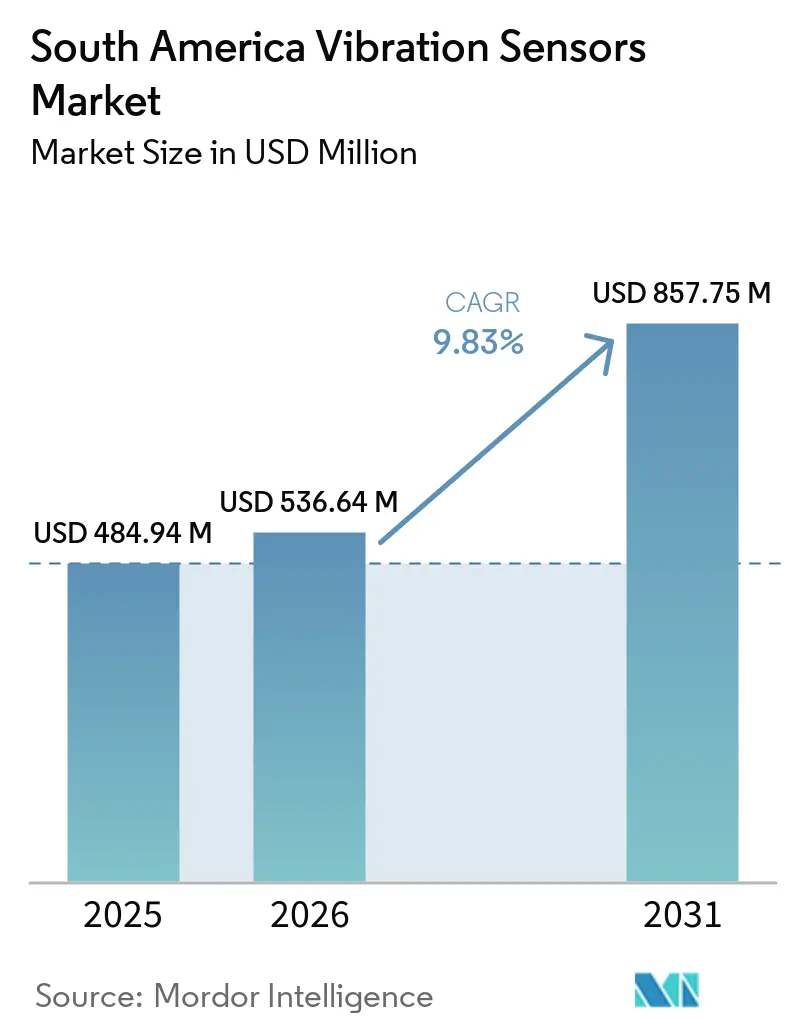
The South America Vibration Sensors Market size was valued at USD 484.94 million in 2025 and estimated to grow from USD 536.64 million in 2026 to reach USD 857.75 million by 2031, at a CAGR of 9.83% during the forecast period (2026-2031). Industrial modernization, offshore energy activity, and wider use of condition-based maintenance support demand across the region. Mining operators are integrating vibration data into maintenance systems to reduce unplanned shutdowns of critical equipment, particularly conveyors, mills, pumps, and other assets that can disrupt a processing chain when they fail. Offshore developments in Brazil require continuous monitoring of rotating equipment, subsea assets, and structural systems, with inspections and repairs that may require specialized access and planned operating windows. Wireless MEMS devices also make monitoring more practical at remote mines and energy facilities where wired installations are difficult, costly, or unsuitable for dispersed equipment. These factors give the South America Vibration Sensors Market a broader base of demand across industrial assets, rather than dependence on a single application.
Key Report Takeaways
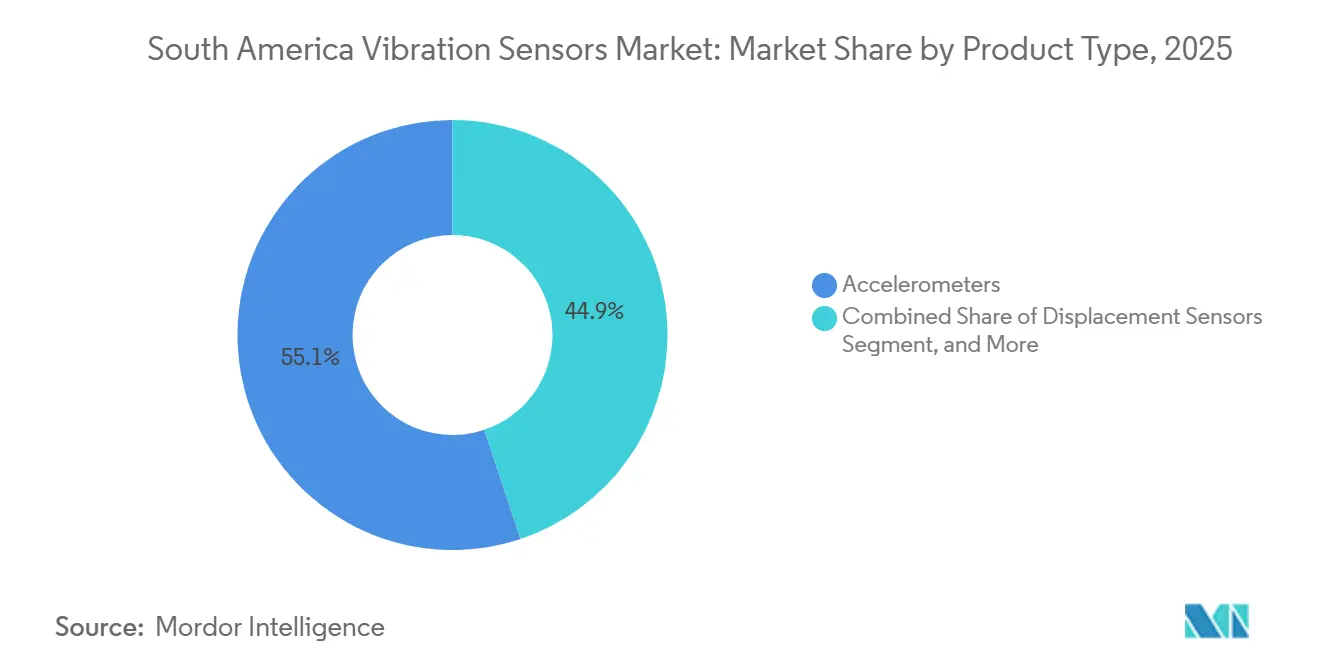
- By product type, accelerometers held 55.14% of the South America Vibration Sensors Market share in 2025, while vibration-grade gyroscopes are projected to expand at an 11.39% CAGR through 2031.
- By technology, piezoelectric sensors accounted for 47.12% of the South America Vibration Sensors Market revenue in 2025, while MEMS technology is projected to grow at a 10.87% CAGR through 2031.
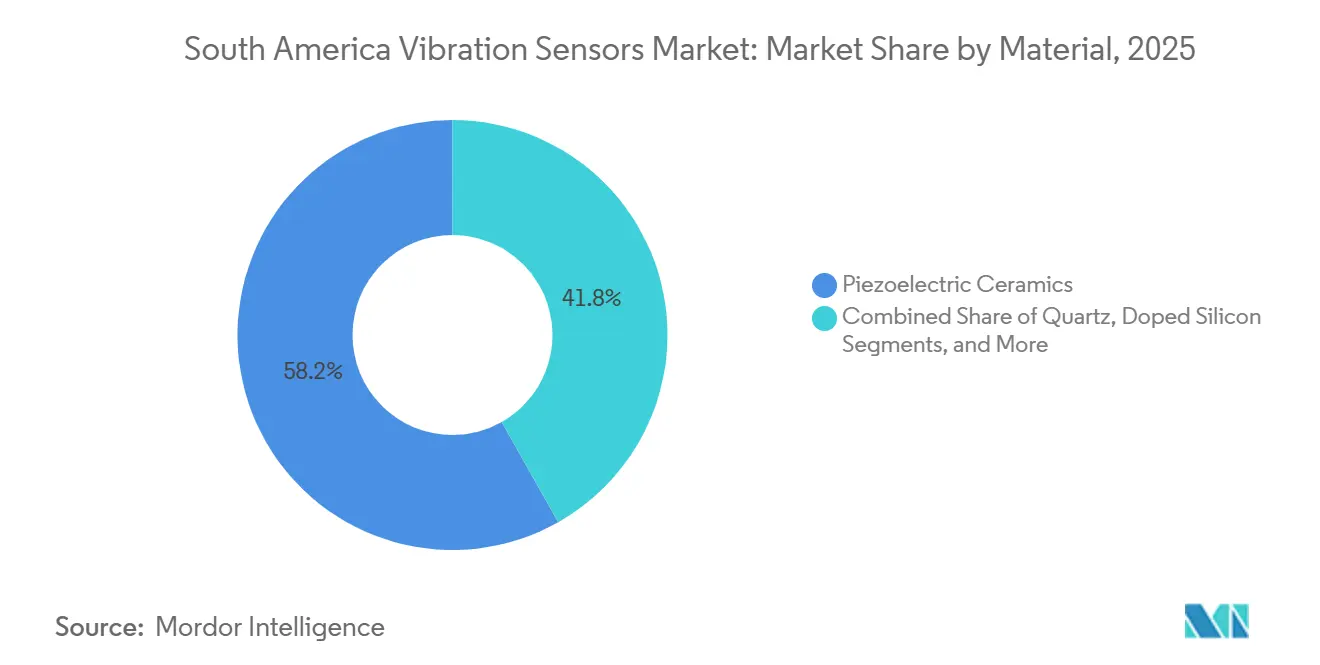
- By material, piezoelectric ceramics held 58.19% of the South America Vibration Sensors Market share in 2025, while doped silicon is projected to record an 11.87% CAGR through 2031.
- By end-use industry, industrial manufacturing held 23.72% of the South America Vibration Sensors Market share in 2025, while oil and gas is projected to expand at an 11.06% CAGR through 2031.
- By geography, Brazil accounted for 45.11% share in 2025, while Chile is projected to grow at an 11.22% CAGR through 2031.
Note: Market size and forecast figures in this report are generated using Mordor Intelligence’s proprietary estimation framework, updated with the latest available data and insights as of January 2026.
Market Trends and Insights
Drivers Impact Analysis of South America Vibration Sensors Market*
| Driver | (~) % Impact on CAGR Forecast | Geographic Relevance | Impact Timeline |
|---|---|---|---|
| Predictive Maintenance in Mining and Metals | +2.8% | South America-wide, strongest in Chile and Brazil mining corridors | Medium term (2-4 years) |
| Offshore Oil and Gas Production in Brazil | +2.5% | Brazil pre-salt offshore, with effects in Colombia and Argentina | Long term (≥ 4 years) |
| Industrial Modernization and Industry 4.0 Adoption | +1.9% | Brazil and Argentina industrial hubs, with early gains in Bogotá and Montevideo | Medium term (2-4 years) |
| Wireless MEMS Monitoring at Remote Assets | +1.4% | Chile, Brazil, and Peru remote mining and energy sites | Medium term (2-4 years) |
| Wind and Hydropower Equipment Monitoring | +0.9% | Brazil, Chile, Colombia, and Argentina renewable power corridors | Long term (≥ 4 years) |
| Retrofit Demand From Aging Rotating Machinery | +0.7% | Brazil and Argentina legacy industrial zones | Short term (≤ 2 years) |
| Source: Mordor Intelligence | |||
Expansion of Predictive Maintenance in Mining and Metals
The South America vibration sensors market benefits as mining companies treat equipment monitoring as part of operating continuity. Large mines depend on conveyors, mills, pumps, and crushers, where an unplanned failure can interrupt a single production process, delay downstream activities, and require workers to inspect equipment in difficult operating areas. Codelco reported that sensor and analytics work at El Teniente avoided potential losses exceeding USD 11 million and eliminated manual tasks related to rotating machinery. Vale used 467 connected loggers across 7 mine dams, showing that monitoring programs can cover infrastructure as well as individual machines and can bring information from remote locations into a common operational view. ISO 17359:2018 and the ISO 13373 series provide common condition-monitoring frameworks that influence equipment specifications, equipment selection, and the way maintenance data is reviewed. This wider use of formal maintenance methods supports repeat sensor purchases, integration services, and long-term diagnostics work in the South America vibration sensors market.
Offshore Oil and Gas Production Growth in Brazil
Brazil's pre-salt projects create demand for vibration sensors that can work in high-value and difficult operating environments. Petrobras and its partners committed USD 450 million to seismic monitoring at the Mero field, using ocean-bottom nodes designed for deepwater use. The Mero project involved sensor units at depths of nearly 2,000 meters during the first qualification phase in 2026. Offshore platforms also require monitoring of pumps, compressors, turbines, risers, and other assets, where inspection access may involve offshore logistics, production scheduling, safety controls, and careful coordination between operations and maintenance teams. Each additional floating production unit can therefore create several years of demand for sensing hardware, data collection systems, spare parts, and maintenance support. This long project cycle helps the South America vibration sensors market remain active even when commodity prices change in the short term.
Industrial Modernization and Industry 4.0 Adoption
Industrial modernization expands the number of assets that can be connected to sensor-based maintenance programs. Brazil's Nova Indústria Brasil program identified sensors and the Internet of Things as enabling technologies within its Industry 4.0 agenda.[1] The U.S. Department of Commerce reported that 50% of medium- and large-sized industrial companies in Brazil used sensor-based process control. The same source noted that fewer than 7% of industrial companies had adopted 10 or more advanced manufacturing technologies. This gap leaves room for plants to add vibration monitoring as they digitize maintenance, production, quality, and plant-control workflows, rather than treating sensor deployment as a separate activity. The South America vibration sensors market is therefore supported by both new automation projects and upgrades to equipment already in service, especially where plants need better evidence for maintenance planning.
Deployment of Wireless MEMS Monitoring in Remote Assets
Wireless MEMS systems reduce the installation burden at high-altitude mines, isolated energy facilities, and dispersed industrial sites. A 2025 IEEE validation study found that triaxial MEMS accelerometers at 4 kHz achieved at least 99% fault-classification accuracy in the tested system. The study reported 100% sensitivity and specificity for its support vector machine model, compared with 98.6% for the piezoelectric reference system. Brazilian suppliers have introduced LoRa-connected vibration and temperature devices for industrial monitoring, including products suited to remote deployment where long cable runs and regular battery replacement are practical concerns. Local processing can also help sites manage limited network availability, intermittent data transfer, and data-residency requirements. These capabilities let the South America vibration sensors market reach secondary equipment that could not justify traditional wired monitoring or frequent manual inspection.
Restraints Impact Analysis of South America Vibration Sensors Market*
| Restraint | (~) % Impact on CAGR Forecast | Geographic Relevance | Impact Timeline |
|---|---|---|---|
| Import Dependence and Foreign-Exchange Exposure | -1.4% | South America-wide, most acute in Argentina and Brazil | Medium term (2-4 years) |
| Shortage of Vibration Diagnostics Specialists | -0.9% | South America-wide, strongest in Rest of South America | Long term (≥ 4 years) |
| Connectivity and Data-Sovereignty Limits at Remote Sites | -0.6% | Chile and Peru mining highlands, and Brazilian Amazon industrial sites | Medium term (2-4 years) |
| Fragmented Procurement and Long Qualification Cycles | -0.5% | South America-wide, most pronounced in Brazil and Argentina | Short term (≤ 2 years) |
| Source: Mordor Intelligence | |||
High Import Dependence and Foreign-Exchange Exposure
The South America vibration sensors market relies heavily on imported precision hardware from North American and European suppliers. Changes in the Argentine peso and Brazilian real can alter local purchasing power, disrupt approved budgets, delay procurement decisions, and cause the final cost of an imported system to differ from the cost considered at the time of project approval. Import tariffs on electronic components and measurement instruments also raise the delivered cost of advanced equipment in Brazil. These costs can weaken the financial case for multi-year replacement plans, even when a monitoring project has clear operational value and an established maintenance need. Local integration services can help users configure systems, source compatible parts, provide support, and reduce the work required during installation. However, many precision transducer elements remain imported, so foreign-exchange exposure continues to affect the South America vibration sensors market.
Shortage of Vibration Diagnostics Specialists
Sensor deployment creates value only when personnel can interpret the resulting data and act on it. A 2025 study at a Chilean mining company found that vibration analysis could be applied to only 42 of 290 reviewed pieces of equipment due to certification and interpretation limitations. This shortage can limit the number of assets that receive active diagnostic attention and the speed of a response when a fault pattern appears, particularly when maintenance teams support several sites. It can also lead teams to collect data without building effective maintenance decisions around it, reducing confidence in a monitoring program. Training and certification take time, which means the availability of skills may lag behind equipment deployment as monitoring programs move beyond pilot projects and become part of normal maintenance routines. Vendors that provide managed diagnostics or embedded analysis can reduce this constraint for customers in the South America vibration sensors market.
*Our forecasts treat driver/restraint impacts as directional, not additive. The impact forecasts reflect baseline growth, mix effects, and variable interactions.
South America Vibration Sensors Market Segment Analysis
By Product Type:
Accelerometers Support Broad Equipment DiagnosticsAccelerometers accounted for 55.14% of the South America vibration sensor market share in 2025. They detect bearing defects, shaft imbalance, structural resonance, and flow-induced vibration across mining, offshore, and manufacturing equipment. Their installed base has created established alarm thresholds, calibration practices, and maintenance workflows, which make replacement and expansion simpler for end users. Velocity sensors remain useful on older rotating equipment, while displacement sensors serve shaft-gap monitoring on turbines and compressors.
Vibration-grade gyroscopes are projected to expand at an 11.39% CAGR through 2031. They support directional drilling automation and provide angular vibration data that linear accelerometers do not capture. The Society of Petroleum Engineers documented real-time monitoring for casing drilling, which is relevant to Argentina's Vaca Muerta formation. PCB Piezotronics released the HV356A03 in January 2026 for direct-contact operation up to 2,000 VDC, while Kistler's 0.9-gram KiVibe Miniature device was targeted for structural dynamics testing.[2] These developments support accelerometer leadership while specialized devices expand in high-value applications.

By Technology:
Piezoelectric Systems Lead While MEMS Expands CoveragePiezoelectric technology accounted for 47.12% of regional revenue in 2025. It offers high-frequency sensitivity and has a recognized record in offshore, chemical, and heavy industrial environments. Charge-output configurations can work with vibration analyzers and protection systems already installed at many sites. Piezoresistive, capacitive, and strain-gauge technologies are used in lower-frequency, quasi-static applications, including structural monitoring of dams, bridges, and wind turbine towers.
MEMS technology is projected to grow at a 10.87% CAGR through 2031. Lower unit costs allow wireless triaxial nodes to be installed where cabled systems were not economical. Tebe Sensors offers vibration and temperature monitoring products for industrial applications, and IEEE research found that the tested MEMS nodes matched or exceeded the performance of a reference piezoelectric system in fault classification. Sinop Energia used strain gauges and proximity transducers to monitor runner components at the UHE Sinop hydroelectric plant. Piezoelectric devices are likely to retain critical precision applications, while MEMS expands coverage across less-monitored equipment.
By Material:
Piezoelectric Ceramics Retain a Strong Installed BasePiezoelectric ceramics held 58.19% of the material segment in 2025. Their use reflects stable performance in the thermal and chemical conditions found in offshore and smelting operations. Suppliers and end users also have extensive experience with their specifications and operating behavior, reducing the need for recertification when equipment is replaced. Quartz meets narrower requirements in aerospace, defense, and laboratory measurement, while other materials include polymer-based films and emerging composites for smaller industrial applications.
Doped silicon is projected to register an 11.87% CAGR through 2031. It supports the growing use of MEMS accelerometers at remote mining and energy assets. Doped silicon can integrate sensing elements, amplifiers, and analog-to-digital conversion on a single die, reducing component count and assembly costs. Validated MEMS results show that lower-cost sensing elements can still support predictive fault classification. This material shift can support temporary monitoring campaigns before planned shutdowns at aging industrial sites.
By End-Use Industry:
Industrial Manufacturing Leads While Oil and Gas Grows FasterIndustrial manufacturing held 23.72% of regional revenue in 2025. Brazil's manufacturing base includes food processing, petrochemicals, metals, and automotive production, all of which use motors, pumps, compressors, and gearboxes. Many of these assets do not yet have continuous vibration monitoring. Power generation also creates steady demand because generating equipment runs under continuous duty, and CPFL Energia's hydroelectric portfolio used more than 1,800 auscultation instruments in a machine-learning-based monitoring platform.
Oil and gas are projected to expand at an 11.06% CAGR through 2031. Brazil's pre-salt developments and Argentina's Vaca Muerta activity support demand for real-time equipment monitoring. SPE guidance indicates that sensor-informed retrofits can reduce vibration amplitude at critical fatigue locations by 50%- 80%. Baker Hughes deployed its Cordant Asset Health platform at Acelen's refinery site in Brazil and planned a 2026 machine-health expansion. Healthcare, aerospace, defense, and consumer wearables remain smaller applications with demand tied to broader local investment.
Geography Analysis
Brazil Vibration Sensors Market
Brazil held 45.11% of regional revenue in 2025. Its position reflects the scale and diversity of offshore energy, manufacturing, hydropower, and other industrial assets that require regular equipment inspection. The Mero field seismic program committed USD 450 million to ocean-bottom monitoring technology, indicating the technical standards expected for large offshore projects. CESI completed an Itaipu Dam upgrade in January 2026 with 59 MEMS IPI inclinometric sensors and 25 extensometers, while Omexom's Amador Aguiar I and II modernization included more than 1,300 instruments with IO-Link connectivity. These programs show that Brazil has demand from both new offshore assets and the modernization of established power infrastructure.
Chile Vibration Sensors Market
Chile is projected to grow at an 11.22% CAGR through 2031, the fastest rate in the South America vibration sensors market. Copper and lithium mining drive a stronger focus on predictive maintenance because equipment availability directly affects processing capacity and production schedules. Codelco's work at El Teniente demonstrated the financial value of sensor-led predictive analytics for concentrator operations. Wireless systems are increasingly well-suited to mining equipment because they reduce cable requirements across large, remote sites and enable more assets to be monitored from a central maintenance function. Liebherr supplied remote monitoring for SQM's PR 776 G8 mining fleet, indicating that original equipment manufacturers can add monitoring through equipment contracts.
South America Vibration Sensors Market
Argentina's Vaca Muerta formation is a key area for drilling and production monitoring, while Colombia offers potential in oil gathering, midstream assets, and manufacturing digitalization. SPE research on real-time casing-drilling monitoring supports the relevance of vibration data in these operations. Peru and Bolivia add mining-related demand, although projects are often less standardized than in Brazil and Chile. A central Peruvian concentrator study applied ISO 10816-3 thresholds and fast Fourier transform analysis to 42 critical equipment items.[3] Vendors that combine equipment with diagnostic support can serve these project-based markets more effectively.
Competitive Landscape
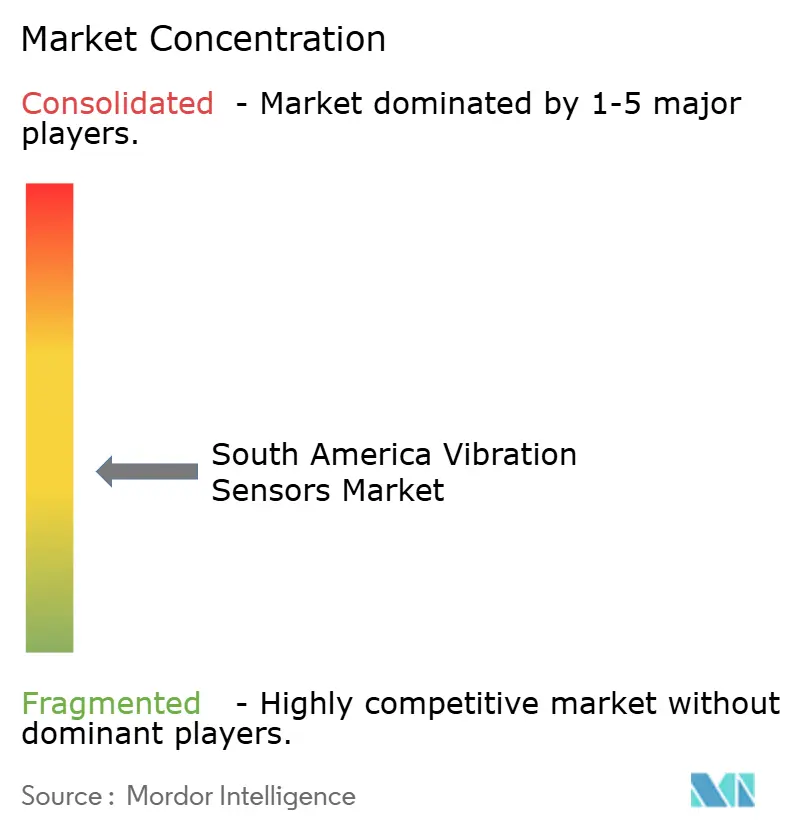
The South America vibration sensors market is moderately fragmented. SKF AB, PCB Piezotronics, Kistler Instrumente AG, and Meggitt Sensing Systems compete with specialized providers including Hansford Sensors, Wilcoxon Sensing Technologies, Sensoteq, and Adash. Suppliers use direct sales, distributors, and technical service partnerships because customer requirements vary by country, equipment type, certification needs, and installed maintenance practices. Offshore energy and power projects often favor companies with strong certification records and established equipment relationships. SKF agreed to acquire G-Tech Instruments in March 2026 to strengthen its condition-monitoring portfolio and add more analyzer and diagnostic capability.
Kistler used its PiezoStar crystal technology in the KiVibe Miniature accelerometer, which it introduced in 2025. PCB Piezotronics released the HV356A03 in January 2026 for vibration measurement on energized high-voltage systems, extending its offering into electric powertrain validation.[4] These moves show that suppliers are differentiating through measurement capability, environmental tolerance, and application coverage. CEMB, Acoem, and SPM Instrument compete through application expertise and local distribution, often helping customers implement complete condition-monitoring programs. Managed diagnostics are becoming increasingly important for customers with limited in-house analytical capacity.
Lower-cost MEMS hardware increases competition in the sensor layer and places more emphasis on service quality. Vendors can respond through remote diagnostics, anomaly detection, outcome-based maintenance support, and algorithm-enabled devices that provide a fault result rather than only raw vibration data. This approach can mitigate the regional shortage of diagnostic specialists and shift customer value toward software, services, and local support. The South America vibration sensors industry remains open to focused providers because no supplier has a dominant installed-base position across all end uses.
South America Vibration Sensors Industry Leaders
-
PCB Piezotronics, Inc.
-
Brüel & Kjær Vibro GmbH
-
Hansford Sensors Ltd.
-
Metrix Instrument Co. LP
-
Wilcoxon Sensing Technologies
- *Disclaimer: Major Players sorted in no particular order
South America Vibration Sensors Market Companies Covered in this Report
- PCB Piezotronics, Inc.
- Brüel & Kjær Vibro GmbH
- Hansford Sensors Ltd.
- Metrix Instrument Co. LP
- Wilcoxon Sensing Technologies
- Dytran Instruments, Inc.
- Connection Technology Center, Inc.
- Kistler Instrumente AG
- Acoem France SAS
- CEMB S.p.A.
- SPM Instrument AB
- Adash spol. s r.o.
- Vibration Research Corporation
- RDI Technologies, Inc.
- Sensoteq Limited
- SKF AB
- Meggitt Sensing Systems Limited
- FUTEK Advanced Sensor Technology, Inc.
- Advanced Sensors Calibration GmbH
- ASC GmbH
Recent Industry Developments in South America Vibration Sensors Market
- June 2026: Brazil's ANATEL issued Resolution No. 812, effective September 1, 2026, requiring Radio Equipment Certification for wireless remote-monitoring, vibration-analysis, and SCADA communication modules used in wind turbine nacelle systems in the 2.4 GHz or 5.8 GHz ISM bands.
- May 2026: Petrobras and its Libra Consortium partners completed the first qualification phase of the On-Demand Ocean Bottom Node system at the Mero field in the Santos pre-salt Basin, deploying 84 ocean-bottom sensor units at a depth of nearly 2,000 meters. The consortium committed USD 450 million to the initiative, with initial data collection beginning in the second quarter of 2026.
- March 2026: SKF AB signed an agreement to acquire G-Tech Instruments Inc., a condition-monitoring and vibration-analyzer specialist with USD 10 million in 2025 sales, to strengthen its condition-monitoring portfolio.
- January 2026: CESI, through ISMES SpA, completed a 24-month monitoring upgrade at the Itaipu Dam with 59 MEMS IPI inclinometric sensors and 25 extensometers at depths up to 93 meters.
South America Vibration Sensors Market Report Scope
The South America Vibration Sensors Market comprises the revenue generated from the sale, installation, integration, and maintenance of vibration sensing devices used to detect, measure, monitor, and analyze vibration, displacement, motion, and mechanical condition parameters across industrial, automotive, aerospace, energy, healthcare, consumer electronics, and infrastructure applications in South America. The market includes vibration-sensing technologies deployed for condition monitoring, predictive maintenance, equipment diagnostics, structural health monitoring, and motion-sensing applications.
The South America Vibration Sensors Market Report is Segmented by Product Type (Accelerometers, Velocity Sensors, Displacement Sensors, and Gyroscopes [Vibration-Grade]), Technology (Piezoelectric, Piezoresistive, Capacitive, Strain-Gauge, and MEMS), Material (Quartz, Piezoelectric Ceramics, Doped Silicon, and Other Materials), End-Use Industry (Automotive, Aerospace and Defense, Oil and Gas, Industrial Manufacturing, Power Generation, Healthcare, Consumer Electronics and Wearables, and Other End-Use Industries), and Geography (Brazil, Argentina, Chile, Colombia, and Rest of South America). The Market Forecasts are Provided in Terms of Value (USD).
Segmentation Overview
By Product Type
| Accelerometers |
| Velocity Sensors |
| Displacement Sensors |
| Gyroscopes (Vibration-Grade) |
By Technology
| Piezoelectric |
| Piezoresistive |
| Capacitive |
| Strain-Gauge |
| MEMS |
By Material
| Quartz |
| Piezoelectric Ceramics |
| Doped Silicon |
| Other Materials |
By End-Use Industry
| Automotive |
| Aerospace and Defense |
| Oil and Gas |
| Industrial Manufacturing |
| Power Generation |
| Healthcare |
| Consumer Electronics and Wearables |
| Other End-Use Industries |
By Geography
| Brazil |
| Argentina |
| Chile |
| Colombia |
| Rest of South America |
| By Product Type | Accelerometers |
| Velocity Sensors | |
| Displacement Sensors | |
| Gyroscopes (Vibration-Grade) | |
| By Technology | Piezoelectric |
| Piezoresistive | |
| Capacitive | |
| Strain-Gauge | |
| MEMS | |
| By Material | Quartz |
| Piezoelectric Ceramics | |
| Doped Silicon | |
| Other Materials | |
| By End-Use Industry | Automotive |
| Aerospace and Defense | |
| Oil and Gas | |
| Industrial Manufacturing | |
| Power Generation | |
| Healthcare | |
| Consumer Electronics and Wearables | |
| Other End-Use Industries | |
| By Geography | Brazil |
| Argentina | |
| Chile | |
| Colombia | |
| Rest of South America |
Key Questions Answered in the Report
What is the size of the South America vibration sensors market?
The South America Vibration Sensors Market was valued at USD 484.94 million in 2025 and is estimated at USD 536.64 million in 2026. It is forecast to reach USD 857.75 million by 2031 at a CAGR of 9.83%.
What is driving demand for vibration sensors in South America?
Predictive maintenance in mining, Brazil's offshore energy projects, industrial modernization, and wireless MEMS deployment support demand. These uses extend from critical equipment to secondary assets that have limited monitoring coverage.
Which product type has the largest share in South America?
Accelerometers held 55.14% share in 2025 because they support a broad range of rotating-equipment fault diagnostics. Their installed base also supports familiar maintenance workflows and alarm-setting practices.
Which technology is expected to grow fastest through 2031?
MEMS technology is projected to grow at a 10.87% CAGR through 2031 as wireless, lower-cost nodes reach remote and secondary assets. The technology can reduce the practical barriers associated with cabled installations.
Which country is expected to grow fastest in vibration sensing?
Chile is projected to record an 11.22% CAGR through 2031, supported by predictive maintenance adoption in copper and lithium mining. Remote monitoring also fits the operating needs of large, dispersed mining sites.
Why are managed diagnostics important for South American users?
A shortage of qualified vibration analysts can limit the value of sensor installations, which makes embedded analysis and managed diagnostic services important. These services can help users convert monitoring data into maintenance actions.