
Market Overview
| Study Period | 2020 - 2031 |
|---|---|
| Forecast Data Period | 2026 - 2031 |
| Base Year Market Size (2025) | USD 318.33 Million |
| Market Size (2026) | USD 343.36 Million |
| Market Size (2031) | USD 506.14 Million |
| Growth Rate (2026 - 2031) | 8.07 % |
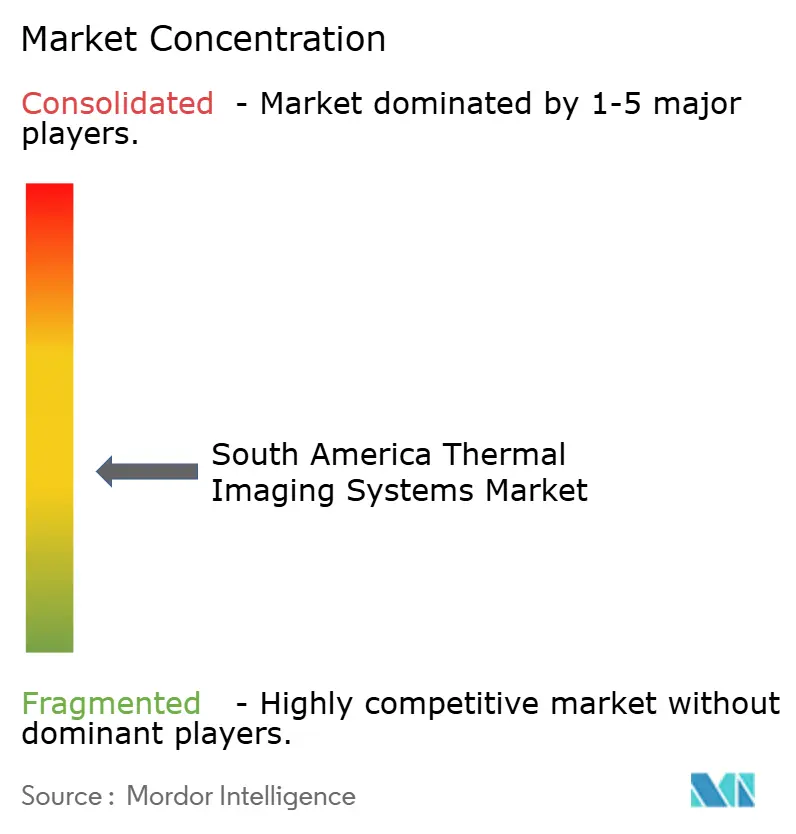
| Market Concentration | Medium |
Major Players *Disclaimer: Major Players sorted in no particular order Image © Mordor Intelligence. Reuse requires attribution under CC BY 4.0. | |
South America Thermal Imaging Systems Market Analysis by Mordor Intelligence
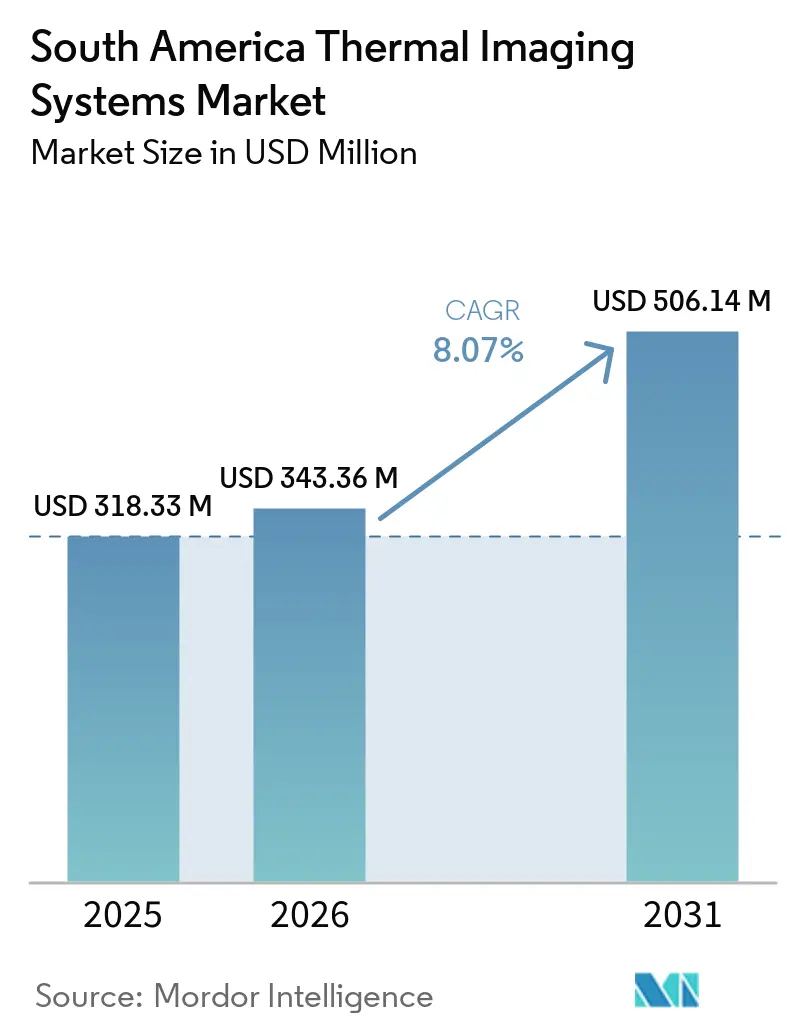
The South America Thermal Imaging Systems Market size is projected to be USD 318.33 million in 2025, USD 343.36 million in 2026, and reach USD 506.14 million by 2031, growing at a CAGR of 8.07% from 2026 to 2031.
The South America thermal imaging systems market is moving from occasional tender purchases toward equipment that supports regular industrial, security, and clinical operations. Industrial maintenance, public-sector surveillance, and healthcare screening are broad sources of demand. Connected cameras, edge processing, cloud analytics, and cellular Internet of Things connections are making thermal devices part of ongoing monitoring systems. This change favors suppliers that can combine cameras, software, integration support, and local service. It also creates room for lower-cost equipment in commercial settings where thermal sensing was previously difficult to justify.
Key Report Takeaways
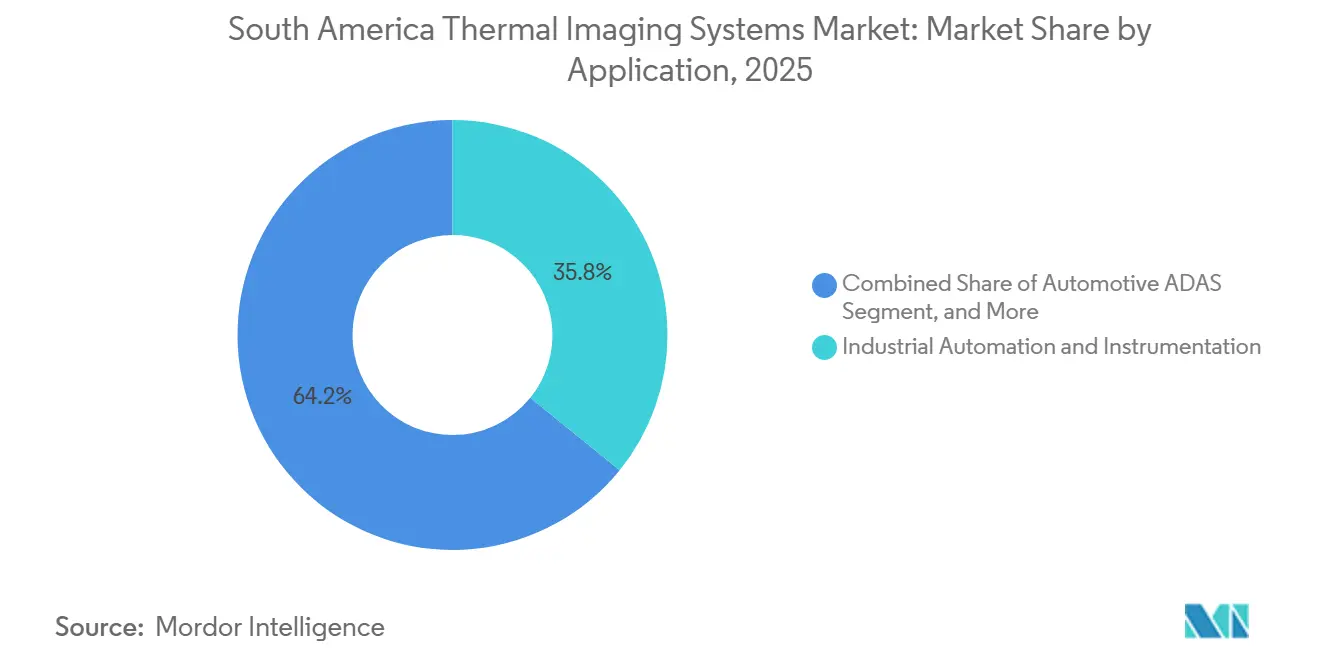
- By application, industrial automation and instrumentation held 35.82% revenue share in the South America thermal imaging systems market in 2025, while automotive advanced driver-assistance systems is projected to expand at an 8.99% CAGR through 2031.
- By form factor, hand-held imaging devices accounted for 53.72% of revenue in the South America thermal imaging systems market in 2025, while integrated OEM modules are projected to expand at an 8.78% CAGR through 2031.
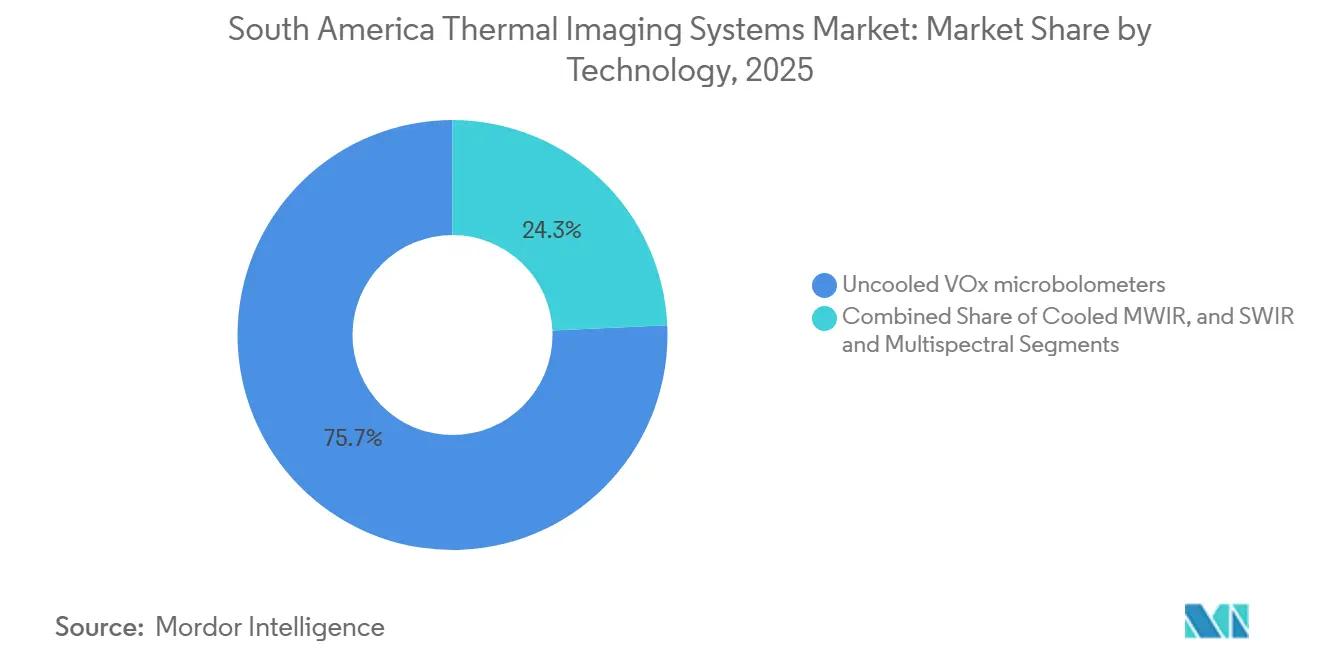
- By technology, uncooled long-wave infrared, or LWIR, technology held 75.72% revenue share in the South America thermal imaging systems market in 2025, while short-wave infrared, or SWIR, and multispectral systems are projected to expand at an 8.67% CAGR through 2031.
- By component, complete cameras accounted for 44.62% of revenue in the South America thermal imaging systems market in 2025, while software and analytics are projected to expand at a 9.52% CAGR through 2031.
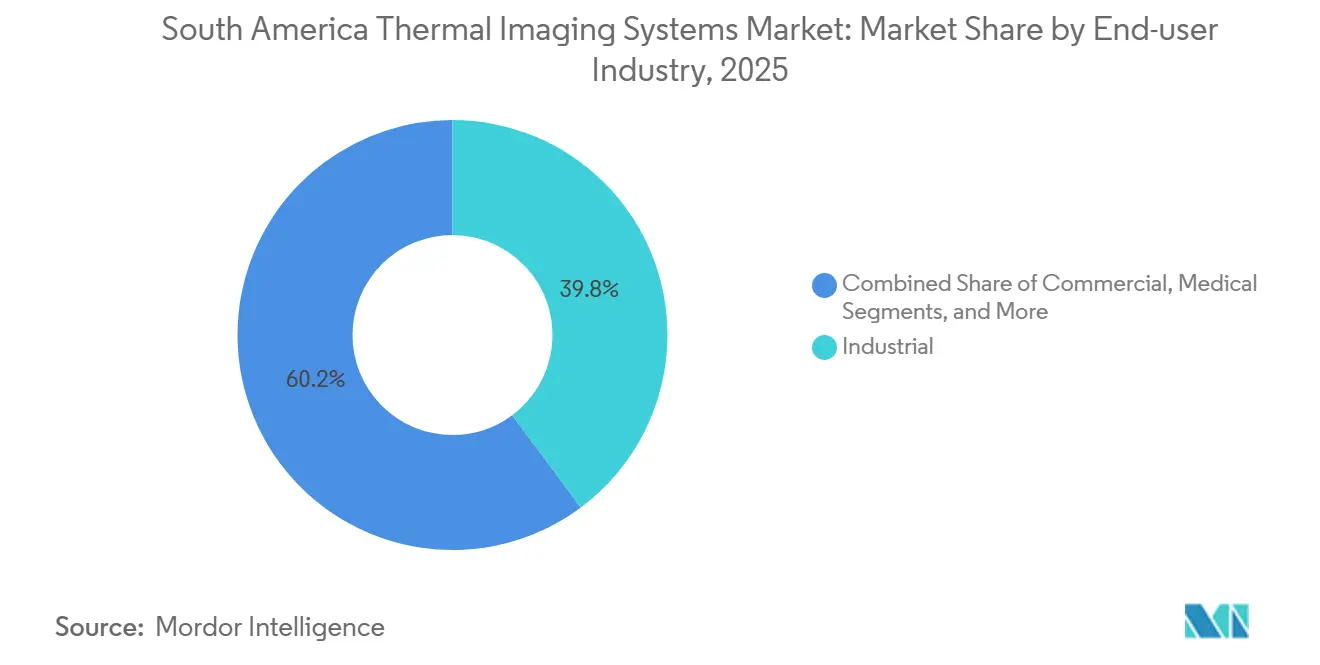
- By end-user industry, industrial users held 39.82% rrevenue share in the South America thermal imaging systems market in 2025, while medical users are projected to expand at a 9.23% CAGR through 2031.
- By geography, Brazil held 43.82% revenue share in the South America thermal imaging systems market in 2025, while Chile is projected to expand at a 9.11% CAGR through 2031.
Note: Market size and forecast figures in this report are generated using Mordor Intelligence’s proprietary estimation framework, updated with the latest available data and insights as of January 2026.
Market Trends and Insights
Drivers Impact Analysis of South America Thermal Imaging Systems Market*
| Driver | (~) % Impact on CAGR Forecast | Geographic Relevance | Impact Timeline |
|---|---|---|---|
| Industrial Digitization and Predictive Maintenance | +2.4% | Brazil, Chile, Colombia, Peru, with spillover to Argentina | Medium term (2-4 years) |
| Defense, Border Security, and Crime-Control Modernization | +2.0% | Brazil, Colombia, Peru, with spillover to Chile and Argentina | Medium term (2-4 years) |
| Mining and Energy Asset Reliability Needs | +1.5% | Chile, Peru, Brazil, Colombia | Long term (≥ 4 years) |
| Lower Uncooled Microbolometer Prices | +1.3% | South America, with stronger commercial relevance across the region | Short term (≤ 2 years) |
| Brazilian Localization of Strategic Thermal Equipment | +0.8% | Brazil, with spillover to Chile and Colombia defense supply chains | Long term (≥ 4 years) |
| Drone Thermography for Dams and Remote Assets | +0.7% | Brazil, Chile, Peru, Colombia | Medium term (2-4 years) |
| Source: Mordor Intelligence | |||
Industrial Digitization and Predictive Maintenance Adoption
Industrial facilities in Brazil, Chile, Colombia, and Peru are increasing spending on condition-monitoring platforms that support maintenance planning and equipment availability. Thermal imaging is used alongside vibration analysis and acoustic sensing in predictive maintenance programs, particularly where process equipment operates under demanding conditions. The South America thermal imaging systems market benefits when operators connect camera readings to asset-management dashboards and broader maintenance workflows. This makes thermal data useful beyond scheduled inspections by supporting continuous equipment oversight, helping maintenance teams prioritize checks, and providing a record of changing temperature conditions. At Codelco Norte's Chuquicamata smelting complex, thermal cameras monitored converter and furnace equipment operating above 1,250°C. The International Council on Mining and Metals reported that unplanned failures can cause losses exceeding 180% of the maintenance cost difference compared with predictive maintenance programs.[1]
Defense, Border Security, and Counter-Organized-Crime Modernization
South American governments are modernizing border-surveillance platforms, intelligence aircraft, and tactical ground equipment as security organizations seek persistent coverage across extensive, difficult terrain. This spending supports thermal and electro-optical systems that operate in low-light conditions and can form part of wider surveillance networks. Brazil's SISFRON program covers 16,886 km of frontier and integrates fixed and mobile sensors, radars, and remotely piloted aircraft in a command-and-control network. The Brazilian Army adopted the OLHAR thermal imaging monocular in March 2025 after it met 63 absolute technical requirements and 22 operational requirements. The product was developed by Opto Space and Defense, an Akaer subsidiary, thereby strengthening Brazil's domestic thermal imaging capability and making local engineering more visible to defense buyers. The South America thermal imaging systems market also receives support from continuing procurement activity in Colombia and Peru, where border control, counter-narcotics work, and intelligence needs sustain institutional interest.
Mining and Energy Infrastructure Reliability Requirements
Mining and energy operators need reliable inspection methods for extraction, processing, and power assets, where equipment failure can disrupt production or pose safety risks. That requirement is especially relevant in Chile, Peru, Brazil, and Colombia, which have major mining, energy, and associated infrastructure operations. Thermal devices can identify abnormal temperatures without interrupting operations or requiring staff to approach equipment closely. The South America thermal imaging systems market benefits when mine operators use cameras for equipment checks, slope observation, remote inspections, and periodic monitoring of difficult locations. At Codelco's Radomiro Tomic division, dual-mode fixed thermal cameras monitor slope faces and provide data for rockfall risk assessment. Brazil's National Mining Agency also conducts drone-based dam inspections as part of its oversight activities.[2]
Falling Prices of Uncooled Microbolometers
Uncooled microbolometers are becoming more capable in compact camera designs without requiring the cooling systems associated with higher-performance cooled products. The change supports broader use in building inspection, light industrial work, automotive systems, and connected factory equipment that need compact sensors. Smaller cameras can reduce the cost and space required for embedded thermal sensing, which is useful for original equipment manufacturers integrating sensors into a broader product line. In January 2026, Lynred introduced the YOCTO1024 uncooled microbolometer with an 8.5-micron pixel pitch and XGA resolution of 1024×768. The product shows the continued focus on compact, higher-resolution infrared sensing and the effort to improve image detail in small modules. The South America thermal imaging systems market can reach more small maintenance contractors, building inspectors, and agricultural operators as suitable equipment becomes more accessible.
Restraints Impact Analysis of South America Thermal Imaging Systems Market*
| Restraint | (~) % Impact on CAGR Forecast | Geographic Relevance | Impact Timeline |
|---|---|---|---|
| Import Dependence and Landed-Cost Volatility | -1.8% | Argentina, Brazil, Colombia, Peru, most acute in Argentina | Medium term (2-4 years) |
| Limited Certified Thermographer and Integration Capacity | -1.0% | All South America, most severe in Peru, Bolivia, and Paraguay | Long term (≥ 4 years) |
| Currency Depreciation and Lumpy Capital Spending | -0.8% | Argentina, Brazil, Colombia | Medium term (2-4 years) |
| Dual-Use Controls for Cooled Systems | -0.5% | Brazil, Colombia, Peru | Long term (≥ 4 years) |
| Source: Mordor Intelligence | |||
Import Dependence and Landed-Cost Volatility
The South America thermal imaging systems market relies on imported focal-plane arrays, cooled detectors, and high-performance optical assemblies that are not widely manufactured within the region. Tariffs, import licenses, and customs procedures can raise delivered equipment costs and make procurement schedules less predictable for distributors and customers. Argentina's import controls have disrupted distributor inventories and delayed planned camera purchases during periods of limited foreign-exchange availability. This has caused some users to extend equipment life rather than replace systems, even where more capable equipment could improve inspection workflows. Freight, insurance, and compliance costs can affect smaller contractors, independent thermographers, and agricultural operators most severely because they have fewer ways to absorb higher delivered costs. Uncertainty over component origin, warranty coverage, and spare-part availability can also make buyers cautious about long-term system purchases and supplier commitments.
Limited Certified Thermographer and Integration Capacity
A shortage of trained thermographers and system integrators can limit adoption among smaller buyers without established inspection teams. These users may lack the skills to validate diagnoses, calibrate cameras, reliably interpret radiometric data, or connect equipment outputs to maintenance processes. The American Society for Nondestructive Testing credentials and ISO 18436-7 provide professional frameworks for condition-monitoring personnel.[3] Limited awareness of these qualifications can lead facilities to rely on occasional third-party inspections rather than fixed monitoring systems that require regular interpretation and management. This lowers per-user spending and slows the shift toward continuous monitoring, especially where equipment suppliers offer limited local integration support. Training from equipment vendors, technical institutions, and industry associations would help reduce this limitation in Peru, Bolivia, Paraguay, and other markets.
*Our forecasts treat driver/restraint impacts as directional, not additive. The impact forecasts reflect baseline growth, mix effects, and variable interactions.
South America Thermal Imaging Systems Market Segment Analysis
By Application:
Industrial Demand Anchors Revenue While Automotive ADAS EmergesIndustrial automation and instrumentation accounted for 35.82% of South America thermal imaging systems market share in 2025. This application serves mining, petrochemicals, power generation, and manufacturing facilities. Buyers use thermal cameras for fault detection and non-contact temperature measurement. The application is becoming more connected to enterprise asset-management systems. That integration supports ongoing monitoring rather than isolated camera checks. Security and surveillance, military and defense, and inspection applications drive additional demand through government procurement and facility protection needs.
Automotive advanced driver-assistance systems are projected to expand at an 8.99% CAGR through 2031. The segment is supported by vehicle-safety requirements and local manufacturing activity. Domestic production of intelligent front cameras in Brazil adds a regional supply element to the application. This localization can shorten supplier response times for vehicle manufacturers and support technical adaptation for local vehicle platforms. Thermal sensing is relevant where low-light detection complements conventional camera performance. The application remains dependent on vehicle programs, component qualification, and the pace of regulatory implementation. Firefighting remains a defined application area, while maritime, aerospace, and personal-vision systems benefit from security and coast-guard needs. Fire departments need equipment that identifies heat sources in smoke-filled spaces, while coast-guard and port-security users need detection capability during nighttime operations. Smartphones and tablets remain early-stage uses as clip-on thermal modules become more affordable. These smaller uses broaden awareness of thermal imaging, although they do not yet have the purchasing scale of industrial or public-sector applications.

By Form Factor:
Hand-Held Devices Lead While OEM Modules Support Embedded UseHand-held imaging devices held 53.72% revenue share in 2025. This leading position reflects their use by field thermographers, border-patrol officers, firefighters, building inspectors, and medical screeners. The devices suit project-based work because they can be moved between sites. South American demand includes many small users who do not require a fixed installation. This buyer base supports continued demand for portable systems. The South America thermal imaging systems market, therefore, retains broad use of handheld equipment among end users.
Integrated OEM modules are projected to expand at an 8.78% CAGR through 2031. Manufacturers embed these thermal cores in automotive systems, unmanned aerial vehicle payloads, and industrial robots. Embedded deployment can make thermal sensing a built-in system capability rather than an item used only during a separate inspection. Fixed-mount rotary and non-rotary systems are another important form factor for perimeter security, slope monitoring, and critical infrastructure. Codelco's Radomiro Tomic deployment demonstrates how fixed cameras can enable around-the-clock slope monitoring. These installations are suited to sites where regular physical inspection is difficult, slow, or unsafe. Edge processing improves the usefulness of fixed systems at remote sites with limited bandwidth. It can classify a possible anomaly locally before an operator reviews the image stream. This feature can support broader use in mining and energy locations. It also allows site managers to align camera placement with specific operational risks.
By Technology:
Uncooled LWIR Leads While SWIR and Multispectral Systems AdvanceUncooled LWIR technology commanded 75.72% revenue share in 2025. Its cost, durability, and suitability for industrial, commercial-security, and firefighting uses support that position. These applications represent large demand pools across South America. Uncooled technology also fits compact camera and embedded-module designs. The South America thermal imaging systems industry uses it across commercial and light-defense settings. Its broad compatibility supports continued leadership even as buyers seek greater detection range and resolution.
SWIR and multispectral technology is projected to expand at an 8.67% CAGR through 2031. It is used in precision agriculture, food-quality inspection, mining-process work, and multisensor defense platforms. These uses value information that is not available from a standard visible-light image. Cooled mid-wave infrared systems continue to play a role in military night-vision sights, intelligence payloads, and counter-unmanned-aircraft missions. Their higher performance is important when users require long-range detection or demanding surveillance capabilities. In February 2026, Teledyne FLIR OEM launched the Neutrino SX8 ISR 50-1000 cooled module with 20× continuous zoom for surveillance, perimeter security, and counter-unmanned-aircraft uses. OEM Export controls for high-performance cooled arrays can add procurement friction in Brazil, Colombia, and Peru. This can preserve the appeal of uncooled systems for many commercial uses. Buyers must balance detection needs, system complexity, procurement conditions, and the skills required to operate each technology.
By Component:
Software and Analytics Outpace Hardware CategoriesComplete cameras held 44.62% revenue share in 2025. Commercial and industrial customers often prefer turnkey systems that limit integration work. Detectors and cores are also important because they supply the base technology for automotive, unmanned aerial vehicle, and automation equipment. Optics and lens sets affect the performance of thermal systems. Specialized germanium and chalcogenide optics are predominantly sourced from outside South America. This creates another supply dependency for regional system integrators.
Software and analytics are projected to expand at a 9.52% CAGR through 2031. Industrial buyers are placing greater weight on analytical capability when selecting thermal systems. Subscription software can reduce the upfront capital commitment for mid-market users in Brazil. It can also allow a buyer to use updates and analytical functions without replacing camera hardware. HIKMICRO introduced SuperScene and SuperScene+ algorithms in June 2025 for electrical and building-envelope inspections. The tools are designed to identify anomalies without requiring expert interpretation. This can make thermal systems more usable for customers with limited in-house thermography capability. Teledyne FLIR OEM launched Prism Ground ISR in June 2026 for automated detection, classification, and tracking in ground-based intelligence and surveillance uses. Software therefore affects both commercial inspection workflows and security applications. It also gives vendors a way to differentiate systems that use similar detector hardware.
By End-User Industry:
Industrial Users Lead While Medical Demand AcceleratesIndustrial users held 39.82% revenue share in 2025. Mining, manufacturing, and power utilities form the main customer base in Brazil, Chile, Colombia, and Peru. The South America thermal imaging systems industry serves equipment monitoring, plant inspection, and utility maintenance in these settings. Defense and homeland security constitute another major end-user category through public procurement. Private-security providers also use thermal equipment at mining and energy installations. Commercial and public-safety users include airport screening, building diagnostics, and utility inspection.
Medical users are projected to expand at a 9.23% CAGR through 2031. Hospitals and screening locations can use thermal equipment for fever checks and clinical thermography. Affordable hand-held cameras can widen access for outpatient clinics in secondary cities. These settings often need simple workflows and equipment that staff can use without specialized infrastructure. This could extend use beyond major urban academic centers. The South America thermal imaging systems market gains a new group of potential healthcare buyers when these tools fit routine patient-intake workflows. Clinical use also requires appropriate procedures for image interpretation and equipment calibration. Cost and professional training remain important factors for wider medical adoption. Hospital procurement decisions will continue to weigh those requirements against the expected operational benefit. The result is a gradual expansion of medical demand rather than a uniform shift across all healthcare providers.
Geography Analysis
Brazil Thermal Imaging Systems Market
Brazil held 43.82% of South America thermal imaging systems market share in 2025. The country has the region's largest manufacturing base and strong institutional demand for defense. It also has an established distribution and service network for thermal cameras. These features can make equipment availability, servicing, and customer support more practical than in smaller national markets. Localization policies can direct public orders toward domestically assembled or designed equipment. The Brazilian Army adopted the OLHAR monocular in March 2025, which supported the credibility of the local defense supply base. Domestic capability can support suppliers seeking to participate in longer public procurement cycles. Brazil's National Defense Strategy, approved in June 2025, prioritized sensing systems alongside nuclear, cyber, and space capabilities. Industrial maintenance adds a separate private-sector demand base that is less dependent on defense orders alone. This combination gives Brazil a broad set of end users for thermal equipment.
Chile and Andean Markets
Chile is projected to expand at a 9.11% CAGR through 2031, the fastest pace among country markets. Copper and lithium mining support demand for inspection and monitoring tools. Geotechnical and environmental safety requirements also support applications for dams and slopes. The operational value of reliable equipment monitoring is particularly clear where a mine faces high-altitude conditions and difficult physical access. Chilean operators have a relatively sophisticated industrial buyer base for thermal inspection. Codelco uses fixed dual-mode thermal cameras at Radomiro Tomic for slope monitoring. This type of deployment creates a practical reference for similar open-pit operations. Colombia and Peru are additional demand centers because of airport modernization, security procurement, mining, and hydrocarbon infrastructure. Their buyer base spans government organizations and private industrial operators. Drone-based inspection is becoming more relevant in both countries for dams and remote assets. Improving operating frameworks for drones can assist this use where ground access is limited.
Argentina and Wider South America Thermal Imaging Systems Market
Argentina faces greater supply constraints because import restrictions and foreign-exchange controls can disrupt distributor inventories. Demand remains concentrated in power utilities, oil and gas operations, petrochemicals, and other critical-infrastructure uses. In the Vaca Muerta shale formation, operational needs can outweigh budget pressure for necessary maintenance equipment. Buyers may prioritize replacement and inspection needs that have a direct effect on equipment availability. Ecuador, Bolivia, Uruguay, Paraguay, and Venezuela remain smaller contributors to the South America thermal imaging systems market. Their smaller scale does not remove the need for infrastructure inspection, security, or industrial maintenance tools. Bolivia's lithium-carbonate projects and Ecuador's oil-sector maintenance needs could support future demand. Each opportunity is affected by fiscal conditions, project timing, distribution reach, and local technical support. Fiscal pressure, infrastructure limits, and limited technical capacity may constrain near-term adoption across this group. These conditions can make market development less predictable than in Brazil or Chile.
Competitive Landscape
The South America thermal imaging systems market has moderate concentration in premium defense and high-performance industrial equipment. Teledyne FLIR LLC, L3Harris Technologies, and BAE Systems serve these areas through established procurement relationships, export authorizations, and application engineering. Their equipment is relevant where buyers need advanced performance, dependable support, and compliance with formal procurement requirements. Commercial and mid-market categories are more fragmented and price sensitive. HIKMICRO and Guide Sensmart compete actively in this part of the field through lower-cost offerings and software features. Their presence gives small and medium-sized users more equipment choices. HIKMICRO launched AI-powered SuperScene Mode in April 2026 for its Eco, B Series, and Pocket Series thermal cameras. The update supports automated electrical and building-envelope anomaly detection. Such functions can reduce the level of manual image review required in common inspection tasks. This matters for users that have limited access to experienced thermographers.
Brazilian suppliers such as Opto Space and Defense and Acoem Brasil are becoming more relevant to institutional customers. Their position is supported by localization credentials and Brazilian defense procurement preferences. Local participation can be important when public buyers consider service access, national capability, and compliance requirements. The OLHAR monocular adoption in March 2025 showed the ability of a domestic supplier to meet formal Army requirements. Lynred launched the YOCTO1024 in January 2026, adding a compact uncooled detector with 8.5-micron pixel pitch and XGA resolution. Teledyne FLIR OEM launched the Boson SX8 in June 2026, an 8-micron pixel-pitch SXGA uncooled LWIR module for compact defense and industrial uses. These component launches give camera and system manufacturers new technical options. Product performance, software functions, support capability, and price will continue to shape supplier selection.
Competition also reflects differences in portfolio breadth and analytics capabilities. Fluke combines thermal imaging with vibration and acoustic imaging for condition-monitoring work. Teledyne FLIR OEM uses software-led offerings such as Prism Ground ISR for tactical perception. These approaches seek to address a workflow rather than a single camera specification. The South America thermal imaging systems market has an opening for certified drone-based thermal inspection services in mining and energy. Smaller mining operators in Peru and Colombia may need organized service providers for these assignments. Service providers can help customers use thermal data without maintaining all specialist skills internally. In February 2026, Teledyne FLIR OEM launched the Lepton XDS, a compact dual thermal-and-visible camera module for mobile and industrial equipment. The product signals continued interest in embedded sensing for price-sensitive emerging markets. It may support product designs that combine visible and thermal information within a smaller device. These designs can be relevant for mobile equipment and industrial original equipment manufacturers.
South America Thermal Imaging Systems Industry Leaders
-
Teledyne FLIR LLC
-
Fluke Corporation
-
Hikmicro
-
Axis Communications AB
-
Leonardo DRS, Inc.
- *Disclaimer: Major Players sorted in no particular order
South America Thermal Imaging Systems Market Companies Covered in this Report
- Teledyne FLIR LLC
- Fluke Corporation
- Testo SE and Co. KGaA
- Hikmicro
- Guide Sensmart
- Axis Communications AB
- Leonardo DRS, Inc.
- L3Harris Technologies, Inc.
- Lockheed Martin Corporation
- BAE Systems plc
- Opgal Optronic Industries Ltd.
- Seek Thermal, Inc.
- Excelitas Technologies Corp.
- Lynred USA, Inc.
- Bullard
- Zhejiang Dali Technology Co., Ltd.
- IRay Technology Co., Ltd.
- InfraTec GmbH
- Thermoteknix Systems Ltd.
- Xenics NV
- OPTO Space and Defense
Recent Industry Developments in South America Thermal Imaging Systems Market
- June 2026: Teledyne FLIR OEM launched Prism Ground ISR, an AI-driven software stack for ground-based ISR providing automated detection, classification, and tracking of military vehicle classes. The software targeted South American defense procurement programs requiring persistent situational awareness at national borders. The release reflected the growing importance of analytics in surveillance systems, where operators need to identify and prioritize objects from continuing sensor feeds. It also complemented the company’s thermal hardware offerings for border and perimeter missions.
- June 2026: Teledyne FLIR OEM launched the Boson SX8, the first NDAA-compliant 8-micron pixel-pitch, SXGA (1280×1024) uncooled LWIR thermal camera module in volume production. The product set a new resolution benchmark for compact defense and industrial ISR modules with implications for South American defense sensor-modernization programs. Its compact module design was relevant to equipment makers that need high-resolution thermal sensing in space-constrained platforms. The development also showed continuing product attention to uncooled systems used in industrial and defense equipment.
- May 2026: FLIR Marine launched Ocean Scout Pro II, a 35 mm hand-held marine thermal monocular enabling human detection at up to 1,000 m and rated IP67. The product targeted South American coast-guard, port-security, and maritime law-enforcement agencies. These users operate in low-light conditions and need equipment that can be carried by personnel during vessel or shoreline activity. The IP67 rating was relevant for use in wet and exposed marine settings.
- April 2026: HIKMICRO launched SuperScene Mode AI algorithm updates across its Eco, B Series, and Pocket Series thermal cameras on the occasion of the company’s 10th anniversary. The update enabled automated electrical and building-envelope anomaly detection without expert interpretation and lowered the skill-access barrier for commercial adoption. This function was relevant for building inspectors and maintenance personnel who need a simpler way to review thermal findings. It also aligned with the move toward software features that support the South America thermal imaging systems market.
South America Thermal Imaging Systems Market Report Scope
The South America Thermal Imaging Systems Report is Segmented by Application (Security and Surveillance, Military and Defense, Thermography/Inspection, Firefighting, Personal Vision Systems, Smartphones and Tablets, Automotive ADAS, and Maritime and Aerospace), Form Factor (Hand-held Imaging Devices, Fixed-mount, and Integrated OEM Modules), Technology (Uncooled LWIR, Cooled MWIR, and SWIR and Multispectral), Component (Detectors/Cores, Complete Cameras, Optics and Lens Sets, and Software and Analytics), End-User Industry (Defense and Homeland Security, Industrial, Commercial, Medical, and Public Safety), and Country (Brazil, Argentina, Chile, Colombia, Peru, and Rest of South America). The Market Forecasts are Provided in Terms of Value (USD).
Segmentation Overview
By Application
| Security and Surveillance |
| Military and Defense |
| Thermography / Inspection |
| Firefighting |
| Industrial Automation and Instrumentation |
| Smartphones and Tablets |
| Automotive ADAS |
| Maritime and Aerospace |
By Form Factor
| Hand-held Imaging Devices |
| Fixed-mount (Rotary / Non-rotary) |
| Integrated OEM Modules |
By Technology
| Uncooled LWIR |
| Cooled MWIR |
| SWIR and Multispectral |
By Component
| Detectors / Cores |
| Complete Cameras |
| Optics and Lens Sets |
| Software and Analytics |
By End-user Industry
| Defense and Homeland Security |
| Industrial |
| Commercial |
| Medical |
| Public Safety |
By Country
| Brazil |
| Argentina |
| Chile |
| Colombia |
| Peru |
| Rest of South America |
| By Application | Security and Surveillance |
| Military and Defense | |
| Thermography / Inspection | |
| Firefighting | |
| Industrial Automation and Instrumentation | |
| Smartphones and Tablets | |
| Automotive ADAS | |
| Maritime and Aerospace | |
| By Form Factor | Hand-held Imaging Devices |
| Fixed-mount (Rotary / Non-rotary) | |
| Integrated OEM Modules | |
| By Technology | Uncooled LWIR |
| Cooled MWIR | |
| SWIR and Multispectral | |
| By Component | Detectors / Cores |
| Complete Cameras | |
| Optics and Lens Sets | |
| Software and Analytics | |
| By End-user Industry | Defense and Homeland Security |
| Industrial | |
| Commercial | |
| Medical | |
| Public Safety | |
| By Country | Brazil |
| Argentina | |
| Chile | |
| Colombia | |
| Peru | |
| Rest of South America |
Key Questions Answered in the Report
What is the South America thermal imaging systems market size?
The South America thermal imaging systems market was valued at USD 318.34 million in 2025 and is estimated to reach USD 506.15 million by 2031 at an 8.07% CAGR.
Which application has the largest revenue share?
Industrial automation and instrumentation led applications with 45.82% revenue share in 2025, supported by maintenance needs in mining, power, manufacturing, and petrochemicals.
What is driving demand for thermal cameras in South America?
Predictive maintenance, border security, mining and energy asset monitoring, and wider access to uncooled thermal devices are supporting demand.
Which thermal imaging technology leads regional demand?
Uncooled LWIR technology held 75.72% revenue share in 2025 because it fits industrial, commercial-security, and firefighting applications.
Which country is expanding fastest through 2031?
Chile is projected to expand at a 9.11% CAGR through 2031, supported by copper and lithium mining operations and monitoring requirements.