
South America Smart Home Market Size and Share
Market Overview
| Study Period | 2020 - 2031 |
|---|---|
| Forecast Data Period | 2026 - 2031 |
| Base Year Market Size (2025) | USD 0.95 Billion |
| Market Size (2026) | USD 1.12 Billion |
| Market Size (2031) | USD 2.71 Billion |
| Growth Rate (2026 - 2031) | 19.33 % |
| Market Concentration | Low |
Major Players *Disclaimer: Major Players sorted in no particular order Image © Mordor Intelligence. Reuse requires attribution under CC BY 4.0. | |
South America Smart Home Market Analysis by Mordor Intelligence
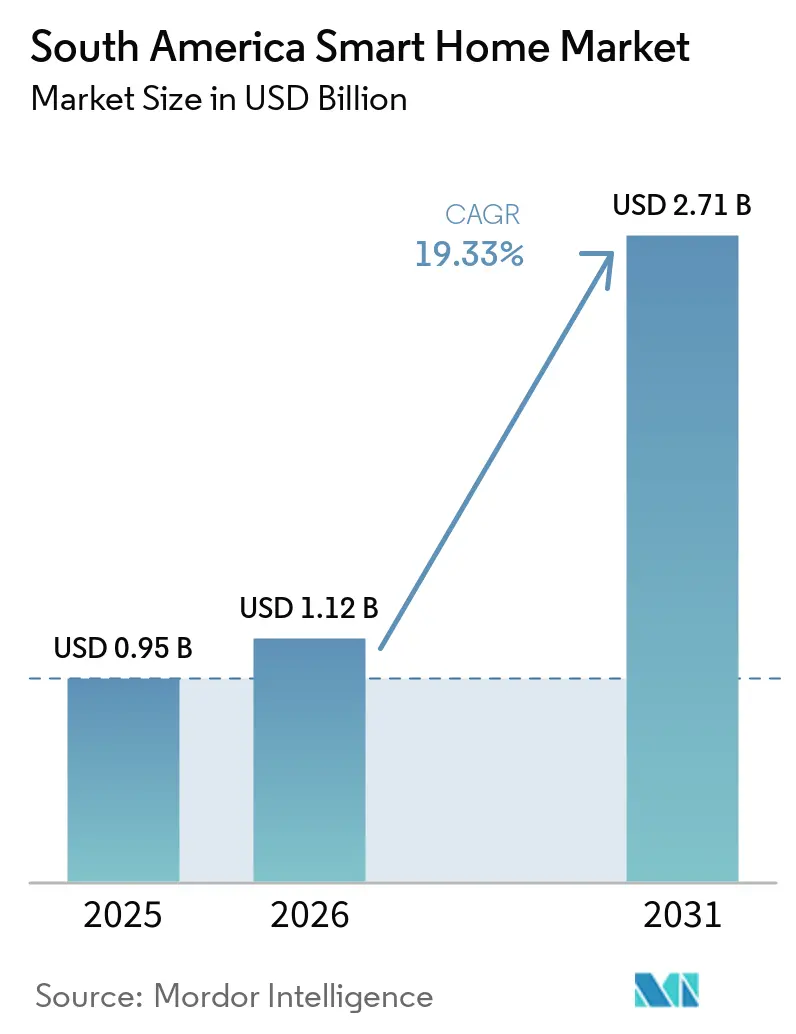
The South America Smart Home Market size was valued at USD 0.95 billion in 2025 and estimated to grow from USD 1.12 billion in 2026 to reach USD 2.71 billion by 2031, at a CAGR of 19.33% during the forecast period (2026-2031). The South America Smart Home Market is supported by broader household connectivity, security-focused purchasing, and wireless products that integrate with existing homes. Brazil has the largest installed base, with 93.6% of households having internet access in 2024 and 13.5 million households using at least 1 smart device. Security is an early entry point, while solar adoption, connected appliances, and remote care broaden the range of uses. Suppliers are balancing online reach and installer relationships, while developer partnerships offer a route into new multifamily buildings.
Key Report Takeaways
- By component, Access Control, Safety, and Security accounted for 38.12% of the South America Smart Home Market share in 2025, while Smart-Home Healthcare is forecast to grow at a 20.41% CAGR through 2031.
- By housing type, Single-Family Dwelling held 74.23% of the South America Smart Home Market share in 2025, while Multifamily Dwelling is forecast to grow at a 21.27% CAGR through 2031.
- By installation type, Retrofit held 66.41% of the South America Smart Home Market share in 2025, while New Construction is forecast to grow at a 20.68% CAGR through 2031.
- By sales channel, Offline held 58.72% of the South America Smart Home Market share in 2025, while Online is forecast to grow at a 21.14% CAGR through 2031.
- By connectivity technology, Wi-Fi held 71.84% of the South America Smart Home Market share in 2025, while Thread is forecast to grow at a 20.92% CAGR through 2031.
- By application, Safety and Security held 36.59% of the South America Smart Home Market share in 2025, while Assisted Living and Home Healthcare are forecast to grow at a 20.46% CAGR through 2031.
- By geography, Brazil held 47.16% of the South America Smart Home Market share in 2025, while Colombia is forecast to grow at a 21.81% CAGR through 2031.
Note: Market size and forecast figures in this report are generated using Mordor Intelligence’s proprietary estimation framework, updated with the latest available data and insights as of January 2026.
Market Trends and Insights
Drivers Impact Analysis of South America Smart Home Market*
| Driver | (~) % Impact on CAGR Forecast | Geographic Relevance | Impact Timeline |
|---|---|---|---|
| Rising Broadband, Smartphone, and Connected-Home Penetration | +4.2% | South America, with the strongest uplift in Brazil, Colombia, and Chile | Medium term (2-4 years) |
| Growing Demand for Residential Security and Remote Monitoring | +3.8% | South America, with the highest concentration in Brazil and Colombia | Short term (≤ 2 years) |
| Energy-Cost Management and Distributed-Energy Integration | +3.2% | Brazil, Chile, and Argentina | Medium term (2-4 years) |
| Smart Appliance and Voice-Control Adoption | +2.7% | Brazil, Colombia, Chile, and Argentina | Short term (≤ 2 years) |
| Developer-Led Smart-Home Standardization in Premium Multifamily Projects | +2.3% | Brazil, Chile, and Colombia | Medium term (2-4 years) |
| Spanish- and Portuguese-Language Localized Automation Experiences | +1.6% | Brazil, Argentina, Colombia, Chile, and Venezuela | Long term (≥ 4 years) |
| Source: Mordor Intelligence | |||
Rising Broadband, Smartphone, and Connected-Home Penetration
Household connectivity provides the South America Smart Home Market with a larger base of connected devices. Reported that 93.6% of Brazilian households had internet access in 2024, while fixed broadband reached 88.9% of connected homes.[1] The same survey counted 13.5 million Brazilian homes with at least 1 smart device, after an increase of 1.9 million homes in 1 year. This installed base supports both first purchases and later additions such as cameras, lamps, and sensors. Better network access also makes lower-cost Wi-Fi products practical for households that do not want a complex installation.
Growing Demand for Residential Security and Remote Monitoring
Security demand remains a direct driver for the South America Smart Home Market because cameras, locks, and alarms solve visible household concerns. Brazil’s electronic security sector included 33,000 companies in 2025, showing the scale of the existing distribution and installer base.[2] Connected security products can be added gradually, which lowers the initial commitment for buyers. A camera or digital lock can also introduce a household to broader automation without requiring a full system purchase. Suppliers that pair easy installation with dependable monitoring are better placed to turn security buyers into repeat customers.
Energy-Cost Management and Distributed-Energy Integration
Rooftop solar creates a practical use case for smart energy controls in the South America Smart Home Market. Solfácil introduced Solfácil Smart in 2025 to monitor residential solar generation, consumption, and savings in real time. A connected household can use monitoring tools to schedule loads when solar output is available. This ties controllers and HVAC settings to a household financial decision rather than to a convenience purchase. The opportunity is strongest where residential solar is established, and households can see the value of controlling consumption.
Smart Appliance and Voice-Control Adoption
Connected appliances and voice controls widen the South America Smart Home Market beyond security systems. Voice interfaces allow users to operate lights, appliances, and entertainment equipment without learning separate controls for each device. The effect is strongest when products support Portuguese or Spanish commands and integrate with the platforms already used at home. Suppliers can reduce purchase friction by selling starter bundles that combine a speaker with basic devices. The category still depends on value-focused offers because appliances cost more than entry-level sensors or lighting products.
Restraints Impact Analysis of South America Smart Home Market*
| Restraint | (~) % Impact on CAGR Forecast | Geographic Relevance | Impact Timeline |
|---|---|---|---|
| High Upfront Retrofit and Professional-Installation Costs | -2.8% | South America, most acute in Brazil and Argentina | Short term (≤ 2 years) |
| Cybersecurity, Privacy, and Trust Concerns | -2.2% | Brazil and Argentina | Medium term (2-4 years) |
| Currency Volatility and Import-Dependent Device Pricing | -1.8% | Argentina and Venezuela, with a moderate effect in Brazil and Colombia | Short term (≤ 2 years) |
| Voltage, Wiring, and Building-Stock Compatibility Constraints | -1.4% | Brazil and Argentina | Medium term (2-4 years) |
| Source: Mordor Intelligence | |||
High Upfront Retrofit and Professional-Installation Costs
Retrofit work can slow the South America Smart Home Market because much of the residential stock was not designed for connected systems. Older homes may lack suitable wiring, hub locations, or compatible switch boxes. Professional installation can raise the total cost and place integrated systems beyond many middle-income households. This creates a split between premium installations and simpler do-it-yourself products. Wireless products that avoid rewiring can reduce this barrier, but they may not provide every function sought in a whole-home system.
Cybersecurity, Privacy, and Trust Concerns
Data protection concerns can delay purchases in the South America Smart Home Market, especially for cameras and devices that collect household information. Brazil requires cybersecurity provisions for relevant telecommunications equipment under the Anatel Act 77/21, which makes compliance a commercial requirement for vendors. Clear data practices and reliable software updates can help suppliers address buyer concerns. Smaller vendors may face a longer path to meet technical and documentation requirements. The issue also favors devices and services that make privacy controls visible to users.
*Our forecasts treat driver/restraint impacts as directional, not additive. The impact forecasts reflect baseline growth, mix effects, and variable interactions.
South America Smart Home Market Segment Analysis
By Components:
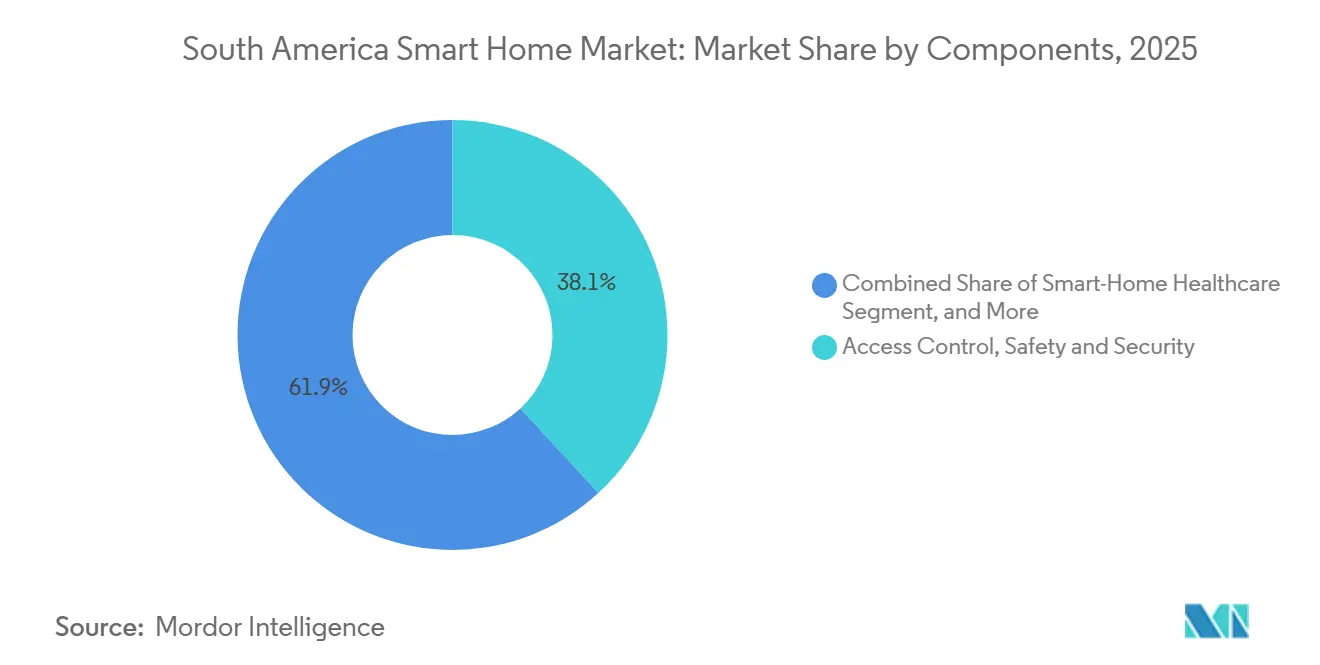
Security Hardware Leads, While Healthcare Supports GrowthAccess Control, Safety, and Security accounted for 38.12% of the South America Smart Home Market in 2025. Cameras, alarms, smart locks, smoke detectors, and monitoring devices serve a direct need for protection in private homes and shared residential spaces. The group also benefits from established security distributors and installers who can recommend products, configure systems, and provide post-installation support. Cloud-managed panels are useful to professional installers because they support monitoring and maintenance needs across multiple customer locations. Consumer Electronics, including smart speakers, home theater systems, and air purifiers, is another important component group because it brings familiar connected products into homes.
Smart-Home Healthcare is forecast to grow at a 20.41% CAGR through 2031. The category includes remote monitoring products that can support older adults and patients who require regular observation, while keeping care linked to the home. In March 2026, InCor began a 200-patient trial of a smart cardiac wristband with Arqia, and commercialization is planned for 2027. Lighting, energy management, climate controls, controllers, and hubs can grow alongside security as users add products and connect separate device categories over time. Smart kitchen products remain small in size, but developer-led housing projects can introduce them to buyers through preselected bundles.[3]

By Housing Type:
Single-Family Homes Lead, While Multifamily Buildings Gain GroundSingle-Family Dwelling held 74.23% of the South America Smart Home Market share in 2025. Detached-home owners have more flexibility to add outdoor cameras, lighting, access controls, and climate products without requiring approval from a building manager. These homes can support gradual do-it-yourself upgrades as well as professionally integrated systems, which gives vendors multiple ways to reach the same household. Security products are particularly suited to homes with exterior areas, garages, gates, and separate points of entry. The segment, therefore, remains central to near-term device volumes and to the coverage strategies used by retailers and installation companies.
Multifamily Dwelling is forecast to expand at a 21.27% CAGR through 2031. Developers can add connectivity, access control, shared cameras, and building management features before residents move in, reducing the complexity of later installations. Housi stated in January 2026 that it was targeting more than 400,000 apartments with embedded technology across 80 cities and 17 Brazilian states. This model provides a ready foundation for residents to add personal devices after occupancy, rather than starting with basic infrastructure work. Suppliers that establish developer relationships can create repeat demand across multiple residential projects and build an installed base for later upgrades.
By Installation Type:
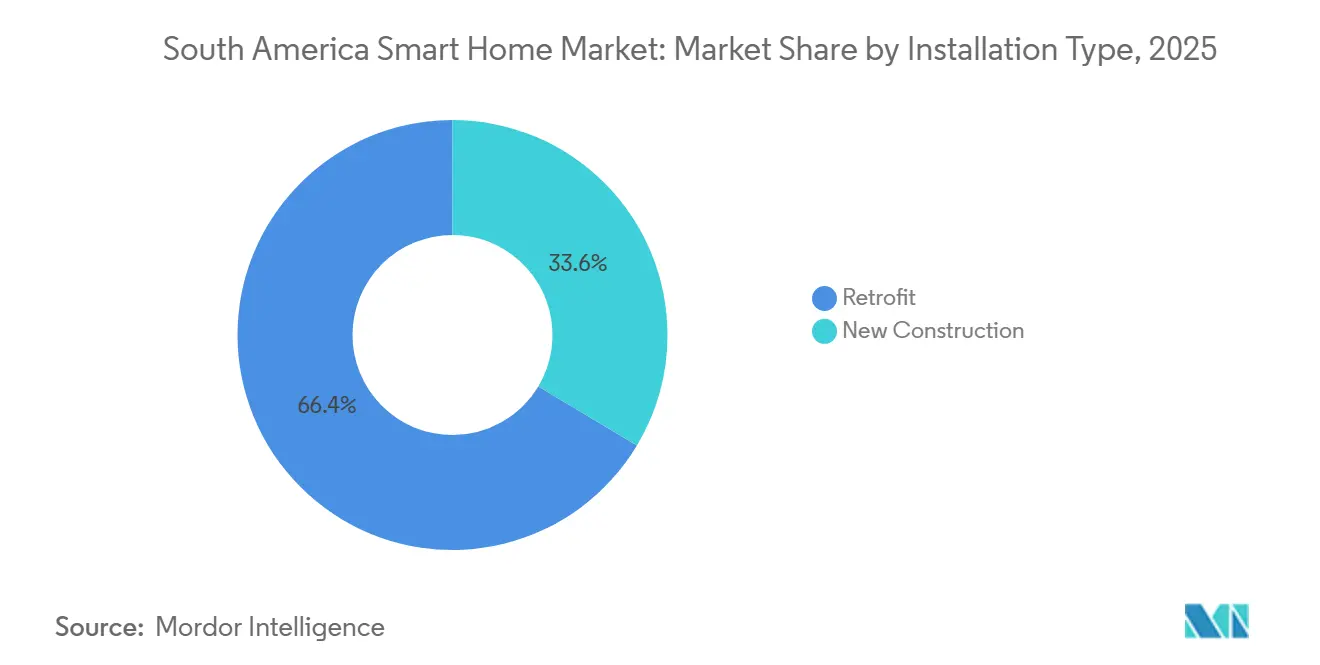
Retrofits Dominate, While New Construction Favors Integrated SystemsRetrofit accounted for 66.41% of the South America Smart Home Market size in 2025. Existing homes form the largest addressable base because most residential buildings were completed before smart-home wiring, dedicated hub locations, and integrated connectivity became common. Wi-Fi and Thread products reduce the need for major electrical work, allowing buyers to introduce sensors, lamps, cameras, and speakers in stages. This setting favors devices with clear setup instructions, dependable wireless performance, and straightforward compatibility with common household networks. It also gives security installers a substantial opportunity to provide individual product installations and later expand systems for existing customers.
New Construction is forecast to expand at a 20.68% CAGR through 2031. Pre-installation lets developers include network coverage, wiring, controllers, and access systems before handover, when the cost and disruption of installation are lower. Vivo expanded partnerships with property developers in July 2025 to provide connectivity and smart-home services in new residential projects. Bulk procurement can support more standardized equipment choices, consistent handover packages, and wider deployment of products that would be difficult to retrofit later. The model can raise system value per unit, although it makes vendors more dependent on a limited number of developer relationships.
By Sales Channel:
Offline Expertise Remains Important as Online Sales ExpandOffline held 58.72% of the South America Smart Home Market share in 2025. Specialist distributors, physical retailers, and installers remain important for equipment that needs technical advice, product demonstrations, or on-site configuration. Buyers often seek help with cameras, alarms, controllers, and integrated systems because performance depends on device placement and network conditions. The channel also supports project-specific sourcing for condominiums, larger homes, and security installations with several devices. These strengths keep offline channels relevant even as consumer awareness rises and product information becomes easier to find online.
Online sales are forecast to grow at a 21.14% CAGR through 2031. Digital storefronts let buyers compare compatible products, select smaller starter bundles, and access products outside specialist store service areas. The channel benefits when suppliers provide clear product descriptions, setup guidance, and post-purchase support that reduces uncertainty for first-time buyers. It will not remove the need for installers, since many customers will still need help with integrated systems or more demanding electrical work. Vendors that provide installers with practical online ordering tools can connect the two routes rather than having them compete for the same customer.
By Connectivity Technology:
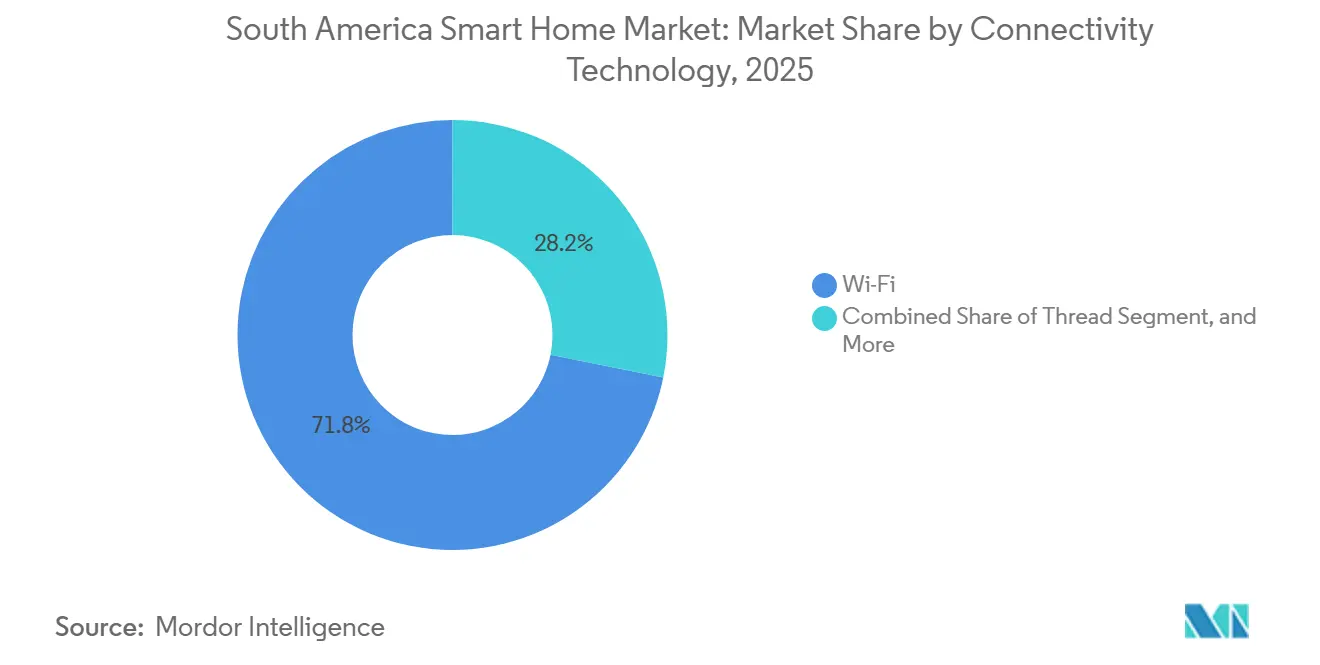
Wi-Fi Leads, While Thread Expands Device OptionsWi-Fi held 71.84% of the South America Smart Home Market share in 2025. Most connected households already use broadband routers, which makes Wi-Fi devices familiar, easy to find, and straightforward for many buyers to set up. It supports cameras, speakers, displays, and appliances that need higher data capacity or continuous connection to household networks. Wi-Fi is often the practical first choice for consumers who want to add 1 device at a time without committing to a dedicated system. Its large installed base also helps suppliers offer broad compatibility with leading smart-home platforms and familiar mobile platforms.
The thread is forecast to grow at a 20.92% CAGR through 2031. It is suited to low-power products such as sensors, locks, bulbs, and smoke detectors, where battery life is central to the user experience. The Thread Group reported 240 members and more than 1,090 certified products in its 2025 annual report. Matter support can help devices from different suppliers work together, reducing concerns that a household is locked into a proprietary system. Zigbee, Z-Wave, Bluetooth Low Energy, and powerline connections also retain roles in which installer preferences, proximity functions, or building materials shape the best technical approach.[4]
By Application:
Safety Leads, While Assisted Living Gains RelevanceSafety and Security accounted for 36.59% of the South America Smart Home Market in 2025. Video doorbells, connected cameras, alarms, and motion sensors solve a direct household problem and can be purchased without committing to extensive automation. The application benefits from a large base of electronic security distributors, professional installers, and retailers who have experience explaining surveillance and access products. It can also introduce households to lighting, access control, and other connected functions once a camera or lock has been installed. This makes safety a practical entry application for many first-time buyers who want visible value from their first connected device.
Assisted Living and Home Healthcare is forecast to grow at a 20.46% CAGR through 2031. The application includes medical alerts, smart monitors, and connected tools that can help users and caregivers follow health needs at home. Dong-A ST signed a distribution agreement with CARDIOS in May 2026 for its HiCardi+ remote monitoring device in Brazil. Energy management is gaining relevance where solar-equipped homes need better visibility over generation and consumption patterns. Entertainment, climate control, and smart kitchen products create further opportunities as households move from a single use case to a broader connected setup.
Geography Analysis
Brazil Smart Home Market
Brazil held 47.16% of the South America Smart Home Market share in 2025. Its large connected population, established security supply chain, and wide choice of wireless products give it the strongest base in South America. Reported that 93.6% of Brazilian households had internet access in 2024. The country also had 13.5 million homes with at least 1 smart device during that year. Demand runs from professionally installed systems in major cities to entry-level Wi-Fi devices that consumers buy online for their own homes.
Colombia and Chile Smart Home Market
Colombia is forecast to grow at a 21.81% CAGR through 2031. Bogotá and Medellín combine connected urban households with demand for residential access control, monitoring, and devices that work with local installer support. Local suppliers can benefit when Spanish-language interfaces and service partners make products more usable for households and building managers. Chile also offers a connected urban customer base and demand for higher-value home systems, especially where product interoperability improves consumer choice. In February 2026, SUBTEL removed the former formal certification requirement for Matter-compliant devices, subject to stated compliance information requirements. This change can shorten the route for qualifying devices to enter Chile and gives vendors more reason to consider the country in their regional launch plans.
South America Smart Home Market
Argentina has a demand for connected security and energy controls, but import-dependent equipment remains sensitive to currency volatility and can become less affordable when local currencies weaken. Suppliers may therefore focus on lower-cost security products, staged upgrades, and distribution models that manage inventory carefully. Venezuela faces further constraints due to infrastructure conditions, currency controls, and low purchasing power, although demand for basic monitoring persists. Peru, Ecuador, Bolivia, Paraguay, and Uruguay offer developing opportunities where stronger connectivity and installer coverage can gradually widen the adoption of wireless devices.
Competitive Landscape
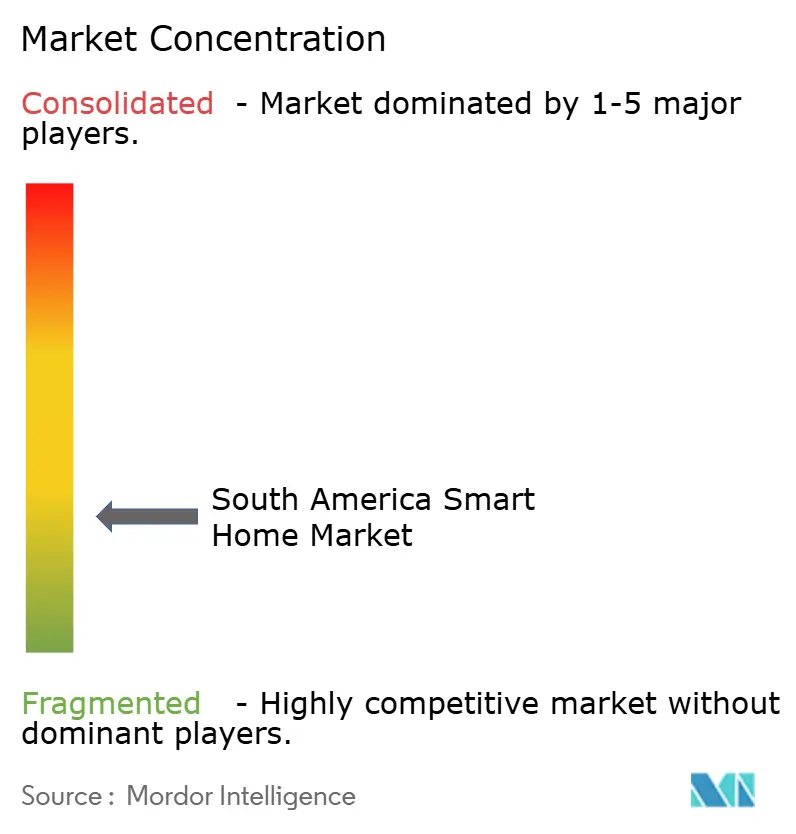
The South America Smart Home Market includes global platforms, specialist device suppliers, and regional companies with different routes to customers. Global brands bring established platforms, wide product ranges, and distribution resources that can support device availability and ecosystem familiarity. Specialist suppliers compete through performance in security, access, connectivity, energy management, or another focused category. Regional providers can compete through local service, Portuguese or Spanish support, installer relationships, and residential developer partnerships. The competitive environment remains fragmented because no supplier shares information in the supplied research.
Ajax Systems entered the Brazilian market in April 2025 with a dedicated local team and later partnered with Segware, a security monitoring software developer. The move gave the company a closer route to local security professionals and monitoring partners that influence product selection and installation practices. Tuya announced a partnership with Hometree Casa Inteligente in May 2024 to develop a whole-house smart-home software solution for Brazilian households. The arrangement covered app management, product selection, supply chain management, and agent channel integration for the local market. These examples show that local execution and software support matter alongside product features and retail reach.
Vivo’s July 2025 developer partnerships show how telecom providers can enter the South America Smart Home Market through new housing projects. This approach can combine connectivity and smart-home services before a resident moves in, improving the ease of later device adoption. In June 2026, Silicon Labs reported a 200-node Matter-over-Thread validation network that demonstrated technical scale for larger deployments. Suppliers that offer interoperable products, dependable support, simple setup, and visible data protection can strengthen their position in multifamily and retrofit projects.
South America Smart Home Industry Leaders
-
Samsung Electronics Co., Ltd.
-
Amazon.com, Inc.
-
LG Electronics Inc.
-
Robert Bosch GmbH
-
Schneider Electric SE
- *Disclaimer: Major Players sorted in no particular order
South America Smart Home Market Companies Covered in this Report
- Samsung Electronics Co., Ltd.
- Alarm.com Incorporated
- Amazon.com, Inc.
- LG Electronics Inc.
- Vivint, Inc.
- Robert Bosch GmbH
- Schneider Electric SE
- Eve Systems GmbH
- Lumi United Technology Co., Ltd.
- Tuya Inc.
- Shelly Group SE
- Nice S.p.A.
- FIBARO Group S.A.
- Somfy SA
- Nuki Home Solutions GmbH
- Ajax Systems Inc.
- ELSYS Equipamentos Eletronicos Ltda.
- Flex Automation Ltda.
- Hometree Casa Inteligente LTDA
- Smart Homy SpA
- Tholz LtdA
Recent Industry Developments in South America Smart Home Market
- June 2026: Silicon Labs announced the successful deployment and operation of a 200-node Matter-over-Thread validation network at the Connectivity Standards Alliance's inaugural Unify event on June 16, 2026. The achievement demonstrates Matter's scalability for large multifamily and commercial IoT environments, directly relevant to South America's growing smart-condominium segment.
- May 2026: Dong-A ST signed a distribution agreement with Brazilian cardiac monitoring specialist CARDIOS for its HiCardi+ wearable patch-type remote patient monitoring device at Hospitalar 2026 in São Paulo on May 22, 2026. The deal follows HiCardi+'s ANVISA regulatory approval in February 2025 and its official launch in Brazil at SOCESP 2025 in June 2025, positioning it as a leading device in the smart-home healthcare segment.
- March 2026: Instituto do Coração, affiliated with the Hospital das Clínicas of the University of São Paulo, initiated a clinical trial on March 26, 2026, of a smart wristband developed with IoT and AI connectivity firm Arqia for remote cardiovascular monitoring of 200 patients. A commercial launch is planned for 2027, signaling growing institutional validation of smart-home healthcare devices in Brazil's clinical care pathways.
- March 2026: Chile's Subsecretaría de Telecomunicaciones removed the prior formal certification requirement for Matter-compliant devices effective February 22, 2026. Vendors now require only a publicly accessible compliance page declaring bands, power, RF modules, and importer details, materially reducing the market-entry timeline and cost for smart-home manufacturers targeting Chile.
South America Smart Home Market Report Scope
The South America smart home market refers to the ecosystem of interconnected devices, appliances, and control systems installed in residential properties across the region. This includes smart security, lighting, climate control, kitchen appliances, and healthcare monitors that communicate via protocols like Wi-Fi, Zigbee, or Thread. Sold through both online and offline channels for new construction and retrofits, these solutions provide homeowners with enhanced security, energy efficiency, convenience, and automation.
The South America Smart Home Market Report is Segmented by Components (Consumer Electronics [Smart Speakers, Smart Home Theater, Smart Purifiers, and Other Consumer Electronics], Access Control, Safety and Security [Smart Alarms, Smart Locks, Smart Sensors, Smoke and Hazard Detectors, Smart Cameras and Monitoring, and Garage-Door Operators and Rest of Access Control, Safety and Security], Lighting [Smart Lighting, Smart Lamps and Luminaires, Ambient Lighting, and Other Lighting Products], Energy Management [Lighting Energy Controllers, Central Control Systems, and HVAC Energy Controls], Smart HVAC and Climate Control [Fans, Radiators, Thermostats, and Air Conditioners], Controllers and Hubs [DIY Hubs and Panels and Professional Hubs and Panels], Smart-Home Healthcare [Medical-Alert Systems, Smart Glucose Monitors, and Smart Cardiac Monitors], and Smart Kitchen [Smart Refrigerators, Smart Cookware and Cooktops, Smart Dishwashers, Smart Ovens, and Other Smart Kitchen Products]), Housing Type (Single-Family Dwelling, and Multifamily Dwelling), Installation Type (New Construction, and Retrofit), Sales Channel (Online, and Offline), Connectivity Technology (Wi-Fi, Zigbee and Z-Wave, Bluetooth Low Energy, Thread, Powerline and PLC, and Rest of Connectivity Technology), Application (Safety and Security, Energy Management, Comfort and Climate Control, Entertainment and Media, Assisted Living and Home Healthcare, and Smart Kitchen and Household Tasks), and Geography (Brazil, Argentina, Colombia, Chile, and Rest of South America). The Market Forecasts are Provided in Terms of Value (USD).
Segmentation Overview
| Consumer Electronics | Smart Speakers |
| Smart Home Theater | |
| Smart Purifiers | |
| Other Consumer Electronics | |
| Access Control, Safety and Security Solution | Smart Alarms |
| Smart Locks | |
| Smart Sensors | |
| Smoke and Hazard Detectors | |
| Smart Cameras and Monitoring | |
| Garage-Door Operators among Other Access Control, Safety and Security Solutions | |
| Lighting | Smart Lighting |
| Smart Lamps and Luminaires | |
| Ambient Lighting | |
| Other Lighting Products | |
| Energy Management | Lighting Energy Controllers |
| Central Control Systems | |
| HVAC Energy Controls | |
| Smart HVAC and Climate Control | Fans |
| Radiators | |
| Thermostats | |
| Air Conditioners | |
| Controllers and Hubs | DIY Hubs and Panels |
| Professional Hubs and Panels | |
| Smart-Home Healthcare | Medical-Alert Systems |
| Smart Glucose Monitors | |
| Smart Cardiac Monitors | |
| Smart Kitchen | Smart Refrigerators |
| Smart Cookware and Cooktops | |
| Smart Dishwashers | |
| Smart Ovens | |
| Other Smart Kitchen Products |
| Single-Family Dwelling |
| Multifamily Dwelling |
| New Construction |
| Retrofit |
| Online |
| Offline |
| Wi-Fi |
| Zigbee and Z-Wave |
| Bluetooth Low Energy |
| Thread |
| Powerline and PLC |
| Rest of Connectivity Technology |
| Safety and Security |
| Energy Management |
| Comfort and Climate Control |
| Entertainment and Media |
| Assisted Living and Home Healthcare |
| Smart Kitchen and Household Tasks |
| Brazil |
| Argentina |
| Colombia |
| Chile |
| Rest of South America |
| By Components | Consumer Electronics | Smart Speakers |
| Smart Home Theater | ||
| Smart Purifiers | ||
| Other Consumer Electronics | ||
| Access Control, Safety and Security Solution | Smart Alarms | |
| Smart Locks | ||
| Smart Sensors | ||
| Smoke and Hazard Detectors | ||
| Smart Cameras and Monitoring | ||
| Garage-Door Operators among Other Access Control, Safety and Security Solutions | ||
| Lighting | Smart Lighting | |
| Smart Lamps and Luminaires | ||
| Ambient Lighting | ||
| Other Lighting Products | ||
| Energy Management | Lighting Energy Controllers | |
| Central Control Systems | ||
| HVAC Energy Controls | ||
| Smart HVAC and Climate Control | Fans | |
| Radiators | ||
| Thermostats | ||
| Air Conditioners | ||
| Controllers and Hubs | DIY Hubs and Panels | |
| Professional Hubs and Panels | ||
| Smart-Home Healthcare | Medical-Alert Systems | |
| Smart Glucose Monitors | ||
| Smart Cardiac Monitors | ||
| Smart Kitchen | Smart Refrigerators | |
| Smart Cookware and Cooktops | ||
| Smart Dishwashers | ||
| Smart Ovens | ||
| Other Smart Kitchen Products | ||
| By Housing Type | Single-Family Dwelling | |
| Multifamily Dwelling | ||
| By Installation Type | New Construction | |
| Retrofit | ||
| By Sales Channel | Online | |
| Offline | ||
| By Connectivity Technology | Wi-Fi | |
| Zigbee and Z-Wave | ||
| Bluetooth Low Energy | ||
| Thread | ||
| Powerline and PLC | ||
| Rest of Connectivity Technology | ||
| By Application | Safety and Security | |
| Energy Management | ||
| Comfort and Climate Control | ||
| Entertainment and Media | ||
| Assisted Living and Home Healthcare | ||
| Smart Kitchen and Household Tasks | ||
| By Geography | Brazil | |
| Argentina | ||
| Colombia | ||
| Chile | ||
| Rest of South America | ||
Key Questions Answered in the Report
What is the South America Smart Home Market size?
The South America Smart Home Market was valued at USD 0.95 billion in 2025 and is estimated at USD 1.12 billion in 2026. It is forecast to reach USD 2.71 billion by 2031 at a 19.33% CAGR.
What is driving smart-home adoption in South America?
Household internet access, security demand, wireless retrofit products, solar-related energy controls, and developer partnerships are supporting adoption.
Which component leads smart-home demand in South America?
Access Control, Safety and Security led with a 38.12% share in 2025, supported by demand for cameras, locks, alarms, and monitoring devices.
Which South American country is growing fastest for smart homes?
Colombia is forecast to grow at a 21.81% CAGR from 2026 to 2031, supported by demand for connected access control and monitoring in urban areas.
Which installation type is most common for smart homes?
Retrofit accounted for 66.41% of installations in 2025 because most existing homes were not built with smart-home infrastructure.
Which connectivity technology is growing fastest?
Thread is forecast to grow at a 20.92% CAGR through 2031 as low-power devices and interoperability needs increase.