
South America Pump Rental Market Size and Share
Market Overview
| Study Period | 2022 - 2032 |
|---|---|
| Forecast Data Period | 2027 - 2032 |
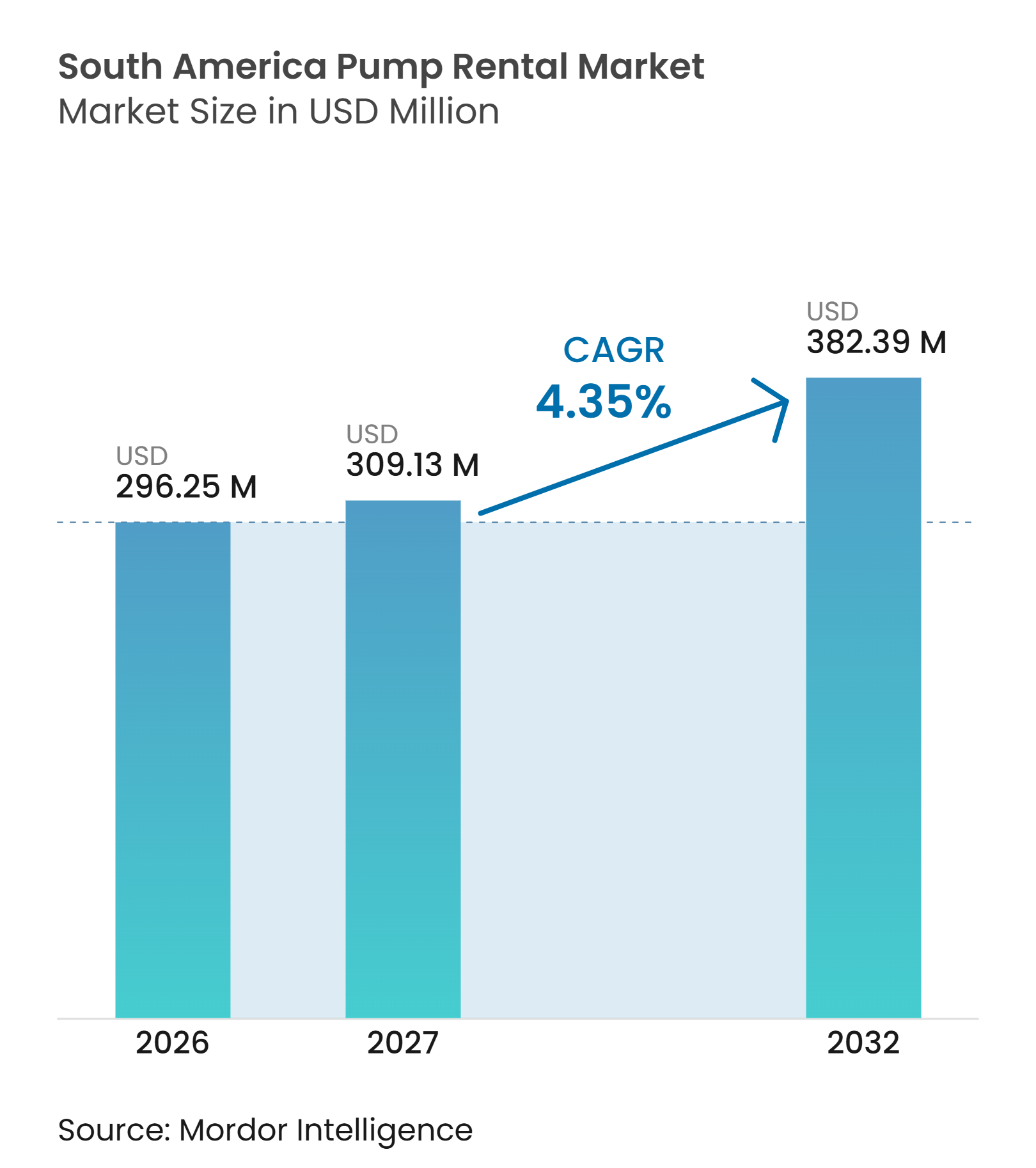
| Base Year Market Size (2026) | USD 296.25 Million |
| Market Size (2027) | USD 309.13 Million |
| Market Size (2032) | USD 382.39 Million |
| Growth Rate (2027 - 2032) | 4.35 % |
| Market Concentration | Medium |
Major Players *Disclaimer: Major Players sorted in no particular order Image © Mordor Intelligence. Reuse requires attribution under CC BY 4.0. | |
South America Pump Rental Market Analysis by Mordor Intelligence
The South America Pump Rental Market size is expected to grow from USD 296.25 million in 2026 to USD 309.13 million in 2027 and is forecast to reach USD 382.39 million by 2032 at 4.35% CAGR over 2027-2032. Brazil’s sanitation modernization program, mining investment in Chile and Argentina, and project-led construction activity support demand for temporary pumping capacity. These customers often need equipment before permanent assets are commissioned, which supports multi-month rental agreements. The South America pump rental market also benefits when customers prefer operating costs over capital purchases during periods of currency volatility. Connected fleets, electric pumps, and managed pumping contracts are becoming more relevant because operators need reliable performance at remote sites. Suppliers with nearby service teams and monitoring capabilities can compete on availability and response time rather than day-rate pricing alone.
Key Report Takeaways
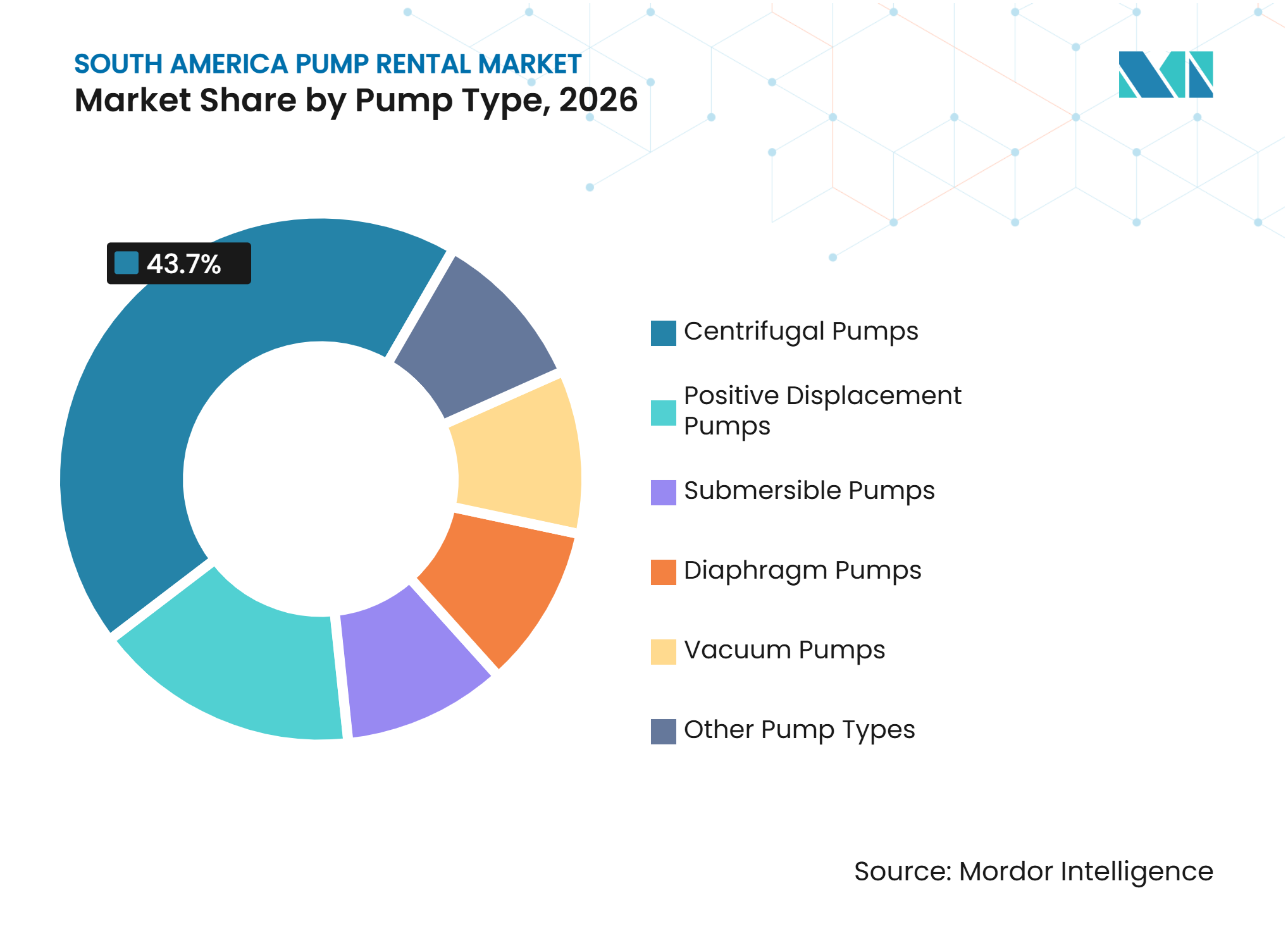
- By pump type, centrifugal pumps held 43.7% of the South America pump rental market share in 2026, while submersible pumps are forecast to expand at a 4.9% CAGR through 2032.
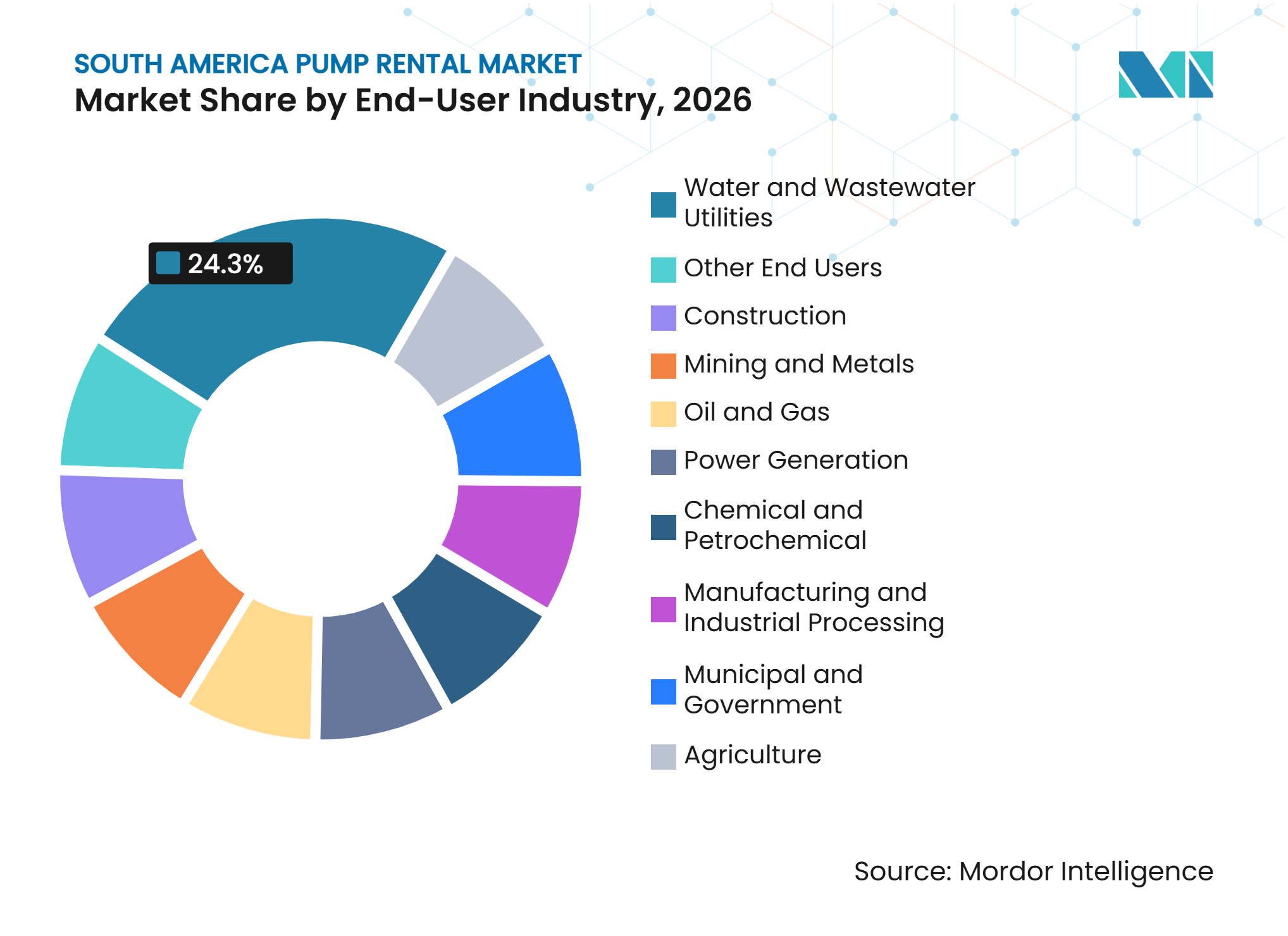
- By end-user industry, water and wastewater utilities accounted for 24.3% of the South America pump rental market share in 2026, while mining and metals recorded the highest projected CAGR at 4.7% through 2032.
- By geography, Brazil accounted for 48.5% of market revenue in 2026, while Chile is projected to grow at a 4.6% CAGR through 2032.
Note: Market numbers in this report are based on Mordor Intelligence's proprietary estimation framework, which combines nine months of actuals with Q4 projections for base year 2026.
Market Trends and Insights
Drivers Impact Analysis of South America Pump Rental Market*
| Driver | (~) % Impact on CAGR Forecast | Geographic Relevance | Impact Timeline |
|---|---|---|---|
| Brazil Sanitation and Wastewater Modernization | +1.6% | Brazil, with spillover to Argentina and Uruguay | Short term (≤ 2 years) |
| Mining Dewatering for Copper, Lithium, and Iron Ore | +1.1% | Chile, Argentina, and Brazil | Medium term (2-4 years) |
| Construction and Infrastructure Project Rental Demand | +0.7% | Brazil, Chile, and the wider region | Short term (≤ 2 years) |
| Emergency Flood Control and Sewer Bypass Requirements | +0.3% | Brazil, Argentina, and Bolivia | Short term (≤ 2 years) |
| Remote Monitoring and Turnkey Pumping Services | +0.4% | Brazil, Chile, and the wider region | Medium term (2-4 years) |
| Localized Fleets for High-Altitude and Corrosive Applications | +0.2% | Chile and Argentina | Long term (≥ 4 years) |
| Source: Mordor Intelligence | |||
Brazil Sanitation and Wastewater Modernization
Brazil’s sanitation targets provide a durable source of project activity for the South America pump rental market. Lei No. 14.026/2020 requires water and sewage service providers to work toward 99% water coverage and 90% sewage coverage by 2033.[1] The Ministry of Cities identifies USD 160.29 billion (BRL 882.4 billion) of investment needs through 2033, including USD 66.58 billion (BRL 366.5 billion) for water supply and sewage systems.[2] Sabesp reported USD 2.76 billion (BRL 15.2 billion) in capital investment for 2025, including infrastructure spending across its São Paulo network. ACCIONA received sanitation and water network contracts in northeastern Brazil during 2025. Contract transitions can require bypass systems and temporary pumping while new facilities are brought online. This operating need favors providers that can install, monitor, and maintain equipment under a single rental agreement.
Mining Dewatering for Copper, Lithium, and Iron Ore
Mining projects are a major source of specialized work for the South America pump rental market because remote operations need dewatering, seawater transfer, and standby capacity. The Chilean Copper Commission (COCHILCO) projects Chilean copper mining water demand will reach 22.1 m³/s by 2034, while seawater demand rises 113.2% and continental water demand falls 36.7%.[3] This shift requires additional pumping stages along long-distance pipelines and creates a service need during maintenance periods. The Weir Group secured a GBP 40 million contract from Codelco in 2025 for the Talabre tailings expansion, supplying GEHO and WARMAN pump systems with digital controls. Pumps used at altitude and in abrasive services require specialized maintenance and material selection. Rental providers with technical staff and locally held spare parts can respond more quickly than a supplier that only sells equipment. This supports longer contracts where availability and operating reliability are part of the service.
Construction and Infrastructure Project Rental Demand
Construction projects support the South America pump rental market when their equipment needs are temporary and linked to a defined work schedule. Developers can use rental fleets for excavation dewatering, runoff handling, and temporary water transfer without retaining equipment after project completion. Brazil’s construction safety framework, Norma Regulamentadora 18 (NR-18), places responsibility on worksites to meet defined safety requirements. Certified and maintained rental equipment can therefore reduce the operational burden on contractors. Pumping needs can rise sharply where construction occurs near mines, urban drainage systems, or environmentally controlled areas. The South America pump rental market gains from this pattern because customers value rapid mobilization, site setup, and demobilization. Providers that combine pumps with hoses, controls, generators, and field support are better positioned to serve complex project sites.
Remote Monitoring and Turnkey Pumping Services
Remote monitoring is becoming more important in the South America pump rental market because many mine, utility, and infrastructure sites operate far from central maintenance teams. Brazil’s National Water and Basic Sanitation Agency regulate water resource use and supports monitoring requirements for water withdrawals. Connected pumps can provide operating data, alarms, fuel use, pressure readings, and maintenance alerts. Itubombas describes satellite-connected monitoring solutions for fluid movement applications in Brazil.[4] This allows the service provider to manage uptime rather than simply delivering equipment. Customers can use the data to reduce site visits and plan maintenance before a failure interrupts work. This approach creates room for managed-service contracts that include the equipment, oversight, and response capability.
Restraints Impact Analysis of South America Pump Rental Market*
| Restraint | (~) % Impact on CAGR Forecast | Geographic Relevance | Impact Timeline |
|---|---|---|---|
| Exchange-Rate Volatility and Imported Equipment Costs | -0.9% | Argentina, Brazil, and Chile | Short term (≤ 2 years) |
| Remote-Site Logistics and Spare-Parts Availability | -0.5% | Chile, Argentina, and Brazil | Medium term (2-4 years) |
| Electricity, Fuel, and Maintenance Cost Burden | -0.4% | Across the region, especially remote sites | Medium term (2-4 years) |
| Informal Operators and Inconsistent Fleet Standards | -0.3% | Brazil and Argentina | Short term (≤ 2 years) |
| Source: Mordor Intelligence | |||
Exchange-Rate Volatility and Imported Equipment Costs
Exchange-rate changes restrain the South America pump rental market because specialized rental equipment often depends on imported components. A weaker local currency can raise the cost of fleet additions, spare parts, and manufacturer support. Operators may respond by delaying replacement cycles or adjusting rental rates more frequently. This can be difficult for customers that receive revenue in local currency but need equipment priced against global supply costs. Local production can reduce some exposure. KSB reports manufacturing operations in Brazil that support its regional supply position. However, specialized units and replacement parts may still depend on international supply chains. The restraint is most significant when currency volatility coincides with high demand for new fleet capacity.
Remote-Site Logistics and Spare-Parts Availability
Remote logistics can limit the South America pump rental market even where project demand is strong. Mining sites in northern Chile, Patagonia, the Amazon, and inland oil fields can be far from ports, service centers, and paved transport routes. Long travel distances increase the time and cost needed to deploy equipment and technicians. Specialty pumps may require nonstandard materials that local depots do not routinely stock. A delayed repair can outweigh a customer’s savings from a lower rental rate. Suppliers are responding by expanding regional service capacity, as shown by Ruhrpumpen’s Antofagasta facility. The South America pump rental market will remain sensitive to how effectively providers position fleets and parts near remote demand centers.
*Our forecasts treat driver/restraint impacts as directional, not additive. The impact forecasts reflect baseline growth, mix effects, and variable interactions.
South America Pump Rental Market Segment Analysis
By Pump Type:
Centrifugal Pumps Support Broad Rental Demand, While Submersibles Grow FasterCentrifugal pumps accounted for 43.7% of the South America pump rental market share in 2026. Their position reflects use across municipal transfer, construction dewatering, irrigation, and industrial process water applications. These units are well suited to high-flow work were straightforward maintenance and common spare parts support fleet utilization. Generalist rental providers can keep a large centrifugal fleet because the equipment serves many customer groups. This breadth reduces reliance on any single end user. The South America pump rental market size for centrifugal fleets is supported by sanitation and construction projects that need temporary water movement. Suppliers can differentiate through pump sizing, fuel efficiency, accessories, and on-site support rather than the core equipment alone.
Submersible pumps are forecast to grow at a 4.9% CAGR through 2032. Their use in mine dewatering and wastewater lift stations supports demand where pumps must operate below water level or in constrained spaces. These applications can require remote controls and rugged materials, which increases the value of specialist support. The South America pump rental market benefits when users rent submersibles for temporary or emergency tasks instead of purchasing units with irregular utilization. KSB identifies water, mining, and energy activity as important regional applications for its pump portfolio. Positive displacement, diaphragm, and vacuum pumps remain relevant for specialized chemical, oil and gas, and abrasive-fluid applications. These smaller categories can carry higher service requirements even when their installed fleet volume is lower.



By End-User Industry:
Utilities Provide Scale, While Mining Adds Specialized DemandWater and wastewater utilities held 24.3% of the South America pump rental market share in 2026. Brazil’s sanitation investment needs and concession activity support temporary pumping during construction, asset handovers, and maintenance. The Ministry of Cities continues to link universalization goals to major water and sewage investment requirements. Utility customers also need bypass systems when existing facilities are upgraded without interrupting service. These contracts favor providers that can design a temporary setup, operate it safely, and remove it when permanent assets are ready. The South America pump rental industry benefits from this work because project timelines can extend beyond a short emergency assignment. Monitoring and preventive maintenance are especially valuable where public service continuity is a contractual requirement.
Mining and metals is projected to expand to a 4.7% CAGR through 2032. Chile’s increasing reliance on seawater for copper mining supports pipeline, transfer, and dewatering needs at sites with demanding elevation profiles. Mining customers may require standby assets during maintenance and project phases, which makes rental a practical option alongside owned equipment. The Weir Group’s Talabre contract shows the engineering scale associated with tailings handling in Chile. Construction, oil and gas, agriculture, power generation, chemical processing, and municipal services supply additional demand patterns. Their contracts vary by site duration, fluid type, regulatory requirements, and service intensity. Utility work can prioritize service continuity, while mining customers may prioritize technical performance in difficult terrain. Construction customers often need faster mobilization and predictable end dates. This diversity can stabilize fleet use when activity in one end-user group slows. The South America pump rental industry is therefore not defined by equipment alone, but by the provider’s ability to serve several operating conditions with dependable field support.

Geography Analysis
Brazil
Brazil accounted for 48.5% of the South America pump rental market share in 2026. Its sanitation modernization program creates a large pipeline of water and sewage projects, while broader industrial and construction activity supports demand across several pump applications. The Legal Framework for Basic Sanitation sets national service targets for 2033 and supports continued investment in water and sewage infrastructure. Sabesp’s reported 2025 capital investment of USD 2.76 billion (BRL 15.2 billion) signals the scale of ongoing network activity in São Paulo. Brazil’s National Water and Sanitation Agency (ANA) has a centralregulatory role in water resource management and the use of monitoring data. Itubombas offers monitored pumping systems and fluid movement equipment from its Brazilian base. The country’s geographic scale favors suppliers with depot coverage, mobile technicians, and the ability to combine equipment with operating support.
Chile
Chile is forecast to expand at a 4.6% CAGR through 2032, making it the fastest-growing geography in the South America pump rental market. Copper mining is a central driver because the sector is shifting toward seawater use as continental water availability declines. These projects often move water across long distances and major elevation changes, which require staged pumping and reliable maintenance. Chile’s amended Water Code, Ley No. 21.740, strengthened supervision and procedural clarity around water rights in 2025. Tsurumi established Tsurumi Pump Latin America SpA in Santiago during 2025, targeting construction, water treatment, and mining customers. Ruhrpumpen’s Antofagasta service center also places service capacity closer to the Atacama mining region. The South America pump rental market size in Chile is supported by the need for locally available equipment, qualified technicians, and rapid parts access.
Argentina and the Rest of South America
Argentina and the rest of South America combine resource opportunities with varied operating constraints. Argentina’s Vaca Muerta activity and lithium projects can require high-specification water handling and monitoring services. Sulzer opened its third facility in Argentina, a 2,600 m² rotating equipment service center in Ezeiza, in July 2025. This investment expands local repair and field-service capacity for industrial customers. Currency volatility can make fleet replacement and contract pricing more difficult, which limits near-term expansion for smaller operators. Peru also provides mining-related demand through copper and polymetallic development, while Bolivia offers longer-term lithium-related potential. The South America pump rental market share outside Brazil and Chile remains dispersed, so access to service networks can be more important than a broad physical fleet. Providers can use regional hubs and partnerships to serve these markets while managing transport costs and equipment availability. The geography also requires contracts that account for different maintenance practices, local procurement conditions, and customer payment arrangements. This makes a uniform regional fleet less effective than a model that combines a common platform with local service decisions. It also gives established manufacturers a route into rental support through their service branches.
Competitive Landscape
Market Concentration
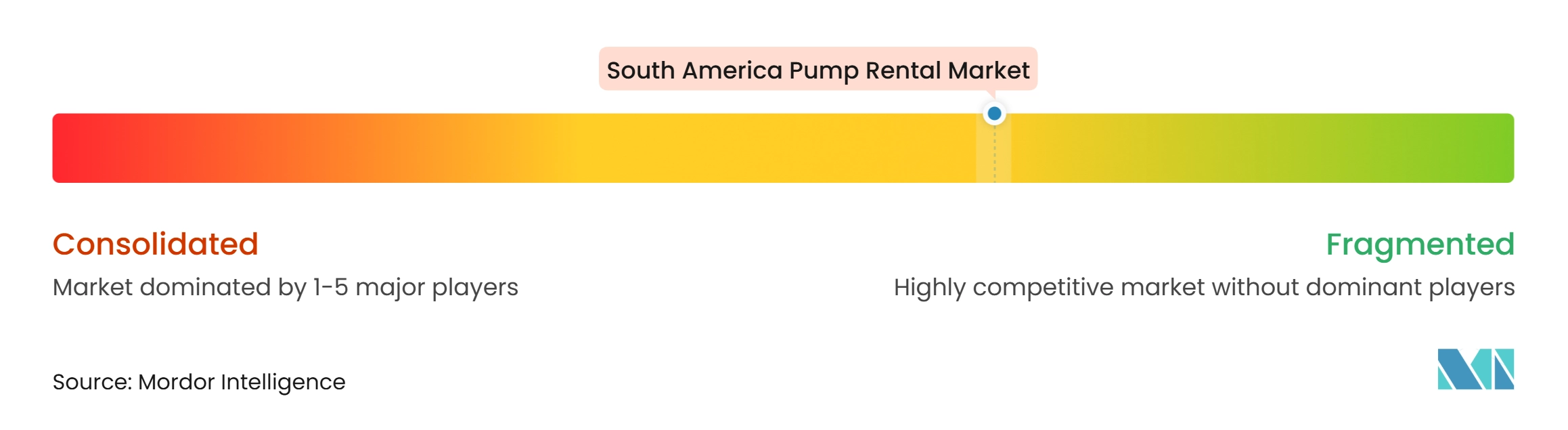
The South America pump rental market is moderately consolidated. It combines global equipment groups, rental specialists, and local service providers. Atlas Copco has a strong dedicated rental presence in Brazil through Itubombas, which the group identifies as part of its specialty rental offering. Itubombas presents diesel and electric equipment with connected monitoring for fluid-management work. Aggreko competes by combining power, temperature control, and fluid-management capabilities for complex sites. Local specialists can retain strong positions where they understand mining, construction, or utility requirements in a specific geography. Competition is therefore more fragmented for standard equipment than for managed projects requiring technical integration.
Service coverage is becoming a key basis of competition in the South America pump rental market. Sulzer expanded in Argentina with the Ezeiza facility, strengthening its service footprint for rotating equipment. Ruhrpumpen opened its Antofagasta center to improve proximity to customers in Chile’s mining regions. Tsurumi’s new Latin American subsidiary in Chile gives it a local platform for water treatment, construction, and mining applications. These moves show that providers are investing in response capability, not only equipment sales. Customers at remote sites may place more value on available parts, technical support, and uptime than on the lowest rental rate. Certification, documented quality practices, and proven safety processes can further separate formal providers from informal operators.
Technology is also changing the South America pump rental market. Connected equipment can help providers monitor pressure, location, fuel use, and maintenance needs without a constant site visit. Atlas Copco completed its acquisition of National Tank & Equipment in 2025, expanding its specialty rental capabilities in fluid-transfer and storage solutions. Almar Water Solutions and Transelec began construction of SIAM II for Centinela in Chile during 2025, adding major seawater transport capacity for mining operations. These examples point to closer links between pumping, water treatment, power supply, and digital controls. Customers can obtain a broader operating solution when the provider combines equipment, monitoring, maintenance, and site support. This model is particularly relevant where water management cannot be separated from energy availability or treatment capacity. It also raises the importance of clear service obligations during a project. The supplied evidence indicates a fragmented supplier base with several established global groups and local specialists, rather than a small group with documented control of the sector.
South America Pump Rental Industry Leaders
-
Atlas Copco AB
-
Xylem Inc.
-
Aggreko plc
-
Sulzer Ltd.
-
Wilo SE
- *Disclaimer: Major Players sorted in no particular order
South America Pump Rental Market Companies Covered in this Report
- A Geradora
- Aggreko plc
- Almar Water Services Latam
- ANDRITZ AG
- Atlas Copco AB
- EBARA Corporation
- FAMAC Motobombas Ltda.
- Flowserve Corporation
- Grundfos Holding A/S
- IMBIL – Indústria e Manutenção de Bombas ITA Ltda.
- Itubombas
- KSB SE & Co. KGaA
- Orco Ingeniería Ltda.
- Orguel Equipamentos e Serviços
- Ruhrpumpen Group
- Sulzer Ltd.
- The Weir Group PLC
- Tsurumi Manufacturing Co., Ltd.
- Wilo SE
- Xylem Inc.
Recent Industry Developments in South America Pump Rental Market
- August 2026: French equipment rental group Loxam has engaged Demarest Advogados and Spinelli Advogados to acquire a majority stake in Brazilian counterpart Mills for 3.8 billion reais. The deal marks a significant cross-border expansion for Loxam into the Brazilian equipment rental market.
- October 2025: Tsurumi Manufacturing Co., Ltd. established Tsurumi Pump Latin America SpA in Santiago, Chile, marking the company’s first South American subsidiary under its Transformation 2027 medium-term plan. The subsidiary targets construction, water treatment, and mining markets in Chile and neighboring countries including Argentina, Bolivia, Paraguay, and Uruguay, with submersible pumps as its core product.
- July 2025: Sulzer opened a third facility in Argentina, a 2,600 m² rotating equipment service center in Ezeiza, complementing its existing Buenos Aires main office and La Plata field service hub. The expansion followed a 15% increase in Argentine staff and is intended to serve oil and gas, pulp and paper, and power generation clients across the broader South American cone.
- July 2025: Ruhrpumpen inaugurated a new service center in Antofagasta, Chile. The facility is the first of several planned proximity centers designed to reduce parts lead times and emergency response times for major copper and lithium mining clients in the Atacama Region.
South America Pump Rental Market Report Scope
Pump rental is a service that provides temporary or long-term access to specialized pumping equipment without requiring an outright purchase.
South America pump rental market is segmented into pump type, end-use industry, and geography. By pump type, the market is segmented into centrifugal pumps, positive displacement pumps, submersible pumps, diaphragm pumps, vacuum pumps, and other pump types. By end-use industry, the market is divided among construction, mining and metals, oil and gas, water and wastewater utilities, power generation, chemical and petrochemical, manufacturing and industrial processing, municipal and government, agriculture, and other end users. The report also covers the market size and forecasts for the South America pump rental market across 3 countries in key countries. For each segment, the market sizing and forecasts have been provided on the basis of value (USD).
Segmentation Overview
| Centrifugal Pumps |
| Positive Displacement Pumps |
| Submersible Pumps |
| Diaphragm Pumps |
| Vacuum Pumps |
| Other Pump Types |
| Construction |
| Mining and Metals |
| Oil and Gas |
| Water and Wastewater Utilities |
| Power Generation |
| Chemical and Petrochemical |
| Manufacturing and Industrial Processing |
| Municipal and Government |
| Agriculture |
| Other End Users |
| Brazil |
| Argentina |
| Chile |
| Rest of South America |
| By Pump Type | Centrifugal Pumps |
| Positive Displacement Pumps | |
| Submersible Pumps | |
| Diaphragm Pumps | |
| Vacuum Pumps | |
| Other Pump Types | |
| By End-User Industry | Construction |
| Mining and Metals | |
| Oil and Gas | |
| Water and Wastewater Utilities | |
| Power Generation | |
| Chemical and Petrochemical | |
| Manufacturing and Industrial Processing | |
| Municipal and Government | |
| Agriculture | |
| Other End Users | |
| By Geography | Brazil |
| Argentina | |
| Chile | |
| Rest of South America |
Key Questions Answered in the Report
What is the projected value of South America pump rental by 2032?
The sector is projected to reach USD 382.39 million by 2032, growing at a 4.35% CAGR from 2027.
Which pump type leads rental demand in South America?
Centrifugal pumps lead with 43.7% revenue share in 2026 because they serve a broad set of water transfer, construction, and industrial applications.
Which end-user group is expanding fastest?
Mining and metals is forecast to grow at a 4.7% CAGR through 2032, supported by dewatering and seawater transfer requirements.
Why is Brazil important for pump rental suppliers?
Brazil accounts for 48.5% of 2026 revenue and has a large sanitation infrastructure pipeline under its national legal framework.
Why is Chile expected to grow faster than other countries?
Chile is forecast to grow at a 4.6% CAGR through 2032 as copper mining increasingly relies on seawater pipelines and specialized pumping.
What capabilities matter most to rental providers?
Remote monitoring, rapid site response, available spare parts, and the ability to manage high-altitude or corrosive applications are key competitive capabilities.