
South America Public Infrastructure Safety Market Size and Share
Market Overview
| Study Period | 2020 - 2031 |
|---|---|
| Forecast Data Period | 2026 - 2031 |
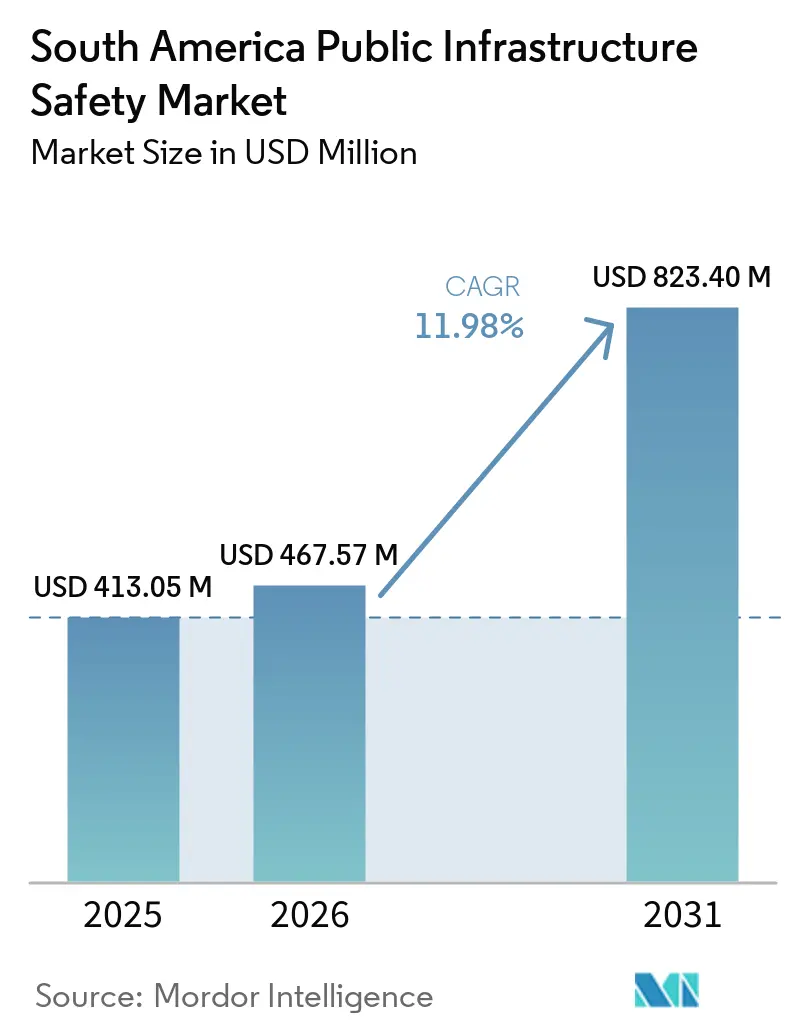
| Base Year Market Size (2025) | USD 413.05 Million |
| Market Size (2026) | USD 467.57 Million |
| Market Size (2031) | USD 823.40 Million |
| Growth Rate (2026 - 2031) | 11.98 % |
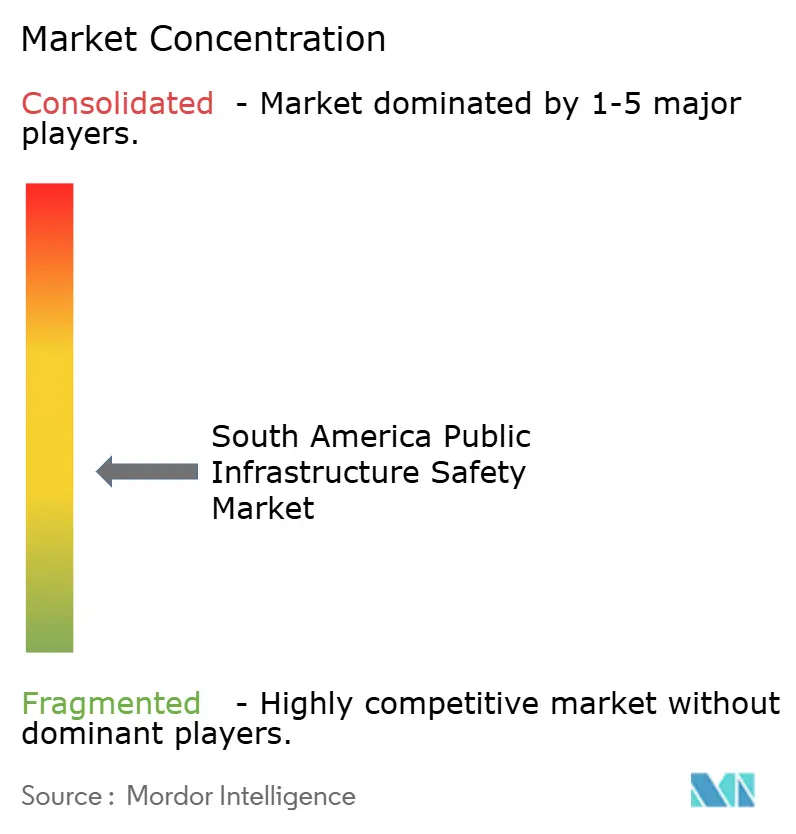
| Market Concentration | Medium |
Major Players *Disclaimer: Major Players sorted in no particular order Image © Mordor Intelligence. Reuse requires attribution under CC BY 4.0. | |
South America Public Infrastructure Safety Market Analysis by Mordor Intelligence
The South America Public Infrastructure Safety Market size was valued at USD 413.05 million in 2025 and estimated to grow from USD 467.57 million in 2026 to reach USD 823.40 million by 2031, at a CAGR of 11.98% during the forecast period 2026 to 2031. Urban security needs, government safe-city programs, and modernization of transport and utility networks support demand. Procurement is shifting toward integrated contracts that combine equipment, software, and managed services. Programs in Brazil show that public buyers increasingly require cameras, sensors, communications, and control centers to work together. This change creates opportunities for providers that can support installation, integration, and ongoing operations. Cybersecurity requirements are also becoming more important in projects for power, water, ports, and transport assets.
Key Report Takeaways
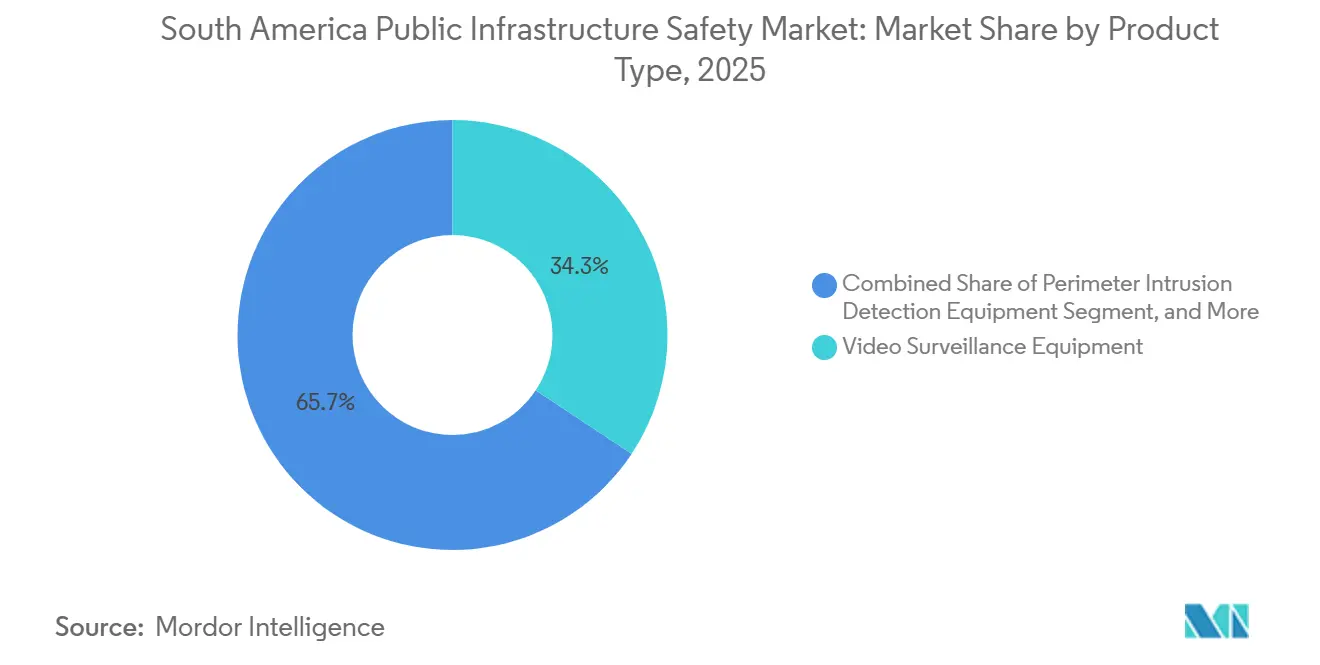
- By product type, Video Surveillance Equipment led with 34.32% of the South America Public Infrastructure Safety Market share in 2025, while Other Public Infrastructure Safety Products is forecast to grow at an 12.11% CAGR through 2031.
- By systems, Physical Security Systems held 44.16% share in 2025, while Cyber-Physical Infrastructure Protection Systems recorded the highest projected CAGR at 12.42% through 2031.
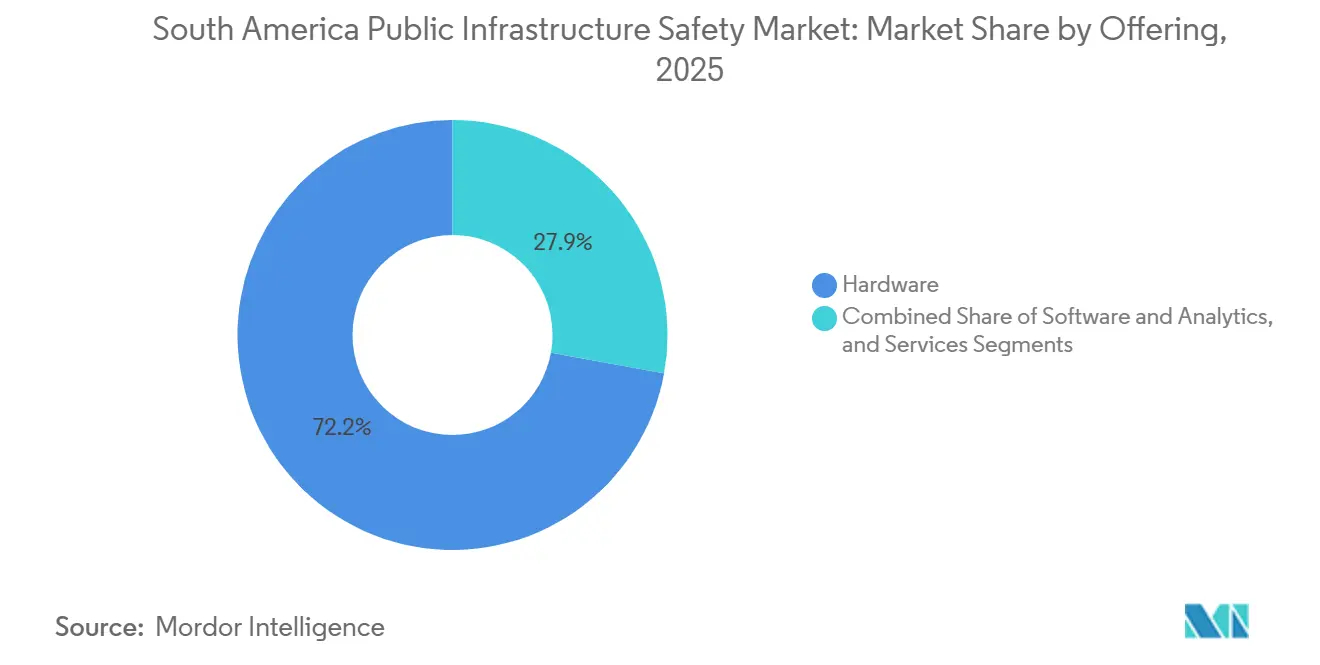
- By offering, Hardware accounted for a 72.15% share of the South America Public Infrastructure Safety Market in 2025, while Software and Analytics are forecast to expand at a 12.78% CAGR through 2031.
- By deployment mode, On-Premises held a 58.54% share in 2025, while Hybrid and Edge-Based deployments are projected to grow at a 13.38% CAGR through 2031.
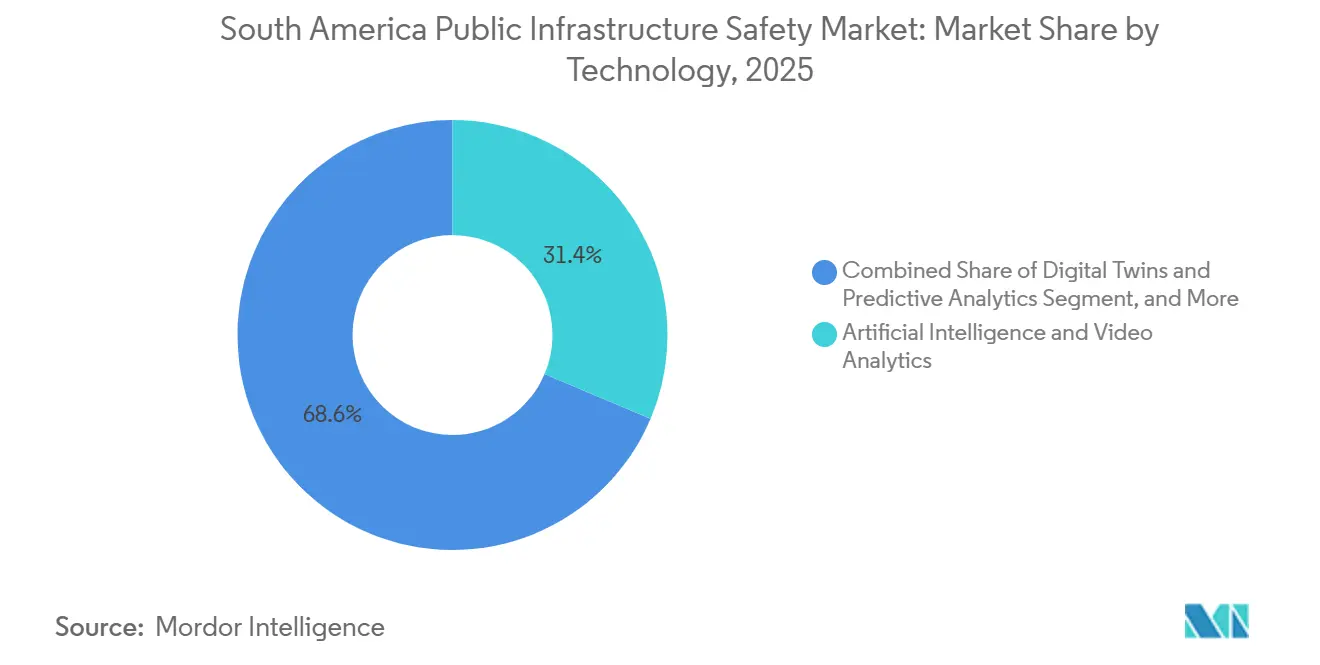
- By technology, Artificial Intelligence and Video Analytics held a 31.36% share of the South America Public Infrastructure Safety Market in 2025, while Digital Twins and Predictive Analytics are forecast to grow at a 13.12% CAGR through 2031.
- By application, Transportation Infrastructure held 39.11% share in 2025, while Utilities and Critical Infrastructure are forecast to expand at an 12.89% CAGR through 2031.
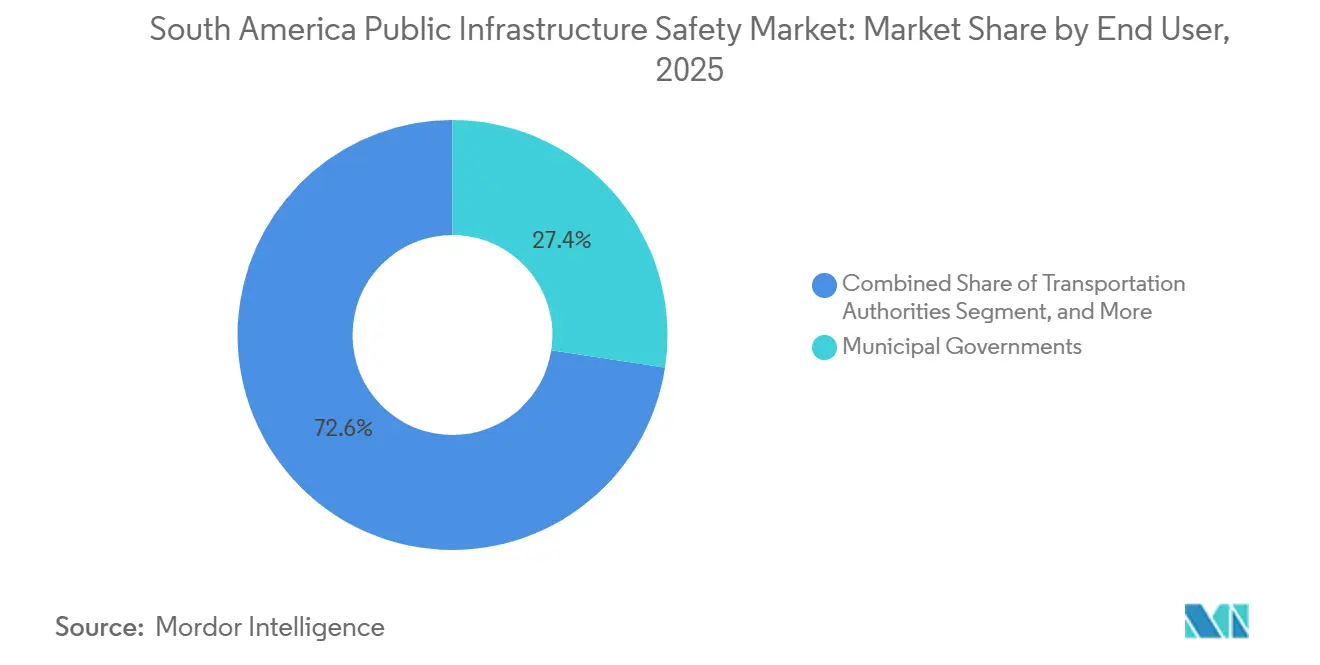
- By end user, Municipal Governments held a 27.42% share in the South America Public Infrastructure Safety Market 2025, while Transportation Authorities and Concessionaires are projected to grow at a 12.71% CAGR through 2031.
- By geography, Brazil led with 30.12% share in 2025, while Chile is forecast to expand at an 12.11% CAGR through 2031.
Note: Market size and forecast figures in this report are generated using Mordor Intelligence’s proprietary estimation framework, updated with the latest available data and insights as of January 2026.
Market Trends and Insights
Drivers Impact Analysis of South America Public Infrastructure Safety Market*
| Driver | (~) % Impact on CAGR Forecast | Geographic Relevance | Impact Timeline |
|---|---|---|---|
| Public-Sector Smart-City and Safe-City Investment | +2.2% | Brazil, Colombia, Chile, Argentina, and Peru | Short term (≤ 2 years) |
| Government Road-Safety and Infrastructure Modernization Programs | +1.5% | Brazil, Chile, and Colombia | Medium term (2-4 years) |
| Migration from Analog Surveillance to AI-Enabled Video Systems | +1.3% | Brazil, Colombia, Argentina, and Chile | Short term (≤ 2 years) |
| Expansion of Integrated Critical-Infrastructure Protection | +1.0% | Brazil, Chile, Colombia, Venezuela, and Rest of South America | Medium term (2-4 years) |
| Digitization of Distributed Infrastructure Assets | +0.8% | Brazil, Chile, Colombia, and Argentina | Medium term (2-4 years) |
| Resilient Safety Systems for Unreliable Power and Connectivity | +0.5% | Venezuela and secondary cities across South America | Long term (≥ 4 years) |
| Source: Mordor Intelligence | |||
Public-Sector Smart-City and Safe-City Investment
Municipal and state agencies are moving from pilot projects to broader public-safety deployments. These projects increasingly include surveillance cameras, sensors, control centers, and monitoring services under one contract. Rio Grande do Sul launched the RS Atento program in April 2026 for 23 cities, combining AI cameras, sensors, and an incident platform for public spaces and schools. Lima and CAF signed a 2026 technical cooperation agreement for the diagnostics and design of smart security systems.[1] Such work can move projects from planning into larger procurement programs. The South America Public Infrastructure Safety Market benefits when contracts include operational support because suppliers can extend their relationship beyond initial equipment delivery.
Government Road-Safety and Infrastructure Modernization Programs
Road concessions and government corridor projects are expanding demand for monitoring and response systems. Chile’s 2025 to 2026 concession portfolio included USD 8.6 billion across 15 projects, including safety-compliant road corridors and public safety facilities. São Paulo authorized the BRL 284 million, USD 49.6 million, Rodoanel Seguro program in April 2026. The program includes 4K cameras, license-plate reading, facial recognition, fiber infrastructure, and intelligent lighting. These requirements connect safety technology to broader transport modernization work. The South America Public Infrastructure Safety Market gains a second driver of demand when concessionaires must meet technology upgrade obligations.
Migration From Analog Surveillance to AI-Enabled Video Systems
Public authorities are upgrading existing camera networks rather than replacing every unit at once. São Paulo had 25,000 Smart Sampa cameras installed by 2025 and was planning AI upgrades to the existing network.[2] Paraná committed BRL 400 million (USD 68.9 million) in 2025 for 1,500 AI-capable cameras, with a plan for 26,500 units. Chile’s SITIA platform was active in 5 regions by August 2025 and integrated camera and license-plate reader systems. This approach increases spending on video management, analytics, and system integration. It also allows equipment suppliers to offer upgrade paths alongside new installations.[3]
Expansion of Integrated Critical-Infrastructure Protection
Utilities, ports, and transport networks are combining physical protection with cybersecurity controls. Magos Systems reported that Eletrobras Chesf installed 310 radars, 2,991 cameras, and 245 km of fiber across more than 90 Brazilian substations by 2025. Colombia’s National Operation Council updated its electricity cybersecurity framework through Agreement 1960 in 2025. The agreement used a risk-based approach for critical assets, including protection systems and dam gates. Chile also deployed a quantum-safe communication link for electricity-grid control in 2026, although this development is not used as a source for the analysis. The South America Public Infrastructure Safety Market is supported by projects that require one provider or team to coordinate surveillance, access, network protection, and control-system security.[4]
Restraints Impact Analysis of South America Public Infrastructure Safety Market*
| Restraint | (~) % Impact on CAGR Forecast | Geographic Relevance | Impact Timeline |
|---|---|---|---|
| Public Procurement Delays and Budget Uncertainty | -0.8% | Brazil, Colombia, Argentina, and other South American countries | Short term (≤ 2 years) |
| Import Duties and Local-Content Requirements | -0.6% | Brazil, Argentina, and Colombia | Medium term (2-4 years) |
| Fragmented Standards Across South American Countries | -0.4% | All South American countries, especially multi-country projects | Long term (≥ 4 years) |
| Shortage of Certified Installation and Maintenance Specialists | -0.3% | Secondary cities, Venezuela, and Rest of South America | Medium term (2-4 years) |
| Source: Mordor Intelligence | |||
Public Procurement Delays and Budget Uncertainty
Public contracts can face delays when budgets change or agencies lack delivery capacity. These delays can separate procurement announcements from physical installation by several years. They also make it harder for suppliers to forecast shipment timing and service revenue. Large programs may require local integrators to accept some payment and implementation risk. Providers with local teams and established financing relationships can be better prepared for those timing gaps. This restraint most affects the South America Public Infrastructure Safety Market when public buyers defer capital spending while retaining the underlying safety requirement.
Import Duties and Local-Content Requirements
Import duties can increase the delivered cost of finished cameras, access-control products, and fire-safety equipment. Brazil’s tax structure has encouraged global vendors to work through local distributors, integrators, and assembly partners. Local participation also helps suppliers manage installation, maintenance, and logistics after deployment. Argentina’s import controls and foreign-exchange restrictions add uncertainty for cross-border suppliers. Local-content requirements can narrow the addressable opportunity for equipment suppliers that depend entirely on imports. These conditions favor providers that build an in-country delivery model before bidding for large public projects.
*Our forecasts treat driver/restraint impacts as directional, not additive. The impact forecasts reflect baseline growth, mix effects, and variable interactions.
South America Public Infrastructure Safety Market Segment Analysis
By Product Type:
Video Surveillance Holds Scale While Other Products Grow FasterVideo Surveillance Equipment held 34.32% of the South America Public Infrastructure Safety Market in 2025. Municipal camera programs in Brazil, Colombia, and Chile supported this position. The installed base is shifting toward AI-capable cameras with behavioral detection, facial recognition, and license-plate identification. São Paulo’s existing camera network illustrates why software upgrades can accompany equipment replacement. Video surveillance remains central to city, road, and transport projects because it produces the core visual data used by command centers. Demand also extends to cameras that work in low-light, high-traffic, and remote settings.
Other Public Infrastructure Safety Products is forecast to grow at an 12.11% CAGR through 2031. This group includes drone-based surveillance, perimeter radar, and environmental sensors for flood and infrastructure monitoring. Water-level detection cameras can support river monitoring and emergency response in flood-prone locations. Access-control equipment, fire detection, road barriers, emergency communications, and intrusion detection retain separate purchasing cycles. Fire equipment is linked to building requirements, while road products are tied to concession upgrades. Perimeter products are becoming more relevant at substations and ports where operators are replacing guard-only models with radar and camera coverage.

By Systems:
Physical Security Leads While Cyber-Physical Protection ExpandsPhysical Security Systems accounted for 44.16% of the market in 2025. Surveillance, access control, and perimeter systems remain widely deployed at transport hubs, civic buildings, and government facilities. Public buyers increasingly favor unified command environments rather than isolated devices. Johnson Controls positions its critical-infrastructure systems around integrated video, access, and fire-safety operations. This model reflects the need to coordinate several safety functions during incidents. Physical systems will continue to anchor deployments where agencies are building basic surveillance and access infrastructure.
Cyber-Physical Infrastructure Protection Systems is forecast to grow at an 12.42% CAGR through 2031. Energy-sector requirements are moving cyber controls closer to physical security investments. Colombia’s Agreement 1960 applies risk-based controls to critical electricity assets. This requires utilities to consider network resilience, control-system access, and site protection together. Fire and Life-Safety Systems remain linked to hospitals, data centers, schools, and public buildings. Road and Transport Safety Systems benefit from concession-based highway modernization. The South America Public Infrastructure Safety Market, therefore, includes a growing need for integrated delivery across operational technology and physical assets.
By Offering:
Hardware Leads Spending While Software and Analytics Grows FasterHardware held 72.15% of the South America Public Infrastructure Safety Market in 2025. New programs still require cameras, sensors, control panels, communications equipment, and physical access devices. This high share reflects the ongoing buildout of foundational public-safety infrastructure. Many public agencies are installing systems that more mature cities deployed earlier. Services also play an important role because municipalities often require external system integration, maintenance, and managed monitoring. Hardware will remain important while new safe-city and transport projects continue to add field equipment.
Software and Analytics is forecast to grow at an 12.78% CAGR through 2031. AI platforms can be added to existing camera estates, creating a recurring revenue path for providers. ISA Vías and DXC deployed a digital twin on Chile’s Ruta del Maipo in June 2025 for traffic analysis, emergency simulation, and predictive maintenance.[5] CPFL Energia also described a platform that uses machine learning and data from more than 1,800 instruments across 56 Brazilian hydroelectric plants. These examples show that infrastructure operators can use analytics after physical assets are installed. Software demand grows when buyers seek faster incident response and better asset-condition visibility.
By Deployment Mode:
On-Premises Is Established While Hybrid and Edge-Based Systems AdvanceOn-premises deployment accounted for 58.54% of the market in 2025. Government agencies often prefer self-contained environments for sensitive surveillance and communications data. Brazil launched the Rede Privativa do Governo Federal in June 2026 as a dedicated network connecting security institutions. This model supports control over data, network access, and system operations. On-premises configurations remain relevant where agencies have strict sovereignty requirements. They also fit large public facilities with established internal technology teams.
Hybrid and Edge-Based deployment is forecast to grow at a 13.38% CAGR through 2031. Remote highways, border points, secondary cities, and distributed energy assets do not always have reliable network connectivity. Edge processing allows cameras and sensors to analyze data locally before sharing selected information. This reduces dependence on a constant connection to a central data center. The RS Atento program covers 23 cities, illustrating the dispersed operating conditions that require resilient field systems. Cloud deployment is growing in connected metropolitan locations, but public-sector data concerns continue to limit its use in sensitive applications.
By Technology:
AI and Video Analytics Leads While Digital Twins Gain UseArtificial Intelligence and Video Analytics held 31.36% of the market in 2025. AI-enabled cameras are increasingly specified in municipal surveillance projects. The technology supports event detection, traffic analysis, facial recognition, and license-plate reading. Chile’s SITIA platform demonstrates how public and private camera feeds can be linked through a government analytics framework. Biometrics and digital identity remain important for controlled access and public safety. Internet of Things sensors, thermal imaging, drones, and multi-sensor systems support infrastructure monitoring in difficult operating conditions.
Digital Twins and Predictive Analytics are forecast to grow at an 13.12% CAGR through 2031. This technology supports a shift toward planning and prevention instead of responding only after an event. DXC’s Ruta del Maipo deployment allowed operators to model road conditions and emergency scenarios. CESAR described a Petrobras digital twin project to monitor CO₂ corrosion on offshore risers.[6] Connected roadside systems integrate sensors, lighting, and communications nodes to support road operations. These capabilities become more useful as agencies collect data from cameras, infrastructure sensors, and field personnel.
By Application:
Transportation Leads While Utilities and Critical Infrastructure Grows FastestTransportation Infrastructure held 39.11% of the South America Public Infrastructure Safety Market in 2025. Highway monitoring, toll-plaza control, airport perimeter security, and transit surveillance supported the segment. Chile’s concession portfolio included road projects where safety compliance was an explicit requirement. Road modernization typically requires cameras, communications, emergency systems, and control-center integration. Government and Civic Infrastructure also require building security for public offices, courts, detention facilities, and civic spaces. Transportation will retain its leading position because many projects combine physical infrastructure renewal with operating technology.
Utilities and Critical Infrastructure are forecast to grow at an 12.89% CAGR through 2031. Regulatory requirements are pushing power operators to improve protection for control systems and sites. Eletrobras Chesf’s substation deployment shows the scale of radar, camera, and fiber integration required for electricity assets. Healthcare and Educational Infrastructure grow through hospital projects and school security programs. Industrial and Logistics Infrastructure also needs surveillance, access control, and fire protection in ports and distribution facilities. This application group is supported by the need to keep essential services operational. The South America Public Infrastructure Safety Market benefits when asset owners manage physical threats and cyber risks through coordinated investments.
By End User:
Municipal Governments Lead While Concessionaires Increase Technology UseMunicipal Governments held 27.42% of the market in 2025. Their spending covers cameras, control centers, public-space monitoring, school protection, and incident coordination. City-level projects can vary widely in size but create a large base of deployments across South America. RS Atento is an example of a public program that spans multiple cities and school settings. Federal agencies and state governments also award large contracts for national networks and highway infrastructure. Utility operators purchase specialized systems for substations, grids, and other controlled facilities.
Transportation Authorities and Concessionaires are forecast to grow at an 12.71% CAGR through 2031. Public-private financing increasingly links safety technology to concession obligations. Operators use digital twins, cameras, and communications systems to manage risk and meet performance standards. ISA Vías used DXC’s digital twin platform on a concession-managed road in Chile. Construction and infrastructure contractors also embed safety systems into engineering and delivery programs. Healthcare and educational institutions remain a growing end-user group because new facilities require fire, access, and emergency communications systems. The segment’s growth reflects stronger technology requirements in long-term infrastructure operating agreements.
Geography Analysis
Brazil Public Infrastructure Safety Market
Brazil led the South America Public Infrastructure Safety Market with a 30.12% share in 2025. It has the largest volume of public-safety, transport, and communications projects in the region. São Paulo authorized BRL 284 million, USD 49.6 million, for Rodoanel Seguro in April 2026. The federal government also launched a private communications network for security institutions in June 2026. Brazil’s scale supports demand from basic surveillance equipment to advanced communications and analytics. Its local delivery requirements can favor suppliers with established partners and service capacity.
Chile Public Infrastructure Safety Market
Chile is forecast to grow at an 12.11% CAGR through 2031. Its 2025 to 2055 infrastructure plan and concession framework support a pipeline that extends beyond annual government spending cycles. SITIA was active in 5 regions by August 2025 and provides a shared analytics environment for surveillance networks. Chile also has road operators using digital twins for emergency response and predictive maintenance. These conditions support demand for compatible platforms, transport safety systems, and utility protection. Data-protection requirements scheduled for December 2026 may increase demand for privacy-conscious video analytics.
South America Public Infrastructure Safety Market
Colombia remains an important growth area for integrated city and transport safety projects. Colombia’s electricity sector cybersecurity framework is relevant to protecting critical assets. Budget constraints can delay procurement, even where safety needs remain high. Argentina continues smart-city and airport-security upgrades but faces constraints due to import restrictions and currency controls. Venezuela remains limited to essential maintenance projects because of political and economic conditions. Peru’s Ministry of Interior launched a 2025 AI video-surveillance pilot integrating 3,282 cameras from police and municipal networks. Ecuador, Bolivia, Paraguay, Uruguay, and other countries offer additional project opportunities, particularly in areas where public security and road modernization programs are advancing.[7]
Competitive Landscape
The South America Public Infrastructure Safety Market is moderately fragmented. Global technology manufacturers, including Hangzhou Hikvision Digital Technology, Zhejiang Dahua Technology, Honeywell International, and Johnson Controls, compete in high-volume procurement for surveillance and access control. Regional integrators and specialists remain important in command centers, local deployment, and maintenance.[8] Competition is fragmented across fire safety, road safety products, and systems integration. Johnson Controls introduced exacqVision 26.0 and Kantech EntraPass 9.10 at ISC West in March 2026, strengthening interoperability across video and access-control systems. This supports its position in projects that need coordinated security operations.
Hikvision and Dahua remain relevant in camera-led public procurement, while their local distribution and installation networks shape their ability to compete. Johnson Controls emphasizes integrated command-center capabilities for critical infrastructure customers. Suppliers can differentiate through interoperability, cybersecurity readiness, and the ability to support local deployment. These factors matter more when customers require systems to connect with existing networks and control centers.
Regional providers can compete effectively where public tenders value local operations and tailored command-center services. Seguritech won the Medellín C5i contract in May 2026 with its SAIMON Tech platform. Road-safety manufacturers face rising competition as concession activity increases in Brazil, Chile, and Colombia. Lindsay Corporation reported 8% revenue growth in its infrastructure segment in the third quarter of fiscal year 2026, driven by demand for road-safety products. Fire-safety standards and local certification requirements support established providers by providing code knowledge and servicing capabilities. The competitive environment remains balanced between global product scale and local execution strength.
South America Public Infrastructure Safety Industry Leaders
-
Hangzhou Hikvision Digital Technology Co., Ltd.
-
Robert Bosch GmbH
-
Honeywell International Inc.
-
Zhejiang Dahua Technology Co., Ltd.
-
Johnson Controls International plc
- *Disclaimer: Major Players sorted in no particular order
South America Public Infrastructure Safety Market Companies Covered in this Report
- Hangzhou Hikvision Digital Technology Co., Ltd.
- Zhejiang Dahua Technology Co., Ltd.
- Axis Communications AB
- Hanwha Vision Co., Ltd.
- Robert Bosch GmbH
- Honeywell International Inc.
- Johnson Controls International plc
- ASSA ABLOY AB
- Allegion plc
- dormakaba International Holding AG
- MSA Safety Incorporated
- Rosenbauer International AG
- Gentex Corporation
- HOCHIKI CORPORATION
- Nittan Company, Limited
- NAPCO Security Technologies, Inc.
- METALESA SEGURIDAD VIAL, S.L.
- Lindsay Corporation
- Valmont Industries, Inc.
- Cochrane Corporation
- Pandrol Limited
Recent Industry Developments in South America Public Infrastructure Safety Market
- June 2026: Brazil's ministries of Justice and Communications launched the BRL 1 billion, USD 174.5 million, Rede Privativa do Governo Federal, a dedicated private communications network integrating federal security agencies, including the Brazilian Army, Federal Police, and Congressional security forces, on a unified government-owned infrastructure with nationwide rollout continuing through 2027.
- May 2026: Seguritech signed a contract with Medellín to build Colombia's first C5i command center, with an investment exceeding COP 205 billion (USD 48.8 million), deploying its SAIMON Tech AI dispatch platform, integrated with thousands of cameras, license plate readers, IoT sensors, and planned counter-drone systems.
- April 2026: São Paulo's state government authorized the BRL 284 million (USD 49.6 million), Rodoanel Seguro program deploying 4K cameras with facial recognition and license-plate reading integrated into the Muralha Paulista network, alongside high-capacity fiber optic and intelligent lighting across 174 km of the Rodoanel Mário Covas.
- April 2026: Rio Grande do Sul launched the RS Atento program for 23 cities with BRL 199.6 million, (USD 34.4 million), in investment through 2027, integrating AI cameras, advanced sensors, and an AI-driven incident platform for public-safety monitoring and school-environment security.
South America Public Infrastructure Safety Market Report Scope
The South America Public Infrastructure Safety Market refers to the integrated hardware, software, and services designed to protect critical public assets and ensure civilian safety. It encompasses physical security, fire safety, and road transport systems equipped with advanced technologies like AI video analytics, IoT sensors, drones, and digital twins. Deployed across transportation, government, and utility sectors via on-premises or cloud models, these solutions help regional authorities and operators prevent incidents, manage emergencies, and secure essential infrastructure against physical and cyber-physical threats.
The South America Public Infrastructure Safety Market Report is Segmented by Product Type (Video Surveillance Equipment, Access-Control and Identification Equipment, Fire Detection and Suppression Equipment, Road Safety Barriers and Crash Protection Equipment, Emergency Communication and Mass Notification Equipment, Perimeter Intrusion Detection Equipment, Public Infrastructure Safety Lighting and Signaling Equipment, and Other Public Infrastructure Safety Products), Systems (Physical Security Systems, Fire and Life-Safety Systems, Road and Transport Safety Systems, and Cyber-Physical Infrastructure Protection Systems), Offering (Hardware, Software and Analytics, and Services), Deployment Mode (On-Premises, Cloud-Based, and Hybrid and Edge-Based), Technology (Artificial Intelligence and Video Analytics, Biometrics and Digital Identity, Internet of Things and Sensor Networks, Thermal and Multi-Sensor Imaging, Drones and Unmanned Surveillance, Digital Twins and Predictive Analytics, and Connected Roadside and Smart-Pole Technology), Application (Transportation Infrastructure, Government and Civic Infrastructure, Utilities and Critical Infrastructure, Healthcare and Educational Infrastructure, and Industrial and Logistics Infrastructure), End User (Federal and National Government Agencies, State and Provincial Governments, Municipal Governments, Transportation Authorities and Concessionaires, Utility Operators, Construction and Infrastructure Contractors, Healthcare and Educational Institutions, and Industrial and Commercial Facility Operators), and Geography (Brazil, Argentina, Colombia, Chile, and Rest of South America). The Market Forecasts are Provided in Terms of Value (USD).
Segmentation Overview
| Video Surveillance Equipment |
| Access-Control and Identification Equipment |
| Fire Detection and Suppression Equipment |
| Road Safety Barriers and Crash Protection Equipment |
| Emergency Communication and Mass Notification Equipment |
| Perimeter Intrusion Detection Equipment |
| Public Infrastructure Safety Lighting and Signaling Equipment |
| Other Public Infrastructure Safety Products |
| Physical Security Systems |
| Fire and Life-Safety Systems |
| Road and Transport Safety Systems |
| Cyber-Physical Infrastructure Protection Systems |
| Hardware |
| Software and Analytics |
| Services |
| On-Premises |
| Cloud-Based |
| Hybrid and Edge-Based |
| Artificial Intelligence and Video Analytics |
| Biometrics and Digital Identity |
| Internet of Things and Sensor Networks |
| Thermal and Multi-Sensor Imaging |
| Drones and Unmanned Surveillance |
| Digital Twins and Predictive Analytics |
| Connected Roadside and Smart-Pole Technology |
| Transportation Infrastructure |
| Government and Civic Infrastructure |
| Utilities and Critical Infrastructure |
| Healthcare and Educational Infrastructure |
| Industrial and Logistics Infrastructure |
| Federal and National Government Agencies |
| State and Provincial Governments |
| Municipal Governments |
| Transportation Authorities and Concessionaires |
| Utility Operators |
| Construction and Infrastructure Contractors |
| Healthcare and Educational Institutions |
| Industrial and Commercial Facility Operators |
| Brazil |
| Argentina |
| Colombia |
| Chile |
| Rest of South America |
| By Product Type | Video Surveillance Equipment |
| Access-Control and Identification Equipment | |
| Fire Detection and Suppression Equipment | |
| Road Safety Barriers and Crash Protection Equipment | |
| Emergency Communication and Mass Notification Equipment | |
| Perimeter Intrusion Detection Equipment | |
| Public Infrastructure Safety Lighting and Signaling Equipment | |
| Other Public Infrastructure Safety Products | |
| By Systems | Physical Security Systems |
| Fire and Life-Safety Systems | |
| Road and Transport Safety Systems | |
| Cyber-Physical Infrastructure Protection Systems | |
| By Offering | Hardware |
| Software and Analytics | |
| Services | |
| By Deployment Mode | On-Premises |
| Cloud-Based | |
| Hybrid and Edge-Based | |
| By Technology | Artificial Intelligence and Video Analytics |
| Biometrics and Digital Identity | |
| Internet of Things and Sensor Networks | |
| Thermal and Multi-Sensor Imaging | |
| Drones and Unmanned Surveillance | |
| Digital Twins and Predictive Analytics | |
| Connected Roadside and Smart-Pole Technology | |
| By Application | Transportation Infrastructure |
| Government and Civic Infrastructure | |
| Utilities and Critical Infrastructure | |
| Healthcare and Educational Infrastructure | |
| Industrial and Logistics Infrastructure | |
| By End User | Federal and National Government Agencies |
| State and Provincial Governments | |
| Municipal Governments | |
| Transportation Authorities and Concessionaires | |
| Utility Operators | |
| Construction and Infrastructure Contractors | |
| Healthcare and Educational Institutions | |
| Industrial and Commercial Facility Operators | |
| By Geography | Brazil |
| Argentina | |
| Colombia | |
| Chile | |
| Rest of South America |
Key Questions Answered in the Report
What is the South America Public Infrastructure Safety Market size?
The market was valued at USD 413.05 million in 2025 and is estimated at USD 467.57 million in 2026. It is forecast to reach USD 823.40 million by 2031 at a 11.98% CAGR.
Which product category led public infrastructure safety spending in South America?
Video Surveillance Equipment led with 34.32% in 2025, supported by municipal camera, transport, and public-space monitoring programs.
Which deployment approach is growing the fastest?
Hybrid and Edge-Based deployment is forecast to grow at a 13.38% CAGR through 2031 because remote infrastructure requires local processing and resilient connectivity.
Why are utilities increasing security investment?
Utility operators are combining perimeter protection with cybersecurity controls for substations, grids, water assets, and other essential systems.
Which country leads demand for public infrastructure safety systems?
Brazil held 30.12% in 2025, supporting its leading role in the South America Public Infrastructure Safety Market.
What are the main barriers to project delivery in South America?
Procurement delays, budget uncertainty, import duties, local-content requirements, fragmented standards, and limited specialist capacity can delay deployment.