
Market Overview
| Study Period | 2021 - 2031 |
|---|---|
| Forecast Data Period | 2026 - 2031 |
| Base Year Market Size (2025) | USD 298.65 Million |
| Market Size (2025) | USD 316.66 Million |
| Market Size (2031) | USD 428.13 Million |
| Growth Rate (2026 - 2031) | 6.22 % |
| Market Concentration | Medium |
Major Players *Disclaimer: Major Players sorted in no particular order Image © Mordor Intelligence. Reuse requires attribution under CC BY 4.0. | |
South America Proximity Sensors Market Analysis by Mordor Intelligence
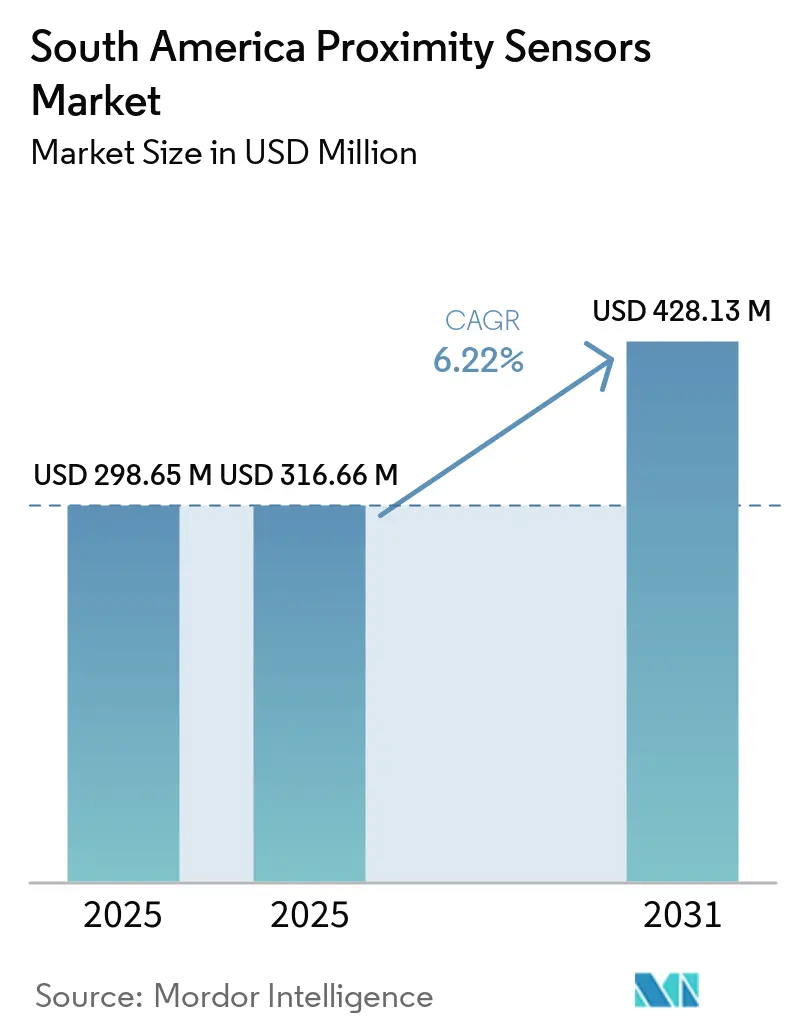
The South America Proximity Sensors Market size is projected to expand from USD 298.65 million in 2025 and USD 316.66 million in 2025 to USD 428.13 million by 2031, registering a CAGR of 6.22% between 2025 and 2031.
Brazil remains the central source of demand because its manufacturing base includes automotive production, food processing, mining, and process industries. The region has a large installed base of older industrial equipment, which supports replacement demand as plants add automated controls. New industrial investment is also raising demand for equipment that can detect parts, materials, and machine positions. Suppliers are placing more emphasis on local distribution, compatible digital interfaces, and products designed for washdown or harsh operating conditions. Import costs and currency volatility remain important constraints, especially where manufacturers depend on imported electronics and automation equipment.
Key Report Takeaways
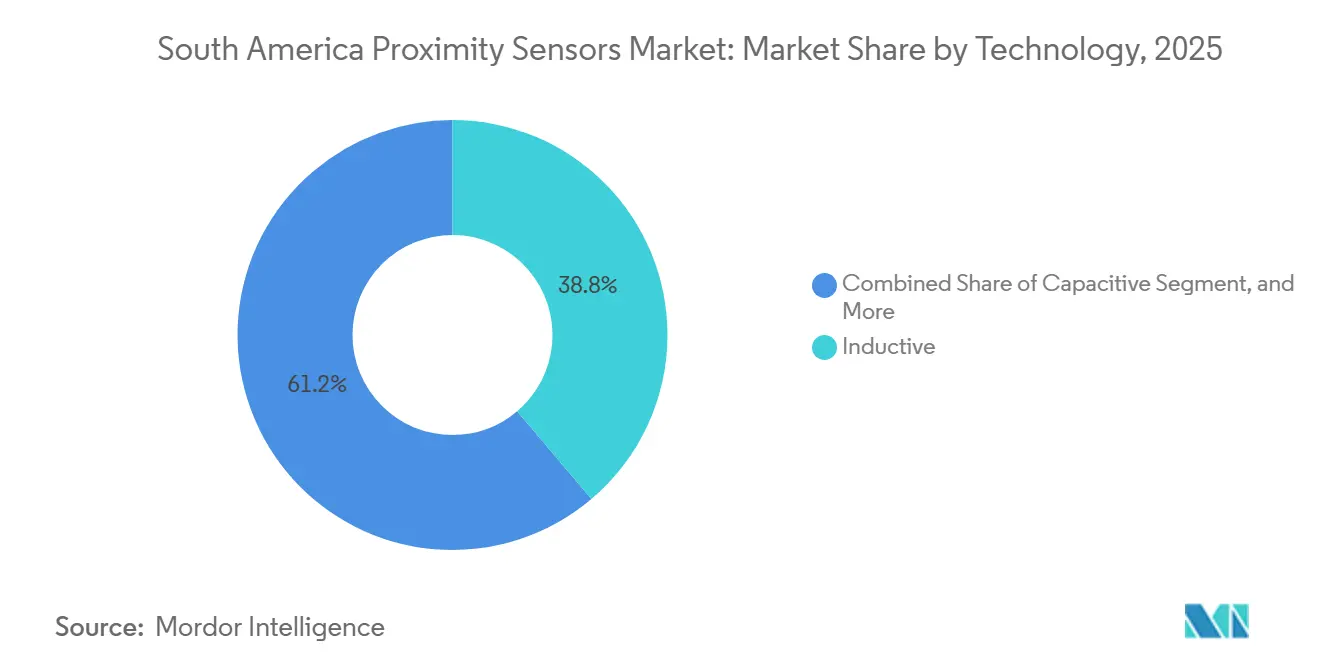
- By technology, inductive sensors held 38.82% of the South America proximity sensors market share in 2025, while ultrasonic sensors are projected to expand at a 6.78% CAGR through 2031.
- By product type, fixed-distance sensors accounted for 61.74% of revenue in 2025, while adjustable-distance sensors are expected to expand at a 7.02% CAGR through 2031.
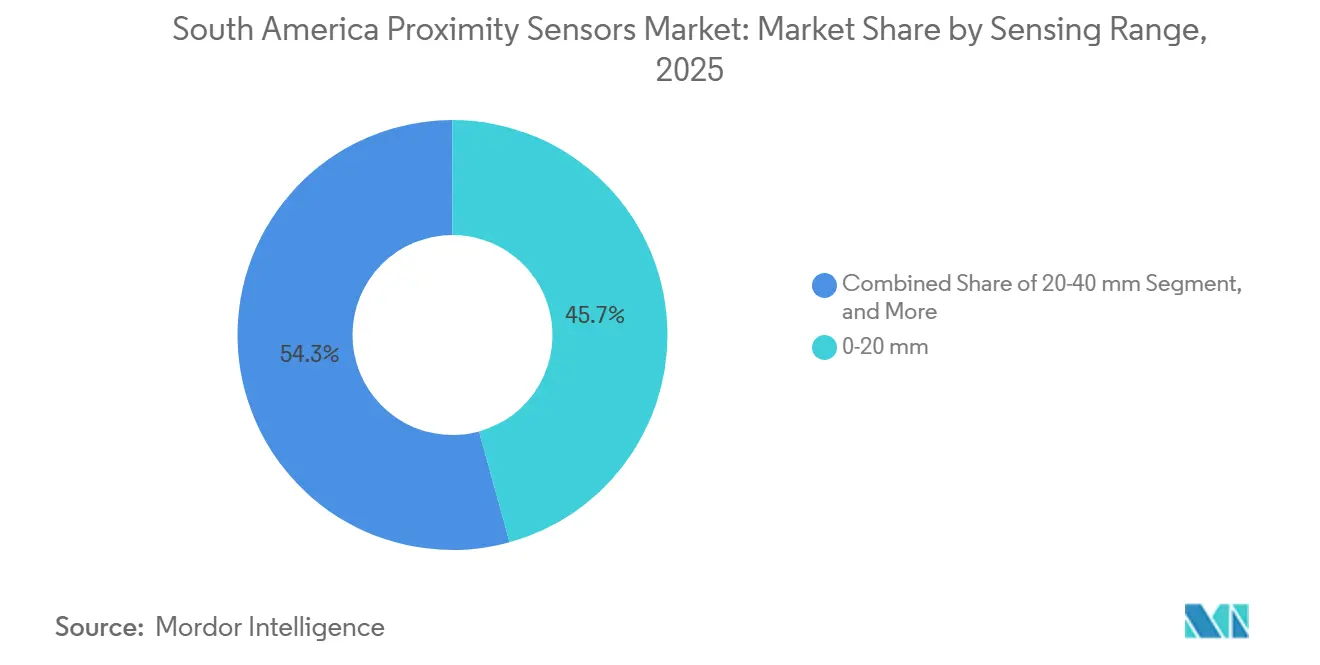
- By sensing range, the 0-20 mm category held 45.72% of revenue in 2025, while sensors with a range greater than 40 mm are projected to expand at a 6.75% CAGR through 2031.
- By housing and form factor, cylindrical sensors accounted for 46.73% of revenue in 2025, while miniature and PCB-mount sensors are projected to expand at a 6.88% CAGR through 2031.
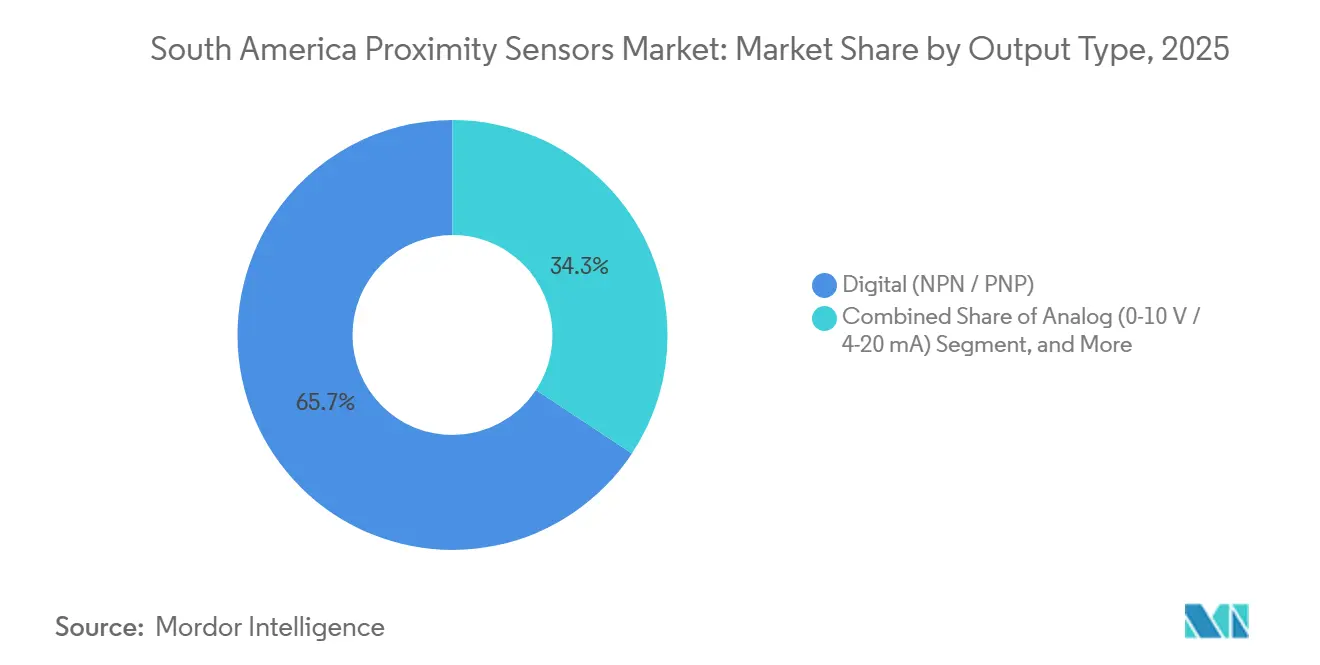
- By output type, digital NPN/PNP products held 65.72% of revenue in 2025, while IO-Link and other smart interfaces are projected to expand at a 6.78% CAGR through 2031.
- By channel wiring, 3-wire DC products accounted for 54.73% of revenue in 2025, while 4-wire complementary products are expected to expand at a 7.03% CAGR through 2031.
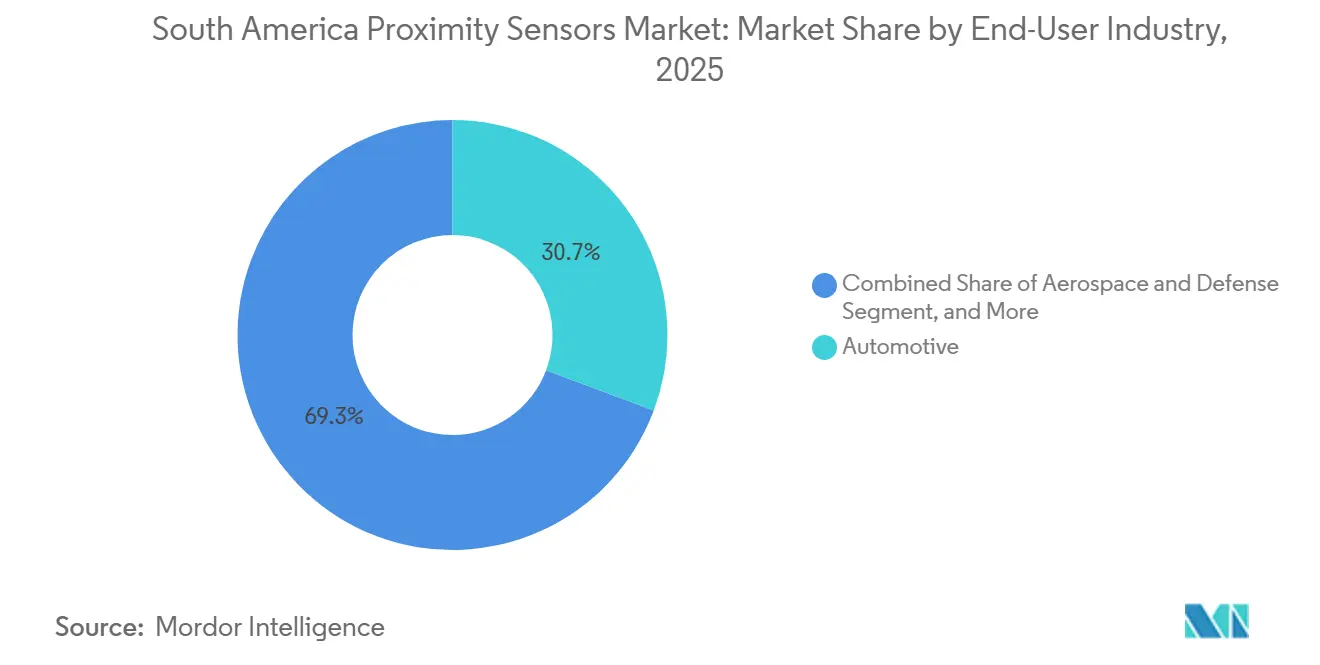
- By end-user industry, automotive accounted for 30.72% of revenue in 2025, while industrial automation and robotics are projected to expand at a 7.11% CAGR through 2031.
- By country, Brazil held 53.72% of the South America proximity sensors market share in 2025, while Argentina is projected to expand at a 7.21% CAGR through 2031.
Note: Market size and forecast figures in this report are generated using Mordor Intelligence’s proprietary estimation framework, updated with the latest available data and insights as of January 2026.
South America Proximity Sensors Market Trends and Insights
Drivers Impact Analysis*
| Driver | (~) % Impact on CAGR Forecast | Geographic Relevance | Impact Timeline |
|---|---|---|---|
| Industrial Automation and Industry 4.0 Retrofit Adoption | +1.8% | Global, with emphasis on Brazil, Argentina, Chile, and Colombia | Short term (≤ 2 years) |
| Automotive Electrification and Advanced Assembly Automation | +1.5% | Brazil, with secondary relevance in Argentina and Chile | Short term (≤ 2 years) |
| Mining Automation and Autonomous Equipment Deployment | +1.0% | Chile, Peru, and Brazil, with spillover into Colombia and Argentina | Medium term (2-4 years) |
| Food, Beverage, and Packaging Hygienic Automation | +0.8% | Brazil, with secondary relevance in Argentina and Colombia | Medium term (2-4 years) |
| Brazil-Based Powershoring and Industrial Modernization | +0.6% | Brazil, with spillover into Argentina and Chile | Long term (≥ 4 years) |
| Localized Sensor Assembly and Distributor-Led Availability | +0.3% | Brazil, with secondary relevance in Argentina and Colombia | Short term (≤ 2 years) |
| Source: Mordor Intelligence | |||
Industrial Automation and Industry 4.0 Retrofit Adoption
Brazil has a broad installed base of manufacturing equipment that can be upgraded with basic detection and control devices. These conditions support replacement demand as plants add automated functions. The South America proximity sensors market, therefore, benefits from retrofit projects as well as new factory installations. Inductive products are likely to receive initial retrofit spending because many existing programmable logic controller systems use digital inputs. This installed base can delay wider adoption of connected sensor interfaces until plants also upgrade their network infrastructure. The replacement cycle can continue after initial modernization projects are completed.
Manufacturers can test automated production cells before committing to larger capital projects. That process can support incremental upgrades and later demand for replacement sensors. Government-backed programs in Colombia can extend similar activity into secondary industrial locations. Argentina’s depreciation changes for automation hardware shortened the tax recovery period from 7 years to 3 years in 2024. The policy change can improve the financial case for plant upgrades that had been postponed. These factors support a broad but uneven modernization cycle across the South America proximity sensors market.
Automotive Electrification and Advanced Assembly Automation
Brazil produced 2.3 million vehicles in 2025 and remained a major regional manufacturing center. Vehicle assembly plants require part-presence detection, position confirmation, welding controls, and automated material handling. Electric vehicle production adds battery modules, aluminum structures, and more precise welding tasks to those requirements. This creates demand for sensor specifications that differ from conventional combustion-engine assembly lines. The South America proximity sensors market can therefore gain from plant retooling as vehicle makers raise local electric and hybrid production. Automotive suppliers also need compatible devices as new production lines extend through the local parts network.
Brazil’s electric vehicle registrations increased significantly during the first five months of 2026 compared with the same period in 2025. BYD is expanding its Camaçari facility to increase its annual production capacity by the end of 2026. The company also plans to increase local content, which could attract additional component manufacturing to domestic supply chains. Bosch is investing in Brazil to manufacture electric and hybrid vehicle components. These investments could increase demand for sensing equipment across vehicle manufacturing plants and supplier facilities. Over time, local production could also reduce reliance on fully assembled imported vehicles.
Mining Automation and Autonomous Equipment Deployment
Mining operations in Chile, Peru, and Brazil require reliable detection systems in dusty, wet, and high-vibration environments. Autonomous equipment underscores the importance of continuous monitoring of location, obstacles, and materials. This setting favors rugged devices with longer operating ranges and robust housings. The South America proximity sensors market can benefit as mining companies move from individual trials to fleets of automated equipment. Larger mining machines also create uses that short-range inductive devices cannot address on their own. Ultrasonic and photoelectric technologies can become more relevant in these operating conditions.
Ferreyros, Caterpillar, and Volcan Compañía Minera deployed Peru’s first fleet of autonomous CAT R1600H underground loaders at the Romina unit in July 2026.[1]International Mining, “Ferreyros Deploys First for Peru Underground Auto CAT LHD Fleet for Volcan,” International Mining, im-mining.com. The equipment uses camera, radar, and sensor data for autonomous hauling and remote bucket loading. Anglo American’s 34-truck autonomous fleet at Quellaveco had hauled more than 500 million tonnes by June 2026. Vale and ABB also agreed in August 2026 to expand digitalization and automation across Brazilian ore-processing plants. The Conceição II pilot used more than 7,300 automated equipment units and advanced sensing instruments. Such deployments can increase demand for ruggedized sensors certified for humidity, dust, and vibration.
Food, Beverage, and Packaging Hygienic Automation
Brazil’s food and beverage sector provides a large base for equipment used in processing, filling, and packaging. Production lines in meat, dairy, and beverage plants need sensors that can withstand regular cleaning. High-pressure washdown environments also make materials and enclosure ratings important purchasing criteria. The South America proximity sensors market is affected by the shift toward hygienic equipment that meets food and drug processing requirements. Plants that supply export markets have further reason to improve cleaning controls and traceability. These requirements can favor durable products with stainless-steel construction and compatible digital interfaces.
Amcor installed its first Moda Vac high-speed rotary vacuum sealing system in Brazil at Barra Mansa Alimentos in June 2026.[2]Amcor, “Amcor Introduces Moda Vacuum Sealing in Brazil,” Amcor, amcor.com. The installation demonstrates how additional automated stages can incorporate non-contact sensing into primary and secondary packaging processes. ifm electronic offers hygienic ultrasonic flow meters with stainless-steel measuring tubes, CIP and SIP compatibility, and IO-Link integration. Food processors may increasingly seek products that combine sanitary materials with digital monitoring. Suppliers focused only on legacy 3-wire DC outputs may face more competition during connected maintenance upgrades. This shift supports demand for devices that meet both washdown and data connectivity requirements.
Restraints Impact Analysis*
| Restraints | (~) % Impact on CAGR Forecast | Geographic Relevance | Impact Timeline |
|---|---|---|---|
| High Upfront Automation Costs and Extended Payback Periods | -0.9% | South America, especially Brazil, Colombia, and Peru | Short term (≤ 2 years) |
| Import Dependence and Foreign-Exchange Volatility | -0.7% | Brazil, Argentina, and Colombia | Short term (≤ 2 years) |
| Shortage of Certified Commissioning and Maintenance Engineers | -0.3% | Brazil, Chile, Colombia, and Peru | Medium term (2-4 years) |
| Certification Lead Times for Hazardous and Washdown Environments | -0.2% | Brazil, Chile, and Peru | Medium term (2-4 years) |
| Source: Mordor Intelligence | |||
High Upfront Automation Costs and Extended Payback Periods
Many smaller manufacturers must assess the full cost of an automation cell before approving a project. That cost can include sensors, wiring, programmable logic controllers, commissioning, software, and systems integration. These expenses can extend payback beyond the 4-5 year period that often guides investment approval. Import costs can further increase the price of automation platforms for regional buyers. This can concentrate adoption among larger companies with better access to finance. The South America proximity sensors market is consequently exposed to slower project decisions among smaller buyers.
Financing costs can increase the cost of capital equipment purchases. Public credit programs can reduce some funding pressure, but borrowing still requires a credible return from the investment. Local integrators may not always quantify the maintenance value of connected sensors for prospective buyers. This limits the perceived value of premium devices that provide diagnostic information. Support programs can provide partial assistance for formal industrial enterprises. Smaller and informal manufacturers can remain outside their reach.
Import Dependence and Foreign-Exchange Volatility
Proximity sensor supply chains in South America remain dependent on electronic components and completed products from Asia and Europe. Higher component costs can affect local assemblers, distributors, system integrators, and end users. Import duties can also add to the cost of capital equipment and specialized automation products. This can raise the total price paid for imported machinery and the components used in it. Supply conditions may vary by country and product category. These pressures can postpone purchasing decisions in cost-sensitive applications.
Argentina’s peso volatility adds risk during procurement, inventory holding, and invoicing. Importers may build currency protection into quoted prices, which can weaken price competitiveness. Brazil’s trade measures can also encourage manufacturers to consider local light assembly and calibration operations. Such investment could reduce exposure to supply disruptions over the medium term. However, local operations require sufficient sales volume, skilled personnel, and reliable component availability. These conditions can slow the response to import-related cost pressure in the South America proximity sensors market.
*Our forecasts treat driver/restraint impacts as directional, not additive. The impact forecasts reflect baseline growth, mix effects, and variable interactions.
Segment Analysis
By Technology: Inductive Sensors Lead, While Ultrasonic Sensors Address Complex Conditions
Inductive proximity sensors held 38.82% of the South America proximity sensors market share in 2025. Their position reflected long-standing use in automotive stamping, welding, and assembly equipment. These applications require dependable detection of metallic targets under oil mist and coolant exposure. The region’s existing programmable logic controller base is commonly configured for NPN or PNP digital inputs. This makes inductive devices practical for brownfield replacements because they can work within existing wiring and controls. The South America proximity sensors market size for inductive products is supported by a large installed base of discrete manufacturing equipment. Their established use also makes them a familiar choice for plant maintenance teams.
Ultrasonic sensors are projected to expand at a 6.78% CAGR through 2031. Their ability to detect non-metallic targets makes them useful in filling, conveyor monitoring, and agricultural material handling. Food and beverage applications can use them where metal-only detection does not meet the process need. Mining equipment can also use longer-range ultrasonic products for detection tasks in rugged areas. Banner Engineering offers stainless-steel IP69K ultrasonic sensors for demanding washdown applications. Capacitive sensors serve bulk solids and liquid-level tasks, while photoelectric and magnetic products address specialized position detection needs. Infrared and other technologies remain smaller categories that are linked to electronics and wearable-device assembly.



By Product Type: Fixed-Distance Sensors Lead, While Adjustable-Distance Sensors Support Flexible Lines
Fixed-distance sensors accounted for 61.74% of product-type revenue in 2025. Their lower cost and dependable operating point suit high-volume production environments. Automotive body shops, bottling lines, and mineral conveyors often use fixed switching distances. These facilities usually operate with defined product dimensions and stable equipment layouts. This supports continued demand for fixed-distance products across the South America proximity sensors market. The category also fits maintenance programs that value simple replacement and established specifications. Its strong revenue position reflects the prevalence of fixed-format production across the region.
Adjustable-distance sensors are projected to expand at a 7.02% CAGR through 2031. Mixed-SKU food lines and multi-platform electric-vehicle plants require settings that can change without physical adjustment. Products with IO-Link parameterization can allow remote configuration during line changes. GWM planned 80,000 vehicle sales in Brazil in 2026 from its Iracemápolis operation, which entered 3-shift production in April. Higher production cadence can increase the value of flexible control settings. Vendors can compete by providing application-specific parameter sets with pre-certified sensor models. This approach can reduce the need to change sensor mounting or wiring during retrofits.
By Sensing Range: Short-Range Products Lead, While Long-Range Products Gain From Mining
The 0-20 mm sensing range category held 45.72% of revenue in 2025. This range serves common factory tasks such as part-presence detection and end-of-stroke confirmation. Automotive assembly jigs and food packaging conveyors commonly require short-distance detection. Pneumatic cylinders also use this range for repeated position confirmation. These familiar applications underpin the South America proximity sensors market size for short-range devices. The category benefits from its relevance to high-volume equipment throughout the region. Its scale reflects the wide use of compact detection tasks in established industrial plants.
Sensors with a range greater than 40 mm are projected to expand at a 6.75% CAGR through 2031. Mining and bulk material handling require longer-range detection around large equipment and conveyors. Autonomous loaders and haul trucks require sensing architectures that cannot rely only on short-range inductive designs. The Romina underground loader deployment and Quellaveco truck fleet demonstrate the wider automation context in Peru. Longer-range demand can favor ultrasonic and photoelectric products with rugged protection ratings. It can also encourage suppliers to expand IP68 and IP69K product portfolios in the region. The 20-40 mm category retains a role in actuator feedback and robot-cell guarding.
By Housing and Form Factor: Cylindrical Sensors Prevail, While Miniature Products Enter New Uses
Cylindrical sensors held 46.73% of revenue in 2025. Standard M8, M12, M18, and M30 threaded mounting bores are common across factory equipment in South America. This allows cylindrical models to fit existing machines without custom brackets or adapters. The South America proximity sensors market share for these products reflects that practical compatibility. Packaging machinery, manufacturing cells, and industrial conveyors all support continuing demand. Maintenance teams can also replace threaded devices with limited mechanical modification. These factors keep cylindrical housings important in routine industrial applications.
Miniature and PCB-mount sensors are projected to expand at a 6.88% CAGR through 2031. Their smaller size is useful where end-of-arm tooling and compact electronics leave limited installation space. WEG deployed 15 collaborative robots at its Jaraguá do Sul facility in 2026 as part of an automation investment exceeding BRL 180 million (USD 31 million). Compact cells can create demand for sensing products that fit tightly constrained equipment layouts. Rectangular products retain importance in conveyor guarding and packaging machinery. Slot and channel sensors continue to serve label, sheet, and film applications. Ring and through-beam devices support shaft rotation and conveyor-gap detection in specialized equipment.
By Output Type: Digital NPN/PNP Products Lead, While Smart Interfaces Change Device Use
Digital NPN/PNP output products held 65.72% of revenue in 2025. Their leading position reflects the programmable logic controller architecture used across South American manufacturing. Many plants use digital inputs for standard inductive and capacitive sensing tasks. This installed base supports a stable replacement cycle for established outputs. The South America proximity sensors market size for digital products is tied to automotive, packaging, and general industrial equipment. Digital devices are also familiar to local maintenance and integration teams. Analog outputs remain relevant in chemical, oil and gas, water treatment, and other process applications.
IO-Link and other smart interfaces are projected to expand at a 6.78% CAGR through 2031. These products can provide diagnostic information and remote parameter settings alongside basic switching functions. Global installed IO-Link nodes reached 71 million by 2025.[3]IO-Link Community, “IO-Link Sensor Actuator Activity,” IO-Link Community, io-link.com. Lower prices for master modules can make the interface more accessible for regional automation projects. Siemens and Rockwell platforms can integrate IO-Link devices into wider control environments. The technology can make sensors more valuable within maintenance and data systems. Adoption may remain gradual where brownfield plants have not upgraded their communication infrastructure.
By Channel Wiring: 3-Wire DC Leads, While 4-Wire Complementary Wiring Supports Redundancy
3-wire DC wiring held 54.73% of revenue in 2025. This configuration is widely used with NPN and PNP digital sensors. Automotive and industrial automation environments have a substantial installed base of compatible equipment. The configuration therefore supports straightforward replacements in existing plants. Its position in the South America proximity sensors market reflects the broad use of standard digital control circuits. 2-wire AC/DC wiring remains relevant where relay-logic equipment has not been upgraded to programmable control. Such installations can still be found in smaller food and packaging facilities.
4-wire complementary wiring is projected to expand at a 7.03% CAGR through 2031. It can provide normally open and normally closed outputs for applications that need dual signals. Electric vehicle battery assembly and mining vehicle controls can use this type of redundancy. The rise of complementary wiring aligns with demand for more detailed machine-state information. WEG planned BRL 3.6 billion, equivalent to USD 621 million, in investments during 2026 across automation, motors, and energy systems. System design projects can specify richer sensor signal arrangements before equipment is installed. This may support adoption where new automation hardware is selected locally.
By End-User Industry: Automotive Leads, While Industrial Automation and Robotics Advance Fastest
Automotive accounted for 30.72% of revenue in 2025. Brazil’s vehicle manufacturing facilities are concentrated in São Paulo, Minas Gerais, and Bahia. These plants require sensors for assembly, welding, material movement, and quality-related equipment. The South America proximity sensors market share for automotive reflects the scale of this manufacturing footprint. Battery-module assembly and electric vehicle production can add more sensor-intensive tasks. Stellantis committed BRL 30 billion through 2030 for activity that includes electric vehicle production lines in Brazil. The automotive base will remain important for both replacement demand and line retooling.
Industrial automation and robotics are projected to expand at a 7.11% CAGR through 2031. Automated guided vehicles and autonomous mobile robots use more sensors than fixed machinery because they require multiple detection points. The South America proximity sensors market can benefit as mobile equipment becomes more widely deployed in factories and warehouses. Food and beverage processing can gain relevance as hygiene specifications become more demanding. Mining, agriculture, and marine operations add applications as autonomous equipment moves toward wider deployment. Healthcare, medical devices, consumer electronics, and wearables remain smaller areas with localized manufacturing activity. Aerospace, defense, building automation, and smart infrastructure provide a stable demand base.
Geography Analysis
Brazil accounted for 53.72% of the South America proximity sensors market share in 2025. Its manufacturing base supports demand across automotive, food processing, mining, oil and gas, and general industrial equipment. São Paulo, Minas Gerais, and Rio Grande do Sul remain important centers of industrial sensor use. Brazil’s Northeast is also attracting industrial projects linked to the availability of renewable electricity. New facilities in these locations can add embedded demand for industrial control equipment. Certification requirements can favor vendors with established local operations. These factors strengthen Brazil’s role in regional sensor demand.
Argentina is projected to expand at a 7.21% CAGR through 2031. Mining automation in the lithium-brine provinces of Catamarca and Jujuy supports demand for process sensing. The country’s manufacturing activity in Buenos Aires and Córdoba adds a second source of demand. Chile and Peru have mining operations that are increasingly using automated haulage and related monitoring systems. Quellaveco’s autonomous fleet had moved more than 500 million tonnes by June 2026. Peru’s Romina deployment also extended autonomous loading into underground mining. These operating environments support demand for longer-range and ruggedized sensing equipment.
Colombia has government-backed financing programs and growing manufacturing activity in Bogotá and Medellín. Food, pharmaceutical, and consumer goods plants can support demand for hygienic and general-purpose sensors. Peru combines autonomous mining demand with agro-industrial export processing requirements. Ecuador, Bolivia, Paraguay, and Uruguay form a smaller but steady part of the South America proximity sensors market. Agricultural mechanization, port logistics, and light manufacturing provide their principal uses. Uruguay’s Montevideo industrial cluster and Paraguay’s light manufacturing base are relevant within this group. Across South America, demand is strongest where investment programs reduce the time needed to recover automation spending.
Competitive Landscape
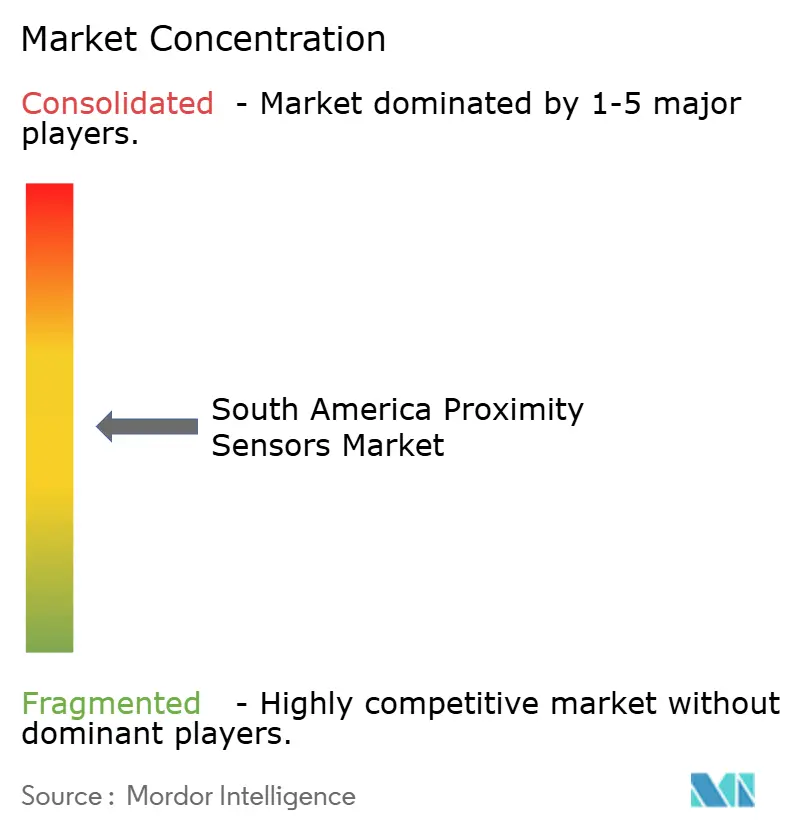
The South America proximity sensors market is moderately concentrated around international sensor specialists and established distribution channels. Keyence, Omron, SICK, Pepperl+Fuchs, ifm electronic, Balluff, and Turck serve premium and mid-range applications through Brazilian subsidiaries and authorized distributors. Lower-cost Asian producers compete more actively in standard cylindrical maintenance and replacement applications. Suppliers compete through connected sensor platforms, hygienic products, and availability outside major industrial cities. Local channel coverage is important because many customers depend on distributors for selection, replacement, and technical support. The South America proximity sensors market, therefore, rewards vendors that combine products with dependable local service. Established certification knowledge can also support incumbent positions in regulated applications.
Pepperl+Fuchs reported that its South American sales had tripled over 9 years through its distributor alignment model. The company’s approach shows the importance of distributor capability in a region with dispersed industrial customers. Siemens launched its Siemens Brasil Tech Hub in April 2026 to develop, validate, and scale digital industrial solutions in Brazil. The initiative includes automation, artificial intelligence, edge computing, and cybersecurity capabilities. Such broader automation offerings can raise integration switching costs for customers. Amcor’s installation of the Moda Vac system in Brazil provides another example of an end user adopting advanced packaging equipment with multiple sensing requirements. These moves strengthen demand for suppliers that can support complete automation environments.
Miniature and PCB-mount products for electronics and wearable-device assembly remain a less fully served area in Argentina and Colombia. Smaller buyers in these markets may need product sizes, package quantities, and pricing that differ from large factory requirements. Connected sensors configured for small and medium-sized manufacturers also remain less widely adopted than products for large system integrators. Long-range ultrasonic products for agricultural uses form another developing area as automated farm equipment becomes more common. Brazilian automation companies such as Altus Sistemas de Automação provide a local control-system footprint. Partnerships with global sensor suppliers could help extend sensor adoption through existing automation relationships.
South America Proximity Sensors Industry Leaders
Keyence Corporation
Omron Corporation
SICK AG
Pepperl+Fuchs SE
WEG S.A.
- *Disclaimer: Major Players sorted in no particular order

Recent Industry Developments
- August 2026: Vale and ABB signed an agreement to deploy AI, automation, and digitalization across Vale's ore-processing plants in Brazil. The pilot at Conceição II Model Plant in Itabira, completed in June 2026, deployed more than 7,300 automated equipment units and advanced sensing instruments at a cost of BRL 200 million (USD 34.5 million), delivering a 25% productivity increase, a 40% rise in premium-ore output, and a 26% reduction in iron losses in tailings. Deployment began at the Brucutu mine, with completion targeted by the end of 2027.
- July 2026: Ferreyros, Caterpillar, and Volcan Compañía Minera deployed Peru's first fleet of autonomous CAT R1600H low-profile underground loaders at the Romina zinc-lead-silver unit, using Caterpillar's MineStar Command for Underground technology. The system uses real-time camera, radar, and sensor data for autonomous hauling and remote bucket loading, making Peru the only country in South America operating this technology.
- June 2026: Caterpillar's autonomous 794 AC truck fleet at Anglo American's Quellaveco copper operation in Moquegua, Peru, surpassed 500 million tonnes hauled by 34 trucks operating since 2021, demonstrating sustained sensor-intensive autonomous haulage performance in South America's high-altitude, dust-heavy mining environment.
- June 2026: Gestamp inaugurated its seventh factory in Brazil in Piracicaba, São Paulo, producing lightweight metal body and chassis parts for electric vehicles under Brazil's local-content framework effective 2027. The plant is designed to increase headcount from 50 to 500 employees and targets partnerships across the expanding Chinese automaker supply chain in Brazil.


South America Proximity Sensors Market Report Scope
The South America Proximity Sensors Report is Segmented by Technology (Inductive, Capacitive, and More), Product Type (Fixed-Distance Sensors, and More), Sensing Range (0-20 Mm, and More), by Housing / Form Factor (Cylindrical, and More), Output Type (Digital NPN/PNP, and More), Channel Wiring (3-Wire DC, and More), End-User Industry (Automotive, and More), and Country. The Market Forecasts are Provided in Terms of Value (USD).
By Technology
| Inductive |
| Capacitive |
| Photoelectric |
| Magnetic (Hall-Effect and Reed) |
| Ultrasonic |
| Infrared and Other Technologies |
By Product Type
| Fixed-Distance Sensors |
| Adjustable-Distance Sensors |
By Sensing Range
| 0-20 mm |
| 20-40 mm |
| Greater Than 40 mm |
By Housing / Form Factor
| Cylindrical |
| Rectangular |
| Slot / Channel |
| Miniature / PCB-Mount |
| Ring and Through-Beam |
By Output Type
| Digital (NPN / PNP) |
| Analog (0-10 V / 4-20 mA) |
| IO-Link and Other Smart Interfaces |
By Channel Wiring
| 2-Wire AC/DC |
| 3-Wire DC |
| 4-Wire Complementary |
By End-User Industry
| Aerospace and Defense |
| Automotive |
| Industrial Automation and Robotics |
| Consumer Electronics and Wearables |
| Food and Beverage Processing |
| Healthcare and Medical Devices |
| Building Automation and Smart Infrastructure |
| Mining, Agriculture, and Marine Industries |
By Country
| Brazil |
| Argentina |
| Chile |
| Colombia |
| Peru |
| Rest of South America |
| By Technology | Inductive |
| Capacitive | |
| Photoelectric | |
| Magnetic (Hall-Effect and Reed) | |
| Ultrasonic | |
| Infrared and Other Technologies | |
| By Product Type | Fixed-Distance Sensors |
| Adjustable-Distance Sensors | |
| By Sensing Range | 0-20 mm |
| 20-40 mm | |
| Greater Than 40 mm | |
| By Housing / Form Factor | Cylindrical |
| Rectangular | |
| Slot / Channel | |
| Miniature / PCB-Mount | |
| Ring and Through-Beam | |
| By Output Type | Digital (NPN / PNP) |
| Analog (0-10 V / 4-20 mA) | |
| IO-Link and Other Smart Interfaces | |
| By Channel Wiring | 2-Wire AC/DC |
| 3-Wire DC | |
| 4-Wire Complementary | |
| By End-User Industry | Aerospace and Defense |
| Automotive | |
| Industrial Automation and Robotics | |
| Consumer Electronics and Wearables | |
| Food and Beverage Processing | |
| Healthcare and Medical Devices | |
| Building Automation and Smart Infrastructure | |
| Mining, Agriculture, and Marine Industries | |
| By Country | Brazil |
| Argentina | |
| Chile | |
| Colombia | |
| Peru | |
| Rest of South America |


Key Questions Answered in the Report
What is the South America proximity sensors market size?
The South America proximity sensors market was valued at USD 298.65 million in 2025 and is estimated to reach USD 428.1378309 million by 2031, at a CAGR of 6.22% from 2026 to 2031.
Which technology leads demand for proximity sensors in South America?
Inductive sensors led with 38.82% of revenue in 2025 because they are widely used for metallic-target detection in automotive and discrete manufacturing equipment.
Which product type is projected to expand fastest through 2031?
Adjustable-distance sensors are projected to expand at a 7.02% CAGR through 2031 as flexible production lines need remotely configurable detection settings.
Why is Brazil important for proximity sensor suppliers?
Brazil held 53.72% of regional revenue in 2025 and has major automotive, food processing, mining, and industrial automation activity.
Which end-user application has the highest projected CAGR?
Industrial automation and robotics are projected to expand at a 7.11% CAGR through 2031 as mobile and automated equipment requires more detection devices.
Page last updated on:





