
South America Flexible Plastic Packaging Market Size and Share
Market Overview
| Study Period | 2020 - 2031 |
|---|---|
| Forecast Data Period | 2026 - 2031 |
| Base Year Market Size (2025) | USD 8.66 Billion |
| Market Size (2026) | USD 9.22 Billion |
| Market Size (2031) | USD 12.73 Billion |
| Growth Rate (2026 - 2031) | 6.66 % |
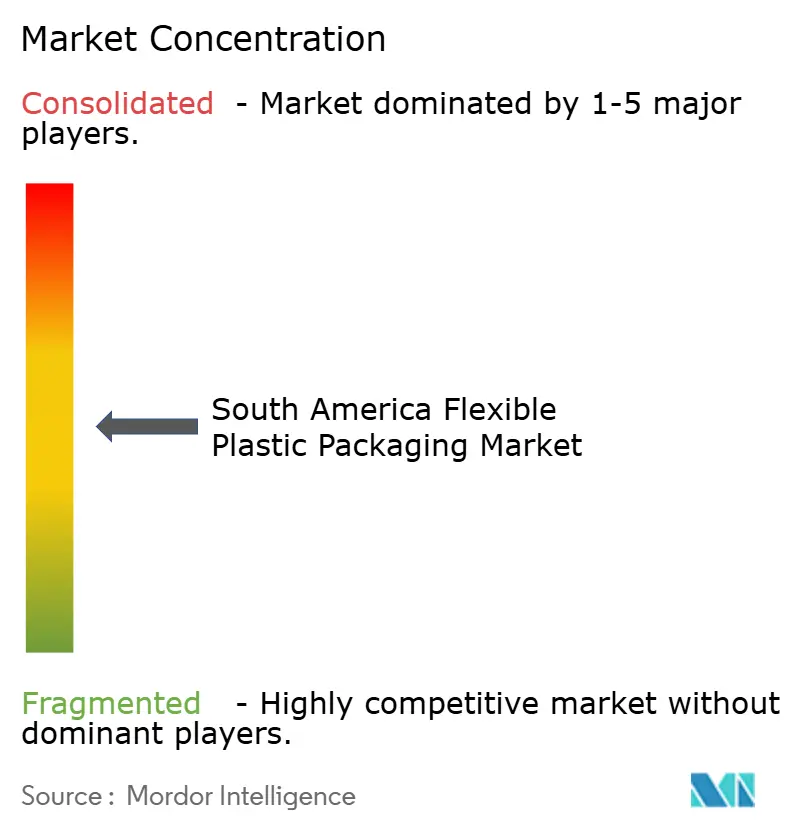
| Market Concentration | Medium |
Major Players *Disclaimer: Major Players sorted in no particular order Image © Mordor Intelligence. Reuse requires attribution under CC BY 4.0. | |
South America Flexible Plastic Packaging Market Analysis by Mordor Intelligence
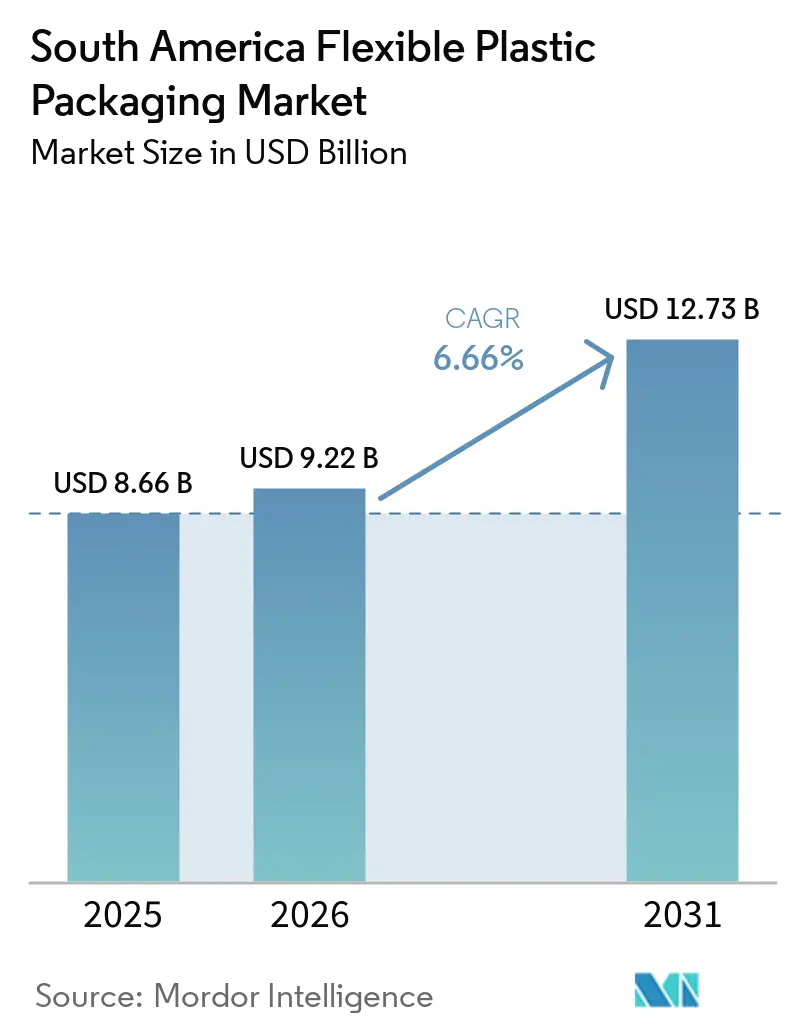
The South America flexible plastic packaging market size was valued at USD 8.66 billion in 2025 and estimated to grow from USD 9.24 billion in 2026 to reach USD 12.73 billion by 2031, at a CAGR of 6.66% during the forecast period (2026-2031). Demand is supported by food processing, medical products, e-commerce fulfillment, and agro-export supply chains. Flexible formats help users manage shelf life, transport weight, and pack design requirements. Brazil remains the region’s largest manufacturing base, while regulatory rules are changing material sourcing and supplier selection. Companies with certified recycled content, high-barrier film capability, and shorter production runs have stronger options in higher-value applications. The South America flexible plastic packaging market also benefits from cold-chain investment near export corridors, where buyers require films that meet destination-country specifications.
Key Report Takeaways
- By material, polyethylene held 61.24% of the South America flexible plastic packaging market share in 2025, while ethylene-vinyl alcohol is projected to expand at a CAGR of 6.92% through 2031.
- By product type, pouches commanded 50.66% of the South America flexible plastic packaging market size in 2025, while films and wraps are projected to expand at a CAGR of 7.13% through 2031.
- By printing technology, flexography held 32.73% share in 2025, while digital printing is projected to expand at a CAGR of 7.26% through 2031.
- By end-use industry, food accounted for 41.37% share in 2025, while medical and pharmaceutical packaging is projected to expand at a CAGR of 7.11% through 2031.
- By distribution channel, direct sales held 41.37% share in 2025, while indirect sales are projected to expand at a CAGR of 6.94% through 2031.
- By geography, Brazil held 35.66% share in 2025, while Argentina is projected to expand at a CAGR of 7.12% through 2031.
Note: Market size and forecast figures in this report are generated using Mordor Intelligence’s proprietary estimation framework, updated with the latest available data and insights as of January 2026.
Market Trends and Insights
Drivers Impact Analysis of South America Flexible Plastic Packaging Market*
| Driver | (~) % Impact on CAGR Forecast | Geographic Relevance | Impact Timeline |
|---|---|---|---|
| Rising Demand for Convenience and Ready-to-Eat Foods | +1.8% | Brazil, Argentina, Colombia, Chile | Short term (≤ 2 years) |
| E-Commerce Fulfillment and Volumetric-Weight Optimization | +1.3% | Brazil, Colombia, Argentina | Short term (≤ 2 years) |
| Expansion of Fresh-Produce and Cold-Chain Distribution | +1.0% | Brazil, Chile, Peru, Colombia | Medium term (2-4 years) |
| Recycled-Content and Extended-Producer-Responsibility Mandates | +0.8% | Brazil, Colombia, spill-over to Argentina and Chile | Medium term (2-4 years) |
| Premium Pet Nutrition and Specialized Animal-Food Packaging | +0.5% | Brazil, Argentina | Medium term (2-4 years) |
| Mono-Material High-Barrier Packaging Innovation | +0.4% | Brazil, Argentina | Long term (≥ 4 years) |
| Source: Mordor Intelligence | |||
Rising Demand for Convenience and Ready-to-Eat Foods
High urbanization levels in Brazil, Argentina, and Chile supported demand for portioned, shelf-stable, and ready-to-eat food formats. These formats use pouches, resealable packs, and form-fill-seal films that protect products while using less material than many rigid alternatives. Food applications accounted for a significant share of the South America flexible plastic packaging market. Confectionery, snacks, fresh produce, and dairy products continue to require packaging that combines practical use with barrier performance. Brazil’s agro-industrial flexible packaging volume increased significantly, according to the ABIEF industry survey.[1]. Food producers increasingly involve converters earlier when they develop products and packaging formats. This can extend supplier relationships where converters provide film, inks, and production equipment support.
E-Commerce Fulfillment and Volumetric-Weight Optimization
Parcel delivery pricing has made packaging weight an important commercial consideration for online sellers. Flexible mailers and bubble-laminated pouches can reduce transport weight and help protect products through warehouse and conveyor handling. MercadoLibre reported a large annual unique buyer base and committed substantial investments to Brazilian logistics infrastructure. This network expansion supports demand for lightweight mailers and direct-to-consumer packaging across the South America flexible plastic packaging market. Premium brands often need short runs with customized graphics, while large marketplace sellers need lower-cost plain-stock formats. Digital printing is projected to expand strongly through the forecast period because it serves shorter runs without flexographic plate costs. Converters that use shared assets for both product tiers can improve equipment utilization and serve a broader customer base.
Expansion of Fresh-Produce and Cold-Chain Distribution
South America accounted for a substantial share of global food exports, and refrigerated logistics investment is increasing demand for high-barrier flexible packaging.[2] Modified-atmosphere packaging, vacuum films, and high-barrier pouches are particularly relevant for produce, protein, dairy, and frozen products. A.P. Moller-Maersk launched a large-scale packing and cold-storage center in Olmos, Peru, to handle substantial volumes of avocados, blueberries, and mangoes each year. Emergent Cold LatAm also expanded its Maipú, Chile, facility to significantly increase capacity. Export buyers in North America, Europe, and Asia often specify oxygen and moisture transmission requirements. This makes Chile and Peru important demand locations for higher-specification films rather than only commodity stretch-wrap grades.
Recycled-Content and Extended-Producer-Responsibility Mandates
Brazil established a nationwide reverse-logistics system for plastic packaging through a federal decree. The decree introduced minimum post-consumer recycled content requirements, with targets increasing over time. Brazil also prohibited solid-waste imports, increasing the importance of domestic recycled-resin supply. These rules are changing procurement requirements across the South America flexible plastic packaging market. The International Finance Corporation committed financing for circular plastics production capacity in Brazil. The financing linked incentives to recycled-resin use and reflected a stronger institutional focus on collection and recycling capacity.[3] Suppliers with traceable recycled resin can meet qualification requirements more readily than converters that depend only on virgin material.
Restraints Impact Analysis of South America Flexible Plastic Packaging Market*
| Restraint | (~) % Impact on CAGR Forecast | Geographic Relevance | Impact Timeline |
|---|---|---|---|
| Limited Availability of Certified Post-Consumer Recycled Resin | -1.5% | Brazil, Colombia, concentrated in São Paulo industrial corridor | Medium term (2-4 years) |
| Resin-Price and Currency Volatility | -1.2% | Brazil, Argentina, Colombia, Chile, Peru | Short term (≤ 2 years) |
| Recycling Incompatibility of Multilayer Structures | -0.7% | Brazil, Colombia | Long term (≥ 4 years) |
| Fragmented Collection and Sorting Infrastructure | -0.5% | Brazil, Rest of South America | Long term (≥ 4 years) |
| Source: Mordor Intelligence | |||
Limited Availability of Certified Post-Consumer Recycled Resin
Brazil’s recycled-content requirement took effect in mid-2026, but certified resin with a traceable chain of custody remains limited. The flexible packaging sector used recycled content below the new target during the initial implementation period. Brazil’s mechanical recycling rate remained limited, while low density and food contamination make flexible films harder to collect than rigid containers. Food-grade recycled resin capacity covers only part of regional demand. Several super-cleaning facilities were in development in Brazil and could add certified capacity after approvals. The South America flexible plastic packaging market faces higher compliance costs where converters have not secured domestic recycled-resin agreements.
Resin-Price and Currency Volatility
Resin-price changes created a near-term margin risk for regional flexible packaging converters. Middle East supply disruptions during 2026 raised resin prices in Brazil and encouraged downgauging, lightweighting, and use of available recycled grades. Brazilian processors also faced anti-dumping surcharges on polypropylene imports from India and South Africa. Argentina’s foreign exchange restrictions increased the effective cost of imported specialty resins, including ethylene-vinyl alcohol and biaxially oriented polypropylene. These pressures affect working capital and make input planning more difficult for the South America flexible plastic packaging market. Mono-material structures can reduce the number of resin families that a converter must source. This can lower exposure to price differences among multiple polymers while also supporting recycling objectives.
*Our forecasts treat driver/restraint impacts as directional, not additive. The impact forecasts reflect baseline growth, mix effects, and variable interactions.
South America Flexible Plastic Packaging Market Segment Analysis
By Material:
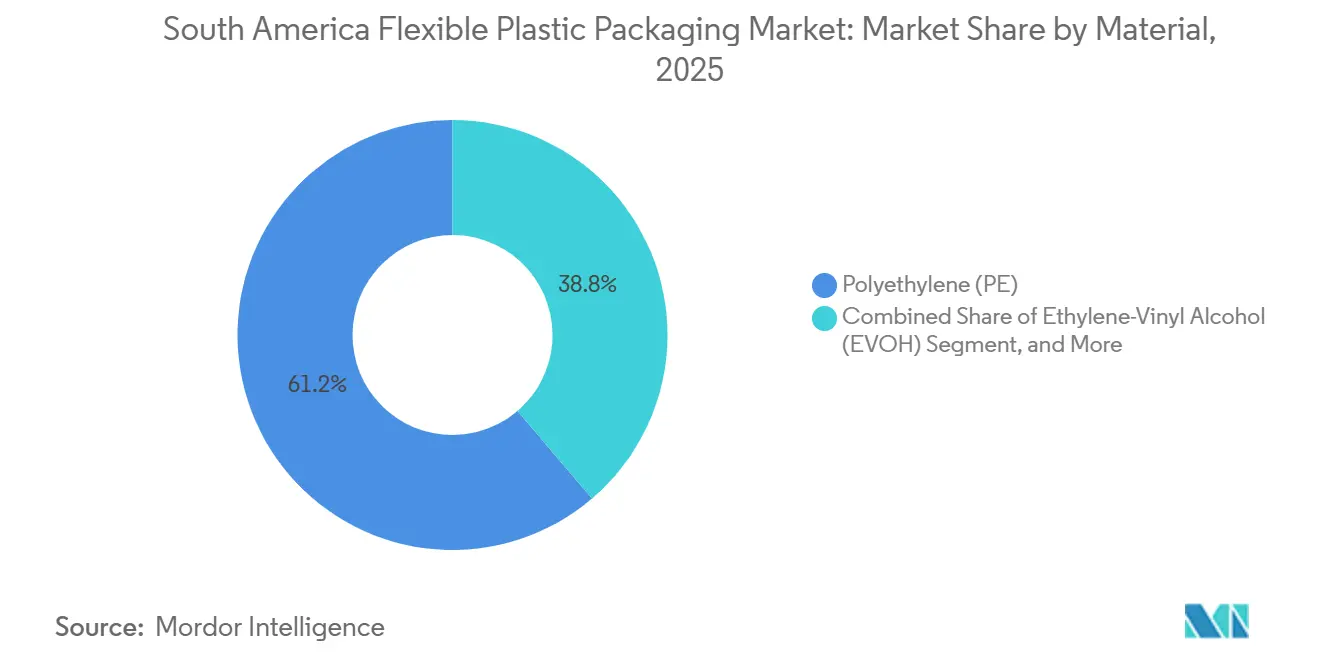
PE Anchors Volume as EVOH Gains Structural Barrier GroundPolyethylene held 61.24% of the South America flexible plastic packaging market share in 2025, supported by established film and pouch conversion capacity in Brazil and Argentina. Low-density polyethylene and linear low-density polyethylene accounted for most of Brazil’s flexible plastic packaging volume during the year, according to the ABIEF survey. This material base supports food, agro-industrial, and consumer goods applications. Polyethylene remains practical for applications that require cost control, sealability, and production flexibility. It also plays a central role in mono-material designs that support recycling requirements.
Biaxially oriented polypropylene is widely used for snacks, confectionery, and bakery packaging because it provides clarity and print performance. Cast polypropylene is used in retort and steam-barrier processed-food applications. Polyvinyl chloride retains a smaller role in selected industrial and specialty uses. Its recycling limitations are directing some investment toward alternatives that use fewer material families. Ethylene-vinyl alcohol is projected to expand at a CAGR of 6.92% through 2031 within the South America flexible plastic packaging market. Demand comes from pharmaceutical, fresh-protein, and produce applications that require strong oxygen barriers. Ethylene-vinyl alcohol co-extrusion investments allow converters to address food and pharmaceutical requirements from the same production platform.

By Product Type:
Pouches Define the Category, Films and Wraps AcceleratePouches commanded 50.66% of the South America flexible plastic packaging market size in 2025. Stand-up, retort, spouted, and zipper-reclosable formats are used in food, pet nutrition, home care, and personal care products. Stand-up pouches are widely used in agro-industrial exports because they improve pallet density and can reduce the need for secondary cartons. Their printable surface can also carry product information without an additional label. Bags and sacks remain relevant for seeds, fertilizer, bulk ingredients, and other applications requiring load-bearing formats.
Other products include specialty wraps for industrial goods and flexible intermediate bulk containers. Their demand is linked to industrial output and agricultural commodity activity. Films and wraps are projected to expand at a CAGR of 7.13% through 2031. Cold-chain expansion, modified-atmosphere packaging, and protective e-commerce films support this outlook. Amcor installed Moda rotary vacuum chamber sealing technology in Brazil in June 2026 with Barra Mansa Alimentos. The project showed how equipment and packaging materials can be introduced together at a meat-processing site. The South America flexible plastic packaging market has demand for both export-grade barrier films and polyethylene stretch-wrap products, but export specifications offer a clearer path to differentiated film portfolios.
By Printing Technology:
Flexography Anchors Volume, Digital Disrupts the Short-Run TierFlexography held 32.73% share of the South America flexible plastic packaging market in 2025. It remains established in high-volume food, beverage, and personal care runs in Brazil and Argentina. The plate cost can be spread across long runs, which supports its use when volumes exceed 50,000 linear meters. Rotogravure maintains a role in longer runs that require consistent color and photographic-quality reproduction. This is relevant to confectionery and premium food packs where brand color control is important.
Inkjet and electrophotographic printing serve serialization and specialty label applications, although their combined presence remains smaller than analog technologies. Digital printing is projected to expand at a CAGR of 7.26% through 2031 in the South America flexible plastic packaging market. Valgroup installed an HP Indigo 200K in 2025, described as the first press of that model in South America. The installation supported short-run, food-safe flexible packaging production. Online brands often need rapid artwork changes and lower order volumes. Hybrid flexographic and digital lines can serve long-run customers and short-run accounts without requiring separate operating platforms.
By End-Use Industry:
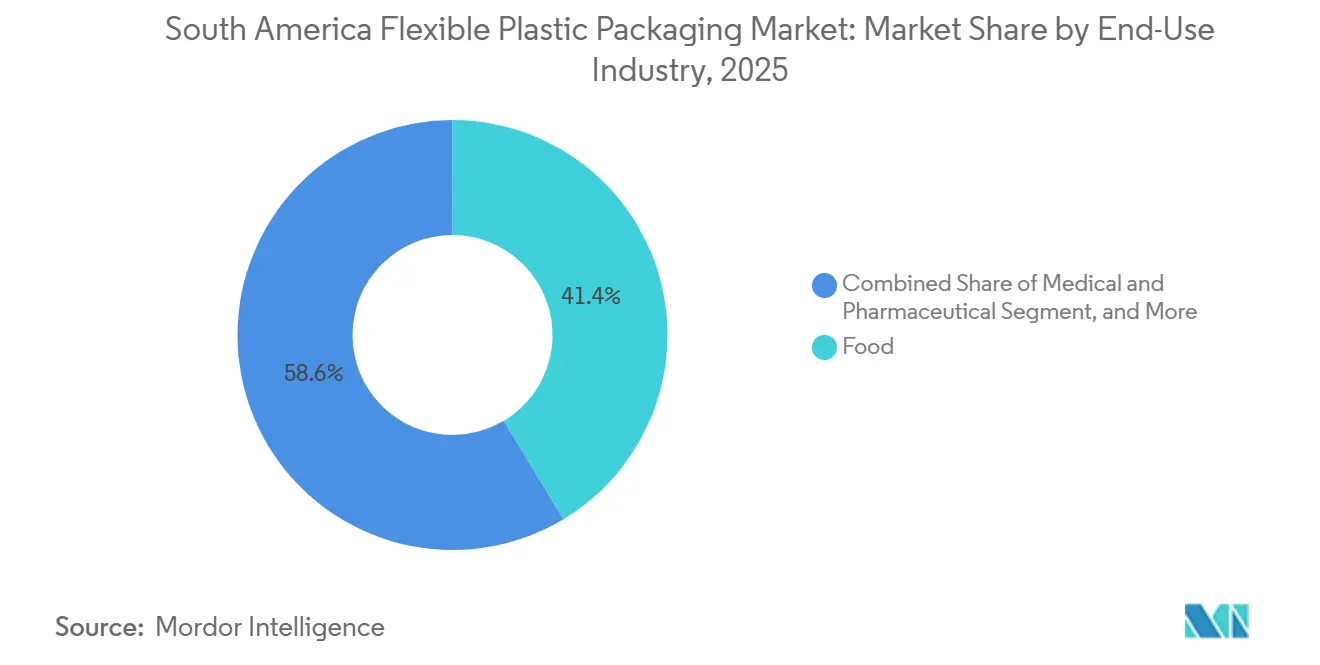
Food Commands Share, Medical and Pharmaceutical Rises FastestFood accounted for 41.37% of the South America flexible plastic packaging market share in 2025. The segment includes confectionery, snacks, breads, cereals, fresh produce, dairy products, and other food formats. Confectionery and snacks lead this demand, while fresh produce is changing quickly because exporters need modified-atmosphere and high-barrier films. Chile, Peru, and Brazil are key locations for this export-related use. Beverage applications use flexible pouches and spouted formats for juices and liquid food products in cost-sensitive channels.
Personal care, home care, agricultural, chemical, and automotive uses add complementary volume. Premium personal care products can use metallic and holographic finishes that support higher packaging values. Medical and pharmaceutical packaging is projected to expand at a CAGR of 7.11% through 2031. Brazil’s ANVISA serialization requirements support demand for qualified primary packaging materials. Brazil and Argentina represented a significant share of regional pharmaceutical-grade film consumption. Generic drugs, biosimilars, and injectable products require films with low oxygen transmission. Braskem completed its first commercial sale of circular polyethylene in South America to Copobras for flexible pet food packaging. This demonstrated the role of premium pet nutrition in adopting traceable recycled-content materials.
By Distribution Channel:
Direct Sales Dominant, Indirect Channels AccelerateDirect sales held 41.37% of the South America flexible plastic packaging market share in 2025. Long-term supply agreements are common between converters and large food processors, consumer goods companies, and pharmaceutical customers. The model gives converters better production visibility and supports technical work on custom specifications. It can also support equipment integration, as shown by Amcor’s 2026 vacuum-sealing deployment in Brazil. Scheduled delivery and advance commitments can reduce inventory exposure in periods of resin-price volatility.
Indirect sales are projected to expand at a CAGR of 6.94% through 2031. The channel serves small and medium-sized brand owners through distributors, trading agents, and online procurement platforms. MercadoLibre stated that its Brazilian platform hosted more than 9.5 million active small and medium-sized enterprises and entrepreneurs in its 2025 impact report. These businesses may buy through intermediaries instead of negotiating directly with a converter. Distributors are adding specification advice and inventory services. Converters that provide digital ordering, modular stock-keeping units, and short-run production can address channel demand without matching sales-force growth.
Geography Analysis
Brazil Flexible Plastic Packaging Market
Brazil held 35.66% of the South America flexible plastic packaging market share in 2025. Its position reflects an established petrochemical base, large food and beverage processing activity, and the concentration of packaging and consumer goods headquarters around São Paulo. The Brazilian flexible plastic packaging sector generated BRL 40.1 billion (USD 7.31 billion) in revenue during 2025, according to ABIE. It produced 2.321 million tonnes while operating at 70.4% of its 3.297 million tonnes annual installed capacity. This capacity base can accommodate additional volumes without a matching level of new greenfield investment.
Argentina Flexible Plastic Packaging Market
Brazil’s recycled-content requirements are concentrating capital expenditure among suppliers that can use certified material. São Paulo and Minas Gerais are important locations for these qualification efforts. Port-adjacent cold-chain investment around Santos and Rio de Janeiro also supports demand for high-barrier films for protein, dairy, and produce. Argentina is projected to expand at a CAGR of 7.12% through 2031, the highest country rate in the South America flexible plastic packaging market. Mandatory electronic prescriptions have supported demand for serialized blister packs and flexible laminates in retail pharmacies. MercadoLibre reported strong year-over-year growth in unique buyers in Argentina during a recent quarter and opened a large fulfillment warehouse in Tres de Febrero. These developments support e-commerce packaging demand in urban areas.
South America Flexible Plastic Packaging Market
Colombia has an established extended-producer-responsibility framework and favors suppliers with documented recovery systems. Its consumer goods assembly role supports packaging demand from food, fast-moving consumer goods, and pharmaceutical production. Chile and Peru are key locations in the agro-export corridor. Emergent Cold LatAm expanded its Maipú facility in Chile with USD 35 million of investment in March 2026. Maersk’s Olmos center in Peru added a focused demand location for modified-atmosphere films. Ecuador, Bolivia, Paraguay, Uruguay, and other countries contribute food, agriculture, and industrial packaging demand as organized retail and formal procurement expand.
Competitive Landscape
The South America flexible plastic packaging market is moderately fragmented. Amcor plc, Mondi plc, Sealed Air Corporation, Huhtamäki Oyj, and Constantia Flexibles Group GmbH compete with Grupo Oben Holding, Vitopel do Brasil Ltda., Zaraplast S.A., Gualapack S.p.a., and Petropack S.A. Regional converters use localized manufacturing, shorter lead times, customization, and lower minimum order quantities to serve customers. Multinational suppliers have broader material portfolios, qualification capability, and recycled-content sourcing networks. This creates different competitive positions across commodity, pharmaceutical, and export applications.
Amcor completed its acquisition of Berry Global, creating a combined entity with substantial annualized revenue. The transaction expanded Amcor’s scale and combined barrier-film qualification capabilities with recycled-content sourcing. ProAmpac completed its acquisition of TC Transcontinental Packaging. The combined organization expanded its manufacturing footprint and workforce across numerous countries. This added manufacturing presence and barrier-film capability that can affect the South America flexible plastic packaging market. Constantia Flexibles presented EcoLam, a RecyClass-approved mono-polyethylene structure, with multiple machine partners at Interpack. It also presented PERPETUA, an aluminum-free pharmaceutical mono-polymer packaging platform.
Videplast Plastic Industry Ltda., Embaquim Indústria e Comércio Ltda., Parnaplast Indústria de Plásticos Ltda., and Grupo HZ compete effectively in commodity formats. However, pharmaceutical and export accounts require certifications, research capability, and capital that can be harder for local suppliers to fund. Valgroup’s installation of a digital flexible packaging press strengthened its position in short-run direct-to-consumer work. Braskem’s circular polyethylene supply to Copobras created an upstream option for converters that need traceable material. Companies that can combine digital printing, recycled-content integration, and pharmaceutical-grade barrier films have room to address specialized demand. The largest suppliers have stronger resources, but regional suppliers retain a practical advantage where fast turnaround and smaller order sizes matter.
South America Flexible Plastic Packaging Industry Leaders
-
Amcor plc
-
Mondi plc
-
ProAmpac Intermediate Inc.
-
Sealed Air Corporation
-
Grupo Oben Holding
- *Disclaimer: Major Players sorted in no particular order
South America Flexible Plastic Packaging Market Companies Covered in this Report
- Amcor plc
- Mondi plc
- Sealed Air Corporation
- Coveris Management GmbH
- Grupo Oben Holding
- Sonoco Products Company
- Transcontinental Inc.
- ProAmpac Intermediate Inc.
- Huhtamaki Oyj
- Constantia Flexibles Group GmbH
- SIG Group AG
- Gualapack S.p.a.
- Videplast Plastic Industry Ltda.
- Zaraplast S.A.
- Vitopel do Brasil Ltda.
- Petropack S.A.
- Grupo HZ
- Embaquim Industria e Comercio Ltda.
- Parnaplast Industria de Plasticos Ltda.
- Plasfil Industria e Comercio de Plasticos Ltda.
Recent Industry Developments in South America Flexible Plastic Packaging Market
- July 2026: Emergent Cold LatAm brought 2 new blast-freezing tunnels into operation in San Antonio, Chile, enabling the processing of over 10,500 tonnes of frozen food annually. The expansion strengthened cold-chain logistics infrastructure near Chile’s principal export port and supported demand for specification-grade barrier flexible packaging for frozen protein and produce destined for international markets.
- June 2026: Amcor plc announced the installation of the first Moda rotary vacuum chamber sealing technology in Brazil, in partnership with Barra Mansa Alimentos. The system replaced up to 9 belt-chamber machines per line, with all 3 lines expected to be fully operational by the end of 2026.
- June 2026: Natoo Pet Foods, the Brazil-based superpremium pet food brand under PremieRpet, introduced redesigned flexible packaging across its portfolio for the United States pet specialty market. The packaging emphasized sustainability and Brazilian heritage through recyclable, nature-inspired design.
- April 2026: Siegwerk and Enplater Group announced the joint development of a fully recyclable mono-polypropylene pouch with integrated barrier and sealing performance. The structure received RecyClass Technology Approval and performed on par with multi-material barrier solutions.
South America Flexible Plastic Packaging Market Report Scope
South America Flexible Plastic Packaging Market refers to the production and supply of thin, bendable plastic films, sheets, and laminates used to package consumer and industrial goods in flexible formats. It includes pouches, bags, wraps, films, tubes, sleeves, and liners made from materials such as PE, PP, PET, BOPP, PA, and multilayer barrier structures.
The South America Flexible Plastic Packaging Market Report is Segmented by Material (Polyethylene (PE), Biaxially Oriented Polypropylene (BOPP), Cast Polypropylene (CPP), Polyvinyl Chloride (PVC), Ethylene-Vinyl Alcohol (EVOH), and Other Materials), Product Type (Pouches, Bags and Sacks, and Films and Wraps, and Other Product Types), Printing Technology (Flexography, Rotogravure, Digital Printing, Inkjet Printing, and Electrophotographic Printing), End-Use Industry (Food, Beverages, Medical and Pharmaceutical, Personal and Home Care, and Other End-Use Industries [Agriculture, Chemicals, and Automotive]), Distribution Channel (Direct Sales, and Indirect Sales), Geography (Brazil, Argentina, Colombia, Chile, Peru, and Rest of South America). The Market Forecasts are Provided in Terms of Value (USD).
Segmentation Overview
| Polyethylene (PE) |
| Biaxially Oriented Polypropylene (BOPP) |
| Cast Polypropylene (CPP) |
| Polyvinyl Chloride (PVC) |
| Ethylene-Vinyl Alcohol (EVOH) |
| Other Materials |
| Pouches |
| Bags and Sacks |
| Films and Wraps |
| Other Product Types |
| Flexography |
| Rotogravure |
| Digital Printing |
| Inkjet Printing |
| Electrophotographic Printing |
| Food | Confectionery and Snacks |
| Breads and Cereals | |
| Fresh Produce | |
| Dairy-Based Products | |
| Other Food Applications | |
| Beverages | |
| Medical and Pharmaceutical | |
| Personal and Home Care | |
| Other End-Use Industries | Agriculture |
| Chemicals | |
| Automotive |
| Direct Sales |
| Indirect Sales |
| Brazil |
| Argentina |
| Colombia |
| Chile |
| Peru |
| Rest of South America |
| By Material | Polyethylene (PE) | |
| Biaxially Oriented Polypropylene (BOPP) | ||
| Cast Polypropylene (CPP) | ||
| Polyvinyl Chloride (PVC) | ||
| Ethylene-Vinyl Alcohol (EVOH) | ||
| Other Materials | ||
| By Product Type | Pouches | |
| Bags and Sacks | ||
| Films and Wraps | ||
| Other Product Types | ||
| By Printing Technology | Flexography | |
| Rotogravure | ||
| Digital Printing | ||
| Inkjet Printing | ||
| Electrophotographic Printing | ||
| By End-Use Industry | Food | Confectionery and Snacks |
| Breads and Cereals | ||
| Fresh Produce | ||
| Dairy-Based Products | ||
| Other Food Applications | ||
| Beverages | ||
| Medical and Pharmaceutical | ||
| Personal and Home Care | ||
| Other End-Use Industries | Agriculture | |
| Chemicals | ||
| Automotive | ||
| By Distribution Channel | Direct Sales | |
| Indirect Sales | ||
| By Geography | Brazil | |
| Argentina | ||
| Colombia | ||
| Chile | ||
| Peru | ||
| Rest of South America | ||
Key Questions Answered in the Report
What is the size of the South America flexible plastic packaging market?
The South America flexible plastic packaging market size was USD 9.24 billion in 2026 and is forecast to reach USD 12.73 billion by 2031 at a CAGR of 6.66%.
Which material has the largest role in flexible plastic packaging in South America?
Polyethylene held 61.24% share in 2025, supported by established regional film and pouch converting capacity.
Which product format is expanding fastest in the region?
Films and wraps are projected to expand at a CAGR of 7.13% through 2031, supported by cold-chain, modified-atmosphere, and e-commerce demand.
What is driving demand for high-barrier flexible films?
Agro-export activity, cold-storage investment, pharmaceutical requirements, and fresh-produce packaging are raising demand for films with stronger oxygen and moisture barriers.
Which country is expected to expand fastest through 2031?
Argentina is projected to expand at a CAGR of 7.12% through 2031, supported by pharmacy compliance needs and e-commerce logistics investment.
How are recycled-content rules affecting packaging suppliers?
Brazils 22% post-consumer recycled-content requirement from July 2026 favors suppliers that can source certified, traceable recycled resin.