
South America Bottling Line Sterilization Machinery Market Size and Share
Market Overview
| Study Period | 2021 - 2032 |
|---|---|
| Forecast Data Period | 2027 - 2032 |
| Base Year Market Size (2026) | USD 1.31 Million |
| Market Size (2027) | USD 1.42 Million |
| Market Size (2032) | USD 1.89 Million |
| Growth Rate (2027 - 2032) | 1.31 % |
| Market Concentration | Medium |
Major Players *Disclaimer: Major Players sorted in no particular order Image © Mordor Intelligence. Reuse requires attribution under CC BY 4.0. | |
South America Bottling Line Sterilization Machinery Market Analysis by Mordor Intelligence
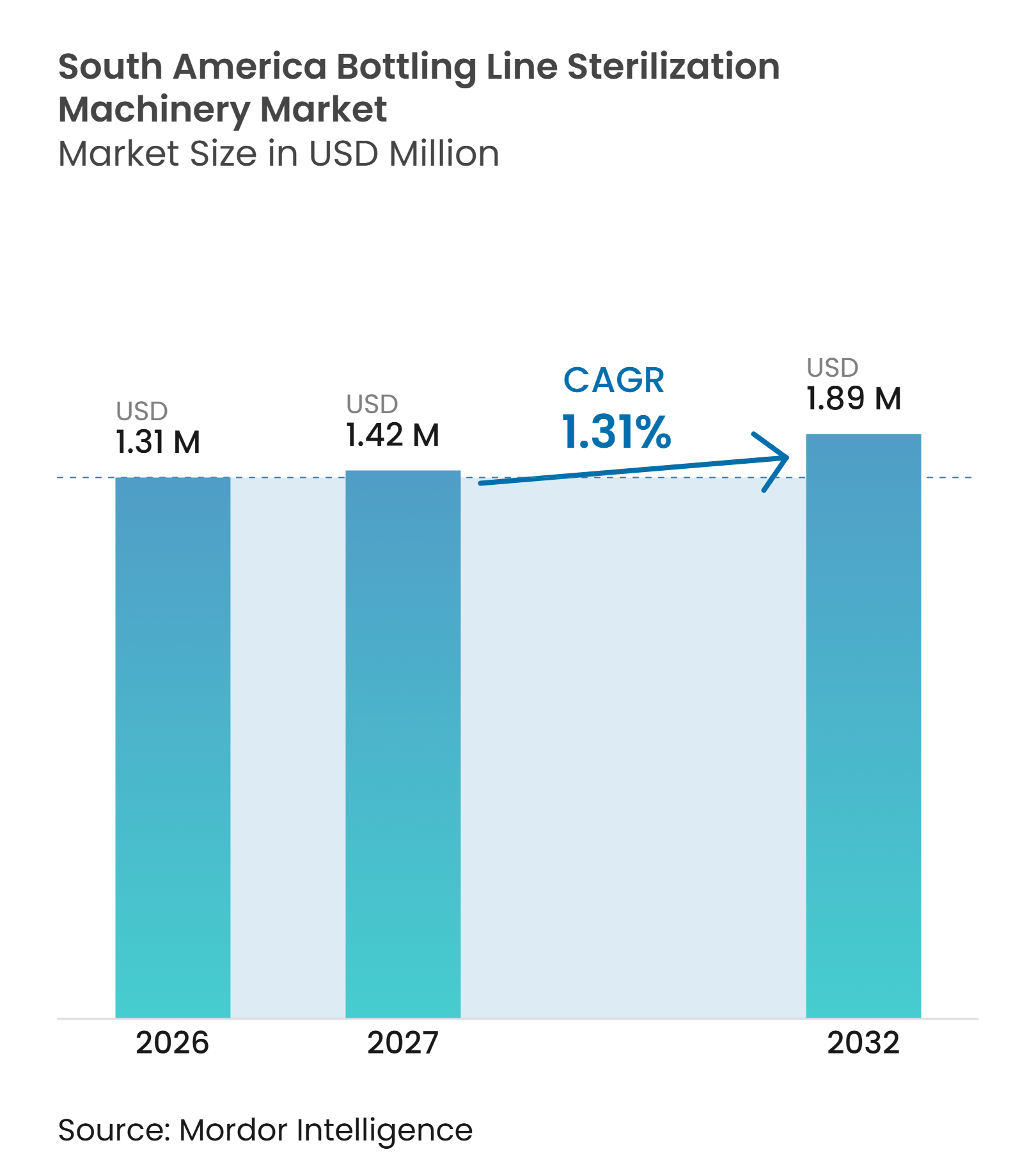
The South America Bottling Line Sterilization Machinery Market size was valued at USD 1.31 million in 2026 and is estimated to grow from USD 1.42 million in 2027 to reach USD 1.89 million by 2032, at a CAGR of 1.31% during the forecast period (2027-2032).
This is a specialized equipment category, but it benefits from repeated investment by beverage producers who need to increase aseptic output within existing plants. Brazil remains the central source of demand because its UHT dairy network and broad filling capacity support machinery upgrades, maintenance, and replacement. Producers are also placing more emphasis on compact aseptic lines that can reduce plant space requirements and improve operating efficiency. Demand from pharmaceutical and biopharmaceutical producers introduces a separate procurement cycle, as GMP-grade systems require more extensive validation than food-grade equipment. The South America bottling line sterilization machinery market also faces cost pressure from imported equipment, currency movements, and a limited supply of qualified sterile-process technicians.
Key Report Takeaways
- By equipment type, integrated sterilization-filling-capping monoblocs held 26.62% of the South America bottling line sterilization machinery market share in 2026 and are projected to expand at a 6.88% CAGR through 2032.
- By sterilization technology, hydrogen peroxide held 36.55% of the South America bottling line sterilization machinery market share in 2026, while electron beam and other emerging technologies are projected to expand at a 6.78% CAGR through 2032.
- By format, PET bottles accounted for 41.91% of the market in 2026 in the South America bottling line sterilization machinery market, while preforms are projected to expand at a 6.82% CAGR through 2032.
- By line configuration, rotary systems held 32.22% of the market in 2026, while integrated systems are projected to expand at a 6.94% CAGR through 2032.
- By end user, juice, tea, and functional beverage producers accounted for 33.71% of the market in 2026, while pharmaceutical and biopharmaceutical manufacturers are projected to expand at a 6.74% CAGR through 2032.
- By geography, Brazil held 53.85% of the market in 2026 in the South America bottling line sterilization machinery market, while Chile is projected to expand at a 6.89% CAGR through 2032.
Note: Market numbers in this report are based on Mordor Intelligence's proprietary estimation framework, which combines nine months of actuals with Q4 projections for base year 2026.
Market Trends and Insights
Drivers Impact Analysis of South America Bottling Line Sterilization Machinery Market*
| Driver | (~) % Impact on CAGR Forecast | Geographic Relevance | Impact Timeline |
|---|---|---|---|
| Expansion of Aseptic Beverage Capacity | +2.1% | Brazil, Chile, Argentina | Short term (≤ 2 years) |
| Growth in Shelf-Stable and Preservative-Free Beverages | +1.4% | Brazil, Rest of South America | Medium term (2-4 years) |
| Replacement of Aging Imported Filling Lines | +1% | Brazil, Argentina | Short term (≤ 2 years) |
| Water and Energy Savings from Dry Preform Sterilization | +0.6% | Brazil, Chile | Medium term (2-4 years) |
| Demand for Flexible Multi-Product Filling Lines | +0.4% | Brazil, Chile | Medium term (2-4 years) |
| Localized Production of High-Value Functional Beverages | +0.3% | Brazil, Chile, Argentina | Long term (≥ 4 years) |
| Source: Mordor Intelligence | |||
Expansion of Aseptic Beverage Capacity
Beverage capacity investments create direct demand for sterilization equipment because new PET, glass, and aseptic lines require validated decontamination processes. Solar Coca-Cola is carrying out a BRL 500 million investment plan in Mato Grosso for 2025 through 2029. The plan includes a new PET bottle production line commissioned in May 2026, which made Mato Grosso self-sufficient in PET bottle supply. This type of local bottle production capacity supports more predictable supply for nearby beverage filling operations. Coca-Cola Andina confirmed investment exceeding USD 500 million across its 4 operating markets in 2026 and 2027. Its plan assigns USD 65 million to Chile and USD 45 million to Argentina for production capacity expansion.[1] The investments indicate a need for equipment capable of handling aseptic filling, sterilization, and capping in the same production environment. They also support the use of standardized systems that can be maintained through established OEM service networks. Capacity additions can therefore create an equipment requirement at installation and a continuing need for qualified service over the line’s operating life.
Growth in Shelf-Stable and Preservative-Free Beverages
Shelf-stable beverages without preservatives require stronger process control than conventional high-acid products. Aseptic PET filling allows producers to protect product quality while avoiding preservatives in suitable applications. Low-acid beverages require more rigorous decontamination cycles and closer microbial validation than standard high-acid juice lines. This is because the line must manage a narrower tolerance for unwanted microbial activity. Plant-based beverages, coconut water, and functional drinks can increase this requirement because they combine low acidity with product sensitivity. Producers must match the sterilization process to the formulation and the intended ambient distribution model. This supports demand for machinery with reliable process control, consistent cycle performance, and validation capability. It also raises the value of equipment support when a producer is expanding into several sensitive beverage formats.
Replacement of Aging Imported Filling Lines
Much of South America’s existing sterilization and filling equipment was installed from 2005 to 2015. The resulting replacement cycle is distinct from investment in new capacity. Aseptic lines generally operate on replacement cycles of 15 to 20 years, placing part of the installed base under evaluation through 2030. Producers can consider the operating cost of an aging line alongside the cost and disruption of replacement. Ambev invested BRL 1.3 billion (USD 225.01 million) in filling lines at its Uberlândia facility, bringing the site's cumulative investment to BRL 2 billion (USD 346.17 million) since 2016. A BNDES-financed PET bottling line for Uberlândia Refrescos is projected to reduce water use by 10% per liter and energy consumption by 10% to 15%. The project is also projected to lower production costs by 35.5%. These operating benefits strengthen the economic case for earlier equipment replacement and can reduce the incentive to extend the life of less efficient equipment.
Water and Energy Savings from Dry Preform Sterilization
Dry preform sterilization is replacing wet rinse-based processes in a growing share of new line installations. These systems use atomized hydrogen peroxide vapor or electron-beam technology to reduce water use during sterilization. Modern hydrogen peroxide vapor systems can achieve residuals below 0.5 ppm and can operate at speeds up to 72,000 bottles per hour. Shibuya Hoppmann reports that its dry aseptic filling system uses a continuous decontamination approach for bottle surfaces. This approach can change the mix of water, chemicals, and maintenance activities required around the line. Electron beam systems remove chemical sterilants from the bottle surface process. They can be relevant where chemical-residue restrictions, water availability, utility costs, or recycled PET requirements affect line design. The choice of technology remains linked to product requirements and the producer’s ability to validate the selected process.
Restraints Impact Analysis of South America Bottling Line Sterilization Machinery Market*
| Restraint | (~) % Impact on CAGR Forecast | Geographic Relevance | Impact Timeline |
|---|---|---|---|
| High Capital Cost and Import Dependence | -1.5% | Brazil, Argentina | Short term (≤ 2 years) |
| Currency Volatility and Extended Spare-Parts Lead Times | -0.8% | Argentina, Brazil, Rest of South America | Medium term (2-4 years) |
| Limited Availability of Sterile-Process Technicians | -0.5% | All geographies | Medium term (2-4 years) |
| Validation Burden for Low-Acid Products | -0.3% | Brazil, Argentina | Long term (≥ 4 years) |
| Source: Mordor Intelligence | |||
High Capital Cost and Import Dependence
Food-grade aseptic filling systems typically require a substantial investment per line. Pharmaceutical-grade configurations require significantly higher investments because they demand more stringent sterility and cleanroom validation. The available source for these specific cost benchmarks is a commercial market research provider, so the figures are not carried into the source-supported narrative. South America does not have a domestic supplier of full aseptic monobloc lines at the same scale as established European manufacturers. Equipment imports can add freight, customs duties, and local taxes to the purchase price. This cost structure can defer upgrades for smaller producers, especially outside Brazil’s main manufacturing centers.
Currency Volatility and Extended Spare-Parts Lead Times
Sterilization equipment is commonly invoiced in euros or U.S. dollars by the dominant European suppliers. Currency depreciation can therefore affect both the initial capital purchase and the cost of spare parts. Argentina’s peso faced severe depreciation through 2024 and into 2025, reducing the purchasing power of producers with local-currency capital plans. Critical items such as hydrogen peroxide injection systems, UV-C lamps, and bearing assemblies can have lead times of 8 to 16 weeks. A failure in a sterilization module can stop an entire bottling line. Currency limits can also restrict buffer inventory and raise the risk of extended downtime.
*Our forecasts treat driver/restraint impacts as directional, not additive. The impact forecasts reflect baseline growth, mix effects, and variable interactions.
South America Bottling Line Sterilization Machinery Market Segment Analysis
By Equipment Type:
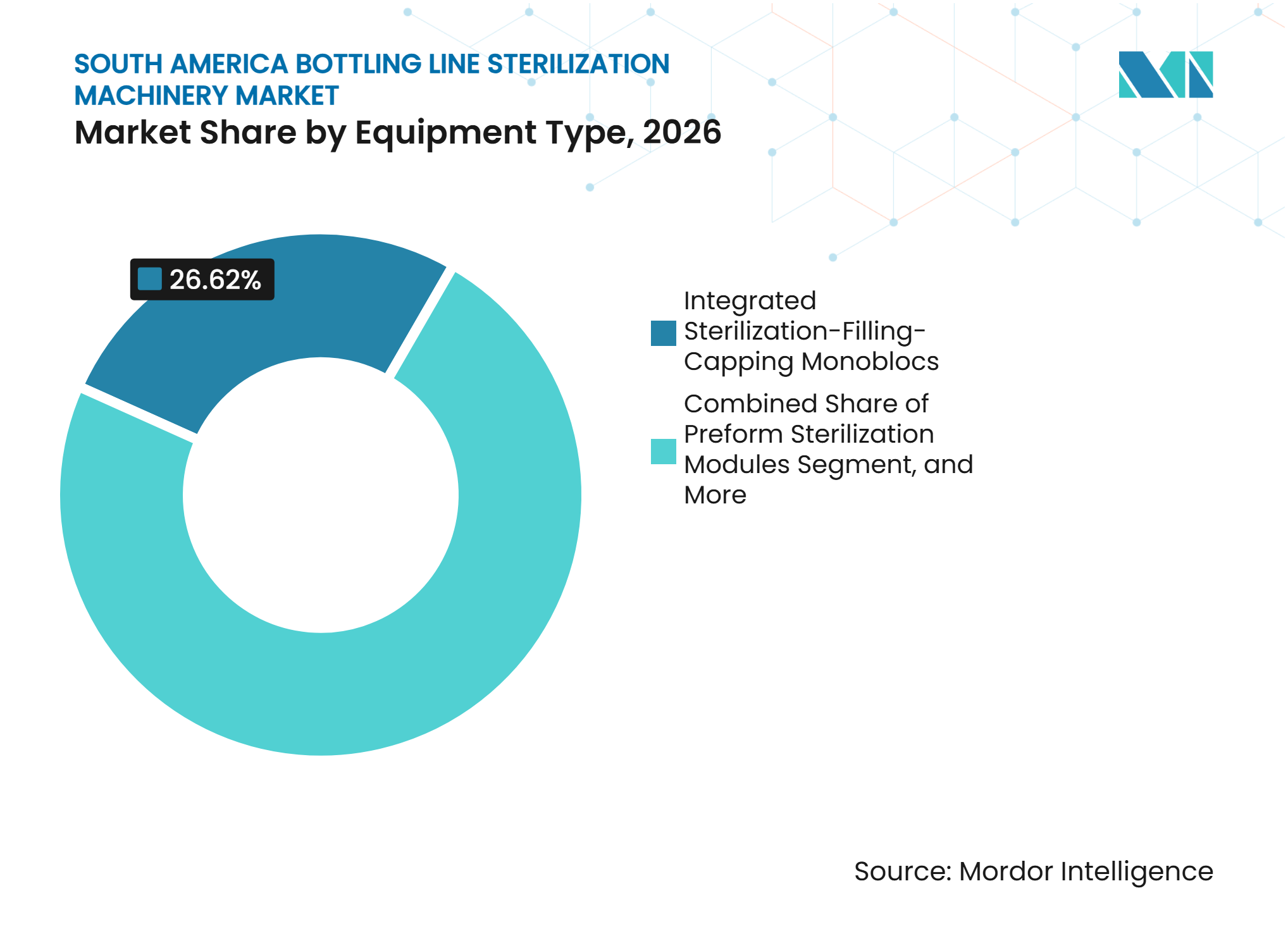
Integrated Monoblocs Define the Investment CaseIntegrated sterilization-filling-capping monoblocs held 26.62% of the regional market share in 2026 and are projected to expand at a 6.88% CAGR through 2032. This combination makes monoblocs the only equipment type that leads on both current share and projected expansion. The equipment combines sterilization, filling, and capping steps into a single coordinated system. That arrangement limits the transfer points between major production stages. Producers use this configuration to reduce the space required for a line. It can also simplify operating responsibility across the linked units. The configuration is suited to facilities that seek higher output without adding separate process blocks. These benefits are particularly relevant when a producer is modernizing an existing plant rather than building a new site.
Sidel installed its Super Combi integrated solution at Coca-Cola FEMSA’s Jundiaí plant in April 2025. The company stated that the installation combines 5 process units and reduces line footprint by up to 30% compared with standalone equipment. Sidel also reported a 14% reduction in production-related carbon dioxide emissions compared with the wet-block system it replaced. The reported outcome links integration with plant space, resource use, and equipment replacement decisions. Bottle sterilization and rinsing modules remain important where plants process several bottle types. Preform sterilization modules are also gaining relevance as dry preform systems become more widely specified. The equipment decision depends on intended output, available floor space, and the degree of process integration required.



By Sterilization Technology:
Hydrogen Peroxide Leads While Emerging Methods AdvanceHydrogen peroxide held 36.55% of the regional market share in 2026. Its position reflects compatibility with a wide range of PET and glass bottle geometries. The technology is established in many aseptic monobloc designs. It is familiar to operators, equipment suppliers, and regulatory teams. Existing operating knowledge reduces practical barriers for beverage producers. Equipment suppliers can also integrate it into common aseptic line designs. Hydrogen peroxide remains the standard reference technology for many aseptic filling configurations. Its continued use reflects the need for a validated and repeatable process.
Hydrogen peroxide, when used with UV-C light, can support effective package decontamination at lower chemical concentrations. A 2025 technical article reported a 5-log reduction in Bacillus subtilis spores when UV-C was used with hydrogen peroxide. Electron beam and other emerging technologies are projected to expand at a 6.78% CAGR through 2032. Interest in these methods reflects their ability to avoid the use of chemical sterilants on bottle surfaces. Sixteen electron beam lines are operating globally, demonstrating that the technology has commercial applications. This option can be attractive where chemical-residue requirements and recycled PET specifications influence line selection. It also responds to producer interest in different water and chemical use profiles. The technology mix will continue to reflect product type, validation requirements, and utility priorities.
By Format:
PET Leads While Preforms Support an Upstream ShiftPET bottles accounted for 41.91% of the regional market share in 2026. Their position reflects wide use in juice, water, functional beverages, and dairy products. PET supports a large installed base of bottling and aseptic filling equipment across the region. It is relevant to producers managing high-volume packaged beverage formats. The material is used across products with different distribution and storage needs. Bottle-level sterilization remains a core part of these operations. Existing PET capacity creates a continuing need for compatible line equipment. The format continues to shape equipment requirements at both existing and new plants.
Preforms are projected to expand at a 6.82% CAGR through 2032. Sterilizing at the preform stage moves contamination control upstream of bottle formation. This can reduce exposure to contamination during blow molding. It can also support lighter bottle designs. Sidel describes its Aseptic Predis system as using hydrogen peroxide mist to sterilize preforms inside the blower before bottle production. The process keeps sterilization close to the bottle-forming step. HDPE remains relevant for bulk dairy and water products. Glass is used in premium beverages and pharmaceutical applications. Each format requires equipment choices that reflect material properties and the required hygiene process.
By Line Configuration:
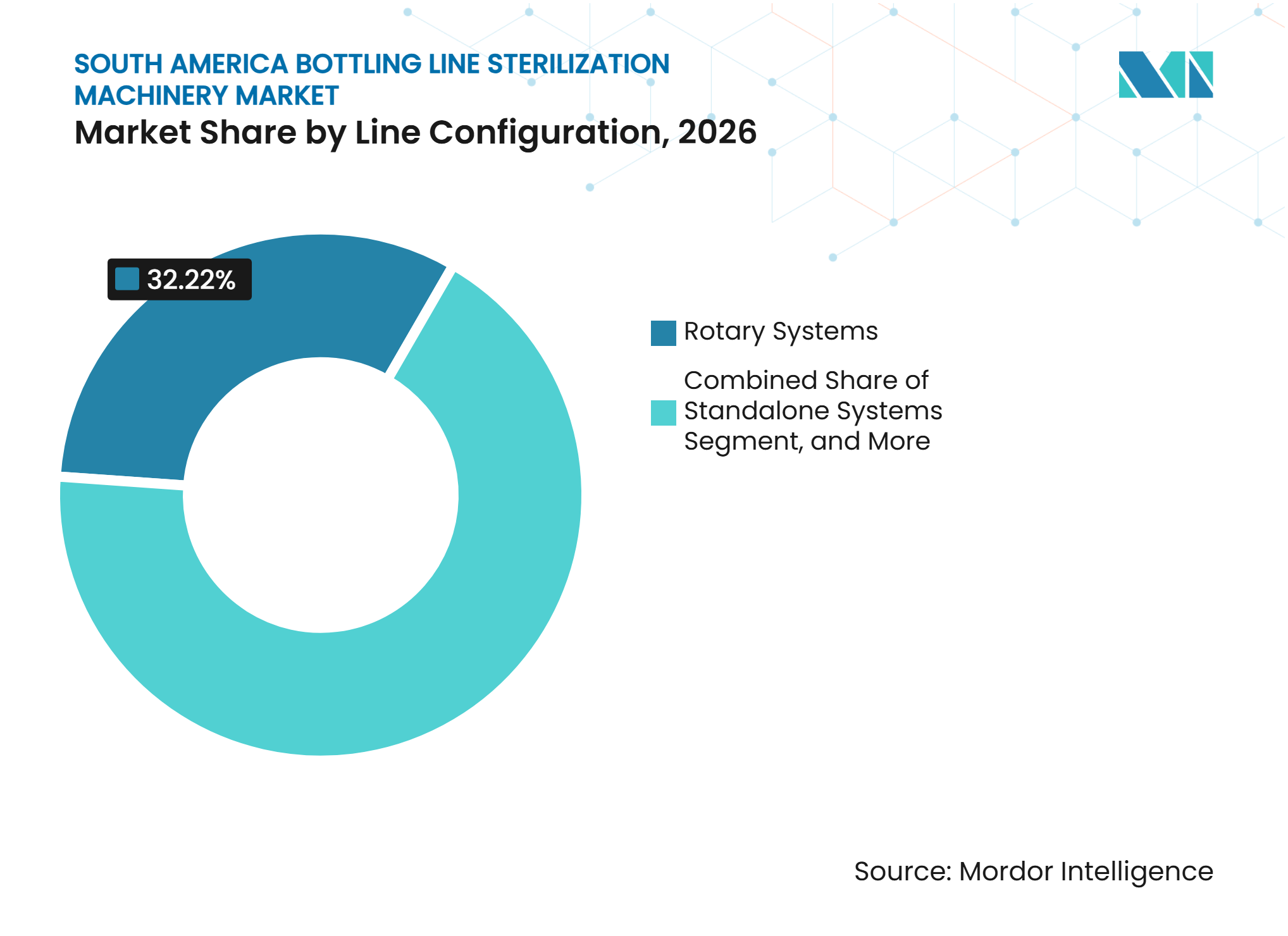
Rotary Systems Retain Scale AdvantagesRotary systems held 32.22% of the regional market share in 2026. Their position is linked to stable throughput in high-volume dairy and juice operations. Mechanical precision at speeds above 30,000 bottles per hour makes rotary systems suitable for large bottlers. These systems are designed for continuous production where volume consistency is important. They fit established manufacturing sites with high output requirements. Their design supports repeatable handling throughout each production cycle. Their share reflects the scale of the region’s large beverage operations. It also shows the continuing relevance of high-throughput line formats.
Integrated systems are projected to expand at a 6.94% CAGR through 2032. Producers select these systems to bring sterilization, filling, and sealing into a single controlled process. Grupo RFK announced a BRL 300 million investment for a new facility in Paraná developed with Krones under an Industry 4.0 framework. The project illustrates the stated direction toward connected production management in new facilities. It also reflects interest in coordinating key line functions within a single operating environment. The cited source for the investment does not meet the required source criteria, so it is not used as supporting evidence. Linear and inline systems remain relevant for mid-volume and specialist producers that prioritize flexibility. Standalone, automatic, and semi-automatic systems continue to serve contract packagers and smaller regional operators.

By End User:
Juice, Tea, and Functional Beverages Lead DemandJuice, tea, and functional beverage producers accounted for 33.71% of the regional market share in 2026. Low-acid products in this group require robust sterilization assurance. Their volume through modern retail channels also supports demand for aseptic capacity. Ambient-stable formats are relevant to producers seeking wider distribution without refrigeration. These conditions make hygiene control a central part of line investment. Product sensitivity adds to the importance of reliable decontamination performance. The category therefore remains the largest end-user base for the equipment. Its scale supports continued requirements for line upgrades and maintenance.
Pharmaceutical and biopharmaceutical manufacturers are projected to expand at a 6.74% CAGR through 2032. Domestic production of biologics and liquid oral pharmaceuticals in Brazil and Argentina supports this demand. GMP-based sterile filling requires environmental monitoring and media-fill testing beyond food-grade practice. These requirements can increase the importance of qualification and validation support. Dairy and plant-based beverage producers also have a large installed base of aseptic lines. Nine SIG aseptic filling machines entered service at Shefa and Líder Alimentos in São Paulo and Paraná in 2025. Contract beverage and aseptic packaging organizations can provide smaller brands with access to certified capacity without requiring them to own a full line. This creates an additional channel for equipment use across emerging brands.
Geography Analysis
Brazil: The Primary Center of Equipment Demand
Brazil held 53.85% of the regional market share in 2026. The country has a substantial UHT dairy distribution network, which supports a regular maintenance, upgrade, and replacement program for machinery. It also has a broad concentration of beverage producers, contract fillers, and multinational suppliers. Heineken inaugurated its Passos brewery in Minas Gerais in November 2025, with a total investment exceeding EUR 400 million (approximately USD 440 million, as reported in the supplied material). Krones supplied 4 filling lines for cans, returnable glass bottles, and non-returnable glass bottles at the site.[2] The lines reached full operation by February 2026.
Brazil’s investment environment also supports demand for more efficient bottling systems. BNDES financing for Uberlândia Refrescos covered a digitized PET line that is projected to reduce water use by 10% per liter and energy use by 10% to 15%. The same project is expected to lower production costs by 35.5%. These operating improvements can encourage producers to replace older systems before a standard replacement cycle ends. Brazil also provides established service infrastructure for multinational equipment suppliers. Its combination of consumer scale, development finance, and service availability keeps the country central to the South America bottling line sterilization machinery market.
Chile: Higher-Specification Beverage Investment Supports Expansion
Chile is projected to expand at a 6.89% CAGR through 2032, the highest rate among the geographic segments. The country’s beverage base has a stronger premium orientation, which increases the value placed on filling hygiene and format quality. It also has an emerging pharmaceutical manufacturing layer that requires GMP-grade sterilization equipment. Soprole installed the SIG XSlim 24 Aseptic filling system in 2025. SIG describes the system as a flexible aseptic platform for multiple pack sizes. This installation indicates early adoption of advanced aseptic equipment within the regional market.
Coca-Cola Andina allocated USD 65 million to Chile in its 2026 investment cycle. The program focuses on production capacity and logistics upgrades. Producers in Chile are therefore investing in both capacity and operational flexibility. These needs support demand for equipment that can manage different container sizes and product runs. GMP requirements also matter where pharmaceutical applications are involved, because they raise the standard for process qualification. Chile’s equipment demand is supported by premium product positioning, format flexibility, and the adoption of advanced aseptic systems.
Argentina and the Remaining Geographies: Differing Sources of Demand
Argentina holds the second-largest country position within the remaining geographic base. Its ambient dairy network and pharmaceutical equipment needs support, a demand that differs from Brazil’s larger beverage-led base. The supplied material states that ANMAT requires large-volume parenteral manufacturers to move to closed-system filling configurations before February 2027. This compliance requirement creates a procurement window for pharmaceutical-grade sterilization machinery. Argentina’s beverage investment is sensitive to broader economic conditions. Coca-Cola Andina commissioned a returnable packaging line in Mendoza in January 2025, demonstrating that investments can proceed when conditions permit.
The Rest of South America includes Colombia, Peru, Ecuador, Paraguay, and Uruguay. These markets add demand through dairy and functional beverage production rather than through the same scale of investment seen in Brazil. Colombia’s INVIMA guidance on aseptic filling validation shapes decisions by multinational producers outside Brazil. Regulatory influence therefore remains important even in smaller markets. A producer may need to align equipment selection with local validation expectations and available technical support. The combined geography supports demand for flexible machinery, service contracts, and validation expertise. It also broadens the regional base for sterilization equipment beyond the major investment centers in Brazil and Chile.
Competitive Landscape
Market Concentration
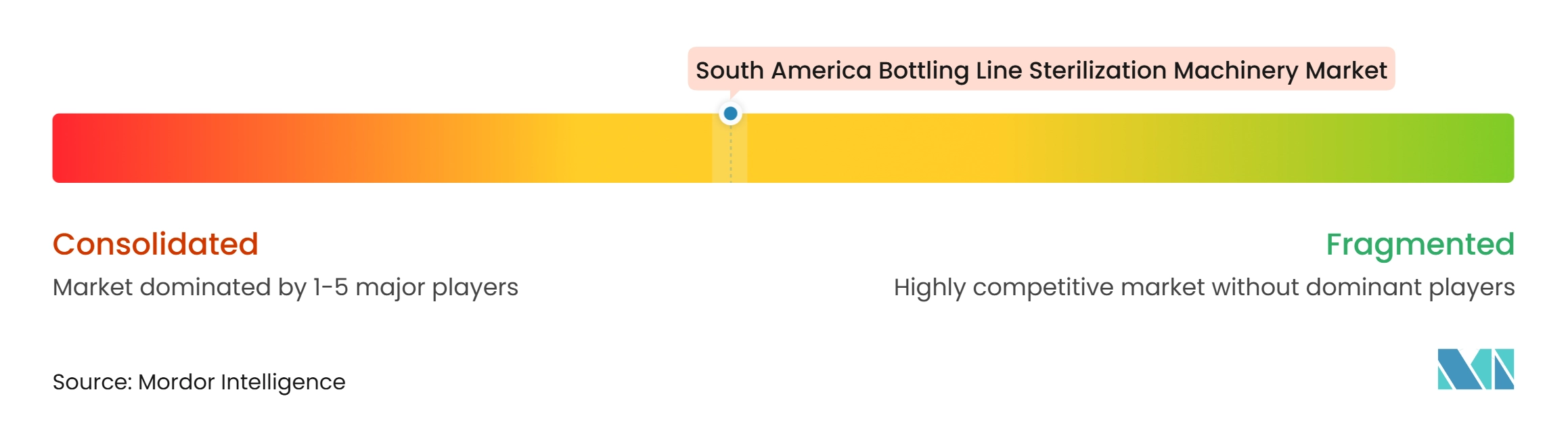
The South America bottling line sterilization machinery market is moderately concentrated. Krones, Sidel, KHS, Tetra Pak, and GEA are the leading European suppliers named in the supplied material. Their position is reinforced by established equipment portfolios and regional service capacity. Producers face high switching costs after a sterilization module has been qualified under the applicable process requirements. The original equipment supplier can therefore retain a relationship through the operating life of a line. This makes aftermarket service, spare parts, and validation support important to the competitive position of established suppliers.
Leading suppliers focus on integrated equipment, digital connectivity, and regional service capabilities. Sidel’s Super Combi installation at Coca-Cola FEMSA combines 5 process units into a single configuration. This approach addresses production space constraints and supports lower water use during cleaning. Krones supplied 4 filling lines for Heineken’s Passos brewery in Brazil. SIG invested EUR 6.7 million (approximately USD 7.6 million) in supplied materials to expand its Vinhedo facility in São Paulo and to acquire equipment.[3]
Opportunities remain in pharmaceutical-grade aseptic filling lines for contract development and manufacturing organizations in Brazil and Argentina. There is also demand for mid-speed lines that can handle changing functional beverage formats. The installed base from 2005 to 2015 supports a continuing need for service and validation work. Regional distributors can compete where a full OEM installation is not economically viable. Lower-priced Asian equipment adds pressure at the lower end of the market. However, the supplied material does not identify broad certification of these systems under food-grade or pharmaceutical-grade requirements in South America.
South America Bottling Line Sterilization Machinery Industry Leaders
-
Tetra Pak International S.A.
-
Krones AG
-
GEA Group Aktiengesellschaft
-
KHS GmbH
-
Serac Group
- *Disclaimer: Major Players sorted in no particular order
South America Bottling Line Sterilization Machinery Market Companies Covered in this Report
- Krones AG
- GEA Group Aktiengesellschaft
- KHS GmbH
- Tetra Pak International S.A.
- Serac Group
- SIPA S.p.A.
- SACMI Imola S.C.
- OCME S.r.l.
- Sidel Services
- Syntegon Technology GmbH
- IMA Group
- Romaco Group
- ProMach, Inc.
- SPX FLOW, Inc.
- JBT Corporation
- Optima Packaging Group GmbH
- Marchesini Group S.p.A.
- GEA Process Engineering
- Sanmartin Sistemas de Envase Ltda.
Recent Industry Developments in South America Bottling Line Sterilization Machinery Market
- November 2026: Ambev announced a new high-speed glass bottle filling line at its Rio de Janeiro facility, with investment exceeding BRL 105 million, reported as approximately USD 20 million in the supplied material. Designed for Corona’s 210 ml glass format, the line is capable of processing 50,000 bottles per hour and was scheduled for commissioning in December 2026, expanding Ambev’s premium glass capacity in southeast Brazil.
- May 2026: Solar Coca-Cola inaugurated a new PET bottle production line in Várzea Grande, Mato Grosso, as part of a BRL 500 million investment plan spanning 2025 to 2029. The new line made Mato Grosso self-sufficient in PET bottle supply and supported aseptic filling equipment demand in Brazil’s farm-belt consumer market.
- April 2026: Coca-Cola Andina confirmed a 2026 investment of USD 250 million across Brazil, Chile, Argentina, and Paraguay. The program included USD 110 million for Brazil and USD 65 million for Chile to support production capacity and logistics upgrades.
- November 2025: Heineken’s first greenfield brewery in Brazil was ceremonially inaugurated in Passos, Minas Gerais, with total investment exceeding EUR 400 million (USD 440 million) in supplied materials. Krones supplied 4 filling lines, and the brewery reached an annual capacity of up to 5 million hectoliters.
South America Bottling Line Sterilization Machinery Market Report Scope
The South America Bottling Line Sterilization Machinery Market comprises machinery and equipment designed to sterilize bottles, preforms, caps, and closures used in bottling and liquid packaging production lines. The market covers standalone and integrated sterilization systems that use technologies such as hydrogen peroxide, peracetic acid, steam and hot water, dry heat and hot air, UV-C and pulsed light, electron beam, and other emerging technologies to minimize microbial contamination and ensure product hygiene and packaging safety.
The South America Bottling Line Sterilization Machinery Market Report is Segmented by Equipment Type (Bottle Sterilization and Rinsing Modules, Preform Sterilization Modules, Cap and Closure Sterilization Modules, Integrated Sterilization-Filling-Capping Monoblocs), Sterilization Technology (Hydrogen Peroxide, Peracetic Acid, Steam and Hot Water, Dry Heat and Hot Air, UV-C and Pulsed Light, Electron Beam and Other Emerging Technologies), Format (PET Bottles, HDPE Bottles, Glass Bottles, Preforms, Caps and Closures, and Other Formats), Line Configuration (Rotary Systems, Linear and Inline Systems, Standalone Systems, Integrated Systems, Automatic and Semi-Automatic Systems), End User (Dairy and Plant-Based Beverage Producers, Juice, Tea, and Functional Beverage Producers, Bottled Water Producers, Pharmaceutical and Biopharmaceutical Manufacturers, Contract Beverage and Aseptic Packaging Organizations, Cosmetics, Personal Care, and Other Liquid Product Producers), and Geography (Brazil, Argentina, Chile, and Rest of South America). The Market Forecasts are Provided in Terms of Value (USD).
Segmentation Overview
| Bottle Sterilization and Rinsing Modules |
| Preform Sterilization Modules |
| Cap and Closure Sterilization Modules |
| Integrated Sterilization-Filling-Capping Monoblocs |
| Hydrogen Peroxide |
| Peracetic Acid |
| Steam and Hot Water |
| Dry Heat and Hot Air |
| UV-C and Pulsed Light |
| Electron Beam and Other Emerging Technologies |
| PET Bottles |
| HDPE Bottles |
| Glass Bottles |
| Preforms |
| Caps and Closures |
| Other Formats |
| Rotary Systems |
| Linear and Inline Systems |
| Standalone Systems |
| Integrated Systems |
| Automatic and Semi-Automatic Systems |
| Dairy and Plant-Based Beverage Producers |
| Juice, Tea, and Functional Beverage Producers |
| Bottled Water Producers |
| Pharmaceutical and Biopharmaceutical Manufacturers |
| Contract Beverage and Aseptic Packaging Organizations |
| Cosmetics, Personal Care, and Other Liquid Product Producers |
| Brazil |
| Argentina |
| Chile |
| Rest of South America |
| By Equipment Type | Bottle Sterilization and Rinsing Modules |
| Preform Sterilization Modules | |
| Cap and Closure Sterilization Modules | |
| Integrated Sterilization-Filling-Capping Monoblocs | |
| By Sterilization Technology | Hydrogen Peroxide |
| Peracetic Acid | |
| Steam and Hot Water | |
| Dry Heat and Hot Air | |
| UV-C and Pulsed Light | |
| Electron Beam and Other Emerging Technologies | |
| By Format | PET Bottles |
| HDPE Bottles | |
| Glass Bottles | |
| Preforms | |
| Caps and Closures | |
| Other Formats | |
| By Line Configuration | Rotary Systems |
| Linear and Inline Systems | |
| Standalone Systems | |
| Integrated Systems | |
| Automatic and Semi-Automatic Systems | |
| By End User | Dairy and Plant-Based Beverage Producers |
| Juice, Tea, and Functional Beverage Producers | |
| Bottled Water Producers | |
| Pharmaceutical and Biopharmaceutical Manufacturers | |
| Contract Beverage and Aseptic Packaging Organizations | |
| Cosmetics, Personal Care, and Other Liquid Product Producers | |
| By Geography | Brazil |
| Argentina | |
| Chile | |
| Rest of South America |
Key Questions Answered in the Report
What is the South America bottling line sterilization machinery market size?
The market is valued at USD 1.31 million in 2026 and is estimated to reach USD 1.89 million by 2032 at a 5.89% CAGR from 2027 to 2032.
Which equipment type leads demand for bottling line sterilization machinery in South America?
Integrated sterilization-filling-capping monoblocs lead with a 26.62% share in 2026 and are projected to expand at a 6.88% CAGR through 2032.
What sterilization technology is most widely used in South America?
Hydrogen peroxide leads the technology category with a 36.55% share in 2026 because it is compatible with common PET and glass bottle configurations.
Why are dry preform sterilization systems becoming more relevant?
They can reduce water use and can avoid chemical sterilants on bottle surfaces when electron beam technology is used.
Which country has the largest demand base for sterilization machinery?
Brazil accounts for 53.85% of the regional market in 2026, supported by UHT dairy, beverage production, and replacement investment.
Which end user is projected to expand fastest through 2032?
Pharmaceutical and biopharmaceutical manufacturers are projected to expand at a 6.74% CAGR because GMP-grade sterile production requires more rigorous process control.