
Market Overview
| Study Period | 2020 - 2031 |
|---|---|
| Forecast Data Period | 2026 - 2031 |
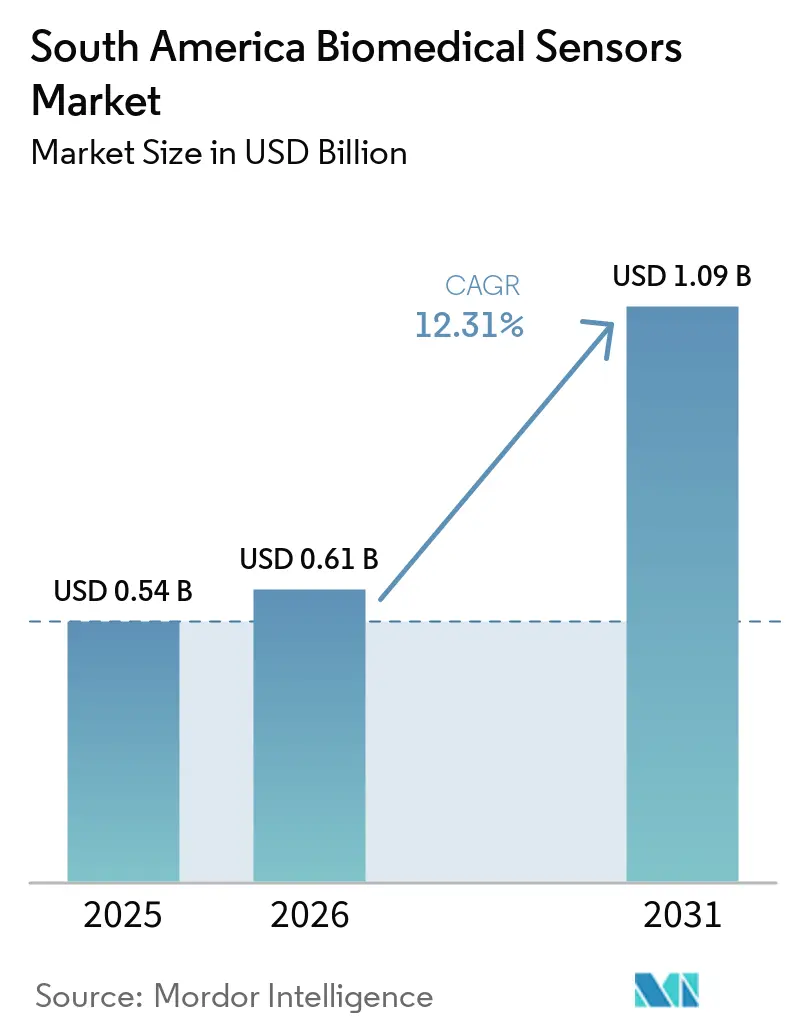
| Base Year Market Size (2025) | USD 0.54 Billion |
| Market Size (2026) | USD 0.61 Billion |
| Market Size (2031) | USD 1.09 Billion |
| Growth Rate (2026 - 2031) | 12.31 % |
| Market Concentration | Medium |
Major Players *Disclaimer: Major Players sorted in no particular order Image © Mordor Intelligence. Reuse requires attribution under CC BY 4.0. | |
South America Biomedical Sensors Market Analysis by Mordor Intelligence
The South America biomedical sensors market size was valued at USD 0.54 billion in 2025 and is estimated to expand from USD 0.61 billion in 2026 to reach USD 1.09 billion by 2031, at a CAGR of 12.31% during the forecast period (2026-2031). Demand is increasingly tied to continuous management of chronic conditions, rather than to isolated clinical visits. Home-based care, remote monitoring, and point-of-care testing are widening the settings in which clinical-grade sensors are used. Connected platforms are also making interoperability, data protection, and validated performance more important in purchasing decisions. Brazil remains the principal regional demand center, while Colombia is gaining momentum through digital health reform. The South America biomedical sensors market, therefore, offers opportunities for suppliers that can meet regulatory requirements, support connected care, and address locally relevant diagnostic needs.
Key Report Takeaways
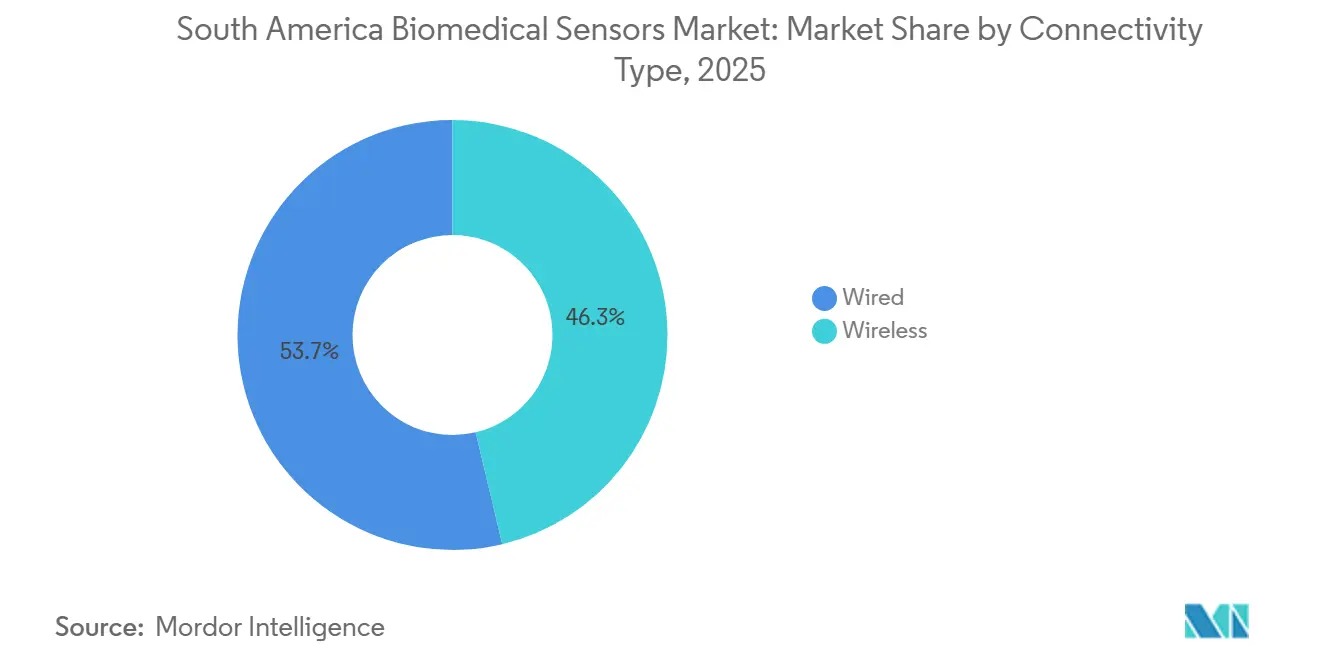
- By type, wired sensors held 53.72% of the South America biomedical sensors market share in 2025, while wireless sensors are projected to expand at a 12.71% CAGR through 2031.
- By sensor type, temperature sensors accounted for 31.18% of revenue in 2025, while biochemical sensors are expected to expand at a 13.89% CAGR through 2031.
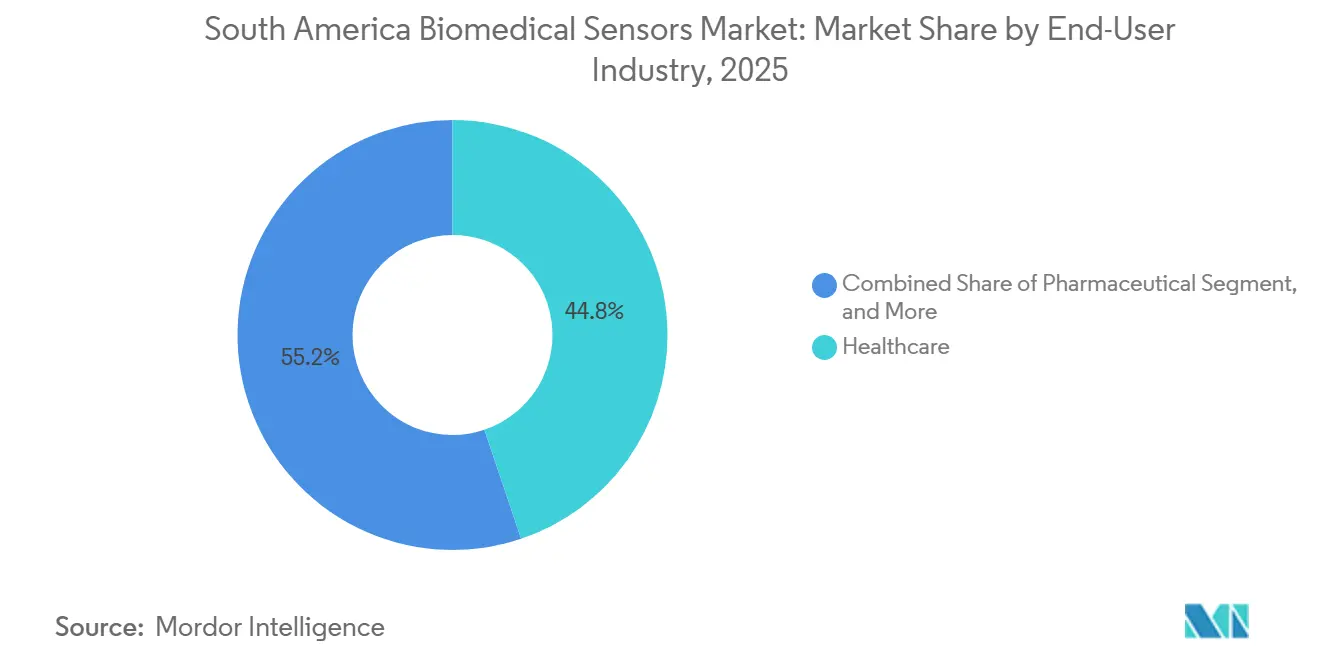
- By industry, healthcare accounted for 44.83% of the South America biomedical sensors market size in 2025, while fitness and wellness is projected to expand at a 13.09% CAGR through 2031.
- By application, monitoring accounted for 35.29% of revenue in 2025, while research and development is forecast to expand at a 13.48% CAGR through 2031.
- By geography, Brazil held 54.67% revenue share in 2025, while Colombia is projected to expand at a 13.12% CAGR through 2031.
Note: Market size and forecast figures in this report are generated using Mordor Intelligence’s proprietary estimation framework, updated with the latest available data and insights as of January 2026.
Market Trends and Insights
Drivers Impact Analysis of South America Biomedical Sensors Market*
| Driver | (~) % Impact on CAGR Forecast | Geographic Relevance | Impact Timeline |
|---|---|---|---|
| Rising Chronic Disease Burden and Continuous Monitoring Demand | +2.8% | Regional, concentrated in Brazil, Argentina, and Colombia | Short term (≤ 2 years) |
| Home-Based Care and Remote Patient Monitoring Expansion | +2.4% | Brazil, Colombia, and Argentina | Medium term (2-4 years) |
| IoT and Wireless Medical Device Integration | +2.0% | Brazil, Colombia, and Chile | Medium term (2-4 years) |
| Point-of-Care Diagnostics and Decentralized Testing | +1.6% | Brazil and Rest of South America | Short term (≤ 2 years) |
| Brazil-Based Innovation and Local Technology Transfer | +1.0% | Brazil, particularly São Paulo and Santa Catarina | Long term (≥ 4 years) |
| Telehealth and Connected-Care Procurement | +0.8% | Brazil, Colombia, Bolivia, and Peru | Medium term (2-4 years) |
| Source: Mordor Intelligence | |||
Rising Chronic Disease Burden and Demand for Continuous Monitoring
Chronic disease is creating a durable need for monitoring across South American care systems. Noncommunicable disease deaths in the Americas reached 6 million in 2021, up 43% from 2000. Cardiovascular disease caused 2.16 million of those deaths, while diabetes caused more than 420,000 deaths, and chronic respiratory conditions caused more than 416,000 deaths. More than 43 million people aged over 30 lacked the care they needed, which increases the importance of monitoring beyond specialist facilities. A 2026 study placed the annual cost of atherosclerotic cardiovascular disease in Brazil at BRL 10 billion (USD 1.8 billion). Brazil also announced BRL 2.4 billion (USD 480 million) in SUS equipment procurement in August 2025, with preferential pricing for domestic manufacturers.[1]
Expansion of Home-Based Care and Remote Patient Monitoring
Home-based care has become an established part of healthcare delivery in the region. The South America remote patient monitoring systems category is expected to increase from USD 254.13 million in 2025 to USD 576 million by 2030, at a 17.78% CAGR. This shift extends the use of sensors into homes, community settings, and post-discharge programs. It also makes accuracy, calibration, and dependable connectivity important because home-use devices must still support clinical decisions. The resulting demand does not favor low-cost devices alone, since providers need evidence that a sensor performs reliably outside a hospital. The South America biomedical sensors market can benefit when suppliers combine validated hardware with services that support remote clinical workflows.
Integration of Biomedical Sensors With IoT and Wireless Medical Devices
Connected devices are changing sensors from stand-alone measurement tools into elements of broader clinical systems. Wireless platforms can combine heart rate, temperature, SpO₂, and biochemical signals within a single data environment. This enables clinicians to use information continuously rather than only after a patient visit. Philips presented its Capsule MDIP interoperability platform in Brazil in May 2026 as part of its connected-care offering. The platform links device information with clinical data systems and supports the practical integration of monitoring equipment within hospital workflows. Wireless sensors are projected to expand, supporting the role of connected monitoring in the South America biomedical sensors market.
Growth of Point-of-Care Diagnostics and Decentralized Testing
Primary care policies are increasing the need for diagnostic sensing closer to patients. Brazil’s family health strategy shifts many services from central laboratories toward primary care units. ANVISA added infectious disease point-of-care nucleic acid testing devices to a fast-track molecular diagnostics pathway in July 2026. The pathway provides a 25-working-day review period for eligible products, which can shorten access to decentralized diagnostic platforms. Bio-Manguinhos at Fiocruz presented a nationally developed rapid diagnostic test for chronic Chagas disease in 2026, underscoring the need for sensors tailored to local disease conditions. These requirements create space for regional specialists with validated products, while the South America biomedical sensors market remains dependent on strong quality and regulatory evidence.
Restraints Impact Analysis of South America Biomedical Sensors Market*
| Restraint | (~) % Impact on CAGR Forecast | Geographic Relevance | Impact Timeline |
|---|---|---|---|
| Data Security and Patient Privacy Vulnerabilities | -1.4% | Brazil, Colombia, and Argentina | Medium term (2-4 years) |
| Stringent Regulatory Procedures and Long Product-Development Cycles | -1.1% | Brazil, Colombia, and Argentina | Short term (≤ 2 years) |
| Limited Calibration, Validation, and Technical-Service Capacity | -0.7% | Rest of South America and smaller urban centers in Brazil and Argentina | Long term (≥ 4 years) |
| Import Dependence, Currency Volatility, and High Landed Costs | -0.9% | Argentina, Brazil, and Rest of South America | Short term (≤ 2 years) |
| Source: Mordor Intelligence | |||
Data Security and Patient Privacy Vulnerabilities
Connected sensors increase the volume of patient information moving across digital systems. A 2025 study of Brazil’s DATASUS platform identified a risk that authorized users could infer sensitive attributes by combining demographic and procedural data. That concern is relevant because sensor-enabled systems increasingly feed information into national and hospital data environments. Brazil’s Decree No. 12.560 of July 2025 revised governance for the National Health Data Network and required data sovereignty, confidentiality, and auditability. Compliance work can delay procurement when healthcare providers need assurance that a vendor’s practices meet LGPD obligations. This can create a higher barrier to entry for smaller connected-device suppliers in the South America biomedical sensors market.[2]
Stringent Regulatory Procedures and Long Product-Development Cycles
Regulatory procedures can delay the launch of sensor products across the region. Brazil’s 2026-2027 agenda introduced changes affecting device identification, software as a medical device, and blood glucose self-testing systems. ANVISA’s Normative Instruction No. 426 became effective on March 1, 2026, establishing requirements for Unique Device Identification data in Brazil’s medical device database. Colombia has also strengthened requirements for platforms that support diagnostic or clinical decision functions. These rules affect connected, AI-enabled, and biochemical sensing products more than basic devices because their compliance obligations are broader. Registration costs and timelines can limit smaller suppliers' ability to enter the South America biomedical sensors market at scale.
*Our forecasts treat driver/restraint impacts as directional, not additive. The impact forecasts reflect baseline growth, mix effects, and variable interactions.
South America Biomedical Sensors Market Segment Analysis
By Connectivity Type:
Wired Reliability Supports Acute Care While Wireless Connectivity Extends AccessWired sensors held 53.72% of the South America biomedical sensors market share in 2025. Their position reflects the need for reliable signal continuity in intensive care, operating rooms, and cardiac monitoring wards. These settings use multi-parameter monitoring systems where interruptions or interference can affect clinical performance. Established suppliers have a strong position because tertiary hospital networks require proven equipment, service support, and compatibility with installed systems. The South America biomedical sensors industry continues to depend on wired configurations for acute and high-acuity care.
Wireless sensors are expected to expand at a 12.71% CAGR through 2031. Their use is increasing in step-down units, outpatient pathways, remote monitoring, and home discharge programs. Wired and wireless systems often complement each other rather than replace one another. Philips showcased its PM 6000 patient monitoring platform, featuring the Patient Information Center iX software, in Brazil in May 2026. The platform illustrates how continuous monitoring in critical care can sit alongside wireless data access and early-warning tools for wider hospital use.
By Sensor Type:
Temperature Sensors Lead While Biochemical Sensors Gain From Diabetes CareTemperature sensors held 31.18% of the South America biomedical sensors market share in 2025. Their broad use covers patient monitoring, pharmaceutical cold-chain management, research laboratories, neonatal care, and critical care. Temperature is a basic clinical measurement that is in high demand across many settings. Pressure, image, inertial, motion, and electrocardiogram sensors serve more specialized needs in diagnostics, cardiovascular care, and imaging-guided procedures. Together, these categories make the South America biomedical sensors industry relevant to both general monitoring and targeted clinical applications.
Biochemical sensors are projected to expand at a 13.89% CAGR through 2031. Demand is linked to diabetes management and wider use of continuous glucose monitoring. Adult diabetes prevalence in the Americas was 13.1% in the 2025 PAHO data. Abbott received FDA authorization for Libre Duo 10 Day in August 2026, a dual glucose-ketone sensor designed to monitor both analytes. FAPESP also supported a 2025 project for a dual-impedimetric platform that monitors glucose and C-peptide using nanocomposite electrodes.
By End-User Industry:
Healthcare Anchors Demand While Fitness and Wellness ExpandsHealthcare accounted for 44.83% of the South America biomedical sensors market size in 2025. Hospitals use clinically validated sensors for monitoring, diagnostics, therapeutic systems, and imaging. Pharmaceutical manufacturers and research institutions represent additional structured demand for process monitoring, analytical sensing, and laboratory equipment. These buyers require biochemical, temperature, and pressure-sensing capabilities that perform reliably in controlled clinical or research environments. Healthcare, therefore, remains the central purchasing base for the South America biomedical sensors market.
Fitness and wellness are forecast to expand at a 13.09% CAGR through 2031. Urban smartwatch use is increasing the installed base of devices that continuously collect biometric data. Consumer devices are also incorporating measurements that more closely align with clinically relevant monitoring parameters. This development broadens exposure to sensing technologies, but it does not remove the need for clinical validation in medical applications. Research institutions remain strategically important because they purchase specialized sensing tools for neglected tropical diseases and endemic conditions. These programs support demand for purpose-built biochemical sensors that standard portfolios may not address.

By Application:
Monitoring Holds the Largest Position While Research and Development AcceleratesMonitoring accounted for 35.29% of the South America biomedical sensors market size in 2025. It is used in hospitals, outpatient care, and the expanding home-monitoring environment for chronic disease management. Diagnostics and therapeutics also represent significant applications. Decentralized testing is supporting diagnostic use, while therapeutic systems use sensors in drug delivery, cardiac rhythm management, and implantable monitoring. Imaging demand is supported by the established base of magnetic resonance imaging, computed tomography, and ultrasound equipment.
Research and development is projected to expand at a 13.48% CAGR through 2031. Brazilian universities, FAPESP-supported centers, and Colombian digital health hubs are increasing demand for specialized sensing technologies. These users need devices that may not fit standard hospital procurement requirements. Bio-Manguinhos at Fiocruz presented work on Chagas disease biosensing and telediagnosis for riverine communities in the Pantanal in 2026. This activity shows how research needs can support application-specific sensor development across the South America biomedical sensors market.
Geography Analysis
Brazil Biomedical Sensors Market
Brazil held 54.67% of the South America biomedical sensors market share in 2025. Its position reflects the region’s largest hospital base, the scale of SUS procurement, and an expanding domestic medical-device manufacturing base. The government announced a BRL 2.4 billion (USD 480 million) procurement program in August 2025 that favored domestic manufacturers in bid pricing. This policy supports institutional demand and a favorable setting for local production. Philips began national production of the CT 5300 scanner at its Varginha facility in November 2025 for Brazil and other South American countries, strengthening Brazil’s role as a regional supply point for imaging systems.[3]
Colombia Biomedical Sensors Market
Colombia is projected to expand at a 13.12% CAGR through 2031. Its national Digital Health Summary became mandatory for registered healthcare providers in April 2026. The HL7 FHIR-based framework provides a common structure for clinical information exchange. It creates demand for sensor platforms that can provide structured, timely data to electronic health record systems.
South America Biomedical Sensors Market
Argentina and the Rest of South America show more uneven conditions. Argentina’s currency instability, import licensing rules, and limited access to US dollars have encouraged providers to extend equipment lifecycles and prioritize refurbishment. These conditions can defer new sensor purchases despite continued clinical demand. PAHO identified Argentina as 1 of 5 countries in the Americas on track to meet the global target for reducing premature mortality from noncommunicable diseases. Chile’s interoperability requirements support orderly procurement, while Peru has demonstrated emerging innovation with a portable electrocardiogram prototype that achieved Technology Readiness Level 6 validation in 2025.
Competitive Landscape
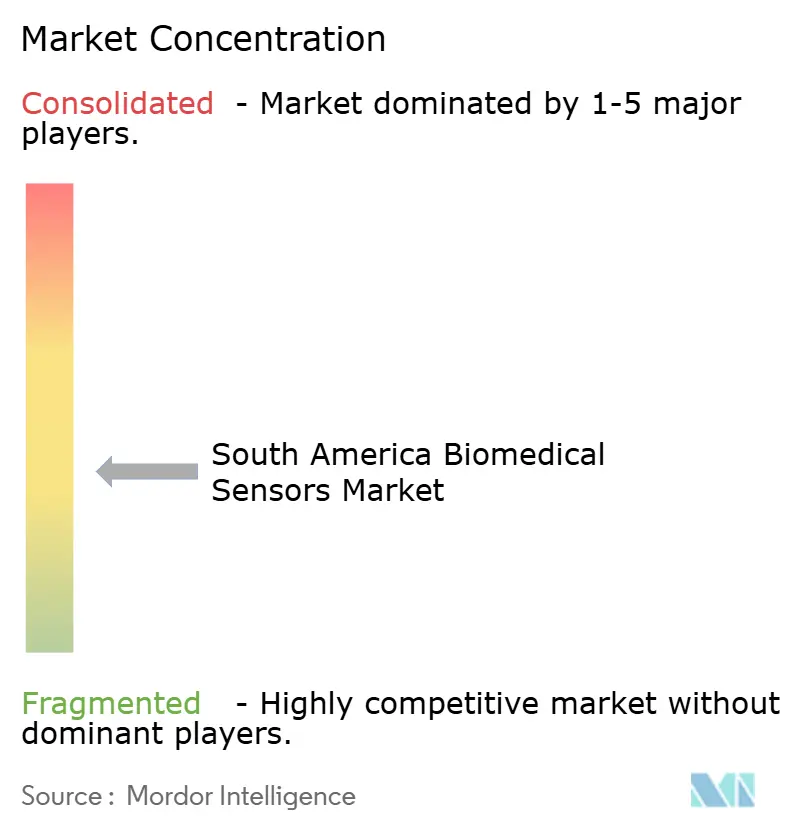
The South America biomedical sensors market is moderately fragmented. Global medical technology companies have established positions in imaging, cardiac monitoring, and continuous glucose monitoring. Regional specialists, local manufacturers, and lower-cost imports compete more actively in diagnostics, point-of-care sensing, and fitness applications. Leading companies use regulatory approvals, integrated platforms, and broad service networks to protect institutional accounts. Smaller suppliers compete through price, local service, and products suited to regional disease conditions.
Platform-based competition is becoming more important than sales of discrete sensor components. Philips has positioned its Integrated Diagnostics strategy around connected imaging, clinical informatics, and workflow tools in Brazil, while Abbott secured CE Mark for Libre Duo in May 2026 and FDA authorization in August 2026. These approaches link sensor hardware with data, analytics, and clinical processes. They show how product development and software-enabled care models can shape competitive positions.
Opportunities are most apparent in calibration services and diagnostics for endemic diseases. Many markets outside the regional anchors have limited capacity to maintain calibration and clinical-grade sensor accuracy. Localized biochemical platforms may also address Chagas disease, dengue, and tuberculosis more closely than standard global product ranges. ANVISA launched Edital de Chamamento 5/2026 in August 2026 to provide regulatory support to innovative medical device developers. It can help local innovators understand registration requirements while strengthening the secondary tier of the South America biomedical sensors market
South America Biomedical Sensors Industry Leaders
-
Medtronic plc
-
Abbott Laboratories
-
GE HealthCare Technologies Inc.
-
Koninklijke Philips N.V.
-
Siemens Healthineers AG
- *Disclaimer: Major Players sorted in no particular order
South America Biomedical Sensors Market Companies Covered in this Report
- Abbott Laboratories
- Analog Devices, Inc.
- Becton, Dickinson and Company
- Biologix
- Boston Scientific Corporation
- Condor Instruments
- Danaher Corporation
- Dexcom, Inc.
- Diasci PD&I
- Edwards Lifesciences Corporation
- GE HealthCare Technologies Inc.
- Honeywell International Inc.
- Koninklijke Philips N.V.
- Masimo Corporation
- Medtronic plc
- NXP Semiconductors N.V.
- Olympus Corporation
- Quoretech
- Sensirion AG
- Siemens Healthineers AG
- ICU Medical, Inc.
- STMicroelectronics N.V.
- Stryker Corporation
- TE Connectivity Ltd.
- Texas Instruments Incorporated
Recent Industry Developments in South America Biomedical Sensors Market
- August 2026: Abbott received FDA authorization for Libre Duo 10 Day, the world’s first dual glucose-ketone sensing technology for people with diabetes. The system simultaneously monitors glucose and rising ketones to prevent diabetic ketoacidosis and is compatible with major automated insulin delivery systems. Abbott indicated a commercial US launch for late 2026, with international markets, including South America, expected to follow as ANVISA and INVIMA pathways are navigated.
- August 2026: ANVISA launched Edital de Chamamento 5/2026, a call for innovative medical-device developers to participate in its regulatory accompaniment program. The initiative targets AI-based diagnostics, advanced monitoring systems, and new biomaterials. The 2023 pilot received 107 proposals and selected 10 projects for regulatory support.
- July 2026: ANVISA issued RDC No. 45/2026, adding infectious disease point-of-care nucleic acid testing devices to the molecular diagnostics fast-track registration path. The regulation set a 25-working-day review period and supports faster access to diagnostic sensing platforms in Brazil’s decentralized testing environment.
- May 2026: Abbott secured CE Mark for Libre Duo, the world’s first dual glucose-ketone sensing technology. The approval preceded its August 2026 FDA authorization and positioned the dual-analyte sensor for future global entry pathways.
South America Biomedical Sensors Market Report Scope
The South America Biomedical Sensors Market comprises sensors and sensor technologies used to detect, measure, and monitor physiological, biochemical, physical, and motion-related parameters in biomedical, healthcare, pharmaceutical, research, and fitness and wellness applications. These sensors convert biological or physical characteristics into measurable signals for patient assessment, disease detection, continuous monitoring, therapeutic applications, medical imaging, biomedical research, and health and wellness tracking.
The South America Biomedical Sensors Market Report is Segmented by Connectivity Type (Wired, and Wireless), Sensor Type (Temperature, Pressure, Image Sensors, Biochemical, Inertial Sensors, Motion Sensors, Electrocardiogram (ECG), and Other Sensor Types), End-User Industry (Pharmaceutical, Healthcare, Research Institutions, and Fitness and Wellness), Application (Diagnostics, Monitoring, Therapeutics, Imaging, Research and Development, and Other Applications), and Geography (Brazil, Argentina, Colombia, and Rest of South America). The Market Forecasts are Provided in Terms of Value (USD).
Segmentation Overview
By Connectivity Type
| Wired |
| Wireless |
By Sensor Type
| Temperature |
| Pressure |
| Image Sensors |
| Biochemical |
| Inertial Sensors |
| Motion Sensors |
| Electrocardiogram (ECG) |
| Other Sensor Types |
By End-User Industry
| Pharmaceutical |
| Healthcare |
| Research Institutions |
| Fitness and Wellness |
By Application
| Diagnostics |
| Monitoring |
| Therapeutics |
| Imaging |
| Research and Development |
| Other Applications |
By Geography
| Brazil |
| Argentina |
| Colombia |
| Rest of South America |
| By Connectivity Type | Wired |
| Wireless | |
| By Sensor Type | Temperature |
| Pressure | |
| Image Sensors | |
| Biochemical | |
| Inertial Sensors | |
| Motion Sensors | |
| Electrocardiogram (ECG) | |
| Other Sensor Types | |
| By End-User Industry | Pharmaceutical |
| Healthcare | |
| Research Institutions | |
| Fitness and Wellness | |
| By Application | Diagnostics |
| Monitoring | |
| Therapeutics | |
| Imaging | |
| Research and Development | |
| Other Applications | |
| By Geography | Brazil |
| Argentina | |
| Colombia | |
| Rest of South America |
Key Questions Answered in the Report
What is the South America biomedical sensors market size?
The South America biomedical sensors market was valued at USD 0.54 billion in 2025 and is estimated at USD 0.61 billion in 2026. It is forecast to reach USD 1.09 billion by 2031 at a 12.31% CAGR.
What is driving demand for biomedical sensors in South America?
Chronic disease management, home-based care, remote monitoring, connected devices, and decentralized testing are expanding use across clinical and nonclinical settings.
Which sensor type is expanding fastest in South America?
Biochemical sensors are projected to expand at a 13.89% CAGR through 2031, supported by diabetes management and continuous glucose monitoring.
Which application has the largest position in the region?
Monitoring held 35.29% revenue share in 2025 because it is used across hospitals, outpatient settings, and home-based chronic disease care.
Which country leads regional demand for biomedical sensors?
Brazil held 54.67% revenue share in 2025, supported by hospital infrastructure, SUS procurement, and domestic manufacturing activity.
What factors can slow deployment of connected sensor platforms?
Data privacy obligations, regulatory reviews, limited calibration capacity, import dependence, and currency volatility can delay purchases and product launches.