
Market Overview
| Study Period | 2019 - 2031 |
|---|---|
| Forecast Data Period | 2026 - 2031 |
| Base Year Market Size (2025) | USD 1.27 Billion |
| Market Size (2026) | USD 1.32 Billion |
| Market Size (2031) | USD 1.61 Billion |
| Growth Rate (2026 - 2031) | 4.05 % |
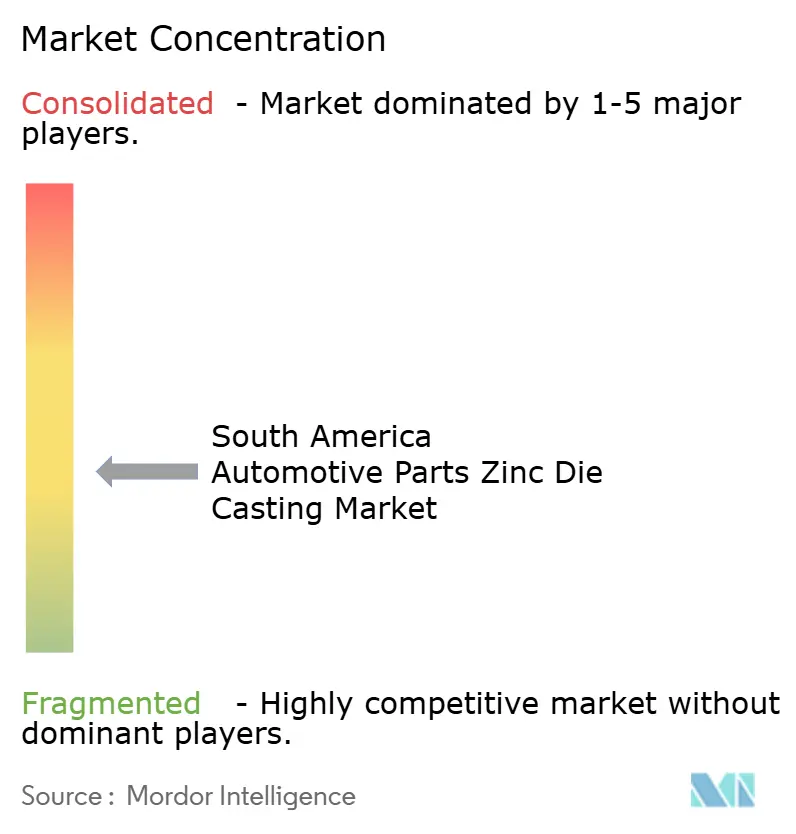
| Market Concentration | Medium |
Major Players *Disclaimer: Major Players sorted in no particular order Image © Mordor Intelligence. Reuse requires attribution under CC BY 4.0. | |
South America Automotive Parts Zinc Die Casting Market Analysis by Mordor Intelligence
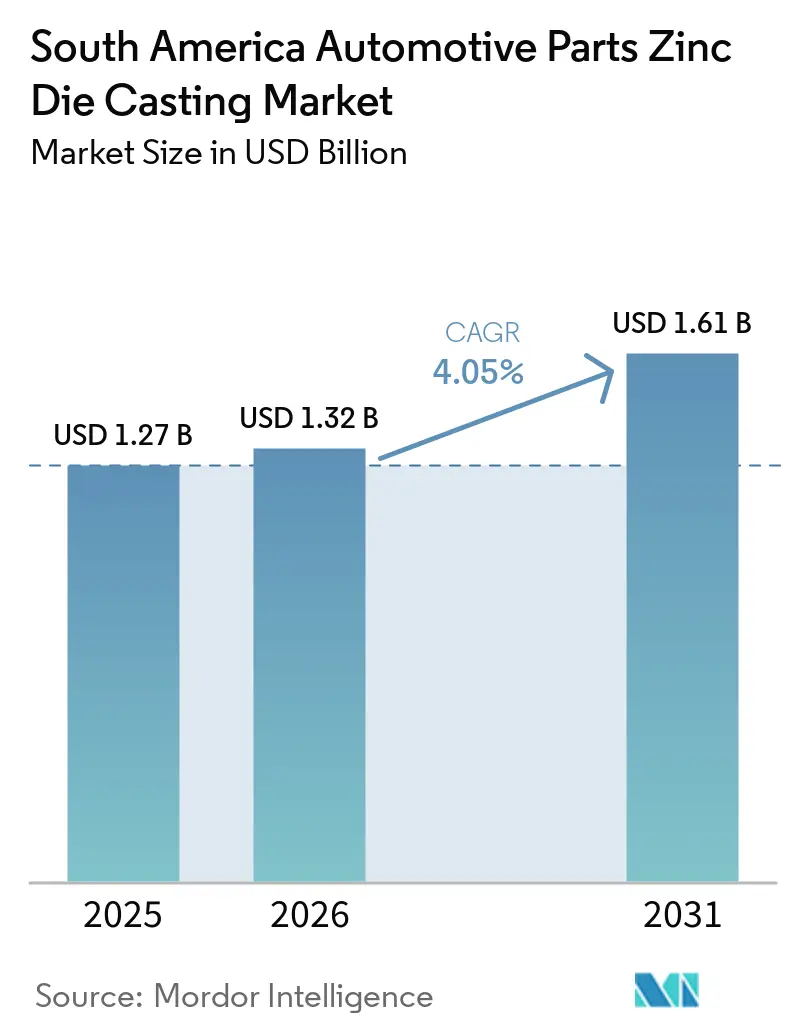
The South America automotive parts zinc die casting market size was valued at USD 1.27 billion in 2025, is estimated at USD 1.32 billion in 2026, and is projected to reach USD 1.61 billion by 2031, growing at a CAGR of 4.05% from 2026 to 2031. Brazil dominates the current demand landscape, but grapples with grid instability and zinc-price fluctuations, putting pressure on foundry margins. In a bid to meet Brazil's PROCONVE L-7/L-8 emission standards and align with the United States CAFE regulations trickling down the supply chain, automakers are increasingly opting for zinc over steel brackets. While still a niche, vacuum die casting is rapidly gaining traction, driven by electric vehicle (EV) programs' need for porosity-free, EMI-shielded housings in battery management systems. Additionally, due to incentives from Argentina's Law 27 686 and the EU-Mercosur trade agreement, regional die casters are now poised to vie for European aftermarket contracts, free from the previous tariff encumbrance[1].
Key Report Takeaways
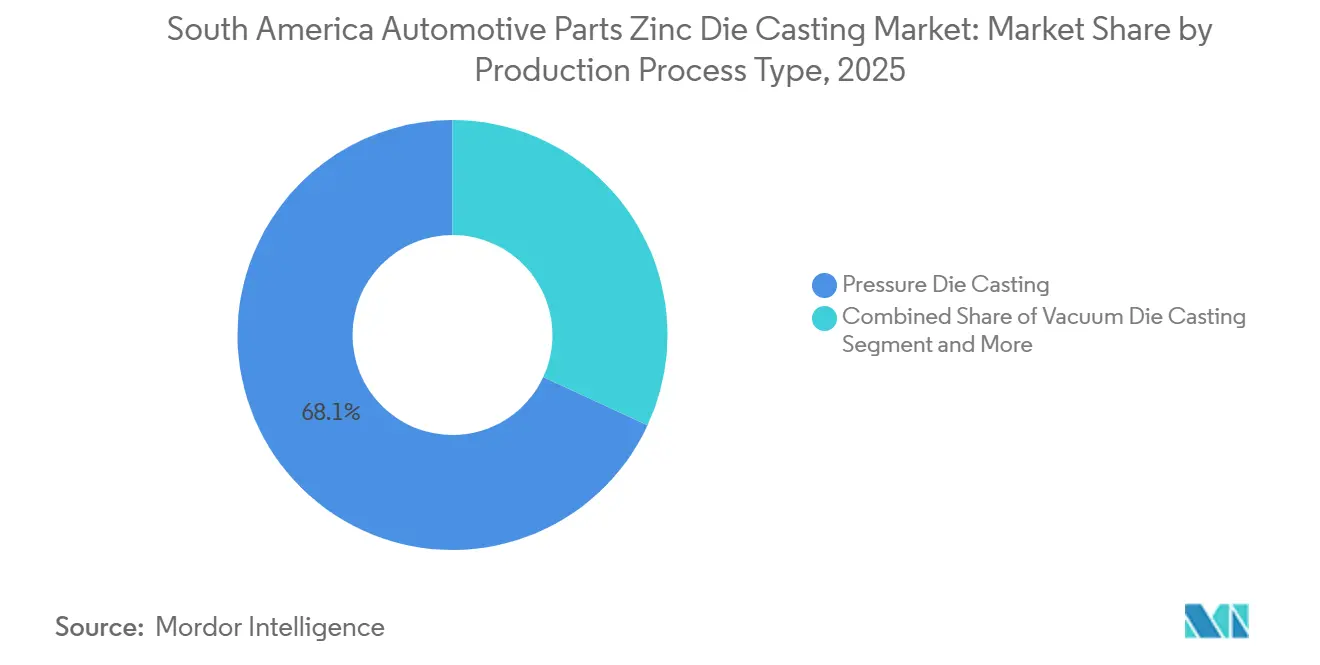
- By production process, pressure die casting led with 68.12% of the South American automotive parts zinc die casting market share in 2025; vacuum die casting is projected to expand at a 7.48% CAGR to 2031.
- By alloy type, Zamak 3 commanded 50.25% of the South America automotive parts zinc die casting market size in 2025, while ZA alloys will record the fastest growth at 8.27% CAGR through 2031.
- By application, engine parts held a 35.22% share of the South America automotive parts zinc die casting market size in 2025, whereas electrical and electronics housings advanced at a 9.13% CAGR during 2026-2031.
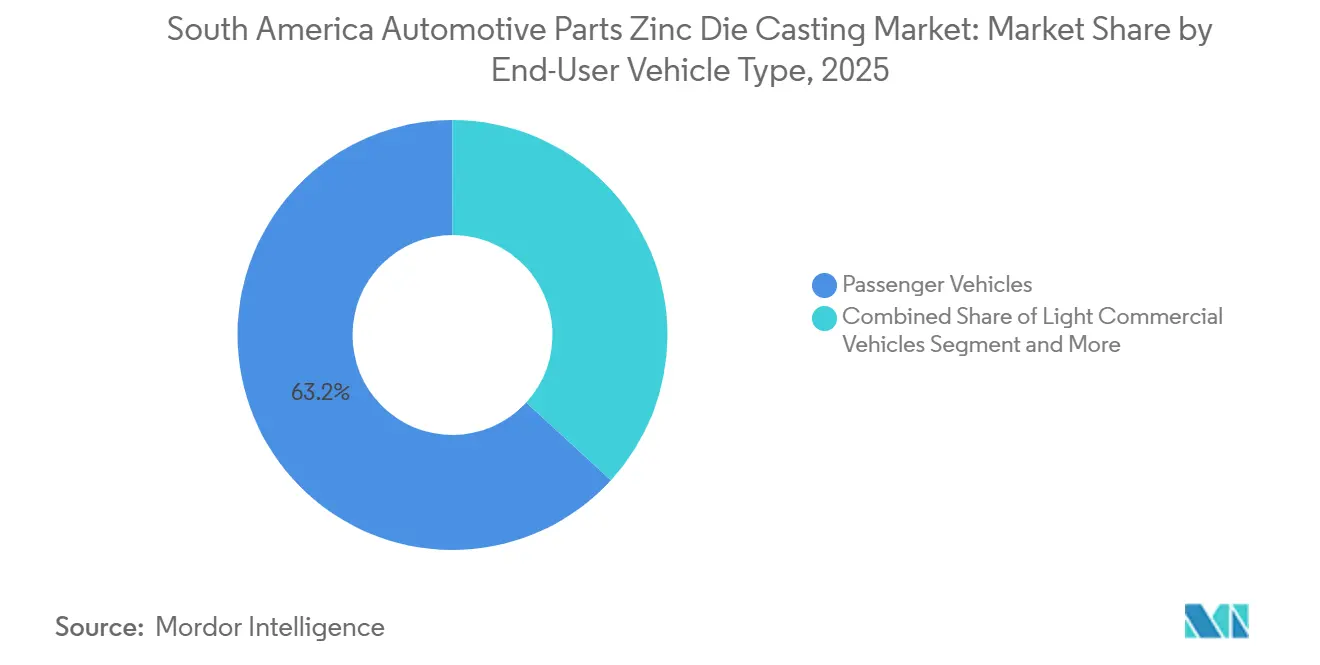
- By end-user vehicle type, passenger vehicles accounted for a 63.15% share in 2025 and are projected to grow at a 6.44% CAGR to 2031, outpacing commercial categories.
- By sales channel, the OEM segment held 84.03% of the South America automotive parts zinc die casting market share in 2025; the aftermarket will be the fastest-growing channel at a 6.95% CAGR through 2031.
- By country, Brazil dominated with 45.18% revenue share in 2025, while Peru is set to grow with the highest regional CAGR at 5.86% between 2026 and 2031.
Note: Market size and forecast figures in this report are generated using Mordor Intelligence’s proprietary estimation framework, updated with the latest available data and insights as of January 2026.
Market Trends and Insights
Drivers Impact Analysis of South America Automotive Parts Zinc Die Casting Market*
| Driver | (~) % Impact on CAGR Forecast | Geographic Relevance | Impact Timeline |
|---|---|---|---|
| Passenger-Vehicle Production Growth | +1.2% | Brazil, Argentina | Medium term (2-4 years) |
| Demand for EMC-Shielded E/E Housings | +1.1% | Brazil, Argentina | Medium term (2-4 years) |
| Lightweighting Favor Zinc Components | +0.9% | Brazil, Chile | Long term (≥ 4 years) |
| Surge in EV Motor and Battery-Housing | +0.8% | Brazil, Chile | Long term (≥ 4 years) |
| Localization Incentives for Auto Parts | +0.7% | Argentina, Brazil, Paraguay, Uruguay | Medium term (2-4 years) |
| Tooling Cost Versus Competing Processes | +0.6% | Brazil | Short term (≤ 2 years) |
| Source: Mordor Intelligence | |||
Growth in South American Passenger-Vehicle Production
Brazil achieved a notable rebound that lifted regional vehcile output in 2025, increasing immediate demand for zinc die-cast brackets and housings. According to the International Energy Agency, South America witnessed significant growth in electrified vehicles by 2025. Electric models require more zinc compared to their internal-combustion counterparts. In Argentina, a local-content mandate is driving increased sourcing toward domestic Tier-2 zinc casters. Additionally, the ratification of the EU-Mercosur pact is expanding export opportunities for foundries in Brazil and Argentina.
Rising Demand for EMC-Shielded E/E Housings in EVs
Electric drivetrains create electromagnetic interference, and zinc die-cast enclosures readily deliver 60-80 dB attenuation across 30 MHz-1 GHz, eliminating the cost of conductive coatings. By 2026, South America's electric vehicle (EV) fleet will require a significant number of housing units. The region is capable of meeting this demand using its existing pressure die-casting cells. ZA-27 alloy is gaining favor for motor shields, while Zamak 5 dominates under-floor battery trays exposed to salt spray. Brazil’s emissions standards indirectly accelerate EMI compliance, and a tight link to the United States EV supply chains keeps design cycles short.
Lightweighting Regulations Favoring Zinc Alloy Components
Brazil’s PROCONVE L-7/L-8 CO₂ limits, effective 2025, have been pushing OEMs to replace heavier steel brackets with zinc equivalents, trimming mass by 15-20% per part. Chile's introduction of voluntary lightweighting targets is encouraging zinc use in door handles and HVAC housings. Zinc’s self-passivating corrosion layer allows thinner wall sections than steel, a key benefit for coastal markets with chronic salt-spray exposure. The combined regulatory push cements zinc’s position for non-structural components over the long term.
Surge in EV Motor and Battery-Housing Applications
The International Zinc Association forecasts a fourfold jump in zinc per EV between 2022 and 2030 due to motor-end shields, battery-tray stiffeners, and inverter housings [2]. South American OEMs are specifying ZA-27 early to sidestep future redesigns tied to 800-V architectures. Porosity-free, pressure-tight battery enclosures are driving significant growth in vacuum die casting. In 2025, the region secured substantial investments for EV components, with many funds earmarked for local zinc sourcing to comply with government regulations.
Restraints Impact Analysis of South America Automotive Parts Zinc Die Casting Market*
| Restraint | (~) % Impact on CAGR Forecast | Geographic Relevance | Impact Timeline |
|---|---|---|---|
| Competition from Aluminum Die Casting | -0.8% | Brazil, Argentina | Medium term (2-4 years) |
| Volatility of Zinc Prices | -0.6% | Brazil, Argentina | Short term (≤ 2 years) |
| Grid Intermittency Disrupting Smelters | -0.5% | Brazil, Argentina, Chile | Short term (≤ 2 years) |
| Stricter Waste-Disposal Rules | -0.3% | Brazil, Chile | Long term (≥ 4 years) |
| Source: Mordor Intelligence | |||
Competition from Aluminum Die Casting
Aluminum’s 2.7 g/cm³ density offers notable weight savings versus zinc, luring OEMs for battery-tray frames despite higher tooling costs [3]. A leading precision manufacturer expanded its aluminum production capacity in 2025 to supply an electric vehicle manufacturer. Supported by a strong operational base and decades of expertise, Nemak can flexibly adjust its production capacity across metals, prompting zinc die casters to specialize in complex geometries.
Volatility of Zinc Prices
In October 2025, spot zinc experienced a significant surge above futures, coinciding with a decline in LME inventories. Due to limited hedging tools, South American casters face profit fluctuations that directly impact their EBITDA. This was evident in the EBITDA challenges faced by a major industry player in Q3 2024. Such margin instability has made banks hesitant to extend working-capital lines to mid-tier foundries.
*Our forecasts treat driver/restraint impacts as directional, not additive. The impact forecasts reflect baseline growth, mix effects, and variable interactions.
South America Automotive Parts Zinc Die Casting Market Segment Analysis
By Production Process Type:
Pressure Dominates, Vacuum GainsPressure die casting captured a 68.12% share of the South American automotive parts zinc die casting market in 2025, supported by mature plant know-how and sub-60-second cycle times. Vacuum die casting’s 7.48% CAGR through 2031 reflects EV demand for porosity-free, leak-tight battery enclosures, narrowing the cost gap as scrap rates fall below 1%.
Vacuum cells require sealed chambers and pumps, increasing capital expenditure. Semi-solid and squeeze variants remain experimental, limited to prototype thin-wall parts. Continuous training and NADCA-standard certification help large casters defend their share against aluminum rivals as the South American automotive parts zinc die casting market pivots to higher-integrity EV applications.

By Alloy Type:
Zamak 3 Leads, ZA Alloys AccelerateZamak 3 held 50.25% of the South American automotive parts zinc die casting market size in 2025 because of superior castability and cost-effectiveness. ZA alloys are projected to grow at 8.27% CAGR to 2031 as 800-V architectures call for tensile strength up to 425 MPa, beating Zamak 3’s 280 MPa ceiling.
Zamak 5’s chromium micro-addition makes it the alloy of choice for coastal body assemblies, while proprietary blends with copper or magnesium serve niche wear-resistant fuel-system housings. As EV adoption rises, OEMs shift incremental volume into ZA-27 motor shields, increasing the South American automotive parts zinc die-casting market share of high-strength alloys and driving multi-alloy flexibility investments across major plants.
By Application:
Engine Parts Lead, E/E Housings SurgeEngine parts represented 35.22% of South America's automotive parts zinc die casting market share in 2025, as oil-pump housings and timing-chain covers leverage zinc’s vibration-damping and dimensional stability. Electrical and electronics housings will grow fastest at 9.13% CAGR, underpinned by CISPR 25 EMI benchmarks.
Thin-wall inverter boxes and DC-DC converter enclosures now specify ZA-27 for combined mechanical and shielding performance, lifting average selling prices. Body assemblies and transmission parts maintain mid-teens contributions, yet lightweighting rules keep shifting brackets and hinges to zinc, padding the South America automotive parts zinc die casting market size allocated to non-powertrain components.
By End-User Vehicle Type:
Passenger Vehicles DominatePassenger vehicles held 63.15% of demand in 2025 and will expand at a 6.44% CAGR to 2031, as rideshare fleets in São Paulo refresh with hybrid sedans that add 15-20% more zinc per unit. Light commercial vehicles trail but enjoy incremental upside from last-mile e-commerce electrification.
Heavy commercial vehicles choose aluminum for frame-critical parts, leaving zinc to electrical housings. Two-wheelers stay niche yet strategic as premium scooters embed zinc handlebar mounts and footpegs. Overall, consumer credit trends and tariff stability will determine how much of the South American automotive parts zinc die casting market size remains tethered to passenger vehicles.
By Sales Channel:
OEM Leads, Aftermarket AcceleratesOEMs accounted for 84.03% of the South American automotive parts zinc die casting market size in 2025, under multi-year contracts linked to zinc indexation. The aftermarket, projected at 6.95% CAGR, profits from an aging 10-year-plus fleet and proliferating e-commerce parts portals.
Higher aftermarket margins offset its scale disadvantage, yet small foundries must support broader SKU sets and 48-hour ship targets. As EV fleets mature, OEM channels will retain dominance, but aftermarket demand for legacy internal-combustion replacements will ensure sustained baseline volumes across the South American automotive parts zinc die casting industry.
Geography Analysis
Brazil Automotive Parts Zinc Die Casting Market
Brazil led with a 45.18% revenue share in 2025, due to its production rebound and lightweighting mandates that favor zinc over steel. However, hydropower shortages and rolling blackouts have inflated operating costs, prompting widespread generator installations.
Europe and South America Automotive Parts Zinc Die Casting Market
Argentina leverages Law 27 686 to capture localized casting, while the EU-Mercosur pact gradually erodes Europe’s tariff wall, opening export channels. Peru’s 5.86% CAGR reflects a small but fast-growing base anchored in greenfield assembly and Mercosur cumulation benefits, though supply chains are still thin.
Chile and Andean South America Automotive Parts Zinc Die Casting Market
Chile’s voluntary lightweighting targets and renewable-heavy power mix introduce both demand potential and intermittency challenges, whereas the rest of South America faces currency instability and underdeveloped supply ecosystems. Collectively, grid reliability and trade policy clarity will decide how much incremental South American automotive parts zinc die casting market size accrues to Brazil versus emerging Andean players.
Competitive Landscape
The South American automotive parts zinc die casting market is fragmented. Industry participants reported significant EBITDA in 2024 and expanded joint ventures to include on-site machining and plating. Through this vertical integration, companies aimed to mitigate the impact of zinc price fluctuations.
Nemak, with USD 4.9 billion in 2024 revenue, kept aluminum as its core but holds optional zinc capacity across Brazil and Argentina, prepared to pivot if lightweighting mandates tighten. Form Technologies (Dynacast) and Martinrea International bring global process know-how but are geographically concentrated in Brazil, leaving white space in Chile and Peru.
Strategic bifurcation is clear: incumbents scale vertically and automate for cost control, while smaller foundries specialize in short-run interior trim or complex E/E housings. Technology penetration lags Europe—vacuum die casting remains low, mainly due to capital constraints and scarce die-design talent. Consolidation pressure will likely intensify as energy costs and zinc-price volatility widen the cost gap between efficient and sub-scale operators across the South American automotive parts zinc die casting market.
South America Automotive Parts Zinc Die Casting Industry Leaders
-
PHB Inc.
-
Martinrea International Inc.
-
Starcast Industrial Ltda
-
Bruschi Srl
-
Spark Minda (Minda Corporation Limited)
- *Disclaimer: Major Players sorted in no particular order
South America Automotive Parts Zinc Die Casting Market Companies Covered in this Report
- PHB Inc.
- Redstone Manufacturing
- Empire Casting Co
- Spark Minda (Minda Corporation Limited)
- Martinrea International Inc.
- Bremetsa S.A.
- Starcast Industrial Ltda
- Bruschi Srl
- Brillcast Manufacturing LLC
- JEGAN, S.A.L.
- HSL Industria
- Sinyetec S.A.S.
Recent Industry Developments in South America Automotive Parts Zinc Die Casting Market
- May 2026: In May 2026, Mercedes-Benz Camiones y Buses, a subsidiary of Daimler Truck, officially inaugurated its new Zárate Industrial Center, located north of Buenos Aires. Built on a 20-hectare site, the Industrial Center produces Mercedes-Benz truck models and bus chassis. The complex also includes a logistics center for spare parts and components, as well as Argentina's first facility dedicated to remanufacturing used truck and bus replacement parts. The expansion of Argentina’s automotive sector is expected to support the zinc die-casting auto parts market by increasing local demand for high-strength, corrosion-resistant commercial vehicle components, such as brackets, electrical enclosures, and lock housings.
- March 2026: The CAOA CHANGAN plant in Brazil, a joint venture between Changan Automobile and CAOA, the country’s largest automaker, officially commenced production. For Avatr, Changan’s premium brand, this milestone accelerated localization, streamlined operations across South America, and strengthened its regional presence. As premium new energy vehicles (NEVs) typically use zinc die-cast components for shielding and housing, the development could support demand for these components.
South America Automotive Parts Zinc Die Casting Market Report Scope
The scope includes segmentation by production process type (pressure die casting, vacuum die casting, squeeze die casting, and semi-solid die casting), alloy type (zamak 3, zamak 5, ZA alloys, and others), application (body assemblies, engine parts, transmission parts, electrical and electronics housings, and interior and trim components), end-user vehicle type (passenger vehicles, light commercial vehicles, heavy commercial vehicles, and two-wheelers), and sales channel (OEM and aftermarket). The analysis also covers country-level analysis, including Brazil, Argentina, Chile, Peru, and the Rest of South America. Market size and growth forecasts are presented by value in USD.
Segmentation Overview
By Production Process Type
| Pressure Die Casting |
| Vacuum Die Casting |
| Squeeze Die Casting |
| Semi-Solid Die Casting |
By Alloy Type
| Zamak 3 |
| Zamak 5 |
| ZA Alloys |
| Others |
By Application
| Body Assemblies |
| Engine Parts |
| Transmission Parts |
| Electrical and Electronics Housings |
| Interior and Trim Components |
By End-User Vehicle Type
| Passenger Vehicles |
| Light Commercial Vehicles |
| Heavy Commercial Vehicles |
| Two-Wheelers |
By Sales Channel
| OEM |
| Aftermarket |
By Country
| Brazil |
| Argentina |
| Chile |
| Peru |
| Rest of South America |
| By Production Process Type | Pressure Die Casting |
| Vacuum Die Casting | |
| Squeeze Die Casting | |
| Semi-Solid Die Casting | |
| By Alloy Type | Zamak 3 |
| Zamak 5 | |
| ZA Alloys | |
| Others | |
| By Application | Body Assemblies |
| Engine Parts | |
| Transmission Parts | |
| Electrical and Electronics Housings | |
| Interior and Trim Components | |
| By End-User Vehicle Type | Passenger Vehicles |
| Light Commercial Vehicles | |
| Heavy Commercial Vehicles | |
| Two-Wheelers | |
| By Sales Channel | OEM |
| Aftermarket | |
| By Country | Brazil |
| Argentina | |
| Chile | |
| Peru | |
| Rest of South America |
Key Questions Answered in the Report
What is the forecast size of South American automotive parts zinc die casting by 2031?
The value is projected to reach USD 1.61 billion in 2031.
Which production process is growing fastest in the region?
Vacuum die casting is advancing at a 7.48% CAGR through 2031.
Why are ZA alloys gaining traction for EV components?
They deliver up to 425 MPa tensile strength and strong EMI shielding that suit 800-V battery and motor housings.
What is the aftermarket growth outlook for zinc die-cast auto parts in South America?
Aftermarket demand is expected to expand at a 6.95% CAGR between 2026 and 2031 as the vehicle fleet continues to age.