
Market Overview
| Study Period | 2019 - 2031 |
|---|---|
| Forecast Data Period | 2026 - 2031 |
| Base Year Market Size (2025) | USD 374.76 Million |
| Market Size (2026) | USD 395.41 Million |
| Market Size (2031) | USD 517.03 Million |
| Growth Rate (2026 - 2031) | 5.51 % |
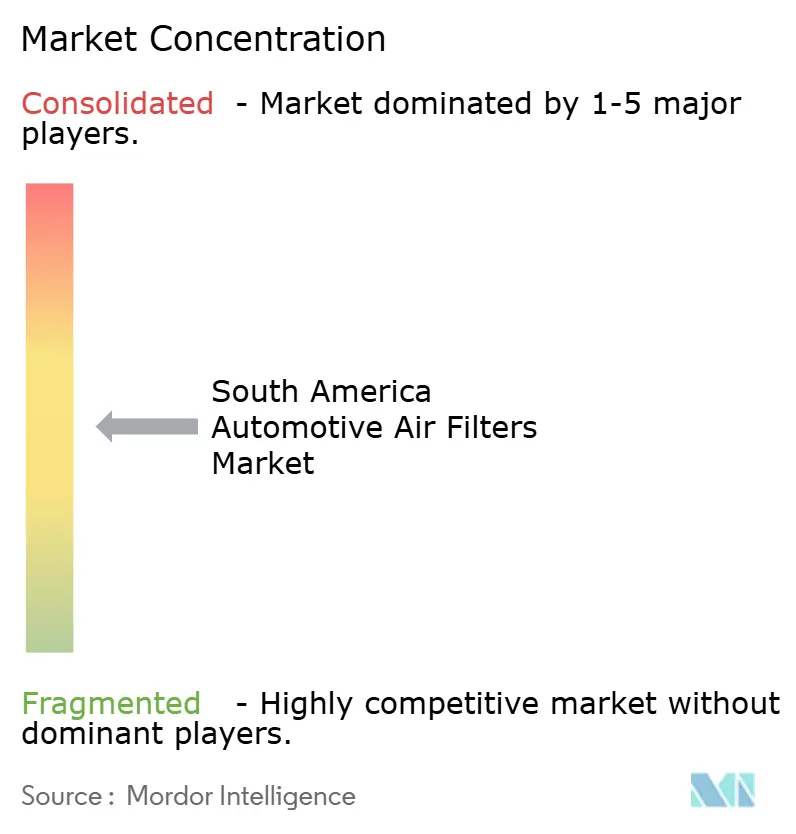
| Market Concentration | Medium |
Major Players *Disclaimer: Major Players sorted in no particular order Image © Mordor Intelligence. Reuse requires attribution under CC BY 4.0. | |
South America Automotive Air Filters Market Analysis by Mordor Intelligence
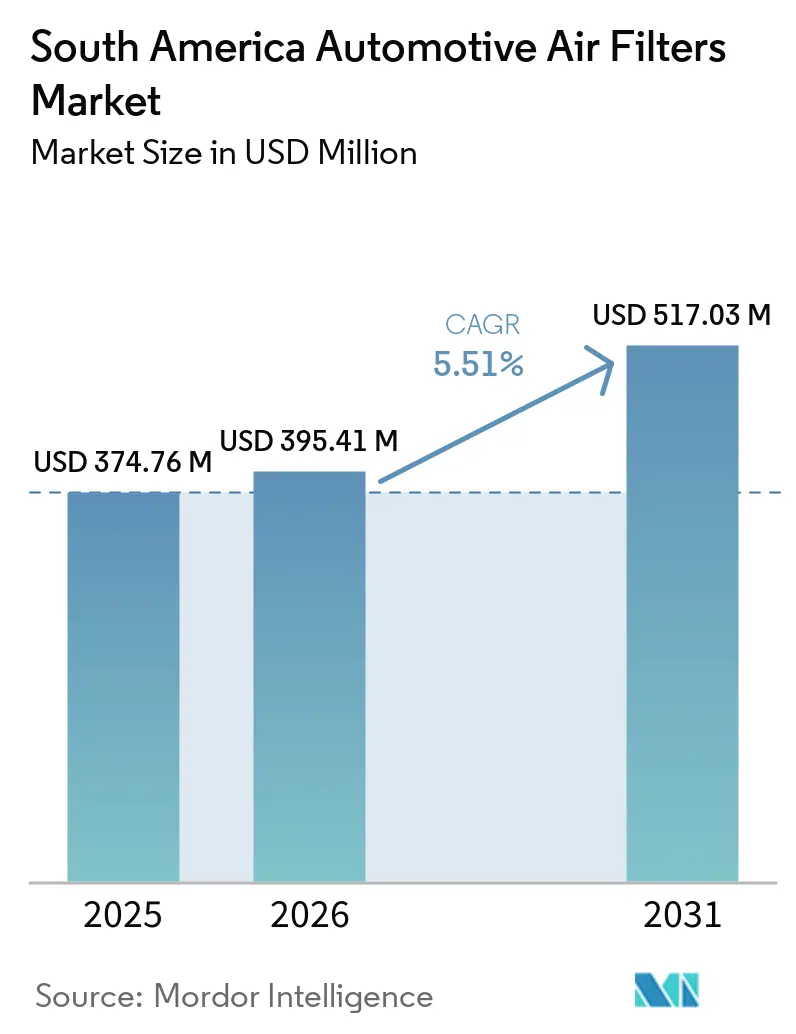
The South American automotive air filters market size was valued at USD 374.76 million in 2025 and is estimated to grow from USD 395.41 million in 2026 to reach USD 517.03 million by 2031, at a 5.51% CAGR during the forecast period (2026–2031). The large installed vehicle base continues to support replacement demand, especially in Brazil, where older vehicles require regular maintenance. Tighter emissions rules in Brazil are raising technical requirements for engines and related filtration systems. The South American automotive air filters market also benefits from commercial fleets, mining equipment, and logistics vehicles that operate under demanding dust conditions. Suppliers are responding through local engineering investment, wider vehicle coverage, and premium cabin and severe-duty products.
Key Report Takeaways
- By material type, paper and cellulose filters held 67.84% of the South American automotive air filters market in 2025, while synthetic-fiber filters are forecast to grow at a 6.47% CAGR through 2031.
- By filter type, engine filters held 71.63% of the market in 2025, while cabin filters are forecast to grow at a 6.52% CAGR through 2031.
- By vehicle type, passenger cars accounted for 77.56% of the market in 2025, while heavy commercial vehicles are forecast to grow at a 6.18% CAGR through 2031.
- By propulsion, gasoline vehicles accounted for 60.74% of the market in 2025, while battery electric vehicles are forecast to grow at a 12.18% CAGR through 2031.
- By sales channel, the aftermarket accounted for 68.47% of the market in 2025, while online retail is forecast to grow at an 8.16% CAGR through 2031.
- By application, engine air intake accounted for 72.68% of the market in 2025, while passenger-cabin air conditioning is forecast to grow at a 6.83% CAGR through 2031.
- By filter specification, standard particulate filtration accounted for 63.71% of the market in 2025, while activated-carbon cabin filters are forecast to grow at an 8.14% CAGR through 2031.
- By country, Brazil accounted for 42.76% of the market in 2025 and is forecast to grow at a 5.52% CAGR through 2031.
Note: Market size and forecast figures in this report are generated using Mordor Intelligence’s proprietary estimation framework, updated with the latest available data and insights as of January 2026.
Market Trends and Insights
Drivers Impact Analysis of South America Automotive Air Filters Market*
| Driver | (~) % Impact on CAGR Forecast | Geographic Relevance | Impact Timeline |
|---|---|---|---|
| Expansion of Vehicle Parc and Replacement-Cycle Demand | +1.8% | Brazil, Argentina and Colombia | Short term (≤ 2 years) |
| Growth of Commercial Fleets, Logistics, Mining, and Construction Activity | +1.2% | Brazil, Chile, Peru, Argentina, and mining corridors | Medium term (2-4 years) |
| Tightening Emission Standards and Preventive-Maintenance Practices | +1% | Brazil | Medium term (2-4 years) |
| Rising Cabin Air-Quality Awareness in Polluted Urban Corridors | +0.9% | São Paulo, Bogotá, and Santiago | Medium term (2-4 years) |
| Severe-Duty Filter Specification for Mining and High-Dust Routes | +0.4% | Chile, Peru, Brazil, and Argentina | Long term (≥ 4 years) |
| Vehicle-Data-Enabled Maintenance and Filter-Change Compliance | +0.3% | Brazil | Long term (≥ 4 years) |
| Source: Mordor Intelligence | |||
Expansion of Vehicle Parc and Replacement-Cycle Demand
An aging vehicle fleet across major South American markets continues to support recurring demand for replacement filters and other maintenance parts. Older vehicles typically require more frequent servicing because components experience greater wear and are subject to prolonged exposure to dust and operating conditions. Brazil, in particular, provides a strong foundation for aftermarket demand due to its large and mature vehicle population. This installed base makes the South American automotive air filters market relatively resilient to short-term fluctuations in vehicle production and new-vehicle sales. At the same time, independent workshops, parts distributors, and service centers remain important channels for purchasing replacement filters.
Growth of Commercial Fleets, Logistics, Mining, and Construction Activity
Commercial fleets use filters more frequently than privately operated passenger cars because they have higher mileage and operating hours. MRS Logística transported 213 million tons in 2025, while its iron ore volumes reached 130.50 million tons[1]. Mining trucks and off-highway machinery face heavy dust loads and often require shorter replacement intervals than highway vehicles. Scheduled fleet maintenance also favors certified products because operators need reliable service records and predictable equipment uptime. These operating conditions give the South American automotive air filters market a stronger base in mining, agriculture, freight, and construction applications.
Tightening Emission Standards and Preventive-Maintenance Practices
Brazil’s PROCONVE L8 requirements took effect in January 2025 and progressively reduced the permitted NMOG+NOx emissions from light vehicles [2]. The standard moved manufacturers toward powertrain configurations that require tighter control of airflow and particulate exposure. Regulations do not prescribe a specific air filter, but they increase the value placed on proven filtration performance. This supports higher-efficiency media in OEM programs and professional replacement channels across the South American automotive air filters market.
Urban Pollution Awareness is Reshaping Cabin-Filter Demand
Urban drivers are paying more attention to air quality inside vehicles, particularly in congested metropolitan areas. Research in the Belém metropolitan area documented high cabin temperatures and ventilation deficiencies in public transport vehicles. A 2025 study of urban public transport also reported peak carbon dioxide concentrations of 4,210 ppm under high passenger occupancy. Cabin filters can reduce exposure to particulate matter and, when activated-carbon is used, to certain gases and odors. This wider focus on cabin conditions supports demand for upgraded cabin products in the South American automotive air filters market.
Restraints Impact Analysis of South America Automotive Air Filters Market*
| Restraint | (~) % Impact on CAGR Forecast | Geographic Relevance | Impact Timeline |
|---|---|---|---|
| Electrification Reducing Engine-Intake Filter Demand per Vehicle | -0.8% | Brazil | Long term (≥ 4 years) |
| Low-Cost Unbranded Imports and Counterfeit Replacement Parts | -0.5% | Brazil, Colombia, and Argentina | Short term (≤ 2 years) |
| Uneven Service-Center Capability and Low Cabin-Filter Replacement Awareness | -0.3% | Bolivia, Paraguay, Ecuador, and Venezuela | Medium term (2-4 years) |
| Volatility in Resin, Cellulose, Synthetic-Fiber, and Freight Costs | -0.2% | Regional markets with weaker currencies | Short term (≤ 2 years) |
| Source: Mordor Intelligence | |||
Electrification Reducing Engine-Intake Filter Demand per Vehicle
Battery electric vehicles do not require engine intake filters, so their wider adoption reduces the demand for filtration per vehicle. Electric-car sales in South America exceeded 350,000 units in 2025[3], increasing 75% from the previous year. Plug-in hybrids accounted for nearly 50% of those sales and retained engine-intake filtration requirements. Electric and plug-in hybrid vehicles still represented a small share of Brazil’s total light-vehicle fleet in 2026. The effect on the South American automotive air filters market is therefore a longer-term shift toward cabin filtration and slower electrification of heavy-duty applications.
Low-Cost Unbranded Imports and Counterfeit Replacement Parts
Low-cost and counterfeit products limit established suppliers' ability to translate rising volumes into higher revenue. Counterfeit activity represents a material issue across Brazil, Colombia, and Argentina. Certified suppliers need to explain fitment, quality, and service-life benefits when competing with unbranded offerings. Product certification and clear catalog information can support buyer confidence, although enforcement gaps remain in informal and online channels.
*Our forecasts treat driver/restraint impacts as directional, not additive. The impact forecasts reflect baseline growth, mix effects, and variable interactions.
South America Automotive Air Filters Market Segment Analysis
By Material Type:
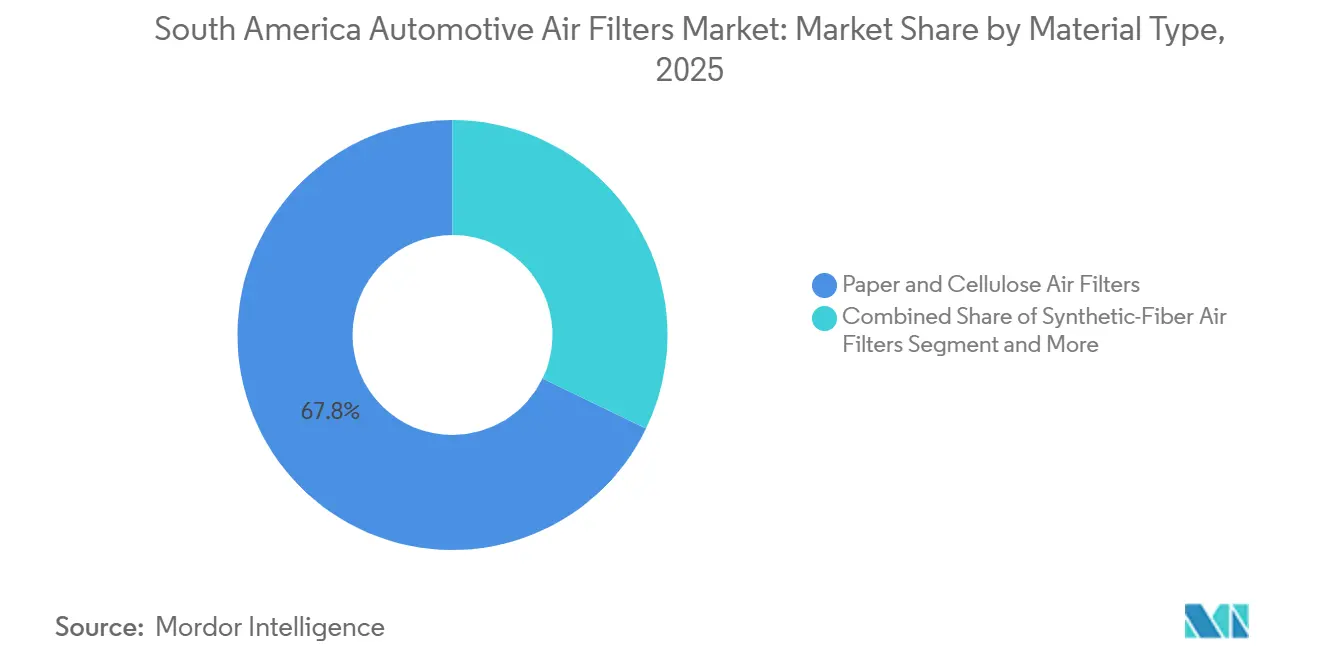
Cellulose Holds the Volume Share, but Synthetic Fibers Define Premium CapturePaper and cellulose filters held 67.84% of the South American automotive air filters market in 2025. Their position reflects the cost advantage of cellulose media in workshop-led replacement decisions. Local distributors and independent mechanics are familiar with these filters across a wide range of legacy vehicles. The material also benefits from established supply chains and broad compatibility with common OEM applications. Cotton gauze and foam remain smaller categories that mainly serve motorcycles, enthusiast vehicles, and selected performance applications.
Synthetic-fiber filters are forecast to grow at a 6.47% CAGR from 2026 to 2031. They provide greater dust-holding capacity and can support longer service intervals in demanding applications. Nanofiber and hybrid filtration technologies are creating a higher-value tier within the South American automotive air filters industry. Hybrid designs using cellulose and nanofiber layers can combine cost efficiency with enhanced filtration performance, creating opportunities for premium positioning in commercial and severe-duty applications.

By Filter Type:
Cabin Filters Capture Incremental Margin as Intake Filters Sustain VolumeEngine filters held 71.63% of the South American automotive air filters market in 2025. The large installed base of gasoline and diesel vehicles requires engine air cleaning at routine maintenance intervals. Cellulose remains common in cost-sensitive passenger-car replacement work. Synthetic engine products are gaining acceptance in turbocharged platforms that need more stringent filtration performance. These conditions keep engine filters central to replacement volume even as cabin products advance.
Cabin filters are forecast to grow at a 6.52% CAGR through 2031. Urban pollution concerns, longer time spent in traffic, and broader HVAC fitment support this pace. Electrostatic and multi-layer cabin products remain smaller but are developing categories. Wider replacement awareness can create volume without a corresponding increase in the number of vehicles on the road.
By Vehicle Type:
Passenger Car Volumes Underpin the Market, Commercial Vehicles Carry Specification PremiumPassenger cars accounted for 77.56% of the South American automotive air filters market in 2025. Their lead follows the regional vehicle parc, which is dominated by privately used light vehicles. Light commercial vehicles also see steady demand because delivery vans and urban freight vehicles cover greater distances. Buses operate under scheduled maintenance systems that can make filter purchases more regular. Motorcycles represent a high-volume category with lower value per filter.
Heavy commercial vehicles are forecast to grow at a 6.18% CAGR between 2026 and 2031. Truck fleets on agricultural routes and mining vehicles operate in high-dust environments that shorten service intervals. Severe-duty filters can support fleet uptime in environments with high dust exposure. Centralized procurement also creates an opening for suppliers that can demonstrate certification, traceability, and reliable regional delivery.
By Propulsion:
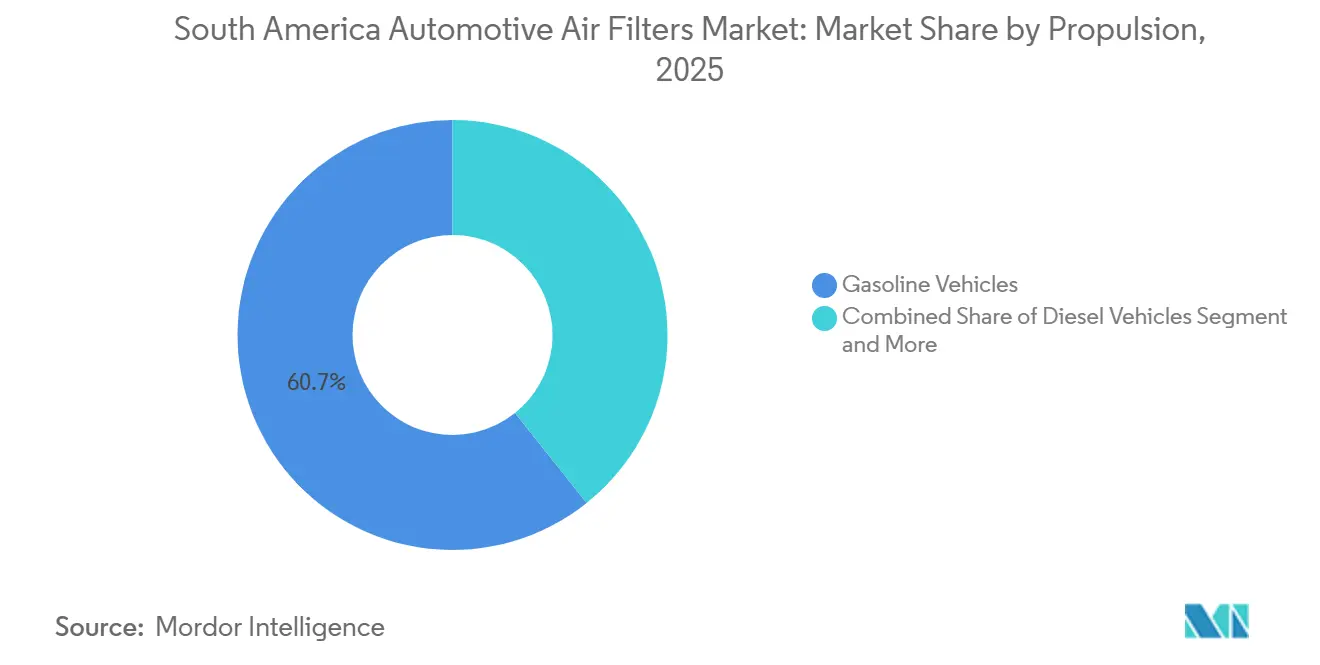
Gasoline Powertrain Retains Commanding Share While BEV Growth Triggers a Specification PivotGasoline vehicles held 60.74% of the South American automotive air filters market in 2025. Brazil’s flex-fuel vehicle base supports this position across its passenger-car parc. Diesel vehicles remain important in commercial fleets and heavy-duty transport. Hybrids retain engine air filtration while adding a cabin product opportunity. Suppliers can use bundled offerings to cover both engine and cabin needs for hybrid owners.
Battery electric vehicles are forecast to expand at a 12.18% CAGR through 2031. The South American automotive air filters market for this propulsion group is affected by the absence of engine intake demand. Brazil’s electrified vehicle fleet remained limited relative to its total light-vehicle base in 2026. Electric vehicles still need cabin filters, and quieter cabins can make odors and airborne particles more noticeable to occupants. Premium activated-carbon and multilayer media may therefore have greater relevance in the electric-vehicle ownership experience.
By Sales Channel:
Aftermarket Independence Consolidates, Online Retail Grows from Negligible to MeaningfulThe aftermarket held 68.47% of the South American automotive air filters market in 2025. It includes authorized dealerships, independent workshops, parts retailers, and online sellers. Independent workshops guide many replacement decisions across Brazil. Price, distributor relationships, and mechanic familiarity often carry more weight than detailed technical specifications. This channel structure also creates access points for unbranded and counterfeit products.
Online retail is forecast to grow at an 8.16% CAGR between 2026 and 2031. Online listings can display product specifications, certification information, and fitment references more clearly than a workshop counter. This visibility may help certified brands explain how they differ from unbranded alternatives. The OEM channel held 31.50% in 2025 and continues to require coverage for newly introduced vehicle platforms. Widespread adoption of Chinese vehicles increases the need for updated catalogs and replacement coverage across the South American automotive air filters market.
By Application:
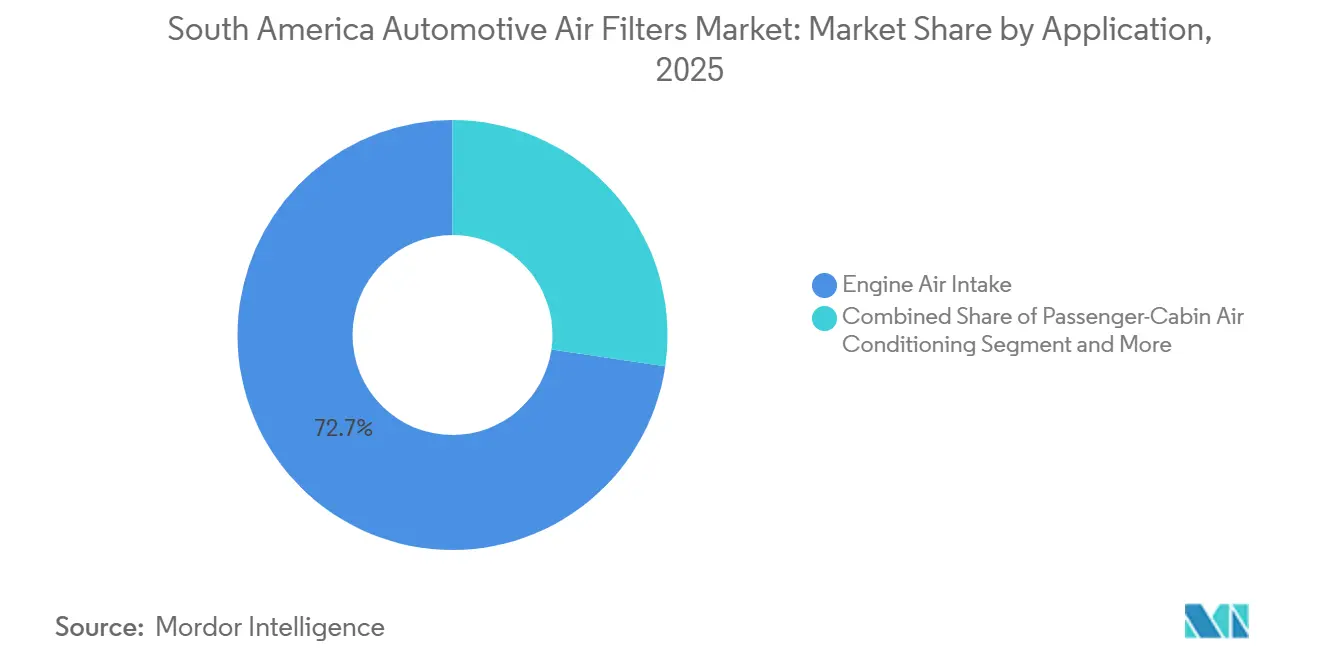
Engine Air Intake Sustains Scale While Cabin Segment Captures Value AppreciationEngine air intake applications accounted for 72.68% of the South American automotive air filters market in 2025. This lead reflects the scale of internal-combustion vehicle platforms operating across the region. Public transport, municipal fleets, logistics operators, and mining companies often purchase filters through centralized programs. Their procurement standards are usually tighter than those in informal replacement channels. These accounts can be less exposed to counterfeit products when specifications and maintenance records are audited.
Passenger-cabin air conditioning is forecast to grow at a 6.83% CAGR through 2031. Scientific research has documented ventilation challenges in tropical public transport environments. This evidence supports greater attention to cabin air management across private and commercial transport. Supplier education for repair shops can improve replacement compliance and customer understanding. Cabin filtration is therefore becoming a more significant value area within the South American automotive air filters market.
By Filter Specification:
Standard Filters Face Incremental Share Loss as Premium Tiers AccelerateStandard particulate filtration held 63.71% of the South American automotive air filters market in 2025. Broad vehicle compatibility, low prices, and easy availability support its position. High-efficiency and odor-adsorption products hold smaller shares but meet a growing need for better cabin and engine filtration. Low-restriction products are relevant for long-haul trucking, where total operating cost matters more than purchase price. Severe-duty products also serve equipment exposed to mining dust and agricultural routes.
Activated-carbon cabin filters are forecast to grow at an 8.14% CAGR through 2031. They can capture odor compounds, nitrogen oxides, and volatile organic compounds in addition to particulate matter. Demand is strongest where drivers are more aware of pollution and cabin air quality. Suppliers that secure regional relationships for material supply and processing can improve their competitive position. The South American automotive air filters industry has room for localized activated-carbon and synthetic-media production, where these products remain import-dependent.
Geography Analysis
Brazil Automotive Air Filters Market
Brazil held 42.76% of the South American automotive air filters market in 2025 and is forecast to grow at a 5.52% CAGR through 2031. Brazil’s automotive air filters market was supported by its large, relatively mature vehicle parc, with replacement demand sustained by an aging fleet. São Paulo, Minas Gerais, and Goiás are important automotive manufacturing and commercial-vehicle hubs, with production facilities spanning passenger cars, light commercial vehicles, and trucks.
South America Automotive Air Filters Market
Brazil remains the largest South American opportunity because it has the region’s largest vehicle parc. PROCONVE L8 is influencing engine technology and filtration performance requirements. Argentina’s older vehicle base continues to drive replacement demand despite economic volatility. Chile’s copper and lithium operations create demand for premium products that withstand severe dust conditions.
Peru and Bolivia require specialized products for high-altitude mining and associated fleet operations. Lower air density can require filtration systems that maintain engine performance in difficult operating conditions. Venezuela’s economic constraints and import restrictions limit the addressable replacement base. Paraguay and Ecuador mainly serve as distribution markets for regional and imported brands. Chinese vehicle brands are also expanding the range of platforms needed in smaller Andean countries.
Competitive Landscape
The South American automotive air filters market is moderately consolidated in OEM and Tier-1 supply, where qualification cycles and vehicle-specific engineering create barriers to entry. The independent aftermarket is more fragmented because distributors, workshop networks, price positions, and catalog breadth have greater influence. MANN+HUMMEL, MAHLE, Donaldson, UFI Filters, Sogefi, and Tecfil compete through OEM relationships and replacement coverage. Tecfil benefits from localized Brazilian manufacturing and a distribution network that reaches more than 60 countries for export. Local engineering, Asian-platform coverage, and premium cabin products are becoming important points of competition.
MAHLE expanded its Americas Filter Engineering Center in Jundiaí in September 2025, adding laboratories, test benches, and development areas. MANN-FILTER, a premium MANN+HUMMEL brand, launched nanofiber air filters for commercial vehicles in July 2026, offering particle separation efficiency of up to 99.98%. Donaldson completed its acquisition of Facet Filtration for USD 829 million in May 2026, broadening its high-performance filtration portfolio. These moves show a focus on engineering capability, premium performance, and broader technical coverage. They also strengthen supplier relevance in fleet and industrial applications that require reliable filtration under difficult conditions.
Premium cabin products for dense urban areas remain a clear opportunity for established brands. Severe-duty products for mining, agricultural, and logistics fleets are another priority because replacement intervals are shorter. Certified aftermarket ranges can help suppliers compete with lower-cost products when buyers need clearer assurance of quality and fitment. Brazil’s certification requirements can reinforce procurement preference for established products. The competitive setting remains balanced because global firms have technical depth, while regional suppliers retain strong distribution and cost advantages.
South America Automotive Air Filters Industry Leaders
-
Tecfil S.A.
-
MAHLE GmbH
-
UFI Filters S.p.A.
-
Donaldson Company, Inc.
-
MANN+HUMMEL
- *Disclaimer: Major Players sorted in no particular order
South America Automotive Air Filters Market Companies Covered in this Report
- MANN+HUMMEL
- Tecfil S.A.
- UFI Filters S.p.A.
- Donaldson Company, Inc.
- MAHLE GmbH
- Robert Bosch GmbH
- DENSO Corporation
- Sogefi S.p.A.
- A.L. Group
- K&N Engineering, Inc.
- FRAM Group IP LLC
- Hengst SE
- Parker Hannifin Corporation
- Freudenberg Filtration Technologies SE & Co. KG
- Baldwin Filters, Inc.
- ACDelco
- WIX Filters
- SAKURA Filter
Recent Industry Developments in South America Automotive Air Filters Market
- July 2026: MANN+HUMMEL launched its nanofiber air filters for commercial vehicles under the MANN-FILTER brand, achieving up to 99.98% particle separation efficiency through an exclusively developed polymer nanofiber layer 0.15 micrometers in diameter. The product targets construction, mining, and road-haulage fleets requiring long service intervals under heavy dust loads.
- May 2026: Donaldson Company completed the all-cash acquisition of Facet Filtration for USD 829 million, expanding its portfolio into fuel and fluid filtration for mission-critical applications in Aerospace, Defense, and Power Generation. The acquisition diversifies Donaldson's revenue mix beyond automotive mobile filtration and builds capabilities applicable to specialized commercial-fleet and industrial filter requirements in South America.
South America Automotive Air Filters Market Report Scope
The South America Automotive Air Filters Market is segmented by material type, filter type, vehicle type, propulsion, sales channel, application, filter specification, and geography. By material type, the market is segmented into paper and cellulose air filters, synthetic-fiber air filters, cotton gauze air filters, foam air filters, and other materials. By filter type, the market is segmented into engine filters and cabin filters, with intake filters further segmented into cellulose and synthetic filters, and cabin filters into particulate, activated-carbon, electrostatic, and multi-layer filters. By vehicle type, the market is segmented into passenger cars, light commercial vehicles, heavy commercial vehicles, buses, and motorcycles. By propulsion, the market is segmented into gasoline, diesel, hybrid, and battery electric vehicles. By sales channel, the market is segmented into original equipment manufacturers (OEMs) and the aftermarket, which is further segmented into authorized dealerships, independent workshops, automotive parts retailers, and online retail. By application, the market is segmented into engine air intake, passenger-cabin air conditioning, heavy-duty and off-road applications, and fleet and institutional vehicles. By filter specification, the market is segmented into standard particulate filtration, high-efficiency particulate filtration, odor and gas adsorption, low-restriction and extended-service-life filters, and severe-duty dust and water-separation filters. By geography, the market is segmented into Brazil, Argentina, Chile, Colombia, Peru, Ecuador, Bolivia, Paraguay, Uruguay, Venezuela, and the rest of South America.
Segmentation Overview
By Material Type
| Paper and Cellulose Air Filters |
| Synthetic-Fiber Air Filters |
| Cotton Gauze Air Filters |
| Foam Air Filters |
| Rest of Material Types |
By Filter Type
| Engine Filters | Cellulose Engine Filters |
| Synthetic Engine Filters | |
| Cabin Filters | Particulate Cabin Filters |
| Activated-Carbon Cabin Filters | |
| Electrostatic and Multi-Layer Cabin Filters |
By Vehicle Type
| Passenger Cars |
| Light Commercial Vehicles |
| Heavy Commercial Vehicles |
| Buses |
| Motorcycles |
By Propulsion
| Gasoline Vehicles |
| Diesel Vehicles |
| Hybrid Vehicles |
| Battery Electric Vehicles |
By Sales Channel
| Original Equipment Manufacturer | |
| Aftermarket | Authorized Dealerships |
| Independent Workshops | |
| Automotive Parts Retailers | |
| Online Retail |
By Application
| Engine Air Intake |
| Passenger-Cabin Air Conditioning |
| Heavy-Duty and Off-Road Applications |
| Fleet and Institutional Vehicles |
By Filter Specification
| Standard Particulate Filtration |
| High-Efficiency Particulate Filtration |
| Odor and Gas Adsorption |
| Low-Restriction and Extended-Service-Life Filters |
| Severe-Duty Dust and Water-Separation Filters |
By Country
| Brazil |
| Argentina |
| Chile |
| Colombia |
| Peru |
| Ecuador |
| Bolivia |
| Paraguay |
| Uruguay |
| Venezuela |
| Rest of South America |
| By Material Type | Paper and Cellulose Air Filters | |
| Synthetic-Fiber Air Filters | ||
| Cotton Gauze Air Filters | ||
| Foam Air Filters | ||
| Rest of Material Types | ||
| By Filter Type | Engine Filters | Cellulose Engine Filters |
| Synthetic Engine Filters | ||
| Cabin Filters | Particulate Cabin Filters | |
| Activated-Carbon Cabin Filters | ||
| Electrostatic and Multi-Layer Cabin Filters | ||
| By Vehicle Type | Passenger Cars | |
| Light Commercial Vehicles | ||
| Heavy Commercial Vehicles | ||
| Buses | ||
| Motorcycles | ||
| By Propulsion | Gasoline Vehicles | |
| Diesel Vehicles | ||
| Hybrid Vehicles | ||
| Battery Electric Vehicles | ||
| By Sales Channel | Original Equipment Manufacturer | |
| Aftermarket | Authorized Dealerships | |
| Independent Workshops | ||
| Automotive Parts Retailers | ||
| Online Retail | ||
| By Application | Engine Air Intake | |
| Passenger-Cabin Air Conditioning | ||
| Heavy-Duty and Off-Road Applications | ||
| Fleet and Institutional Vehicles | ||
| By Filter Specification | Standard Particulate Filtration | |
| High-Efficiency Particulate Filtration | ||
| Odor and Gas Adsorption | ||
| Low-Restriction and Extended-Service-Life Filters | ||
| Severe-Duty Dust and Water-Separation Filters | ||
| By Country | Brazil | |
| Argentina | ||
| Chile | ||
| Colombia | ||
| Peru | ||
| Ecuador | ||
| Bolivia | ||
| Paraguay | ||
| Uruguay | ||
| Venezuela | ||
| Rest of South America | ||
Key Questions Answered in the Report
What is the market size of South American automotive air filters market in 2026 and 2031?
The South American automotive air filters market size is estimated to grow from USD 395.41 million in 2026 to reach USD 517.03 million by 2031.
Which filter category is growing fastest in South America?
Activated-carbon cabin filters are forecast to grow at an 8.14% CAGR through 2031, supported by stronger attention to cabin air quality.
Why do aftermarket channels lead sales of automotive air filters in South America?
The aftermarket held 68.47% in 2025 because independent workshops, retailers, and distributors handle a large share of replacement work.
How will electric vehicles affect replacement filter demand?
Battery electric vehicles do not use engine intake filters, but they continue to require cabin filters, while hybrids retain both needs.
Which country leads automotive air filter demand in South America?
Brazil held 42.76% of 2025 revenue and is forecast to grow at a 5.52% CAGR through 2031.
What products are relevant for mining and logistics fleets?
Severe-duty filters with high dust capacity and longer service intervals are relevant for mining, agricultural, and freight operations.