
Market Overview
| Study Period | 2020 - 2031 |
|---|---|
| Forecast Data Period | 2026 - 2031 |
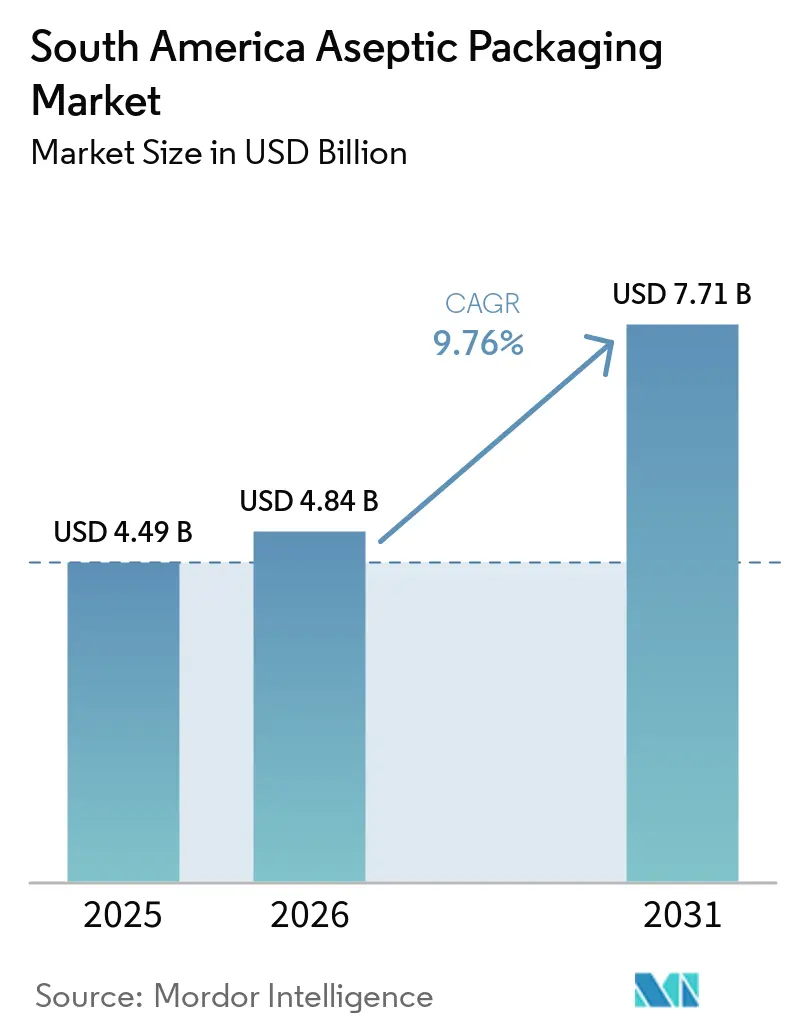
| Base Year Market Size (2025) | USD 4.49 Billion |
| Market Size (2026) | USD 4.84 Billion |
| Market Size (2031) | USD 7.71 Billion |
| Growth Rate (2026 - 2031) | 9.76 % |
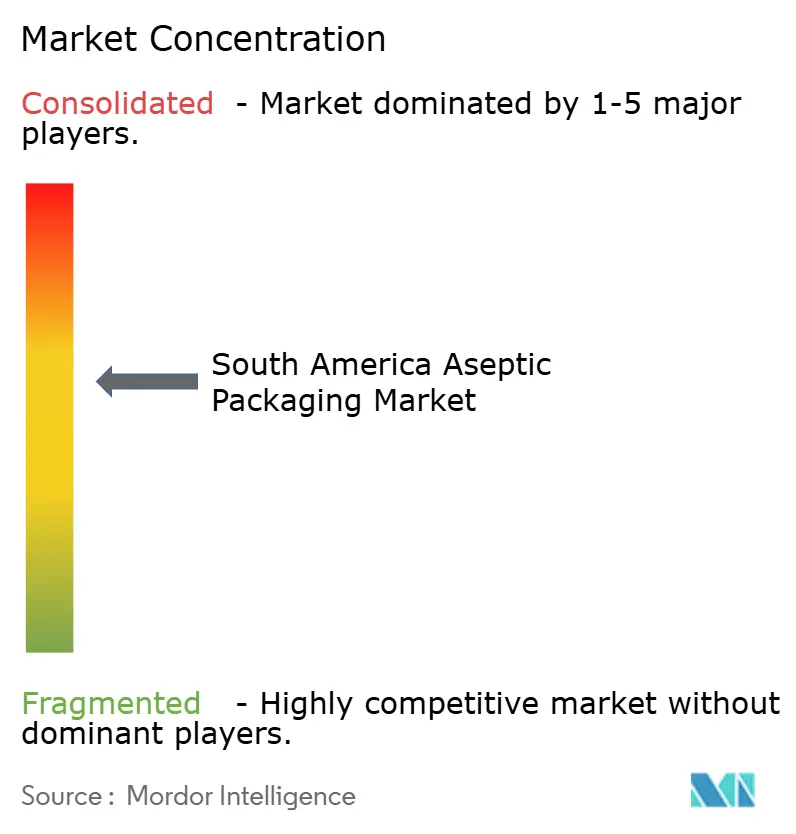
| Market Concentration | Medium |
Major Players *Disclaimer: Major Players sorted in no particular order Image © Mordor Intelligence. Reuse requires attribution under CC BY 4.0. | |
South America Aseptic Packaging Market Analysis by Mordor Intelligence
The South America Aseptic Packaging Market size is projected to expand from USD 4.49 billion in 2025 to USD 4.84 billion in 2026, and to USD 7.71 billion by 2031, registering a CAGR of 9.76% between 2026 and 2031. Demand is moving toward shelf-stable food, beverages, and pharmaceutical liquids that can be distributed without continuous refrigeration. Brazil remains the central demand base because its UHT dairy system uses more than 5 billion aseptic cartons annually. Modern retail investment in Colombia and rising household incomes in Peru and Ecuador are widening access to packaged products outside major cities. Packaging suppliers are responding with paper-based barriers, flexible pouches, and sterile filling systems that address both distribution needs and recycling requirements. The South America aseptic packaging market also faces higher costs of resins, aluminum foil, and paperboard, while the cost of sterile filling equipment continues to limit entry by smaller converters.
Key Report Takeaways
- By product, cartons held 52.43% of the South America aseptic packaging market share in 2025, while bags and pouches are projected to expand at a 10.74% CAGR through 2031.
- By material, paper and paperboard accounted for 56.82% of the market in 2025, while composite laminates are expected to record a 10.78% CAGR through 2031.
- By application, beverages represented 61.87% of the South America aseptic packaging market share in 2025, while pharmaceutical and healthcare applications are projected to expand at a 10.56% CAGR through 2031.
- By filling technology, form-fill-seal held 59.68% of the market in 2025, while blow-fill-seal is expected to register a 10.49% CAGR through 2031 in the South America aseptic packaging market.
- By geography, Brazil accounted for 56.19% of the market in 2025, while Colombia is projected to expand at a 10.51% CAGR through 2031 in the the South America aseptic packaging market.
Note: Market size and forecast figures in this report are generated using Mordor Intelligence’s proprietary estimation framework, updated with the latest available data and insights as of January 2026.
South America Aseptic Packaging Market Trends and Insights
Drivers Impact Analysis*
| Driver | (~) % Impact on CAGR Forecast | Geographic Relevance | Impact Timeline |
|---|---|---|---|
| Shelf-Stable Dairy and Beverage Distribution | +2.8% | Brazil, Argentina, Chile, Colombia | Short term (≤ 2 years) |
| Convenient, Functional, and Plant-Based Beverages | +2.1% | Brazil, Colombia, Argentina, Chile | Medium term (2-4 years) |
| Packaged Food and Ready-to-Eat Consumption | +1.4% | Brazil, Argentina, urban centers across South America | Medium term (2-4 years) |
| Pharmaceutical and Ophthalmic Aseptic Filling | +0.9% | Brazil, Argentina, Colombia | Medium term (2-4 years) |
| Lower Cold-Chain Dependence in Remote Retail Corridors | +0.6% | Brazil, Colombia, Rest of South America | Short term (≤ 2 years) |
| Recycling Infrastructure for Mono-Material Conversion | +0.4% | Brazil, Colombia, Argentina, Chile | Long term (≥ 4 years) |
| Source: Mordor Intelligence | |||
Expansion of Shelf-Stable Dairy and Beverage Distribution
Dairy and beverage producers continued to invest in UHT processing and aseptic filling during 2024 and 2025. Shelf-stable distribution reduces the need for refrigerated storage at retail and foodservice locations. This is important in Brazil's interior and the Andean region, where refrigeration coverage is less reliable. The South America aseptic packaging market benefits when producers can serve dispersed retail corridors with fewer refrigerated assets. SIG reported broad-based regional performance in 2025, including new filling lines in Brazil, higher volumes from Colombian customers, and expanded dairy and beverage activity in Chile.[1] SIG Group AG, “Americas Regional Review,” SIG Annual Report 2025, reports.sig.biz This ongoing equipment activity supports the South America aseptic packaging market by expanding capacity for ambient products.
Growth of Convenient, Functional, and Plant-Based Beverages
Functional, protein-enhanced, and plant-based beverages need containers that maintain product quality during ambient storage. These products suit aseptic pouches and single-serve packs because they can be distributed through retail channels with limited chilled capacity. Kerry reported that 86% of South American consumers preferred hybrid protein formulations that combine plant and animal proteins. The development of smaller product batches also increases demand for equipment capable of changing formats quickly. This places the South America aseptic packaging market closer to fast-moving beverage launches than conventional high-volume carton production. It supports the use of spouted pouches for protein drinks, yogurt, fruit purée, and other portable products.
Rising Packaged Food and Ready-to-Eat Consumption
High urbanization in Brazil and Argentina supports demand for shelf-stable prepared foods. Aseptic filling is used for soups, fruit purées, dairy desserts, sauces, and meal components that need a long shelf life without preservatives. Meal-kit delivery and premium retail expansion in São Paulo, Buenos Aires, and Bogotá are also increasing the relevance of ambient formats. Smurfit Westrock invested USD 150 million in Brazilian paper production and converting capacity through 2026, reflecting its focus on demand for food and beverage packaging in the country. These investments strengthen the regional supply base for fiber-based packaging materials. The South America aseptic packaging market has room to add volume in savory ambient products, where use remains below established packaged-food categories.
Expansion of Pharmaceutical and Ophthalmic Aseptic Filling
Pharmaceutical liquid production is increasing the demand for validated sterile filling environments. Brazil, Argentina, and Colombia are tightening expectations for injectables, ophthalmic products, and other sterile liquids. Argentina's ANMAT issued requirements effective from February 2027 that define closed-system filling for large-volume parenterals and identify blow-fill-seal and form-fill-seal systems as compliant technologies. These rules are encouraging equipment qualification and capacity additions before the compliance deadline. STEQ obtained exclusive representation for SYFPAC blow-fill-seal technology in Brazil during 2025. Unither also listed ophthalmic formulations in blow-fill-seal multidose containers for Brazil, with approval targets extending through 2026 and 2027. The South America aseptic packaging market gains a broader base of higher-value applications as sterile liquid production expands.
Restraints Impact Analysis*
| Restraint | (~) % Impact on CAGR Forecast | Geographic Relevance | Impact Timeline |
|---|---|---|---|
| High Capital Intensity of Sterile Filling Systems | -0.8% | Brazil, Argentina, Colombia | Medium term (2-4 years) |
| Limited Recycling Capacity for Multilayer Packs | -0.5% | Brazil, Rest of South America | Long term (≥ 4 years) |
| Volatile Resin, Aluminum Foil, and Paperboard Costs | -0.4% | Global, most acute in Brazil and Argentina | Short term (≤ 2 years) |
| Fragmented Extended Producer Responsibility Execution | -0.2% | Brazil, Colombia, Rest of South America | Medium term (2-4 years) |
| Source: Mordor Intelligence | |||
High Capital Intensity of Sterile Filling Systems
Food-grade aseptic filling lines can require investments above USD 5 million per line. Pharmaceutical-grade systems can cost USD 20 million or more due to stricter sterility and validation requirements. Small converters can struggle to justify this investment when volumes in plant-based drinks, functional beverages, or ophthalmic solutions remain limited. Sterile product manufacturers must also pay for audits, process validation, and environmental monitoring. Colombia's INVIMA provides technical guidance on the validation of aseptic filling processes, reinforcing the detailed controls required for these installations. The result is a smaller group of well-capitalized facilities, especially in Brazil and Argentina, capable of offering pharmaceutical contract filling.
Limited Recycling Capacity for Multilayer Packs
Aseptic cartons and flexible pouches often combine paperboard, polyethylene, and aluminum. These material layers create recycling challenges where collection and separation facilities are limited. SIG funded a facility in Paraná to recover polymers and aluminum separately from polyaluminum carton waste. Brazil's Decree No. 12.688, published in October 2025, set binding reverse-logistics and recycled-content requirements for plastic packaging starting in 2026.[2]Brazilian Government, “Decreto Nº 12.688, de 21 de Outubro de 2025,” Planalto, planalto.gov.br The Fiber-based Carton Association Global has stated that paper-based barriers can simplify recycling by reducing the number of layers requiring separation. However, material conversion requires upgrades at packaging plants and customer qualification programs, which can take 3-5 years at scale.
*Our forecasts treat driver/restraint impacts as directional, not additive. The impact forecasts reflect baseline growth, mix effects, and variable interactions.
Segment Analysis
By Product: Cartons Retain Scale While Pouches Gain Use
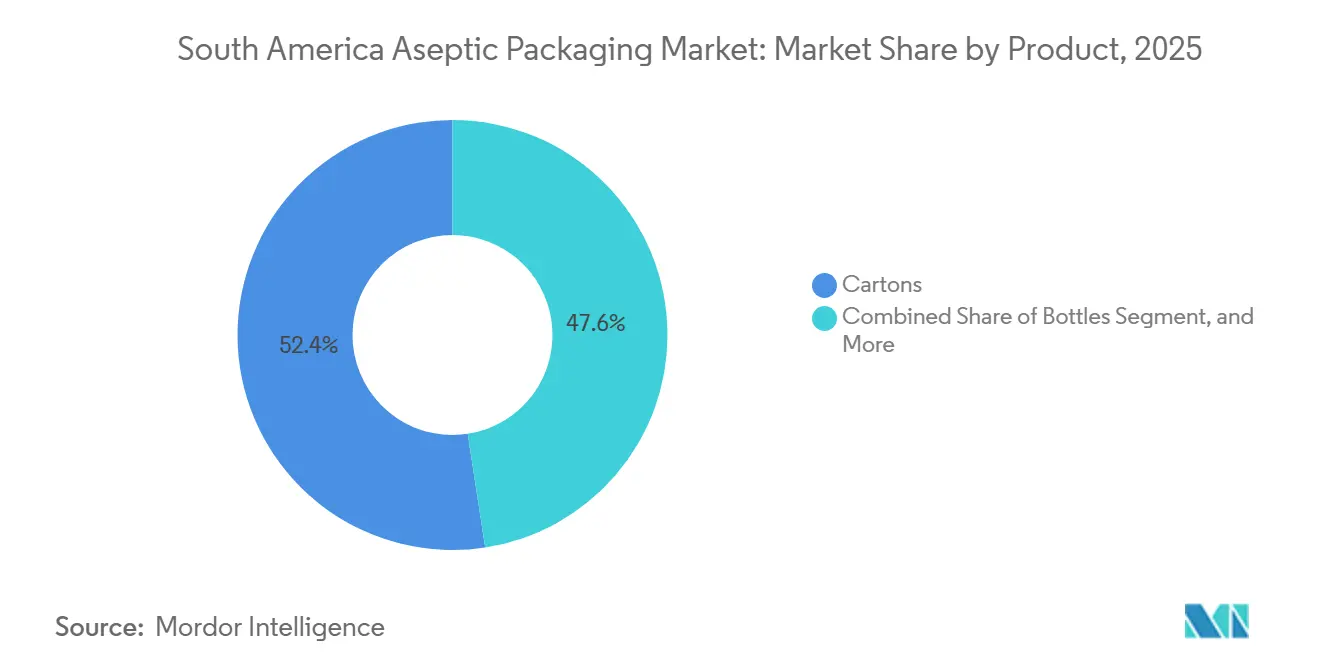
Cartons held 52.43% of regional aseptic packaging revenue in 2025. Their position reflects the large UHT dairy and ambient juice base in Brazil, Argentina, and Colombia. High-speed carton lines are widely installed at leading regional food and beverage producers. The format provides low unit costs for large-volume, price-sensitive products. Tetra Pak and SIG continue to improve carton systems with paper-based barriers and traceability features. These upgrades help carton users extend existing filling assets rather than replace them. Cartons also remain familiar to consumers buying milk, juice, and shelf-stable dairy products.
Bags and pouches are projected to expand at a 10.74% CAGR through 2031. Their lower weight and efficient shape can reduce freight costs compared with rigid formats. Spouted versions are well-suited to protein drinks, yogurt, fruit purées, and other products consumed away from home. SIG reported rising pouch activity in South America for fruit purée, yogurt, and dairy products. The South America aseptic packaging market is using these formats where convenience and transport efficiency matter more than the throughput advantages of cartons. Bottles support premium ready-to-drink beverages and pharmaceutical liquid dosing, while cans remain a smaller option for specialty coffee and nutritional drinks. Vials and ampoules remain important for sterile injectables, with plastic blow-fill-seal formats qualifying unit-dose ophthalmic and parenteral applications.



By Material: Paperboard Leads While Composite Laminates Advance
Paper and paperboard accounted for 56.82% of the South America aseptic packaging market size in 2025. Liquid packaging board supply chains connect global and regional fiber producers with filling sites across Brazil and Argentina. Paperboard is cost-effective for high-volume cartons and provides a renewable-material proposition for food and beverage brands. Its installed base also supports established purchasing, converting, and filling relationships. Paperboard remains central to milk and juice cartons because it provides stiffness and printability. These characteristics keep it relevant even as the material mix changes.
Composite laminates are expected to register a 10.78% CAGR through 2031. These structures combine barrier performance with lower material weight and can support flexible aseptic formats. Tetra Pak launched a 1-liter aseptic carton with a paper-based barrier in April 2026. The company said the design raises paper content to 80% and can reduce carbon footprint by up to 43%. Tetra Pak also invested EUR 60 million (USD 67.8 million) in a pilot plant for paper-based barrier technology in January 2026.[3]Tetra Pak International S.A., “Tetra Pak Invests EUR 60 Million in Owned Pilot Plant to Advance Its Paper-Based Barrier Technology Development,” Tetra Pak, tetrapak.com Plastics remain necessary as barrier layers and for blow-fill-seal containers. Glass maintains a niche in pharmaceuticals because of its inertness and established regulatory acceptance, while metal remains limited to specialty beverage and industrial uses.
By Application: Beverages Lead While Pharmaceutical Use Accelerates
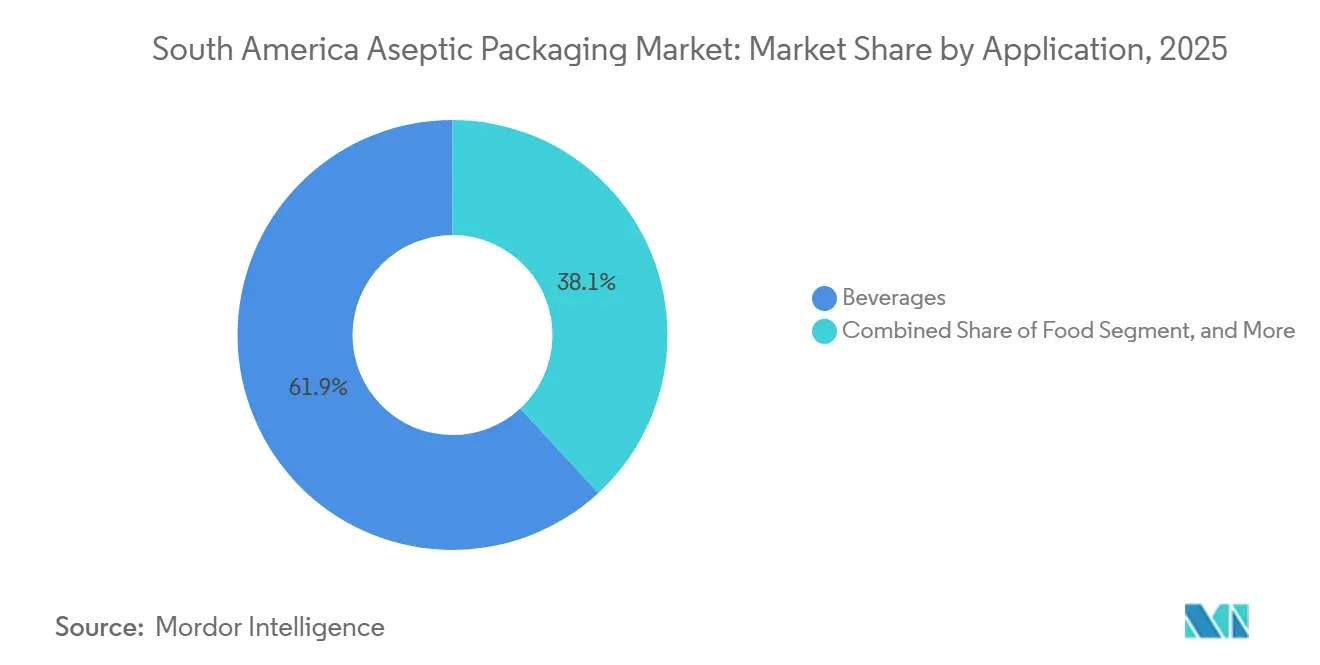
Beverages represented 61.87% of regional aseptic packaging revenue in 2025. UHT milk, ambient juice, and ready-to-drink beverages remain the primary volume base. Dairy products have the largest role within the beverage category. Functional drinks and plant-based products are adding new formats and pack sizes. Shelf-stable beverages are particularly useful in areas with limited chilled retail capacity. This has kept beverage applications at the center of filling-line investment in the South America aseptic packaging market.
Pharmaceutical and healthcare applications are projected to expand at a 10.56% CAGR through 2031. Sterile injectable vials, blow-fill-seal ophthalmic doses, and biologics packaging are increasing the need for validated aseptic capacity. Food applications hold the next-largest position through soups, purées, dairy foods, and ready-to-eat components. Aseptic filling can provide extended shelf life without preservatives for ambient soups and broths. Personal care and cosmetics remain the smallest application, as regional contract-filling capacity for aseptic single-dose products is more limited.
By Filling Technology: Form-Fill-Seal Holds the Installed Base While Blow-Fill-Seal Builds Capacity
Form-fill-seal accounted for 59.68% of the South America aseptic packaging market in 2025. The technology is used across cartons, pouches, and flexible bags. Its installed base reflects decades of regional investment in dairy and juice production. Tetra Pak, SIG, and Elopak have established equipment, service, and material networks that lower operating barriers for existing users. Customer qualification records and compatible supply chains also make format changes less immediate. Form-fill-seal, therefore, remains the main filling route for high-volume ambient beverages.
Blow-fill-seal is expected to register a 10.49% CAGR through 2031. The process forms, fills, and seals a container in a closed sequence, which is valuable for sterile pharmaceutical liquids. Nine new SIG aseptic filling machines became operational at Shefa and Líder Alimentos in São Paulo and Paraná during 2025, serving UHT dairy, plant-based beverages, and nectars. Aseptic injection filling serves biologics and other critical liquids that require strict cleanroom control. Rotary aseptic filling remains suited to large dairy and beverage volumes. The South America aseptic packaging market can benefit from increased flexible filling capacity as systems with in-line sterilization become more widely available.
Geography Analysis
Brazil accounted for 56.19% of regional aseptic packaging revenue in 2025. Its position is supported by a food processing sector valued above USD 170 billion and UHT dairy carton volumes exceeding 5 billion units annually. SIG reported 4.4% constant-currency revenue expansion in South America during 2025, supported by filling-line activity in Brazil. Brazil also has the region's most developed sustainability framework for packaging. Decree No. 12.688 established national reverse-logistics and recycled-content rules for plastic packaging, effective from 2026. IFC committed EUR 65 million (USD 73.5 million) in October 2025 to America Embalagens for 2 plastic-tube lines with up to 80% recycled content. These rules and investments give the South America aseptic packaging market a clearer route toward improved recycling and material design.
Colombia is projected to expand at a 10.51% CAGR through 2031, the highest among the geographic markets covered. Rising urban incomes and broader modern retail distribution are supporting demand for dairy, food, and beverages. Pharmaceutical manufacturing is also adding interest in validated aseptic filling systems. SIG identified Celema as a new aseptic carton customer and regional co-packer in Colombia in 2025. The company also cited flexible filling technology that enabled new product concepts and volumes in the country. Argentina holds the second-largest country position due to its established ambient dairy producers and carton infrastructure. Its macroeconomic and exchange-rate conditions remain a source of demand volatility, but ANMAT's 2027 compliance requirement is creating a defined investment need for closed-system pharmaceutical filling.
The Rest of South America includes Chile, Peru, Ecuador, Bolivia, Paraguay, Uruguay, and Venezuela, each with distinct retail and logistics conditions. Chile has organized retail and stronger cold-chain coverage, making adoption of new cartons and pouches more dependent on product launches and trade flows. Peru and Ecuador have greater distribution challenges beyond large cities. The World Health Organization documented cold-chain constraints in remote Brazilian communities during 2024, showing the practical distribution value of products that can tolerate ambient transport. Similar logistics constraints affect the availability of shelf-stable foods and over-the-counter pharmaceutical liquids in Andean and Amazonian areas. Aseptic packs can allow products to reach these areas without continuous refrigeration. Improving roads, logistics networks, and modern retail are expected to support new filling investment in Peru, Ecuador, and Bolivia through 2031.
Competitive Landscape
The South America aseptic packaging market is moderately concentrated around Tetra Pak and SIG, which hold the largest installed bases for carton and spouted-pouch filling systems. Their competition spans packaging materials and equipment installation to technical services, traceability, and recycling programs. SIG offers its pac.trust platform, which assigns a unique QR code to each aseptic package for supply-chain visibility. This capability is relevant to pharmaceutical customers and premium food producers that need package-level traceability. Tetra Pak is investing in paper-based barriers and related production capacity. Its April 2026 paper-barrier carton launch established a new reference point for reducing aluminum use in aseptic cartons.
Elopak reported headwinds in the Americas during the first quarter of 2026 due to changes in plant-based consumption and lower aseptic juice demand in some channels. This illustrates the challenge for carton suppliers as demand shifts toward functional dairy and pharmaceutical uses. The most open areas for new competition are pharmaceutical-grade aseptic filling outside Brazil's largest cities and flexible aseptic pouches in Andean markets. Regional glass-vial converters in Buenos Aires and Bogotá may face stronger competition from blow-fill-seal systems where high-volume liquid medication production expands. Amcor introduced Moda rotary vacuum chamber sealing technology in Brazil in June 2026 through a partnership with Barra Mansa. The initial application was for protein foods, showing how international firms can introduce specialized technologies into regional food categories without directly challenging carton-system suppliers.
Smurfit Westrock expanded its Brazilian paper and converting capacity with USD 150 million in investment through 2026. It also introduced the ActiBlu glueline-free packaging prototype in May 2026. These actions strengthen its ability to participate in the broader shift toward fiber-based packaging as barrier technologies advance. The South America aseptic packaging market continues to favor suppliers that can combine materials, filling equipment, technical support, and compliance expertise. High equipment costs and lengthy customer qualification cycles favor partnerships and acquisitions for suppliers seeking a broader regional footprint. Competition is likely to remain strongest where firms can offer complete systems.
South America Aseptic Packaging Industry Leaders
Tetra Pak International S.A.
SIG Group AG
Elopak ASA
Greatview Aseptic Packaging Co., Ltd.
IPI S.r.l
- *Disclaimer: Major Players sorted in no particular order

Recent Industry Developments
- June 2026: Amcor introduced Moda rotary vacuum chamber sealing technology in Brazil through a partnership with Barra Mansa. The company installed the first system of its type in the country for protein-food applications, with 3 planned lines targeted for completion by year-end.
- May 2026: Smurfit Westrock unveiled ActiBlu, a prototype glueline-free packaging solution that uses up to 60% less adhesive than conventional hot-melt systems. The company also presented 3 AI-based packaging-performance tools at its 2026 Innovation Event in the Netherlands.
- April 2026: Tetra Pak and Sterilgarda Alimenti launched the first 1-liter aseptic carton with a paper-based barrier. The pack replaces aluminum foil, raises paper content to 80%, and enables up to 92% traceable renewable content with plant-based polymers.
- February 2026: Tetra Pak extended paper-based barrier technology to high-speed Tetra Pak A3/Speed filling lines that can process up to 24,000 packages per hour. Maeil Dairies in South Korea became the first global producer to implement the format at industrial scale.


South America Aseptic Packaging Market Report Scope
The South America Aseptic Packaging Market refers to the market for packaging solutions designed to maintain the commercial sterility and quality of packaged products by combining sterilized packaging materials, controlled filling processes, and aseptic sealing technologies. The market includes packaging formats used for shelf-stable and sterile products across food, beverage, pharmaceutical, healthcare, and personal care and cosmetics applications.
The South America Aseptic Packaging Report is Segmented by Product (Cartons, Bottles, Cans, Bags and Pouches, and Vials and Ampoules), Material (Paper and Paperboard, Plastics, Glass, Metal, and Composite Laminates), Application (Beverages, Food, Pharmaceutical and Healthcare, and Personal Care and Cosmetics), Filling Technology (Form-Fill Seal (FFS), Blow-Fill Seal (BFS), Injection Aseptic Filling, and Rotary Aseptic Filling), and Geography (Brazil, Argentina, Colombia, and Rest of South America). The Market Forecasts are Provided in Terms of Value (USD).
By Product
| Cartons |
| Bottles |
| Cans |
| Bags and Pouches |
| Vials and Ampoules |
By Material
| Paper and Paperboard |
| Plastics |
| Glass |
| Metal |
| Composite Laminates |
By Application
| Beverages | Readyto-Drink (RTD) Beverages |
| Dairy-Based Beverages | |
| Food | Processed Food and Soups |
| Fruits and Vegetables | |
| Dairy Food | |
| Pharmaceutical and Healthcare | |
| Personal Care and Cosmetics |
By Filling Technology
| Form-Fill Seal (FFS) |
| Blow-Fill Seal (BFS) |
| Injection Aseptic Filling |
| Rotary Aseptic Filling |
By Geography
| Brazil |
| Argentina |
| Colombia |
| Rest of South America |
| By Product | Cartons | |
| Bottles | ||
| Cans | ||
| Bags and Pouches | ||
| Vials and Ampoules | ||
| By Material | Paper and Paperboard | |
| Plastics | ||
| Glass | ||
| Metal | ||
| Composite Laminates | ||
| By Application | Beverages | Readyto-Drink (RTD) Beverages |
| Dairy-Based Beverages | ||
| Food | Processed Food and Soups | |
| Fruits and Vegetables | ||
| Dairy Food | ||
| Pharmaceutical and Healthcare | ||
| Personal Care and Cosmetics | ||
| By Filling Technology | Form-Fill Seal (FFS) | |
| Blow-Fill Seal (BFS) | ||
| Injection Aseptic Filling | ||
| Rotary Aseptic Filling | ||
| By Geography | Brazil | |
| Argentina | ||
| Colombia | ||
| Rest of South America | ||


Key Questions Answered in the Report
What is the size of the South America aseptic packaging market?
The South America aseptic packaging market was valued at USD 4.49 billion in 2025 and is estimated at USD 4.84 billion in 2026. It is forecast to reach USD 7.71 billion by 2031.
What is driving demand for aseptic packaging in South America?
Shelf-stable UHT dairy, ambient beverages, ready-to-eat foods, and sterile pharmaceutical liquids are increasing demand. These products can be distributed without continuous refrigeration.
Which product format has the largest share in the region?
Cartons held 52.43% of the market in 2025. Their large installed base in UHT dairy and ambient juice supports this position.
Which aseptic packaging application is expanding fastest?
Pharmaceutical and healthcare applications are projected to expand at a 10.56% CAGR through 2031. Sterile injectables and ophthalmic products are important sources of demand.
Which country is expected to expand fastest through 2031?
Colombia is projected to expand at a 10.51% CAGR through 2031. Modern retail, rising income, and pharmaceutical manufacturing support its demand outlook.
How are sustainability rules affecting aseptic packs in Brazil?
Decree No. 12.688 established recycled-content and reverse-logistics requirements from 2026 onward. These requirements are encouraging investment in recycling systems and paper-based barriers.
Page last updated on:





