
Market Overview
| Study Period | 2021 - 2031 |
|---|---|
| Forecast Data Period | 2026 - 2031 |
| Base Year Market Size (2025) | USD 0.99 Billion |
| Market Size (2026) | USD 1.06 Billion |
| Market Size (2031) | USD 1.46 Billion |
| Growth Rate (2026 - 2031) | 6.64 % |
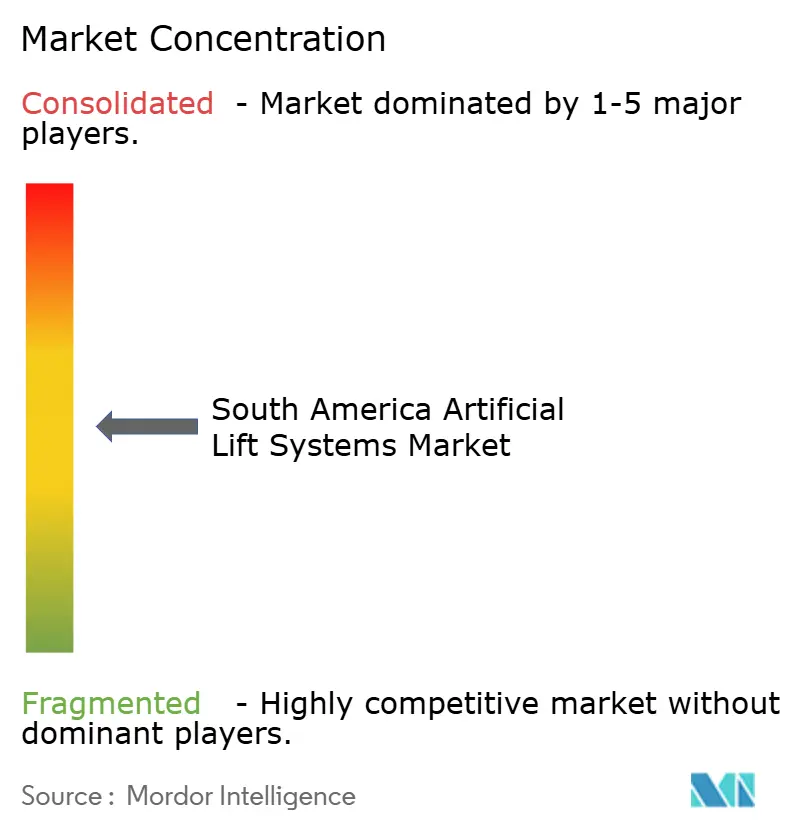
| Market Concentration | Medium |
Major Players *Disclaimer: Major Players sorted in no particular order Image © Mordor Intelligence. Reuse requires attribution under CC BY 4.0. | |
South America Artificial Lift Systems Market Analysis by Mordor Intelligence
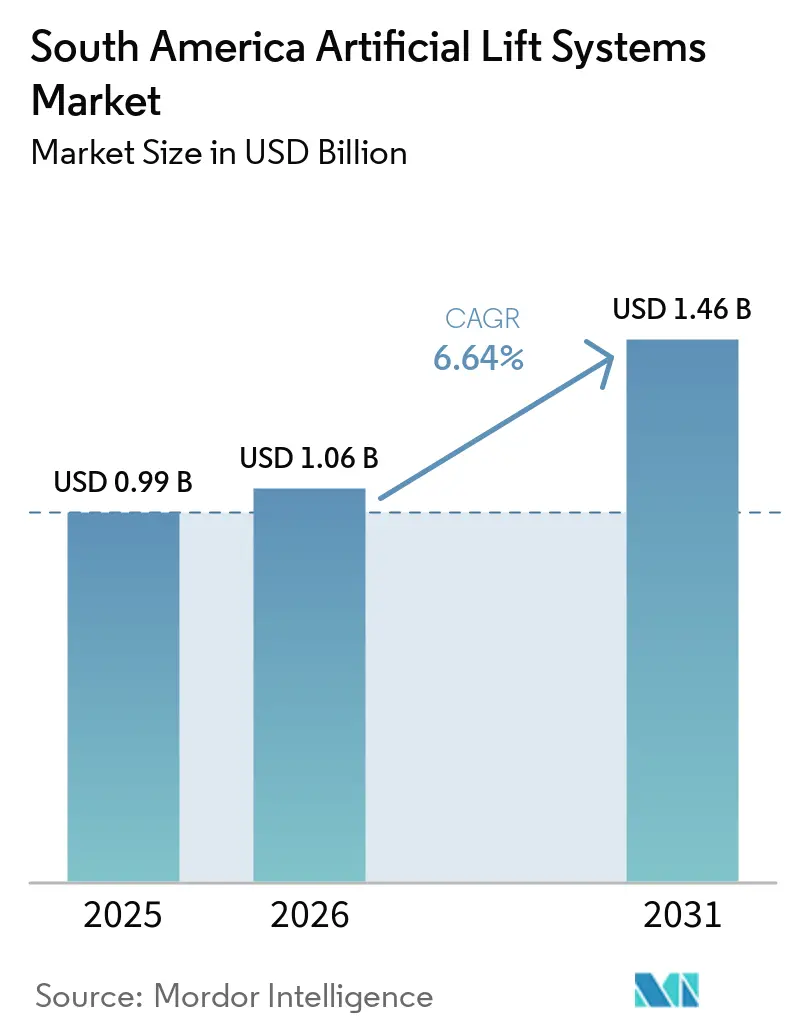
The South America Artificial Lift Systems Market size is projected to be USD 0.99 billion in 2025, USD 1.06 billion in 2026, and reach USD 1.46 billion by 2031, at a CAGR of 6.64% from 2026 to 2031. The South America artificial lift systems market is supported by mature fields that need continued production support and by new offshore and unconventional projects that require lift planning from the start. Brazil remains central because its pre-salt developments require qualified systems for complex deepwater wells. Argentina adds a different source of demand through horizontal development in Vaca Muerta and continuing work across established onshore fields. Guyana brings a faster-growing offshore opportunity as new projects add well clusters and production infrastructure. Suppliers that combine equipment, field service, remote monitoring, and maintenance are better positioned to serve these different operating conditions.
Key Report Takeaways
- By lift type, electric submersible pumps led with 32.6% revenue share in 2025 and are forecast to grow at an 6.8% CAGR through 2031.
- By well orientation, vertical wells held 57.4% revenue share in 2025, while horizontal wells are projected to grow at an 7.1% CAGR through 2031.
- By reservoir type, conventional reservoirs held 69.3% revenue share in 2025, while unconventional reservoirs are expected to grow at an 8.2% CAGR through 2031.
- By application, onshore applications held 58.3% revenue share in 2025, while offshore applications are projected to grow at an 7.3% CAGR through 2031.
- By component, pumps led with 36.8% revenue share in 2025, while variable speed drives and controls are expected to grow at an 7.5% CAGR through 2031.
- By service, installation and commissioning led with 42.5% revenue share in 2025, while optimization and monitoring are expected to grow at an 8.1% CAGR through 2031.
- By geography, Brazil led with 52.4% revenue share in 2025, while Guyana is expected to grow at an 9.3% CAGR through 2031.
Note: Market size and forecast figures in this report are generated using Mordor Intelligence’s proprietary estimation framework, updated with the latest available data and insights as of January 2026.
South America Artificial Lift Systems Market Trends and Insights
Drivers Impact Analysis*
| Driver | (~) % Impact on CAGR Forecast | Geographic Relevance | Impact Timeline |
|---|---|---|---|
| Mature-Well Rejuvenation and Production-Life Extension | +1.40% | Argentina (Golfo San Jorge, Neuquén), Colombia (Llanos, Middle Magdalena), Brazil (Campos Basin) | Long term (≥ 4 years) |
| Vaca Muerta Horizontal-Well Development | +1.10% | Argentina (Neuquén Basin), spill-over to Bolivia and Chile export infrastructure | Medium term (2-4 years) |
| Brazil Pre-Salt and Guyana-Adjacent Offshore Expansion | +1.30% | Brazil (Santos and Campos Basins), Guyana (Stabroek Block) | Long term (≥ 4 years) |
| Digital Lift Optimization and Remote Surveillance | +0.70% | Global; early adoption concentrated in Brazil and Argentina | Medium term (2-4 years) |
| Local Supply Hubs for Corrosive-Service Lift Equipment | +0.50% | Argentina (Comodoro Rivadavia), Brazil (Macaé, Porto do Açu) | Medium term (2-4 years) |
| Automated Gas-Handling Retrofits in High-GOR Wells | +0.50% | Argentina (Vaca Muerta), Brazil (pre-salt), Colombia (Llanos) | Short term (≤ 2 years) |
| Source: Mordor Intelligence | |||
Mature-Well Rejuvenation And Production-Life Extension
Mature producing fields across South America rely on artificial lift after natural reservoir pressure declines. This creates recurring demand for equipment replacement, repairs, and service work across established basins. Ecopetrol has addressed failure reduction and energy use in its artificial lifting systems, covering ESP, mechanical pumping, and progressive cavity pump installations in Colombia[1]. The work shows why operators focus on pump reliability and energy performance as wells age. The South America artificial lift systems market therefore includes demand that is tied to preserving production, rather than only to new drilling. That base can support service activity when operators delay less essential expansion projects.
Mature wells also require a broader mix of lift methods because water production, fluid viscosity, and gas content vary across fields. Operators use ESPs where high fluid volumes justify the system, while rod lift and PCP systems remain relevant in many established onshore operations. Field teams must maintain these systems regularly because deferred repairs can result in lost output. Local service capacity is important when workovers or equipment changes are needed quickly. The South America artificial lift systems market benefits from this installed base because service contracts can continue through several intervention cycles. Suppliers that hold nearby inventory and experienced field crews can reduce downtime for operators.
Brazil Pre-Salt And Guyana Offshore Expansion
Brazil’s pre-salt program remains a major source of offshore system demand in the region. Petrobras reported 2.56 million barrels of oil equivalent per day from its own pre-salt production in 2025. The company also reported that the Almirante Tamandaré FPSO produced 270,000 barrels per day during 2025. These developments require equipment that can operate under deepwater pressure, high gas volumes, and demanding fluid conditions. The South America artificial lift systems market gains from projects where lift selection is incorporated into well and production-system design. Suppliers need to meet technical qualification requirements before they can participate in these projects.
Guyana adds another offshore development path to the regional demand base. ExxonMobil reported that Stabroek Block production reached 900,000 barrels per day in November 2025. The company stated that the Uaru FPSO began operations in 2026 with a design rate of 250,000 barrels per day. New projects increase the need for qualified completion, monitoring, and production-support systems across added well clusters. Offshore operators place high value on run life because subsea intervention can be difficult and expensive. This encourages the use of monitoring systems that identify operating issues before they require a major intervention.
Digital Lift Optimization And Remote Surveillance
Digital systems help operators monitor lift performance without relying only on manual field checks. Baker Hughes stated that its Leucipa platform uses production data to help customers monitor operations and identify opportunities for optimization. In June 2025, Baker Hughes and Repsol announced AI-enabled functionality for the platform, including a virtual assistant for plunger-lift operations[2]. These tools can support faster operating decisions when wells show changing flow behavior. The South America artificial lift systems market is increasingly shaped by controls, sensors, and services that extend the value of installed equipment. Remote monitoring is especially useful where experienced field personnel are limited or wells are far from service bases.
A 2025 study presented through the Southwestern Petroleum Short Course reported 85% to 95% accuracy in identifying 12 rod-lift failure modes through machine-learning analysis of dynacards[3]. Such capabilities can help operators move from responding to failures toward earlier maintenance planning. The value of the approach is not limited to avoiding equipment damage. It can also reduce production losses that occur when a failure is detected after a well is shut in. Digital services can be sold alongside new equipment or added to existing installations. This gives integrated providers an opportunity to build longer relationships with operators.
Automated Gas-Handling Retrofits In High-GOR Wells
High gas-to-oil-ratio wells can create difficult operating conditions for pumps and related lift equipment. Gas-handling upgrades can help stabilize production where free gas reduces pump efficiency. This need is relevant in offshore projects and in unconventional wells during early production periods. Equipment selection must account for gas separation, motor protection, and changing flow conditions. The South America artificial lift systems market includes opportunities for suppliers that can adapt installed systems rather than requiring complete replacement. Retrofit work can also provide a shorter route to improving performance in wells already on production.
The value of these upgrades depends on the specific well profile and the operator’s maintenance plan. Gas-handling tools are most useful when they are matched with reliable operating data and regular surveillance. A supplier may combine a retrofit with controls that adjust operating speed as conditions change. This can improve the useful operating range of a pump and reduce unplanned shutdowns. The South America artificial lift systems market is supported when field teams can apply these upgrades without extended production interruptions. Operators also benefit when the same service provider can supply equipment, installation support, and follow-up monitoring.
Restraints Impact Analysis*
| Restraint | (~) % Impact on CAGR Forecast | Geographic Relevance | Impact Timeline |
|---|---|---|---|
| Crude-Price-Driven Upstream CAPEX Deferrals | -1.20% | Regional; most acute in Colombia, Chile, and smaller producing nations | Short term (≤ 2 years) |
| Ultra-Deepwater Intervention and Workover Economics | -0.80% | Brazil (Santos and Campos Basins), Guyana | Medium term (2-4 years) |
| Specialty-Elastomer and Power-Electronics Bottlenecks | -0.60% | Global sourcing, impact concentrated in Brazil and Argentina mega-projects | Short term (≤ 2 years) |
| Shortage of Automation-Ready Field Personnel | -0.50% | Argentina, Colombia; nascent in Brazil | Medium term (2-4 years) |
| Source: Mordor Intelligence | |||
Ultra-Deepwater Intervention And Workover Economics
Deepwater lift systems must operate reliably because replacement can require specialized vessels, subsea equipment, and detailed planning. This raises the cost of failures in Brazil’s pre-salt fields and Guyana’s offshore developments. A 2025 article in the Journal of Petroleum Technology discussed operating challenges for an ESP in the ultra-deepwater, heavy-oil Atlanta field in Brazil[4]. The article described how heavy oil, gas conditions, and water depth complicate ESP operation. These conditions can shift investment toward run-life improvements and monitoring instead of frequent replacement activity. The South America artificial lift systems market must therefore balance the value of high-specification hardware against the cost of intervention.
Operators reduce this exposure by placing greater emphasis on equipment qualification and failure prevention. They may use redundant configurations or monitoring tools where the production risk is high. This approach can favor established suppliers with experience in demanding offshore applications. It can also lengthen purchasing processes because operators review reliability and service capability closely. High intervention costs can limit the willingness to test unproven systems in critical wells. The South America artificial lift systems market remains attractive for qualified providers, but entry into deepwater work requires significant technical credibility.
Specialty-Elastomer And Power-Electronics Bottlenecks
Specialty elastomers and power electronics are important parts of many ESP and control configurations. Delays in these inputs can extend delivery schedules for equipment used in major projects. Offshore systems may require materials that can withstand pressure, temperature, corrosive fluids, and long service periods. Controls and drives also depend on qualified electrical components that meet the operating requirements of the application. This makes procurement more complex than it is for standard onshore pumping equipment. The South America artificial lift systems market can face delays when critical components are not available within project schedules.
Smaller operators may be more exposed to these constraints because they have limited ability to hold inventory or secure long-term supply arrangements. Larger integrated providers can be better placed when they control more of the component supply chain. Operators may respond by ordering equipment earlier or by standardizing certain specifications across projects. These measures can reduce procurement uncertainty, but they may reduce flexibility in equipment selection. Reliable supply of qualified parts is therefore part of the competitive offering, not only an operational detail. Suppliers with local support hubs can also reduce the time needed to replace selected surface components.
*Our forecasts treat driver/restraint impacts as directional, not additive. The impact forecasts reflect baseline growth, mix effects, and variable interactions.
Segment Analysis
By Lift Type: ESPs Lead Broad Deployment Across Well Profiles
Electric submersible pumps held 32.6% of the South America artificial lift systems market in 2025 and are forecast to grow at a 6.8% CAGR through 2031. ESPs serve high-volume wells across offshore and deep onshore applications. Their adaptability supports use from mature conventional wells to complex offshore completions. Petrobras uses artificial lift within its pre-salt production architecture, where equipment reliability is important. BW Energy’s May 2025 Maromba decision included 6 initial horizontal production wells with downhole ESP systems.
Progressive cavity pumps remain important in onshore operations with viscous fluids and mature reservoirs. Rod lift retains a substantial installed base across older producing areas. Gas lift, plunger lift, hydraulic pumps, and other systems serve wells where ESPs are less suitable. The artificial lift systems industry depends on this broad technology mix because no single system suits every well. ISO 15551:2023 sets requirements for design verification, performance ratings, and functional evaluation for tubing-deployed ESP systems.
By Well Orientation: Horizontal Wells Increase Design Requirements
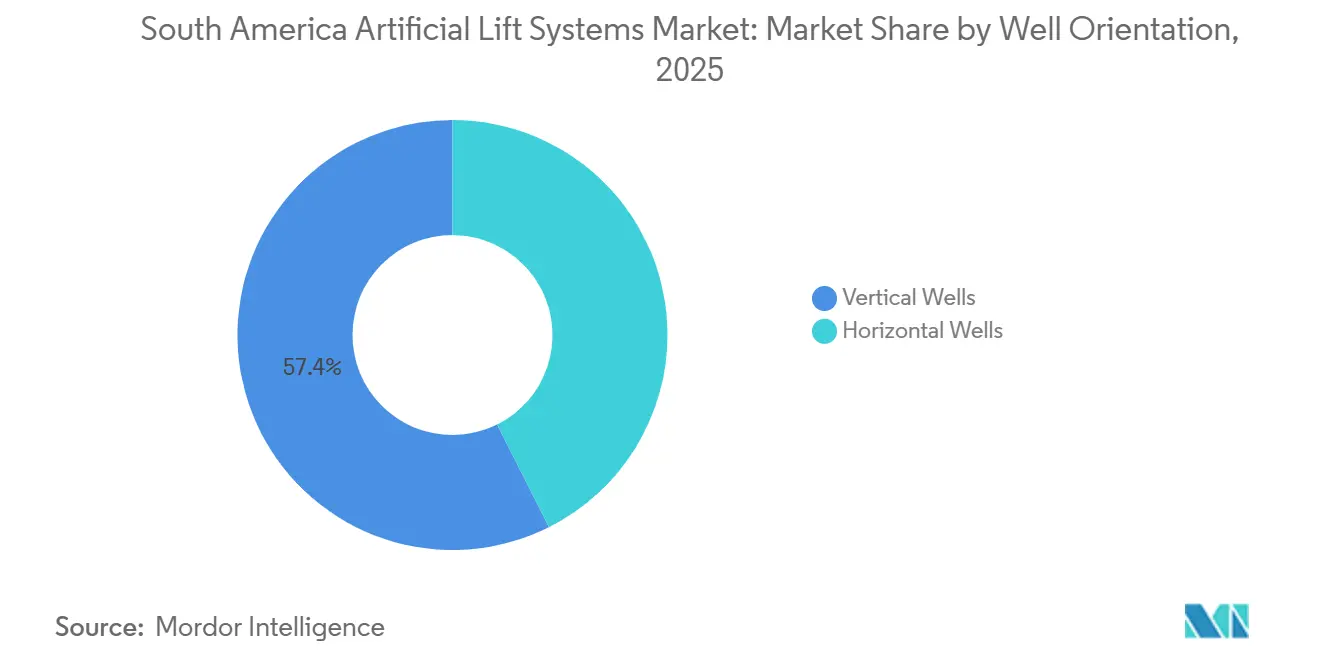
Vertical wells accounted for 57.4% of the South America artificial lift systems market in 2025. Horizontal wells are projected to grow at a 7.1% CAGR through 2031 as unconventional development expands. The vertical installed base is concentrated in established onshore basins across Argentina, Colombia, and Brazil. Horizontal completions can require different pump geometry and stronger gas-handling capability. The South America artificial lift systems market size for horizontal wells is growing with multi-well development in unconventional acreage.
Lift installation in horizontal wells requires planning around completion design and reservoir pressure changes. Equipment must support stable flow without increasing failure risk. The design process includes pump intake, gas behavior, and power assessments. Global suppliers with unconventional experience can bring proven designs to the region. Local service teams remain essential for installation and troubleshooting at the well site.
By Reservoir Type: Conventional Scale Supports Recurring Demand
Conventional reservoirs held 69.3% of the South America artificial lift systems market share in 2025. The segment is supported by the installed base across Brazil, Colombia, and Argentina. Maintenance, repairs, and upgrades form a recurring share of spending in these fields. Unconventional reservoirs are forecast to grow at an 8.2% CAGR through 2031. The higher rate reflects the expansion of horizontal shale development in Vaca Muerta.
Conventional operators use lift systems alongside water injection, gas reinjection, or other reservoir-management practices. These programs can extend the period in which a well remains commercially productive. Ecopetrol’s work on energy use and failure reduction shows the operating focus required in mature fields. Unconventional wells can require artificial lift earlier as reservoir pressure declines. Suppliers must maintain products and service models for both reservoir groups.
By Application: Offshore Growth Builds On New Well Clusters
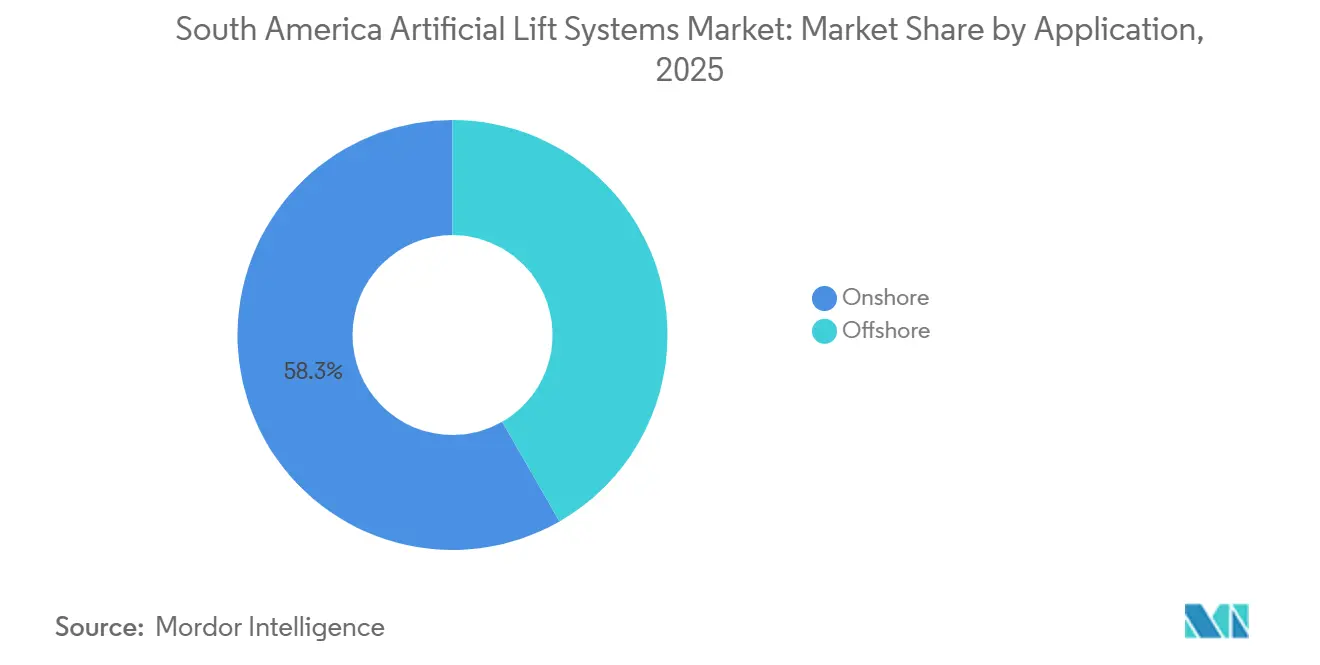
Onshore applications held 58.3% of the South America artificial lift systems market in 2025. Offshore applications are forecast to grow at a 7.3% CAGR through 2031. Onshore activity reflects the high number of producing wells in Argentina, Colombia, and Brazil’s land basins. Petrobras’ pre-salt activity and Guyana’s offshore development support demand for deepwater systems. ExxonMobil stated that Yellowtail began production in August 2025 through the ONE GUYANA FPSO.
Offshore applications can combine lift equipment, subsea infrastructure, controls, and monitoring in one production system. The cost of intervention makes equipment reliability particularly valuable. Operators can select suppliers based on installation, commissioning, and long-term monitoring capability. Onshore operations emphasize response time, local inventory, and field service coverage. Both applications require suppliers to manage changing well conditions over the producing life.
By Component: Controls Add Value To The Installed Equipment Base
Pumps held 36.8% of the South America artificial lift systems market in 2025. Variable speed drives and controls are forecast to grow at a 7.5% CAGR from 2026 to 2031. The pump share reflects the large number of ESP, PCP, and rod lift units in the region. Controls help operators adjust pump operation as flow, pressure, and power conditions change. The South America artificial lift systems market size for this component is supported by upgrades to installed equipment.
SLB states that its Smarten variable speed drives reduce nuisance shutdowns and provide remote operational control. Baker Hughes states that FusionPro can increase ESP uptime by up to 10% and reduce field visits by up to 50%. Motors, surface equipment, sensors, seal sections, and packers also shape the component offering. Sensors provide downhole pressure and temperature data for maintenance planning. Established suppliers benefit where documentation and system integration requirements are high.
By Service: Monitoring Supports Recurring Customer Engagement
Installation and commissioning held 42.5% of the South America artificial lift systems market in 2025. Optimization and monitoring are forecast to grow at an 8.1% CAGR through 2031. Installation benefits when operators activate new wells or replace equipment. The higher growth rate reflects demand for continuing performance support after installation. The South America artificial lift systems market is shifting toward services that maintain output and prevent failures.
Baker Hughes describes Leucipa Field Connect as a service that uses production data to support field management. Maintenance, repair, and overhaul remain important because all major lift types need periodic intervention. These services are needed across mature wells and newer developments. Providers can strengthen their position through multi-year monitoring and maintenance arrangements. This service model can make revenue less dependent on individual equipment orders.
Geography Analysis
Brazil held 52.4% of the South America artificial lift systems market share in 2025. Petrobras produced 2.56 million barrels of oil equivalent per day from its own pre-salt resources during 2025. The Almirante Tamandaré FPSO reached 270,000 barrels per day in the same year. Brazil’s offshore systems require equipment that can perform under demanding pressure, temperature, and gas conditions. Local fabrication and service capability can affect access to major contracts.
Argentina held the second-largest regional position in 2025 because it combines horizontal development in Vaca Muerta with mature onshore production. This creates demand for gas lift, ESPs, rod lift, and related services across different well types. Suppliers must support installations that range from new horizontal wells to legacy fields requiring maintenance. Local crews and available inventory can be important when multiple wells are developed or serviced together. Argentina gives the South America artificial lift systems market a broad onshore demand profile.
Guyana is forecast to grow at a 9.3% CAGR through 2031. ExxonMobil reported that its Hammerhead project received a final investment decision in September 2025. The project is expected to produce 150,000 barrels per day when it begins operations in 2029. Colombia, Chile, and other countries contribute demand from mature conventional operations.
Competitive Landscape
The South America artificial lift systems market has moderate concentration among major oilfield service providers and specialized equipment companies. SLB, Baker Hughes, Halliburton, Weatherford, and NOV hold important positions in high-specification offshore and unconventional work. Specialized providers such as Borets, Novomet, PCM Artificial Lift, AccessESP, and Alkhorayef compete in selected onshore and corrosive-service applications. Competition is based on reliability, local service coverage, technical qualification, and integrated monitoring. Local firms can remain relevant when they offer fast service and practical knowledge of basin conditions.
SLB completed its acquisition of ChampionX in July 2025 for USD 8 billion in an all-stock transaction. The acquisition combined artificial lift hardware, production chemicals, and digital capabilities. Baker Hughes announced AI-enabled Leucipa functionality with Repsol in June 2025. In September 2025, Baker Hughes secured a multi-year Petrobras contract for offshore stimulation vessels. These moves link offshore service capacity with production and digital capabilities.
Halliburton received Petrobras deepwater contracts in October 2025. SLB also received a Petrobras completions contract for up to 35 ultra-deepwater wells in September 2025. These awards reinforce the importance of qualification and project execution. Smaller providers can compete through specialized equipment and short response times.
South America Artificial Lift Systems Industry Leaders
-
SLB
-
Baker Hughes Company
-
Halliburton Company
-
Weatherford International plc
-
Dover Corporation
- *Disclaimer: Major Players sorted in no particular order
Recent Industry Developments
- October 2025: Halliburton was awarded multiple deepwater contracts by Petrobras for vessel stimulation, intelligent completions, and tubing-retrievable safety valves at the Búzios, Sépia, and Atapu fields, with work expected to begin in 2026, marking Halliburton's deepening foothold across Brazil's primary production hubs.
- September 2025: SLB was awarded a major completions contract by Petrobras for up to 35 ultra-deepwater wells in the Santos Basin (Atapu and Sépia fields), deploying advanced electric completions technologies and digital solutions scheduled to begin in mid-2026.
- September 2025: ExxonMobil made a final investment decision for the Hammerhead development offshore Guyana, the seventh Stabroek project, committing USD 6.8 billion for an FPSO expected to produce approximately 150,000 barrels per day when it comes online in 2029, adding further subsea well infrastructure requiring artificial lift.
- September 2025: Baker Hughes secured a multi-year agreement with Petrobras to extend deployment of the Blue Marlin and Blue Orca offshore stimulation vessels across Brazil's pre- and post-salt fields, including gravel pack, frac pack, and production optimization operations.
South America Artificial Lift Systems Market Report Scope
Artificial lift systems are technologies and equipment used to increase or maintain the flow of crude oil, natural gas, or other fluids from a well when the reservoir's natural pressure is insufficient to bring fluids to the surface at the desired production rate. Artificial lift works by reducing the hydrostatic pressure of the fluid column or mechanically adding energy to the well, thereby improving well productivity. These systems are commonly deployed in mature or low-pressure oil and gas wells.
The South America Artificial Lift Systems Market is segmented by lift type, well orientation, reservoir type, application, component, service, and geography. By lift type, the market is segmented into electric submersible pumps (ESP), progressive cavity pumps (PCP), rod lift, gas lift, and other lift types. By well orientation, the market is segmented into horizontal and vertical wells. By reservoir type, the market is segmented into conventional and unconventional reservoirs. By application, the market is segmented into onshore and offshore. By component, the market is segmented into pumps, motors, variable-speed drives (VSD) and controls, and other components. By service, the market is segmented into installation, optimization, and maintenance, repair, and overhaul (MRO). The report also covers the market size and forecasts for the South America artificial lift systems market across Brazil, Argentina, Guyana, Colombia, Chile, and other countries in the region. For each segment, the market sizing and forecasts have been provided on the basis of value (USD).
By Lift Type
| Electric Submersible Pumps (ESP) |
| Progressive Cavity Pump (PCP) |
| Rod Lift (Beam, Sucker-Rod) |
| Gas Lift |
| Hydraulic Piston & Jet Pumps |
| Plunger Lift |
| Other Niche Systems (Hydraulic Submersible, Capillary) |
By Well Orientation
| Horizontal Wells |
| Vertical Wells |
By Reservoir Type
| Conventional |
| Unconventional (Shale/Tight) |
By Application
| Onshore |
| Offshore |
By Component
| Pump |
| Motor |
| Variable Speed Drive & Controls |
| Surface Equipment |
| Ancillary (Sensors, Seal-Sections, Packers) |
By Service
| Installation and Commissioning |
| Optimization and Monitoring |
| Maintenance, Repair & Overhaul (MRO) |
By Geography
| Brazil |
| Argentina |
| Guyana |
| Colombia |
| Chile |
| Rest of South America |
| By Lift Type | Electric Submersible Pumps (ESP) |
| Progressive Cavity Pump (PCP) | |
| Rod Lift (Beam, Sucker-Rod) | |
| Gas Lift | |
| Hydraulic Piston & Jet Pumps | |
| Plunger Lift | |
| Other Niche Systems (Hydraulic Submersible, Capillary) | |
| By Well Orientation | Horizontal Wells |
| Vertical Wells | |
| By Reservoir Type | Conventional |
| Unconventional (Shale/Tight) | |
| By Application | Onshore |
| Offshore | |
| By Component | Pump |
| Motor | |
| Variable Speed Drive & Controls | |
| Surface Equipment | |
| Ancillary (Sensors, Seal-Sections, Packers) | |
| By Service | Installation and Commissioning |
| Optimization and Monitoring | |
| Maintenance, Repair & Overhaul (MRO) | |
| By Geography | Brazil |
| Argentina | |
| Guyana | |
| Colombia | |
| Chile | |
| Rest of South America |
Key Questions Answered in the Report
What is the expected growth rate for South America artificial lift systems?
The sector is forecast to grow at a 6.64% CAGR from 2026 to 2031, reaching USD 1.46 billion by 2031.
Which lift technology held the largest share in 2025?
Electric submersible pumps led with 32.6% revenue share in 2025 and are forecast to grow at a 6.8% CAGR through 2031.
Why is Brazil important for artificial lift suppliers?
Brazil held 52.4% revenue share in 2025, supported by Petrobras pre-salt production and high-specification offshore requirements.
Which application is growing faster, onshore or offshore?
Offshore applications are forecast to grow at a 7.3% CAGR through 2031, compared with onshore holding the largest 2025 share at 58.3%.
What is driving demand for monitoring services?
Optimization and monitoring services are forecast to grow at an 8.1% CAGR as operators seek to reduce failures and maintain production.
Why do deepwater wells require specialized systems?
Deepwater wells can be costly to intervene in, so operators prioritize reliable equipment, careful qualification, and early problem detection.