
Market Overview
| Study Period | 2019 - 2031 |
|---|---|
| Forecast Data Period | 2026 - 2031 |
| Base Year Market Size (2025) | USD 1.29 Billion |
| Market Size (2026) | USD 1.46 Billion |
| Market Size (2031) | USD 2.70 Billion |
| Growth Rate (2026 - 2031) | 13.11 % |
| Market Concentration | Medium |
Major Players *Disclaimer: Major Players sorted in no particular order Image © Mordor Intelligence. Reuse requires attribution under CC BY 4.0. | |
South America ADAS Market Analysis by Mordor Intelligence
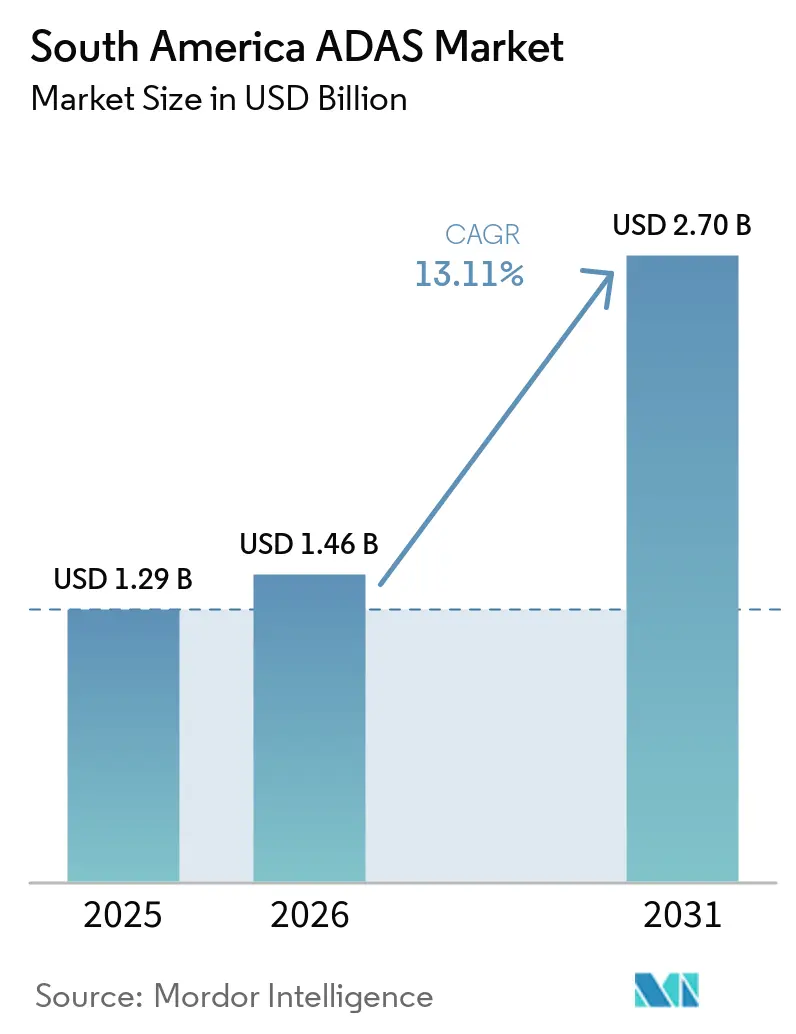
The South America ADAS market size was valued at USD 1.29 billion in 2025 and is estimated at USD 1.46 billion in 2026, and is projected to reach USD 2.70 billion by 2031, at a CAGR of 13.11% during the forecast period (2026-2031). The South American ADAS market is moving beyond premium vehicle trims as vehicle makers add more active-safety functions to mid-priced and mass-market models. Brazil's mandatory automatic emergency braking requirements and the revised Latin NCAP protocol are bringing safety specifications into product planning earlier in the vehicle development cycle. These changes favor suppliers that can support local vehicle programs with sensors, software, testing, and calibration services. Brazil remains the center of regional procurement because it combines vehicle production capacity, policy support, and a growing set of vehicle programs. The South American ADAS market also has room for aftermarket systems and fleet services because much of the regional vehicle base remains in operation for many years.
Key Report Takeaways
- By ADAS function, adaptive cruise control held 23.23% of the South America ADAS market share in 2025, while lane departure warning is forecast to grow at a 14.78% CAGR through 2031.
- By technology, LiDAR accounted for 43.88% of the South America ADAS market size in 2025, while camera systems are forecast to expand at a 15.11% CAGR through 2031.
- By vehicle type, passenger cars held 84.33% of the regional revenue share in 2025 and are projected to grow at a 15.38% CAGR through 2031.
- By offering, hardware accounted for 76.76% of the South America ADAS market size in 2025, while software is forecast to grow at a 14.98% CAGR through 2031.
- By automation level, Level 1 driver assistance held 56.12% of the South America ADAS market share in 2025, while Level 2 partial driving automation is forecast to expand at a 15.22% CAGR through 2031.
- By country, Brazil held 35.63% of the regional market in 2025 and is forecast to grow at a 15.23% CAGR through 2031.
Note: Market size and forecast figures in this report are generated using Mordor Intelligence’s proprietary estimation framework, updated with the latest available data and insights as of January 2026.
Market Trends and Insights
Drivers Impact Analysis of South America ADAS Market*
| Driver | (~) % Impact on CAGR Forecast | Geographic Relevance | Impact Timeline |
|---|---|---|---|
| Rising OEM Fitment of ADAS Features | +3.5% | Brazil, Argentina, Chile | Medium term (2-4 years) |
| Strengthening Vehicle Safety Requirements | +3.2% | Brazil, with spillover to MERCOSUR markets | Short term (≤ 2 years) |
| Expansion of Vehicle Production | +2.0% | Brazil and Argentina | Medium term (2-4 years) |
| Fleet-Based Demand for Remote Diagnostics and Retrofit ADAS | +1.5% | Brazil, Colombia, Peru | Medium term (2-4 years) |
| Increasing Consumer Demand for Safety and Driving Comfort | +1.3% | Brazil, Chile, Colombia | Medium term (2-4 years) |
| Localized ADAS Camera and Radar Manufacturing | +1.2% | Brazil | Long term (≥ 4 years) |
| Source: Mordor Intelligence | |||
Rising OEM Fitment of ADAS Features
NCAP’s protocol raises the fitment threshold for automatic emergency braking and lane support systems from a partial share of total sales to full coverage. The protocol influences purchasing decisions, as manufacturers must integrate qualifying features into production plans or offer them as stand-alone options. Expanded testing covers nighttime pedestrian detection, cyclist detection, and additional blind spot detection scenarios. These requirements raise the technical standards for camera, radar, and control systems in the South American ADAS market. The Kia Sportage facelift received NCAP’s highest safety rating for its automatic emergency braking, lane support, and blind-spot detection systems, underscoring the adoption of these features in mid-priced vehicles. Consequently, the South American ADAS market is shifting procurement toward suppliers capable of meeting regional testing and validation requirements at scale [1].
Strengthening Vehicle Safety Requirements
Brazil mandates AEB for new vehicle model codes, with full-fleet compliance to follow. Under the stated framework, the stationary-obstacle detection scenario will apply to all produced vehicles. These requirements provide vehicle manufacturers with a clear incentive to integrate AEB during platform updates rather than defer implementation. The NCAP protocol places greater emphasis on AEB for vulnerable road users and introduces more stringent detection conditions for pedestrians and cyclists. It also expands blind-spot assessment coverage and more closely links top safety ratings to assisted-driving features. Collectively, these requirements make safety performance a more prominent product consideration across the South American ADAS market.
Fleet-Based Demand for Remote Diagnostics and Retrofit ADAS
Fleet operators can adopt selected safety features without replacing their entire vehicle fleet. This approach is particularly relevant in Brazil, Colombia, and Peru, where operators manage aging trucks, buses, and light commercial vehicles. Freight insurance requirements and customer safety standards can support retrofit purchases, even when demand for new vehicles remains constrained. In October 2025, Volkswagen Caminhões e Ônibus launched RIO Remote Diagnosis, which provides real-time monitoring for truck and bus fleets. The service enables the early identification of critical maintenance alerts and can improve fleet availability. Such services can establish an ongoing commercial relationship following the installation of a vehicle or retrofit system.
Localized ADAS Camera and Radar Manufacturing in Brazil
ZF began producing 3.5th-generation smart front cameras at its Limeira electronics site in São Paulo in October 2025. The project involved BRL 35 million (USD 6 million) and was supported by Mover Program incentives. ZF plans to produce 500,000 camera units per year by 2027 and to localize its 4.8th-generation camera in 2026. Local production serves a market in which advanced sensor modules have more than 65% import content by value. It can reduce the landed-cost disadvantage that has limited fitment on mass-market models [2]. The South American ADAS market can gain from a regional supply base that reduces delivery, import, and calibration constraints.
Restraints Impact Analysis of South America ADAS Market*
| Restraint | (~) % Impact on CAGR Forecast | Geographic Relevance | Impact Timeline |
|---|---|---|---|
| High ADAS System and Sensor Costs | -1.0% | Brazil, Argentina, Colombia, Peru | Medium term (2-4 years) |
| Inadequate Lane Markings, Road Infrastructure, and Mapping Data | -0.8% | Peru, Colombia, and regional secondary roads | Long term (≥ 4 years) |
| Calibration Challenges Caused by Road, Weather, and Vehicle Variability | -0.5% | Brazil and Andean markets | Medium term (2-4 years) |
| Fragmented Liability and Regulatory Frameworks for Automated Driving | -0.4% | Argentina, Colombia, Chile, Peru | Long term (≥ 4 years) |
| Source: Mordor Intelligence | |||
High ADAS System and Sensor Costs
Brazil imposes import duties on automotive electronics based on product classification and trade agreement coverage. This duty structure creates a cost gap between imported vehicles equipped with comprehensive sensor packages and domestically produced models with fewer features. Consequently, the South American ADAS market faces affordability constraints before advanced functions can achieve broad adoption in entry-level vehicle models. Entry-level aftermarket ADAS units are available through distributors, while integrated fleet platforms incur installation costs and recurring service charges. Local manufacturing could narrow this gap; however, achieving sufficient scale across sensor categories will require time.
Inadequate Lane Markings, Road Infrastructure, and Mapping Data
Camera-based lane departure warning and lane-centering functions require clear and consistent lane markings for reliable operation. However, many secondary and rural roads in South America lack adequate markings. Limited mapping coverage across Andean and Amazonian routes further restricts the operational scope of map-dependent functions. Consequently, suppliers have an incentive to integrate radar, cameras, and other sensor inputs to maintain system performance under less predictable road conditions.
*Our forecasts treat driver/restraint impacts as directional, not additive. The impact forecasts reflect baseline growth, mix effects, and variable interactions.
South America ADAS Market Segment Analysis
By ADAS Function:
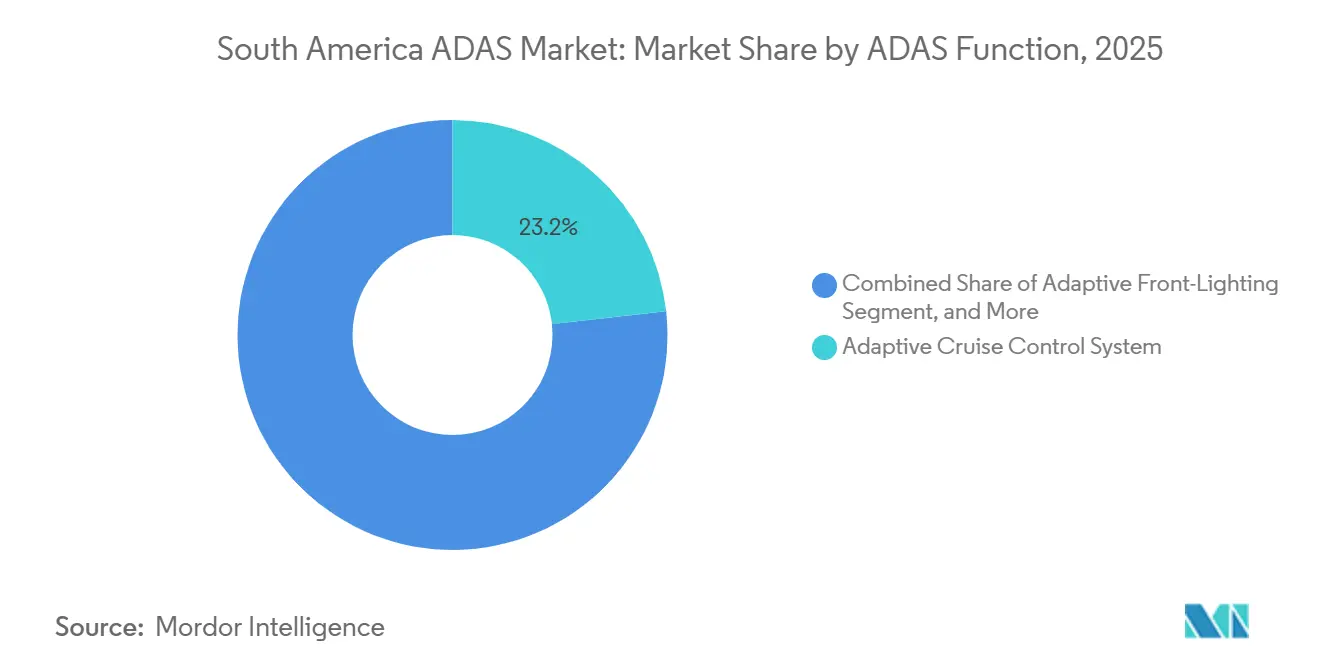
Compliance Deadlines Accelerate Active Safety AdoptionAdaptive cruise control held the largest share of the function at 23.23% in 2025. It remained a familiar entry feature for drivers using advanced driver assistance in mid-sized and flagship passenger cars. Lane departure warning is the fastest-growing function, with a 14.78% CAGR through 2031. NCAP requires lane support system fitment to increase from a substantial share of vehicle sales to full coverage. This requirement increases the importance of lane support in vehicle model planning. The expanding fitment thresholds support the segment value of lane-related functions.
Road conditions do not eliminate demand for lane departure warning systems. Instead, incomplete or worn lane markings differentiate systems that can perform reliably under local conditions. Automatic emergency braking, blind spot detection, and forward collision warning are gaining traction as test requirements become more stringent. NCAP has introduced expanded assessment scenarios for blind spot detection. Fleet programs focused on accident liability are increasingly adopting driver monitoring systems. Adaptive front lighting and other functions currently account for smaller shares but are expected to benefit as manufacturers integrate more advanced sensor stacks. The South American ADAS market will continue to rely on functions that meet both formal assessment requirements and practical road-use needs.

By Technology:
LiDAR Leads by Value While Camera Systems Gain ScaleLiDAR held 43.88% of the technology segment by value in 2025. Its high regional revenue share reflected module prices and system integration value rather than leadership in unit volume. Cameras and radar led unit demand across many vehicle applications. Camera systems are forecast to grow at a 15.11% CAGR through 2031. Brazil requires rear cameras in new vehicles. NCAP’s expanded vulnerable road user tests also require front-facing camera capabilities to detect pedestrians and cyclists.
Radar supports collision avoidance in commercial fleets, while ultrasonic sensors remain widely used for parking assistance. Infrared sensors are primarily limited to premium night-vision and driver-monitoring applications. Sensor fusion integrates data from cameras, radar, and LiDAR through shared processing hardware, making it increasingly relevant for advanced ADAS specifications. Higher-value systems require reliable calibration across the vehicle’s complete sensor suite. Therefore, the South American ADAS market requires both cost-effective camera deployment and the technical capability to support more complex sensor combinations. Local camera production can also help establish a more stable regional technology supply chain.
By Vehicle Type:
Passenger Cars Command Both Scale and GrowthPassenger cars held 84.33% of the regional revenue share by vehicle type in 2025 and are projected to grow at a 15.38% CAGR through 2031. NCAP assessments and Brazilian requirements mainly focus on M1 light vehicles. Passenger cars, therefore, remain the main volume base for sensors, control units, and vehicle software. Chinese vehicle makers are increasing the amount of standard ADAS content in mid-priced electric vehicles. This increases pressure on other manufacturers to offer comparable systems.
Light commercial vehicles increasingly need collision-avoidance functions because fleet operators treat safety equipment as a means of managing liability. Heavy commercial vehicles are at an earlier stage of adoption. They are entering the South American ADAS market through fleet telematics and public transport safety requirements. Buses are a small but distinct part of demand because transit concessions can link safety equipment to operating requirements. Rio de Janeiro's program targets 5,000 new buses by August 2028. That structure differs from consumer-led demand because it relies on public procurement and operational performance expectations. Vehicle makers will need to account for the different purchase criteria used by consumers, fleet operators, and transit authorities.
By Offering:
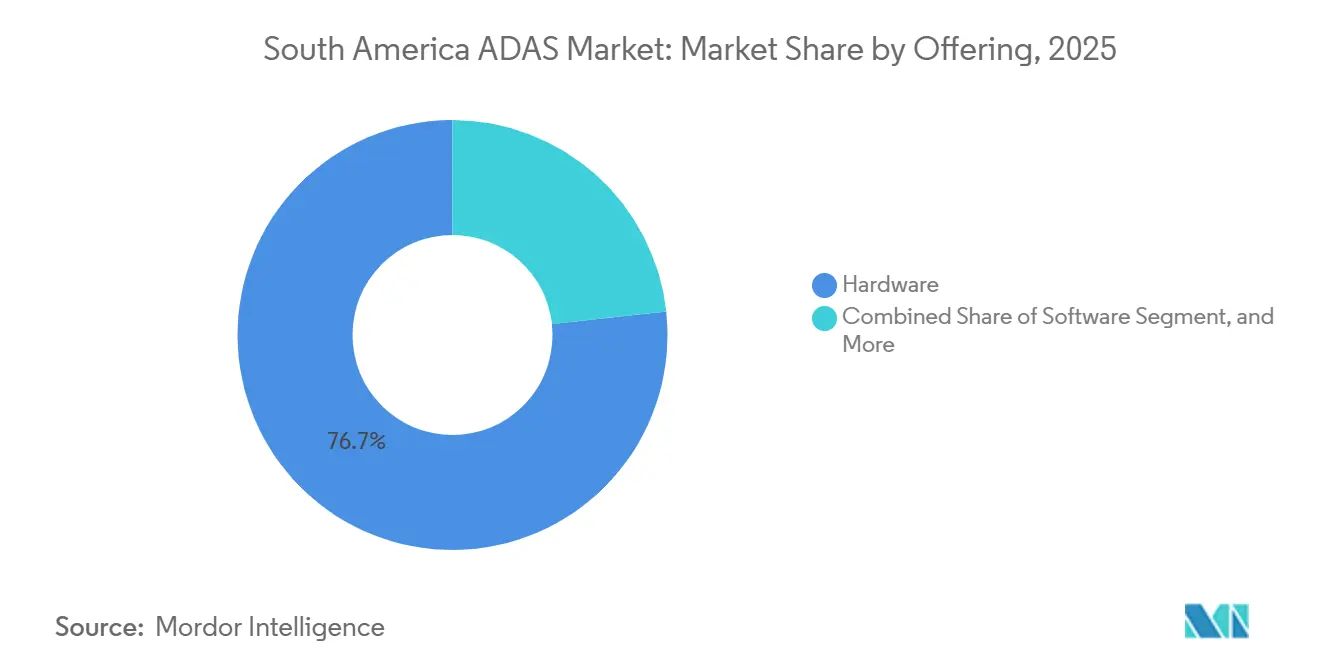
Hardware Entrenched, Software Approaching an InflectionHardware held 76.76% of the South American ADAS market in 2025. Cameras, radar units, LiDAR, electronic control units, and related components create the physical perception layer of equipped vehicles. Software is forecast to expand at a 14.98% CAGR through 2031. Software-defined vehicle designs allow functions to be updated over the air after the initial vehicle sale. This makes software revenue relevant across the operating life of a vehicle. Integrated systems combine sensors, processing, and connectivity within fewer supplier relationships.
The offering mix is changing as software becomes more important for function updates and data handling. Integrated systems can bring perception hardware, fusion processing, and connectivity together under a single supplier relationship. Aftermarket and retrofit products are the fastest-growing hardware subcategory. Their demand comes from the region’s older vehicle base and from logistics operators seeking better operating cost control. The South American ADAS market is therefore linking hardware sales more closely to recurring software and service revenue.
By Automation Level:
Level 1 Entrenched, Level 2 the New Growth FrontierLevel 1 driver assistance held 56.12% of the market by automation level in 2025. Forward collision warning, automatic emergency braking, and lane-departure alerts form the current base of safety equipment in many new vehicles. Level 2 partial driving automation is forecast to grow at a 15.22% CAGR through 2031. This growth follows wider use of multi-sensor fusion systems and stronger expectations for light-vehicle safety equipment. The segment value for Level 2 systems increases as automakers introduce more functions within a common vehicle platform. Level 0 configurations are declining as basic safety requirements become more common.
Level 3 conditional driving automation remains at the pilot and early-policy stage. The legal and liability environment still requires clearer rules before broader deployment can occur. System performance must also account for road markings, mapping gaps, and diverse traffic conditions. These constraints keep the near-term opportunity centered on Level 1 and Level 2 functions. Suppliers that combine local calibration with lower-cost sensor packages may be better placed to serve mass-market vehicles. The South American ADAS industry is moving toward more advanced assistance without treating higher automation as a near-term substitute for human driving. The pace of this shift remains tied to regulation, road readiness, and vehicle affordability.
Geography Analysis
Brazil ADAS Market
Brazil held 35.63% of the regional market in 2025 and is forecast to grow at a 15.23% CAGR through 2031. Brazil serves as a regional hub for ADAS demand, supported by its phased AEB implementation schedule, established vehicle manufacturing base, and incentives for industrial investment. The AEB deadlines provide suppliers and OEMs with a clear timeline for integrating active safety features. São Paulo remains the primary production and procurement hub for vehicle programs, while the concentration of component demand near major assembly operations creates a more viable environment for supplier localization. General Motors expanded its investment plan in Brazil to support product renewal, hybrid vehicle integration, and manufacturing modernization. GWM is also developing an additional plant in Brazil after demand exceeded the capacity of its existing facility. In addition, Changan and CAOA began local assembly of the Uni-T SUV in Anápolis.
South America ADAS Market
Argentina contributes a meaningful share of regional ADAS demand. Chile and Colombia are advancing safety requirements aligned with UNECE frameworks, with phased compliance timelines. Colombia has also progressed in automated-driving policies. Peru presents a challenging operating environment, as most audited Andean road elements failed to meet national specifications. Lima, Bogotá, and Santiago are generating retrofit demand through fleet safety and logistics requirements. These markets expand the regional opportunity, although infrastructure conditions and calibration requirements vary significantly across countries.
Competitive Landscape
The South American ADAS market is moderately concentrated at the OEM supply level. Bosch, Continental, ZF, Valeo, Aptiv, DENSO, and Mobileye maintain significant relationships with manufacturers operating in Brazil. However, no single supplier is insulated from competitive shifts as Chinese OEM platforms expand their presence across the region. Local manufacturing can help suppliers reduce exposure to import tariffs and exchange-rate fluctuations while shortening supply chains for regional vehicle programs. Suppliers that provide local technical support also hold an advantage, particularly when vehicles require calibration for regional road and weather conditions. As a result, local capabilities represent a competitive differentiator rather than merely a compliance-related expense.
In July 2026, Mobileye announced that select Stellantis vehicles, scheduled for launch in 2027, would feature its Cloud-Enhanced ADAS technology[3]. The system uses REM road intelligence, which has expanding coverage across South America. These developments demonstrate how suppliers are combining regional manufacturing capabilities with cloud-enabled functions. The South American ADAS market remains accessible to companies that can meet both vehicle hardware requirements and local road data needs.
The aftermarket presents a potential opportunity because established Tier-1 suppliers often organize their operations around OEM contracts. Fleet operators require installation, servicing, diagnostics, and monitoring capabilities that differ from those needed for new-vehicle supply. Public transit projects also require suppliers to collaborate with city authorities and concession operators. NVIDIA, NXP Semiconductors, and Infineon Technologies participate in the processing layer that supports increasingly integrated Level 2 systems. Bosch announced a BRL 1 billion (~ USD 195.3 million) investment in Brazilian capacity for electric and hybrid vehicle components in April 2026. Although the investment targets electrified components, it demonstrates continued supplier commitment to automotive production in Brazil.
South America ADAS Industry Leaders
-
Robert Bosch GmbH
-
Continental AG
-
ZF Friedrichshafen AG
-
Aptiv PLC
-
DENSO Corporation
- *Disclaimer: Major Players sorted in no particular order

South America ADAS Market Companies Covered in this Report
- Robert Bosch GmbH
- Continental AG
- ZF Friedrichshafen AG
- Aptiv PLC
- DENSO Corporation
- Valeo SE
- Magna International Inc.
- Autoliv AB
- Hyundai Mobis Co., Ltd.
- Forvia SE
- HELLA GmbH & Co. KGaA
- Hitachi Astemo, Ltd.
- BorgWarner Inc.
- Aisin Corporation
- Harman International Industries, Incorporated
- NVIDIA Corporation
- Mobileye Global Inc.
- Infineon Technologies AG
- NXP Semiconductors N.V.
- Texas Instruments Incorporated
- Garmin Ltd.
Recent Industry Developments in South America ADAS Market
- July 2026: Scania introduced its new Super range of coaches for the Brazilian market, where the lineup will make its public debut. According to Scania, the new platform reduces fuel consumption by up to 8% compared with the current generation, while the reintroduced 11-liter engine delivers an additional 2% improvement in energy efficiency. The Super range also includes an advanced driver-assistance system (ADAS) package and a digital instrument panel to enhance safety.
- June 2026: Leapmotor officially entered the Argentine market and announced the pre-sale of the new B10 REEV, a C-segment SUV and the brand’s first model available in the country. The B10 features seven airbags, 15 Level 2 advanced driver-assistance system (ADAS) functions, and a suite of 12 sensors and cameras. The vehicle also incorporates a high-strength steel body structure designed to improve torsional rigidity and occupant protection.
South America ADAS Market Report Scope
The South America ADAS market scope includes segmentation by type, technology, vehicle type, offering, automation level, and country. By type the market is segmented into (adaptive cruise control system, adaptive front-lighting, night vision system, blind spot detection, lane departure warning, and other types), technology the market is segmented into (radar, lidar, and camera), vehicle type the market is segmented into (passenger cars and commercial vehicles), offering the market is segmented into (hardware, and more), automation level the market is segmented into (level 0 driver assistance, and More), and country the market is segmented into (Brazil, Argentina, Chile, Colombia, Peru, and the rest of South America). The report provides the market size and forecast for the South America ADAS market in value (USD) for the segments mentioned above.
Segmentation Overview
By ADAS Function
| Adaptive Cruise Control System |
| Adaptive Front-Lighting |
| Automatic Emergency Braking |
| Blind Spot Detection |
| Driver Monitoring System |
| Forward Collision Warning |
| Lane Departure Warning |
| Other ADAS Functions |
By Technology
| Camera |
| Radar |
| LiDAR |
| Ultrasonic Sensor |
| Infrared Sensor |
| Sensor Fusion |
By Vehicle Type
| Passenger Cars |
| Light Commercial Vehicles |
| Heavy Commercial Vehicles |
| Buses |
By Offering
| Hardware |
| Software |
| Integrated ADAS Systems |
| Aftermarket and Retrofit Systems |
By Automation Level
| Level 0 Driver Assistance |
| Level 1 Driver Assistance |
| Level 2 Partial Driving Automation |
| Level 3 Conditional Driving Automation |
By Country
| Brazil |
| Argentina |
| Chile |
| Colombia |
| Peru |
| Rest of South America |
| By ADAS Function | Adaptive Cruise Control System |
| Adaptive Front-Lighting | |
| Automatic Emergency Braking | |
| Blind Spot Detection | |
| Driver Monitoring System | |
| Forward Collision Warning | |
| Lane Departure Warning | |
| Other ADAS Functions | |
| By Technology | Camera |
| Radar | |
| LiDAR | |
| Ultrasonic Sensor | |
| Infrared Sensor | |
| Sensor Fusion | |
| By Vehicle Type | Passenger Cars |
| Light Commercial Vehicles | |
| Heavy Commercial Vehicles | |
| Buses | |
| By Offering | Hardware |
| Software | |
| Integrated ADAS Systems | |
| Aftermarket and Retrofit Systems | |
| By Automation Level | Level 0 Driver Assistance |
| Level 1 Driver Assistance | |
| Level 2 Partial Driving Automation | |
| Level 3 Conditional Driving Automation | |
| By Country | Brazil |
| Argentina | |
| Chile | |
| Colombia | |
| Peru | |
| Rest of South America |
Key Questions Answered in the Report
What is the forecast for advanced driver assistance systems in South America?
The South America ADAS market is forecast to grow from USD 1.46 billion in 2026 to USD 2.70 billion by 2031 at a 13.11% CAGR.
Which country leads demand for advanced driver assistance systems in South America?
Brazil led with a 35.63% regional share in 2025 and is forecast to expand at a 15.23% CAGR through 2031.
Which ADAS technology is growing fastest in South America?
Camera systems are forecast to grow at a 15.11% CAGR through 2031, supported by rear-camera requirements and expanded safety testing.
Why are automakers adding more driver-assistance features in Brazil?
Safety rules, NCAP assessments, export production requirements, and localization incentives are increasing equipment fitment.
What limits wider ADAS adoption across South America?
Sensor costs, weak lane markings, limited mapping, and local calibration needs remain key constraints.