
South Africa Soil Monitoring Market Size and Share
Market Overview
| Study Period | 2021 - 2031 |
|---|---|
| Forecast Data Period | 2026 - 2031 |
| Base Year Market Size (2025) | USD 3.97 Million |
| Market Size (2026) | USD 4.39 Million |
| Market Size (2031) | USD 7.20 Million |
| Growth Rate (2026 - 2031) | 10.40 % |
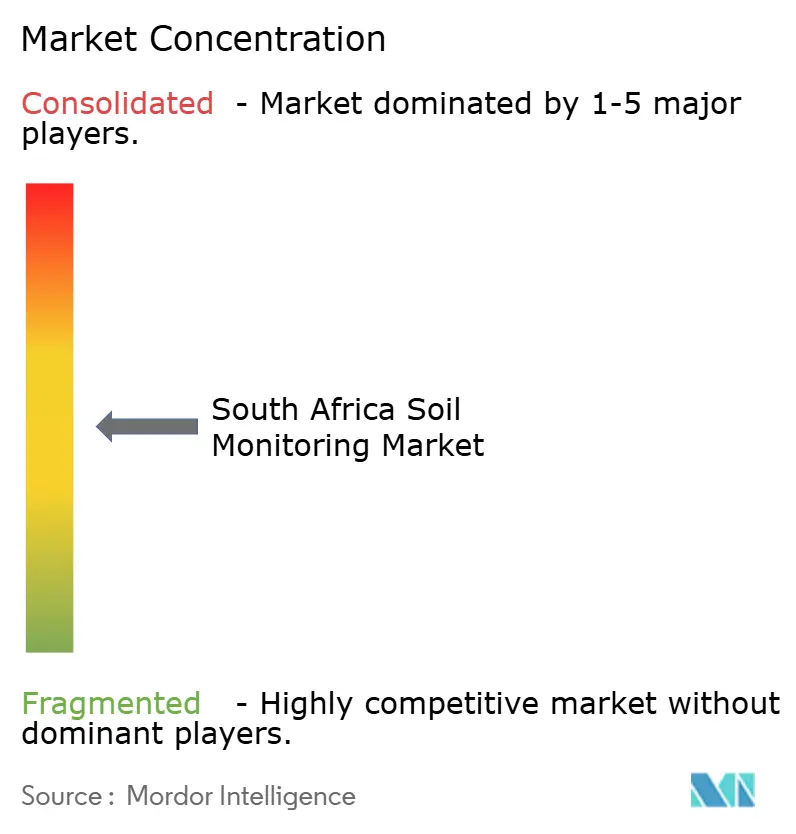
| Market Concentration | Medium |
Major Players *Disclaimer: Major Players sorted in no particular order Image © Mordor Intelligence. Reuse requires attribution under CC BY 4.0. | |
South Africa Soil Monitoring Market Analysis by Mordor Intelligence
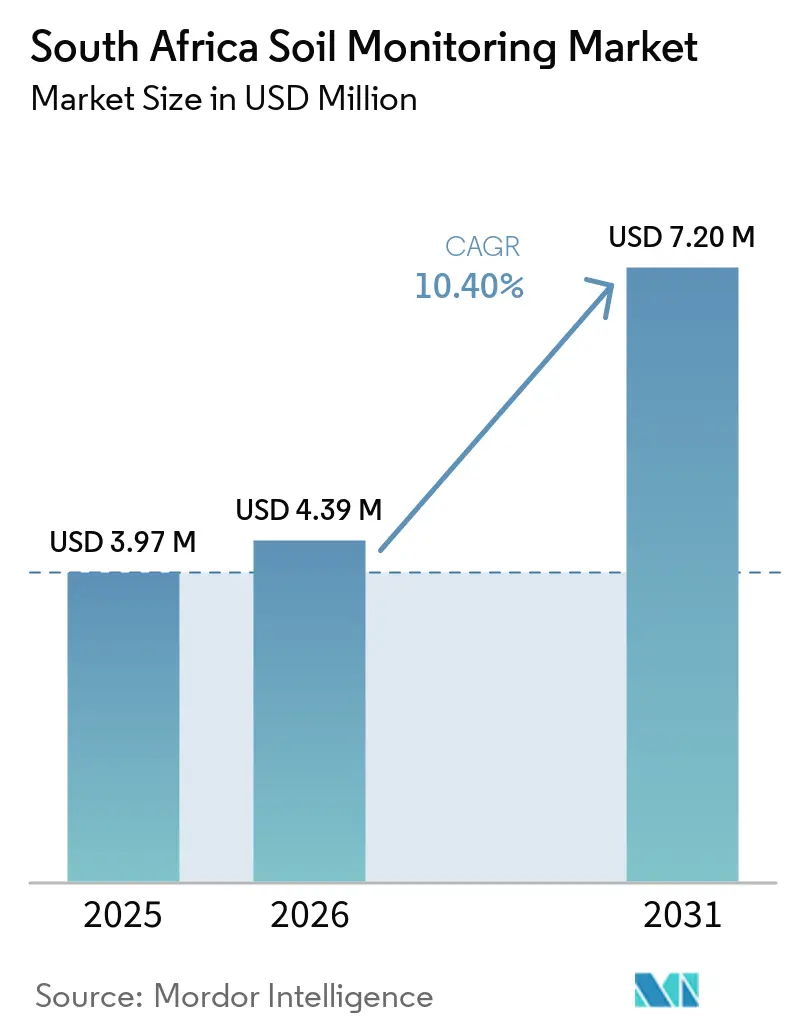
The South Africa soil monitoring market was valued at USD 3.97 million in 2025 and is projected to grow from USD 4.39 million in 2026 to USD 7.20 million by 2031, registering a CAGR of 10.40% during the forecast period (2026–2031). Market growth is driven by the increasing adoption of precision agriculture among commercial farming operations, where soil monitoring technologies support irrigation scheduling, nutrient management, and data-driven crop production. Recurring water scarcity and the need to optimize irrigation efficiency are encouraging growers to adopt continuous soil moisture monitoring solutions, particularly in irrigated production regions. Export-oriented producers are also strengthening the use of soil data to support quality assurance, traceability, and compliance with international market requirements. In addition, the presence of local sensor manufacturers and agronomy service providers improves access to equipment, technical support, and field-level advisory services, while growing interest in carbon farming and sustainable land management is expanding the application of soil monitoring technologies beyond conventional irrigation management.
Key Report Takeaways
- By component, hardware was the largest segment and held 56.0% of South Africa soil monitoring market share in 2025, and services are the fastest-growing segment and are forecasted to expand at a 16.3% CAGR between 2026 and 2031.
- By product type, in-situ sensors were the largest segment and held 44.0% of the South Africa soil monitoring market size in 2025, and remote-sensing platforms are the fastest-growing segment and are forecasted to expand at an 18.1% CAGR between 2026 and 2031.
- By connectivity technology, wireless connectivity was the largest segment and held 68.0% of market share in 2025, and wireless connectivity is also the fastest-growing segment and is forecasted to expand at a 19.8% CAGR between 2026 and 2031.
- By application, open field was the largest segment and held 62.0% of the market share in 2025, and protected cultivation is the fastest-growing segment and is forecasted to expand at a 14.2% CAGR between 2026 and 2031.
- By end user, large commercial farms were the largest segment and held 40.0% of the market share in 2025, and research institutes and universities are the fastest-growing segment and are forecasted to expand at a 14.6% CAGR between 2026 and 2031.
Note: Market size and forecast figures in this report are generated using Mordor Intelligence’s proprietary estimation framework, updated with the latest available data and insights as of January 2026.
South Africa Soil Monitoring Market Trends and Insights
Drivers Impact Analysis*
| Driver | (~) % Impact on CAGR Forecast | Geographic Relevance | Impact Timeline |
|---|---|---|---|
| Sensor-based irrigation in water-stressed areas | +2.5% | National, concentrated in Northern Cape, Western Cape, and Limpopo irrigation districts | Short term (≤ 2 years) |
| Local production and agronomy support | +1.8% | South Africa, strongest in Western Cape and KwaZulu-Natal commercial farming corridors | Short term (≤ 2 years) |
| Export-crop traceability needs | +1.5% | National, with early gains in Western Cape citrus, deciduous fruit, and table grape hubs | Short term (≤ 2 years) |
| Farm-platform and irrigation integration | +1.2% | South Africa, with potential relevance to neighboring Southern African Development Community (SADC) markets | Medium term (2-4 years) |
| Climate-risk and soil-health finance | +0.9% | National, with carbon program activity in grain-producing provinces | Medium term (2-4 years) |
| Public and research soil intelligence | +1.1% | National, with program intensity in Eastern Cape, Northern Cape, and Limpopo | Medium term (2-4 years) |
| Source: Mordor Intelligence | |||
Sensor-Based Irrigation in Water-Stressed Areas
South Africa is water-scarce, with mean annual rainfall below 500 mm across its land area. Commercial irrigators use soil moisture readings to determine irrigation timing and volume. A 2025 study published in MDPI found that poorly managed irrigation schemes reported water losses of 30% to 60%, while in-situ moisture monitoring enabled water savings of 15% to 30% per growing season in South African smallholder systems[1]. The National Water Act requires licensed irrigators to demonstrate measurable water-use efficiency. These conditions support demand for soil monitoring systems in water-stressed farming regions. As water availability becomes an increasingly important factor in agricultural productivity, growers are investing in sensor-based technologies to improve irrigation precision and optimize resource utilization. This trend is anticipated to strengthen the adoption of soil moisture monitoring solutions, particularly in high-value irrigated crops where efficient water management directly influences yield and profitability.
Local Production and Agronomy Support
The presence of local manufacturers and agronomy service providers is supporting the growth of the South Africa soil monitoring market by improving the accessibility and adoption of soil sensing technologies. Domestic production enables faster equipment availability, shorter maintenance and replacement cycles, and easier access to spare parts, reducing operational downtime for growers. In addition, locally based agronomy teams provide field-specific recommendations and technical support tailored to South Africa's diverse soil types and cropping systems, helping producers maximize the value of soil monitoring data. While international suppliers continue to compete through advanced sensor technologies and digital platforms, the availability of localized technical expertise and after-sales support remains a key factor influencing purchasing decisions and encouraging the wider adoption of soil monitoring solutions.
Export-Crop Traceability Needs
Food Business Operator (FBO) registration is a legal requirement for regulated plant-product exports from South Africa. The South African Macadamia Growers' Association (SAMAC) outlined this requirement in its 2025 FBO guidance. Exporters of citrus, table grapes, and deciduous fruit must maintain auditable records of farm practices, including input usage, irrigation schedules, and pest management activities. Soil and water records can support broader quality management documentation, helping exporters demonstrate compliance during audits and inspections. The Agricultural Product Standards Amendment Act came into force for specified sections in August 2025, introducing updated standards for export product quality and labeling. This compliance requirement gives exporters an additional reason to maintain consistent and accurate field data throughout the production cycle.
Farm-Platform and Irrigation Integration
The integration of soil monitoring systems with digital farm platforms and irrigation management solutions is increasing the value of precision agriculture technologies in South Africa. Soil moisture data can be transmitted directly to farm management platforms to support irrigation scheduling, variable-rate input application, and field-level decision-making, enabling growers to optimize water use and improve resource efficiency. Integrating soil, weather, crop, and irrigation data within a single platform also enhances the long-term value of historical field records by supporting trend analysis and continuous optimization of irrigation practices. As commercial farms increasingly adopt connected precision agriculture technologies, demand is growing for interoperable soil monitoring systems that seamlessly integrate with irrigation infrastructure and broader farm management platforms.
Restraints Impact Analysis*
| Restraint | (~) % Impact on CAGR Forecast | Geographic Relevance | Impact Timeline |
|---|---|---|---|
| High cost and weak smallholder finance | -2.5% | National, most severe in Eastern Cape, Limpopo, and KwaZulu-Natal smallholder areas | Short term (≤ 2 years) |
| Rural connectivity and service gaps | -1.8% | Rural provinces and agricultural zones | Medium term (2-4 years) |
| Calibration across diverse soils and crops | -1.2% | National, with high complexity in the Cape Floristic Region and subtropical KwaZulu-Natal | Medium term (2-4 years) |
| Unclear payback for low-value crops | -0.9% | National, particularly in subsistence and communal grain-growing areas | Medium term (2-4 years) |
| Source: Mordor Intelligence | |||
High Cost and Weak Smallholder Finance
The high cost of soil monitoring technologies and limited access to affordable financing continue to restrain adoption among smallholder farmers in South Africa. Investments in sensors, software subscriptions, maintenance, and advisory services often exceed the financial capacity of smaller agricultural operations, limiting the commercial viability of these solutions. Adoption has been stronger where technologies are supported through government initiatives, extension programs, or subsidized financing schemes, which reduce the initial investment burden. Although emerging carbon and sustainability programs offer additional revenue opportunities by promoting improved soil management practices, stringent verification requirements and minimum farm size thresholds have limited participation among smaller producers. As a result, financial constraints continue to restrict the widespread adoption of soil monitoring technologies, particularly within the smallholder farming segment, slowing the growth of the South Africa soil monitoring market.
Rural Connectivity and Service Gaps
Many agricultural areas have limited broadband and mobile coverage, which affects the reliability of wireless sensors for timely data transmission and remote alerts. The Development Bank of Southern Africa (DBSA) estimated in its 2025 study that achieving nationwide high-speed broadband could require an investment of ZAR 108 billion (USD 6.5 billion) to ZAR 142 billion (USD 8.6 billion)[2]. The Department of Communications and Digital Technologies (DCDT) has identified SA Connect Phase 2 as a program to expand broadband access. Satellite links can support remote deployments, but their higher cost remains a challenge for price-sensitive users. Limited digital infrastructure also restricts the use of cloud-based analytics, real-time decision support, and remote equipment monitoring, reducing the full value that connected soil monitoring systems can provide. As a result, growers in poorly connected regions often rely on offline data collection or less sophisticated monitoring solutions, slowing the adoption of advanced digital soil monitoring technologies across South Africa.
*Our forecasts treat driver/restraint impacts as directional, not additive. The impact forecasts reflect baseline growth, mix effects, and variable interactions.
Segment Analysis
By Component: Services Gain Ground on Hardware’s Dominant Base
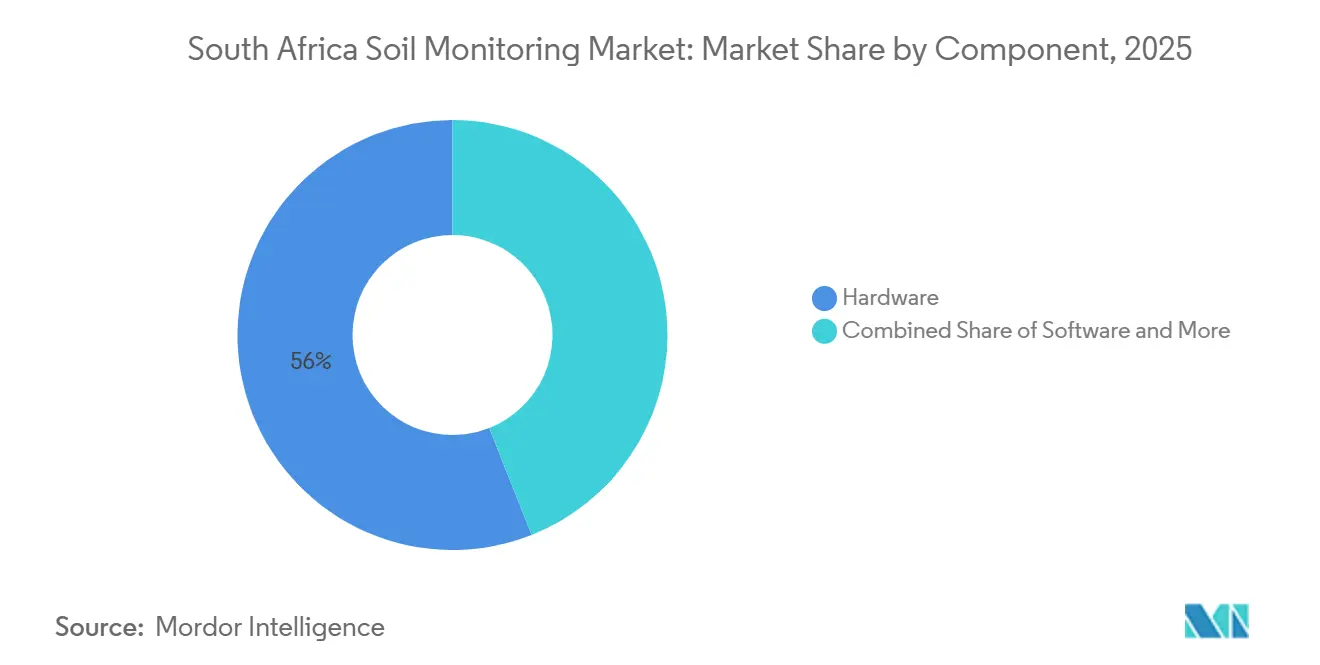
Hardware accounted for 56.0% of the South Africa soil monitoring market share in 2025. This category comprises in-situ probe kits, data loggers, and wireless nodes. Irrigated commercial farms rely on these physical tools to collect data across the root zone. Multi-depth probe networks remain the primary measurement layer in many fields. Replacement needs generate additional revenue following initial system installation. Hardware therefore remains a significant component of the market even as growers adopt software and advisory services.
The South Africa soil monitoring market size for services is forecast to expand at a CAGR of 16.3% between 2026 and 2031. This category includes subscription-based agronomy support, analytical services, and data interpretation. Growers increasingly seek guidance that translates readings into actionable irrigation or crop management decisions. Service offerings can be sold alongside equipment or as ongoing contracts following installation. Bundled models can reduce the need for farms to develop their own data analysis capabilities. The Agriculture and Agro-processing Master Plan's support for commercializing emerging farmers may favor packages that combine monitoring equipment with support services.

By Product Type: Remote-Sensing Platforms Emerge as a Structural Disruptor
In-situ sensors accounted for 44.0% of the product-type segment in 2025. They provide continuous subsurface readings that support irrigation decisions on commercial farms. Fixed sensor installations are particularly relevant where repeated water-management decisions are required. Portable probes and test kits serve research institutes, agronomists, and farms with limited budgets. These products can be used before a farm commits to permanent infrastructure and give extension workers a practical way to introduce field measurement practices.
Remote-sensing platforms are forecasted to expand at an 18.1% CAGR between 2026 and 2031. The category includes satellite-based soil moisture indicators, drone-mounted multispectral sensors, and airborne radar systems. A 2025 study in Frontiers in Agronomy tested an Earth observation and artificial intelligence (AI) framework for irrigation scheduling in Vhembe District, South Africa. The study combined optical satellite data with Agricultural Research Council (ARC) in-situ probe readings and produced evapotranspiration estimates that were competitive with Food and Agriculture Organization (FAO)-56 Penman-Monteith standards. These findings support remote sensing as a complement to local sensor arrays, particularly where broad geographic coverage is required.
By Connectivity Technology: Wireless Dominance Deepens as LPWAN Scales
Wireless (LPWAN, Cellular, Satellite) connectivity accounted for 68.0% of the connectivity technology segment in 2025. The category includes low-power wide-area network (LPWAN) systems, cellular connections, and satellite networks. It is forecasted to expand at a 19.8% CAGR between 2026 and 2031. Farms use wireless systems to transmit soil data from probes to dashboards and irrigation controls, supporting a shift from manual data collection to connected monitoring. Wired systems remain relevant in research stations and protected facilities with fixed infrastructure.
Wireless deployment supports data access across large farms with distributed fields. Pessl Instruments GmbH is establishing a network of weather stations in South Africa as part of a broader Africa initiative. Some probe systems can be configured to use cellular, LPWAN, or satellite backhaul, which is relevant where service availability varies across a farm or province. The South Africa soil monitoring market is therefore supported by connectivity options that can be selected based on local operating conditions.
By Application: Protected Cultivation Accelerates Despite Open Field’s Scale
Open field applications accounted for 62.0% of the application segment in 2025. This segment includes irrigated grain, horticulture, viticulture, and deciduous tree crops, which cover major commercial farming areas in South Africa. Soil readings help growers manage irrigation across fields with varying soil depth and water-holding conditions. Forestry, primarily in KwaZulu-Natal and Mpumalanga, is another application area where moisture data supports water-stress and fire-risk management.
Protected cultivation is forecast to expand at a 14.2% CAGR between 2026 and 2031. In controlled environments, greenhouse vegetable and flower producers can act on high-frequency readings to support decisions on irrigation timing and root-zone conditions. Export-oriented producers also face buyer requirements for documented environmental management. GlobalG.A.P. certification and International Organization for Standardization (ISO) 14001 environmental management systems reinforce the need for reliable farm records, providing a practical basis for continued monitoring adoption in protected cultivation.
By End User: Commercial Farms Drive Revenue While Research Institutes Drive Innovation
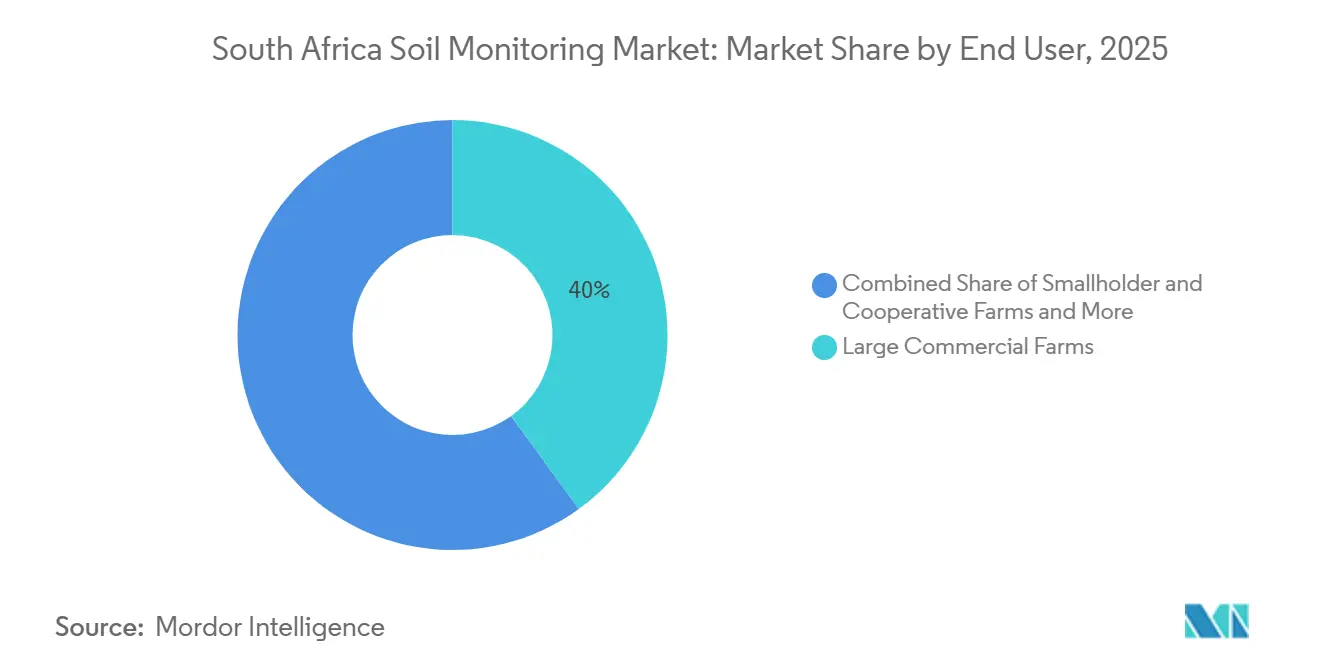
Large commercial farms accounted for 40.0% of the end-user segment in 2025. This share reflects their concentrated irrigated acreage, capital budgets, and established irrigation infrastructure. Corporate farms and diversified agribusinesses can install monitoring networks across multiple fields and integrate the data with machinery, weather, and crop management systems. Smallholder and cooperative farms follow a different adoption path, where donor-supported and extension-led projects remain important in cases where direct equipment purchases are not feasible.
Research institutes and universities are forecast to expand at a 14.6% CAGR between 2026 and 2031. The Agriculture Research Council (ARC) maintains national soil and water research capabilities, while academic users procure instruments for multi-depth monitoring, field trials, and irrigation modeling. Their projects can validate new measurement methods prior to commercial adoption. Public procurement is less dependent on a single crop season's cash flow compared to farm-level purchases, and research activity can generate demand for equipment suppliers that meet scientific measurement requirements.
Geography Analysis
The South Africa soil monitoring market shows distinct demand patterns across the Western Cape, KwaZulu-Natal, Free State, North West, Northern Cape, Limpopo, and Mpumalanga. In 2025, the Western Cape has the highest concentration of installed monitoring infrastructure. Its key export crops include citrus, table grapes, wine grapes, and deciduous fruit. Producers in this province face traceability requirements and rely extensively on irrigation. Pessl Instruments GmbH installed more than 200 METOS weather stations in the Western Cape between 2021 and 2023. The province's export orientation and established precision agriculture practices support its position as the current revenue anchor.
Limpopo and KwaZulu-Natal represent the fastest-growing geographic areas during 2026 to 2031. Limpopo has expanding irrigated vegetable production under semi-arid conditions. A 2025 study in Vhembe District used ARC Delta-T probe arrays at 6 depths ranging from 10 cm to 100 cm and reported Random Forest model accuracy of R² = 0.96 to 0.97[3]. This research provides local evidence for real-time soil monitoring in provincial farming systems. KwaZulu-Natal has commercial macadamia, avocado, sugarcane, and forestry activity. Connectivity remains uneven outside major farming nodes, which can slow wireless deployment.
The Free State, North West, and Mpumalanga are large scale grain producing regions with maize, sunflower, and soybean production. Many growers in these areas rely on dryland rainfall, which has historically reduced the case for in-situ sensors. Variable-rate application programs are helping growers assess the value of field variability data. The Northern Cape presents a different use case, as table grapes and raisins are grown under drip irrigation in the Orange River corridor. Extreme aridity increases the value of timely moisture measurements in these irrigated systems. These provincial differences require suppliers to align their systems with crop type, water availability, and local connectivity conditions.
Competitive Landscape
The South Africa soil monitoring market had moderate concentration in 2025, with the five leading companies — AquaCheck (Pty) Ltd, Pessl Instruments GmbH, Campbell Scientific, Inc., SENTEK PTY. LTD, and SGS South Africa Limited— collectively holding a major share. The remainder was distributed among international equipment brands, local software providers, and soil testing laboratories. AquaCheck competes from its local manufacturing base and established agronomy relationships. Its more than 90,000 global probe sales indicate an installed base that can support replacement and service demand.
Pessl Instruments competes through a connected weather and farm-data platform. Its March 2026 launch of Pessl Instruments GmbH introduced a wholly owned South African subsidiary and a plan to deploy 100,000 METOS weather stations across Africa on a subscription model. Campbell Scientific competes in research and measurement-intensive applications. SENTEK's distribution through Campbell Scientific Africa illustrates a channel model that uses established institutional relationships. SGS South Africa serves a different part of the value chain through soil testing and mapping services, creating an opportunity to link sensor data with laboratory and compliance workflows.
AGRISOFT SOLUTIONS (PTY) LTD and CropX focus on data interpretation and agronomic advice above the hardware layer. PTx Trimble, part of AGCO Corporation, contributes connected farm-data capabilities from the machinery ecosystem. Yara International has linked soil and crop nutrition data with fertilizer management workflows. Delta-T Devices Ltd offers soil moisture measurement products and documented sensing technologies. Vendors that integrate with other farm tools can reduce the complexity of managing data from multiple systems. Suppliers that provide technical support may also be better positioned in applications where calibration is complex. The South Africa soil monitoring market rewards suppliers that combine reliable measurement with practical support and compatible data systems.
South Africa Soil Monitoring Industry Leaders
-
AquaCheck (Pty) Ltd
-
Pessl Instruments GmbH
-
Campbell Scientific, Inc. (Campbell Group, Inc.)
-
SENTEK PTY. LTD
-
SGS South Africa (Pty) Ltd
- *Disclaimer: Major Players sorted in no particular order
Recent Industry Developments
- March 2026: Pessl Instruments GmbH established Pessl Instruments South Africa (Pty) Ltd (PI SA) as a 100% wholly owned subsidiary in Cape Town, launching a privately financed initiative to deploy 100,000 METOS weather stations across Africa on a subscription model.
- August 2025: The Agricultural Product Standards Amendment Act (Act No. 12 of 2023) commenced Sections 1 through 5 via Presidential Proclamation No. 279, strengthening South Africa's regulatory framework for agricultural quality assurance and management systems. This supports the adoption of soil monitoring technologies by encouraging better documentation, traceability, and compliance in export-oriented agriculture.
- March 2025: The Southern African Development Community (SADC) validated the Southern Africa Soil Health and Fertilizer Hub proposal during a high-level workshop in Johannesburg, South Africa, bringing together policymakers, agricultural experts, and researchers from member states to finalize the hub's framework. The initiative focuses on agroecological zoning, soil mapping, and the development of a regional roadmap to strengthen sustainable soil health management across Southern Africa.
South Africa Soil Monitoring Market Report Scope
The Soil Monitoring Market refers to the segment of the market that focuses on the use of technology to monitor soil conditions, which is crucial for agriculture and environmental management. It encompasses various components and is driven by the need for real-time data on soil parameters such as moisture, temperature, and nutrient content.
The South Africa Soil Monitoring Market Report is Segmented by Component (Hardware, Software and Services), by Product Type (In-Situ Sensors, Remote-Sensing Platforms and Portable Probes and Test Kits), by Connectivity Technology (Wired and Wireless), by Application (Open Field, Protected Cultivation and Forestry), and by End-User (Large Commercial Farms, Smallholder and Cooperative Farms Research Institutes and Universities and Government and NGOs). The Market Forecasts are Provided in Terms of Value (USD).
| Hardware |
| Software |
| Services |
| In-Situ Sensors |
| Remote-Sensing Platforms |
| Portable Probes and Test Kits |
| Wired |
| Wireless (LPWAN, Cellular, Satellite) |
| Open Field |
| Protected Cultivation |
| Forestry |
| Large Commercial Farms |
| Smallholder and Cooperative Farms |
| Research Institutes and Universities |
| Government and NGOs |
| By Component | Hardware |
| Software | |
| Services | |
| By Product Type | In-Situ Sensors |
| Remote-Sensing Platforms | |
| Portable Probes and Test Kits | |
| By Connectivity Technology | Wired |
| Wireless (LPWAN, Cellular, Satellite) | |
| By Application | Open Field |
| Protected Cultivation | |
| Forestry | |
| By End User | Large Commercial Farms |
| Smallholder and Cooperative Farms | |
| Research Institutes and Universities | |
| Government and NGOs |
Key Questions Answered in the Report
What is the current size of the South Africa soil monitoring market?
The South Africa soil monitoring market was valued at USD 3.97 million in 2025 and is estimated at USD 4.39 million in 2026. It is forecasted to reach USD 7.20 million by 2031.
What CAGR is forecasted for soil monitoring market in South Africa?
The South Africa soil monitoring market is forecasted to expand at a 10.4% CAGR between 2026 and 2031.
What technology supports connected soil sensors on farms?
Wireless connectivity, including LPWAN, cellular, and satellite systems, held 68.0% of the connectivity segment in 2025 and is forecasted to expand at a 19.80% CAGR between 2026 and 2031.
Why do export growers use soil monitoring systems?
Export growers need traceability and field-management records. FBO registration is required for regulated plant-product exports from South Africa.