
Soju Market Size and Share
Market Overview
| Study Period | 2021 - 2031 |
|---|---|
| Market Size (2026) | USD 5.76 Billion |
| Market Size (2031) | USD 7.29 Billion |
| Growth Rate (2026 - 2031) | 4.80 % |
| Fastest Growing Market | North America |
| Largest Market | Asia-Pacific |
| Market Concentration | High |
Major Players *Disclaimer: Major Players sorted in no particular order Image © Mordor Intelligence. Reuse requires attribution under CC BY 4.0. | |
Soju Market Analysis by Mordor Intelligence
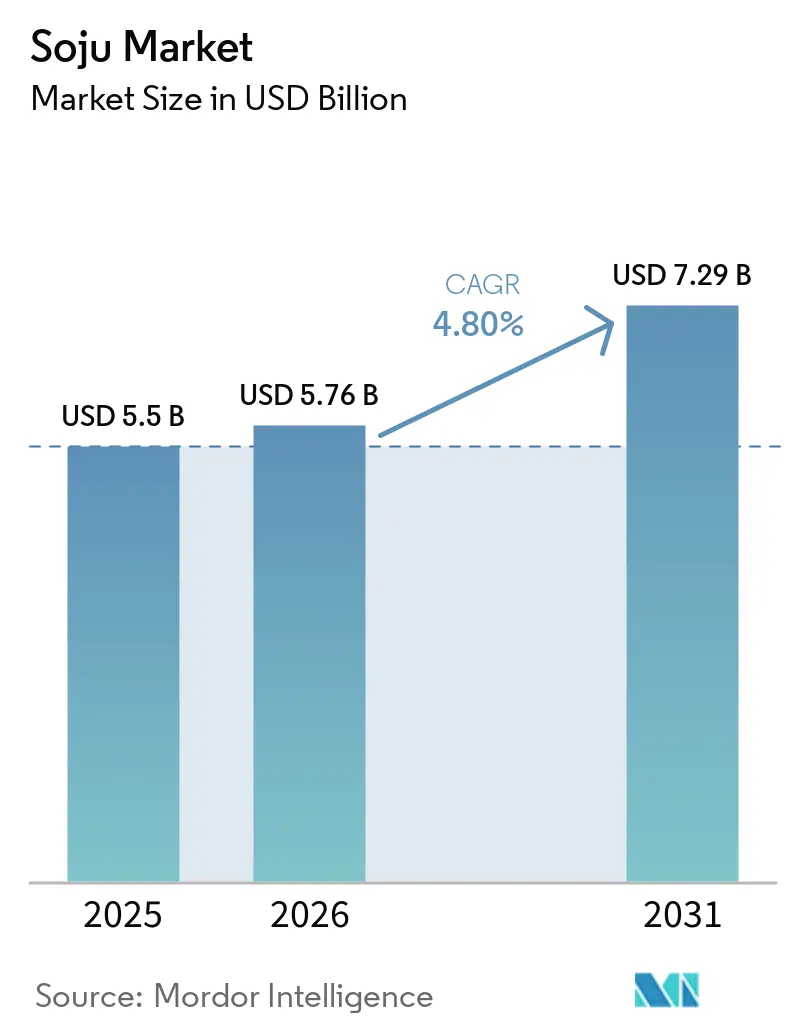
The soju market size is expected to grow from USD 5.50 billion in 2025 to USD 5.76 billion in 2026 and is forecast to reach USD 7.29 billion by 2031 at a 4.80% CAGR over 2026-2031. The soju market is experiencing steady growth, driven by the expanding global influence of Korean culture, cuisine, and entertainment, which has increased recognition of soju as an alcoholic beverage in international markets. Rising consumer interest in premium and distilled variants, along with the growing popularity of fruit-flavored offerings, is broadening the category's appeal among both traditional and new consumers. The increasing use of soju in cocktails and its expanding presence across foodservice and retail channels are further supporting market growth. Manufacturers are also focusing on product innovation, premiumization, and international expansion to strengthen their market presence and address evolving consumer preferences, supporting the market's positive long-term outlook.
Key Report Takeaways
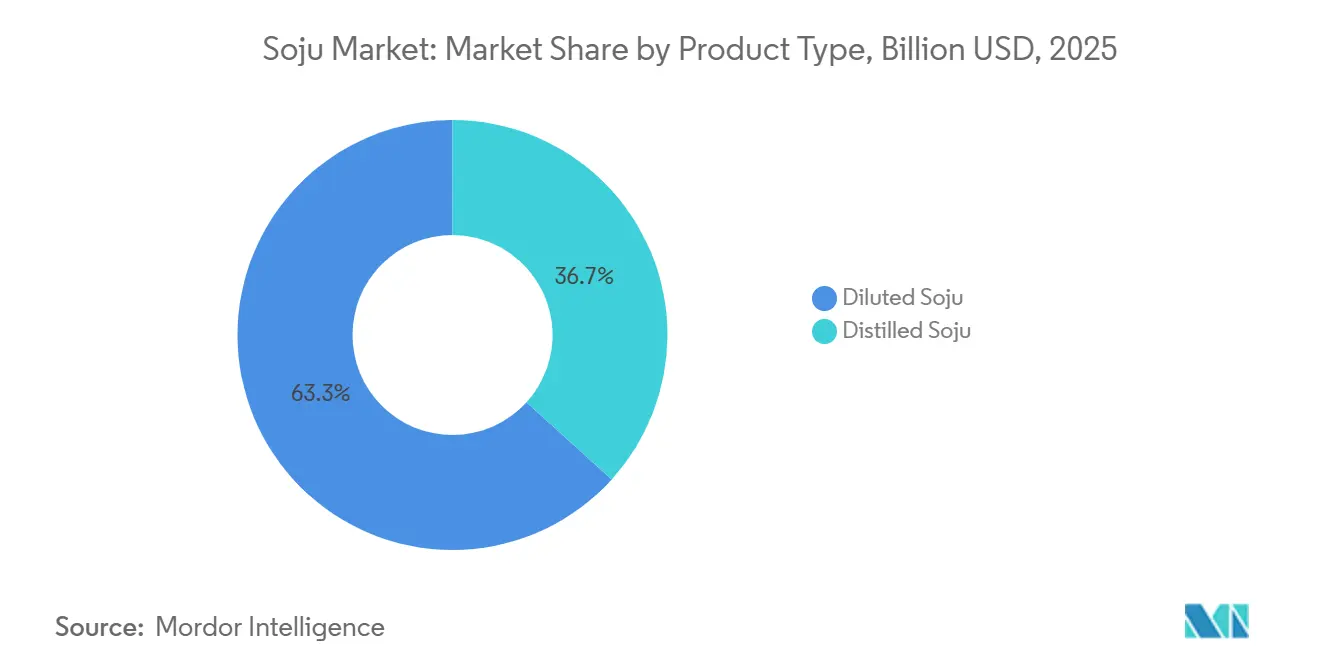
- By product type, diluted soju held 63.27% of the soju market share in 2025, while distilled soju is forecast to grow at a 6.18% CAGR from 2026 to 2031.
- By flavor type, classic original soju held 51.84% of the soju market share in 2025, while fruit-flavored soju is forecast to grow at a 6.46% CAGR from 2026 to 2031.
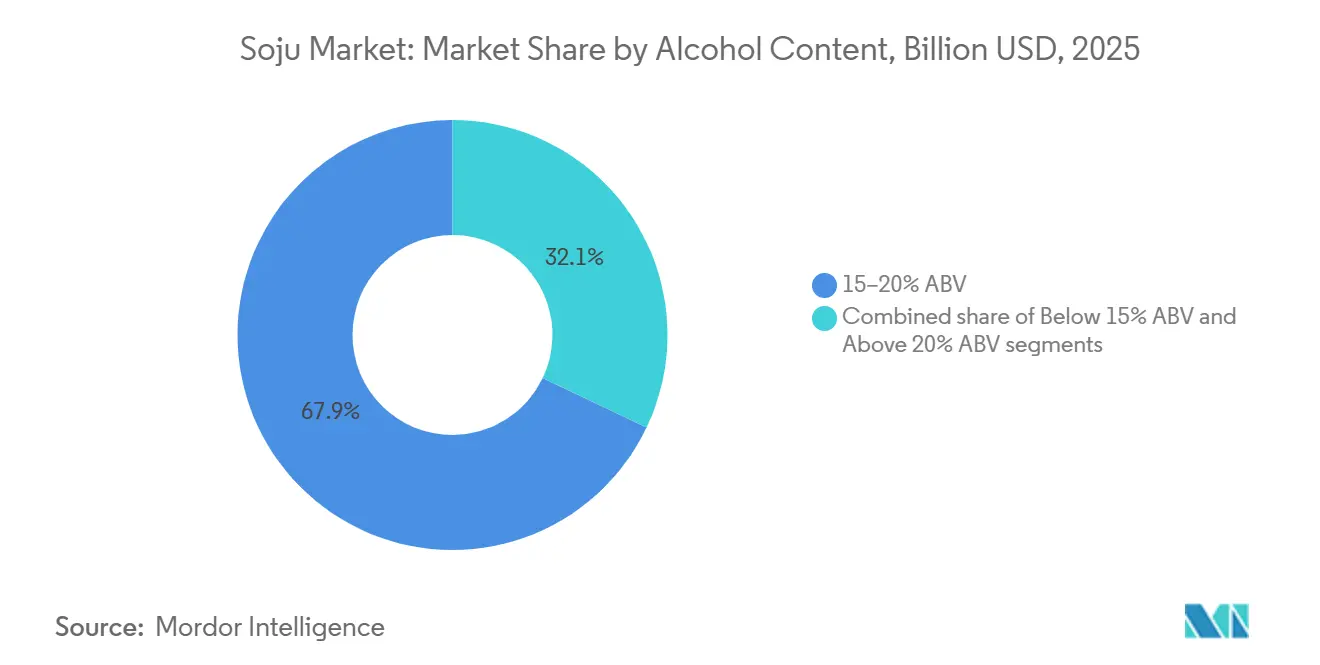
- By alcohol content, the 15–20% ABV tier held 67.92% of the soju market size in 2025, while the below 15% ABV tier is forecast to grow at a 6.72% CAGR from 2026 to 2031.
- By price tier, standard soju held 53.88% of the soju market size in 2025, while super-premium/artisanal soju is forecast to grow at a 7.12% CAGR from 2026 to 2031.
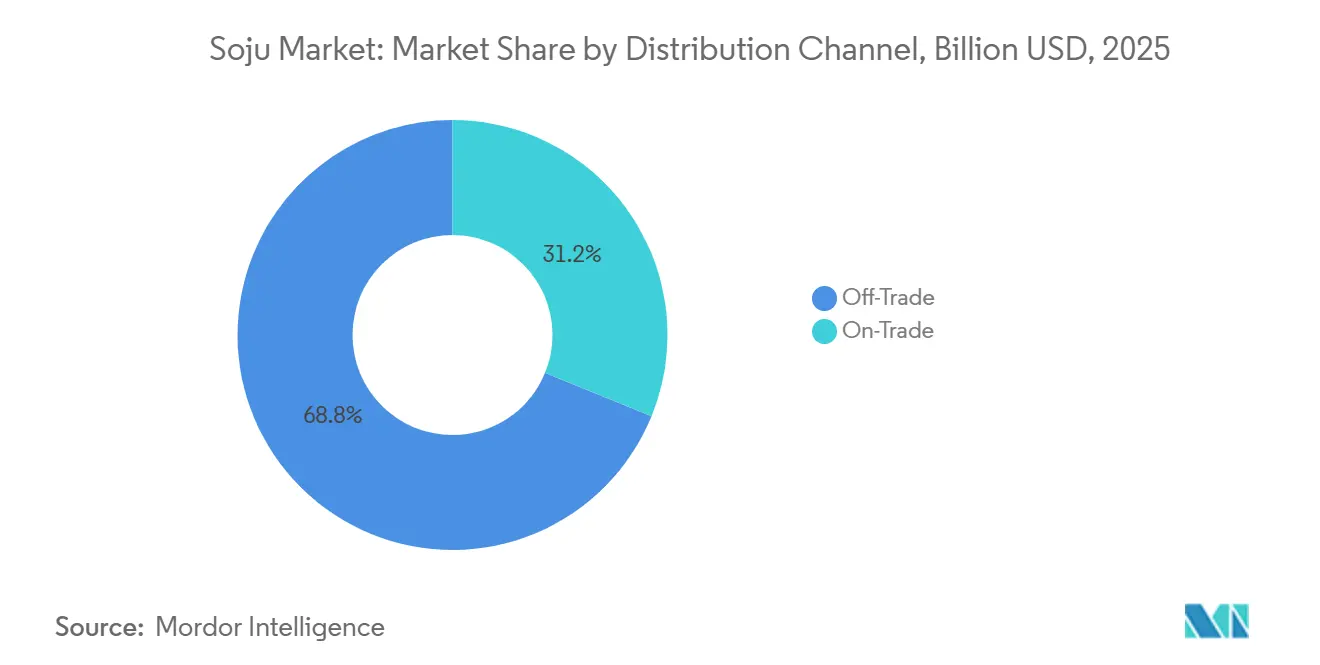
- By distribution channel, off-trade channels held 68.83% of the soju market in 2025, while on-trade channels are forecast to grow at a 6.91% CAGR from 2026 to 2031.
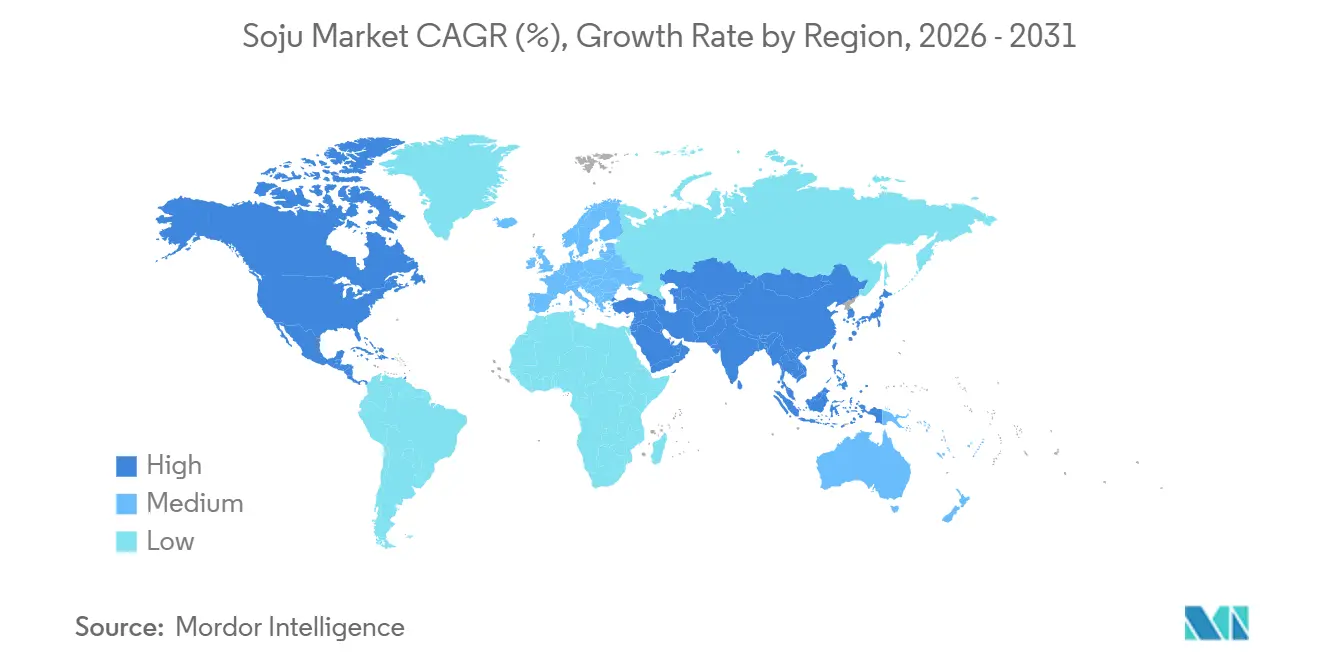
- By geography, Asia-Pacific held 96.14% of the soju market in 2025, while North America is forecast to grow at a 7.73% CAGR from 2026 to 2031.
Note: Market size and forecast figures in this report are generated using Mordor Intelligence’s proprietary estimation framework, updated with the latest available data and insights as of January 2026.
Market Trends and Insights
Drivers Impact Analysis of Soju Market*
| Driver | (~) % Impact on CAGR Forecast | Geographic Relevance | Impact Timeline |
|---|---|---|---|
| Global expansion of Korean culture and cuisine | +1.2% | Global, concentrated in North America, Southeast Asia | Long term (≥ 4 years) |
| Rising consumer preference for lower-ABV alcoholic beverages | +0.8% | Global, particularly North America, Japan, South Korea | Medium term (2–4 years) |
| Flavor innovation expanding appeal among younger consumers | +0.7% | North America, Japan, China, Southeast Asia | Medium term (2–4 years) |
| Growing global soju exports and premium product positioning | +0.8% | Global, led by North America and Europe | Long term (≥ 4 years) |
| Increasing adoption of soju in cocktail culture | +0.5% | North America, Singapore, Australia | Medium term (2–4 years) |
| Expansion of foodservice and hospitality channels for Korean cuisine | +0.4% | North America, Europe, Southeast Asia | Short term (≤ 2 years) |
| Source: Mordor Intelligence | |||
Global Expansion of Korean Culture and Cuisine
The global expansion of Hallyu (the Korean Wave) continues to drive demand for soju by increasing consumer interest in Korean cuisine, dining culture, and alcoholic beverages across international markets. According to the 2025 Overseas Hallyu Survey by South Korea's Ministry of Culture, Sports and Tourism, conducted among 26,400 respondents across 28 countries and regions, 70.3% expressed a favorable perception of Korean cultural content. Korean food was identified as the most mainstream Hallyu category, with 53.7% of respondents stating it is widely recognized and commercially available in their country, while 66.2% expressed willingness to purchase Korean food products[1]. The survey also found that respondents spent an average of 14 hours per month consuming Korean cultural content, reflecting the sustained global influence of Hallyu on the international expansion of soju.
Rising Consumer Preference for Lower-ABV Alcoholic Beverages
Growing consumer preference for lower-alcohol-by-volume (ABV) beverages is supporting demand for products that enable more moderate drinking occasions. According to Drinkaware's 2025 research, 44% of United Kingdom drinkers used alcohol-free or low-alcohol drinks to moderate their alcohol intake, while 33% used low-alcohol drinks specifically, up from 25% in 2018. Among 18–34-year-olds, usage of alcohol-free and low-alcohol drinks for moderation reached 49% in 2025[2]. This broader shift toward lower-strength drinking supports the positioning of soju, which generally has a lower alcohol content than many traditional distilled spirits and can provide a more moderate option for consumers seeking lighter drinking occasions. Its smooth taste, versatility in mixed drinks, and compatibility with diverse cuisines further support its appeal across on-trade and off-trade channels.
Flavor Innovation Expanding Appeal Among Younger Consumers
Continuous flavor innovation is expanding the soju market by making the category more approachable and appealing to younger legal-age consumers seeking diverse drinking experiences. Penn State Extension's 2025 review of alcoholic beverage trends found that 66% of surveyed consumers were open to trying new, unfamiliar flavors, while 74% actively sought exotic taste experiences, highlighting broad interest in flavor experimentation across alcoholic beverages[3]. This is encouraging soju manufacturers to introduce fruit-infused, botanical, and limited-edition variants with sweeter and milder taste profiles. Such innovations can attract consumers who find traditional spirits too strong while encouraging product trial and repeat purchases. As flavor diversification continues across alcoholic beverages, soju's adaptability to different flavor profiles can help broaden its consumer base and strengthen penetration across retail and foodservice channels.
Growing Global Soju Exports and Premium Product Positioning
The growing global availability of soju, driven by expanding export networks and premium product positioning, is supporting the growth of the soju market. Manufacturers are strengthening their international presence by expanding distribution across retail stores, supermarkets, specialty liquor outlets, and restaurants, while introducing premium variants with refined ingredients, improved packaging, and higher-quality production methods. These offerings cater to consumers seeking authentic imported spirits and premium drinking experiences, enabling brands to reach new customer segments beyond traditional markets. The focus on export expansion and premiumization continues to strengthen soju's global market presence and long-term growth potential.
Restraints Impact Analysis of Soju Market*
| Restraint | (~) % Impact on CAGR Forecast | Geographic Relevance | Impact Timeline |
|---|---|---|---|
| Declining alcohol consumption and changing drinking habits in south korea | -0.7% | South Korea (primary), indirect impact on global producer revenues | Medium term (2–4 years) |
| Cross-border alcohol regulations and excise tax complexity | -0.6% | North America, select Asia-Pacific markets | Medium term (2–4 years) |
| Volatility in raw material and packaging costs | -0.5% | Global, concentrated in South Korean production | Short term (≤ 2 years) |
| Competition from local spirits and established alcoholic beverage categories | -0.5% | North America (whiskey), Japan (sake), China (baijiu), Europe (gin/vodka) | Long term (≥ 4 years) |
| Source: Mordor Intelligence | |||
Declining Alcohol Consumption and Changing Drinking Habits in South Korea
Declining alcohol consumption and evolving drinking habits in South Korea are restraining the growth of the soju market. Consumers are increasingly adopting moderation-focused lifestyles, reducing the frequency of alcohol consumption and opting for lower-volume drinking occasions. Growing health awareness, changing social norms, and a preference for a wider variety of alcoholic and non-alcoholic beverages have also reduced reliance on traditional spirits such as soju in its domestic market. Younger consumers in particular are showing greater interest in social occasions that do not center on alcohol, while moderate drinking is becoming more accepted across age groups. This shift is encouraging consumers to diversify their beverage choices and limit overall alcohol intake, placing additional pressure on domestic soju consumption.
Competition from Local Spirits and Established Alcoholic Beverage Categories
Soju competes with locally established spirits and other alcoholic beverage categories that benefit from strong consumer familiarity and established consumption habits. Traditional spirits often hold a significant place in local drinking cultures, supported by recognizable taste profiles and longstanding consumption occasions. Beer, whisky, vodka, rum, and other alcoholic beverages also compete for consumer spending across social and recreational occasions. Established brands in these categories may benefit from extensive distribution networks, strong brand recognition, and consumer loyalty. In markets where local alcoholic beverages are deeply embedded in consumer preferences, these factors can make it more challenging for soju to gain wider adoption.
*Our forecasts treat driver/restraint impacts as directional, not additive. The impact forecasts reflect baseline growth, mix effects, and variable interactions.
Soju Market Segment Analysis
By Product Type:
Diluted Commands Value; Distilled Earns MarginDiluted soju accounted for 63.27% of the soju market share in 2025, supported by its strong consumption base in South Korea and widespread availability across retail and foodservice channels. Its affordability, consistent taste profile, and accessibility have established it as the standard offering for mass-market consumers, with major brands such as Jinro and Chum Churum maintaining strong positions in this segment. The segment also benefits from broad international distribution, as diluted soju remains the most commonly exported format among leading producers.
Distilled soju is projected to register the fastest growth among product types, with a CAGR of 6.18% from 2026 to 2031. Growth is driven by increasing consumer interest in premium alcoholic beverages, traditional production methods, and authentic Korean drinking experiences. Producers are expanding distilled soju offerings with higher-quality ingredients, refined production techniques, and premium positioning to attract consumers in both domestic and international markets.
By Flavor Type:
Classic Anchors Value; Fruit Variant Rewires AppealClassic (original) soju accounted for 51.84% of the soju market share by flavor type in 2025, supported by its strong cultural significance and widespread consumption in South Korea. Its established presence across traditional drinking occasions, restaurants, and social gatherings has made it the preferred choice among mainstream consumers. The segment also benefits from strong brand recognition and long-standing consumer familiarity, maintaining its dominance across both domestic and international markets.
Fruit-flavored soju is projected to register the fastest growth among flavor types, with a CAGR of 6.46% from 2026 to 2031. Growth is driven by rising demand among younger consumers for sweeter, more approachable alcoholic beverages and increased interest in diverse flavor profiles. Peach, strawberry, and green grape variants have gained popularity as entry points for new consumers, while manufacturers continue to introduce fruit-based and specialty offerings to expand the category's appeal.
By Alcohol Content:
The 15–20% ABV Tier Holds Firm; Below 15% ABV Leads Future MomentumThe 15–20% ABV tier accounted for 67.92% of the soju market share by alcohol content in 2025, supported by its widespread adoption among major brands and its position as the standard strength range for mainstream soju products. Major offerings from producers such as HiteJinro and Lotte Corporation typically fall within this range, providing a balance between traditional soju characteristics and broader consumer accessibility. Its established presence across retail, foodservice, and social drinking occasions continues to reinforce its dominance within the category.
The below 15% ABV segment is projected to register the fastest growth among alcohol-content categories, with a CAGR of 6.72% from 2026 to 2031. Growth is driven by increasing consumer preference for lighter alcoholic beverages, moderation-focused drinking habits, and the expansion of flavored soju variants that typically feature lower alcohol levels. Manufacturers are increasingly introducing lower-ABV products to attract new consumers and address evolving preferences for more approachable drinking experiences across domestic and international markets.

By Price Tier:
Standard Holds the Market; Super-Premium AcceleratesStandard soju accounted for 53.88% of the soju market share by price tier in 2025. This is supported by its position as an affordable and widely consumed alcoholic beverage across South Korea and international markets. Its availability through convenience stores, supermarkets, and foodservice outlets, combined with broad consumer familiarity, has helped maintain its dominance within the category. The segment continues to benefit from the established presence of mainstream brands that cater to regular consumption occasions.
Super-premium/artisanal soju is projected to register the fastest growth among price tiers, with a CAGR of 7.12% from 2026 to 2031. Growth is driven by rising interest in premium alcoholic beverages, traditional production methods, and differentiated products featuring higher-quality ingredients and craftsmanship. Producers are increasingly targeting consumers seeking elevated drinking experiences, while premium offerings are gaining visibility through specialty retailers, restaurants, and export markets.
By Distribution Channel:
Off-Trade Anchors Value; On-Trade Regains MomentumOff-trade channels accounted for 68.83% of the soju market share by distribution channel in 2025, supported by the strong presence of soju across supermarkets, convenience stores, liquor retailers, and online platforms. The channel benefits from the product's established role in household consumption and social drinking occasions, particularly in South Korea and overseas markets with Korean consumer communities. Expanding retail availability and broader placement beyond specialty Asian stores are further improving accessibility for new consumers.
On-trade channels are projected to register the fastest growth among distribution channels, with a CAGR of 6.91% from 2026 to 2031. Growth is driven by the increasing integration of soju into restaurant menus, cocktail offerings, and premium hospitality venues worldwide. The expansion of Korean cuisine, fusion dining concepts, and cocktail culture is encouraging bars and restaurants to incorporate soju-based beverages, creating new consumption occasions beyond traditional formats.
Geography Analysis
Asia-Pacific accounted for 96.14% of the soju market share in 2025, supported by South Korea's position as the largest producer and consumer of soju. The region benefits from well-established production capacity, strong domestic consumption, and widespread availability through retail and foodservice channels. Beyond South Korea, demand is expanding across Southeast Asian countries, driven by the growing popularity of Korean cuisine, entertainment, and culture. Manufacturers continue to strengthen their regional presence through expanded distribution and local investments.
North America is projected to register the fastest growth among all regions, with a CAGR of 7.73% from 2026 to 2031. Growth is driven by increasing consumer awareness of Korean alcoholic beverages, expanding availability across mainstream retail and liquor stores, and the rising popularity of Korean restaurants and cocktail culture. Key producers are strengthening their distribution networks through partnerships with local distributors, enabling wider product availability and supporting increased consumption across the United States and Canada.
The Rest of the World is expected to witness steady growth, supported by the gradual expansion of Korean foodservice outlets and the increasing availability of imported soju across Europe, the Middle East, and selected South American markets. Manufacturers are expanding export activities and introducing premium and flavored soju variants to attract new consumer segments. Rising interest in Korean cuisine and culture, along with broader distribution through retail and hospitality channels, continues to support market development across these regions.
Competitive Landscape
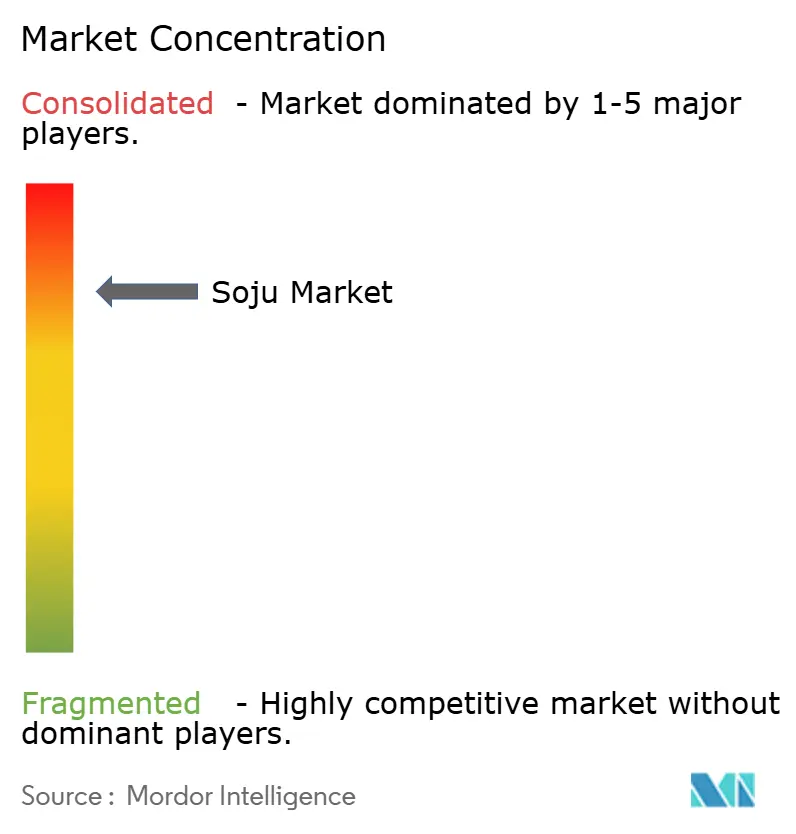
The soju market is highly consolidated, with major Korean producers accounting for a significant share of domestic consumption and international exports. HiteJinro Co., Ltd. and Lotte Corporation are the leading players, supported by strong brand recognition, extensive distribution networks, and established export operations. HiteJinro’s Jinro brand remains one of the most recognized soju brands globally, while Lotte Chilsung continues to expand its presence through brands such as Chum Churum and Soonhari. Other domestic producers, including Muhak Co., Ltd., Daesun Distilling Co., Ltd., and Kumbokju Co., Ltd., maintain regional positions in South Korea by catering to local consumer preferences and established drinking occasions.
Competitive strategies in the soju market are increasingly focused on international expansion, product diversification, and premium positioning. Leading companies are expanding distribution partnerships to increase availability in overseas retail and foodservice channels, while introducing flavored, lower-ABV, and premium variants to attract younger and international consumers. HiteJinro and Lotte Chilsung have strengthened their global presence through export expansion and collaborations with overseas distributors, helping Korean soju gain wider recognition beyond traditional markets.
The premium and craft soju segments represent emerging areas of competition as consumers increasingly seek differentiated alcoholic beverages with unique production methods and higher-quality positioning. Craft producers such as Hwayo and other specialty brands are targeting premium restaurants, bars, and export markets with traditionally produced and higher-priced offerings. While mainstream producers continue to dominate volume sales, growing interest in premium expressions and innovative formats is creating additional opportunities for smaller producers to establish niche positions within the global soju category.
Soju Industry Leaders
-
HiteJinro Co., Ltd.
-
Muhak Co., Ltd.
-
Daesun Distilling Co., Ltd.
-
Kumbokju Co., Ltd.
-
Lotte Corporation
- *Disclaimer: Major Players sorted in no particular order
Soju Market Companies Covered in this Report
- HiteJinro Co., Ltd.
- Lotte Corporation
- Muhak Co., Ltd.
- Kumbokju Co., Ltd.
- Bohae Brewery Co., Ltd.
- Korea Alcohol Co., Ltd.
- Daesun Distilling Co., Ltd.
- West 32 Soju
- Yobo Spirits
- Mackiss Co., Ltd.
- Andong Soju
- Hwayo Co., Ltd.
- The Soju Company
- Progressive Beverages, Inc.
- The Sool Company
- KHEE LLC
- Jun Ho
- Chung-buk Soju
- Royal Wine Corp.
- Kooksoondang Brewery Co., Ltd.
Recent Industry Developments in Soju Market
- August 2026: Hello Soju expanded into Colorado and Texas, marking the California-based brand's entry into two additional United States markets. The expansion was launched alongside the brand's positioning around spirit-based ready-to-drink (RTD) formats, with Hello Soju highlighting growing demand for premium, fruit-based, lower-sugar canned cocktails. The company debuted in Colorado at the Denver Food & Wine Festival and expanded its distribution footprint into both states, strengthening its presence in the spirit-based RTD segments.
- July 2026: So Good Soju entered Karnataka with five new flavors, including Peach, Green Grape, Strawberry, Blueberry, and Green Apple, marking the brand's debut in Bengaluru. The launch expanded So Good Soju's portfolio to seven flavors across still and sparkling variants and formed part of its broader expansion strategy into Goa and Northeast India. The newly introduced variants are also planned for rollout across Maharashtra, Goa, Haryana, and Punjab, strengthening the brand's presence in India's emerging craft spirits market.
- April 2026: HiteJinro launched JINRO MELON LIMITED EDITION, an export-focused flavored soju product with 13% ABV. The limited-edition product was introduced in premium packaging as an extension of the company’s flavored soju portfolio, targeting overseas markets including the United States, Japan, Vietnam, Australia, and the United Kingdom.
Global Soju Market Report Scope
Soju refers to a traditional Korean distilled alcoholic beverage primarily made from grains or starch-based ingredients such as rice, wheat, and sweet potatoes. It is available in various formulations, including diluted and distilled variants, and is consumed through retail and foodservice channels across domestic and international markets.
The soju market report is segmented by product type into distilled soju and diluted soju. The market is segmented by flavor type into classic (original) soju, fruit-flavored soju, and other flavored soju. Based on alcohol content, the market is categorized into below 15% ABV, 15–20% ABV, and above 20% ABV segments. By price tier, the market is divided into value soju, standard soju, premium soju, and super-premium/artisanal soju. The distribution channel segmentation includes on-trade and off-trade channels. Geographically, the market is analyzed across North America, Asia-Pacific, and the Rest of the World.
Segmentation Overview
| Distilled Soju |
| Diluted Soju |
| Classic (Original) Soju |
| Fruit-Flavored Soju |
| Other Flavored Soju |
| Below 15% ABV |
| 15–20% ABV |
| Above 20% ABV |
| Value Soju |
| Standard Soju |
| Premium Soju |
| Super-Premium/Artisanal Soju |
| On-Trade | |
| Off-Trade | Specialty Liquor Stores |
| Other Off-Trade Channels |
| North America | United States |
| Rest of North America | |
| Asia-Pacific | China |
| Japan | |
| South Korea | |
| Rest of Asia-Pacific | |
| Rest of the World |
| By Product Type | Distilled Soju | |
| Diluted Soju | ||
| By Flavor Type | Classic (Original) Soju | |
| Fruit-Flavored Soju | ||
| Other Flavored Soju | ||
| By Alcohol Content | Below 15% ABV | |
| 15–20% ABV | ||
| Above 20% ABV | ||
| By Price Tier | Value Soju | |
| Standard Soju | ||
| Premium Soju | ||
| Super-Premium/Artisanal Soju | ||
| By Distribution Channel | On-Trade | |
| Off-Trade | Specialty Liquor Stores | |
| Other Off-Trade Channels | ||
| By Geography | North America | United States |
| Rest of North America | ||
| Asia-Pacific | China | |
| Japan | ||
| South Korea | ||
| Rest of Asia-Pacific | ||
| Rest of the World | ||
Key Questions Answered in the Report
What is the projected size of the Soju market by 2031?
The Soju market is forecast to reach USD 7.29 billion by 2031, growing from USD 5.76 billion in 2026 at a 4.80% CAGR.
Which soju product type is growing fastest?
Distilled soju is forecast to grow at a 6.18% CAGR from 2026 to 2031, supported by premiumization and export demand.
Which flavored soju product is gaining popularity?
Fruit-flavored soju is forecast to grow at a 6.46% CAGR from 2026 to 2031.
Which price tier is growing fastest?
Super-premium/artisanal soju is forecast to grow at a 7.12% CAGR from 2026 to 2031,