
Soil Testing Equipment Market Size and Share
Market Overview
| Study Period | 2022 - 2032 |
|---|---|
| Market Size (2027) | USD 6.22 Billion |
| Market Size (2032) | USD 10.39 Billion |
| Growth Rate (2027 - 2032) | 10.81 % |
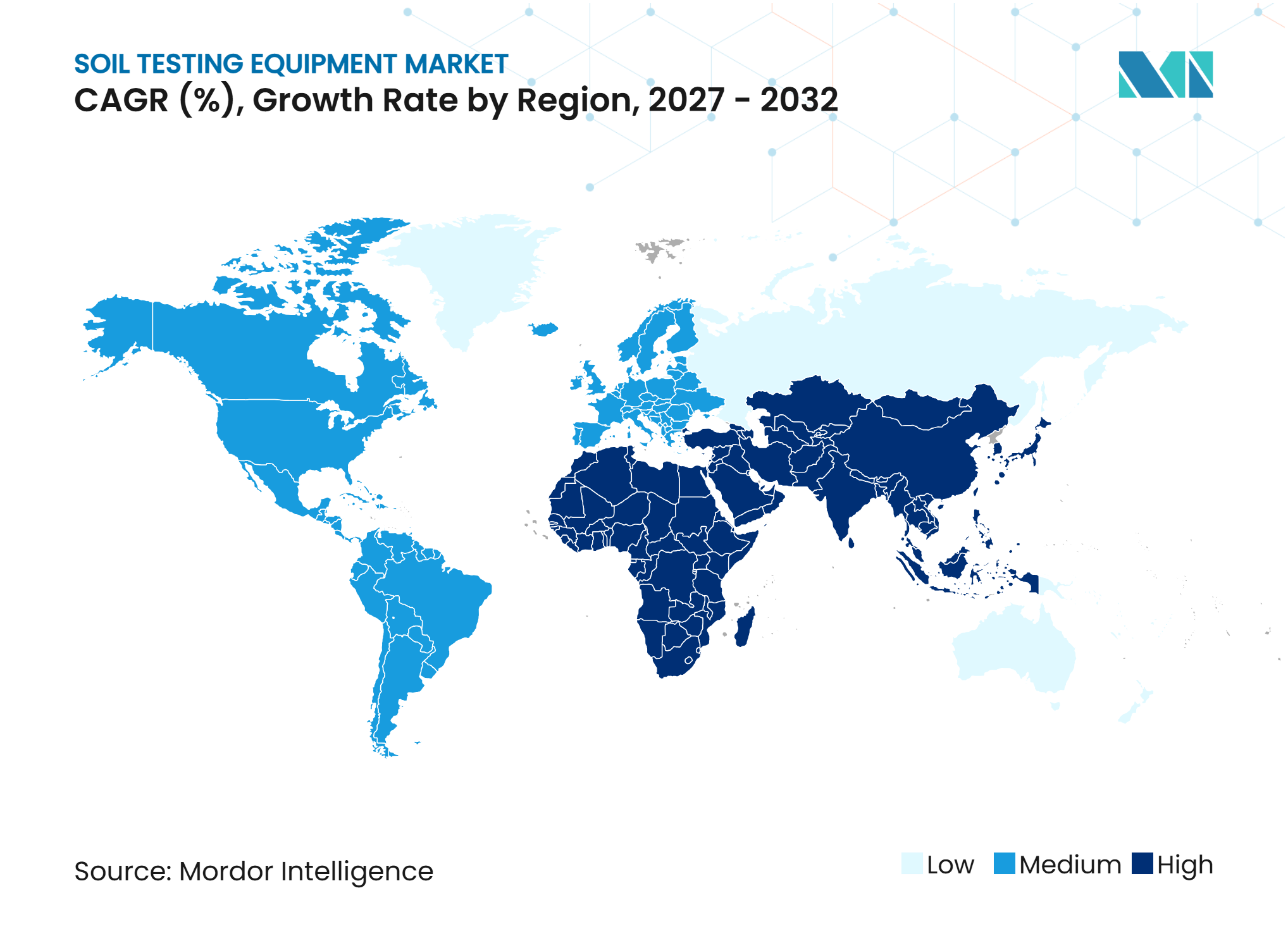
| Fastest Growing Market | Asia-Pacific |
| Largest Market | North America |
| Market Concentration | Low |
Major Players *Disclaimer: Major Players sorted in no particular order Image © Mordor Intelligence. Reuse requires attribution under CC BY 4.0. | |
Soil Testing Equipment Market Analysis by Mordor Intelligence
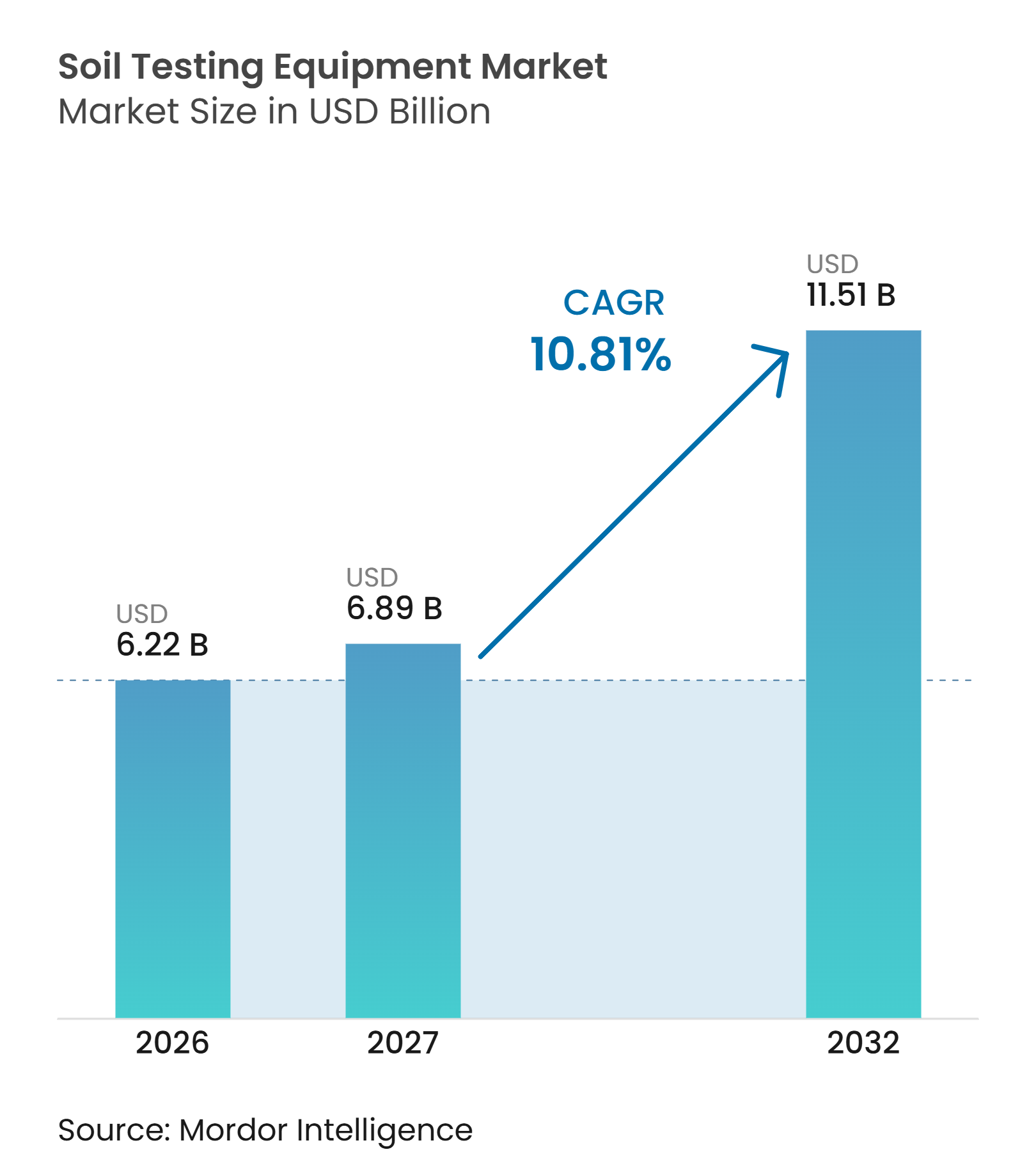
The soil testing equipment market size was valued at USD 6.22 billion in 2026 and is forecast to grow from USD 6.89 billion in 2027 to USD 11.51 billion by 2032, at a CAGR of 10.81% from 2027 to 2032. The market is supported by demand from agriculture, construction, land remediation, and regulatory monitoring. Field devices with mobile connectivity are broadening access to testing services in regions where centralized laboratories are less available. In mature markets, laboratory upgrades and higher data-traceability requirements are shaping procurement decisions. In developing markets, portable instruments support local advisory services and public soil-health programs. These two demand patterns require suppliers to balance high-throughput laboratory systems with lower-cost field equipment.
Key Report Takeaways
-
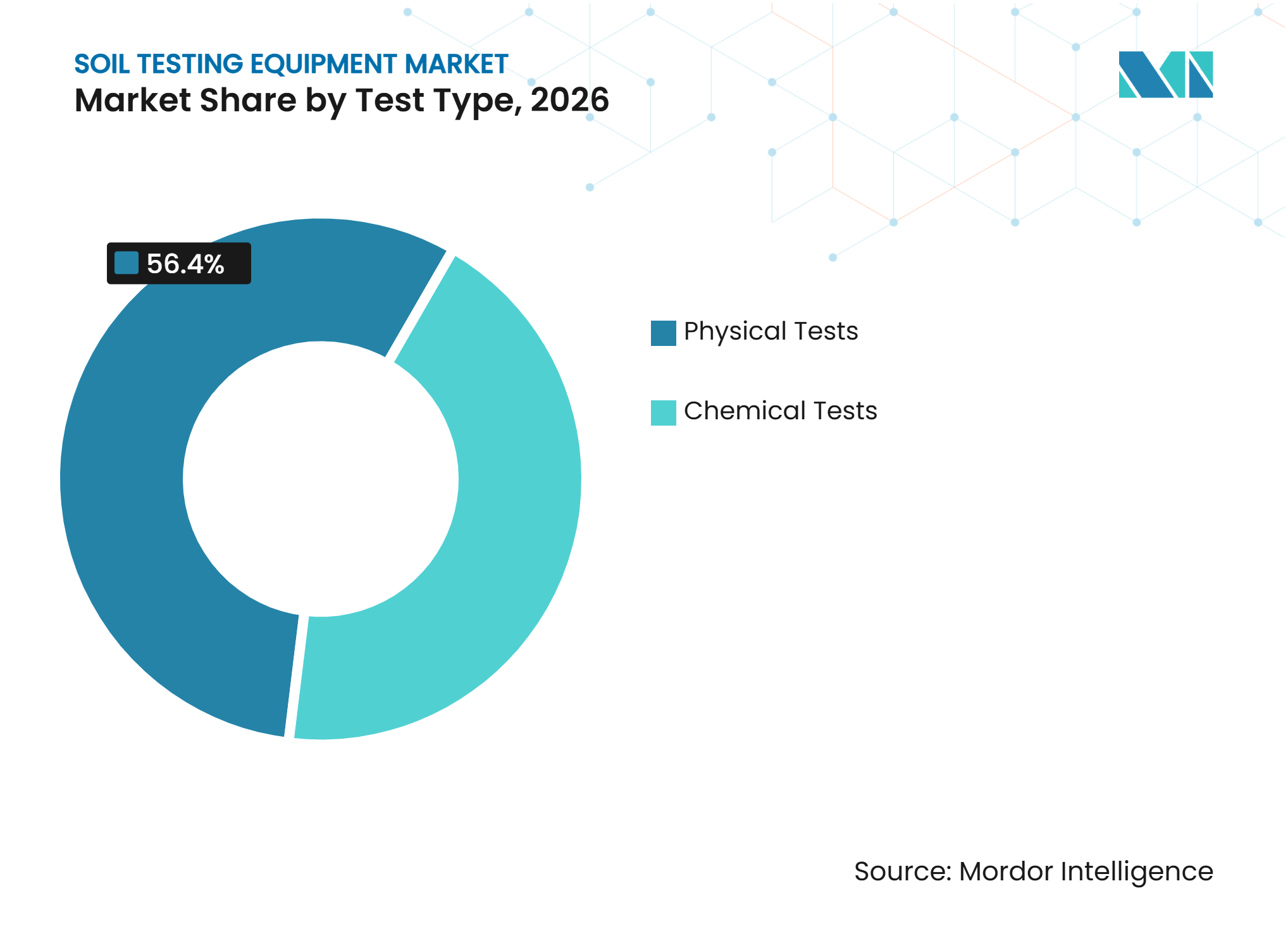
By test type, chemical tests accounted for 43.6% of the soil testing equipment market share in 2026 and are forecast to grow at a CAGR of 11.3% from 2027 to 2032.
-
By degree of automation, semi-automatic equipment accounted for 38.9% of the soil testing equipment market size in 2026, while automatic equipment is forecast to grow at a CAGR of 11.2% from 2027 to 2032.
-
By product type, nutrient testing equipment accounted for 39% of the market share in 2026, while moisture testers are forecast to grow at a CAGR of 12.0% from 2027 to 2032.
-
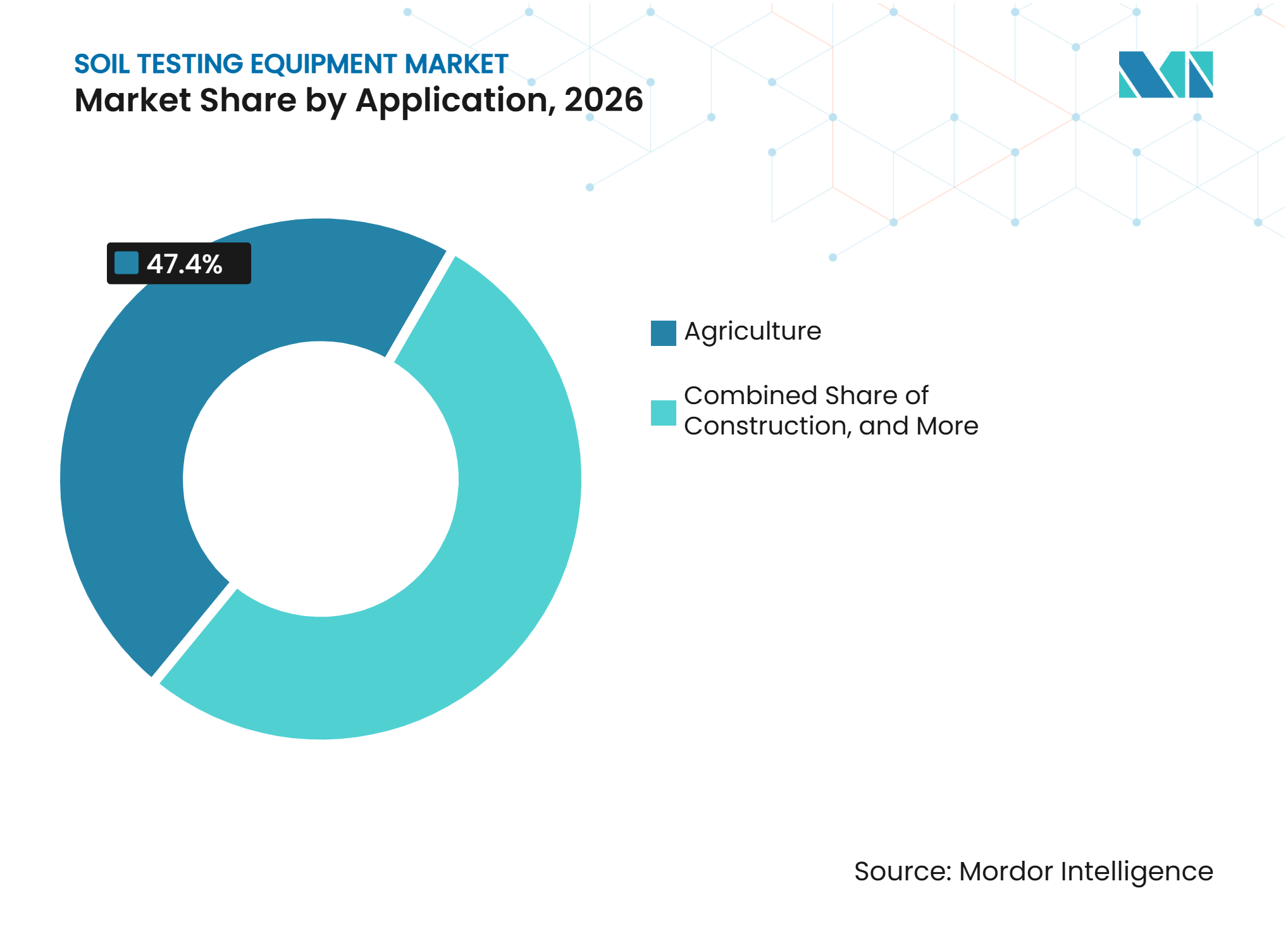
By application, agriculture accounted for 47.4% of the market share in 2026, while environmental monitoring and remediation is forecast to grow at a CAGR of 12.3% from 2027 to 2032.
-
By end user, commercial farms accounted for 31.0% of the market share in 2026, while government agencies are forecast to grow at a CAGR of 10.9% from 2027 to 2032.
-
By geography, North America accounted for 37.6% of the market share in 2026, while the Asia-Pacific region is forecast to grow at a CAGR of 11.6% from 2027 to 2032.
Note: Market numbers in this report are based on Mordor Intelligence's proprietary estimation framework, which combines nine months of actuals with Q4 projections for base year 2026.
Market Trends and Insights
Drivers Impact Analysis of Soil Testing Equipment Market*
| Driver | (~) % Impact on CAGR Forecast | Geographic Relevance | Impact Timeline |
|---|---|---|---|
| Precision Agriculture and Variable-Rate Input Management | +2.8% | Global | Medium term (2-4 years) |
| Government Soil-Health Programs and Environmental Compliance | +2.2% | Global, strongest in North America and Europe | Short term (≤ 2 years) |
| Geotechnical Testing Demand from Infrastructure Development | +1.8% | Asia-Pacific core, with demand in the Middle East and South America | Long term (≥ 4 years) |
| Automation and Digital Data Capture in Soil Analysis | +1.6% | North America, Europe, and advanced Asia-Pacific markets | Medium term (2-4 years) |
| Smartphone-Enabled Testing for Decentralized Agricultural Services | +1.0% | Asia-Pacific, Africa, and South America | Medium term (2-4 years) |
| Localization of Soil-Testing Hardware Supply Chains | +0.6% | North America, Asia-Pacific, and Europe | Short term (≤ 2 years) |
| Source: Mordor Intelligence | |||
Precision Agriculture and Variable-Rate Input Management
Precision farming uses soil nutrient, pH, moisture, and salinity readings to guide variable-rate input decisions. Repeated testing can reduce waste and improve the timing of fertilizer and irrigation use. As these services become part of agronomic advisory contracts, the soil testing equipment market benefits from higher testing frequency rather than from first-time adoption alone. Digital delivery of results favors instruments that can transfer data directly into farm-management workflows. Suppliers that combine hardware with data-management capabilities can be better placed in advisory-led procurement channels.
Government Soil-Health Programs and Environmental Compliance
Government programs are making soil assessment a recurring activity within farm-management and environmental-monitoring frameworks. The European Union Soil Monitoring Directive entered into force on December 16, 2025, and requires member states to monitor soil health across forests, agricultural land, and urban areas using common descriptors and harmonized sampling methods. The European Commission stated that soil degradation costs the European Union more than EUR 50 billion, or USD 55 billion, each year.[1] In March 2026, Agriculture and Agri-Food Canada began work with the Soil Conservation Council of Canada on a National Agricultural Soil Health Strategy covering research, extension, data collection, and incentives.[2] These measures can shorten replacement cycles when laboratories need equipment that meets new testing and reporting requirements.
Geotechnical Testing Demand from Infrastructure Development
Roads, bridges, dams, industrial facilities, and renewable-energy projects require soil characterization before design and during construction. Fugro started geotechnical field operations in April 2026 for Petrobras’s offshore wind pilot project in Rio de Janeiro, including soil sampling, in situ testing, and laboratory analysis. The Arkansas Department of Transportation deployed a cone penetrometer testing machine that captures real-time soil data at 2 centimeters per second, replacing slower manual boring and sample-transport processes.[3] Renewable-energy sites can add demand for soil testing equipment outside traditional road and building cycles. Compliance with ASTM and ISO requirements also supports demand for validated equipment in foundation and compaction work.
Automation and Digital Data Capture in Soil Analysis
Automated platforms can increase sample throughput and reduce variation between analysts. Bentley Systems launched OpenGround Labs in February 2026 to connect soil and rock sample data from field collection through laboratory testing and engineering workflows. ORUN Instruments stated that its automated soil organic matter analyzer can process 60 to 80 samples in a batch through automated reagent addition, digestion, titration, and reporting. The soil testing equipment market is therefore shifting some laboratory roles from routine analysis toward quality assurance and result interpretation. Providers with traceable data flows from the field to the final recommendation can differentiate their systems.
Restraints Impact Analysis of Soil Testing Equipment Market*
| Restraint | (~) % Impact on CAGR Forecast | Geographic Relevance | Impact Timeline |
|---|---|---|---|
| High Acquisition and Calibration Costs | -1.8% | Global, most acute in Asia-Pacific and the Middle East | Medium term (2-4 years) |
| Limited Technical Training and Result Interpretation | -1.4% | Asia-Pacific, Africa, and South America | Long term (≥ 4 years) |
| Calibration Drift in Saline, Clay-Rich, and Organic Soils | -1.1% | Middle East, Australia, and India | Medium term (2-4 years) |
| Reagent, Sensor, and Electronic-Component Supply Volatility | -0.7% | North America, Europe, and Asia-Pacific | Short term (≤ 2 years) |
| Source: Mordor Intelligence | |||
High Acquisition and Calibration Costs
Advanced analyzers require significant initial investment as well as recurring expenditure on calibration, maintenance, and skilled service. These costs can delay procurement in public laboratories and smaller agricultural operations. Laboratories in emerging markets may continue using instruments beyond their validated service life when replacement budgets are limited. Access to traceable reference materials and certified reagents can increase the total operating cost of high-performance systems. Publicly funded laboratories face additional uncertainty when annual budgets fluctuate with broader agricultural spending priorities.
Limited Technical Training and Result Interpretation
Equipment creates value only when staff collect samples correctly and interpret results for the relevant soil conditions. A technician may operate a field sensor correctly but still misapply calibration requirements for a specific soil matrix. A 2026 scientific study found that standard penetration test results could substantially overestimate friction angles in organic-rich and peat soils in the studied Rwandan sites. A 2025 study found that digital agricultural extension services can improve access to information and adoption of practices, although farmers still need support in applying data to soil management decisions. Poor results can reduce institutional trust and limit a laboratory's ability to secure contracts that would otherwise fund further training.
*Our forecasts treat driver/restraint impacts as directional, not additive. The impact forecasts reflect baseline growth, mix effects, and variable interactions.
Soil Testing Equipment Market Segment Analysis
By Test Type:
Chemical Tests Anchor Demand, Physical Tests Gain Ground in InfrastructureChemical tests accounted for 43.6% of the soil testing equipment market share in 2026 and are forecast to grow at a CAGR of 11.3% from 2027 to 2032. pH measurement, nitrogen, phosphorus, potassium, electrical conductivity, and organic matter analysis serve agricultural, environmental, and remediation users. Their repeated use supports recurring demand for consumables and calibration services. Public nutrient management requirements and mobile nutrient testing devices support this expansion of the soil testing equipment market.
Physical tests include texture, bulk density, moisture, permeability, shear-strength, and residual testing. Infrastructure projects in Asia-Pacific and the Middle East require permeability and shear strength data before foundation design can proceed. Residual testing supports contaminated-site assessment under European soil-monitoring requirements. Physical-test equipment can have a longer service life and lower consumable use than chemical platforms. Connected penetrometers can serve agricultural soil assessment and construction quality-control needs.



By Degree of Automation:
Automatic Equipment Leads Growth as Throughput Pressures RiseSemi-automatic equipment accounted for 38.9% of the soil testing equipment market in 2026, as it is widely used in agricultural laboratories and university facilities. These users require greater repeatability than manual methods can provide but may not have the capital for fully automated platforms. Automatic equipment is forecast to grow at a CAGR of 11.2% from 2027 to 2032. Consolidation among public laboratories and commercial testing providers increases the number of samples each instrument handles. Batch processing and direct report export can reduce routine handling requirements.
Manual equipment remains relevant for field sampling and lower-frequency assessments where portability is more important than throughput. Commercial laboratories face pressure to deliver faster turnaround times at similar costs. This can encourage mid-tier providers to move from semi-automatic systems toward entry-level automatic equipment. SEAL Analytical’s 2026 catalog includes an automation solution for soil particle-size distribution that supports steps in ISO 11277 clay-fraction determination. The soil testing equipment industry can gain by leveraging automation to improve compliance while keeping workflows accessible to existing staff.
By Product Type:
Moisture Testers Fastest Growing Amid Irrigation ExpansionNutrient testing equipment accounted for 39% of the market share in 2026, as nitrogen, phosphorus, and potassium analysis remains essential to crop nutrition management. pH meters are widely used in portable kits and laboratory bench-top configurations. Spectrometers and elemental analyzers serve the higher-priced end of the product range. Compaction testers, salinity testers, and soil penetrometers address specific needs in construction and arid-region agriculture. Product selection depends on the test method, required accuracy, and whether the customer needs laboratory or field deployment.
Moisture testers are forecast to grow at a CAGR of 12.0% from 2027 to 2032. Drip irrigation, water-stress monitoring, and connected field-sensor networks support demand for these products. Braveridge introduced two agricultural sensor models that measure moisture, temperature, and electrical conductivity and transmit readings to smartphones and computers. Its LTE-M model can operate without a WiFi router, supporting use on remote farms. Connectivity can integrate a moisture tester as a data source within a farm-management system.
By Application:
Agriculture Dominant, Environmental Monitoring AcceleratingAgriculture accounted for 47.4% of the soil testing equipment market in 2026. Large farms in North America and Australia often use laboratory-grade automated systems, while smallholder programs in India and sub-Saharan Africa use portable or smartphone-connected devices. Agricultural demand includes equipment purchases, testing services, and advisory platforms that convert readings into fertilizer recommendations. The soil testing equipment market accommodates both centralized laboratories and decentralized testing models, serving farms of different sizes and budgets, as well as decision timelines.
Environmental monitoring and remediation is forecast to grow at a CAGR of 12.3% from 2027 to 2032. The European Union directive requires action on contaminated sites, supporting demand for field screening and confirmatory laboratory analysis. Construction demand is supported by bearing capacity, compaction, and permeability tests required for design and roadworks. Research and academic users purchase high-resolution instruments where analytical precision is critical. These applications reduce the market's reliance on agricultural demand alone.

By End User:
Commercial Farms Lead, Government Agencies Gain Procurement WeightCommercial farms accounted for 31.0% of the market share in 2026, with purchases ranging from portable pH meters to service agreements with certified laboratories. Agricultural laboratories are capital-intensive users, as calibration standards and traceability documentation are central to their operations. The Soilmonitor project developed a lab-on-chip nutrient-monitoring system intended to cost less than EUR 500 (approximately USD 550) per unit. A lower price point could enable mid-scale farms to adopt testing tools previously accessed through outside laboratories. Commercial farms also value results that can be converted quickly into field decisions.
Government agencies are forecast to grow at a CAGR of 10.9% from 2027 to 2032, as national programs specify recurring soil-monitoring requirements. The USDA launched a USD 700 million Regenerative Pilot Program for fiscal year 2026, including USD 400 million through EQIP and USD 300 million through the Conservation Stewardship Program. The European Union and Canada also established or advanced soil-health frameworks that require structured data collection. Construction companies purchase equipment directly or use certified testing laboratories for project compliance. Universities and research institutes remain steady buyers of specialized analytical systems.
Geography Analysis
North America accounted for 37.6% of the global soil testing equipment market share in 2026. The region has mature precision-farming systems, USDA conservation spending, and a broad base of certified geotechnical laboratories. The USDA’s fiscal year 2026 Regenerative Pilot Program includes whole-farm planning and soil-health baseline assessments. Canada’s March 2026 soil-health strategy initiative adds a further signal for standardized testing and compatible laboratory equipment.
Asia-Pacific is forecast to grow at a CAGR of 11.6% from 2027 to 2032, making it the fastest-growing region. India’s public soil-health infrastructure supports domestic product development suited to local nutrient conditions and field use. NutriSens deployment across 8 Indian states demonstrates the role of portable systems in decentralized advisory services. Henry Monitor began paid rental of its HMDT-01 soil sensor with JA Zen-Noh Nagano in April 2026. China’s infrastructure activity supports geotechnical testing alongside agricultural demand.
Europe’s growth is supported by the Soil Monitoring Directive, which is establishing common testing descriptors and sampling methods across member states. The Middle East is advancing on the back of irrigation, salinity monitoring, infrastructure, and energy projects that require specialized testing. Africa’s growth is supported by soil-fertility programs and rising demand for portable, lower-cost equipment. Regional growth is shaped by the balance between laboratory capacity, field-service models, and local technical support.
Competitive Landscape
Market Concentration
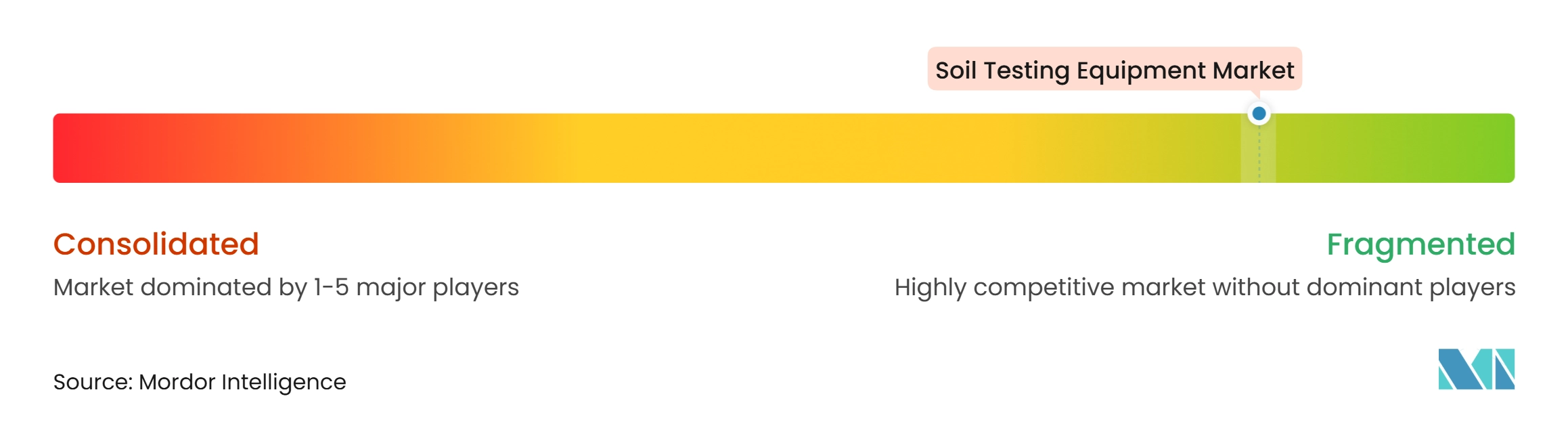
The soil testing equipment market was fragmented in 2026. Thermo Fisher Scientific, Agilent Technologies, PerkinElmer, Controls S.p.A., and Gilson Company serve different product and customer segments. Large analytical-instrument suppliers compete for laboratory systems, while geotechnical specialists serve construction projects and portable-sensor companies target farm and field-service users. Buyers usually select equipment for application fit, accreditation compatibility, and service support. This structure limits supplier-level pricing power across the full market.
Thermo Fisher Scientific launched the Orbitrap Exploris EFOX Mass Detector in October 2025 for environmental and food-safety laboratories working with PFAS, pesticides, and soil contaminants. Bentley Systems introduced OpenGround Labs in February 2026 to connect field and laboratory geotechnical data. Henry Monitor began a paid rental program for its magnetic-field soil sensor with a Japanese agricultural cooperative in April 2026. These developments reflect continued investment in high-resolution analysis, connected data workflows, and faster field assessment. The soil testing equipment market remains open to differentiated products, as customer requirements vary by use case.
Low-cost multinutrient testing for smallholder farms represents an opportunity for smartphone-connected devices with standardized calibration databases. Integration between field-collected data and farm management software is another opportunity, as common data standards are still developing. Calibration services for saline, clay-rich, and organic soils could also differentiate suppliers. Emerging methods such as laser-induced breakdown spectroscopy, lab-on-chip systems, and AI-based soil classification may challenge conventional electrochemical and wet-chemistry workflows. ISO/IEC 17025 requirements can slow the adoption of new methods in regulated laboratories, as equipment and workflows must meet established quality standards.
Soil Testing Equipment Industry Leaders
-
Thermo Fisher Scientific Inc.
-
Agilent Technologies, Inc.
-
PerkinElmer Inc.
-
Controls S.p.A.
-
Gilson Company, Inc.
- *Disclaimer: Major Players sorted in no particular order
Soil Testing Equipment Market Companies Covered in this Report
- Thermo Fisher Scientific Inc.
- Agilent Technologies, Inc.
- PerkinElmer Inc.
- Controls S.p.A.
- LaMotte Company
- Sun Labtek Equipments (I) Pvt. Ltd.
- Martin Lishman Ltd.
- ELE International
- Gilson Company, Inc.
- Humboldt Mfg. Co.
- EIE Instruments Pvt. Ltd.
- Hanna Instruments
- Forney LP
- Aimil Ltd.
- Cooper Research Technology
Recent Industry Developments in Soil Testing Equipment Market
- April 2026: Henry Monitor began paid rental of its HMDT-01 tabletop magnetic-field soil sensor to JA Zen-Noh Nagano. The system reduces conventional soil CEC and base nutrient analysis from several weeks to 20 seconds using AI-based estimation.
- March 2026: Agriculture and Agri-Food Canada announced collaboration with the Soil Conservation Council of Canada to develop the National Agricultural Soil Health Strategy under Bill S-230.
- February 2026: Bentley Systems launched OpenGround Labs, integrating laboratory soil and rock sample data management with field collection workflows.
Global Soil Testing Equipment Market Report Scope
The soil testing equipment market encompasses instruments and devices used to analyze the physical, chemical, and residual properties of soil for applications across agriculture, construction, environmental monitoring, and related industries.
The soil testing equipment report is segmented by test type (physical tests and chemical tests), by degree of automation (manual, semi-automatic, and automatic), by product type (pH meters, moisture testers, nutrient testing equipment, salinity testers, compaction testers, soil penetrometers, soil sampling kits, soil spectrometers and elemental analyzers, and rest of soil testing equipment), by application (agriculture, construction, environmental monitoring and remediation, and research and academia), by end user (commercial farms, agricultural laboratories, government agencies, construction companies, and research institutes and universities), and geography (North America, South America, Europe, Asia-Pacific, Middle East, Africa). The market forecasts are provided in terms of value (USD).
Segmentation Overview
| Physical Tests |
| Chemical Tests |
| Manual |
| Semi-Automatic |
| Automatic |
| pH Meters |
| Moisture Testers |
| Nutrient Testing Equipment |
| Salinity Testers |
| Compaction Testers |
| Soil Penetrometers |
| Soil Sampling Kits |
| Soil Spectrometers and Elemental Analyzers |
| Rest of Soil Testing Equipment |
| Agriculture |
| Construction |
| Environmental Monitoring and Remediation |
| Research and Academia |
| Commercial Farms |
| Agricultural Laboratories |
| Government Agencies |
| Construction Companies |
| Research Institutes and Universities |
| North America | United States |
| Canada | |
| Mexico | |
| South America | Brazil |
| Argentina | |
| Rest of South America | |
| Europe | Germany |
| United Kingdom | |
| France | |
| Italy | |
| Russia | |
| Rest of Europe | |
| Asia-Pacific | China |
| India | |
| Japan | |
| Australia | |
| Rest of Asia-Pacific | |
| Middle East | Saudi Arabia |
| United Arab Emirates | |
| Turkey | |
| Rest of Middle East | |
| Africa | South Africa |
| Nigeria | |
| Egypt | |
| Rest of Africa |
| By Test Type | Physical Tests | |
| Chemical Tests | ||
| By Degree of Automation | Manual | |
| Semi-Automatic | ||
| Automatic | ||
| By Product Type | pH Meters | |
| Moisture Testers | ||
| Nutrient Testing Equipment | ||
| Salinity Testers | ||
| Compaction Testers | ||
| Soil Penetrometers | ||
| Soil Sampling Kits | ||
| Soil Spectrometers and Elemental Analyzers | ||
| Rest of Soil Testing Equipment | ||
| By Application | Agriculture | |
| Construction | ||
| Environmental Monitoring and Remediation | ||
| Research and Academia | ||
| By End User | Commercial Farms | |
| Agricultural Laboratories | ||
| Government Agencies | ||
| Construction Companies | ||
| Research Institutes and Universities | ||
| By Geography | North America | United States |
| Canada | ||
| Mexico | ||
| South America | Brazil | |
| Argentina | ||
| Rest of South America | ||
| Europe | Germany | |
| United Kingdom | ||
| France | ||
| Italy | ||
| Russia | ||
| Rest of Europe | ||
| Asia-Pacific | China | |
| India | ||
| Japan | ||
| Australia | ||
| Rest of Asia-Pacific | ||
| Middle East | Saudi Arabia | |
| United Arab Emirates | ||
| Turkey | ||
| Rest of Middle East | ||
| Africa | South Africa | |
| Nigeria | ||
| Egypt | ||
| Rest of Africa | ||
Key Questions Answered in the Report
What is the current size of the soil testing equipment market?
The soil testing equipment market was USD 6.22 billion in 2026 and is forecast to reach USD 11.51 billion by 2032 at a CAGR of 10.81%.
Which region leads global demand for soil testing equipment?
North America led with 37.6% of the market share in 2026. The soil testing equipment market in Asia-Pacific is forecast to grow at a CAGR of 11.6% from 2027 to 2032.
Which soil test type has the highest demand?
Chemical tests accounted for 43.6% of the soil testing equipment market share in 2026 and are forecast to grow at a CAGR of 11.3% from 2027 to 2032.
Why are moisture testers growing quickly?
Moisture testers are forecast to grow at a CAGR of 12.0% as irrigation monitoring and connected field-sensor networks are expanding. In the soil testing equipment market, they support water management and crop scheduling.