
Sodium Perborate Market Size and Share
Market Overview
| Study Period | 2022 - 2032 |
|---|---|
| Market Size (2027) | USD 159.62 Million |
| Market Size (2032) | USD 190.78 Million |
| Growth Rate (2027 - 2032) | 3.63 % |
| Fastest Growing Market | Asia-Pacific |
| Largest Market | North America |
| Market Concentration | Medium |
Major Players *Disclaimer: Major Players sorted in no particular order Image © Mordor Intelligence. Reuse requires attribution under CC BY 4.0. | |
Sodium Perborate Market Analysis by Mordor Intelligence
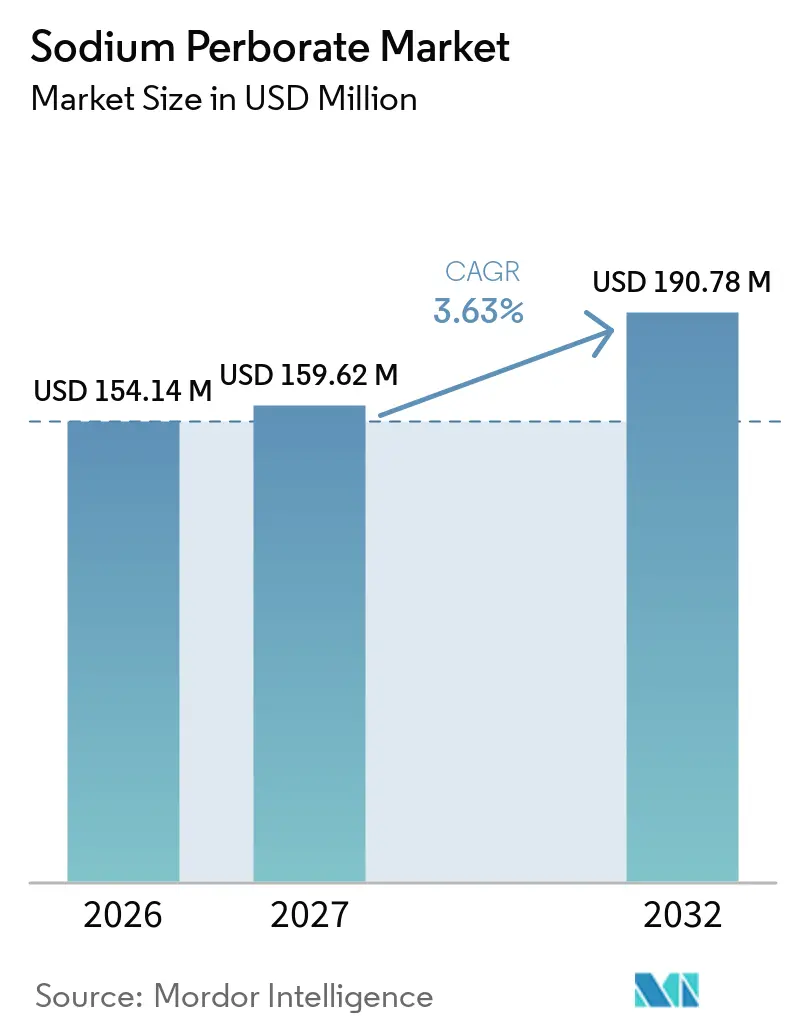
The Sodium Perborate Market size was valued at USD 154.14 million in 2026 and is estimated to grow from USD 159.62 million in 2027 to reach USD 190.78 million by 2032, at a CAGR of 3.63% during the forecast period (2027-2032). Demand for oxygen-based bleaching chemistry in powder detergents, industrial cleaning products, and selected pharmaceutical uses supports this measured expansion. The sodium perborate market sits in a specialized chemical category where chlorine-free bleaching requirements align with continued demand for powdered detergents in price-sensitive economies. In mature Western markets, sodium percarbonate creates substitution pressure, particularly in compact detergent formats. Asia-Pacific and the Middle East continue to consume sodium perborate in household and institutional cleaning uses, where dry-product logistics and cost per wash remain important. Manufacturers are therefore balancing compliance requirements, hydrate-form performance, and product stability as they pursue demand in cleaning, textiles, and higher-value pharmaceutical applications.
Key Report Takeaways
- By type, sodium perborate tetrahydrate held 58.13% of the sodium perborate market share in 2026, while sodium perborate monohydrate is forecast to advance at a 4.15% CAGR through 2032.
- By end-use industry, household and industrial cleaning held 54.72% of the sodium perborate market share in 2026, while healthcare and pharmaceuticals are forecast to advance at a 4.33% CAGR through 2032.
- By geography, North America held 46.51% of the sodium perborate market share in 2026, while Asia-Pacific is forecast to advance at a 4.17% CAGR through 2032.
Note: Market numbers in this report are based on Mordor Intelligence's proprietary estimation framework, which combines nine months of actuals with Q4 projections for base year 2026.
Market Trends and Insights
Drivers Impact Analysis of Sodium Perborate Market*
| Driver | (~) % Impact on CAGR Forecast | Geographic Relevance | Impact Timeline |
|---|---|---|---|
| Demand for Oxygen-Based and Non-Chlorinated Bleaching Agents | +0.85% | Global, with highest intensity in North America & EU | Medium term (2–4 years) |
| Expansion of Powdered Detergent and Household-Care Formulations | +0.75% | Asia-Pacific core, spillover to MEA and South America | Long term (≥ 4 years) |
| Growth of Institutional and Industrial Cleaning Applications | +0.60% | Global, led by North America and Europe | Medium term (2–4 years) |
| Low-Temperature Formulation Engineering Using Activator Systems | +0.50% | Europe primary, expanding to Asia-Pacific | Medium term (2–4 years) |
| Hydrate-Form Optimization for Active-Oxygen and Logistics Efficiency | +0.35% | Global, particularly relevant for Asia-Pacific supply chains | Long term (≥ 4 years) |
| Source: Mordor Intelligence | |||
Demand for Oxygen-Based and Non-Chlorinated Bleaching Agents
Consumer and regulatory pressure against chlorine-based bleaches supports sodium perborate use as a solid oxygen-bleach source across several applications. In water, sodium perborate releases hydrogen peroxide and provides oxidizing, bleaching, and bactericidal activity. Its decomposition products include oxygen and borate salts, which differentiate the chemistry from chlorine-based bleach systems. A 2025 study reported that sodium perborate composite films achieved a 6-log reduction in S. aureus and P. aeruginosa counts. The same study reported wound closure of 28.9% by day 2, compared with 9.3% for untreated controls, with p less than 0.0001. These results support interest in healthcare applications beyond traditional detergent and antiseptic uses.
Expansion of Powdered Detergent and Household-Care Formulations
Powdered detergents remain important in price-sensitive markets in Asia-Pacific, South America, and Africa. Cold-water logistics and cost-per-wash economics can favor dry products over liquid or gel formats in these markets. Sodium perborate provides a stable solid carrier with a long shelf life, avoiding stability constraints associated with liquid peroxide systems. Its granular form also supports measured dosing in tablets and sachets. These formats can help consumers manage detergent use and support product consistency in distribution channels. The sodium perborate market retains a role in household-care formulations even where sodium percarbonate is available at a similar cost.
Growth of Institutional and Industrial Cleaning Applications
Institutional and industrial cleaning customers place weight on storage safety, compliance, and consistent performance at scale. Textile mills, food-processing facilities, and healthcare laundries need controlled oxygen release that supports whitening and microbial cleaning across large wash loads. A 2025 study found that a formulation containing 4 g of sodium perborate and 0.6 g of tetraacetylethylenediamine (TAED) achieved at least 99.99% bacterial reduction on contaminated cotton facepieces at 40 °C. The study reported that the performance met EN 14683:2019 surgical mask cleanliness benchmarks. The findings show why formulators can retain oxygen-bleach systems in institutional applications. Healthcare laundry contracts also use multi-year specifications, which can provide a more visible demand base than commodity cleaning channels.
Hydrate-Form Optimization for Active-Oxygen and Logistics Efficiency
Hydrate-form selection affects active-oxygen content, storage behavior, dissolution, and the efficiency of logistics. Tetrahydrate remains suited to supply chains that need predictable handling and stable product performance. This advantage matters in humid climates and in long distribution routes across the Asia-Pacific. Monohydrate offers a higher active-oxygen density, which can benefit concentrated products and smaller dosage formats. Producers can use granulation and packaging choices to protect quality while matching the requirements of specific detergent or pharmaceutical customers. The sodium perborate market, therefore, depends not only on total demand for bleach chemistry but also on how effectively suppliers tailor hydrate forms to storage and formulation needs.
Restraints Impact Analysis of Sodium Perborate Market*
| Restraint | (~) % Impact on CAGR Forecast | Geographic Relevance | Impact Timeline |
|---|---|---|---|
| Substitution by Sodium Percarbonate and Other Oxidizing Agents | -0.65% | North America, EU core, with spread to Asia-Pacific | Short term (≤ 2 years) |
| Boron-Related Chemical Classification and Compliance Burden | -0.50% | EU, ASEAN bloc, with secondary effects in North America | Medium term (2–4 years) |
| Temperature-Dependent Bleaching Performance and Formulation Constraints | -0.35% | Europe & Japan (low-temperature wash dominant markets) | Medium term (2–4 years) |
| Source: Mordor Intelligence | |||
Substitution by Sodium Percarbonate and Other Oxidizing Agents
Sodium percarbonate presents a material competitive challenge for sodium perborate. It offers comparable active-oxygen content and greater solubility at lower temperatures. Its degradation profile also yields no boron residues, which can matter in regulatory and product-design decisions. Compact and concentrated detergent formats prioritize dissolution speed and formulation volume efficiency. These requirements can favor percarbonate. Sodium perborate continues to retain a place where stability during long, high-humidity logistics chains is important, since its tetrahydrate form can provide controlled-release behavior under storage conditions.
Boron-Related Chemical Classification and Compliance Burden
The regulatory position for boron-containing compounds creates a higher compliance burden for sodium perborate than for boron-free alternatives. Product specifications can require enhanced labeling, worker-exposure assessment, and downstream safety documentation. These activities increase the administrative cost of supplying regulated applications. The Philippine Food and Drug Administration issued Advisory No. 2025-1431 concerning the voluntary recall of a cosmetic product that contained sodium perborate[1]. This action illustrates the regulatory sensitivity surrounding sodium perborate in the personal-care channel. Suppliers must therefore direct compliance resources toward applications where product performance and qualification requirements support the added burden.
*Our forecasts treat driver/restraint impacts as directional, not additive. The impact forecasts reflect baseline growth, mix effects, and variable interactions.
Sodium Perborate Market Segment Analysis
By Type:
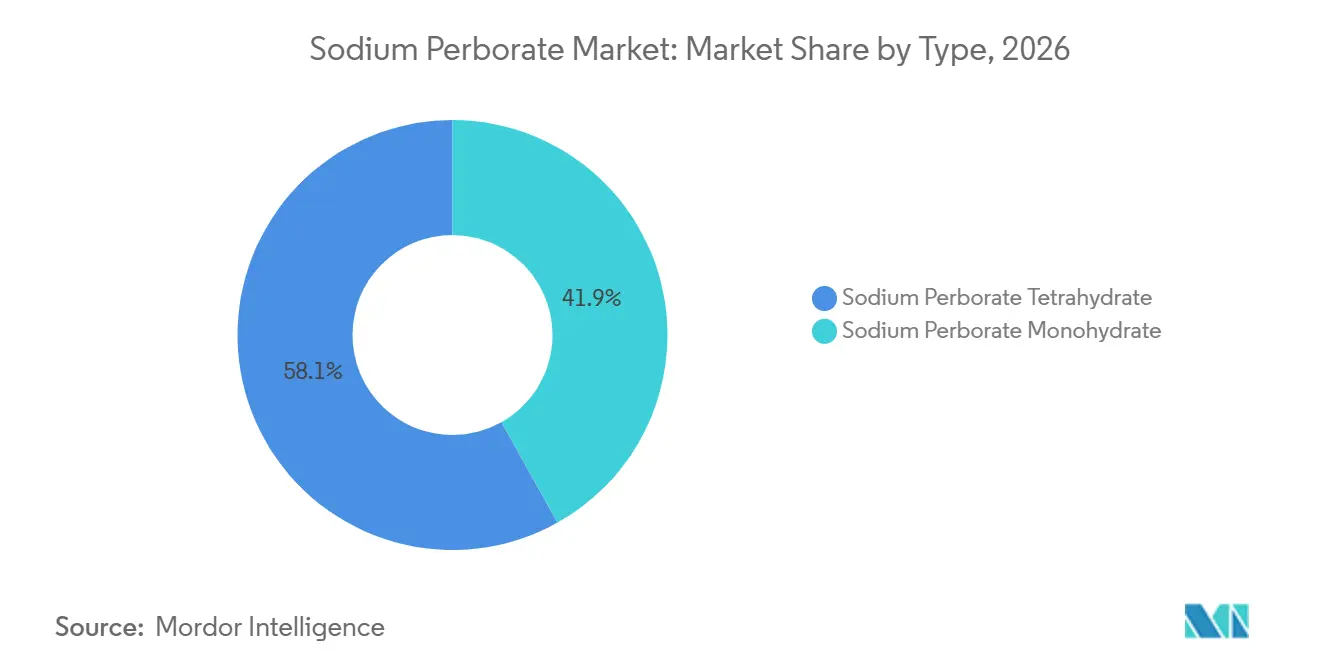
Sodium Perborate Tetrahydrate Leads Share, While Sodium Perborate Monohydrate Leads GrowthSodium perborate tetrahydrate held 58.13% of the sodium perborate market share in 2026. It is widely used in mainstream powder laundry detergent formulations across North America, Europe, and established Asian markets. Its lower water activity after granulation supports compatibility with enzyme-containing detergent matrices. Its dissolution behavior is also predictable in warm-to-hot wash cycles. These attributes make it a practical choice where shelf-life requirements exceed 12 months. The hydration water in the tetrahydrate can buffer humidity during storage and protect active-oxygen content from premature decomposition in tropical conditions. This storage benefit matters for distribution from India to Southeast Asia. A 2025 study confirmed that high-purity monohydrate can be produced through electrochemical synthesis. This manufacturing route could reduce regional reliance on conventional borax and hydrogen peroxide production routes.
Sodium perborate monohydrate is projected to advance at a 4.15% CAGR through 2032. It is gaining relevance in unit-dose tablets, concentrated stain removers, and pharmaceutical-grade antiseptic preparations. The material provides 50% higher active-oxygen content by mass than tetrahydrate. Formulators can therefore reduce ingredient volume per dose while maintaining comparable bleaching performance. This aligns with demand for concentrated product formats in distribution-focused markets. The sodium perborate industry can use purity, active-oxygen density, and documentation as differentiators when serving these applications.
By End-Use Industry:
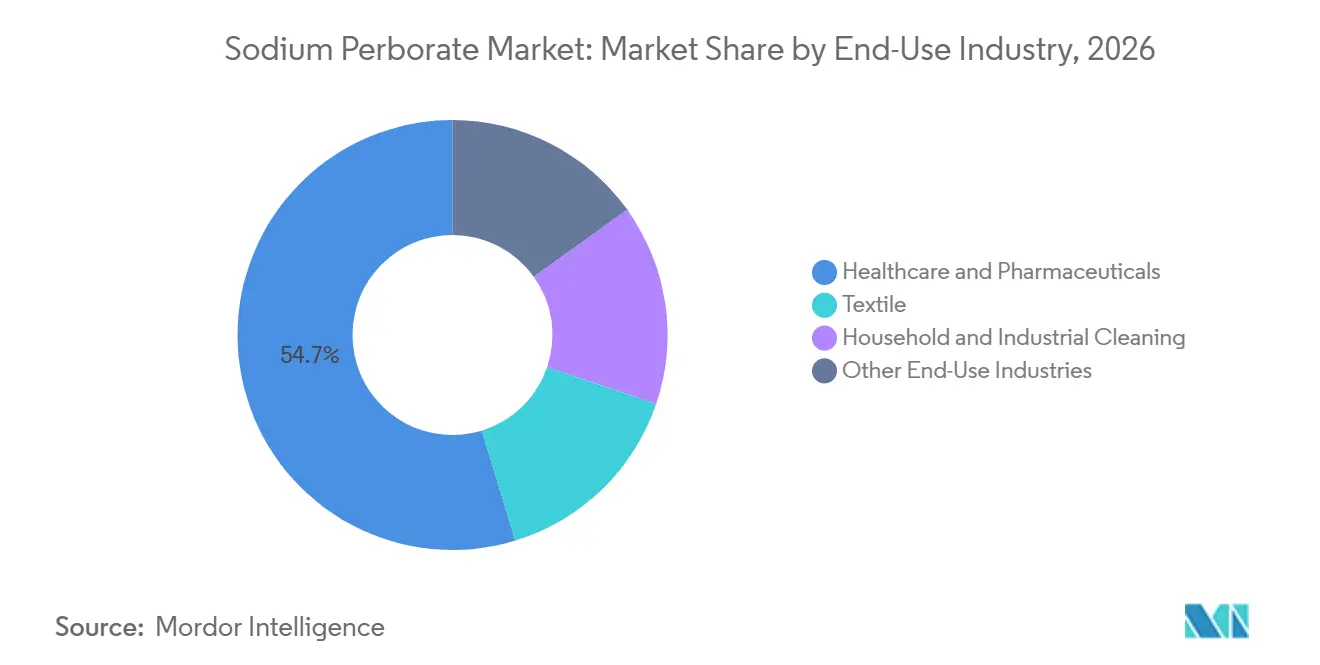
Household and Industrial Cleaning Lead, While Healthcare and Pharmaceuticals Expand FasterHousehold and industrial cleaning accounted for 54.72% of the sodium perborate market size in 2026. Powder laundry detergents, automatic dishwashing products, surface cleaners, and institutional hygiene powders support this position. Hospitals, food-processing facilities, and commercial laundries often follow specification-driven procurement cycles. Switching from sodium perborate can require validation of alternative products against established performance and safety requirements. These qualification requirements help keep cleaning a durable demand base. The segment faces slower growth in mature Western markets because of liquid cleaning products and substitution by other oxidizers. Textile bleaching also consumes sodium perborate in China and India, where it remains a cost-effective option for pretreatment and whitening of cellulosic fabrics. Other end-use industries include water-treatment applications, where activator systems have shown efficacy against pharmaceutical micropollutants.
Healthcare and pharmaceuticals are projected to advance at a 4.33% CAGR through 2032. The evidence base for sodium perborate in wound management is strengthening. A 2025 study found that composite films with sodium perborate in biodegradable polycaprolactone accelerated ischemic wound closure. It also recorded bacterial reductions against Gram-positive and Gram-negative pathogens. Ophthalmic preparations use sodium perborate monohydrate as a disappearing preservative. Tear-fluid enzymes convert it into water and oxygen, which distinguishes it from persistent chemical preservatives. ISO and national pharmacopeia purity requirements govern pharmaceutical-grade product specifications. These standards create a barrier for low-quality commodity suppliers and support differentiation in a higher-value end-use category.

Geography Analysis
North America Sodium Perborate Market
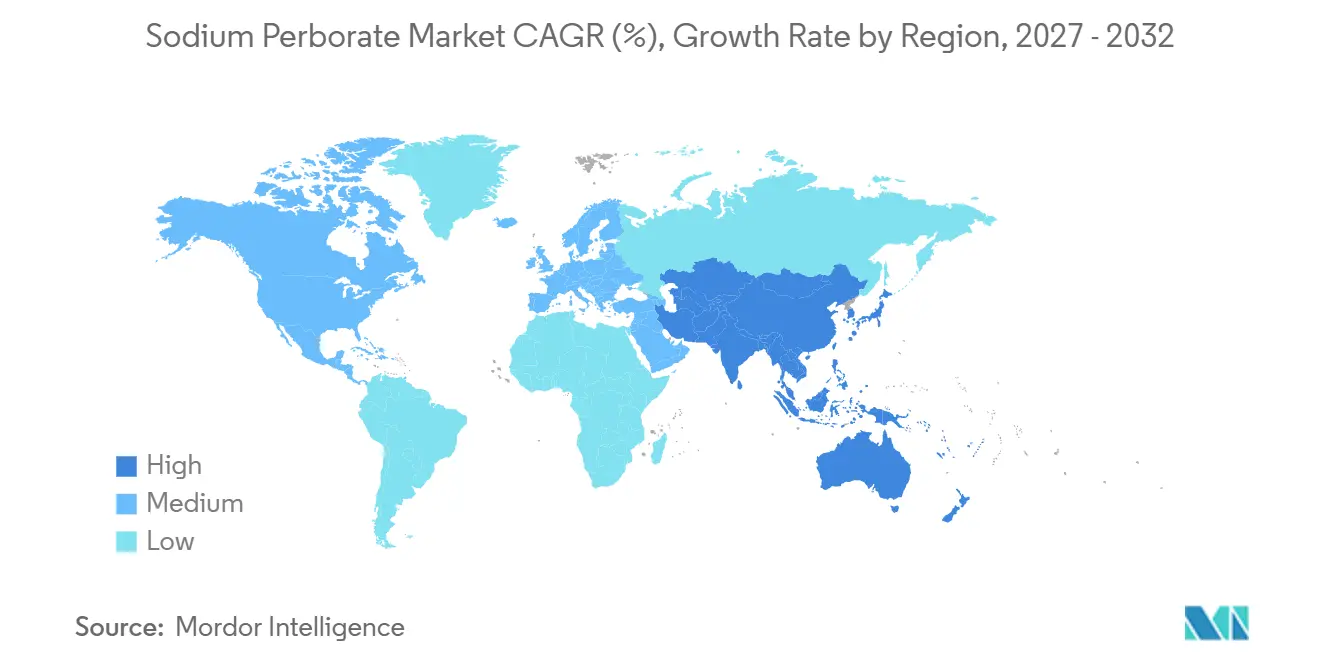
North America held 46.51% of the sodium perborate market share in 2026. The region has a long record of using sodium perborate in powder detergent formulations, institutional cleaning specifications, and industrial bleaching. Sodium percarbonate also displaces some sodium perborate in compact powder products. Mexico adds to regional demand as formal employment in manufacturing and services supports institutional cleaning procurement. Oxygen-based bleach demand provides a stable base for industrial cleaning applications in the United States and Canada.
APAC Sodium Perborate Market
Asia-Pacific is projected to advance at a 4.17% CAGR through 2032. China’s textile sector and domestic cleaning products base create steady demand for solid oxygen bleaches. India’s powder-detergent demand remains centered on dry formats across mid-market and rural distribution channels. These conditions maintain the sodium perborate market’s relevance as an ingredient. Producers in Shandong, Hubei, and Jiangsu support price competition by supplying industrial-grade material within the region. In January 2025, Evonik Industries AG and Fuhua Tongda Chemicals Company established Evonik Fuhua New Materials (Sichuan) Co., Ltd., a 51%-49% hydrogen peroxide joint venture in Leshan, China[2]. The venture has implications for upstream peroxide availability to regional sodium perborate producers.
EMEA, South America and APAC Sodium Perborate Market
The sodium perborate market in Europe remains mature, where regulation is a key strategic consideration. BELINKA PERKEMIJA d.o.o. supports regional supply with ISO 9001 and ISO 14001 certifications, REACH registration, and Seveso Directive compliance. Suppliers serving the sodium perborate market must manage regulatory and documentation requirements while serving detergent, textile, and specialty cleaning customers. South America records demand in Brazil and Argentina, where powder detergent formats remain important. The Middle East and Africa have a smaller demand base but offer longer-term scope through hygiene awareness and manufacturing investment in Saudi Arabia and the UAE. Japan remains a mature, low-growth location focused on premium specialty cleaning and personal-care applications.
Competitive Landscape
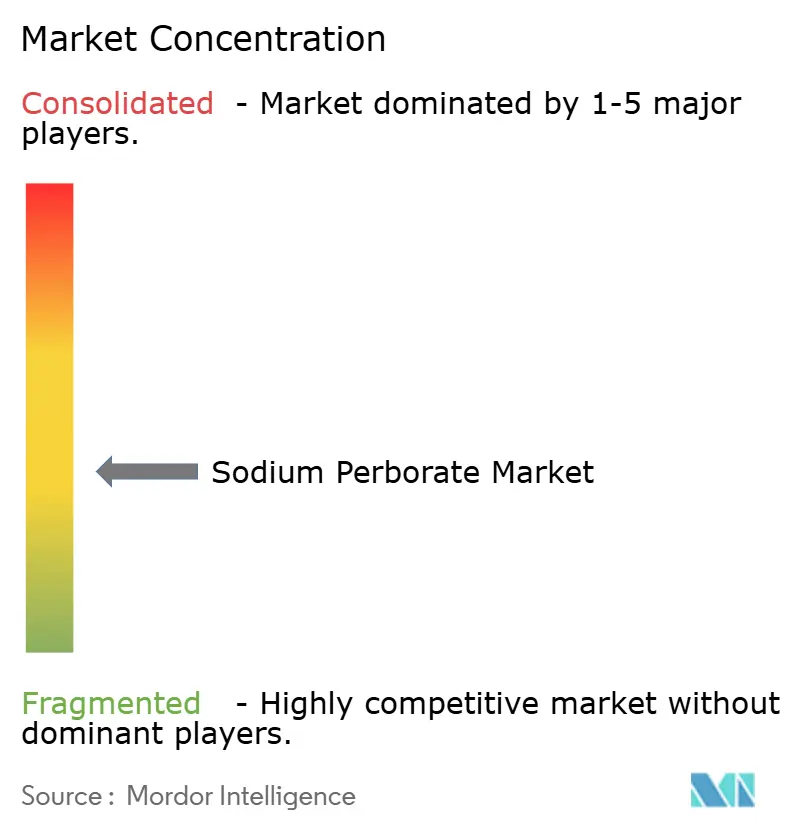
The sodium perborate market is moderately concentrated, with the top five players including BELINKA PERKEMIJA d.o.o., Evonik Industries AG, Fengchen Group Co., Ltd., Thermo Fisher Scientific Inc., and Merck KGaA. Buyers' attention to purity documentation and supply-chain traceability is raising the importance of compliance across these suppliers. The sodium perborate market, therefore, combines suppliers that compete on scale with suppliers that compete on regulated-product qualification. Across these company groups, the sodium perborate market depends on documented quality, dependable availability, and application-specific technical support for customers with distinct product requirements.
Product differentiation in the sodium perborate market centers on hydrate-form purity, particle-size design, controlled dissolution, and compliance documentation. Coated or encapsulated granules can improve moisture protection, dust control, and dissolution in shorter wash cycles. Such features can help suppliers obtain product specifications in premium compact detergent applications. Product development within the sodium perborate market also focuses on matching stability needs in long supply chains and the dose requirements of concentrated cleaning products. In January 2025, Evonik Industries AG and Fuhua Tongda Chemicals Company formed their China hydrogen peroxide joint venture, supporting Evonik’s upstream presence in a key Asian chemical supply chain. This move can affect raw material access for customers who produce perborate-based products. In April 2026, Evonik Industries AG started operations at an expanded specialty amine production facility in Nanjing, China. The investment broadened the company’s Asian manufacturing base relevant to detergent and industrial cleaning co-formulation markets. These strategic moves show how participants in the sodium perborate market can strengthen their chemical supply positions while supporting adjacent formulation needs.
Merck KGaA and Thermo Fisher Scientific Inc. serve pharmaceutical and research-grade demand, where documentation, traceability, and pharmacopeia compliance matter more than volume economics. Competition in the sodium perborate market remains shaped by a mix of industrial-volume supply and specialized laboratory-grade distribution. This structure allows the sodium perborate market to serve both bulk cleaning applications and smaller research-oriented requirements. Pharmaceutical wound-care products and water-treatment systems remain areas where suppliers can evaluate specialized formulations. In December 2025, Merck KGaA launched the ChemiSphere digital app, which provides laboratory scientists with access to safety data sheets and certificates of analysis through 2D barcodes. This development reflects the importance of traceability in laboratory-grade procurement.
Sodium Perborate Industry Leaders
-
BELINKA PERKEMIJA d.o.o.
-
Evonik Industries AG
-
Fengchen Group Co.,Ltd.
-
Thermo Fisher Scientific Inc.
-
Merck KGaA
- *Disclaimer: Major Players sorted in no particular order
Sodium Perborate Market Companies Covered in this Report
- ACURO ORGANICS LIMITED
- BELINKA PERKEMIJA d.o.o.
- Catalynt
- Evonik Industries AG
- Fengchen Group Co.,Ltd.
- Henan BON Chemical Co., Ltd
- Jayvir Dye Chem
- Jiehuayun New Materials (Shanghai) Co., Ltd.
- Junsei Chemical Co., Ltd.
- Kishida Chemical Co., Ltd.
- Loba Chemie Pvt. Ltd.
- Merck KGaA
- Noah Chemicals
- Thermo Fisher Scientific Inc.
- Tokyo Chemical Industry Co., Ltd.
Recent Industry Developments in Sodium Perborate Market
- May 2026: National Peroxide Limited reported its expanded hydrogen peroxide manufacturing capacity of 150,000 metric tons per annum and maintained sodium perborate in its product portfolio for detergent bleaching applications. The development supports the Sodium Perborate Market by reinforcing domestic peroxide-chemical manufacturing capabilities and the supply base for oxygen-based bleaching agents.
- January 2025: Evonik Industries AG and Fuhua Tongda Chemicals Company established Evonik Fuhua New Materials (Sichuan) Co., Ltd., a 51:49 joint venture in Leshan, Sichuan Province, China, to produce specialty hydrogen peroxide grades for solar panels, semiconductors and food packaging. The partnership supports the sodium perborate market by strengthening the regional hydrogen peroxide supply chain, as hydrogen peroxide is an important upstream raw material used in sodium perborate production.
Global Sodium Perborate Market Report Scope
Sodium perborate is an inorganic chemical compound used primarily as an oxygen-releasing agent in bleaching and cleaning formulations. It provides oxidative action and is used in applications that require whitening, stain removal, and controlled oxidation.
The Sodium Perborate Market is segmented by type, end-use industry, and geography. By type, the market is segmented into sodium perborate tetrahydrate and sodium perborate monohydrate. By end-use industry, the market is segmented into healthcare and pharmaceuticals, household and industrial cleaning, textile, and other end-use industries. The report also covers the market size and forecasts for sodium perborate across 15 countries. For each segment, the market sizing and forecasts have been done on the basis of value (USD).
Segmentation Overview
| Sodium Perborate Tetrahydrate |
| Sodium Perborate Monohydrate |
| Healthcare and Pharmaceuticals |
| Household and Industrial Cleaning |
| Textile |
| Other End-Use Industries |
| Asia-Pacific | China |
| India | |
| Japan | |
| South Korea | |
| ASEAN Countries | |
| Rest of Asia-Pacific | |
| North America | United States |
| Canada | |
| Mexico | |
| Europe | Germany |
| United Kingdom | |
| France | |
| Italy | |
| NORDIC Countries | |
| Rest of Europe | |
| South America | Brazil |
| Argentina | |
| Rest of South America | |
| Middle East and Africa | Saudi Arabia |
| South Africa | |
| Rest of Middle East and Africa |
| By Type | Sodium Perborate Tetrahydrate | |
| Sodium Perborate Monohydrate | ||
| By End-Use Industry | Healthcare and Pharmaceuticals | |
| Household and Industrial Cleaning | ||
| Textile | ||
| Other End-Use Industries | ||
| By Geography | Asia-Pacific | China |
| India | ||
| Japan | ||
| South Korea | ||
| ASEAN Countries | ||
| Rest of Asia-Pacific | ||
| North America | United States | |
| Canada | ||
| Mexico | ||
| Europe | Germany | |
| United Kingdom | ||
| France | ||
| Italy | ||
| NORDIC Countries | ||
| Rest of Europe | ||
| South America | Brazil | |
| Argentina | ||
| Rest of South America | ||
| Middle East and Africa | Saudi Arabia | |
| South Africa | ||
| Rest of Middle East and Africa | ||
Key Questions Answered in the Report
What is the size of the sodium perborate market?
The sodium perborate market size was valued at USD 154.14 million in 2026 and is estimated to grow from USD 159.62 million in 2027 to reach USD 190.78 million by 2032, at a CAGR of 3.63% during the forecast period (2027-2032).
Which type held the largest share in 2026?
Sodium perborate tetrahydrate held a 58.13% share in 2026, supported by its stability, handling characteristics, and compatibility with powder detergent formulations.
Which end-use industry is projected to advance fastest through 2032?
Healthcare and pharmaceuticals are projected to advance at a 4.33% CAGR through 2032, supported by wound-care and pharmaceutical-grade applications.
Which region is projected to advance fastest through 2032?
Asia-Pacific is projected to advance at a 4.17% CAGR through 2032, supported by cleaning products and textile bleaching demand.