
Snow Sports Apparel Market Size and Share
Market Overview
| Study Period | 2022 - 2032 |
|---|---|
| Market Size (2027) | USD 3.11 Billion |
| Market Size (2032) | USD 4.26 Billion |
| Growth Rate (2027 - 2032) | 6.50 % |
| Fastest Growing Market | Asia-Pacific |
| Largest Market | North America |
| Market Concentration | Medium |
Major Players *Disclaimer: Major Players sorted in no particular order Image © Mordor Intelligence. Reuse requires attribution under CC BY 4.0. | |
Snow Sports Apparel Market Analysis by Mordor Intelligence
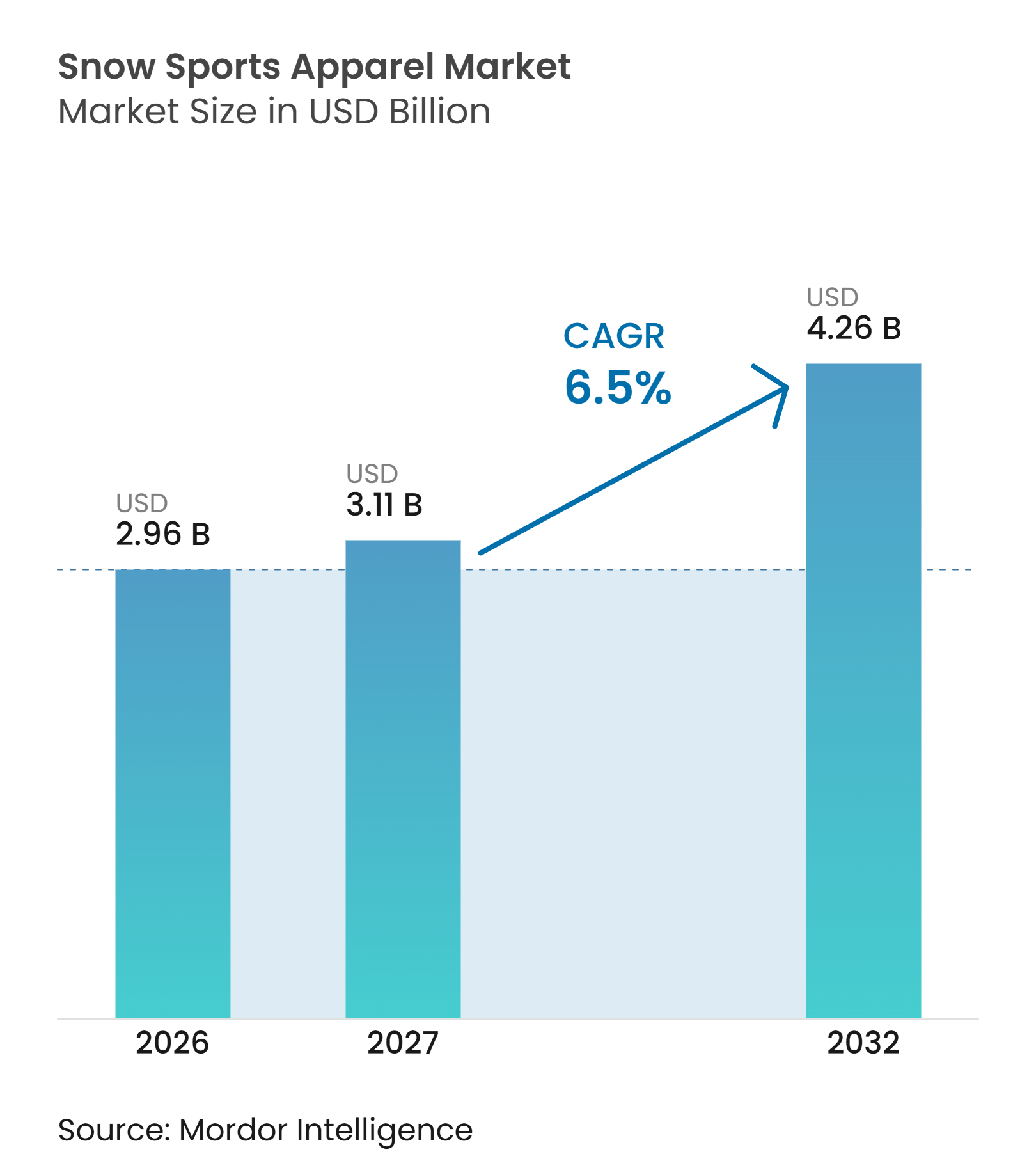
The snow sports apparel market size is expected to grow from USD 2.96 billion in 2026 to USD 3.11 billion in 2027 and is forecast to reach USD 4.26 billion by 2032 at a 6.50% CAGR over 2027-2032. The snow sports apparel market is supported by growing participation in winter sports, increasing interest in outdoor recreational activities, and continued investment in snow sports infrastructure. Rising consumer interest in performance-oriented clothing, combined with demand for functional, comfortable, and versatile apparel, is supporting product innovation and market expansion. Manufacturers are increasingly focusing on technical fabric development, improved insulation, moisture management, and designs that combine athletic performance with everyday wearability. Growing participation among women and younger consumers is further broadening the potential customer base. Additionally, the expansion of digital retail channels and direct-to-consumer platforms is improving product accessibility and strengthening consumer engagement.
Key Report Takeaways
-
By product type, Top Wear held 52.37% of the snow sports apparel market share in 2026, while Socks and Accessories are forecast to grow at an 8.23% CAGR during 2027-2032.
-
By sport type, Alpine Skiing held 54.83% of the snow sports apparel market share in 2026, while Snowboarding is forecast to grow at an 8.17% CAGR during 2027-2032.
-
By end user, Men held 59.83% of the snow sports apparel market share in 2026, while Women are forecast to grow at a 7.89% CAGR during 2027-2032.
-
By distribution channel, Offline Retail Stores held 62.73% of the snow sports apparel market share in 2026, while Online Retail Stores are forecast to grow at an 8.57% CAGR during 2027-2032.
-
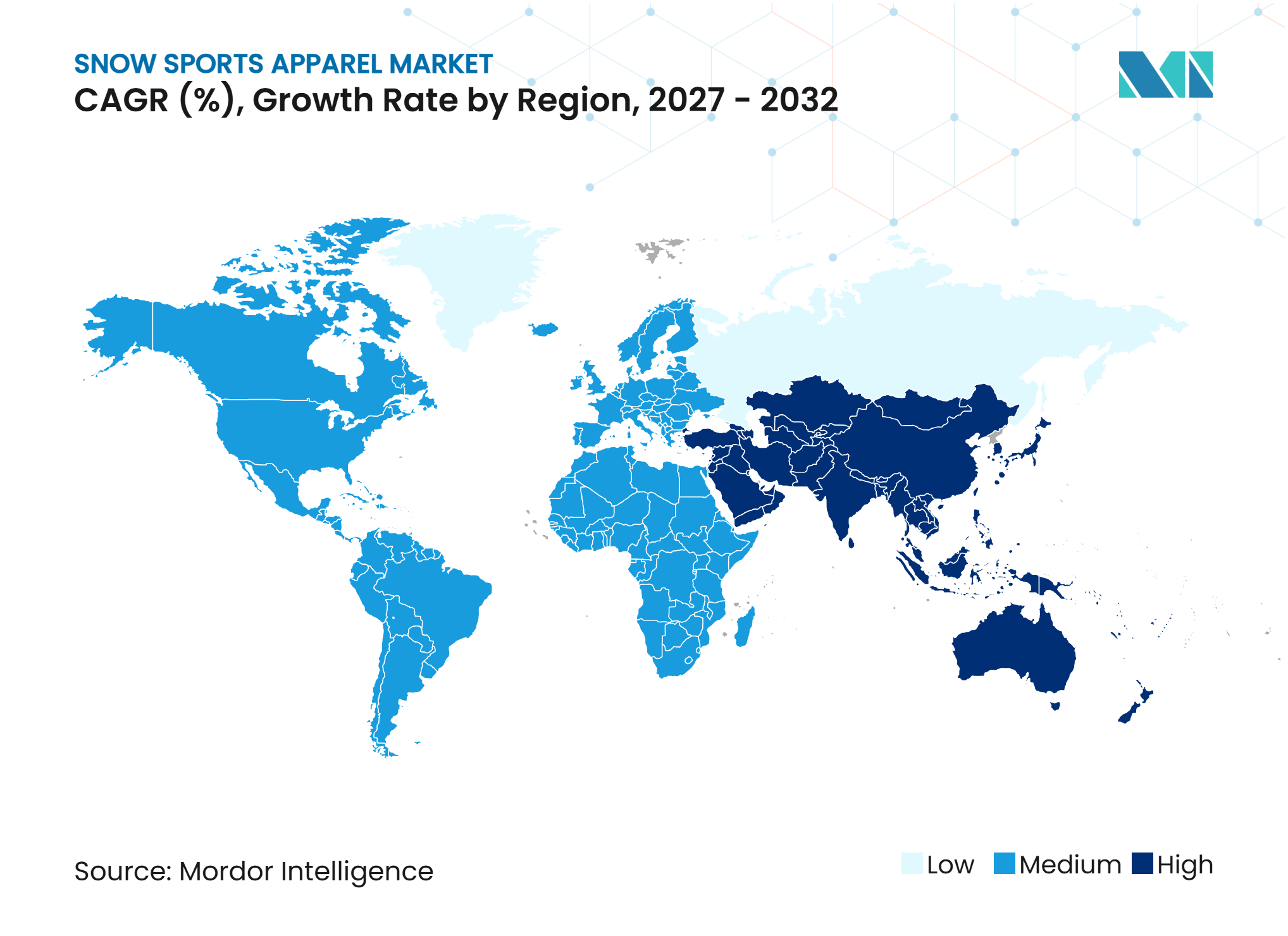
By geography, North America held 37.23% of the snow sports apparel market share in 2026, while Asia-Pacific is forecast to grow at an 8.23% CAGR during 2027-2032.
Note: Market numbers in this report are based on Mordor Intelligence's proprietary estimation framework, which combines nine months of actuals with Q4 projections for base year 2026.
Market Trends and Insights
Drivers Impact Analysis of Snow Sports Apparel Market*
| Driver | (~) % Impact on CAGR Forecast | Geographic Relevance | Impact Timeline |
|---|---|---|---|
| Growth in Snow Sports Participation | +1.4% | Global | Medium term (2-4 years) |
| Growth in Ski Resort Visitation and Winter Tourism | +1.2% | North America and Europe | Short term (≤ 2 years) |
| Expansion of Ski Resort Infrastructure and Year-Round Snow Access | +0.9% | Asia-Pacific, Global | Long term (≥ 4 years) |
| Growing Demand for High-Performance and Weather-Protective Apparel | +1.5% | Global | Short term (≤ 2 years) |
| Growth of E-Commerce and Direct-to-Consumer Retail | +1.2% | Global, led by North America and Asia-Pacific | Medium term (2-4 years) |
| Increasing Influence of Snow Sports Lifestyle and Fashion Trends | +0.8% | Global, led by North America and Europe | Short term (≤ 2 years) |
| Source: Mordor Intelligence | |||
Growth in Snow Sports Participation
Growing participation in snow sports is driving demand for specialized apparel as more consumers take up skiing, snowboarding, and other winter recreational activities. According to Snowsports Industries America (SIA, October 2026), approximately 31.96 million Americans participated in snow sports during the 2025–26 winter season, representing the highest participation level in six seasons[1]. The proportion of the population aged six and older participating in these activities also increased from 10.0% to 10.3%. This expanding base of participants is driving demand for functional, durable, and weather-resistant apparel designed for winter sports. This is also encouraging manufacturers to broaden their product offerings with improved insulation, moisture management, and performance-oriented designs to meet the evolving needs of both recreational and experienced participants.
Growth in Ski Resort Visitation and Winter Tourism
Increasing ski resort visitation and the growing popularity of winter tourism are supporting demand for specialized snow sports apparel. According to the National Ski Areas Association (NSAA, 2025), ski areas recorded approximately 61.65 million visits during the 2024–25 winter season, compared with 60.48 million visits in the preceding season, reflecting increased recreational activity at ski destinations[2]. Rising resort visitation is encouraging greater engagement in skiing, snowboarding, and other snow-based recreational experiences, supporting demand for performance-oriented apparel designed to provide insulation, weather protection, and comfort during outdoor activities.
Expansion of Ski Resort Infrastructure and Year-Round Snow Access
Continued investment in ski resort infrastructure is improving the accessibility and quality of snow sports facilities, supporting wider participation in winter recreational activities. According to the National Ski Areas Association (NSAA, May 2025), United States ski areas invested USD 624.4 million in capital improvements during the 2024–25 season, including 97 new and upgraded lifts[3]. The association also reported that ski areas projected a further USD 560.7 million in capital expenditure for the 2025–26 season, including 47 new lifts and 70 lift upgrades. These investments are supporting improvements to resort infrastructure and visitor facilities, encouraging participation in snow sports, and sustaining demand for specialized apparel designed for skiing and snowboarding.
Growing Demand for High-Performance and Weather-Protective Apparel
Growing consumer preference for high-performance, weather-protective clothing is driving demand for specialized snow sports apparel. Skiing and snowboarding involve exposure to low temperatures, snowfall, wind, and moisture, increasing the need for apparel that provides effective insulation, water resistance, breathability, and thermal comfort. Consumers are increasingly seeking garments that combine technical functionality with flexibility, durability, and freedom of movement during outdoor activities. Manufacturers are responding by developing advanced fabric technologies, improved insulation materials, moisture-management features, and ergonomic designs. The growing emphasis on combining performance, comfort, and contemporary styling is further supporting product innovation and demand across the snow sports apparel market.
Restraints Impact Analysis of Snow Sports Apparel Market*
| Restraint | (~) % Impact on CAGR Forecast | Geographic Relevance | Impact Timeline |
|---|---|---|---|
| Climate Change and Shortening Snow Seasons | -1.5% | Europe (Alps), North America (Midwest and East) | Long term (≥ 4 years) |
| High Cost of Snow Sports Participation and Specialized Apparel | -0.8% | Global | Short term (≤ 2 years) |
| Technical and Material Complexity in Textile Recycling | -0.4% | Global, led by Europe | Medium term (2-4 years) |
| Seasonal Demand Concentration and Inventory Management Challenges | -0.5% | Global | Short term (≤ 2 years) |
| Source: Mordor Intelligence | |||
Climate Change and Shortening Snow Seasons
Climate change and rising global temperatures are affecting snowfall patterns and shortening the duration of natural snow seasons, creating challenges for the snow sports industry. Increasing temperatures, irregular snowfall, and reduced snow cover are affecting the reliability of winter conditions across ski destinations. Shorter operating seasons can limit opportunities for skiing and snowboarding, potentially reducing consumer demand for specialized snow sports apparel. Changing weather conditions are also creating uncertainty around winter tourism activities and influencing consumer purchasing patterns. These factors may constrain market growth by affecting the frequency of snow sports participation and the seasonal demand for performance-oriented apparel.
High Cost of Snow Sports Participation and Specialized Apparel
The high cost of snow sports participation and specialized apparel can limit market adoption, particularly among price-sensitive consumers and occasional participants. Skiing and snowboarding often involve substantial expenses related to equipment, resort access, travel, and accommodation, increasing the overall cost of participation. Additionally, specialized apparel incorporating technical fabrics, advanced insulation, waterproofing, and weather-protection features generally commands higher prices than conventional winter clothing. These costs may discourage first-time buyers and reduce the frequency of apparel purchases among recreational participants. Consequently, affordability constraints can restrict the broader adoption of specialized snow sports apparel and moderate market growth.
*Our forecasts treat driver/restraint impacts as directional, not additive. The impact forecasts reflect baseline growth, mix effects, and variable interactions.
Snow Sports Apparel Market Segment Analysis
By Product Type:
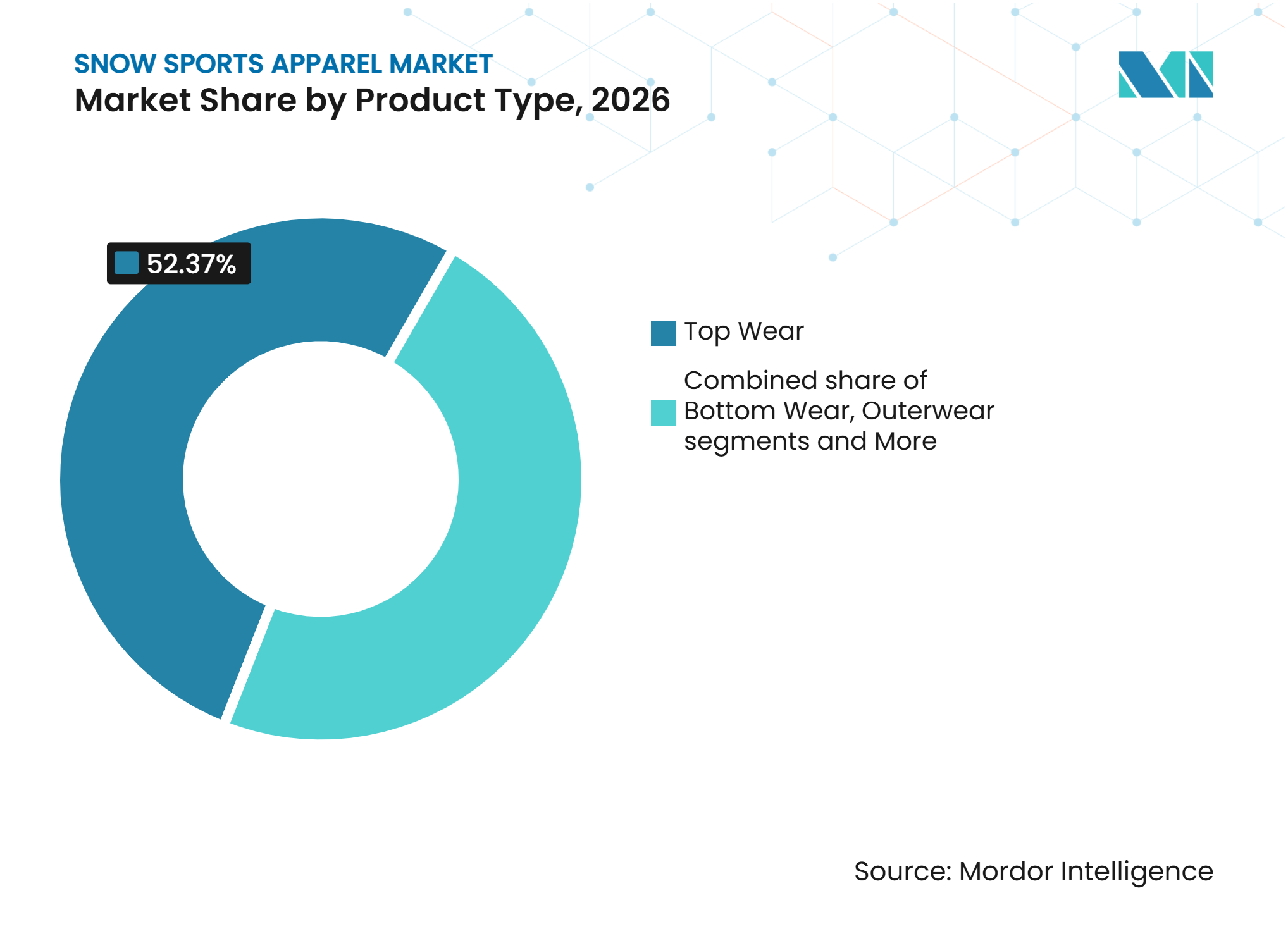
Accessories Outpace as Core Layers MatureTop Wear represents the largest product segment, accounting for 52.37% of the market in 2026. Its leading position is supported by the essential role of jackets and upper-body garments in providing insulation, weather protection, and comfort during snow sports activities. Demand is driven by the need for apparel that combines thermal performance, water resistance, breathability, and flexibility. Continuous product improvements and evolving consumer preferences for functional yet versatile designs are further supporting the segment's market position.
Socks and Accessories is the fastest-growing segment, registering a CAGR of 8.23% through 2032. Growth is supported by rising consumer interest in complementary products that enhance comfort, protection, and convenience for skiing and snowboarding. Demand for specialized socks, gloves, headwear, and other accessories is benefiting from greater awareness of the importance of appropriate snow sports equipment and apparel. Additionally, product innovation, advances in materials technology, and the availability of diverse designs are encouraging more frequent purchases in this segment.



By Sport Type:
Snowboarding Redefines Growth as Youth Participation ExpandsAlpine Skiing represents the largest sport type segment, accounting for 54.83% of the market in 2026. Its leading position is supported by its established base of participants and the demand for specialized apparel for skiing. The sport requires functional clothing that provides thermal insulation, weather resistance, flexibility, and comfort across varying snow conditions. Continued demand for technical clothing and protective garments is supporting the segment's market position.
Snowboarding is the fastest-growing sport type segment, registering a CAGR of 8.17% through 2032. Growth is supported by increasing interest in snowboarding as a recreational and competitive activity, particularly among younger participants. The sport's evolving apparel preferences are encouraging demand for versatile garments that combine technical performance, comfort, and contemporary styling. Continuous product innovation and growing consumer interest in snowboarding-related clothing and accessories are further supporting segment expansion.
By End User:
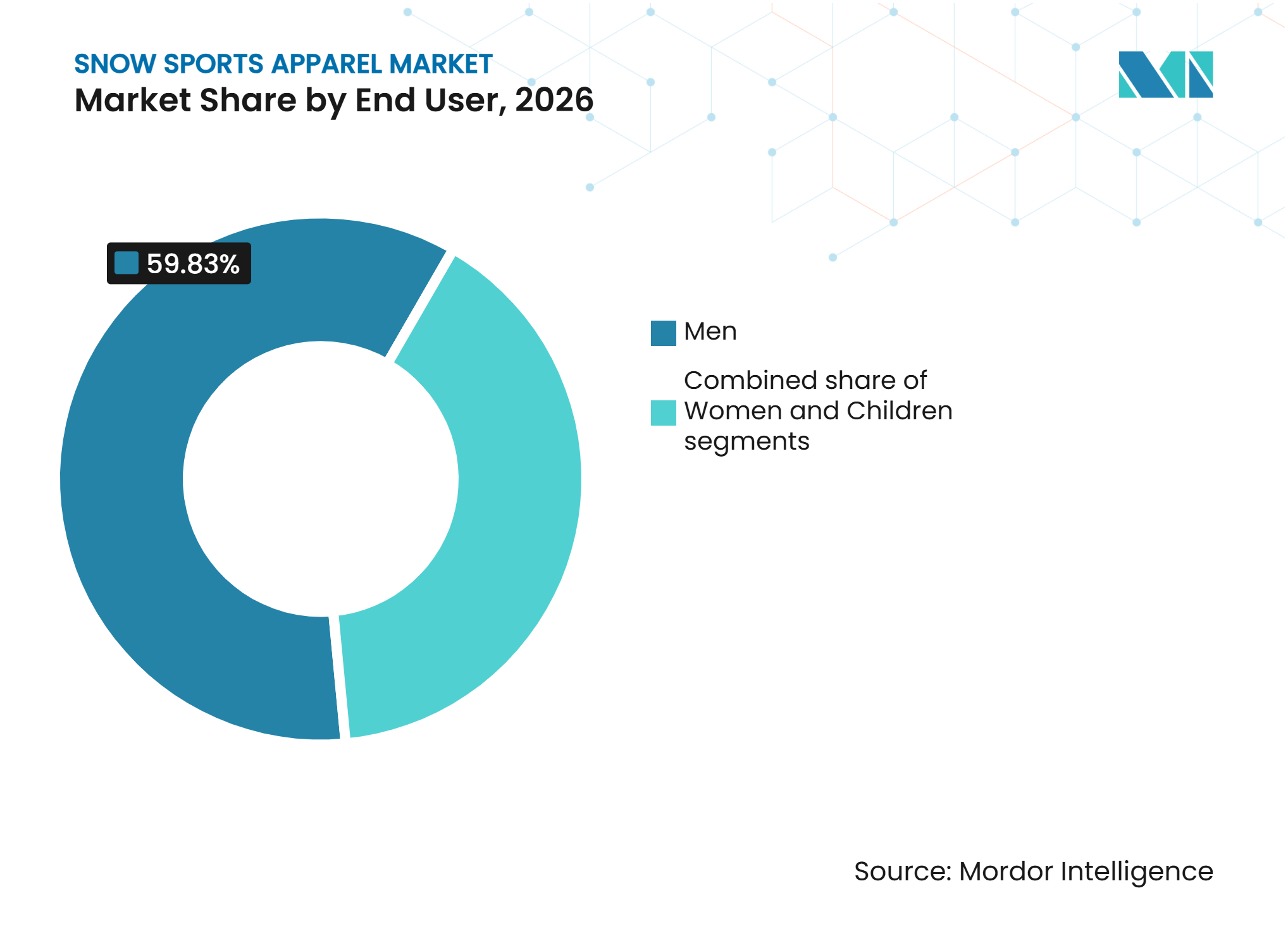
Women's Segment Accelerates on Expanding Participation and Fit DemandMen represent the largest end-user segment, accounting for 59.83% of the market in 2026. Their leading position is supported by an established consumer base and sustained demand for specialized apparel for skiing, snowboarding, and other winter sports. Demand is driven by the need for functional garments that provide thermal insulation, weather protection, durability, and comfort during outdoor activities. Continued interest in technical performance and functional clothing is supporting the segment's market position.
Women represent the fastest-growing end-user segment, registering a CAGR of 7.89% through 2032. Growth is supported by increasing participation in snow sports and expanding consumer demand for apparel designed to address specific fit, comfort, and performance requirements. Manufacturers are increasingly developing dedicated collections that combine technical functionality with contemporary styling and diverse design preferences. Greater product variety and improvements in fit, fabric technology, and functional features further support demand in this segment.

By Distribution Channel:
Offline Anchors Experience, Online Accelerates AccessOffline retail stores represent the largest distribution channel, accounting for 62.73% of the market in 2026. Their leading position is supported by consumers' preference for trying specialized apparel on in person before purchasing, particularly for fit, material quality, comfort, and functional features. Physical stores also provide opportunities for consumers to compare products and receive assistance in selecting apparel suitable for different snow sports. The availability of specialized products and personalized purchasing experiences continues to support demand for offline retail.
Online retail stores represent the fastest-growing distribution channel, registering a CAGR of 8.57% through 2032. Growth is supported by increasing consumer preference for convenient shopping, wider product accessibility, and the ability to compare product specifications across brands. E-commerce platforms and direct-to-consumer channels are also enabling manufacturers to reach a broader customer base beyond traditional retail locations. Improved digital product information, expanded online assortments, and convenient purchasing options further support the growth of this channel.
Geography Analysis
North America
North America represents the largest geographic segment, accounting for 37.23% of the snow sports apparel market in 2026. Its leading position is supported by an established snow sports culture, extensive ski resort infrastructure, and a strong base of recreational and professional participants. Well-developed winter tourism activities and continued investment in ski facilities are sustaining demand for specialized apparel across the region. Consumer preferences are increasingly supporting demand for premium outerwear that combines technical performance, weather protection, durability, and contemporary styling. The presence of established retail networks and specialized apparel manufacturers further strengthens the region's market position.
Asia-Pacific
Asia-Pacific is the fastest-growing geographic segment, registering a projected CAGR of 8.23% during 2027–2032. Growth is supported by increasing participation in snow sports, expanding winter tourism, and continued investment in recreational snow facilities. Rising consumer interest in skiing and snowboarding, particularly among younger populations, is broadening the regional customer base. The development of indoor snow facilities is also expanding access to snow sports beyond the conventional winter season. These developments are supporting demand for specialized apparel, while evolving consumer preferences are encouraging manufacturers to offer products that combine technical functionality with contemporary designs.
Europe, South America, Middle East and Africa
Europe represents another important market, supported by established skiing destinations, a strong winter tourism industry, and developed snow sports apparel manufacturing capabilities. Continued participation in skiing and snowboarding, alongside demand for premium technical clothing, sustains regional demand. South America offers additional growth opportunities through its established mountain resorts and counter-seasonal winter sports calendar, which supports snow sports activities during the Northern Hemisphere's summer months. Meanwhile, the Middle East and Africa present emerging opportunities through investments in indoor snow facilities and winter sports infrastructure, as well as growing interest in specialized recreational experiences. These developments are gradually expanding the potential consumer base and creating additional opportunities for snow sports apparel manufacturers.
Competitive Landscape
Market Concentration

The snow sports apparel market is moderately fragmented, with competition distributed among established multinational companies and specialized apparel manufacturers. Key players include VF Corporation, Columbia Sportswear Company, Amer Sports, Inc., DESCENTE, and Decathlon SE, which maintain competitive positions through diversified product portfolios, established brand recognition, and extensive distribution networks. The market features a mix of large international brands and specialized manufacturers, each targeting distinct consumer segments through differentiated product offerings, technical capabilities, and brand positioning.
Leading players focus on strengthening their market positions through product innovation, portfolio development, athlete sponsorships, and strategic partnerships. Companies are investing in technical fabric development, improved insulation, moisture management, and weather-resistant materials to address the performance requirements of skiing, snowboarding, and other winter sports. Brand collaborations, endorsements, and partnerships with sporting organizations also support brand visibility and consumer engagement. In addition, companies are expanding their digital retail presence and direct-to-consumer channels to improve product accessibility and strengthen customer relationships.
Emerging and specialized players are contributing to market competition through differentiated product designs, proprietary material technologies, and targeted consumer positioning. Some companies are focusing on sustainable materials, circular product design, and improved garment recyclability, while others are developing technical fabrics and performance features to distinguish their offerings. Regional manufacturers and digitally focused brands are also using specialized product portfolios and direct-to-consumer strategies to reach specific consumer groups. These approaches are creating additional competition for established brands and broadening the range of products available in the market.
Snow Sports Apparel Industry Leaders
-
VF Corporation
-
Columbia Sportswear Company
-
Amer Sports, Inc.
-
DESCENTE
-
Decathlon SE
- *Disclaimer: Major Players sorted in no particular order
Snow Sports Apparel Market Companies Covered in this Report
- VF Corporation
- Columbia Sportswear Company
- Amer Sports, Inc.
- Spyder Active Sports, Inc.
- Black Diamond Equipment, Ltd
- Picture Organic Clothing
- Patagonia, Inc.
- ABG-Volcom, LLC
- Helly Hansen
- Burton Snowboards, Inc.
- DESCENTE
- Goldwin Inc.
- Skis Rossignol S.A.
- Decathlon SE
- Lafuma
- Mammut Sports Group AG
- Norrøna Sport AS
- ORTOVOX Sportartikel GmbH
- Obermeyer
- Moncler S.P.A.
Recent Industry Developments in Snow Sports Apparel Market
- November 2026: DICK'S Sporting Goods entered a multi-year partnership with U.S. Ski & Snowboard as its official retail partner and launched an exclusive co-branded apparel collection under its Alpine Design brand. The initial collection included T-shirts and hoodies, with distribution through selected DICK'S stores, its e-commerce platform, and U.S. Ski & Snowboard events.
- November 2026: The North Face launched a 55-piece U.S. Ski & Snowboard capsule collection for Fall/Winter 2026, comprising technical competition outerwear, jackets, fleece, T-shirts, hoodies, hats and other apparel. The launch followed an eight-year partnership announced in May 2026, under which The North Face became the organization's Official Performance Apparel Partner through the 2034 Winter Olympics and Paralympics.
- September 2026: Burton introduced Zeb's Closet, a globally available outerwear and apparel collection developed in partnership with professional snowboarder Zeb Powell. The collection included technical outerwear, insulated vests, snowboarding pants, hoodies, jerseys and accessories, combining performance-oriented construction with streetwear-inspired styling.
- February 2025: Authentic Brands Group granted Outdoor Collective the manufacturing and operating license for its Spyder ski and snow apparel business. Outdoor Collective assumed responsibility for product design, merchandising, sourcing, production, sales, and marketing. The arrangement also provided opportunities to expand Spyder's offerings across on-mountain, freeski, après-ski, and lifestyle apparel categories.
Global Snow Sports Apparel Market Report Scope
The snow sports apparel market includes specialized clothing designed to provide insulation, weather protection, comfort, and performance during skiing, snowboarding, and other snow-based recreational activities. The market is segmented by product type, including top wear, bottom wear, outerwear, socks, and accessories; sport type, including alpine skiing, snowboarding, and other snow sports; end user, including men, women, and children; distribution channel, including online and offline retail stores; and geography, including North America, Europe, Asia-Pacific, South America, and the Middle East and Africa. The market forecasts are provided in terms of value in USD.
Segmentation Overview
| Top Wear |
| Bottom Wear |
| Outerwear |
| Socks and Accessories |
| Alpine Skiing |
| Snowboarding |
| Other Snow Sports |
| Men |
| Women |
| Children |
| Online Retail Stores |
| Offline Retail Stores |
| North America | United States |
| Canada | |
| Mexico | |
| Rest of North America | |
| Europe | Germany |
| United Kingdom | |
| Italy | |
| France | |
| Spain | |
| Netherlands | |
| Poland | |
| Belgium | |
| Sweden | |
| Rest of Europe | |
| Asia-Pacific | China |
| India | |
| Japan | |
| Australia | |
| Indonesia | |
| South Korea | |
| Thailand | |
| Singapore | |
| Rest of Asia-Pacific | |
| South America | Brazil |
| Argentina | |
| Colombia | |
| Chile | |
| Peru | |
| Rest of South America | |
| Middle East and Africa | South Africa |
| Saudi Arabia | |
| United Arab Emirates | |
| Nigeria | |
| Egypt | |
| Morocco | |
| Turkey | |
| Rest of Middle East and Africa |
| By Product Type | Top Wear | |
| Bottom Wear | ||
| Outerwear | ||
| Socks and Accessories | ||
| By Sport Type | Alpine Skiing | |
| Snowboarding | ||
| Other Snow Sports | ||
| By End User | Men | |
| Women | ||
| Children | ||
| By Distribution Channel | Online Retail Stores | |
| Offline Retail Stores | ||
| By Geography | North America | United States |
| Canada | ||
| Mexico | ||
| Rest of North America | ||
| Europe | Germany | |
| United Kingdom | ||
| Italy | ||
| France | ||
| Spain | ||
| Netherlands | ||
| Poland | ||
| Belgium | ||
| Sweden | ||
| Rest of Europe | ||
| Asia-Pacific | China | |
| India | ||
| Japan | ||
| Australia | ||
| Indonesia | ||
| South Korea | ||
| Thailand | ||
| Singapore | ||
| Rest of Asia-Pacific | ||
| South America | Brazil | |
| Argentina | ||
| Colombia | ||
| Chile | ||
| Peru | ||
| Rest of South America | ||
| Middle East and Africa | South Africa | |
| Saudi Arabia | ||
| United Arab Emirates | ||
| Nigeria | ||
| Egypt | ||
| Morocco | ||
| Turkey | ||
| Rest of Middle East and Africa | ||
Key Questions Answered in the Report
What is the projected value of snow sports apparel by 2032?
The sector is forecast to reach USD 4.26 billion by 2032, rising from USD 3.11 billion in 2027 at a 6.50% CAGR.
Which product category has the largest position in snow sports apparel?
Top Wear held 52.37% of revenue in 2026.
Which snow sports apparel category is growing fastest?
Socks and Accessories is forecast to grow at an 8.23% CAGR during 2027-2032.
Which sport is driving demand for snowboarding clothing?
Snowboarding is forecast to grow at an 8.17% CAGR through 2032.