
Smart Fuel Dispenser Market Size and Share
Market Overview
| Study Period | 2021 - 2031 |
|---|---|
| Market Size (2026) | USD 1.07 Billion |
| Market Size (2031) | USD 2.12 Billion |
| Growth Rate (2026 - 2031) | 14.71 % |
| Fastest Growing Market | Asia-Pacific |
| Largest Market | Asia-Pacific |
| Market Concentration | Medium |
Major Players *Disclaimer: Major Players sorted in no particular order Image © Mordor Intelligence. Reuse requires attribution under CC BY 4.0. | |
Smart Fuel Dispenser Market Analysis by Mordor Intelligence
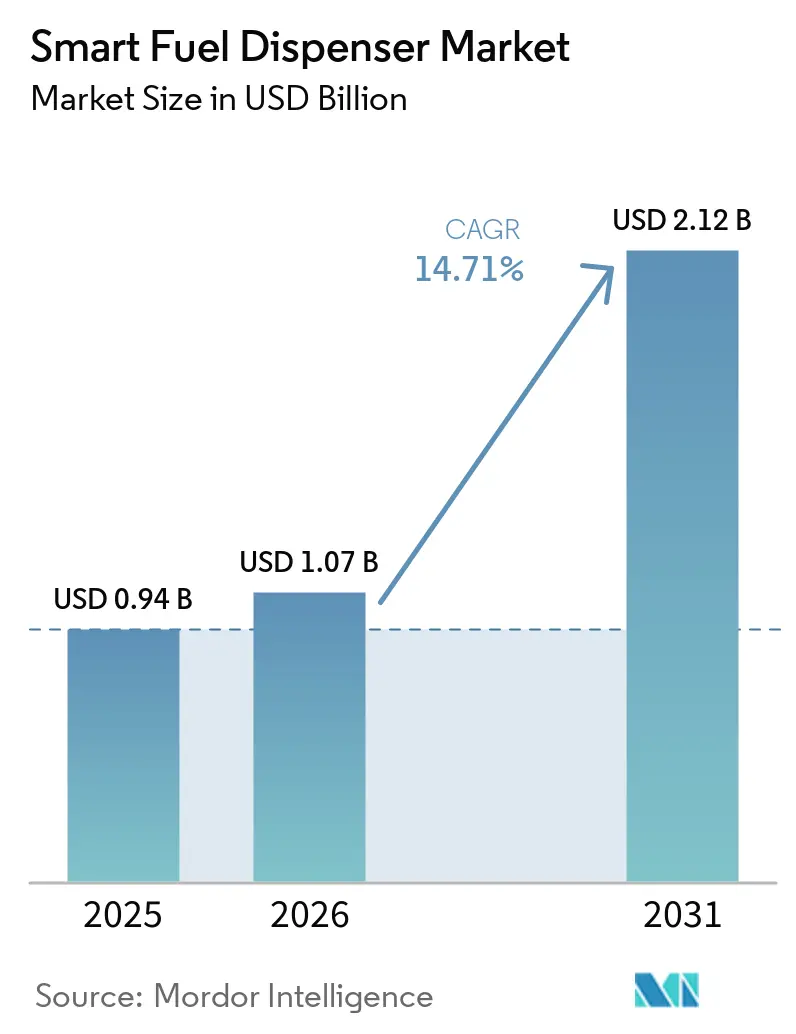
The Smart Fuel Dispenser Market size is expected to increase from USD 0.94 billion in 2025 to USD 1.07 billion in 2026 and reach USD 2.12 billion by 2031, growing at a CAGR of 14.71% over 2026-2031. The smart fuel dispenser market is moving from mechanical metering toward connected equipment that records transactions, supports payment security, and gives operators more control over each site. Payment compliance, alternative-fuel infrastructure, and fleet monitoring are shaping purchasing decisions across the smart fuel dispenser market. Growth has two foundations: new retail sites in emerging economies and replacement demand in established fuel retail networks. Liquid-fuel vehicles still support recurring upgrades, even as electrification changes long-term fuel demand in some countries. Higher-value equipment, software subscriptions, remote service, and multi-energy capability can increase revenue per unit where fuel volumes weaken.
Key Report Takeaways
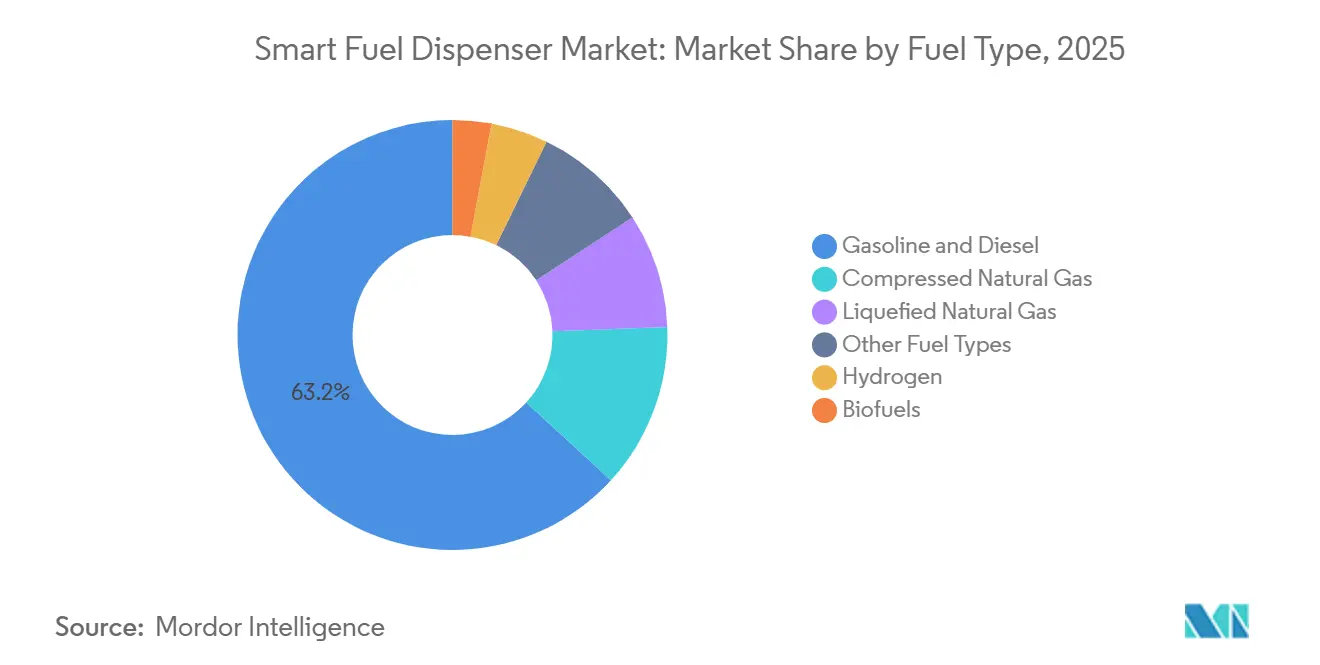
- By fuel type, gasoline and diesel dispensers held 63.2% of smart fuel dispenser market share in 2025, while hydrogen is forecast to grow at a 19.4% CAGR through 2031.
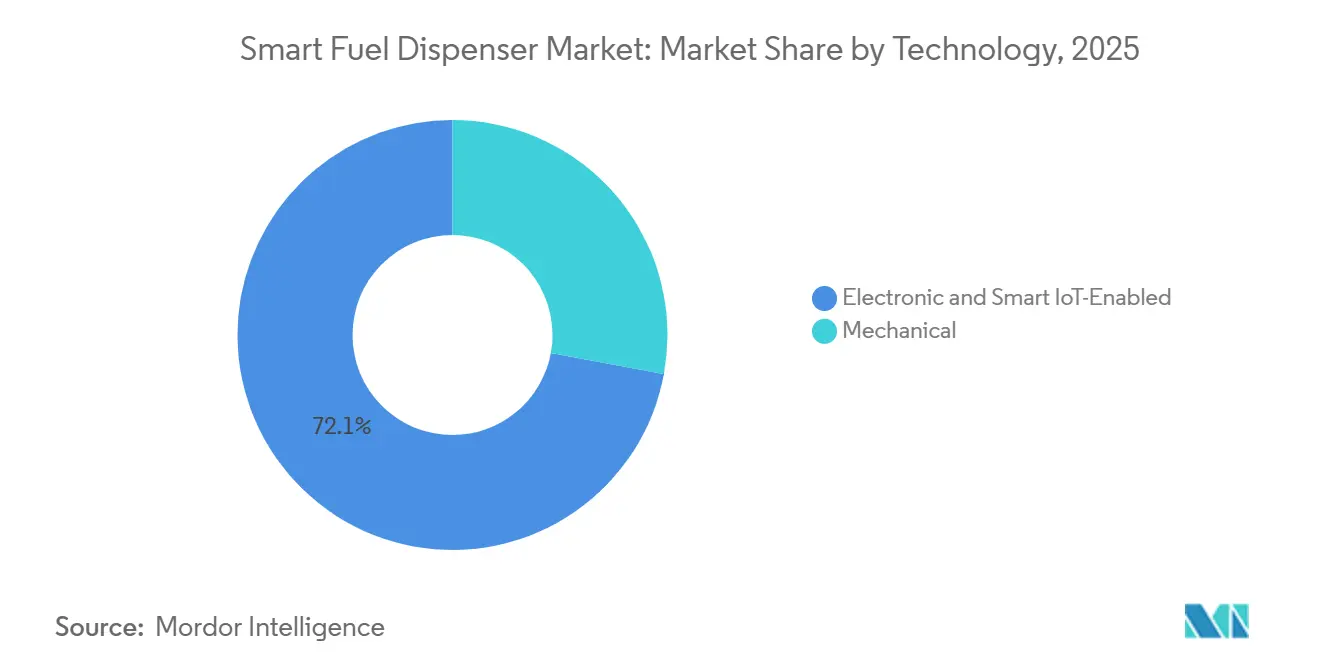
- By technology, electronic fuel dispensers accounted for 51.4% of revenue in 2025, while IoT-enabled smart dispensers are forecast to expand at a 15.1% CAGR through 2031.
- By end user, oil marketing companies held 53.7% of the smart fuel dispenser market in 2025, while fleet operators recorded the highest projected CAGR at 15.9% through 2031.
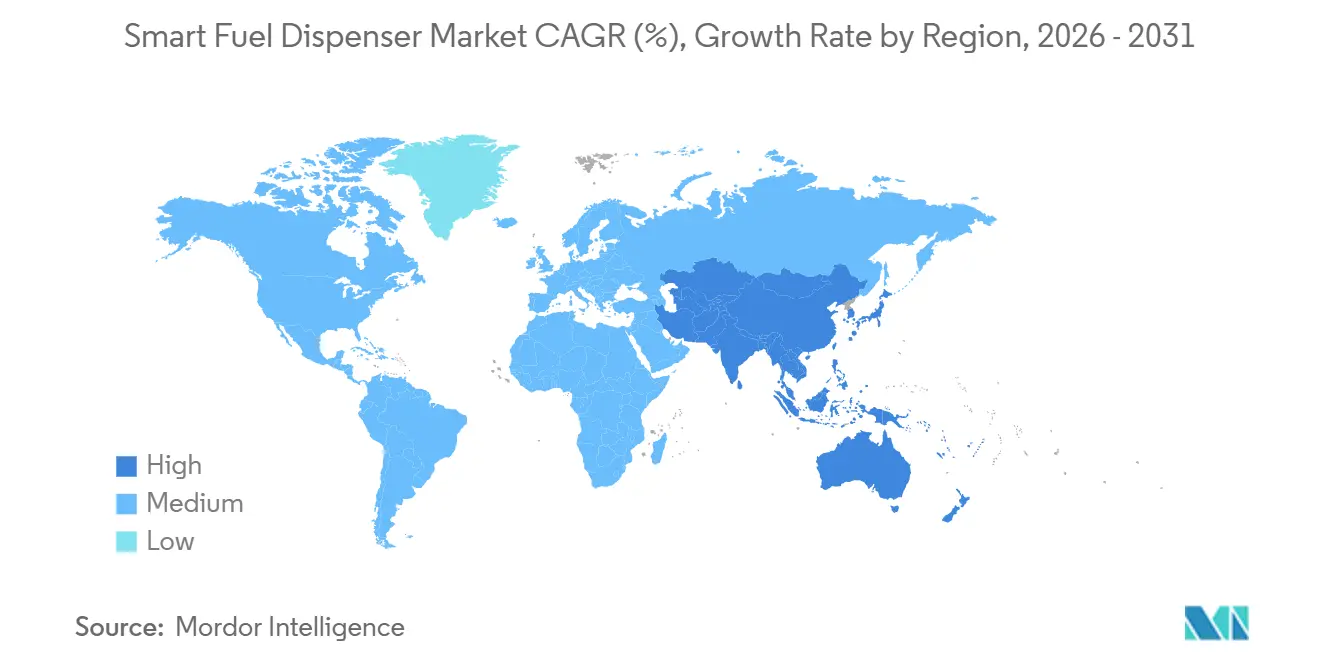
- By geography, Asia-Pacific held 33.5% of revenue in 2025 and is forecast to expand at a 16.6% CAGR through 2031.
Note: Market size and forecast figures in this report are generated using Mordor Intelligence’s proprietary estimation framework, updated with the latest available data and insights as of January 2026.
Market Trends and Insights
Drivers Impact Analysis of Smart Fuel Dispenser Market*
| Driver | (~) % Impact on CAGR Forecast | Geographic Relevance | Impact Timeline |
|---|---|---|---|
| Fuel-Retail Infrastructure Expansion in Emerging Economies | +3.50% | Asia-Pacific, Sub-Saharan Africa, South America | Long term (≥ 4 years) |
| Mandatory EMV and Contactless Payment Upgrades | +2.80% | North America & Europe | Short term (≤ 2 years) |
| Alternative-Fuel and Multi-Energy Station Investment | +2.20% | APAC core, spill-over to Europe and MEA | Medium term (2-4 years) |
| Fleet Fuel Accountability and Remote Monitoring | +2.00% | Global | Medium term (2-4 years) |
| Dispenser Data Monetization and Predictive Maintenance | +1.50% | North America, Europe | Long term (≥ 4 years) |
| AFD Certification-Driven Replacement Cycle | +1.20% | North America, with growing adoption in Europe | Short term (≤ 2 years) |
| Source: Mordor Intelligence | |||
Fuel-Retail Infrastructure Expansion in Emerging Economies
New sites across South and Southeast Asia, Sub-Saharan Africa, and Latin America support demand for the smart fuel dispenser market. India had more than 100,000 fuel retail outlets by 2025, compared with 51,870 in 2014, and Indian Oil Corporation operated more than 41,000 outlets, with nearly one-third serving rural areas[1]. New-build sites increasingly specify digital dispensers, automatic tank gauging, and cashless payments from installation. Dangote Refinery announced direct fuel supply to retail stations in June 2025, alongside 4,000 CNG-powered trucks and more than 100 planned CNG refueling stations in Nigeria[2]. These projects create equipment demand as operators add retail capacity and fuel options. Greenfield sites can deploy connected equipment at the outset rather than replace older mechanical assets over several cycles. This places the smart fuel dispenser market in a different adoption position from mature markets with large legacy installations.
Mandatory EMV and Contactless Payment Upgrades
Payment security requirements are creating a defined replacement cycle for fuel retailers in North America and Europe. PCI DSS 4.0 took effect on March 31, 2025, with stricter requirements for encryption, access management, and audit trails in fuel retail payment environments. PCI PTS v4 devices could not be newly deployed after April 30, 2024, while PTS v5 equipment faces a new-deployment cutoff on April 30, 2027[3]. The U.S. Payments Forum reported that nearly 1.9 million automated fuel dispenser payment devices in the United States face linked PCI PTS and EMV Level 1, Level 2, and Level 3 certification transitions. Operators must coordinate hardware, payment software, and certified installation work. Larger networks can spread these costs across many sites, while independent stations face narrower financial room for upgrades. The smart fuel dispenser market benefits when compliance requires a complete replacement rather than a limited repair.
Alternative-Fuel and Multi-Energy Station Investment
Multi-energy stations are increasing the importance of dispensers that can support gasoline, CNG, LNG, hydrogen, and charging services at one location. There were 1,160 hydrogen refueling stations operating globally at the end of 2024, after a net addition of 125 stations during the year. China had 384 hydrogen stations, followed by South Korea with 198, Japan with 161, and Europe with 294. India’s PNGRB framework targeted 350 LNG refueling stations by 2030 to support a planned shift of one-third of the heavy-duty fleet to LNG. These sites require more complex equipment selection, certification, and service capability. Suppliers with approvals across several fuels can participate in a wider range of projects. This gives the smart fuel dispenser market a path to higher-value installations even where conventional dispenser volumes grow more slowly.
Fleet Fuel Accountability, Remote Monitoring, and Certification Replacement
Fleet operators need equipment that can verify fuel use, reduce pilferage, and provide transaction records to fleet and logistics systems. Nayax deployed OTI PetroSmart’s EasyFuelPlus RFID system for Tesco’s United Kingdom fleet, covering 14 distribution centers and more than 5,000 vehicles by early 2026. The system supports automatic fuel-grade verification, odometer capture, and real-time monitoring through the FuelReporter platform. Dover Fueling Solutions introduced the PetroVend Synergy Fuel Site Controller in July 2024, combining fleet card management, remote site monitoring, and alerts in one platform[4]. Remote diagnostics, predictive maintenance, and cloud access also make data architecture part of the purchasing decision. Certification replacement adds urgency because operators cannot always separate payment upgrades from controller and connectivity changes. The smart fuel dispenser market, therefore, gains from the combined need for accountable fleet fueling, digital services, and compliant payment equipment.
Restraints Impact Analysis of Smart Fuel Dispenser Market*
| Restraint | (~) % Impact on CAGR Forecast | Geographic Relevance | Impact Timeline |
|---|---|---|---|
| Electric-Vehicle Displacement of OECD Liquid-Fuel Volumes | -1.80% | North America, Europe, China | Long term (≥ 4 years) |
| High Retrofit and Integration Costs | -1.20% | Global, concentrated in independent operators in APAC and Africa | Medium term (2-4 years) |
| Certification and Technician Bottlenecks | -0.80% | North America, Europe | Short term (≤ 2 years) |
| Connected-Forecourt Cybersecurity Liability | -0.60% | Global | Medium term (2-4 years) |
| Source: Mordor Intelligence | |||
Electric-Vehicle Displacement of OECD Liquid-Fuel Volumes
Electric vehicle adoption is a long-term constraint on liquid-fuel throughput in OECD markets. International Energy Agency indicated that electric vehicles displaced 1.8 million barrels of oil per day in 2025 and that displacement was expected to rise through 2029. It also stated that the IEA lowered its 2030 estimate to 5.4 million barrels per day from 6 million barrels per day because electric vehicle adoption in the United States was slower than expected. The effect differs by region because India and Sub-Saharan Africa continue to add liquid-fuel demand through 2030. European and North American sites are more exposed to lower transaction frequency and weaker payback on premium equipment. The smart fuel dispenser market can partly offset lower volume through software, data services, and multi-energy upgrades, but this does not remove the risk to conventional fuel throughput.
High Retrofit, Integration, and Security Costs
Legacy upgrades can be costly when they combine contactless payment, connected controls, and support for more than one fuel. Compliance work may require upgraded controllers and communication systems, followed by sequenced EMV Level 1, Level 2, and Level 3 certification by qualified technicians. Technician availability can delay deployment in North America and Europe. Local payment networks in emerging markets can add software integration work where standards are fragmented. Networked forecourts also face cybersecurity obligations as more operating technology becomes connected. CISA issued advisory ICS-IA-24-268-04 after vulnerabilities were identified in automated tank gauge products during 2024. These costs can slow adoption by independent operators even when the smart fuel dispenser market offers clear operating benefits.
*Our forecasts treat driver/restraint impacts as directional, not additive. The impact forecasts reflect baseline growth, mix effects, and variable interactions.
Smart Fuel Dispenser Market Segment Analysis
By Fuel Type:
Gasoline and Diesel Anchor Revenue While Hydrogen Grows FastestGasoline and diesel dispensers held 63.2% of the smart fuel dispenser market size in 2025 because liquid-fuel vehicles remained the largest part of the global vehicle base. The category remains central to replacement programs at conventional fuel stations. CNG equipment is gaining use in emerging markets where governments and fuel suppliers support gas-powered fleets. Nigeria’s NNPC commissioned a Lagos CNG station in May 2024 with a capacity of 5.2 million standard cubic feet per day and service potential of 3,700 vehicles daily. LNG dispensers serve long-haul commercial vehicles, while India’s planned 350 LNG stations provide a defined deployment path. Biofuels and other fuel types remain smaller categories, but they remain relevant where blending rules apply in Southeast Asia, Brazil, and the European Union.
Hydrogen is forecast to be the fastest-growing fuel type at a 19.4% CAGR through 2031. Its growth reflects commercial vehicle programs in East Asia and Northern Europe rather than the broad replacement of conventional retail dispensing. China, South Korea, Japan, and Europe accounted for much of the global hydrogen station base at the end of 2024. Tatsuno displayed its LUMINOUS H2 dual-nozzle high-pressure hydrogen dispenser for large fuel-cell trucks at H2 and FC EXPO Tokyo in February 2024. Hydrogen equipment is more specialized than conventional dispensing equipment. This can support stronger equipment margins for suppliers that meet the necessary technical and regulatory requirements. The smart fuel dispenser industry is therefore adding alternative-fuel capability while conventional liquid-fuel equipment continues to provide most revenue.

By Technology:
Electronic Equipment Leads While IoT-Enabled Smart Dispensers Grow FastestElectronic fuel dispensers accounted for 51.4% of the smart fuel dispenser market size in 2025. This category supports modern fuel retail operations through digital metering, transaction logging, integrated automatic tank gauging, and cashless payment capability. It connects the older mechanical installed base with fully connected forecourt equipment. Mechanical dispensers retain a narrowing role in off-grid and rural locations in parts of Sub-Saharan Africa and Southeast Asia. Grid reliability and communication infrastructure can still limit more advanced equipment in these settings. New-build sites in cost-sensitive areas increasingly require a minimum level of electronic transaction accountability. This makes electronic dispensers the default equipment choice across a broad range of retail locations.
IoT-enabled smart dispensers are forecast to be the fastest-growing technology category at a 15.1% CAGR through 2031. Cloud services, application programming interface connections, and remote management extend the service value of installed equipment beyond the initial hardware sale. Dover Fueling Solutions launched RDM by DFS for EMEA in May 2024, allowing retailers to diagnose and reboot Wayne Helix dispensers remotely. Gilbarco Veeder-Root launched the PCN5 pump control node with Cat3 certification in October 2024 to support remote updates across multi-brand forecourt equipment. AI and biometric smart dispensers form an emerging category within the supplied segmentation, alongside other technology types. Connected equipment makes industrial cybersecurity and IEC 62443 a more relevant part of technical evaluation. These developments shift competition in the smart fuel dispenser industry beyond mechanical accuracy alone.
By End User:
Oil Marketing Companies Lead While Fleets Digitize Fuel ControlOil marketing companies held 53.7% of the smart fuel dispenser market in 2025. Their procurement role across large retail networks allows technical standards to be adopted across dealer-operated sites. IOCL, BPCL, HPCL, and Nayara Energy collectively operated more than 90,000 retail outlets in India. Independent station operators and industrial companies are meaningful secondary buyers. Industrial customers often require equipment certified for hazardous environments. Transportation, mining, and airport customers are smaller but can require more specialized configurations. Global Cynax’s supply of Tatsuno dispensers for Hazrat Shahjalal International Airport’s third terminal illustrates the use of specialized equipment in aviation applications.
Fleet operators are forecast to grow at a 15.9% CAGR through 2031, making them the fastest-growing end-user group. Rising fuel costs and corporate sustainability requirements are increasing demand for accurate records and per-vehicle controls. The Tesco deployment shows that RFID-enabled systems can be deployed across large distribution networks. PetroVend Synergy combines a previously fragmented set of fleet-fueling functions into one management interface. Fleet buyers require machine-readable records and links to logistics systems. That requirement favors suppliers that can provide connected software as well as equipment. The smart fuel dispenser market is becoming more closely tied to daily fleet operations and compliance reporting.
Geography Analysis
APAC and Africa Smart Fuel Dispenser Market
Asia-Pacific held 33.5% of the smart fuel dispenser market in 2025 and is projected to grow at a 16.6% CAGR through 2031. The region combines conventional station development with hydrogen, LNG, CNG, and connected-retail investments. China had 384 hydrogen stations at the end of 2024, including 30 new stations opened during the year. Domestic suppliers such as Censtar and Beijing SANKI are building certifications that can support export activity in Southeast Asia and Africa. India’s 350-station LNG target creates a public policy basis for equipment demand. South Korea and Japan also have established hydrogen networks, with 198 and 161 stations, respectively, at the end of 2024. Vietnam, Indonesia, and Thailand are additional growth areas as vehicle ownership and new fuel retail construction increase.
North America and Europe Smart Fuel Dispenser Market
North America and Europe contribute a large share of premium dispenser value because payment compliance raises equipment requirements. Nearly 1.9 million U.S. automated fuel dispenser payment devices are affected by the migration from PCI PTS v5 to newer standards. April 2027 is the cutoff for new PTS v5 deployments, which gives suppliers a clear replacement deadline. Europe had 294 hydrogen refueling stations at the end of 2024. Germany had 113 stations, France had 65, and the Netherlands had 25. The European Union Measuring Instruments Directive can require re-verification when dispensers are integrated with new electronic point-of-sale systems. This additional compliance step can slow modernization at smaller independent sites while supporting demand for qualified suppliers.
MEA and South America Smart Fuel Dispenser Market
South America, the Middle East, and Africa offer smaller but distinct opportunities for the smart fuel dispenser market. Brazil’s Inmetro recertification requirement for dispensers built under pre-2021 rules created a compliance-related refresh cycle from 2024. This activity can also influence demand in Argentina and Chile. ADNOC Distribution’s reported 2025 plans included annual investment of USD 250 million to USD 300 million in Egypt, Saudi Arabia, and the United Arab Emirates, as well as 40 to 50 new service stations each year. Dangote’s direct-supply plan and proposed CNG station network point to a vertically integrated fuel infrastructure model in Nigeria. Such projects can set common dispenser specifications across a larger connected supply system. These regions combine regulation-led replacements with new construction and alternative-fuel investment.
Competitive Landscape
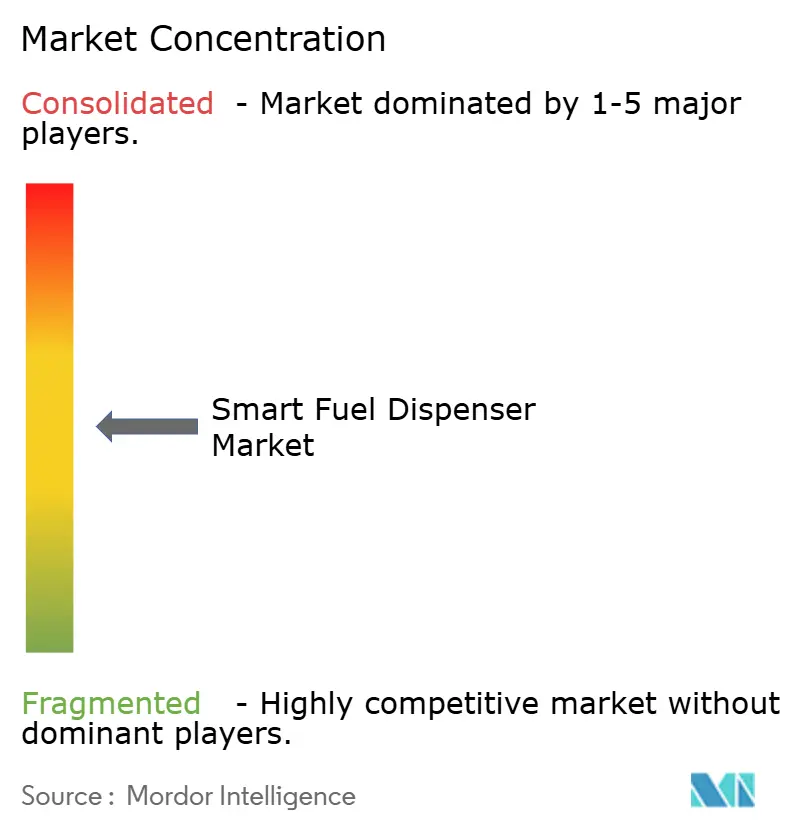
The smart fuel dispenser market is moderately consolidated in its premium technology tier. Dover Fueling Solutions, Gilbarco Veeder-Root, and Tatsuno compete through certified product ranges, connected platforms, and service capability. Competition increasingly extends beyond hardware pricing because connected dispensers can support diagnostics, software subscriptions, and screen-based services. Dover Fueling Solutions launched 4Court Media in December 2025 across more than 1,500 U.S. sites and 13,000 Wayne Ovation screens. This supports retail media revenue while consumers are at the pump. Dover reported that 36% of retailers surveyed for its Retail Rewired 2026 report planned to increase investment in promotion technology. The smart fuel dispenser market, therefore, gives leading suppliers a way to create recurring digital revenue from an installed equipment base.
Gilbarco Veeder-Root’s October 2024 product releases included its PCN5 control node and the Hub cloud integration platform for multi-brand forecourt equipment. These platforms can retain customer relationships by bringing devices into one management interface. Chinese manufacturers, including Censtar Science and Technology, Beijing SANKI, Zhejiang Lanfeng, and Zhejiang Datian, are expanding in Southeast Asia and Africa through lower prices. Their connected capabilities are narrowing the technology gap that supported Western supplier margins in developing markets. A gap remains for suppliers with certifications across gasoline, diesel, CNG, LNG, hydrogen, and electric vehicle charging in one product family. Open payment middleware is also relevant because operators must connect equipment with varied payment systems. This creates room for suppliers that can combine fuel flexibility with secure systems integration.
Cybersecurity is becoming a clearer point of competition in the smart fuel dispenser market. Research disclosed 11 critical vulnerabilities across 6 automated tank gauge models in 2024, including a CVSS 10.0 command-injection flaw identified as CVE-2024-43693. CISA’s related advisory brought greater attention to secure firmware and network controls. Enterprise customers and oil marketing companies increasingly assess connected-forecourt security during procurement. IEC 62443 is becoming a relevant industrial cybersecurity reference for suppliers. Suppliers with established security processes can reduce an operator’s integration and compliance burden. Pricing pressure from lower-cost producers remains strongest where basic dispensing hardware is the main requirement. Premium suppliers retain an advantage where payment certification, multi-fuel capability, cloud functions, and security must work together.
Smart Fuel Dispenser Industry Leaders
-
Gilbarco Veeder-Root
-
Dover Fueling Solutions
-
Tatsuno Corporation
-
Censtar Science & Technology Co., Ltd.
-
Bennett Pump Company
- *Disclaimer: Major Players sorted in no particular order
Smart Fuel Dispenser Market Companies Covered in this Report
- Beijing SANKI Petroleum Technology Co., Ltd.
- Bennett Pump Company
- Censtar Science & Technology Co., Ltd.
- Dover Fueling Solutions
- Gilbarco Veeder-Root
- Jiangyin Furen High-Tech Co., Ltd.
- Korea EnE Co., Ltd.
- Neotec
- PIUSI S.p.A.
- Saike Group
- Scheidt & Bachmann GmbH
- Tatsuno Corporation
- Tokheim
- Tominaga Mfg. Company
- Zhejiang Datian Machine Co., Ltd.
- Zhejiang Lanfeng Machine Co., Ltd.
Recent Industry Developments in Smart Fuel Dispenser Market
- December 2025: Dover Fueling Solutions launched 4Court Media, a retail media network across more than 1,500 U.S. locations and 13,000 Wayne Ovation® dispenser screens, connecting brands with consumers at the pump through programmatic channels and generating non-fuel revenue for forecourt operators.
- September 2025: OKet and Tatsuno Malaysia jointly showcased integrated IoT fuel management solutions, combining OKet's ATG and leak detection systems with Tatsuno's terminal hardware, at Shell Malaysia's Central Site Hero Day 2025, targeting Shell retailers across the Malaysian downstream network.
- June 2025: Nigeria's Dangote Refinery began direct fuel supply to retail stations, deploying 4,000 CNG-powered trucks and committing to building over 100 CNG refueling stations nationwide, reshaping downstream fuel infrastructure and creating a material CNG dispenser procurement pipeline in Sub-Saharan Africa.
- June 2025: Gilbarco Veeder-Root and Arxax activated their integrated digital green fueling solution, combining Gilbarco's Mobile Payment Service with Arxax's H2LLO Connect telematics-linked platform to enable cardless, smartphone-based refueling for medium- and heavy-duty fleets targeting decarbonization.
Global Smart Fuel Dispenser Market Report Scope
A smart fuel dispenser is an advanced fuel dispensing system that integrates conventional fuel dispensing equipment with digital technologies, sensors, connectivity, automation, and data analytics. This enables accurate, secure, and remotely monitored dispensing of fuels such as gasoline, diesel, CNG, LNG, and other alternative fuels. Unlike conventional fuel dispensers, smart dispensers can automatically collect and transmit transaction and operational data, monitor fuel inventory and equipment conditions, authenticate users, detect abnormal activities, and integrate with payment systems, fuel management software, IoT platforms, and station management systems.
The Smart Fuel Dispenser Market is segmented by fuel type, technology, end user, and geography. By fuel type, the market is segmented into gasoline and diesel, CNG, LNG, hydrogen, biofuels, and other fuel types. By technology, the market is segmented into mechanical, electronic, and smart IoT-enabled fuel dispensers. By end user, the market is segmented into oil marketing companies, independent operators, fleet operators, industrial, mining, transportation, airports, and other end users. The report also covers the market size and forecasts for the global Smart Fuel Dispenser Market across 26 countries in key regions. For each segment, the market sizing and forecasts have been provided on the basis of value (USD).
Segmentation Overview
| Gasoline and Diesel |
| Compressed Natural Gas |
| Liquefied Natural Gas |
| Hydrogen |
| Biofuels |
| Other Fuel Types |
| Electronic Fuel Dispensers |
| IoT-Enabled Smart Dispensers |
| AI and Biometric Smart Dispensers |
| Others |
| Oil Marketing Companies |
| Independent Fuel Station Operators |
| Fleet Operators |
| Industrial Companies |
| Mining Companies |
| Transportation Companies |
| Airports and Aviation Companies |
| Other End Users |
| North America | United States |
| Canada | |
| Mexico | |
| Europe | Germany |
| France | |
| Italy | |
| Spain | |
| United Kingdom | |
| Poland | |
| Russia | |
| Rest of Europe | |
| Asia-Pacific | China |
| India | |
| Japan | |
| South Korea | |
| Australia | |
| Indonesia | |
| Vietnam | |
| Thailand | |
| Rest of Asia-Pacific | |
| South America | Brazil |
| Argentina | |
| Chile | |
| Rest of South America | |
| Middle East and Africa | Saudi Arabia |
| United Arab Emirates | |
| Egypt | |
| South Africa | |
| Morocco | |
| Rest of Middle East and Africa |
| By Fuel Type | Gasoline and Diesel | |
| Compressed Natural Gas | ||
| Liquefied Natural Gas | ||
| Hydrogen | ||
| Biofuels | ||
| Other Fuel Types | ||
| By Technology | Electronic Fuel Dispensers | |
| IoT-Enabled Smart Dispensers | ||
| AI and Biometric Smart Dispensers | ||
| Others | ||
| By End User | Oil Marketing Companies | |
| Independent Fuel Station Operators | ||
| Fleet Operators | ||
| Industrial Companies | ||
| Mining Companies | ||
| Transportation Companies | ||
| Airports and Aviation Companies | ||
| Other End Users | ||
| By Geography | North America | United States |
| Canada | ||
| Mexico | ||
| Europe | Germany | |
| France | ||
| Italy | ||
| Spain | ||
| United Kingdom | ||
| Poland | ||
| Russia | ||
| Rest of Europe | ||
| Asia-Pacific | China | |
| India | ||
| Japan | ||
| South Korea | ||
| Australia | ||
| Indonesia | ||
| Vietnam | ||
| Thailand | ||
| Rest of Asia-Pacific | ||
| South America | Brazil | |
| Argentina | ||
| Chile | ||
| Rest of South America | ||
| Middle East and Africa | Saudi Arabia | |
| United Arab Emirates | ||
| Egypt | ||
| South Africa | ||
| Morocco | ||
| Rest of Middle East and Africa | ||
Key Questions Answered in the Report
What is the forecast for smart fuel dispensers through 2031?
The smart fuel dispenser market is projected to grow from USD 1.07 billion in 2026 to USD 2.12 billion by 2031 at a 14.71% CAGR.
Which fuel type will grow fastest through 2031?
Hydrogen is forecast to be the fastest-growing fuel type, with a 19.4% CAGR through 2031.
Why are connected fuel dispensers gaining adoption?
Operators use connected systems for transaction logging, remote diagnostics, payment compliance, fleet control, and cloud-based management.
Which technology holds the largest share of dispenser demand?
Electronic and smart IoT-enabled dispensers held 72.1% of revenue in 2025 and are forecast to grow at a 15.1% CAGR.
Which region will grow fastest through 2031?
Asia-Pacific held 33.5% of revenue in 2025 and is forecast to grow at a 16.6% CAGR through 2031.
What are the main barriers to adoption?
Retrofit cost, technician availability, payment certification requirements, and cybersecurity obligations can slow upgrades, especially for independent operators.