
Smart Crop Scouting and Smart Spraying Market Size and Share
Market Overview
| Study Period | 2021 - 2031 |
|---|---|
| Market Size (2026) | USD 7.20 Billion |
| Market Size (2031) | USD 16.20 Billion |
| Growth Rate (2026 - 2031) | 17.60 % |
| Fastest Growing Market | Asia-Pacific |
| Largest Market | North America |
| Market Concentration | Low |
Major Players *Disclaimer: Major Players sorted in no particular order Image © Mordor Intelligence. Reuse requires attribution under CC BY 4.0. | |
Smart Crop Scouting and Smart Spraying Market Analysis by Mordor Intelligence
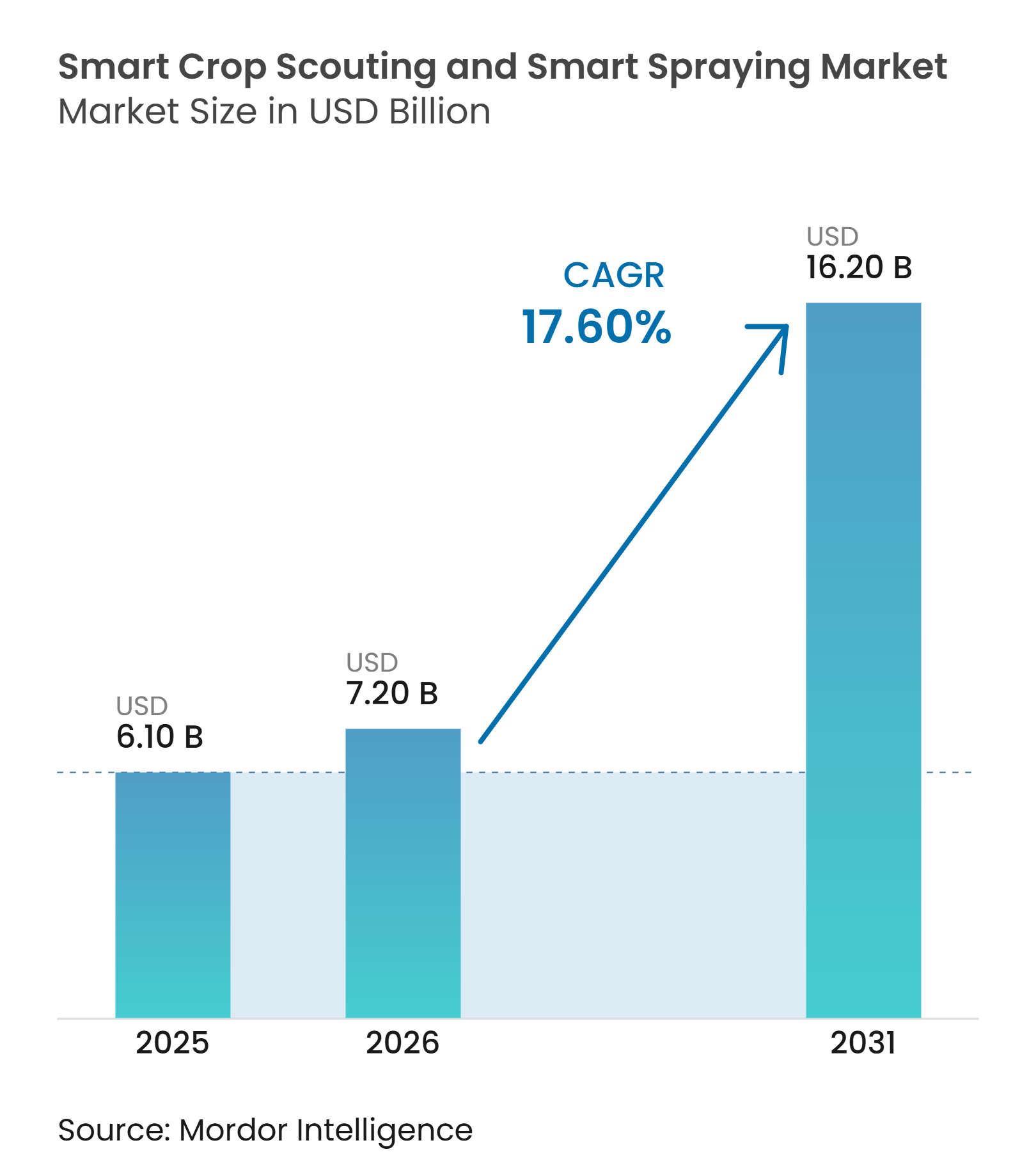
The Smart Crop Scouting and Smart Spraying Market size was valued at USD 6.1 billion in 2025 and is estimated to grow from USD 7.2 billion in 2026 to reach USD 16.2 billion by 2031, at a CAGR of 17.6% during 2026-2031. The smart crop scouting and smart spraying market is shifting from field monitoring to systems that identify problems and direct treatment within a single workflow. Herbicide savings, labor constraints, and regulations on chemical use are making these systems more relevant to farm budgets and operating plans. Camera-guided spraying has gained acceptance in cases where growers can validate savings during normal field operations. The opportunity is strongest for suppliers that can connect scouting, prescription creation, and nozzle control without adding complex steps for farm teams. European drone regulations may expand the addressable market for aerial applications once the required delegated rules are in place.
Key Report Takeaways
- By solution domain, smart crop scouting was the largest revenue category with a share of 44.2% in 2025, while smart spraying is the fastest-growing segment, at a 19.1% CAGR through 2031.
- By product type, tractor-mounted and self-propelled sprayers accounted for 35% in 2025, while drone sprayers are the fastest-growing segment at a 25.9% CAGR through 2031.
- By offering, hardware held 57.7% of the smart crop scouting and smart spraying market share in 2025, while software is forecast to be the fastest-growing offering at an 18.4% CAGR over the forecast period.
- By technology, sensing and imagery held 34.8% of the smart crop scouting and smart spraying market share in 2025, while variable-rate technology is forecast to grow fastest at a 20% CAGR through 2031.
- By application, crop protection accounted for 30.1% of the smart crop scouting and smart spraying market size in 2025, while weed detection and control is fastest with a 22% CAGR through 2031.
- By farm size, medium farms held 46.2% of revenue in 2025, while large farms as the fastest-growing farm-size segment with a CAGR of 18.8% during the forecast period.
- By Geography, North America is the largest segment with share of 31.3% in 2025 and Asia-Pacific is forcasted to be the fastest growing region at 20% during the forecast period.
Note: Market size and forecast figures in this report are generated using Mordor Intelligence’s proprietary estimation framework, updated with the latest available data and insights as of January 2026.
Market Trends and Insights
Drivers Impact Analysis of Smart Crop Scouting and Smart Spraying Market*
| Driver | (~) % Impact on CAGR Forecast | Geographic Relevance | Impact Timeline |
|---|---|---|---|
| Precision Input Optimization and Yield Protection | +3.2% | Global, strongest in the United States, Canada, Germany, France, China, India, and Brazil | Medium term (2-4 years) |
| Agricultural Labor Shortages and Reduced Manual Scouting | +2.8% | Global, especially the United States, Canada, the United Kingdom, Australia, Japan, and Brazil | Short term (≤ 2 years) |
| Sustainability Regulation and Reduced Chemical Use | +2.5% | North America and Europe, with spillover to China and India | Medium term (2-4 years) |
| Agronomic Data-to-Action Latency Compression | +2% | North America, Western Europe, and East Asia-Pacific | Medium term (2-4 years) |
| Weed-Resistance Mapping and Site-Specific Intervention | +2.2% | North America, Europe, Australia, Brazil, and Argentina | Long term (≥ 4 years) |
| Retrofit Economics and Robot-as-a-Service Access | +1.8% | Asia-Pacific, with spillover to the Middle East, Africa, and South America | Medium term (2-4 years) |
| Source: Mordor Intelligence | |||
Precision Input Optimization Turns Cost Pressure Into Scouting Demand
Rising agrochemical costs and shifting commodity prices have strengthened the business case for targeted application. A January 2026 study in Weed Science found that targeted applications using ONE SMART SPRAY reduced foliar herbicide costs in Midwest corn and soybean systems while maintaining weed-control performance. John Deere reported that its See and Spray system reduced herbicide use by more than 60% in fallow applications during 2025 field testing, with positive returns recorded in every field tested. These results provide farm managers with evidence that can be more readily compared against current input budgets, shortening the time required to justify a purchase or service contract. Suppliers lacking field validation data may find it harder to compete on agronomic value than on product features.
Agricultural Labor Shortages Accelerate Autonomous Scouting Adoption
Seasonal labor shortages are increasing the importance of automated scouting and spraying in the United States, Canada, Japan, the United Kingdom, and Australia. Japan's Ministry of Agriculture, Forestry, and Fisheries has identified an aging farm population as a food security concern. In May 2026, Kubota Corporation and NTT DOCOMO demonstrated the remote operation of agricultural machinery in mountainous areas, addressing conditions where fieldwork is difficult to staff and machinery connectivity can be unstable. AGCO Corporation positioned its PTx Trimble OutRun autonomous tillage system as a response to labor and timing constraints during critical farming windows. Medium-sized farms represent an important buyer segment, as they have fewer options for recruiting or retaining seasonal crews. This supports demand for service models and autonomous retrofits that reduce reliance on manual scouting.
Sustainability Regulation Converts Policy Into Hardware Procurement
European policy changes are encouraging farms to adopt precision application equipment. France introduced rules in May 2026 governing trials and authorization of certain drone-applied plant-protection products. The initial rules permit biocontrol substances and inputs approved for organic production. In the same month, the EU Council approved a pathway to ease the long-standing aerial-spraying restriction under the Food and Feed Safety Omnibus. The framework allows 30 months for delegated acts to define qualifying drone types. In the United States, Endangered Species Act herbicide-label restrictions in Midwestern counties are increasing the value of treatment records and targeted-application verification. Demand can increase quickly once compliance dates and operating conditions become clear.
Agronomic Data-to-Action Latency Compression Changes the Value Chain
Traditional scouting can leave a 48- to 72-hour gap between field observation and sprayer dispatch. Faster workflows allow growers to act before weed pressure becomes harder to control. Sentera's SMARTSCRIPT Weeds program produced drone-based weed maps and prescriptions that could be sent directly to sprayer controllers. The program covered more than 13,000 Early Access Program acres in 2024 and was oversubscribed in 2025. Semios stated that its platform refreshed sensor data every 10 minutes across the crops it served in the western United States. The Smart Crop Scouting and Smart Spraying Market, therefore, rewards systems that move from image capture to an actionable prescription with limited manual processing. This shift may reduce dependence on the professional-service layer that historically linked scouting observations to application decisions.
Restraints Impact Analysis of Smart Crop Scouting and Smart Spraying Market*
| Restraint | (~) % Impact on CAGR Forecast | Geographic Relevance | Impact Timeline |
|---|---|---|---|
| High Upfront Cost and Uncertain Payback for Smaller Farms | -1.8% | Asia-Pacific, the Middle East, Africa, and South America | Short term (≤ 2 years) |
| Technical Skills Gaps and Multi-Vendor Integration Complexity | -1.2% | India, Brazil, Mexico, South Africa, and Argentina | Medium term (2-4 years) |
| Connectivity Gaps and Fragmented Farm-Data Governance | -1% | India, Brazil, South Africa, Australia, and Mexico | Medium term (2-4 years) |
| Model Drift Across Crops, Regions, Seasons, and Field Conditions | -0.9% | Global, especially the United States, Canada, France, India, China, Brazil, and Australia | Long term (≥ 4 years) |
| Source: Mordor Intelligence | |||
High Capital Cost Constrains Smallholder Market Entry
For farms below 50 hectares, the cost of smart scouting and spraying hardware can exceed the annual gross margin, restricting adoption where no viable service or financing option exists. John Deere's 2025 field data reported positive returns, but those results came from large row-crop operations with sufficient herbicide spending to support a six-figure investment. Service-based spraying is one response to this limitation. However, moving third-party robots between fragmented fields increases operating costs in markets such as India, Mexico, and South Africa, which can weaken the unit economics of a local provider. Operators that build dense coverage within a limited geography may be better positioned to offer an affordable service.
Technical Skills Gaps Slow Adoption in Emerging Markets
Linking drone images with variable-rate prescriptions requires agronomic knowledge, mapping skills, and software configuration. Many farmers in emerging economies do not yet have these capabilities in-house. Multi-vendor operations can also be challenging when image platforms, farm-management systems, and nozzle controllers use different interfaces. ISO 11786 and ISOBUS standards support machinery-layer integration but do not fully resolve differences in proprietary analytics platforms. Farm teams may still need external support to set up workflows and interpret outputs. Additional implementation time can delay the return from a new system. Suppliers that simplify onboarding and provide local support are more likely to reduce this adoption barrier.
*Our forecasts treat driver/restraint impacts as directional, not additive. The impact forecasts reflect baseline growth, mix effects, and variable interactions.
Smart Crop Scouting and Smart Spraying Market Segment Analysis
By Solution Domain:
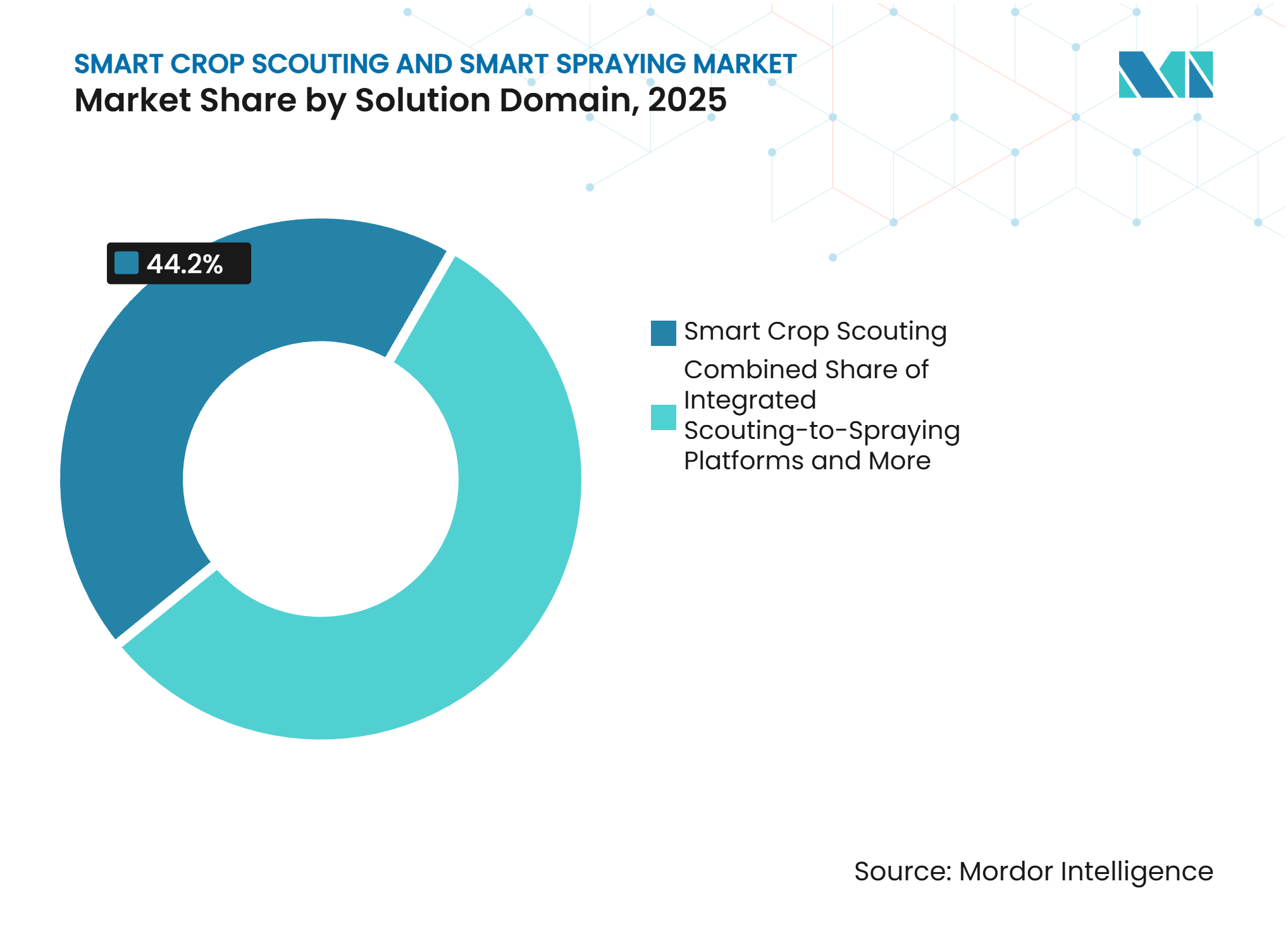
Smart Spraying Gains Ground on Established ScoutingThe smart crop scouting and smart spraying market was led by smart crop scouting with a share of 44.2% in 2025, supported by its longer commercial history and lower entry cost compared to autonomous spraying. Smart spraying is forecast to grow at a 19.1% CAGR from 2026 to 2031. This growth reflects improved green-on-green detection, which identifies weeds within an active crop canopy, a more complex task than green-on-brown detection in fallow fields. Higher detection accuracy is expanding the potential application of targeted spraying during the growing season.
Integrated scouting-to-spraying platforms combine mapping, prescription generation, and boom control into a single workflow. Following its acquisition of Sentera in May 2025, John Deere integrated Sentera's FieldAgent platform with its Operations Center. This integration reduces the gap between crop observation and treatment, and can shorten a multi-day service process to same-day field action. The market is likely to favor platforms that reduce manual file transfers and data conversion.



By Product Type:
Drone Sprayers Shift the Hardware MixTractor-mounted and self-propelled sprayers remain central to large row-crop operations, accounting for 35% in 2025. CNH Industrial N.V. offers SenseApply and New Holland IntelliSense Sprayer Automation as factory-fit options for Model Year 2026 and 2027 Guardian machines. Retrofit systems address a large installed base that cannot be replaced within a single budget cycle. Robotic sprayers remain a smaller category, with specific use in specialty crops. Ecorobotix reported more than 1,000 ARA units sold and 180,000 hectares treated during the spring 2025 season.
In the smart crop scouting and smart spraying market, drone sprayers are the fastest-growing product type, with a forecast CAGR of 25.9% through 2031. This growth reflects improving payload capacity, lower equipment costs, and applicability in difficult terrain. SZ DJI Technology Co., Ltd. launched the Agras T100 and T70P in 2025, followed by the Agras T55 and T100 Dual Battery Spraying System in July 2026. SZ DJI Technology Co., Ltd. reported 600,000 agricultural drones in operation globally at the end of 2025.
By Offering:
Hardware Leads While Service Models Broaden AccessHardware accounted for 57.7% of revenue in the Smart Crop Scouting and Smart Spraying Market in 2025, as cameras, drones, sensors, and boom systems require substantial upfront equipment spending. This positions physical equipment as the largest offering segment in the market. Software follows a different revenue profile with the fastest-growing segment at 18.4% during 2031, as analytics subscriptions can grow without new machine purchases. Services include managed scouting, spraying-as-a-service, and system integration, which can reduce the capital burden for farms that require precision application but cannot own the equipment outright.
Niqo Robotics adopted a per-acre service model rather than an equipment-sales model in India, reporting deployment across more than 148,000 acres during the 2024 season. Service providers can aggregate demand from neighboring farms and schedule equipment more efficiently. Equipment manufacturers can achieve steadier revenue by adding subscriptions and service contracts to an installed base, while also incorporating performance support into the commercial relationship.
By Technology:
Sensing and Imagery Lead While Variable-Rate Technology AdvancesSensing and imaging accounted for 34.8% of Smart Crop Scouting and Smart Spraying Market revenue in 2025, making it the largest technology segment. This segment includes multispectral cameras, hyperspectral sensors, RGB drones, and ground optical systems. These systems provide the field observations required for subsequent prescription decisions. Their dominant position reflects the fact that every automated application workflow begins with identifying field conditions. Image quality and consistent data capture remain important to the reliability of downstream analytics.
Variable-rate technology is forecast to grow at a 20% CAGR through 2031. Individual nozzle control converts detections into treatment adjustments during each pass. TeeJet's DynaJet pulse-width-modulation system was validated by Iowa State University's Digital Ag Innovation Lab for maintaining droplet consistency across varying speeds and terrain. Machine learning and predictive analytics can further improve the savings achieved through each application. However, the commercial value of these systems depends on detection and application accuracy, not on analytics alone.
By Application:
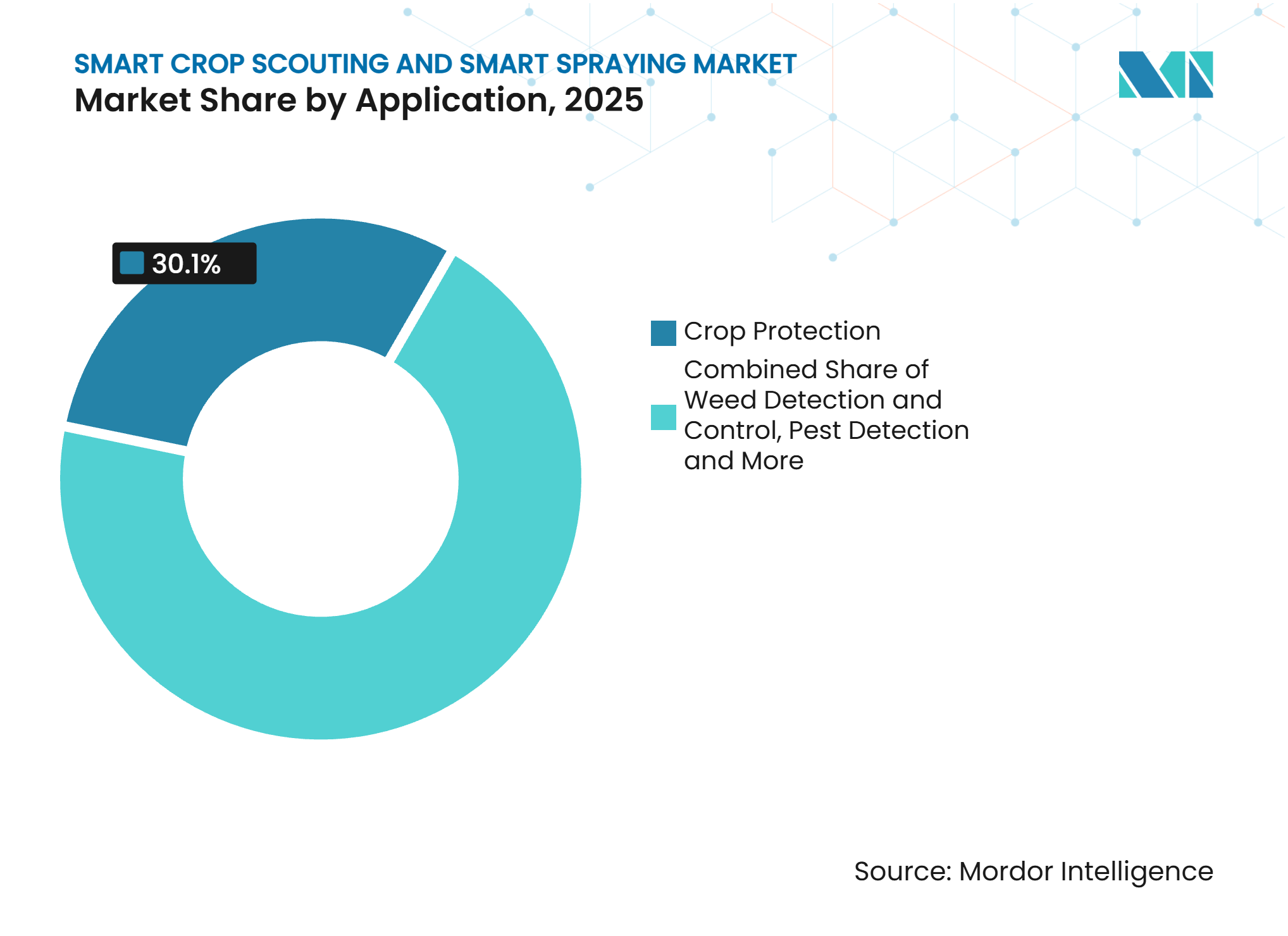
Crop Protection Anchors Revenue While Weed Detection ExpandsCrop protection accounted for 30.1% of Smart Crop Scouting and Smart Spraying Market revenue in 2025, making it the largest application category. It covers herbicide, fungicide, insecticide, and nutrient applications, where reduced input use can be measured against field costs. Weed detection and control is forecast to grow at a 22% CAGR through 2031. Herbicide resistance increases the value of detection, as treatment decisions increasingly depend on identifying where resistant weeds occur. This supports the adoption of systems that identify weeds before broad-field application.
Soil moisture and water-stress assessment is particularly relevant in regions where irrigation efficiency is a policy priority. Semios installed more than 300 irrigation automation nodes in the western United States during 2025. Pest detection remains crop-specific, as target insects and crop economics vary by crop type. Perennial specialty crops can support higher-cost systems where pest-related failures pose a significant quality risk.

By Farm Size:
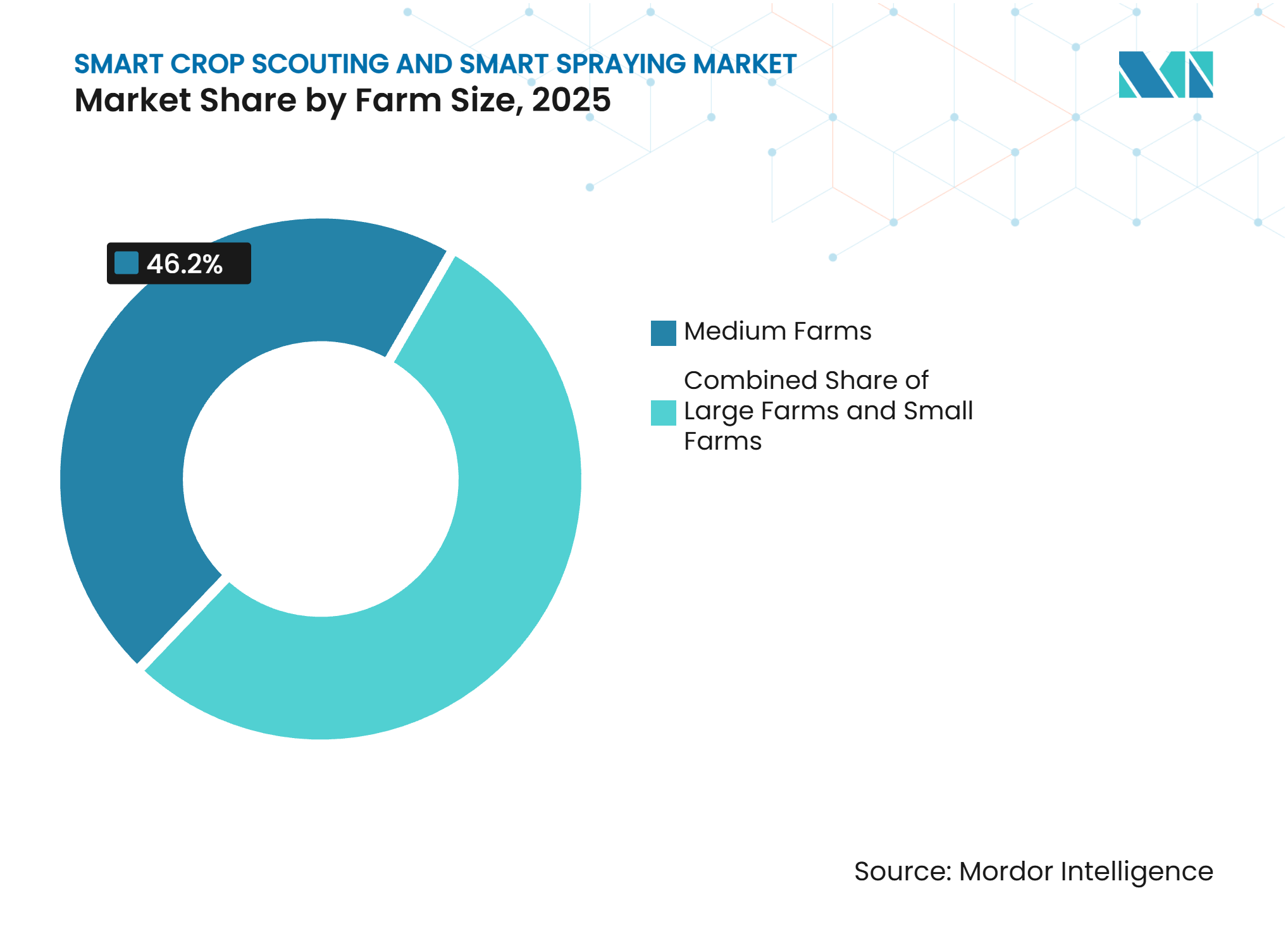
Medium Farms Lead While Large Farms AccelerateMedium farms accounted for 46.2% of Smart Crop Scouting and Smart Spraying Market revenue in 2025. They occupy a position between the financial constraints of small farms and the established technology programs of large operators. This segment can benefit from systems that offer clear input savings without requiring complete machinery replacement. The market has a broad addressable base in this farm-size range. Medium farms may also adopt these technologies through contractors when they cannot support a dedicated technology team.
Large farms are the fastest-growing farm-size segment at a CAGR of 18.8% during the forecast period, as they are early adopters of integrated scouting-to-spraying systems, fleet management tools, and robotic spraying services. CNH Industrial N.V.'s August 2026 Farmer Pulse survey found that 71% of 217 North American farmers and ranchers considered precision technology important to operational success. More than half are estimated to invest in additional precision technology within two years. Small farms remain difficult to serve through equipment ownership models.
Geography Analysis
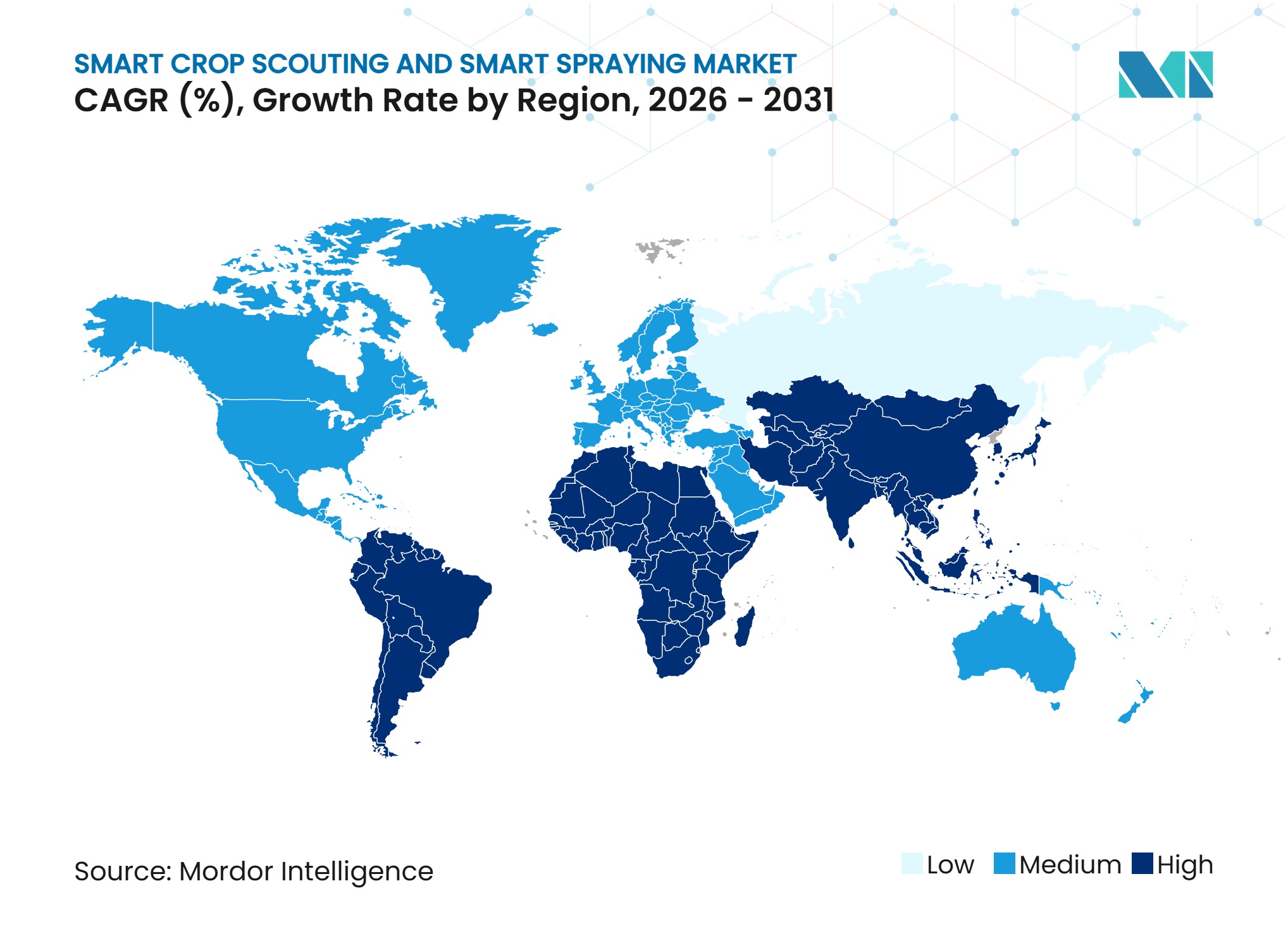
North America held 31.3% of the Smart Crop Scouting and Smart Spraying Market revenue in 2025, making it the largest regional market. It is forecast to grow at a 14% CAGR through 2031, supported by a large installed base of precision agriculture equipment, financing options, and high agrochemical costs. PTx Trimble made its OutRun platform commercially available in Canada and Australia in 2026. AGCO Corporation in Mexico remains at an earlier stage due to smaller farm sizes and financing constraints, which support service-based deployment models.
Europe is anticipated to grow during the forecast period, driven by the regulatory approvals and integration of the technology into the spraying market. The EU Council's May 2026 action could enable the deployment of commercial drone spraying once the delegated rules are finalized. France’s May 2026 drone-spraying rules initially limit eligible plant-protection products to biocontrol products, products authorized for organic farming, and low-risk products. However, Russia's future growth is anticipated, but the country's growth during the forecast period is anticipated to be constrained by limited access to equipment and financing.
Asia-Pacific is the fastest-growing region in the Smart Crop Scouting and Smart Spraying Market, at a 20% CAGR through 2031. SZ DJI Technology Co., Ltd. reported more than 600,000 agricultural drones in operation globally at the end of 2025, with a significant share of deployments concentrated in Southeast and East Asia. South America is supported by large Brazilian farms and the local launch of ONE SMART SPRAY on Stara equipment in 2024. Africa and Middle East are forecasted to grow as water-efficient application systems increases. South Africa, Egypt, the United Arab Emirates, and Saudi Arabia represent entry points where mechanization needs or water constraints are material.
Competitive Landscape
Market Concentration
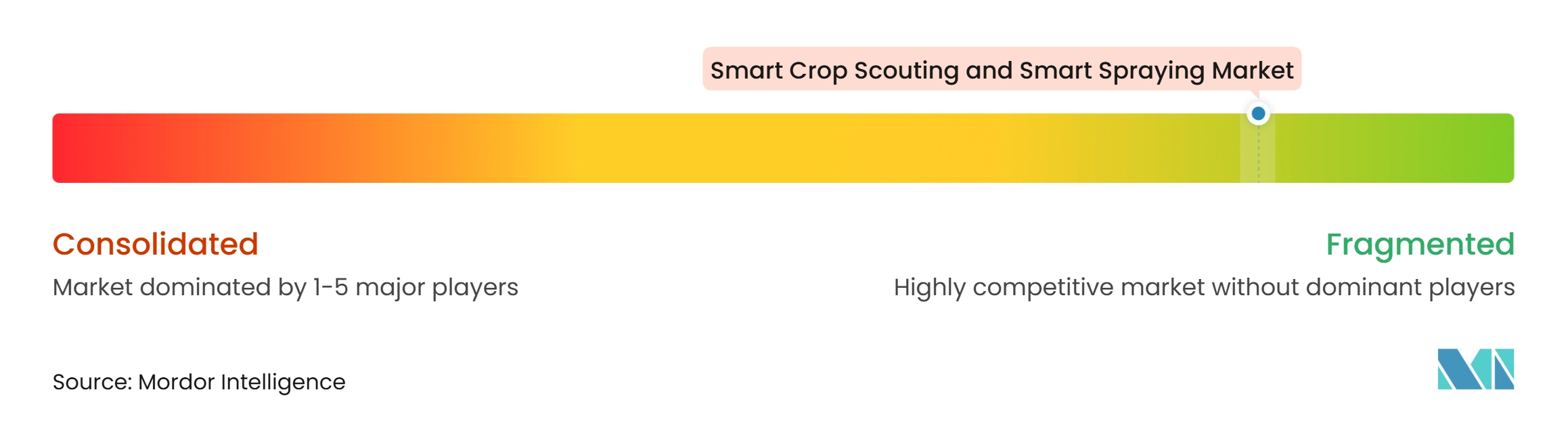
The smart crop scouting and smart spraying market is fragmented. Major players operating in the market include Deere & Company, SZ DJI Technology Co., Ltd., AGCO Corporation, Ecorobotix SA, and CNH Industrial N.V. These companies are integrating sensors, decision tools, and spray actuation into factory-fit equipment, while also maintaining retrofit options for farms seeking to upgrade existing machinery. This approach helps protect installed equipment relationships while expanding software and service revenue.
Deere & Company acquired Sentera in May 2025 to integrate aerial field scouting, prescription maps, and FieldAgent software into its Operations Center. AGCO Corporation and Trimble Inc. closed the PTx Trimble joint venture in April 2024, with AGCO Corporation holding an 85% stake. The joint venture combines precision-agriculture assets and supports mixed equipment fleets. These developments reflect competition across data capture, agronomic decision-making, and physical application, while also reducing the number of workflow steps that equipment suppliers must manage through partners.
Specialist suppliers compete in areas where large equipment platforms have limited coverage. In March 2026, Ecorobotix SA announced a USD 50 million investment in the United States manufacturing in Kansas. Niqo Robotics uses a service model that is more accessible for smallholder farms than equipment ownership. Green-on-green detection for small grains, autonomous orchard and vineyard spraying, and disease or pest treatment timing remain open areas of competition.
Smart Crop Scouting and Smart Spraying Industry Leaders
-
Deere & Company
-
SZ DJI Technology Co., Ltd.
-
AGCO Corporation
-
Ecorobotix SA
-
CNH Industrial N.V.
- *Disclaimer: Major Players sorted in no particular order
Smart Crop Scouting and Smart Spraying Market Companies Covered in this Report
- Deere & Company
- SZ DJI Technology Co., Ltd.
- AGCO Corporation
- CNH Industrial N.V.
- BASF SE
- Robert Bosch GmbH
- Ecorobotix SA
- SemiosBio Technologies Inc.
- Raven Industries, Inc.
- Kubota Corporation
- Mahindra & Mahindra Ltd
- TeeJet Technologies
- Niqo Robotics Private Limited
- Sentera, Inc.
- Agremo
- PIX4D SA
Recent Industry Developments in Smart Crop Scouting and Smart Spraying Market
- January 2026: John Deere announced See and Spray Gen 2 for Model Year 2027 sprayers, featuring upgraded cameras with four times greater weed detection accuracy, expanded crop coverage to include wheat, canola, barley, sugar beets, and peanuts, and the consolidation of three legacy tiers into a single offering. The company also migrated all Gen 1 See and Spray Premium and Ultimate users to the expanded crop library.
- July 2026: SZ DJI Technology Co., Ltd. launched the Agras T55 globally, featuring a 50 L payload and an upgraded obstacle-detection radar, and the Agras T100 Dual Battery Spraying System, with a 90 L dual-battery configuration. The products target large-field operations and orchard applications.
- March 2026: Ecorobotix SA announced a USD 50 million investment to establish the United States manufacturing in Lyons, Kansas, for its ARA Ultra-High Precision Sprayer.
Global Smart Crop Scouting and Smart Spraying Market Report Scope
Smart crop scouting and smart spraying combine AI, computer vision, drones, sensors, and field data to detect crop health issues, pests, diseases, weeds, and nutrient or water stress. The system analyzes field conditions and identifies specific areas requiring intervention, enabling targeted spraying only where needed. This reduces chemical usage and costs while improving crop protection and sustainability.
The Smart Crop Scouting and Smart Spraying Market Report is segmented by solution domain (smart crop scouting, smart spraying, and integrated scouting-to-spraying platforms), by product type(scouting equipment, scouting software, and spraying equipment), by offering (hardware, software, and services), by technology (computer vision, multispectral and hyperspectral imaging, remote sensing, machine learning and predictive analytics, internet of things and connected sensors, global navigation satellite system and geographic information system, autonomous navigation and robotics, and others), by application (weed detection and control, crop protection, pest detection, soil moisture and water-stress assessment, fertilizer and liquid-nutrient application, and others), by farm size (large, medium, and small), and by geography (North America, Europe, Asia-Pacific, Africa, South America and Middle East). The report provides value forecasts in USD.
Segmentation Overview
| Smart Crop Scouting |
| Smart Spraying |
| Integrated Scouting-to-Spraying Platforms |
| Scouting Equipment | Drones and Unmanned Aerial Vehicles |
| Field Robots | |
| Ground Sensors | |
| Multispectral and Hyperspectral Cameras | |
| Scouting Software | Geographic Information System Software |
| Remote Sensing Software | |
| Crop Management Software | |
| Artificial Intelligence Analytics Software | |
| Spraying Equipment | Tractor-Mounted and Self-Propelled Sprayers |
| Robotic Sprayers | |
| Drone Sprayers | |
| Retrofit Smart Spraying Systems |
| Hardware |
| Software |
| Services |
| Computer Vision |
| Multispectral and Hyperspectral Imaging |
| Remote Sensing |
| Machine Learning and Predictive Analytics |
| Internet of Things and Connected Sensors |
| Global Navigation Satellite System and Geographic Information System |
| Autonomous Navigation and Robotics |
| Others |
| Weed Detection and Control |
| Crop Protection |
| Pest Detection |
| Soil Moisture and Water-Stress Assessment |
| Fertilizer and Liquid-Nutrient Application |
| Others |
| Small Farms |
| Medium Farms |
| Large Farms |
| North America | United States |
| Canada | |
| Mexico | |
| Rest of North America | |
| South America | Brazil |
| Argentina | |
| Rest of South America | |
| Europe | Germany |
| United Kingdom | |
| France | |
| Italy | |
| Spain | |
| Netherlands | |
| Russia | |
| Rest of Europe | |
| Asia-Pacific | China |
| India | |
| Japan | |
| South Korea | |
| Australia | |
| Rest of Asia-Pacific | |
| Middle East | Saudi Arabia |
| United Arab Emirates | |
| Rest of Middle East | |
| Africa | South Africa |
| Egypt | |
| Rest of Africa |
| By Solution Domain | Smart Crop Scouting | |
| Smart Spraying | ||
| Integrated Scouting-to-Spraying Platforms | ||
| By Product Type | Scouting Equipment | Drones and Unmanned Aerial Vehicles |
| Field Robots | ||
| Ground Sensors | ||
| Multispectral and Hyperspectral Cameras | ||
| Scouting Software | Geographic Information System Software | |
| Remote Sensing Software | ||
| Crop Management Software | ||
| Artificial Intelligence Analytics Software | ||
| Spraying Equipment | Tractor-Mounted and Self-Propelled Sprayers | |
| Robotic Sprayers | ||
| Drone Sprayers | ||
| Retrofit Smart Spraying Systems | ||
| By Offering | Hardware | |
| Software | ||
| Services | ||
| By Technology | Computer Vision | |
| Multispectral and Hyperspectral Imaging | ||
| Remote Sensing | ||
| Machine Learning and Predictive Analytics | ||
| Internet of Things and Connected Sensors | ||
| Global Navigation Satellite System and Geographic Information System | ||
| Autonomous Navigation and Robotics | ||
| Others | ||
| By Application | Weed Detection and Control | |
| Crop Protection | ||
| Pest Detection | ||
| Soil Moisture and Water-Stress Assessment | ||
| Fertilizer and Liquid-Nutrient Application | ||
| Others | ||
| By Farm Size | Small Farms | |
| Medium Farms | ||
| Large Farms | ||
| By Geography | North America | United States |
| Canada | ||
| Mexico | ||
| Rest of North America | ||
| South America | Brazil | |
| Argentina | ||
| Rest of South America | ||
| Europe | Germany | |
| United Kingdom | ||
| France | ||
| Italy | ||
| Spain | ||
| Netherlands | ||
| Russia | ||
| Rest of Europe | ||
| Asia-Pacific | China | |
| India | ||
| Japan | ||
| South Korea | ||
| Australia | ||
| Rest of Asia-Pacific | ||
| Middle East | Saudi Arabia | |
| United Arab Emirates | ||
| Rest of Middle East | ||
| Africa | South Africa | |
| Egypt | ||
| Rest of Africa | ||
Key Questions Answered in the Report
What is the forecast growth rate for smart crop scouting and smart spraying market?
The market is forecast to grow at a 17.6% CAGR from 2026 to 2031, reaching USD 16.2 billion by 2031.
Which product type is growing the fastest?
Drone sprayers are forecast to grow at a 25.9% CAGR through 2031, supported by improving payloads and broader use across terrain types.
Why are farmers adopting smart spraying systems?
Targeted application can lower herbicide use, address labor gaps, and help farms document more precise treatment decisions.
Which region is anticipated to grow the fastest?
Asia-Pacific is forecast to grow at a 20% CAGR through 2031, led by China, India, and Japan.
Which farm size currently generates the most revenue?
Medium farms held 46.2% of 2025 revenue because they combine workable operating scale with increasing access to affordable precision tools.