
Security Inks Market Size and Share
Market Overview
| Study Period | 2022 - 2032 |
|---|---|
| Market Size (2027) | USD 3.81 Billion |
| Market Size (2032) | USD 4.76 Billion |
| Growth Rate (2027 - 2032) | 4.56 % |
| Fastest Growing Market | Asia-Pacific |
| Largest Market | Asia-Pacific |
| Market Concentration | Medium |
Major Players *Disclaimer: Major Players sorted in no particular order Image © Mordor Intelligence. Reuse requires attribution under CC BY 4.0. | |
Security Inks Market Analysis by Mordor Intelligence
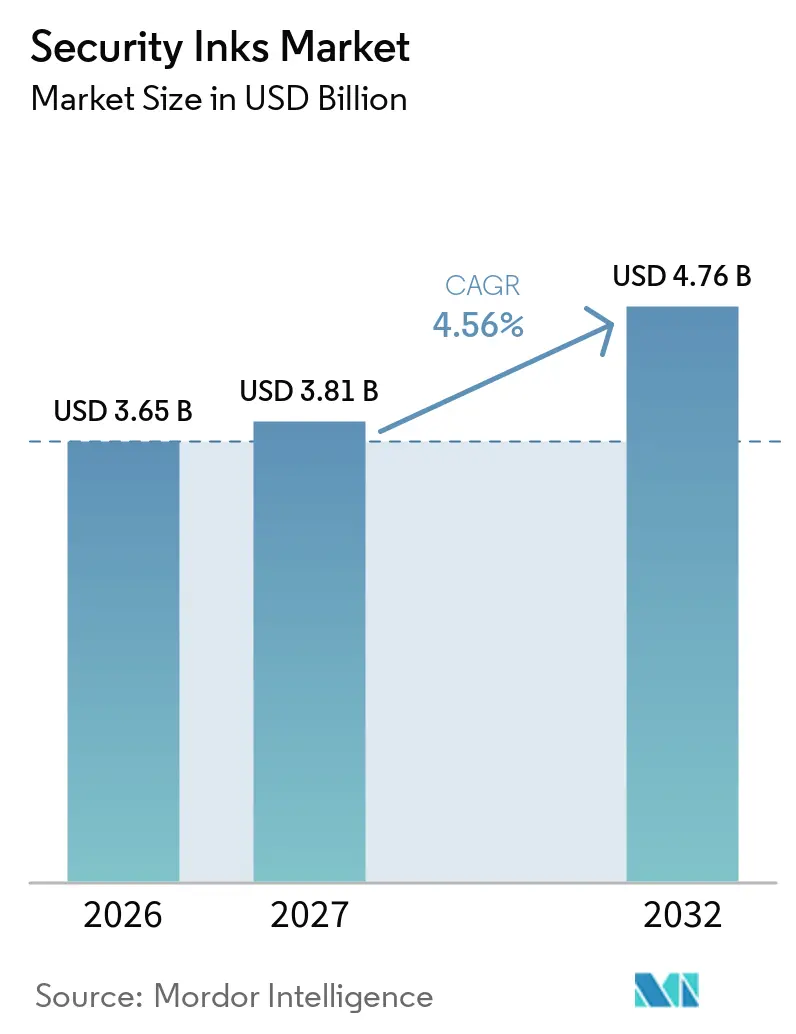
The Security Inks Market size was valued at USD 3.65 billion in 2026 and is estimated to grow from USD 3.81 billion in 2027 to reach USD 4.76 billion by 2032, at a CAGR of 4.56% during the forecast period (2027-2032). Counterfeit currency, identity documents, and branded goods continue to support demand for security features that can be checked by people and machines. Europol reported that Operation DECOY III seized counterfeit cash with an estimated face value of EUR 1.2 billion (approximately USD 1.34 billion) between June and November 2025, showing the continuing scale of cross-border counterfeiting activity. New banknote programs are also sustaining procurement, as the European Central Bank launched a design contest for the next euro banknote series in July 2025. The security inks market is increasingly shaped by formulations that combine visible, covert, and machine-readable properties. These features increase the security content required in each document. The market also faces higher qualification costs, fragmented national regulations, and declining demand for selected paper-based instruments. However, recurring requirements for currency, identity documents, and tax stamps continue to provide a stable demand base. Consequently, demand is becoming less dependent on a single document category than in earlier product cycles. Suppliers capable of meeting secure-printing requirements across multiple applications are better positioned to balance slower paper-based applications with growth in identity credentials and protected packaging.
Key Report Takeaways
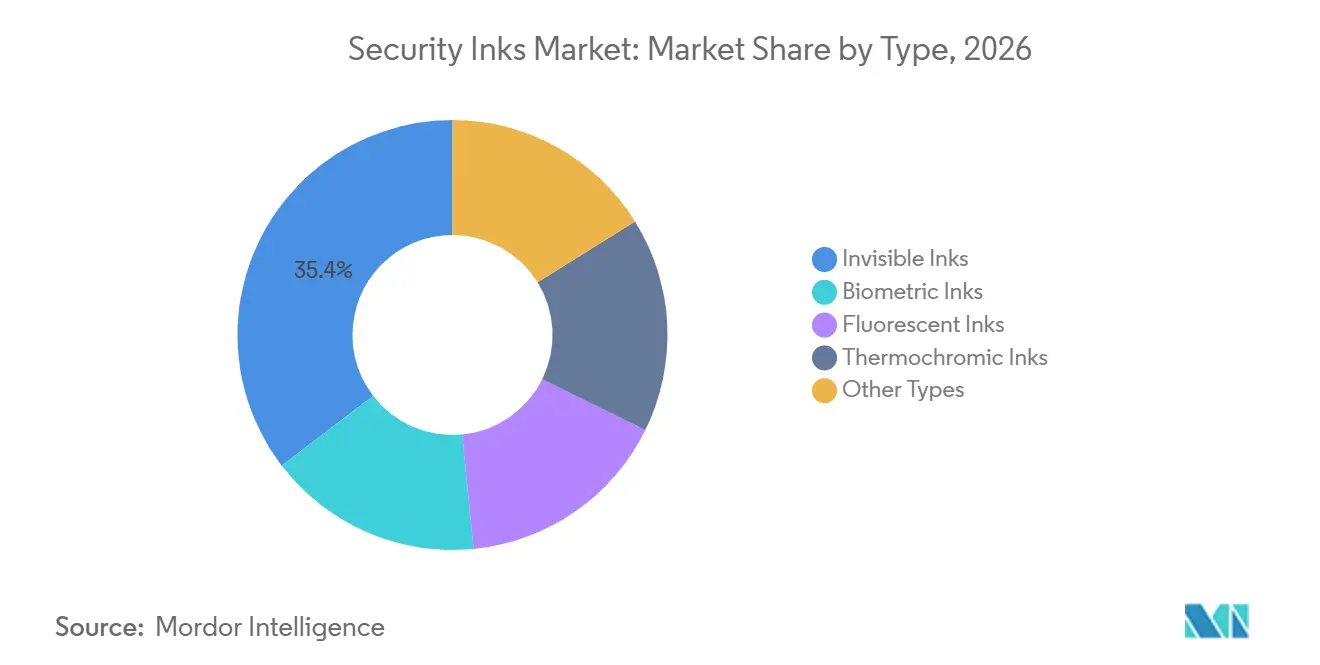
- By type, invisible inks held 35.41% of the security inks market share in 2026, while fluorescent inks are forecast to advance at a 5.12% CAGR through 2032.
- By printing method, offset printing held 30.32% of the security inks market share in 2026, while flexographic printing is forecast to advance at a 5.45% CAGR through 2032.
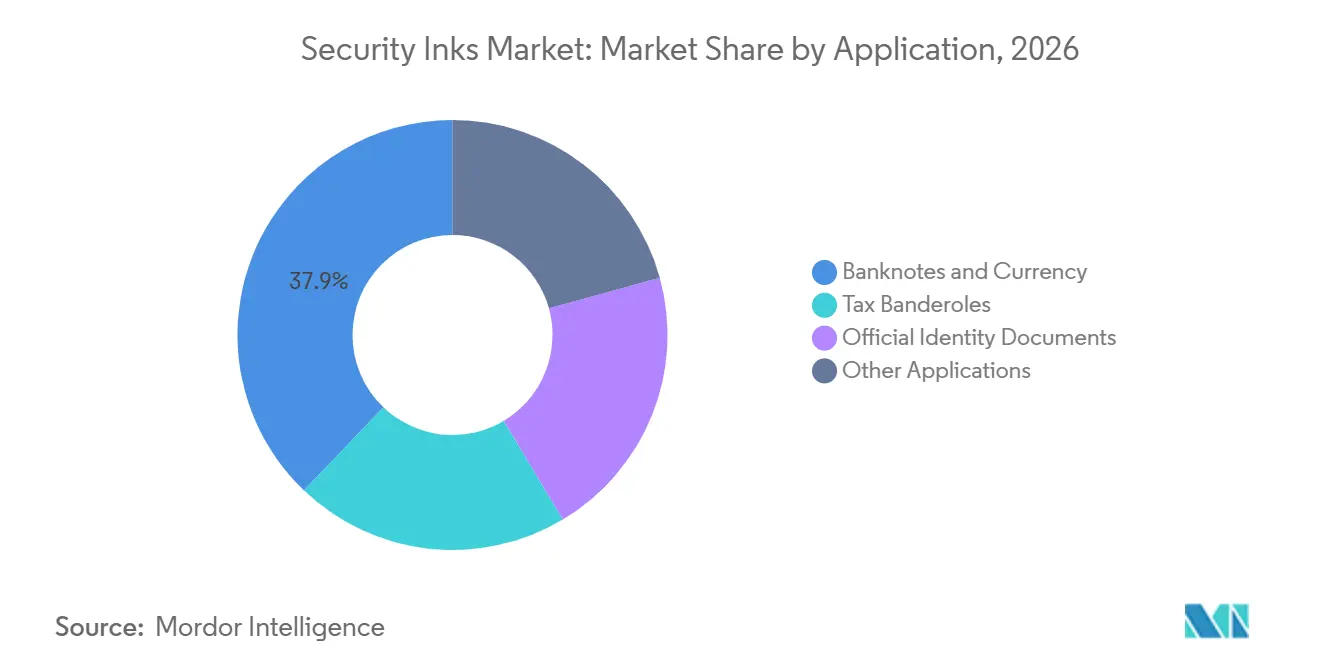
- By application, banknotes and currency held 37.87% of the security inks market share in 2026, while official identity documents are forecast to advance at a 6.09% CAGR through 2032.
- By geography, Asia-Pacific held 40.45% of the security inks market share in 2026 and is forecast to advance at a 5.77% CAGR through 2032.
Note: Market numbers in this report are based on Mordor Intelligence's proprietary estimation framework, which combines nine months of actuals with Q4 projections for base year 2026.
Market Trends and Insights
Drivers Impact Analysis of Security Inks Market*
| Driver | (~) % Impact on CAGR Forecast | Geographic Relevance | Impact Timeline |
|---|---|---|---|
| Rising Counterfeiting Across Currency, Identity Documents and Branded Products | +1.5% | Global, with concentrated enforcement activity in Europe, APAC, and North America | Short term (≤ 2 years) |
| Adoption of Layered Overt, Covert and Machine-Readable Authentication | +1.2% | Global, with early scaling in APAC and Europe | Medium term (2-4 years) |
| Growth of Government Identity and Tax-Stamp Programs | +1.0% | APAC core, spillover to MEA and Latin America | Medium term (2-4 years) |
| Expansion of Secure Packaging and Product Authentication | +0.8% | North America & Europe primary, APAC secondary | Long term (≥ 4 years) |
| Recurring Banknote Replacement and Currency Redesign Cycles | +0.7% | Global, with immediate relevance to Eurozone and Japan redesign cycles | Short term (≤ 2 years) |
| Source: Mordor Intelligence | |||
Rising Counterfeiting Across Currency, Identity Documents and Branded Products
Counterfeiting cases continue to justify spending on document and product authentication. Operation DECOY III involved 18 countries and led to 70 new investigations during its 2025 operation. The operation also found that more than 90% of seized counterfeit cash was linked to shipments originating in China. This pattern reinforces the need for features that can be checked quickly when goods or cash move across borders, rather than relying on a single inspection point after distribution has already occurred. The European Central Bank adopted Decision ECB/2025/36 in October 2025, updating procedures for the reprocessing of suspect counterfeit euro banknotes[1]. Postal distribution means that counterfeit material can reach retail locations far from central sorting facilities. This increases the value of inks that support checks at the point of sale as well as machine checks in currency-processing centers, because a feature must remain reliable when documents move through several handling environments and verification devices.
Adoption of Layered Overt, Covert and Machine-Readable Authentication
Issuing authorities are using several authentication registers in the same document rather than relying on a single visible feature. Japan’s new banknotes include 3D holograms, special luminescent inks, and deep intaglio printing. These features illustrate how color, light response, printed texture, and machine detection can be used together, making simple visual copying less likely to satisfy every check that a document encounters during its circulation. This approach raises the importance of formulations that remain consistent across decentralized retail checks and high-speed sorting equipment, since weak performance in one setting can undermine the value of the wider document-security system. The Common Detector Interface 2 specification provides a shared technical basis for detector performance in the euro area and the United States. A common interface does not make every security design identical, but it makes reliable detection across equipment suppliers a more important part of product selection and technical validation. Authentix introduced its GemVision camera system in May 2025 as a CDI2-compliant fitness solution, linking ink verification more closely to the equipment that evaluates banknotes.
Government Identity, Tax-Stamp, and Banknote Programs
Government identity and revenue programs broaden demand beyond circulation currency. Biometric passports, national identity cards, and tax stamps require inks that can work with polycarbonate, laser personalization, and secure printing processes. ISO 22373:2025 sets out principles for authenticity, integrity, and trust in product and document supply chains. The standard supports procurement practices that favor validated authentication features over generic tamper-evident coatings. It also makes the integrity of the supply chain relevant to the feature itself, which is important when secure materials are sourced, formulated, printed, and distributed through different specialist organizations. SICPA HOLDING SA and 7I Holding entered a partnership with e7 Group in September 2025 that includes capacity for 6 billion tax stamps annually. Currency redesigns add a separate procurement cycle, and the European Central Bank’s current euro banknote work keeps qualification requirements relevant for established suppliers, as material approval must be repeated when a new series moves from design toward production.
Expansion of Secure Packaging and Product Authentication
Brand owners are adding physical authentication features to packaging for pharmaceuticals, luxury goods, and consumer products. Digital codes can be copied or misused, so visible and forensic print features remain useful as a separate layer of defense. Flint Group has an exclusive global arrangement with Microtrace to use Microtaggant technology in narrow-web security inks. This gives packaging converters a route to add taggant-based authentication without changing their core label production model. The approach is relevant when a brand owner wants a physical feature embedded in the package but does not want to replace existing printing equipment or redesign every element of the label. Counterfeit medicines also create direct compliance and liability risks for manufacturers and distributors. Suppliers that can combine food-contact formulation knowledge with forensic capabilities can address an application area that has lower ink penetration than its security risk would suggest, especially where brand owners need authentication features that fit existing packaging lines and compliance requirements.
Restraints Impact Analysis of Security Inks Market*
| Restraint | (~) % Impact on CAGR Forecast | Geographic Relevance | Impact Timeline |
|---|---|---|---|
| Higher Formulation, Equipment and Certification Costs | -0.9% | Global, with highest burden on smaller markets seeking ISO 14298 certification | Medium term (2-4 years) |
| Digitization and Declining Use of Selected Paper-Based Instruments | -0.7% | North America & EU primary, with early signals in urban APAC | Long term (≥ 4 years) |
| Fragmented Regional Compliance and Validation Requirements | -0.5% | MEA, South America, and Emerging APAC; spillover to cross-border export programs | Medium term (2-4 years) |
| Source: Mordor Intelligence | |||
Higher Formulation, Equipment and Certification Costs
Security ink production requires specialized pigments, controlled sourcing, secure manufacturing conditions, and testing systems. ISO 14298:2021 covers management of security printing processes and places requirements on physical, logical, and supply-chain security. These requirements create fixed costs that are harder for small and medium-scale producers to spread across output, because secure premises, controlled materials, documentation, and recurring audits must be maintained before a supplier can pursue many high-value tenders. Intergraf’s Intergraf Certification Requirements (ICR) guidance complements the standard with additional requirements for secure-printing procurement. The resulting pricing floor can limit access to advanced features in budget-constrained government programs, where procurement teams must balance the cost of stronger authentication against competing spending needs and lengthy approval processes. It can also favor suppliers that already have approved production sites and established audit systems.
Digitization and Declining Use of Selected Paper-Based Instruments
Digital payments and digital-currency programs can reduce the use of checks, paper tickets, and some lower-denomination notes. The effect is uneven because the need for physical currency and secure documents has not disappeared. Euro banknotes in circulation totaled EUR 1,619.5 billion (approximately USD 1.90 trillion) at the end of 2025, a 2% increase from the end of 2024. This indicates continued currency demand even as payment behavior changes in some economies. Exposure is greater for suppliers serving one paper document category than for suppliers serving banknotes, tax stamps, and identity documents. Covert and machine-readable features also remain relevant when notes are recirculated because cash-handling systems must authenticate and assess fitness, so demand is linked not only to new issuance but also to the continuing operation of currency-processing infrastructure.
*Our forecasts treat driver/restraint impacts as directional, not additive. The impact forecasts reflect baseline growth, mix effects, and variable interactions.
Security Inks Market Segment Analysis
By Type:
Invisible Inks Lead, While Fluorescent Inks ExpandInvisible inks held 35.41% of the security inks market share in 2026. They are used across banknotes, identity documents, and tax stamps because they create a covert layer that requires specialist equipment for verification. Their position reflects long-standing central bank procurement practices, where invisible features are often a baseline requirement, because issuers value features that can be kept out of public view while remaining available to trained inspectors and equipment. Biometric inks support identity documents that use biometric data and are gaining relevance as passport personalization programs expand.
Fluorescent inks are forecast to grow at a 5.12% CAGR through 2032. China’s GB/T 17001.1-2025 establishes revised requirements for ultraviolet fluorescent anti-counterfeiting inks, strengthening the policy basis for this category from February 2026. Multi-spectral fluorescence lets one formulation respond to long-wave and short-wave ultraviolet light. Optically variable and magnetic products remain important for high-value applications, but long qualification periods and limited approved manufacturing capacity constrain their demand. The security inks market size for fluorescent products benefits from the use of multiple light-based checks in a single feature set.

By Printing Method:
Offset Printing Leads, While Flexographic Printing ExpandsOffset printing held 30.32% of the security inks market share in 2026. It remains established in banknote production, where offset processes support background color, fine design elements, and covert features within controlled print workflows. Intaglio printing uses high-viscosity formulations and specialized pigment systems, which make its inks valuable. The security inks industry relies on process-specific qualification because the same feature can perform differently across press systems and substrates.
Flexographic printing is forecast to expand at a 5.45% CAGR through 2032. Polymer banknotes are one factor because they require formulations designed for different surface behavior than paper substrates. Sun Chemical Security includes flexographic inks for polymer currency substrates in its HelioNOTE range. This response shows that established banknote suppliers are adapting their portfolios to substrate diversification, rather than treating polymer currency and label applications as separate markets with unrelated technical needs. Flexographic adoption therefore connects document printing, tax collection, and brand-protection applications within the security inks market.
By Application:
Banknotes and Currency Lead Demand, While Official Identity Documents Gain MomentumBanknotes and currency accounted for 37.87% of the security inks market share in 2026. Currency redesigns create concentrated demand as printers and suppliers requalify materials for a new design, since feature placement, substrate choice, and sorting requirements can all change at the same time. The European Central Bank’s design contest for the next euro banknote series is an active example of this procurement pathway. Tax banderoles are another growing use case because governments use them to verify excise duty on tobacco, spirits, and pharmaceuticals. SICPA HOLDING SA’s partnership with e7 Group includes capacity for 6 billion tax stamps annually, which indicates the strategic importance of this government application.
Official identity documents are forecast to grow at a 6.09% CAGR through 2032. Biometric passport upgrades and national identity card programs are increasing requirements for polycarbonate-compatible and machine-readable features. International Civil Aviation Organization (ICAO) Doc 9303 provides specifications for machine-readable travel documents used by issuing authorities worldwide. This common framework helps standardize document-security expectations across national programs, giving suppliers a clearer technical reference while still leaving individual issuing authorities responsible for feature selection and procurement. Authentix launched PICO Secure in December 2025 for polycarbonate identity documents, reflecting increased feature complexity on passport data pages. Postage stamps and secure certificates remain more stable and slower-growing uses within the security inks market.
Geography Analysis
Asia-Pacific
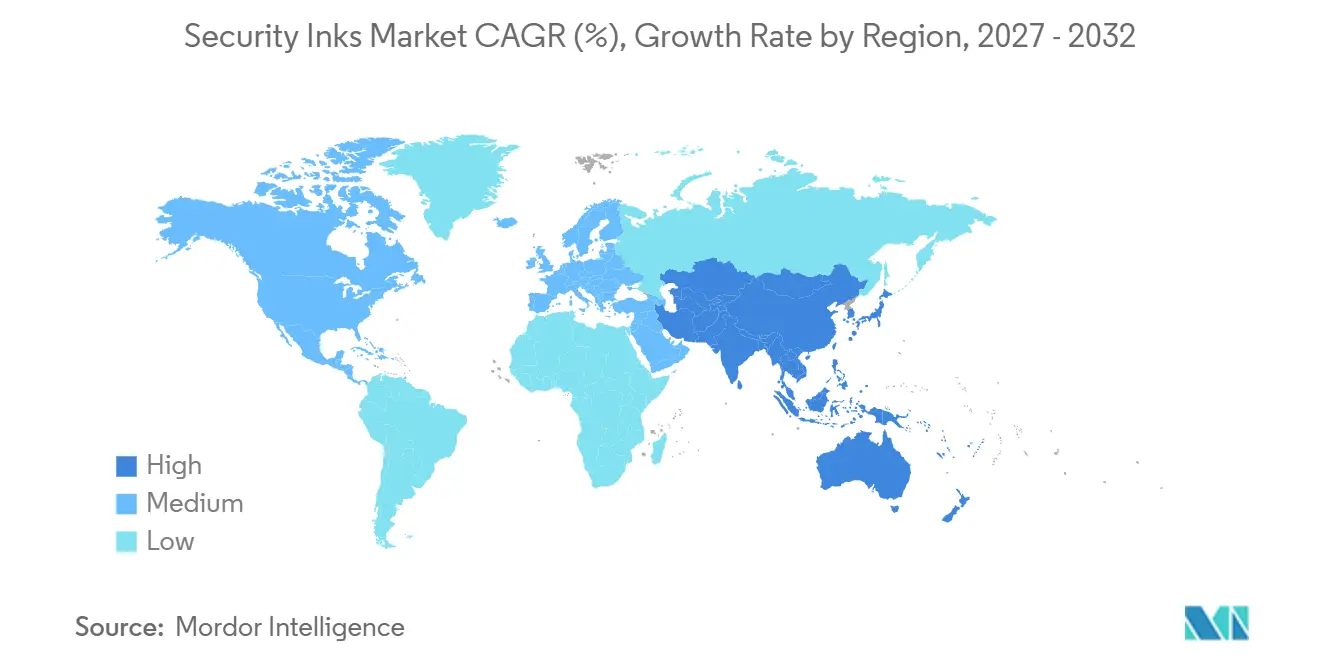
Asia-Pacific held 40.45% of the security inks market share in 2026 and is forecast to grow at a 5.77% CAGR through 2032. China’s centralized currency procurement system issued 2025 notices for specialized magnetic pigment processing, which illustrates continuing demand for proprietary banknote materials[2]. Several Southeast Asian countries are moving from paper notes toward polymer substrates, increasing the need for new flexographic and screen-print formulations that adhere reliably, resist handling, and work with established authentication equipment. China’s ultraviolet-fluorescent ink standard also creates a regulatory influence on supplier qualification from 2026. Japan’s current banknote series uses 3D holograms and special luminescent inks, showing the region’s focus on layered features. The combination of large document volumes and government investment in authentication makes the region central to the security inks market and keeps the security inks market tied closely to public procurement schedules.
North America
North America also has an important position in the security inks market because issuing authorities set demanding requirements for formulation performance and validation. The U.S. Bureau of Engraving and Printing uses procurement and testing programs that influence how suppliers develop banknote inks. Sun Chemical’s Luminescence Security unit supplies fluorescent inks for banknotes and other secure documents. Pharmaceutical, spirits, and electronics packaging provide an additional demand base for physical product authentication. The North American security inks market opportunity lies in the high value of specialized, qualified ink systems, particularly where issuers demand close performance control and support across printing, circulation, and equipment-based checks.
Europe, South America, and Middle East and Africa
Europe benefits from the European Central Bank’s ongoing euro redesign process, which will require continued coordination among national central banks and approved suppliers. Bundesdruckerei is certified to ISO 14298:2021 and develops security colors for banknotes, demonstrating how some European issuers combine internal capabilities with external supply. South America combines stable currency programs with tax-stamp and document-security demand, creating a mixed application base. The Middle East and Africa offer longer-term opportunity as identity systems and revenue-collection programs expand. The e7 Group partnership in the United Arab Emirates shows demand for government platforms that combine tax stamps, identity verification, and revenue mobilization. The security inks market size across these mixed regions depends on the pace of national programs and suppliers’ ability to meet country-specific validation requirements.
Competitive Landscape
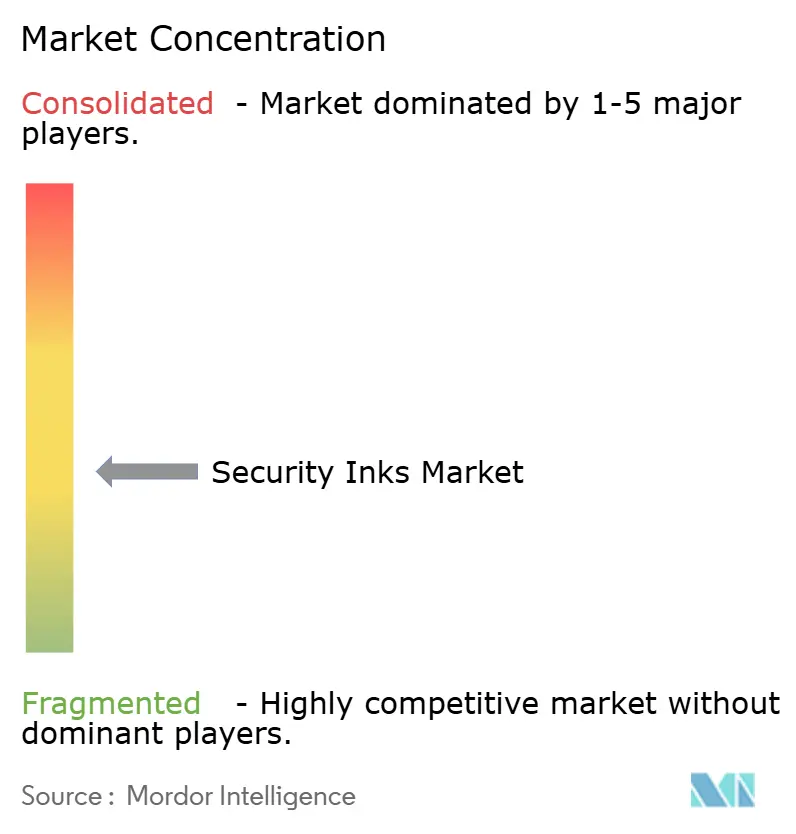
The security inks market is moderately concentrated, with the top five players including SICPA HOLDING SA, Sun Chemical, Kao Collins Corporation, Chromatic Technologies Inc., and Microtrace, LLC. SICPA HOLDING SA has also focused on technology development, including a 2025 security-ink awareness campaign that described the need to combine visual, spectral, and machine-readable performance. Sun Chemical continues to position fluorescent products for banknotes and secure documents. ISO 14298:2021 and Intergraf ICR requirements support high entry barriers in government security printing. This structure directs competition toward proven technical performance and approved production controls rather than price alone.
Competitors are broadening beyond ink supply into authentication systems, materials, and document-security platforms. Authentix launched PICO Secure in December 2025, a nano-optic optical variable device for polycarbonate identity documents that does not use inks or dyes. SICPA HOLDING SA’s September 2025 partnership with e7 Group and 7I Holding extends its approach into government-to-government technology platforms and tax-stamp capacity. Flint Group’s Microtaggant arrangement reflects a separate move toward brand-protection labels. These moves show that the security inks market includes both conventional document suppliers and firms using taggants, optics, and data-enabled authentication, which can allow a supplier to participate in a program beyond the sale of the ink itself.
Specialist suppliers compete where customers need distinctive formulations, regional support, or application-specific materials. Petrel supplies security inks and fibers for currency paper and documents across multiple printing methods. Chromatic Technologies is relevant to thermochromic development, while Kao Collins Corporation, Microtrace, LLC, and Ink Tec Inc. address inkjet, taggant, and ultraviolet applications. Fujifilm Group provides inkjet solutions for banknotes, passports, lottery products, and identity cards, linking print systems with ink capability. The security inks industry therefore has room for specialized companies, even though the highest-value central-bank and identity-document tenders remain difficult to enter because customers require repeated validation, controlled manufacture, and documented security management.
Security Inks Industry Leaders
-
SICPA HOLDING SA
-
Sun Chemical
-
Kao Collins Corporation
-
Chromatic Technologies Inc.
-
Microtrace, LLC
- *Disclaimer: Major Players sorted in no particular order
Security Inks Market Companies Covered in this Report
- artience Co., Ltd.
- Authentix
- Chromatic Technologies Inc.
- Flint Group
- Fujifilm Group
- Gans Ink & Supply Co., Inc.
- Gleitsmann Security Inks GmbH
- Ink Tec Inc.
- Kao Collins Corporation
- Microtrace, LLC
- Petrel
- SICPA HOLDING SA
- Siegwerk Druckfarben AG & Co. KGaA
- Sun Chemical
- T&K Toka Corporation
Recent Industry Developments in Security Inks Market
- September 2026: Nanografi announced its participation in the Secure ID Forum 2026 in Istanbul, where it presented security ink technologies for secure documents, authentication, anti-counterfeiting, and brand protection applications. The development supported the security inks market by increasing industry engagement around advanced ink-based authentication solutions for identity documents and security printing.
- January 2026: SICPA HOLDING SA received a purchase order from Bangko Sentral ng Pilipinas for the supply of enhanced New Generation Currency (eNGC) banknote inks and common banknote inks for its 2027–2028 requirements. The order supported the security inks market by demonstrating continued procurement of specialized inks for currency production and anti-counterfeiting applications.
Global Security Inks Market Report Scope
Security inks are specialized printing inks formulated with features that help authenticate documents, currency, and other valuable printed materials. They incorporate properties such as fluorescence, color changes, and visibility under specific conditions to support counterfeit detection and document verification.
The Security Inks Market is segmented by type, printing method, application, and geography. By type, the market is segmented into invisible inks, biometric inks, fluorescent inks, thermochromic inks, and other types. By printing method, the market is segmented into offset printing, intaglio printing, flexographic printing, letterpress printing, screen printing, and other printing methods. By application, the market is segmented into banknotes and currency, tax banderoles, official identity documents, and other applications. The report also covers the market size and forecasts for security inks across 15 countries. For each segment, the market sizing and forecasts have been done on the basis of value (USD).
Segmentation Overview
| Invisible Inks |
| Biometric Inks |
| Fluorescent Inks |
| Thermochromic Inks |
| Other Types |
| Offset Printing |
| Intaglio Printing |
| Flexographic Printing |
| Letterpress Printing |
| Screen Printing |
| Other Printing Methods |
| Banknotes and Currency |
| Tax Banderoles |
| Official Identity Documents |
| Other Applications |
| Asia-Pacific | China |
| India | |
| Japan | |
| South Korea | |
| ASEAN Countries | |
| Rest of Asia-Pacific | |
| North America | United States |
| Canada | |
| Mexico | |
| Europe | Germany |
| United Kingdom | |
| France | |
| Italy | |
| NORDIC Countries | |
| Rest of Europe | |
| South America | Brazil |
| Argentina | |
| Rest of South America | |
| Middle East and Africa | Saudi Arabia |
| South Africa | |
| Rest of Middle East and Africa |
| By Type | Invisible Inks | |
| Biometric Inks | ||
| Fluorescent Inks | ||
| Thermochromic Inks | ||
| Other Types | ||
| By Printing Method | Offset Printing | |
| Intaglio Printing | ||
| Flexographic Printing | ||
| Letterpress Printing | ||
| Screen Printing | ||
| Other Printing Methods | ||
| By Application | Banknotes and Currency | |
| Tax Banderoles | ||
| Official Identity Documents | ||
| Other Applications | ||
| By Geography | Asia-Pacific | China |
| India | ||
| Japan | ||
| South Korea | ||
| ASEAN Countries | ||
| Rest of Asia-Pacific | ||
| North America | United States | |
| Canada | ||
| Mexico | ||
| Europe | Germany | |
| United Kingdom | ||
| France | ||
| Italy | ||
| NORDIC Countries | ||
| Rest of Europe | ||
| South America | Brazil | |
| Argentina | ||
| Rest of South America | ||
| Middle East and Africa | Saudi Arabia | |
| South Africa | ||
| Rest of Middle East and Africa | ||
Key Questions Answered in the Report
What is the size of the security inks market?
The security inks market size was valued at USD 3.65 billion in 2026 and is estimated to grow from USD 3.81 billion in 2027 to reach USD 4.76 billion by 2032, at a CAGR of 4.56% during the forecast period (2027-2032).
Which type held the largest share in 2026?
Invisible inks held a 35.41% share in 2026, due to their established role in banknotes, identity documents, and tax stamps.
Which printing method is forecast to grow fastest through 2032?
Flexographic printing is forecast to grow at a 5.45% CAGR through 2032, supported by polymer banknotes, tax stamps, and authentication labels.
Which application is forecast to grow fastest through 2032?
Official identity documents are forecast to grow at a 6.09% CAGR through 2032 because biometric passports and national identity programs need machine-readable security features.