
India Securities Brokerage Market Size and Share
India Securities Brokerage Market Analysis by Mordor Intelligence
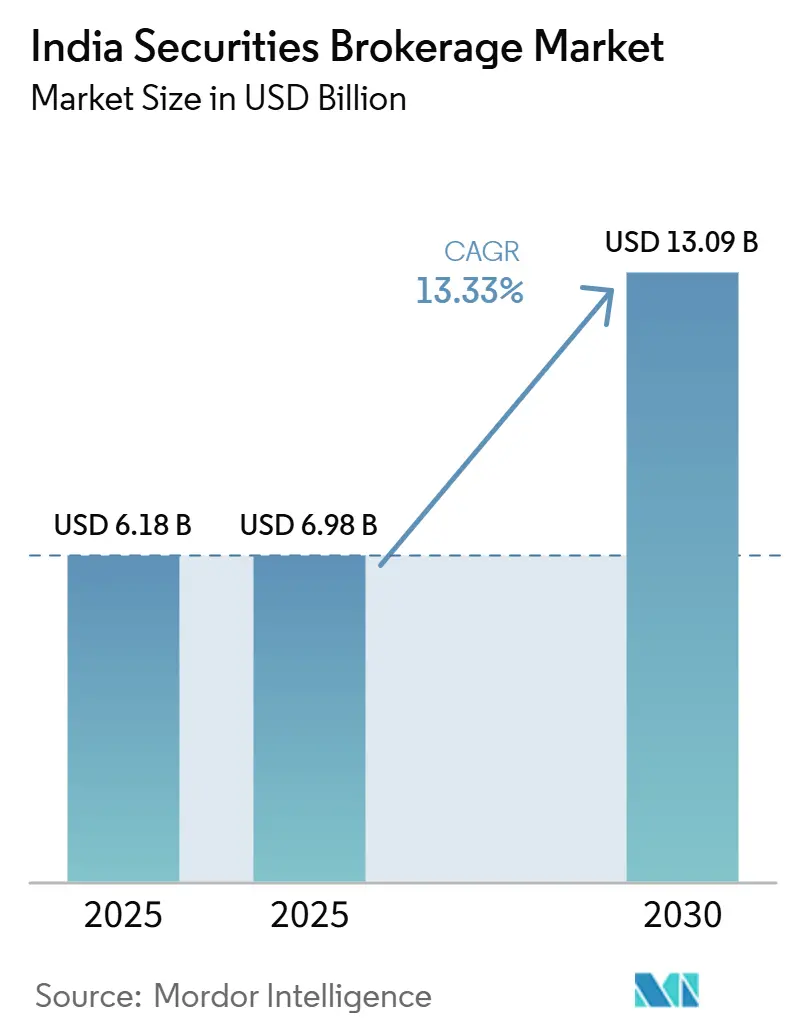
The India securities brokerage market size is expected to increase from USD 6.98 billion in 2026 to USD 7.91 billion in 2027 and reach USD 14.47 billion by 2032, growing at a CAGR of 12.84% over 2027-2032.
In India, access to zero-brokerage equity-delivery trading makes account totals an incomplete guide to brokers' revenue opportunity. Mobile execution and instant funding broaden access, making the conversion of registrations into investment activity a central commercial task. Upfront premiums for equity-index options make funding readiness essential, while electricity futures add a specialized price-risk management use case. Price competition strengthens the case for connecting funding with index-options execution and matching electricity contracts to client exposures, rather than relying on account acquisition alone.
Key Report Takeaways
- By type of security, stocks held a 45.77% India securities brokerage market share in 2026, while derivatives are forecast to grow fastest at a CAGR of 14.5% over 2027-2032.
- Stock brokerage led the brokerage-service category with a 40.33% share of the India securities brokerage market size in 2026, and forex is forecast to grow fastest at a CAGR of 13% over 2027-2032.
- The service-type category was led by online services with a 50.88% share in 2026, with robo-advisor services forecast to grow fastest at a CAGR of 14.7% over 2027-2032.
- Among client types, retail held the largest share at 58.35% in 2026 and is forecast to grow fastest at a CAGR of 13% over 2027-2032.
- Across India's geographies, South India led with a 36.23% share in 2026, while West India is forecast to grow fastest at a CAGR of 13.2% over 2027-2032.
Note: Market numbers in this report are based on Mordor Intelligence's proprietary estimation framework, which combines nine months of actuals with Q4 projections for base year 2026.
Market Trends and Insights
Drivers Impact Analysis of India Securities Brokerage Market*
| Driver | (~) % Impact on CAGR Forecast | Geographic Relevance | Impact Timeline |
|---|---|---|---|
| Surge in demat account openings post-2020 | +5.3% | Nationwide | Medium term (2-4 years) |
| Growth of low-cost mobile trading platforms | +4.7% | Nationwide | Medium term (2-4 years) |
| UPI-enabled instant fund transfer | +3.2% | Nationwide | Short term (≤ 2 years) |
| Expanded exchange product suite | +2.6% | Nationwide | Medium term (2-4 years) |
| Tokenization of sovereign gold bonds | +0.3% | Nationwide | Long term (≥ 4 years) |
| Wealth-tech partnerships with neo-banks | +1.4% | Nationwide | Medium term (2-4 years) |
| Source: Mordor Intelligence | |||
Surge in demat account openings post-2020
An expanding demat-account base gives securities brokers a broader pool of accounts through which investment demand can reach execution services. Central Depository Services (India) Limited (CDSL) added 27.1 million net beneficial-owner accounts during FY2025-26, taking its total to 180.1 million on March 31, 2026.[1] Its depository participants also opened 2.56 million gross beneficial-owner accounts in September 2026. The Securities and Exchange Board of India (SEBI) reported that India's demat accounts reached 225 million in FY2025-26, driven by simplified digital onboarding and discount brokers' mobile trading apps. Closures of 146,040 accounts in September 2026 were small beside the openings, so CDSL's pool of beneficial-owner accounts widened.
Growth of low-cost mobile trading platforms
For individual investors, mobile access becomes more useful when the execution fee does not absorb a disproportionate part of a small investment. Zerodha, whose Kite platform is available as a mobile app, offers retail individuals zero brokerage on equity-delivery investments on the National Stock Exchange of India (NSE) and BSE Limited (BSE), subject to a minimum charge per delivery contract note. Statutory and regulatory charges apply separately to these investments. Groww's NSE active-client base grew 35.46% in FY2025 versus FY2024, counting customers who transacted on NSE within the previous 12 months. For delivery-focused brokers, the opportunity is to make smaller investment relationships economical to serve through digital access.
UPI-enabled instant fund transfer
The interval between transferring money and making it available for investment can interrupt an otherwise digital brokerage journey. Zerodha Broking lets customers transfer funds instantly and for free from a registered bank account to their Zerodha accounts through the Unified Payments Interface (UPI), provided they initiate transfers through its payment gateway. That condition makes the broker-controlled funding route commercially important, rather than treating any transfer as immediately usable. From October 1, 2025, SEBI required registered investor-facing intermediaries to obtain and offer validated UPI IDs, while investor use remained optional. Together, immediate availability and an identifiable collection route can reduce friction before an order is placed. Offering the validated ID satisfies the intermediary's duty, but instant account credit at Zerodha depends on the investor choosing its payment-gateway route.
Expanded exchange product suite
NSE launched Monthly Electricity Futures on July 14, 2025, adding a commodity-derivatives use case for brokers.[2] By 2 p.m. that day, trading exceeded 4,000 lots, with generators, distribution companies, industrial consumers and intermediaries participating. The contract specifications updated in September 2026 provide 50 MWh trading units and cash settlement against the month's average Power Exchange India Limited (PXIL) Day Ahead Market unconstrained clearing prices under an exchange-notified equation. Financial settlement creates a route for brokers to serve electricity-price exposure without organizing physical power delivery. The commercial opening rests on matching the contract benchmark to a client's price exposure, giving specialized execution and contract understanding a purpose beyond simply offering another trading instrument.
Restraints Impact Analysis of India Securities Brokerage Market*
| Restraint | (~) % Impact on CAGR Forecast | Geographic Relevance | Impact Timeline |
|---|---|---|---|
| Zero-brokerage price wars | -1.9% | Nationwide | Short term (≤ 2 years) |
| Exchange infrastructure dependency | -1.4% | Nationwide | Short term (≤ 2 years) |
| Inadequate cyber-resilience frameworks at mid-tier brokers | -0.8% | Nationwide | Medium term (2-4 years) |
| Limited capital-market literacy outside Tier-1 cities | -0.6% | Rural communities across India | Long term (≥ 4 years) |
| Source: Mordor Intelligence | |||
Zero-brokerage price wars
Price competition reduces the room for established brokerage channels to distinguish themselves through execution fees when low-cost pricing spreads across business models. In December 2025, HDFC Securities, SBICAP Securities and Axis Securities charged equity and derivatives brokerage fees similar to discount brokers, while Kotak Securities charged lower fees. CRISIL Ratings also reported intense low-cost competition affecting 5paisa in August 2026. This convergence makes a higher execution charge harder to justify through the provider's channel identity alone. HDFC Securities' chief executive said trading charges increasingly differentiate derivatives brokers and influence some inactive users' and new entrants' decisions to start or resume trading. A broker charging above the converged level therefore has to justify the gap to clients whose activity decisions respond most to cost.
Exchange infrastructure dependency
A broker cannot deliver continuous execution solely through its own technology when access depends on an exchange-controlled recovery sequence. During an NSE disaster-recovery switchover, members are disconnected when the primary site is unavailable and can log in only after the exchange sends an end-of-outage message. For an affected broker, this creates a period in which additional client-facing capacity cannot independently restore exchange access. In May 2026, SEBI described an exchange-provided Contingency Pool Trading facility that lets brokers square off clients' open positions through dedicated terminals at exchange premises during business disruptions. Position closure can reduce exposure during an interruption, but the dependence on restored trading access leaves ordinary execution vulnerable to an externally controlled delay.
*Our forecasts treat driver/restraint impacts as directional, not additive. The impact forecasts reflect baseline growth, mix effects, and variable interactions.
India Securities Brokerage Market Segment Analysis
By Type of Security:
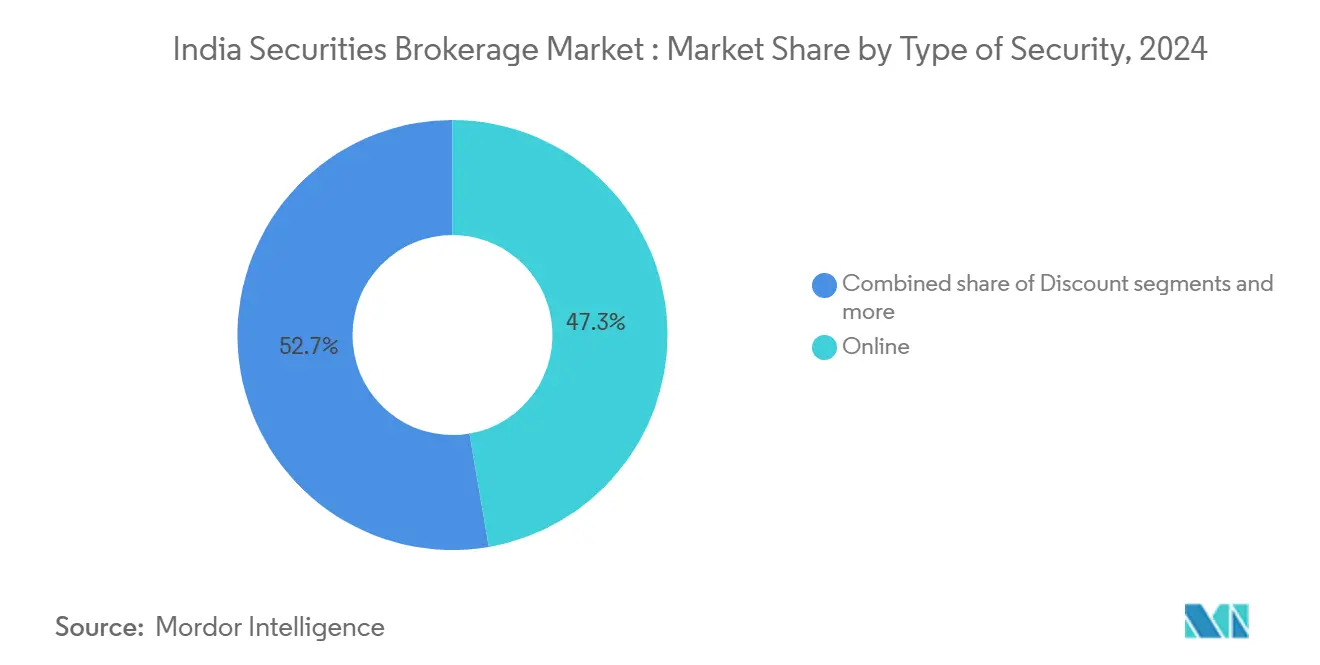
Cash Trading Scale and Funded Derivatives ExecutionStocks accounted for a 45.77% share of the India securities brokerage market size in 2026. India's equity cash segment recorded average daily turnover of INR 1.1 trillion (USD 12.44 billion) in FY2025-26, down 6% from FY2024-25. March 2026 turnover nevertheless reached a fiscal-year peak. Cash-equity revenue planning based on the full-year average avoids treating March's peak as a sustained trading level.
Derivatives are the fastest-growing segment, with a forecast CAGR of 14.5% over 2027-2032. Combined equity-derivatives notional turnover across NSE and BSE rose 4.3% in FY2025-26 compared with FY2024-25. SEBI required brokers to collect option premiums from equity-index derivatives buyers upfront from February 10, 2025. Upfront premium collection makes funding readiness part of the broker's execution process for those index contracts. Coordinating funded participation with contract execution therefore has commercial value, because a larger notional trading base can support a brokerage opportunity only when clients can meet the applicable payment conditions.

By Type of Brokerage Service:
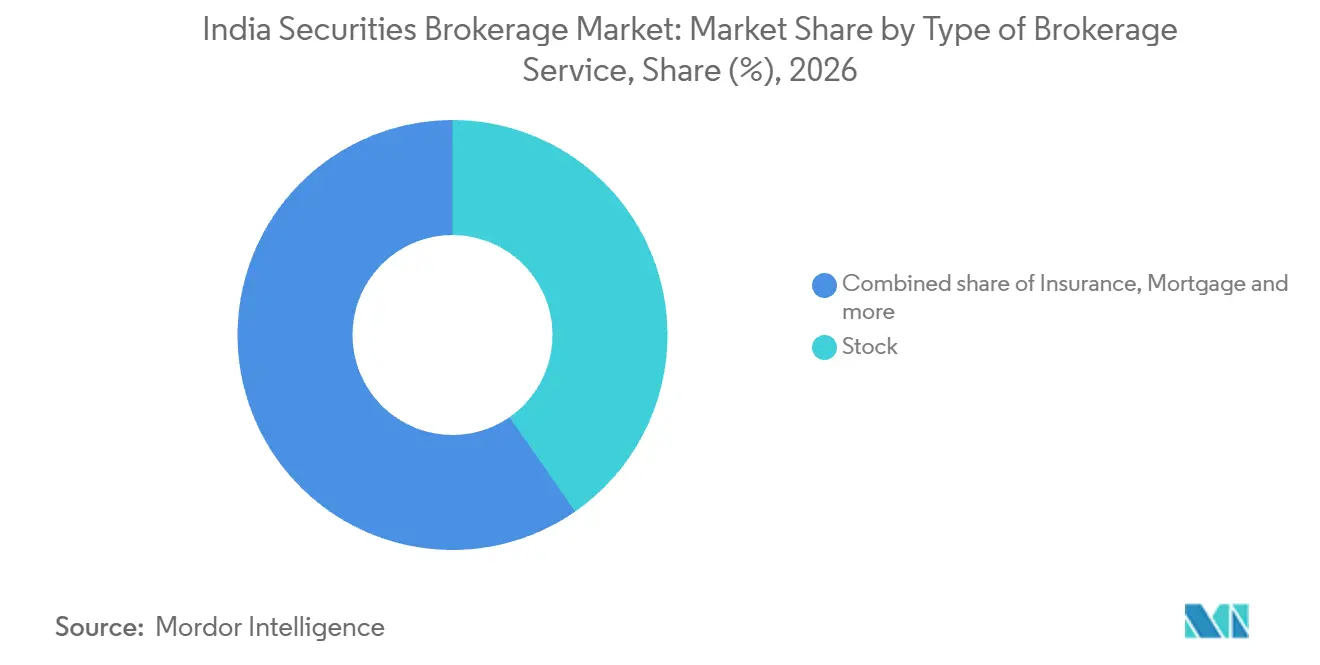
Equity Execution Scale and Currency Hedging NeedsStock brokerage represented a 40.33% India securities brokerage market share in 2026. For the largest segment, NSE reported that average daily turnover in main-board equities rose 21.2% year over year in March 2026, excluding auction-market turnover. A stronger month of traded value creates a larger execution opportunity, although it does not by itself raise the fee retained on each order. Handling the trading flow at a cost consistent with execution pricing determines how much of this opportunity a stock broker can retain.
Forex is the fastest-growing segment, with a forecast CAGR of 13% over 2027-2032. On September 10, 2025, Clearcorp Dealing Systems (India) Limited, a wholly owned subsidiary of the Clearing Corporation of India Limited (CCIL), launched OPTIX for interbank USD-INR foreign-exchange options. CCIL provides clearing and settlement for these options, covering trades with maturities of up to 1 year. Forex brokerage growth can come from execution services that match a currency hedge to a future payment's timing and risk.
By Type of Service:
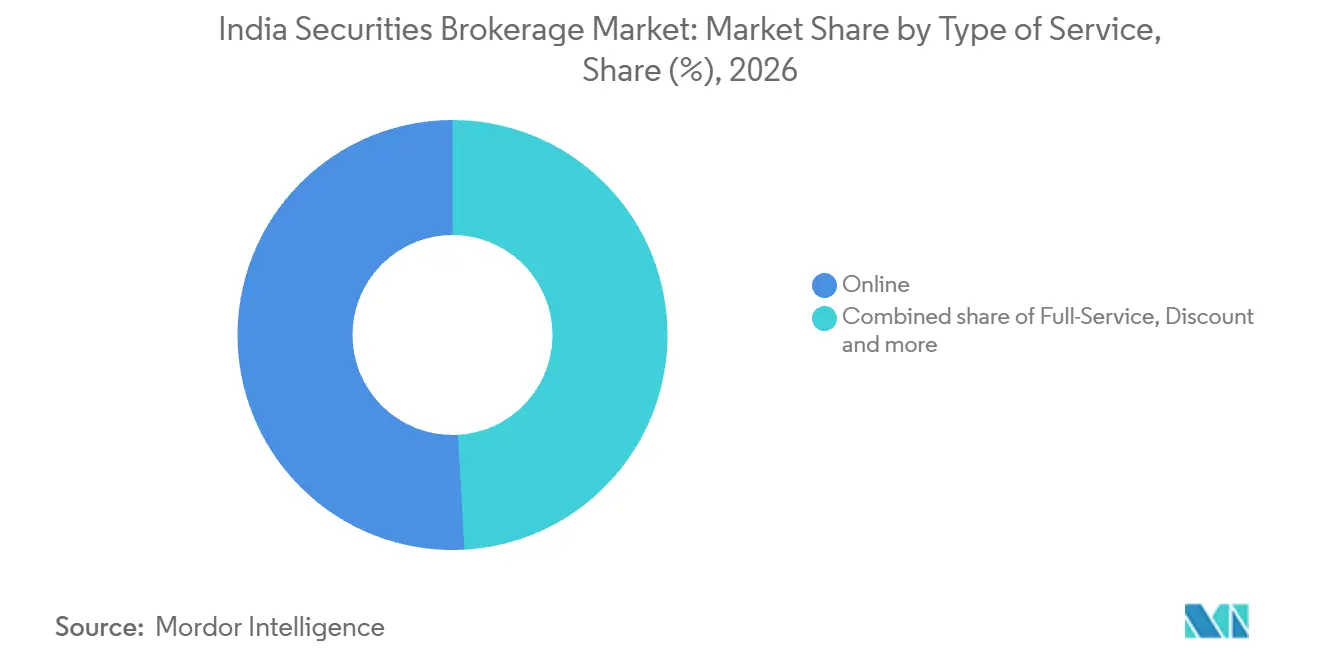
Digital Scale Meets Professionally Supported AdviceOnline services were the largest segment, with a 50.88% share in 2026. Groww reported 12 million Stocks Active Users for FY2025-26, operating the product through a do-it-yourself model and acquiring all customers digitally. Because Groww says it uses no agents, affiliates or sub-brokers for user acquisition, adding a customer does not require replicating an offline acquisition network.
Robo-advisor services are the fastest-growing segment, with a forecast CAGR of 14.7% over 2027-2032. JioBlackRock Investment Advisers launched its digital Personalised Investment Advice platform, powered by BlackRock's Aladdin technology, on February 3, 2026. Experienced professionals build the service's personalized plans around clients' objectives and risk preferences, retaining a human advisory role. Scripbox uses algorithms to construct personalized mutual fund portfolios and monitor funds to trigger exit alerts. Scripbox's algorithmic monitoring shows how recurring portfolio checks can be automated, while JioBlackRock's professionally built plans show digital advice that keeps an adviser in the loop.
By Client Type:
Retail Scale and Institutional Research DepthRetail was the largest segment, with a 58.35% share in 2026, and is the fastest-growing segment, with a forecast CAGR of 13% over 2027-2032. Individual investors accounted for roughly one-third of NSE cash-market turnover in FY2025-26 after their participation share fell 84 basis points year over year. NSE's classification included domestic individuals, nonresident Indians, sole proprietorships and Hindu undivided families. The retail opportunity combines this substantial trading base with continued new-investor onboarding, even as individuals' proportion of cash trading eases.
NSE added 1.05 million investors in India in May 2026, with registrations down 2.5% month over month and 8.2% year over year. For retail brokers, these additions still broaden the potential customer pool despite the slower inflow. Institutional brokerage has a different service model, illustrated by Motilal Oswal Financial Services' cash and derivatives offering to domestic and global institutional investors in FY2025-26. Its Institutional Equity business served more than 900 clients, while its research team covered more than 360 companies across 27 sectors during that reporting period. Maintaining that company and sector coverage commits Motilal Oswal to research expertise beyond the execution access offered by a self-directed retail service.
Geography Analysis
South India Securities Brokerage Market
South India accounted for a 36.23% share of the India securities brokerage market size in 2026, making it the largest geography. SEBI's 2025 survey found that 12% of Karnataka households participated in securities-market products. This participating household base gives brokers an audience for deeper investment-service relationships within a state where securities products have an established foothold. Most Karnataka households were outside the participating group, leaving brokers room to add first-time investors alongside developing services for existing securities-product users.
West India Securities Brokerage Market
West India is the fastest-growing geography, with a forecast CAGR of 13.2% over 2027-2032. NSE recorded 460,000 new investor registrations in its West India regional grouping in August 2026, 40.9% more than in July. This registration inflow creates a brokerage acquisition opportunity by bringing additional investors into the securities participation base. NSE described the August rise as a sequential recovery led by West India after relatively subdued registration momentum in the preceding months.
North India's Delhi had a comparatively broad household securities-product participation base in SEBI's 2025 survey, creating an audience for deeper service relationships. East India's West Bengal also had an established participating household base, supporting acquisition aimed at investors already familiar with securities products. Central India's Chhattisgarh showed more moderate household participation, making the conversion of additional households a distinct development opportunity. North-East India's Nagaland and Meghalaya had lower household participation than Delhi or West Bengal. These contrasts show that household participation differs across the 4 regions, so brokers face a different mix of deepening service use among existing participants and building initial participation in each.
Regulatory Framework and Outlook
This comparison covers selected jurisdictions from the perspective of a SEBI-registered broker operating a Maharashtra office with fewer than 10 workers. National rules govern securities compliance and investor protection, while the state adds establishment obligations to the office's operating requirements. A small office's establishment filing coexists with national compliance oversight, while the April 30, 2026 circular continued state Act duties where consistent with the central Occupational Safety, Health and Working Conditions Code (OSH Code).
Regulatory Table of India Securities Brokerage Market
| Decision factor | India | Maharashtra |
|---|---|---|
| Primary authority | Securities and Exchange Board of India | Maharashtra Labour Department, including designated registration officers |
| Key instruments or direction | Stock Brokers Regulations, 2026 | Shops and Establishments Act, 2017 and April 30, 2026 government circular |
| Commercial effect | Compliance officer, securities-law monitoring, investor-grievance and cyber-resilience duties | Commencement intimation under section 7 for establishments with fewer than 10 workers |
| Current policy attractiveness | Medium | Medium |
| Future direction of policy attractiveness | Hardening | No change |
| Source: Mordor Intelligence | ||
India's Medium rating reflects compliance staffing and cyber-resilience duties, while Hardening reflects SEBI's April 24, 2026 consultation draft, which would add active-client and client-fund exposure components to the earlier cash-balance formula, with comments due May 15, 2026 and no final measure listed as of October 2026. Maharashtra's Medium rating reflects the commencement-intimation duty for the specified office with fewer than 10 workers. An October 1, 2025 ordinance substituted 20 for 10 workers in specified threshold provisions, and Bill LXXXIX introduced on December 8, 2025 proposed replacing that ordinance. The April 30, 2026 circular directed offices below 10 workers to give section 7 commencement intimation, supporting No change for this office's filing burden under either threshold.
Value Chain Stages
The value chain compares customer-facing execution, exchange trading, clearing and settlement, and electronic securities holding. These stages connect the investor's instruction with the infrastructure needed to complete and record a transaction. Their commercial roles differ because the broker can manage the customer interface while other providers supply trading, settlement and custody functions. That division makes the allocation of service income as important as the number of transactions reaching a platform.
Value Chain Analysis Table of India Securities Brokerage Market
| Primary activity | Key participants | Value capture | Bottleneck | Resilience response |
|---|---|---|---|---|
| Customer interface and brokerage execution | Digital brokers such as Groww; brokers and depository participants such as Zerodha | Brokerage and broker depository-participant charges, illustrated by Zerodha | Converting self-directed client instructions into valid orders | Validate instructions and provide escalation before routing orders |
| Exchange trading | Exchange operators such as NSE | Exchange transaction charges | Coordination between order routing and the trading interface | Test order routing and exchange connectivity |
| Clearing and settlement | Clearing operators such as NSE Clearing Limited, a wholly owned NSE subsidiary | Clearing-and-settlement service charges | Coordinating trade obligations across equity, derivatives and commodity settlement | Reconcile trade obligations and settlement records by product |
| Electronic securities holding and transfer | Depository operators such as CDSL | Transaction, account-maintenance and settlement charges paid by depository participants to CDSL | Dependence on accurate holding and transfer records | Reconcile custody records with transfer instructions |
| Source: Mordor Intelligence | ||||
A more convenient brokerage interface cannot independently repair a break in the downstream transaction path. Resilience therefore depends on the handoffs between execution, clearing and the securities record, giving operational reconciliation a role beyond front-end service quality. Commercially, control of the customer relationship can coexist with service income accruing to several infrastructure providers, so transaction activity and broker-retained revenue require separate analysis.
Competitive Landscape
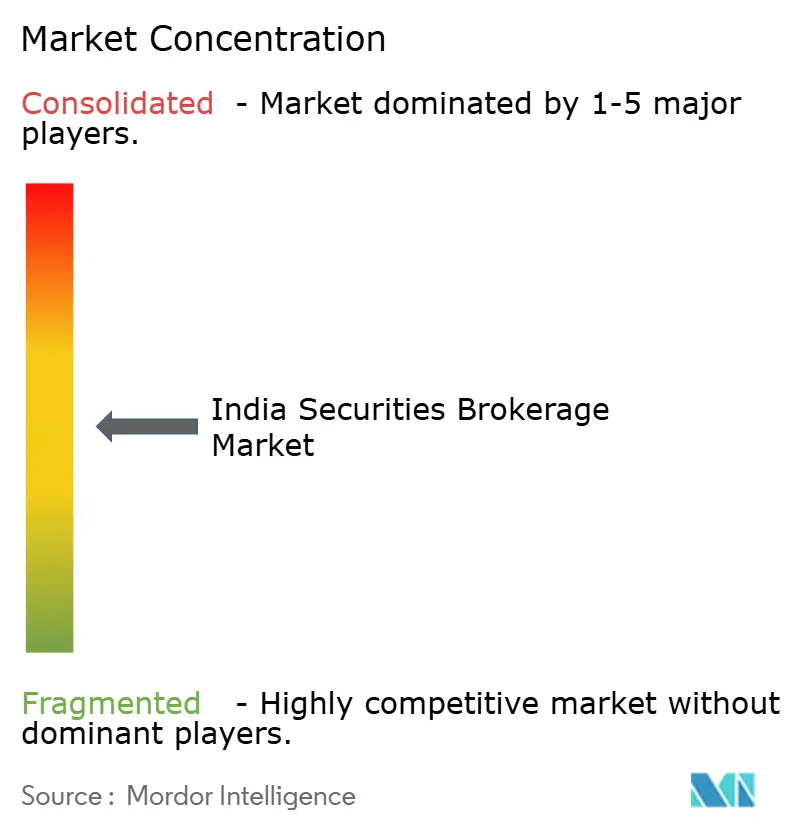
Zerodha, Angel One, ICICI Securities, Upstox and Groww compete in a moderately fragmented field of stock brokers and digital platforms. Angel One reported about 40 million total platform users in Q2 FY2027.[3] Its share of retail overall equity turnover was 19.7%, down 76 basis points year over year in Q2 FY2027. That measure combines retail cash turnover, equity-futures notional turnover and options-premium turnover. A base of about 40 million users therefore did not stop 76 basis points of retail equity turnover share from passing to other brokers.
In June 2025, Zerodha expanded its margin trading facility on Kite to more than 1,300 eligible stocks, with leverage of up to 5 times. In the same month, on June 20, 2025, Upstox enabled margin trading facility support in its good-till-triggered (GTT) order-placement application programming interface (API). Both changes widen the orders a client can place with broker funding, which ties client trading activity more closely to the broker's financing offer. In November 2025, Billionbrains Garage Ventures, the company behind Groww's investment and brokerage platform, began trading on Indian stock exchanges.
Trading interfaces also have to work within the access conditions attached to covered services. NSE standards require clients using broker APIs for covered retail algorithmic trading to provide static IP addresses mapped to their API keys. Brokers may provide this access, while the mapping condition is mandatory for clients who use it under the framework. The commercial barrier is coordinating each client's technical access with compliant order entry. Providers that make those conditions manageable can differentiate through operational support, giving clients a usable path from a trading strategy to an authorized connection.
India Securities Brokerage Industry Leaders
-
Zerodha
-
Angel One
-
ICICI Securities
-
Upstox
-
Groww
- *Disclaimer: Major Players sorted in no particular order
India Securities Brokerage Market Companies Covered in this Report
- Zerodha
- Angel One
- ICICI Securities
- HDFC Securities
- Kotak Securities
- Upstox
- Groww
- Sharekhan
- Motilal Oswal
- Axis Securities
- 5paisa
- SBICAP Securities
- IIFL Capital Services
- Nuvama Wealth and Investment
- Geojit Investments
- Religare Broking
- Paytm Money
- Alice Blue
- Ventura Securities
- Nirmal Bang
Key Opportunities for Market Participants
The openings below compare government-securities execution and retail algorithmic services under 2 SEBI frameworks. In February 2025, SEBI allowed registered stock brokers to trade government securities on Negotiated Dealing System-Order Matching (NDS-OM) through a separate business unit. That unit requires ring-fenced activities, separate accounts and segregated net worth, linking the execution opportunity to the cost of maintaining organizational and financial separation. The retail algorithmic-trading framework and exchange implementation standards applied to all stock brokers from April 1, 2026, making compliant execution access the other defined service route.
Market Opportunities Table of India Securities Brokerage Market
| Opportunity | Why now | Buyer / lead segment | Recommended play | Main barrier | Likely beneficiaries |
|---|---|---|---|---|---|
| Government-securities execution through NDS-OM | SEBI permitted registered brokers to participate through a separate business unit in February 2025 | Investors seeking government-securities execution | Establish a unit exclusively for NDS-OM transactions | Ring-fenced activities, separate accounts and segregated net worth | Registered brokers able to support a dedicated unit |
| Operating services for dedicated government-securities desks | The separate-unit route requires an arms-length relationship with securities-market activities | Brokers establishing NDS-OM business units | Develop accounting and control services around the required separation | Maintaining the unit's exclusive NDS-OM scope and financial separation | Brokers with reusable operating capabilities |
| Compliant retail algorithmic execution | The retail algorithmic framework and exchange standards applied to all brokers from April 1, 2026 | Retail clients seeking algorithmic trading access | Package execution access with the applicable exchange implementation requirements | Delivering the service within the framework and operational standards | Brokers able to combine trading access and compliance |
| Source: Mordor Intelligence | |||||
Compliant retail algorithmic execution is the central opening because exchange standards make implementation capability integral to offering that service. Brokers can combine execution with support for meeting those standards, giving clients a service proposition beyond connection access alone. The commercial test is whether that support makes algorithmic execution usable at a price that covers its delivery cost.
Recent Industry Developments in India Securities Brokerage Market
- May 2026: SEBI discontinued the Investor Risk Reduction Access platform, an alternative trading access point for stock brokers during service disruptions, effective May 7, 2026, and said stock exchanges may review their Contingency Pool Trading facility.
- Jan 2026: SEBI revised the technical-glitch framework for brokers offering internet-based or wireless trading platforms with more than 10,000 registered clients, excluding closed accounts, as of March 31 of the previous financial year. Covered brokers must notify both exchanges and clients within 2 hours of a glitch, subject to the framework's exclusions for specified external disruptions and issues without a direct trading impact.
- Dec 2025: Groww introduced Groww Lite, a web-based backup trading portal designed for emergency trade execution when access to its core app or primary web platforms is temporarily disrupted.
India Securities Brokerage Market Report Scope and Research Methodology
Market Definition and Coverage
The India securities brokerage market measures annual broker revenue from securities brokerage and related margin funding, distribution, and wealth services in India. It counts broker intermediation, financing, distribution, and wealth-service revenue earned in India, classified by instrument or brokerage service, delivery model, client type, and Indian region.
Scope exclusions: The principal or gross transaction value of investments, separately retained market infrastructure fees, investment management fees earned by non-broker asset managers, and broker-service revenue earned outside India are excluded.
Segments Covered in This Report
- By Type of Security
- Bonds
- Stocks
- Treasury Notes
- Derivatives
- Others (ETFs, Mutual Funds)
- By Type of Brokerage Service
- Stock
- Insurance
- Mortgage
- Real Estate
- Forex
- Leasing
- Others (Commodities)
- By Type of Service
- Full-Service
- Discount
- Online
- Robo Advisor
- Broker-Dealers
- By Client Type
- Retail
- High Net Worth Individuals
- Institutional
- Small & Mid-Sized Enterprises
- By Geography
- North India
- West India
- South India
- East India
- Central India
- North-East India
Data Sources, Market Sizing, and Validation
Desk Research
Public sources such as the Securities and Exchange Board of India's bulletin on unique demat holders and investor growth, the National Stock Exchange of India's annual report for trading activity, and Central Depository Services (India) Limited's annual report for demat account formation help define demand signals and broker revenue pools. Motilal Oswal Financial Services' annual report provides a company-level cross-check of brokerage and distribution revenue and business mix. Because investor accounts and exchange turnover describe participation and activity rather than income, analysts interpret them separately from fees, commissions, interest, and advisory income retained by brokers.
Company filings and investor presentations provide segment revenue, client activity, and business mix for cross-checks, while reputable financial press can clarify dated regulatory or market events. These named sources are illustrative rather than exhaustive, and further sources inform collection, validation and clarification.
Primary Interviews and Surveys
The India-focused research design covers senior brokerage executives, business and product leaders, exchange-facing operations specialists, finance and risk managers, and client-facing brokerage managers across large, mid-sized, and smaller firms. Interviews and structured questionnaires would test secondary-source interpretations of revenue recognition, service and client mix, and changes in trading activity, then clarify missing disclosures through targeted follow-up and triangulation across respondents and public records.
Distribution of primary research fieldwork respondents
| Company type | Respondent position | Region |
|---|---|---|
| Top tier: 30% | CXOs: 20% | |
| Mid tier: 50% | Functional/Unit leaders: 35% | |
| Smaller Players: 20% | Managers: 45% |
Market-Sizing & Forecasting
The market model starts with a top-down estimate of annual revenue retained by brokers operating in India, reconciled across execution, margin funding, distribution, and wealth services. Core indicators include active investor and trading-client counts, cash and derivatives activity, realized brokerage fees and yields, margin-funding balances and interest income, and distribution or advisory revenue. These help distinguish account acquisition from monetized activity and recurring service income. A multivariate regression can relate historical revenue to these drivers, with scenario analysis adjusting for regulatory changes, fee competition, and changes in client activity.
Evidence for shares is assembled from broker revenue disclosures, exchange activity, service and instrument disclosures, client mix, and state-level account or activity indicators, then reconciled to the national total. Selective bottom-up checks compare reported revenue from a sample of brokers and, where disclosures permit, sampled client or transaction activity multiplied by observed fee or yield levels with the top-down estimate. When a broker does not disclose a service or regional split, analysts use relevant public activity and revenue mix indicators to bound the allocation, record the assumption, and test its effect. India-based brokerage and market-structure experts review the variables and assumptions behind the forecasts and flag areas for follow-up analysis.
Data Validation & Update Cycle
Analysts triangulate broker filings, regulator and exchange statistics, depository reports, and primary responses, then check revenue totals, segment shares, year-on-year movements, and differences between reported activity and broker income for anomalies. A second analyst reviews source definitions, calculations, and reconciliations before sign-off, and the team resolves material variances or re-contacts suitable respondents when a disclosure is ambiguous or an operating change could alter the estimate. The model is refreshed annually, updated between cycles for material regulatory or market events, and given a fresh pre-delivery review of definitions, sources, calculations, and forecast assumptions.
Mordor Intelligence's India Securities Brokerage Market Estimate Compared With Other Published Estimates
Published estimates can differ in the transactions and products they count and the inputs used to model demand. The India securities brokerage market measures annual broker revenue from securities brokerage and related margin funding, distribution, and wealth services in India.
Key Gap Drivers include the study's defined coverage and market-specific modeling choices. Evidence for shares is assembled from broker revenue disclosures, exchange activity, service and instrument disclosures, client mix, and state-level account or activity indicators, then reconciled to the national total.
Benchmark comparison
| Source | Market Size | Gaps in Research Methodology |
|---|---|---|
| Mordor Intelligence | USD 7.91 B (2027) | |
| Market Research Firm A | USD 5.4 B (2025) | At its 2025 base, this estimate is 31.7% below this report's 2027 value of USD 7.91 B, 2 years later. The 2025 base predates the source's forecast recovery in broker revenue after the documented derivatives-related contraction. |
| Market Research Firm B | USD 3.98 B (2024) | At its 2024 base, this estimate is 49.7% below this report's 2027 value of USD 7.91 B, 3 years later. The estimate uses an earlier revenue base and its published forecast shows subsequent market growth. |
Mordor Intelligence's analysts triangulate broker filings, regulator and exchange statistics, depository reports, and primary responses, then check revenue totals, segment shares, year-on-year movements, and differences between reported activity and broker income for anomalies.
Key Questions Answered in the Report
What is the India securities brokerage market size and growth outlook?
The size is forecast at USD 7.91 billion in 2027 and USD 14.47 billion by 2032, growing at a CAGR of 12.84% over 2027-2032.
What drives demand for securities brokerage services in India?
Demat access, mobile trading and instant funding support participation. CDSL added 27.1 million net beneficial-owner accounts in FY2025-26.
Which security type leads securities brokerage activity?
Stocks were the largest segment, with a 45.77% share in 2026.
Which companies are major securities brokers in India?
Major providers include Zerodha, Angel One, ICICI Securities, Upstox and Groww.
What commercial challenge do securities brokers face?
Low-cost competition pressures fee capture, with CRISIL Ratings identifying intense competition affecting 5paisa in August 2026. Higher-priced brokers must justify their charges to cost-sensitive derivatives clients.
Which Indian regions lead securities brokerage scale and growth?
South India led with a 36.23% share in 2026, while West India is forecast to grow fastest at a CAGR of 13.2% over 2027-2032.