
Rust Stop Lubricants Aerosol Market Size and Share
Market Overview
| Study Period | 2021 - 2031 |
|---|---|
| Market Size (2026) | USD 0.92 Billion |
| Market Size (2031) | USD 1.21 Billion |
| Growth Rate (2026 - 2031) | 5.63 % |
| Fastest Growing Market | Asia-Pacific |
| Largest Market | Asia-Pacific |
| Market Concentration | Medium |
Major Players *Disclaimer: Major Players sorted in no particular order Image © Mordor Intelligence. Reuse requires attribution under CC BY 4.0. | |
Rust Stop Lubricants Aerosol Market Analysis by Mordor Intelligence
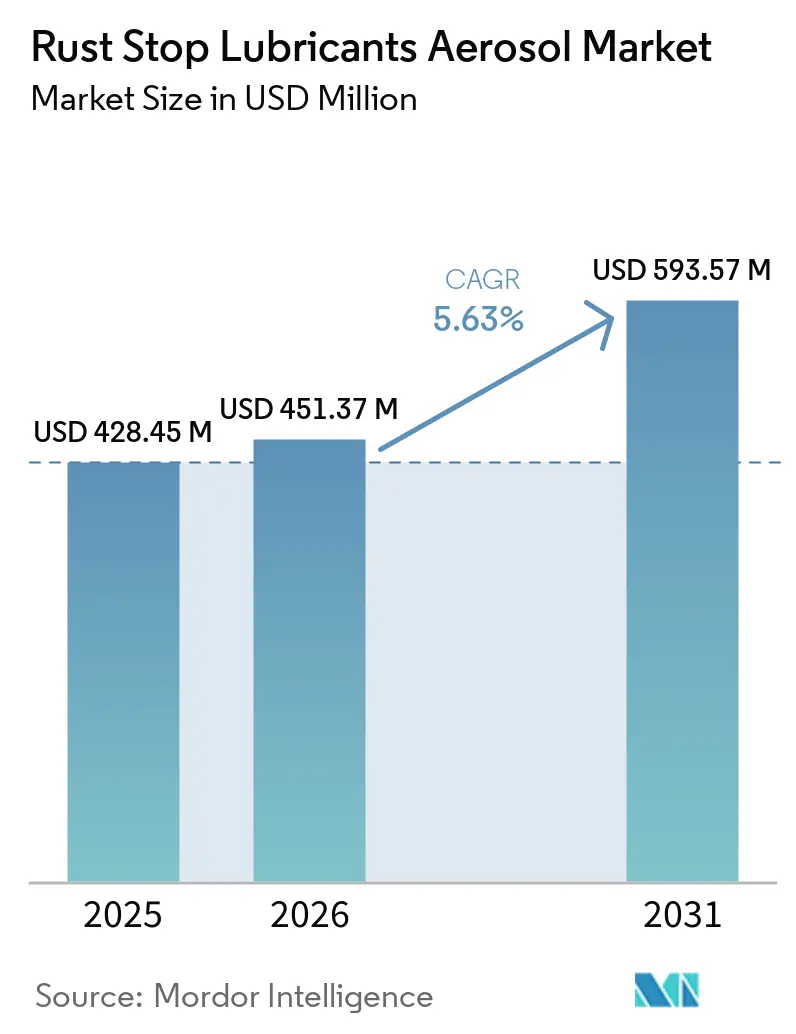
The Rust Stop Lubricants Aerosol Market size is expected to increase from USD 0.87 billion in 2025 to USD 0.92 billion in 2026 and reach USD 1.21 billion by 2031, at a CAGR of 5.63% over 2026-2031. The rust stop lubricants aerosol market benefits from recurring maintenance needs across aging vehicles, industrial equipment, and infrastructure. The average age of the United States light-vehicle fleet exceeded 12.6 years in 2025, supporting repeat aftermarket use of penetrating and corrosion-inhibiting sprays. Manufacturing and infrastructure investment in Asian economies is also expanding the installed base of equipment that requires routine maintenance products. Product development is shifting toward low-volatile organic compound (VOC) and bio-based formulations as North American and European regulations influence product specifications and pricing. These conditions give the rust stop lubricants aerosol market a steady, maintenance-led demand base rather than a short-term replacement cycle.
Key Report Takeaways
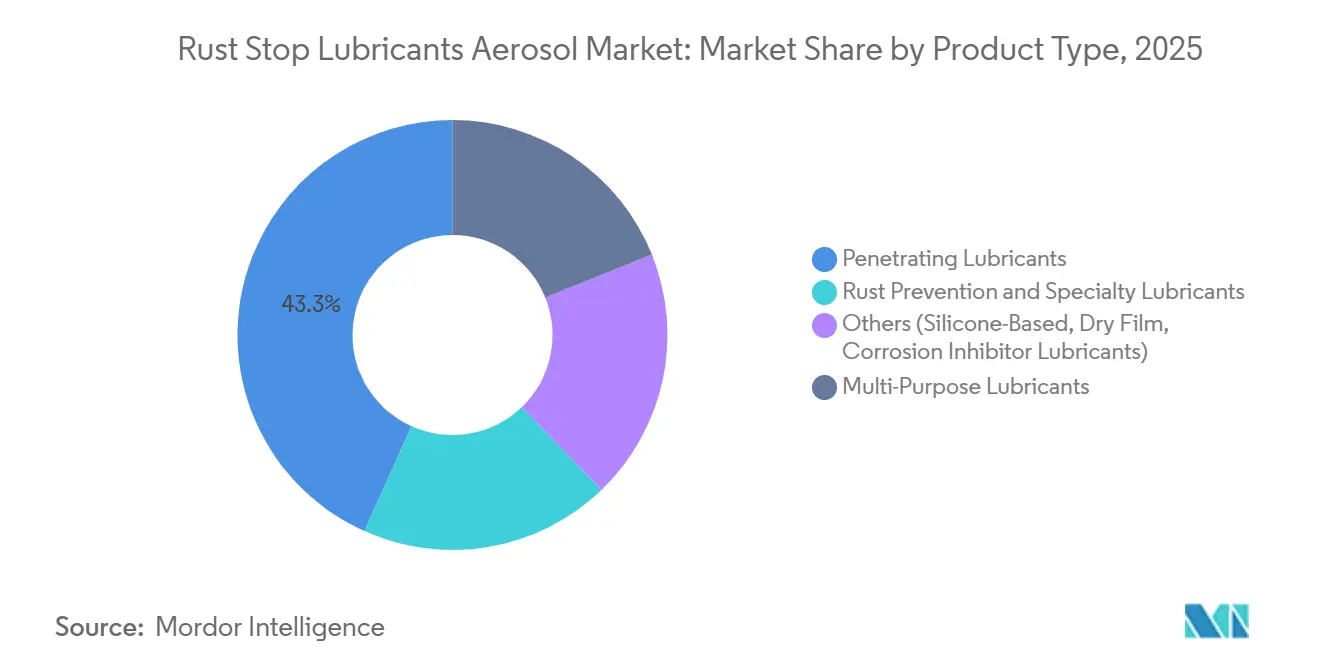
- By product type, Penetrating Lubricants held 43.28% of the rust stop lubricants aerosol market share in 2025, while Rust Prevention and Specialty Lubricants are forecast to grow at a 6.48% CAGR through 2031.
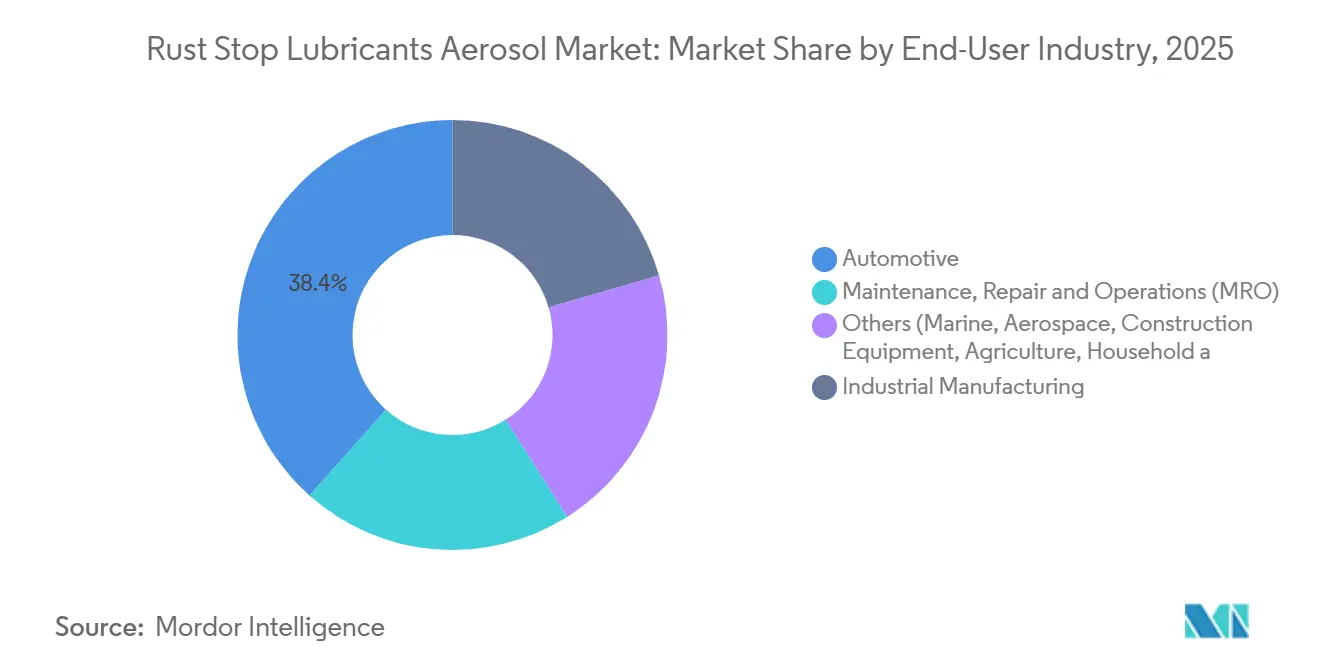
- By end-user industry, Automotive accounted for 38.42% of the rust stop lubricants aerosol market share in 2025, while Industrial Manufacturing recorded the highest projected CAGR at 6.21% through 2031.
- By geography, Asia-Pacific accounted for 36.50% of the rust stop lubricant aerosol market share in 2025 and is projected to expand at a 6.87% CAGR through 2031.
Note: Market size and forecast figures in this report are generated using Mordor Intelligence’s proprietary estimation framework, updated with the latest available data and insights as of January 2026.
Market Trends and Insights
Drivers Impact Analysis of Rust Stop Lubricants Aerosol Market*
| Drivers | (~) % Impact on CAGR Forecast | Geographic Relevance | Impact Timeline |
|---|---|---|---|
| Preventive Maintenance for Aging Equipment | +1.3% | Global, concentrated in North America, Europe, and Japan | Medium term (2-4 years) |
| Expansion of Automotive and Industrial Repair Activity | +1.1% | Global, led by Asia-Pacific and North America | Short term (≤ 2 years) |
| Demand for Multifunctional Penetrant-Lubricant Performance | +0.8% | Global | Medium term (2-4 years) |
| Growth of E-Commerce and Digital Procurement | +0.6% | North America, Asia-Pacific, Europe | Short term (≤ 2 years) |
| Corrosion Protection in Harsh Marine, Coastal, and Outdoor Environments | +0.7% | Asia-Pacific coastal, the Middle-East, and South America | Long term (≥ 4 years) |
| Low-Volatile Organic Compound (VOC), Bio-Based, and Safer Formulation Innovation | +0.5% | North America, Europe, Asia-Pacific | Medium term (2-4 years) |
| Source: Mordor Intelligence | |||
Preventive Maintenance Programs Extend the Demand Base for Aerosol Lubricants
Preventive maintenance creates recurring demand for aerosol lubricants because scheduled lubrication and corrosion-control work occurs before failures disrupt normal operations. The U.S. Department of Transportation has linked corrosion-related failures to 25% of transportation infrastructure maintenance costs, making corrosion protection a practical maintenance priority. Condition-monitoring programs identify equipment issues at an early stage, before they develop into major failures, making aerosol spot lubrication a practical response for equipment operators. These programs support maintenance practices that limit unplanned downtime, reduce avoidable disruption, and encourage regular procurement of lubrication and corrosion-control consumables. The rust stop lubricants aerosol market benefits from programs that favor small, frequent interventions over large repair events, particularly in facilities where equipment availability guides maintenance decisions.
Automotive and Industrial Repair Activity Sustains High-Frequency Consumption
Automotive repair is a recurring source of demand because older vehicles require corrosion treatment and lubricant application during routine service. The rust stop lubricants aerosol market is supported by work on corroded fasteners, joints, hinges, chain links, and pipe fittings in independent workshops, fleet maintenance locations, and service departments. Industrial upgrades add lubrication points through machine retrofits, robotic equipment, precision assembly lines, and conveyor systems that require reliable movement and protection of metal components, providing a broad maintenance setting for aerosol consumables. OSHA safety practices and EPA emissions requirements encourage documented service procedures, which make routine facility maintenance more formal and traceable[1]. These conditions support frequent purchases of rust stop lubricant aerosol products for planned work rather than only for infrequent bulk maintenance projects.
Multifunctional Penetrant-Lubricant Performance Reshapes Buyer Criteria
Automotive dealers, MRO distributors, and industrial maintenance teams are reducing inventory complexity by choosing products that combine multiple functions into a single can. Buyers value products that penetrate seized parts, lubricate moving surfaces, displace moisture, inhibit corrosion, and clean components without requiring several separate materials. This preference reduces storage requirements, product selection time, and labor time during maintenance events when technicians need to complete work promptly. FUCHS used Alchemite machine learning in formulation development and reported a 50% improvement in key performance measures within three experimental design rounds in 2025. Faster formulation cycles raise performance expectations for products serving fleet and plant accounts, where technical requirements are typically more defined.
E-Commerce and Digital Procurement Accelerate Access and Buyer Power
Digital purchasing expands access to specialty aerosol products for workshops and small maintenance buyers who previously depended on nearby hardware stores or local distributors. This channel improves product availability across Asia-Pacific and Latin American networks while allowing buyers to compare stated performance, certifications, package formats, and product suitability. Radco Industries launched an e-commerce platform for its Radcolube specialty lubricant range in July 2025 to reduce purchasing friction and improve product availability. This change increases pressure on brands to communicate performance, certification, and relevant applications clearly before a buyer places an order. Established distributors remain important for availability and technical advice, but online access reduces the advantage created solely by physical coverage. The rust stop lubricants aerosol market is affected because small workshops can source specialized products with fewer ordering barriers and more direct access to product comparisons.
Restraints Impact Analysis of Rust Stop Lubricants Aerosol Market*
| Restraints | (~) % Impact on CAGR Forecast | Geographic Relevance | Impact Timeline |
|---|---|---|---|
| Volatile Organic Compound (VOC), Flammability, and Chemical Compliance Costs | -0.8% | North America and Europe, with spillover to the Asia-Pacific | Medium term (2-4 years) |
| Volatile Base Oil, Solvent, Additive, and Propellant Costs | -0.6% | Global | Short term (≤ 2 years) |
| Aerosol Transport, Storage, and Disposal Constraints | -0.4% | Global, accentuated in the Middle-East, Africa, and South America | Medium term (2-4 years) |
| Substitution by Non-Aerosol, Coating, and Mechanical Repair Methods | -0.4% | Europe, North America | Long term (≥ 4 years) |
| Source: Mordor Intelligence | |||
VOC, Flammability, and Chemical Compliance Costs Compress Formulator Margins
Aerosol lubricant producers in North America and Europe face regulations that raise formulation, testing, reporting, and documentation costs. The Environmental Protection Agency (EPA) finalized amendments to the National VOC Emission Standards for Aerosol Coatings in January 2025 and later extended the compliance date to January 17, 2027. California maintains separate VOC requirements, adding another layer of compliance for gear, chain, and penetrant lubricant suppliers selling across multiple jurisdictions. Reformulation can require retesting, updated safety data sheets, product registrations, retailer documentation, and alignment with changing chemical and hazard communication requirements. Smaller producers may find these requirements difficult to meet due to fewer regulatory specialists, less research capacity, and a limited ability to spread fixed compliance costs across a broad portfolio. The rust-stop lubricant aerosol market may therefore favor suppliers that can absorb compliance work while maintaining reliable products available to professional and retail customers.
Raw Material and Propellant Volatility Undermines Forward Planning
Aerosol lubricant costs depend on base oils, solvents, additives, propellants, and aluminum cans, so changes across several input categories can simultaneously affect supplier margins. Liquefied Petroleum Gas (LPG) export prices fell from USD 930 per ton in 2023 to USD 533 per ton in 2024, and rose by 25% as of March 2026 amid tensions in the Middle-East[2]. Propane and butane are central aerosol propellants, making their price movements significant for a product sold in pressurized cans and distributed through multiple channels. Aluminum costs can add further pressure when metal prices rise, encouraging lightweighting and alternative can designs that use less material per unit. Suppliers without hedging capacity may need to absorb input cost increases by lowering margins or raising prices in ways that weaken private-label competitiveness. The rust-stop lubricant aerosol market consequently faces uneven margins, even when maintenance demand remains steady and underlying consumption conditions remain favorable.
*Our forecasts treat driver/restraint impacts as directional, not additive. The impact forecasts reflect baseline growth, mix effects, and variable interactions.
Rust Stop Lubricants Aerosol Market Segment Analysis
By Product Type:
Specialty Films Gain Specification Share as Penetrant Lead MaturesPenetrating lubricants accounted for 43.28% of the rust stop lubricants aerosol market share in 2025, supported by regular workshop use for seized fasteners, chain links, and pipe fittings. Repeat sales reflect established buying habits in automotive repair and MRO channels across all regions. Rust prevention and specialty lubricants are projected to grow at a 6.48% CAGR through 2031, as users specify long-dwell protective films in marine, renewable energy, and outdoor infrastructure applications. FUCHS CEPLATTYN 300 SPRAY is a dry-film aerosol for wind-turbine gear teeth and illustrates demand in high-load, dust-exposed settings where wet greases are unsuitable. The rust stop lubricant aerosol market for specialized uses benefits when maintenance teams select products for specific operating conditions.
Multi-purpose lubricants retain a stable role and remain central to brands such as WD-40 Multi-Use Product. WD-40 Company reported USD 477.96 million in net sales for the product in fiscal year 2025, despite category maturity. The other category includes silicone-based, dry-film, and corrosion-inhibiting lubricants that serve electronics assembly and food processing environments. EU Ecolabel criteria and NSF International (NSF) H1 and H2 registrations support product selection where sustainability and food-contact conditions are relevant. CRC Industries introduced Bio-Based Power Lube in 2025 as a vegetable oil-based, ceramic-fortified aerosol with Organisation for Economic Co-operation and Development (OECD) 301B biodegradability compliance, illustrating the innovation focus within the rust stop lubricants aerosol industry.

By End-User Industry:
Factory MRO Channels Accelerate as Automotive Lead Holds SteadyAutomotive accounted for 38.42% of the rust stop lubricants aerosol market share in 2025, reflecting ongoing work on fasteners, joints, and corrosion-prone vehicle components. Repair workshops regularly use penetrants and protective sprays as vehicle maintenance involves safety and corrosion-control tasks. Industrial manufacturing is projected to grow at a 6.21% CAGR through 2031, as automation, machine retrofits, and precision production systems add maintenance requirements. The rust stop lubricants aerosol market tied to factory MRO demand is rising with industrial equipment deployment in Asia-Pacific and nearshoring-related investment in North America and Mexico. Aerosol delivery enables maintenance teams to apply targeted treatment without fully disassembling equipment.
MRO distributors connect product suppliers with automotive, industrial, and aerospace customers, helping new products reach multiple end-user groups. Their distribution role enables maintenance departments to evaluate specialty aerosols as part of routine purchasing processes. Marine, aerospace, construction, agriculture, and household do-it-yourself (DIY) activities add demand beyond the two leading end-user segments. Marine applications require corrosion control in demanding conditions, while construction and agriculture require maintenance products for exposed equipment. The rust stop lubricants aerosol industry has a diversified demand base, as users face varying equipment, environmental, and procurement conditions.
Geography Analysis
APAC Rust Stop Lubricants Aerosol Market
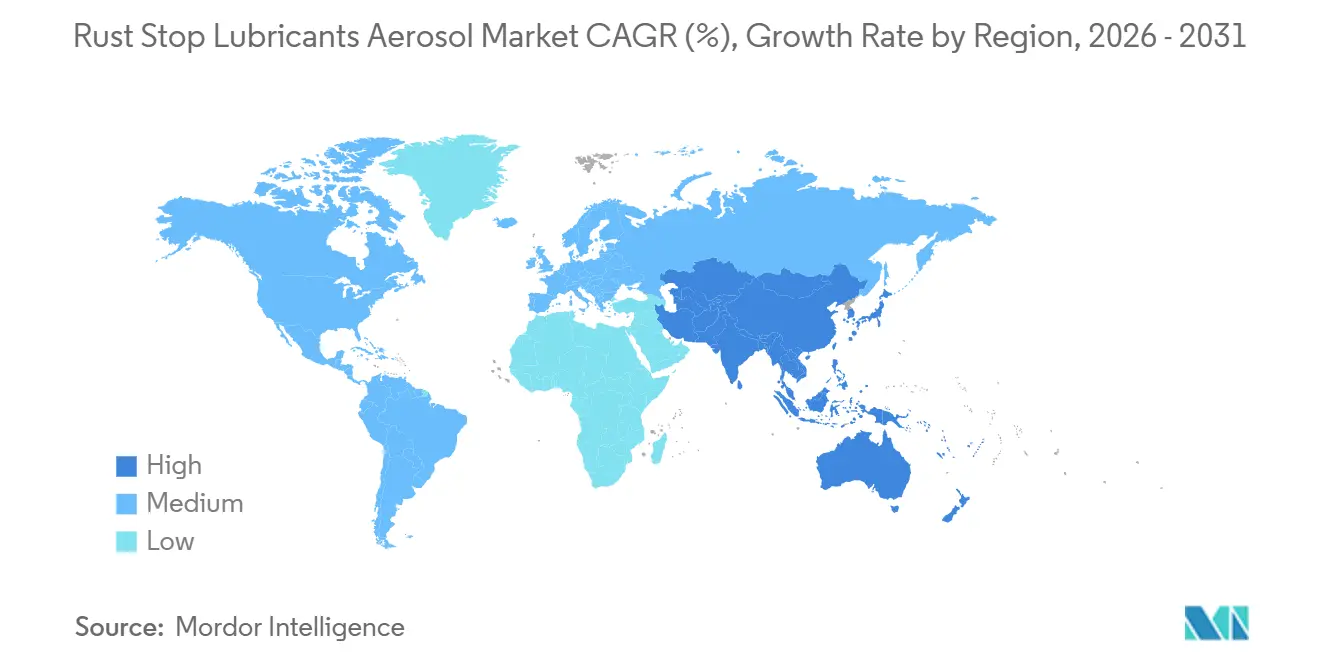
Asia-Pacific accounted for 36.50% of the rust stop lubricants aerosol market share in 2025 and is expected to post the fastest regional CAGR of 6.87% through 2031. China supports output through its large manufacturing base, while India adds demand from rail expansion, construction equipment maintenance, and a developing automotive aftermarket. Japan and South Korea contribute to demand for dry-film and specialty aerosols suited to precision manufacturing applications. Infrastructure investment in industrial corridors and logistics networks in India is increasing equipment deployment and creating subsequent maintenance needs. The regional market size is further supported by established vehicle and manufacturing clusters and expanding repair networks.
North America and Europe Rust Stop Lubricants Aerosol Market
North America and Europe are important markets for premium formulations and regulatory-driven product changes. The Environmental Protection Agency (EPA) aerosol coatings rule has a January 2027 compliance date, prompting suppliers to develop lower-reactivity formulations and prepare related documentation. North American automotive and aerospace clusters support demand for specialty products aligned with formal maintenance practices. Germany produced 934 million aerosol units in 2025, up from 932 million in 2024, and corrosion-protection coatings posted 3% growth in 2025.
South America, MEA and Oceania Rust Stop Lubricants Aerosol Market
South America provides additional output through agribusiness equipment, offshore oil and gas, and construction maintenance. Brazil recorded weaker aerosol can deliveries in the first half of 2025 as consumer purchasing power declined, while demand for industrial maintenance products was less directly affected by consumer confidence. The Middle-East and Africa benefit from oil and gas maintenance activity and maritime operations through the Red Sea and Gulf corridors. Saudi Arabia and South Africa support regional demand as engineering contractors formalize Maintenance, Repair, and Operations (MRO) procurement. B'laster expanded into Australia and New Zealand through Repco in 2025, demonstrating how North American brands are broadening access to Pacific workshop networks. The rust stop lubricants aerosol market retains a varied regional profile, as repair practices, environmental exposure, and distribution coverage differ across countries.
Competitive Landscape
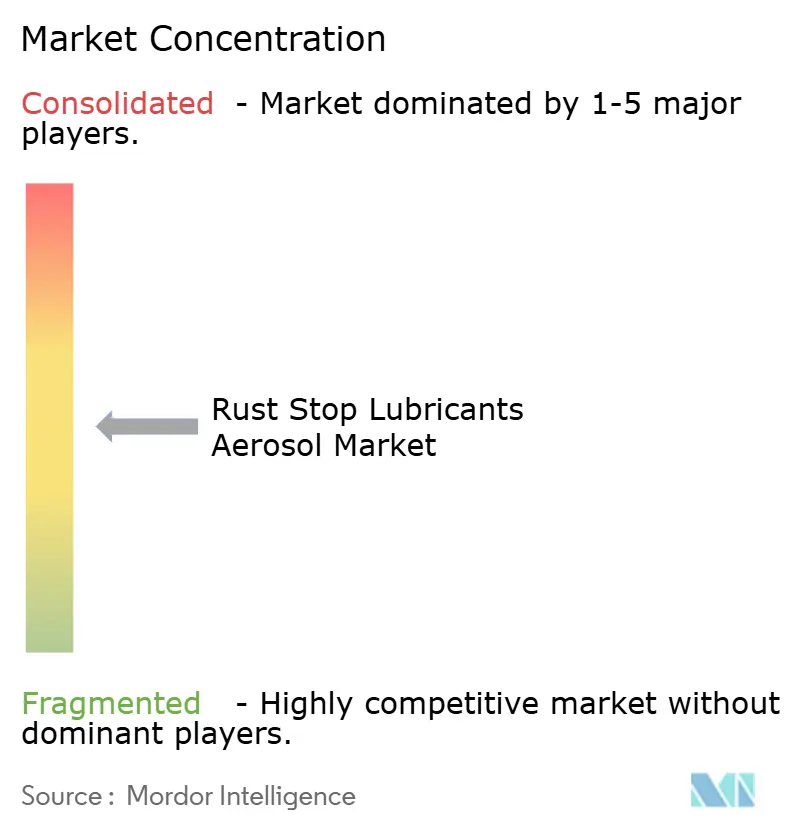
The rust stop lubricants aerosol market is moderately fragmented, with WD-40 Company, CRC Industries, Illinois Tool Works (through Permatex), and Shell holding recognized positions in automotive and MRO channels. These companies benefit from established distribution networks, recognized brands, and broad product portfolios. Competition is increasingly based on formulation credentials rather than distribution reach alone. Bio-based content, EU Ecolabel certification, and National Sanitation Foundation (NSF) food-grade registrations can strengthen a supplier's position in professional purchasing decisions. WD-40 Company reported USD 591 million in maintenance product net sales for fiscal year 2025, up 6% from the prior year, while the WD-40 Specialist line grew 11%.
WD-40 Company also reported year-to-date global growth of 22% for WD-40 Specialist in its second-quarter 2026 results, reflecting its focus on premium maintenance categories. CRC Industries introduced Bio-Based Power Lube in 2025, expanding its offering to include biodegradable and specialty aerosol formats. FUCHS uses machine learning to shorten formulation development cycles, reducing the time required to bring specialized products to market. These developments indicate that product performance and faster development cycles are key competitive factors in the rust stop lubricants aerosol market.
Specialist suppliers compete in focused applications where standard multi-purpose sprays may not meet customer requirements. Kano Laboratories addresses food-safe needs through NSF H1-registered and KOSHER-approved products, while Cortec offers CorShield VpCI-369 for vapor-phase corrosion protection in enclosed metal spaces. Environmental Protection Agency (EPA) and Registration, Evaluation, Authorisation and Restriction of Chemicals (REACH) requirements can favor larger firms with dedicated regulatory teams and diversified portfolios. The market remains competitive across both broad maintenance products and narrower certified applications.
Rust Stop Lubricants Aerosol Industry Leaders
-
WD-40 Company
-
CRC Industries
-
B'laster LLC
-
Rust-Oleum Corporation
-
Illinois Tool Works Inc.
- *Disclaimer: Major Players sorted in no particular order
Rust Stop Lubricants Aerosol Market Companies Covered in this Report
- 3M
- American Polywater Corporation
- B'laster LLC
- Cortec Corporation
- CRC Industries
- Exxon Mobil Corporation
- FUCHS
- Illinois Tool Works Inc.
- Kano Laboratories LLC
- Lubrication Engineers
- Rust-Oleum Corporation
- Shell plc
- TotalEnergies
- WD-40 Company
- Zep Inc.
Recent Industry Developments in Rust Stop Lubricants Aerosol Market
- July 2026: WD-40 Company launched WD-40 Specialist Bio Lubricant Multi-Use across European markets. The product is the first multi-use aerosol lubricant in its portfolio to carry EU Ecolabel certification (Decision (EU) 2018/1702). The formulation uses 85% bio-based ingredients and holds NSF H2 registration for incidental food-contact environments, raising the specification baseline for premium aerosol lubricants across professional and light-industrial accounts.
- November 2025: CRC Industries debuted Bio-Based Power Lube and Evapo-Rust Spray Gel at AAPEX 2025. Bio-Based Power Lube uses a vegetable oil base, a ceramic powder additive package, and an OECD 301B biodegradability certification. Evapo-Rust Spray Gel addresses in-situ rust removal on vertical surfaces without soaking. Both products expand the addressable use cases for biodegradable and specialty aerosol formats.
Global Rust Stop Lubricants Aerosol Market Report Scope
Rust stop lubricant aerosols are multi-purpose, moisture-displacing sprays designed to penetrate tight metal spaces, loosen rusted bolts, eliminate squeaks, and protect automotive, industrial, and household metal parts from future corrosion.
The rust stop lubricants aerosol market is segmented by product type, end-user industry, and geography. By product type, the market is segmented into multi-purpose lubricants, penetrating lubricants, rust prevention and specialty lubricants, and others (silicone-based, dry film, corrosion inhibitor lubricants). By end-user industry, the market is segmented into automotive, industrial manufacturing, maintenance, repair and operations (MRO), and others (marine, aerospace, construction equipment, agriculture, household, and DIY). The report also covers market size and forecasts for rust stop lubricants aerosol across 15 countries in major regions. The market sizes and forecasts are provided in terms of value (USD).
Segmentation Overview
| Multi-Purpose Lubricants |
| Penetrating Lubricants |
| Rust Prevention and Specialty Lubricants |
| Others (Silicone-Based, Dry Film, Corrosion Inhibitor Lubricants) |
| Automotive |
| Industrial Manufacturing |
| Maintenance, Repair and Operations (MRO) |
| Others (Marine, Aerospace, Construction Equipment, Agriculture, Household and DIY) |
| Asia-Pacific | China |
| India | |
| Japan | |
| South Korea | |
| Rest of Asia-Pacific | |
| North America | United States |
| Canada | |
| Mexico | |
| Europe | Germany |
| United Kingdom | |
| France | |
| Italy | |
| Rest of Europe | |
| South America | Brazil |
| Argentina | |
| Rest of South America | |
| Middle-East and Africa | Saudi Arabia |
| South Africa | |
| Rest of Middle-East and Africa |
| By Product Type | Multi-Purpose Lubricants | |
| Penetrating Lubricants | ||
| Rust Prevention and Specialty Lubricants | ||
| Others (Silicone-Based, Dry Film, Corrosion Inhibitor Lubricants) | ||
| By End-User Industry | Automotive | |
| Industrial Manufacturing | ||
| Maintenance, Repair and Operations (MRO) | ||
| Others (Marine, Aerospace, Construction Equipment, Agriculture, Household and DIY) | ||
| By Geography | Asia-Pacific | China |
| India | ||
| Japan | ||
| South Korea | ||
| Rest of Asia-Pacific | ||
| North America | United States | |
| Canada | ||
| Mexico | ||
| Europe | Germany | |
| United Kingdom | ||
| France | ||
| Italy | ||
| Rest of Europe | ||
| South America | Brazil | |
| Argentina | ||
| Rest of South America | ||
| Middle-East and Africa | Saudi Arabia | |
| South Africa | ||
| Rest of Middle-East and Africa | ||
Key Questions Answered in the Report
What is current market size of Rust Stop Lubricants Aerosol Market?
The Rust Stop Lubricants Aerosol Market size is expected to increase from USD 0.87 billion in 2025 to USD 0.92 billion in 2026 and reach USD 1.21 billion by 2031, at a CAGR of 5.63% over 2026-2031.
Which product category led sales in 2025?
Penetrating Lubricants led with 43.28% of revenue in 2025, supported by regular workshop maintenance requirements.
Which product category is forecast to grow the fastest?
Rust Prevention and Specialty Lubricants are expected to grow at a 6.48% CAGR through 2031 as demand rises in marine, renewable energy, and outdoor infrastructure applications.
Which end-user group had the largest demand in 2025?
Automotive accounted for 38.42% of revenue in 2025 because repair work requires recurring lubrication and corrosion treatment.