
Running Shoes Market Size and Share
Market Overview
| Study Period | 2022 - 2032 |
|---|---|
| Market Size (2027) | USD 79.78 Billion |
| Market Size (2032) | USD 101.10 Billion |
| Growth Rate (2027 - 2032) | 4.85 % |
| Fastest Growing Market | Asia-Pacific |
| Largest Market | North America |
| Market Concentration | Medium |
Major Players *Disclaimer: Major Players sorted in no particular order Image © Mordor Intelligence. Reuse requires attribution under CC BY 4.0. | |
Running Shoes Market Analysis by Mordor Intelligence
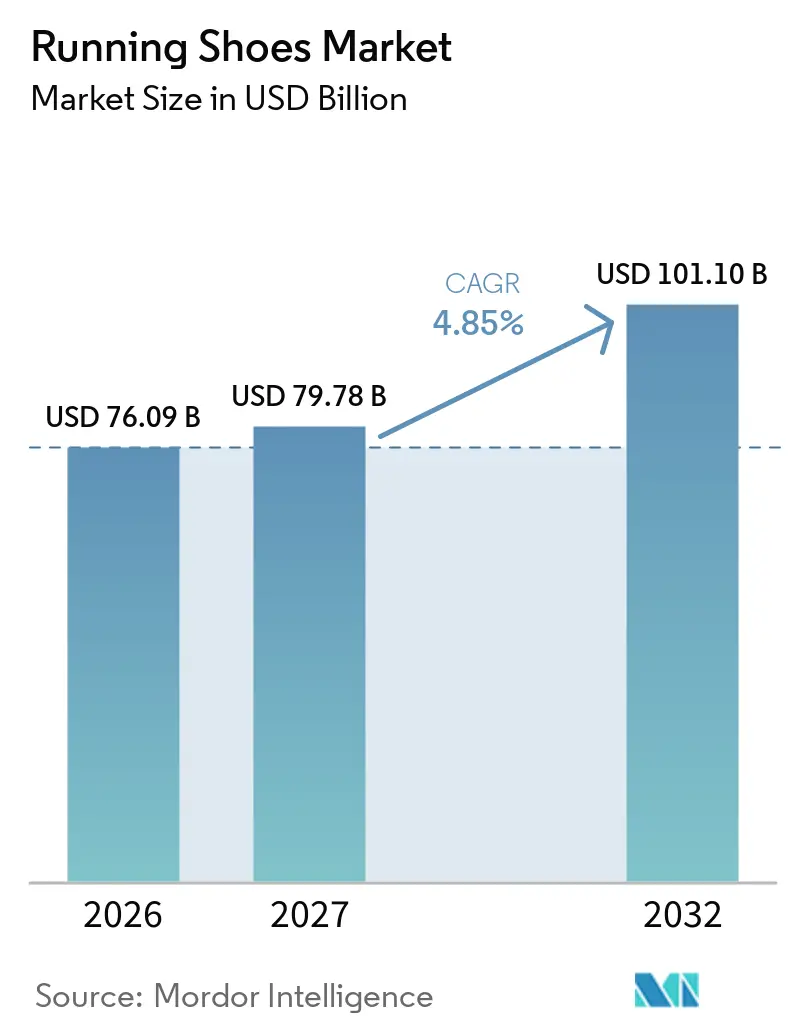
The running shoes market size is expected to grow from USD 76.09 billion in 2026 to USD 79.78 billion in 2027 and is forecast to reach USD 101.10 billion by 2032 at a 4.85% CAGR over 2027-2032. The running shoes market is benefiting from increased participation in fitness, a growing number of running events, and rising demand for specialized shoes for road, trail, and racing applications. Premium performance products, ongoing product innovation, and the expansion of online sales channels are creating additional growth opportunities. Brands are strengthening their market presence through differentiated designs, advanced materials, broader product portfolios, and enhanced consumer engagement.
Key Report Takeaways
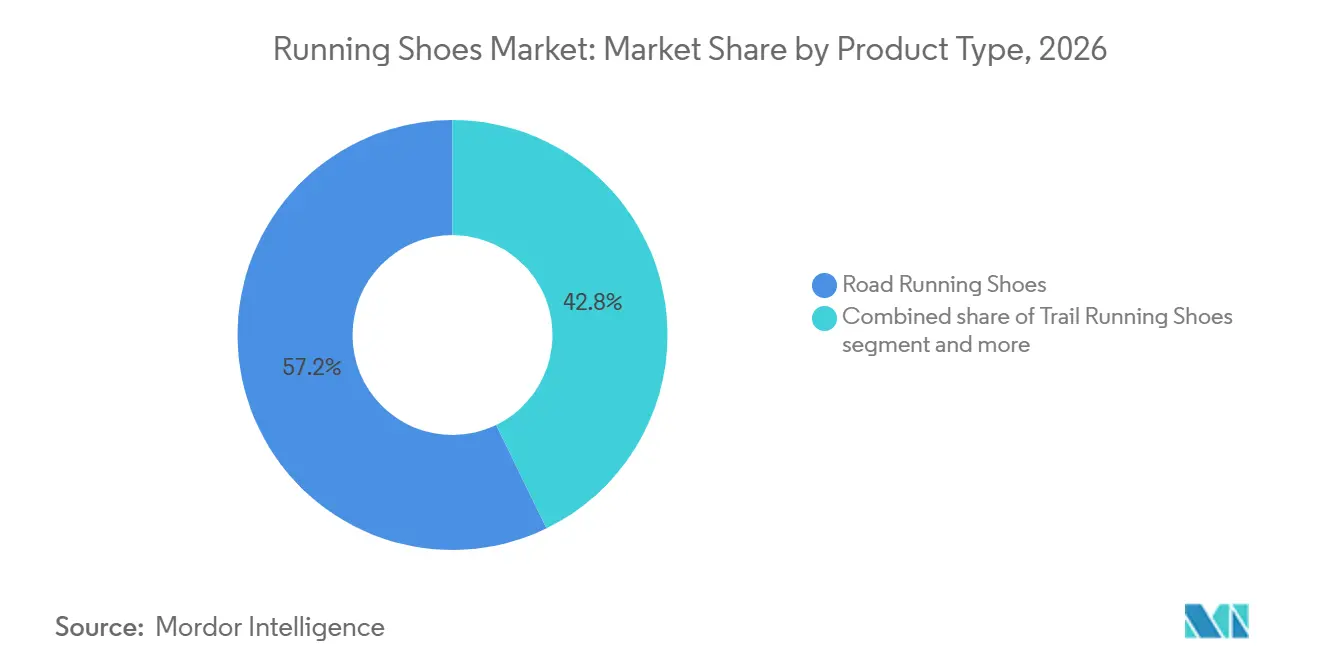
- By product type, road running shoes held 57.21% of the running shoes market share in 2026, while trail running shoes are forecast to expand at a CAGR of 6.67% through 2032.
- By end user, men held 65.86% of the running shoes market share in 2026, while kids /children are forecast to expand at a CAGR of 5.15% through 2032.
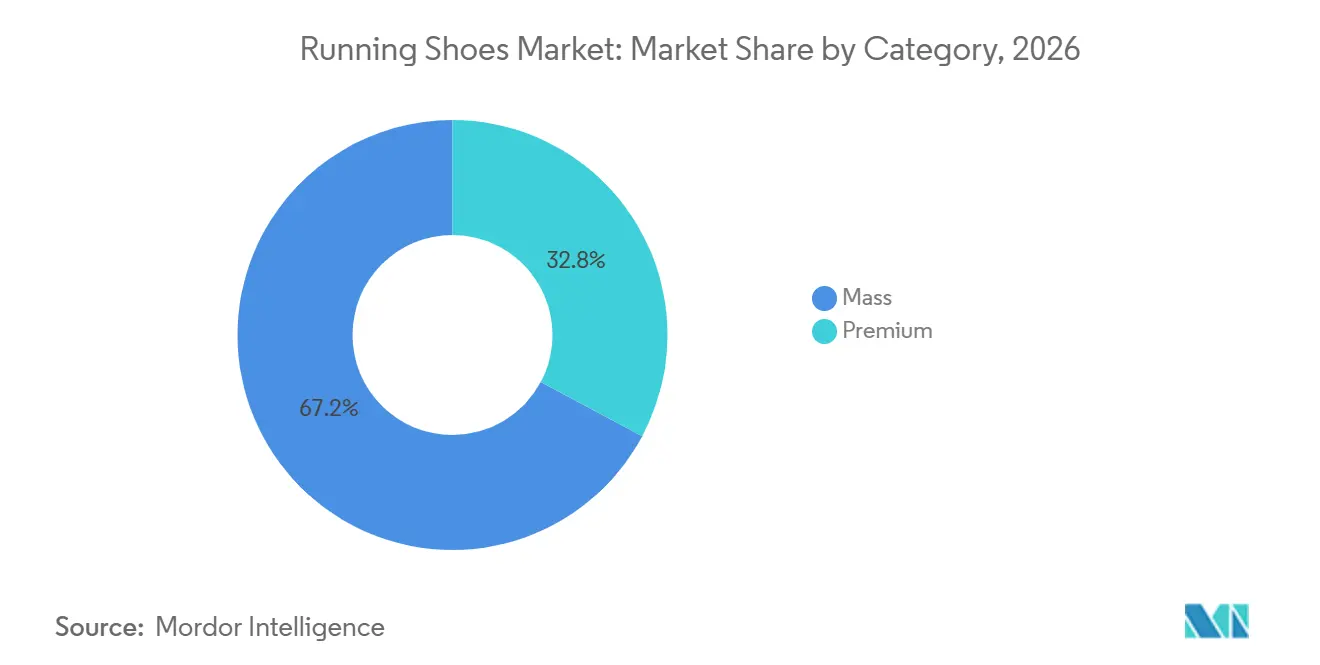
- By category, mass held 67.23% of the running shoes market share in 2026, while premium is forecast to expand at a CAGR of 6.41% through 2032.
- By distribution channel, sports and athletic goods stores held 55.61% of the running shoes market share in 2026, while online retail stores are forecast to expand at a CAGR of 6.13% through 2032.
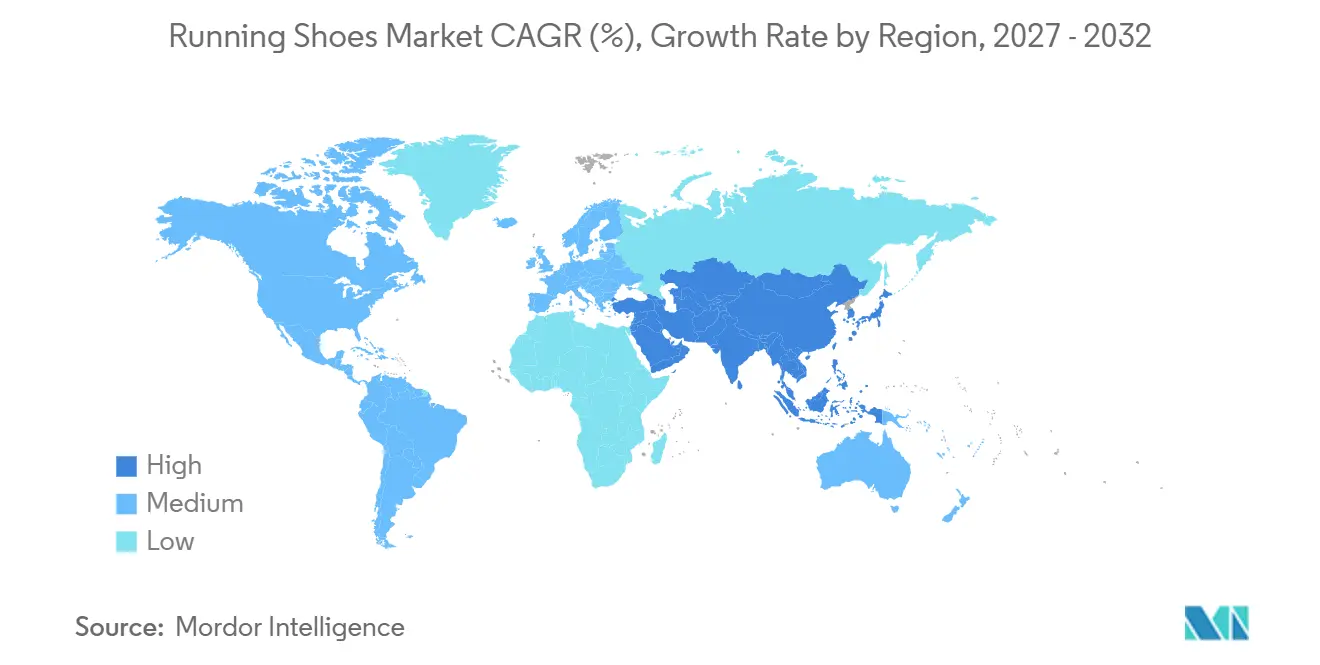
- By geography, North America held 34.33% of the running shoes market share in 2026, while Asia-Pacific is forecast to expand at a CAGR of 5.87% through 2032.
Note: Market numbers in this report are based on Mordor Intelligence's proprietary estimation framework, which combines nine months of actuals with Q4 projections for base year 2026.
Market Trends and Insights
Drivers Impact Analysis of Running Shoes Market of Running Shoes Market*
| Driver | (~) % Impact on CAGR Forecast | Geographic Relevance | Impact Timeline |
|---|---|---|---|
| Rising health and fitness participation | +1.2% | Global | Medium term (2-4 years) |
| Expansion of marathons, running clubs, and organized events | +0.9% | Global, strongest in North America, Europe, and Asia-Pacific | Medium term (2-4 years) |
| Technological advancements in cushioning, energy return, and propulsion | +0.8% | Global, led by North America, Europe, Japan, and South Korea | Long term (≥ 4 years) |
| Rising demand for specialized and performance-oriented footwear | +0.7% | North America and Europe, with expansion into Asia-Pacific | Medium term (2-4 years) |
| Increasing women's participation and demand for inclusive running footwear | +0.5% | Global, particularly North America, Europe, and Asia-Pacific | Medium term (2–4 years) |
| Product innovation in sustainable and lightweight materials | +0.4% | Global, led by Europe and North America, with growing adoption in Asia-Pacific | Long term (≥ 4 years) |
| Source: Mordor Intelligence | |||
Rising Health and Fitness Participation
Rising participation in health and fitness activities is encouraging more consumers to incorporate running into their regular exercise routines, supporting demand for running shoes. For instance, in April 2026, according to Sport England's survey, approximately 7.1 million adults in England ran in 2024–25, an increase of more than 500,000. The survey also reported that 15.3 million adults participated in fitness activities, an annual increase of 921,000 [1]. This growing participation in individual fitness activities creates opportunities for running shoe manufacturers to attract recreational users with comfortable, supportive, and versatile footwear designed for regular exercise.
Expansion of Marathons, Running Clubs, and Organized Events
The expansion of running clubs and organized running activities is encouraging more people to participate in recreational running, thereby supporting demand for specialized footwear. For instance, in January 2025, England Athletics reported a network of more than 1,800 affiliated clubs and 3,400 RunTogether groups across England. The organization also highlighted the availability of beginner-friendly Couch to 5K sessions and thousands of licensed races through its RunEvents platform [2]. This expanding network of running communities and organized events creates opportunities for shoe brands to engage new and existing runners through training, road-running, and performance-oriented shoe collections.
Technological Advancements in Cushioning, Energy Return, and Propulsion
Technological advancements in running footwear are driving the development of performance-oriented shoes with advanced foam materials and carbon-fiber plates. For instance, in June 2025, according to USA Track & Field, super shoes that incorporate high-tech foam and carbon plates would increase running speed by up to 4% and are becoming increasingly common at marathon start lines worldwide, including among recreational runners. These shoes typically last for only a few races, whereas conventional running shoes generally require replacement after 300–500 miles of use [3]. The growing adoption of advanced footwear technologies creates opportunities for manufacturers to innovate in midsole materials, cushioning systems, lightweight construction, and propulsion features for both competitive and recreational runners.
Rising Demand for Specialized and Performance-Oriented Footwear
Specialization is expanding the running shoes market as runners increasingly purchase footwear designed for specific surfaces, distances, and training requirements. Growing interest in trail running is driving demand for shoes that can handle uneven terrain, while road runners are increasingly exploring specialized footwear for off-road activities. Differences in training intensity, running distances, and individual performance requirements are also increasing demand for application-specific shoe designs. In response, manufacturers are expanding their product portfolios with terrain-specific traction, protective uppers, enhanced cushioning, and lightweight constructions to address diverse running needs.
Restraints Impact Analysis of Running Shoes Market of Running Shoes Market*
| Restraint | (~) % Impact on CAGR Forecast | Geographic Relevance | Impact Timeline |
|---|---|---|---|
| Import tariffs, freight costs, and supply chain disruptions | -0.6% | North America primarily, with spillover to Europe | Short term (≤ 2 years) |
| Intense competition, changing preferences, and environmental compliance pressures | -0.5% | Global, with stronger seasonal effects in North America and Europe | Medium term (2-4 years) |
| Seasonal demand fluctuations and changing consumer preferences | -0.4% | Global, with stronger seasonal effects in North America and Europe | Medium term (2–4 years) |
| Environmental compliance and footwear waste management pressures | -0.5% | Global, with stronger regulatory pressures in Europe and North America | Medium term (2–4 years) |
| Source: Mordor Intelligence | |||
Import Tariffs, Freight Costs, and Supply Chain Disruptions
Import tariffs, freight costs, and supply chain disruptions are increasing cost pressures in the running shoes market, given the industry’s reliance on Asian manufacturing hubs. Changes in international trade policies and higher import duties raise sourcing costs for footwear brands that depend on overseas production. These factors increase operational expenses and may require manufacturers to adjust product prices, manage profit margins, and diversify sourcing locations. Smaller brands face greater challenges due to their limited purchasing power and negotiating leverage. In addition, supply chain uncertainties can disrupt production planning, inventory availability, and product delivery timelines.
Intense Competition, Changing Preferences, and Environmental Compliance Pressures
Intense competition, seasonal demand fluctuations, and environmental compliance requirements pose challenges for the running shoes market. The widespread availability of advanced cushioning systems, carbon-fiber plates, and high-rebound foam technologies across competing brands is intensifying competition and limiting manufacturers’ pricing flexibility. Seasonal variations and weather conditions also affect outdoor running activity, leading to fluctuations in footwear demand across key markets. In addition, increasingly stringent environmental requirements are prompting manufacturers to prioritize sustainable material selection, product durability, and footwear waste management.
*Our forecasts treat driver/restraint impacts as directional, not additive. The impact forecasts reflect baseline growth, mix effects, and variable interactions.
Running Shoes Market Segment Analysis
By Product Type:
Trail Running Shoes Reconfiguring a Road-Dominated MarketRoad running shoes held 57.21% of the running shoes market share in 2026, supported by the scale of urban training, road-race infrastructure, and established retail distribution. Road running shoes appeal to a broad consumer base because they suit routine exercise, paved surfaces, and beginner-level running. Their price range from entry-level training shoes to premium models with advanced cushioning and carbon plates, serving casual, recreational, and competitive runners. Specialty stores offer fitting guidance and product comparisons, while direct-to-consumer platforms provide wider product selections, exclusive designs, and detailed information.
Trail running shoes are forecast to expand at a CAGR of 6.67% through 2032. Trail running shoes are experiencing growing demand as more consumers take up off-road running and seek footwear designed for uneven terrain. Features such as enhanced grip, rock protection, water resistance, and stability differentiate trail running shoes from conventional road running footwear. Rising participation among women and younger consumers is further expanding the potential customer base. In addition, innovations in midsole materials and carbon-plate designs are driving the development of specialized footwear for competitive runners.

By End User:
Youth Segment Accelerates as Women’s Participation Reshapes DemandMen held 65.86% of the running shoes market share in 2026, reflecting their established participation in competitive running, road races, and trail events. This group serves a broad range of use cases, including daily training, race preparation, and outdoor recreation. It also represents a large addressable base for premium footwear, as experienced runners may own multiple pairs for different activities. Strong brand recognition and broad size availability reinforce the segment's position across physical and online channels. Major brands continue to leverage elite athlete visibility and race activations to engage this segment. The scale of the men’s category also creates opportunities to advance inclusive fit systems and product testing.
Kids/children are forecast to expand at a CAGR of 5.15% through 2032. Growing participation in school fitness activities, youth sports, and recreational running is driving demand for running shoes among children and women. In China, school fitness assessments and rising parental spending on children’s sports activities are increasing the demand for youth running footwear. In India, greater participation by women in organized running events is expanding the women’s footwear segment. These trends are prompting brands to strengthen their youth and women’s product portfolios by offering improved fit, appropriate cushioning, supportive designs, and footwear tailored to different running needs.
By Category:
Premium Tier Leads Growth as Aspirational Purchasing BroadensMass held a 67.23% share of the running shoes market in 2026, driven by a large share of purchases at accessible price points. The mass category drives demand in the running shoes market by offering affordable footwear for beginners, recreational runners, and consumers seeking shoes for regular physical activities. Its broad price range makes running shoes accessible across emerging Asian markets and among value-conscious consumer groups in North America. Mass-market products are widely available through supermarkets, general sports retailers, and other distribution channels, extending reach beyond specialty footwear stores. Demand is further supported by consumers’ need for comfortable, durable, and reliable footwear for everyday use.
Premium is forecast to grow at a CAGR of 6.41% through 2032 as high-performance materials move into training products. Demand for high-performance running footwear that combines advanced technology, comfort, durability, and specialized design features supports the premium category. Competitive and dedicated recreational runners increasingly seek shoes that offer enhanced cushioning, energy return, stability, and support across a range of running conditions. This demand encourages manufacturers to invest in advanced midsole materials, lightweight construction, and performance-oriented designs. The growing emphasis on product quality and technical features continues to strengthen the appeal of premium running shoes among consumers seeking enhanced running experiences.
By Distribution Channel:
Online Retail Accelerates While Specialty Anchors Brand EquitySports and athletic goods stores held 55.61% of the running shoes market share in 2026. These stores remain important because fit, gait guidance, and knowledgeable sales support play a more significant role in running footwear than in many other footwear categories. New runners often need assistance comparing neutral, stability, trail, and racing products before making a purchase. Specialist stores also offer opportunities for local club partnerships, product testing, and event-related promotions. Physical retail remains an effective channel for establishing product credibility for technical footwear and provides brands with feedback on fit-related issues and local consumer preferences that may not be evident in online sales data.
Online retail stores are forecast to expand at a CAGR of 6.13% through 2032. The online distribution channel is expanding as consumers increasingly use digital platforms to research and purchase running footwear. E-commerce platforms offer access to a broad range of products, enabling consumers to compare designs, technical features, prices, and customer reviews before making purchase decisions. These platforms also allow manufacturers to provide detailed product information and reach consumers across diverse geographic markets. In addition, brand-owned websites enable manufacturers to build direct customer relationships, enhance product visibility, and gain insights into consumer purchasing preferences.
Geography Analysis
North America
North America held 34.33% of the running shoes market share in 2026, supported by specialist retail, high athletic footwear spending, and a dense calendar of road and trail events. The region benefits from strong consumer demand for performance footwear and broad participation in organized running events. Growing interest in recreational and competitive running encourages consumers to invest in specialized footwear that meets varying training and performance needs. Manufacturers are strengthening price management, inventory planning, and sourcing diversification to effectively navigate import tariffs and sourcing costs while maintaining product availability and competitiveness across the region.
Asia-Pacific
Asia-Pacific is forecast to expand at a CAGR of 5.87% through 2032. The Asia-Pacific is driven by rising demand for performance footwear, increasing digital adoption, and broader access to products across multiple price points. Consumers in developed markets are increasingly seeking technologically advanced running shoes, while expanding digital retail platforms are improving product accessibility and visibility in emerging markets. Manufacturers are also introducing affordable, locally relevant footwear to attract first-time and recreational runners. These diverse consumer preferences are prompting brands to strengthen their regional product portfolios through performance-focused designs, expanded digital distribution, and accessible pricing strategies.
Europe, South America, and the Middle East and Africa
The market in the region benefits from well-established running cultures, major sporting events, and specialist footwear retailers across key countries. Regular marathons and organized running events continue to encourage participation and sustain demand for performance-oriented footwear. Meanwhile, increasingly stringent environmental regulations are prompting manufacturers to prioritize sustainable material selection, product durability, and footwear waste management. In South America, the expansion of running events and recreational participation supports market development. In the Middle East and Africa, sports participation initiatives and growing urban populations are creating opportunities for long-term demand growth. These regional differences are prompting manufacturers to tailor their product offerings and distribution strategies to local consumer preferences and market conditions.
Competitive Landscape
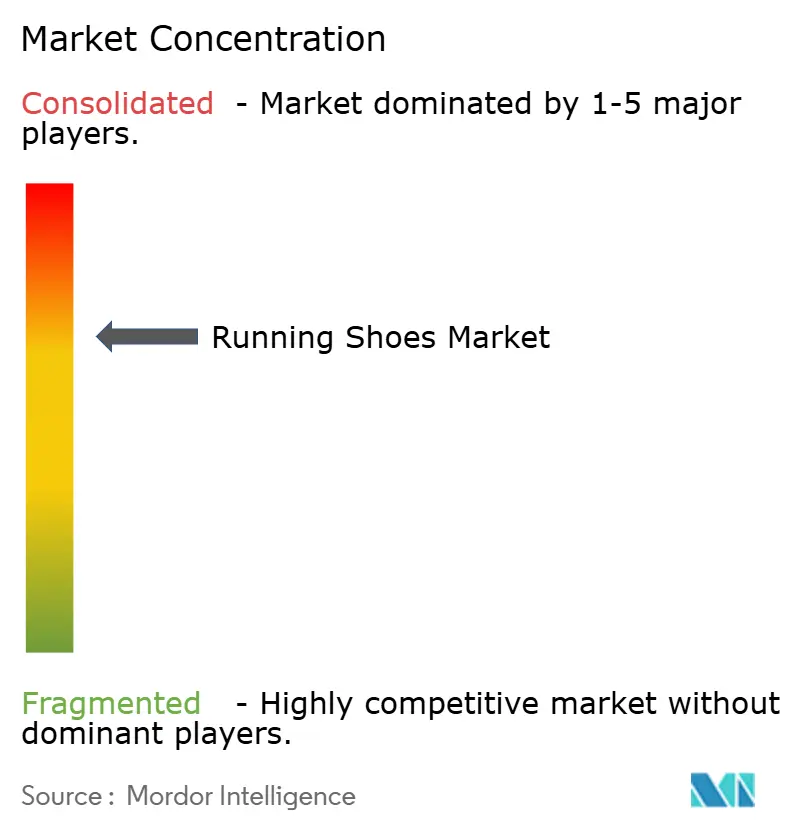
The running shoes market is moderately concentrated, with established global brands leveraging strong distribution networks, extensive product portfolios, and high brand recognition. Specialized competitors are also strengthening their market positions. Product innovation, advanced cushioning technologies, lightweight materials, pricing strategies, and performance-focused designs increasingly shape the competitive landscape. Regional manufacturers are gaining visibility by addressing local consumer preferences and offering products across various price points. This competitive environment is driving companies to invest in product development, expand retail and digital distribution networks, and differentiate their offerings to attract and retain consumers.
Product innovation and technology differentiation have become key competitive strategies in the running shoes market. Manufacturers are adopting advanced production processes, lightweight materials, enhanced cushioning systems, and sustainable footwear components to improve product performance and differentiation. Experiential marketing at major sporting events also helps brands connect performance-oriented products with consumers and specialist retail channels. Additionally, localized product development enables manufacturers to address regional preferences, pricing requirements, and cultural considerations.
The competitive environment in the running shoes market creates opportunities for brands that target specialized consumer groups, including women trail runners, young athletes, and consumers seeking connected footwear. Community-focused brands can build customer loyalty through distinctive brand identities, local engagement, and specialized product offerings. Larger manufacturers benefit from broader marketing reach and established distribution networks. Partnerships with specialty retailers also remain important, as consumers often seek expert guidance on shoe fit, comfort, and technical features before making a purchase. Additionally, proprietary materials, specialized cushioning technologies, and customized fit systems are increasingly important differentiators, prompting manufacturers to move beyond generic performance claims.
Running Shoes Industry Leaders
-
NIKE, Inc.
-
adidas AG
-
On Holding AG
-
Deckers Outdoor Corporation (HOKA)
-
ASICS Corporation
- *Disclaimer: Major Players sorted in no particular order
Running Shoes Market Companies Covered in this Report
- NIKE, Inc.
- adidas AG
- On Holding AG
- Deckers Outdoor Corporation (HOKA)
- ASICS Corporation
- New Balance Athletics, Inc.
- Berkshire Hathaway Inc. (Brooks Sports, Inc.)
- PUMA SE
- Wolverine World Wide, Inc. (Saucony)
- Mizuno Corporation
- 3G Capital (Skechers U.S.A., Inc.)
- Amer Sports, Inc. (Salomon)
- Under Armour, Inc.
- VF Corporation (Altra)
- ANTA Sports Products Limited
- Xtep International Holdings Limited
- Li Ning Company Limited
- 361 Degrees International Limited
- Decathlon SE (KIPRUN)
- Designer Brands Inc. (Topo Athletic)
Recent Industry Developments in Running Shoes Market
- October 2026: Nike introduced the Vegam Run, its first running shoe developed specifically for the Indian market. The company designed the product to meet local runners’ requirements, combining cushioning, breathability, durability, and versatility for running and everyday use.
- August 2026: Lazada partnered with adidas to exclusively launch the ZENBOOST running shoes across six Southeast Asian markets. The collaboration gave consumers early access through adidas’ official Lazada stores and included promotional campaigns and community running events.
- January 2026: ASICS Japan announced the limited-edition NOVABLAST 5 TOKYO and GEL-NIMBUS 28 TOKYO running shoes to commemorate the Tokyo Marathon 2026. The models feature event-inspired colors and graphics and were scheduled for sale through ASICS’ online store, company-operated stores, and sports retailers.
Global Running Shoes Market Report Scope
Running shoes are specialized athletic footwear designed to provide comfort, cushioning, stability, and support during running activities. The global running shoes market is segmented by product type, end user, category, distribution channel, and geography. By product type, the market is segmented into road, trail, track, and other running shoes. By end user, the market is segmented into men, women, and children. By category, the market is segmented into mass and premium. By distribution channel, the market is segmented into supermarkets and hypermarkets, sports and athletic goods stores, online retail stores, and other distribution channels. By geography, the market is segmented into North America, Europe, Asia-Pacific, South America, and the Middle East and Africa. Market forecasts are provided in terms of value (USD).
Segmentation Overview
| Road Running Shoes |
| Trail Running Shoes |
| Track Running Shoes |
| Other Running Shoes |
| Men |
| Women |
| Kids/Children |
| Mass |
| Premium |
| Supermarkets and Hypermarkets | Sports and Athletic Goods Stores |
| Online Retail Stores | |
| Other Distribution Channels |
| North America | United States |
| Canada | |
| Mexico | |
| Rest of North America | |
| Europe | United Kingdom |
| Germany | |
| France | |
| Italy | |
| Spain | |
| Netherlands | |
| Poland | |
| Belgium | |
| Sweden | |
| Rest of Europe | |
| Asia-Pacific | China |
| Japan | |
| India | |
| Australia | |
| Indonesia | |
| South Korea | |
| Thailand | |
| Singapore | |
| Rest of Asia-Pacific | |
| South America | Brazil |
| Argentina | |
| Colombia | |
| Chile | |
| Peru | |
| Rest of South America | |
| Middle East and Africa | South Africa |
| Saudi Arabia | |
| United Arab Emirates | |
| Nigeria | |
| Egypt | |
| Morocco | |
| Turkey | |
| Rest of Middle East and Africa |
| By Product Type | Road Running Shoes | |
| Trail Running Shoes | ||
| Track Running Shoes | ||
| Other Running Shoes | ||
| By End User | Men | |
| Women | ||
| Kids/Children | ||
| By Category | Mass | |
| Premium | ||
| By Distribution Channel | Supermarkets and Hypermarkets | Sports and Athletic Goods Stores |
| Online Retail Stores | ||
| Other Distribution Channels | ||
| By Geography | North America | United States |
| Canada | ||
| Mexico | ||
| Rest of North America | ||
| Europe | United Kingdom | |
| Germany | ||
| France | ||
| Italy | ||
| Spain | ||
| Netherlands | ||
| Poland | ||
| Belgium | ||
| Sweden | ||
| Rest of Europe | ||
| Asia-Pacific | China | |
| Japan | ||
| India | ||
| Australia | ||
| Indonesia | ||
| South Korea | ||
| Thailand | ||
| Singapore | ||
| Rest of Asia-Pacific | ||
| South America | Brazil | |
| Argentina | ||
| Colombia | ||
| Chile | ||
| Peru | ||
| Rest of South America | ||
| Middle East and Africa | South Africa | |
| Saudi Arabia | ||
| United Arab Emirates | ||
| Nigeria | ||
| Egypt | ||
| Morocco | ||
| Turkey | ||
| Rest of Middle East and Africa | ||
Key Questions Answered in the Report
What is the projected value of the running shoes market by 2032?
The category is projected to reach USD 101.10 billion by 2032, expanding at a 4.85% CAGR.
Which running shoe product type is growing fastest?
Trail running shoes are forecast to expand at a CAGR of 6.67% through 2032, supported by rising trail participation and specialized product demand.
What risks are affecting running-shoe suppliers?
Tariffs, freight costs, strong competition, seasonal demand shifts, and tighter environmental requirements can affect pricing and sourcing choices.
Which region is expected to grow fastest for running footwear?
Asia-Pacific is forecast to expand at a CAGR of 5.87% through 2032, supported by growth in Japan, China, and India.