
Rubber Processing Chemicals Market Size and Share
Market Overview
| Study Period | 2021 - 2031 |
|---|---|
| Market Size (2026) | USD 6.33 Billion |
| Market Size (2031) | USD 8.54 Billion |
| Growth Rate (2026 - 2031) | 6.17 % |
| Fastest Growing Market | Asia-Pacific |
| Largest Market | Asia-Pacific |
| Market Concentration | Medium |
Major Players *Disclaimer: Major Players sorted in no particular order Image © Mordor Intelligence. Reuse requires attribution under CC BY 4.0. | |
Rubber Processing Chemicals Market Analysis by Mordor Intelligence
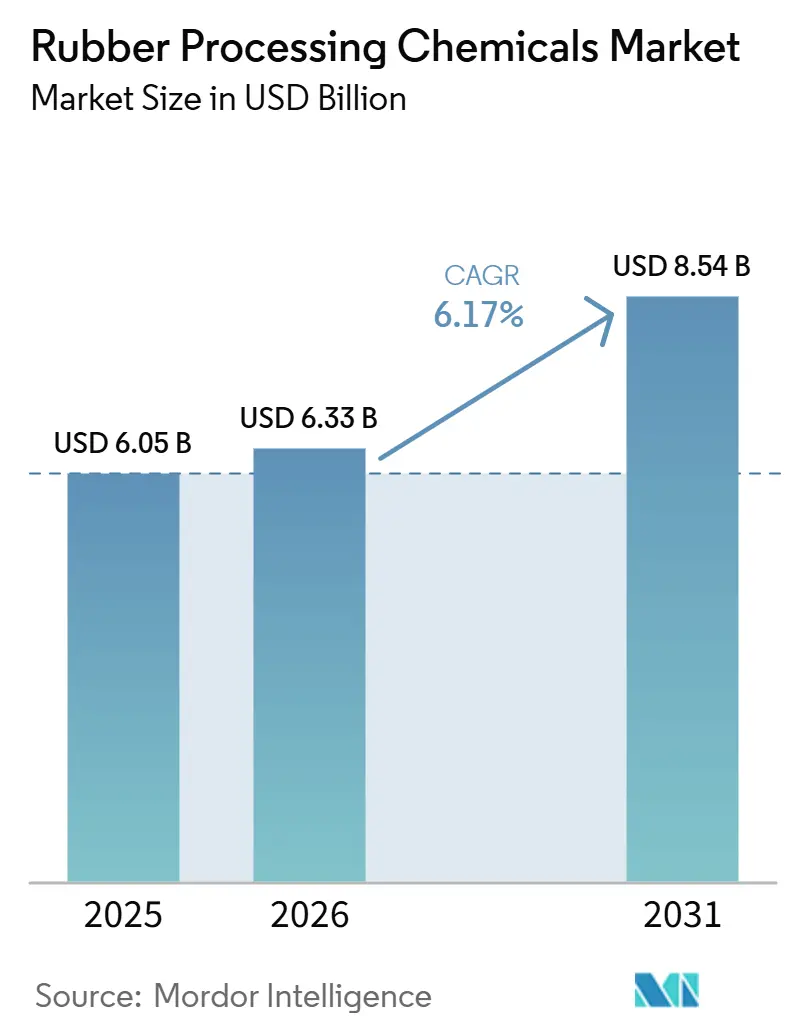
The Rubber Processing Chemicals Market was valued at USD 6.05 billion in 2025 and is estimated to grow from USD 6.33 billion in 2026 to reach USD 8.54 billion by 2031, at a CAGR of 6.17% during the forecast period (2026–2031). Tire production remains the main source of demand because tires consume substantial volumes of antidegradants, accelerators, vulcanizing agents, and processing aids. Electric vehicle tire specifications are raising the importance of silica-filled compounds, controlled dispersion, and materials that manage higher loads and heat. Regulatory action in Europe is increasing the value of compliant alternatives, especially for antioxidant and processing-aid formulations. Suppliers are responding through product development, local production, and sustainability-linked materials, which create openings for higher-value specialty products. Input costs and weaker European automotive output remain risks for suppliers that depend on commodity volumes or a single regional customer base.
Key Report Takeaways
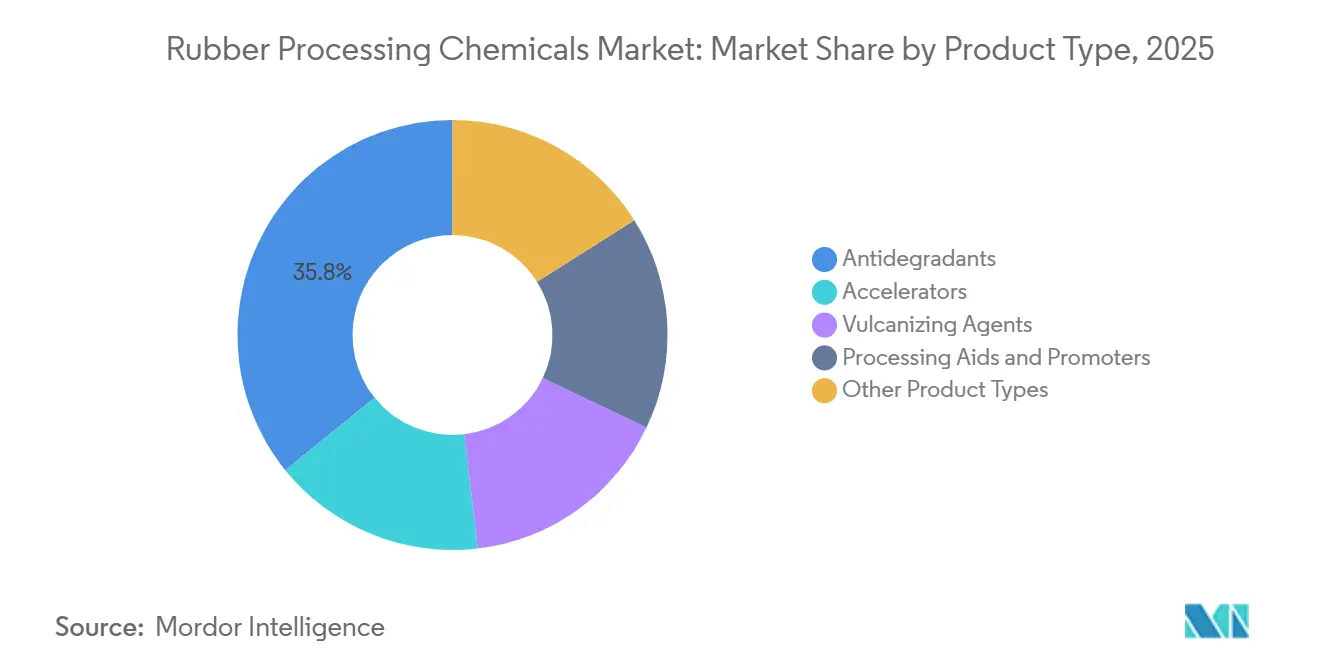
- By product type, antidegradants held 35.82% of the rubber processing chemicals market share in 2025, while processing aids and promoters are forecast to grow at a 6.83% CAGR through 2031.
- By formulation type, solid held 56.44% of the rubber processing chemicals market share in 2025, while liquid is forecast to grow at a 6.52% CAGR through 2031.
- By application, tires held 58.36% of the rubber processing chemicals market share in 2025, while non-tire is forecast to grow at a 6.95% CAGR through 2031.
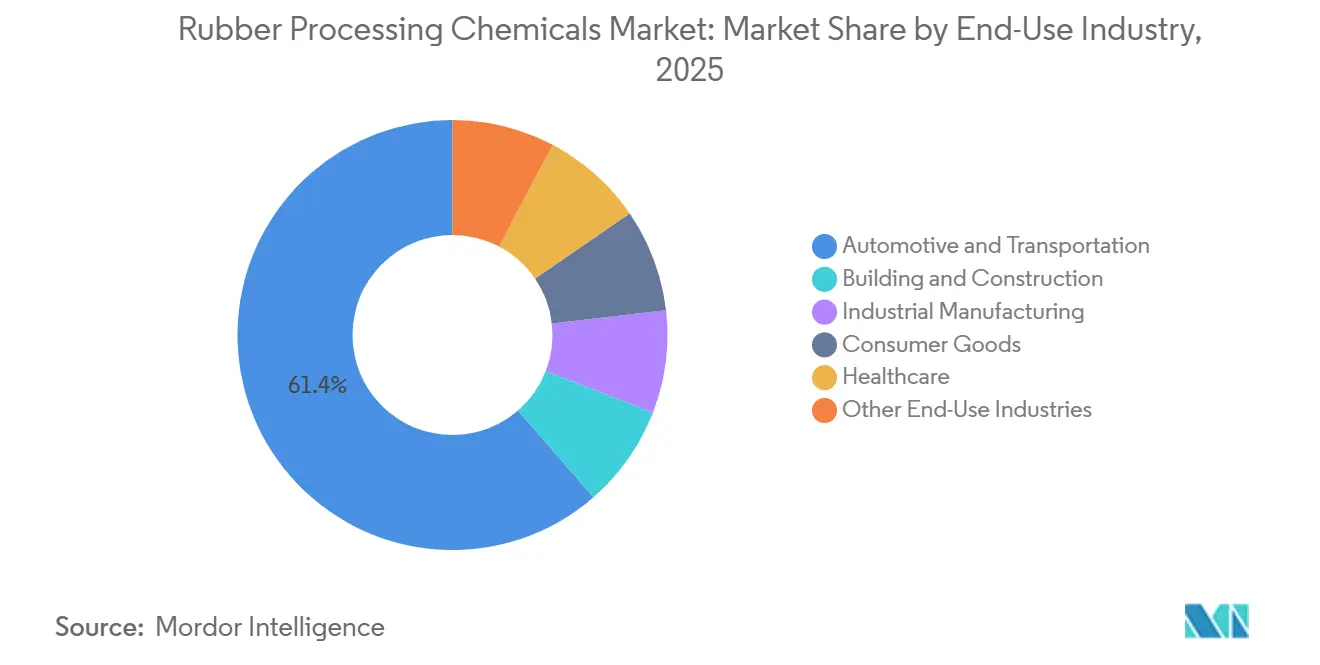
- By end-use industry, automotive and transportation held 61.39% of the rubber processing chemicals market share in 2025, while industrial manufacturing is forecast to grow at a 6.67% CAGR through 2031.
- By geography, Asia-Pacific held 46.84% of the rubber processing chemicals market share in 2025 and is forecast to grow at a 7.02% CAGR through 2031.
Note: Market size and forecast figures in this report are generated using Mordor Intelligence’s proprietary estimation framework, updated with the latest available data and insights as of January 2026.
Market Trends and Insights
Drivers Impact Analysis of Rubber Processing Chemicals Market*
| Driver | (~) % Impact on CAGR Forecast | Geographic Relevance | Impact Timeline |
|---|---|---|---|
| Expansion of Global Tire Production and Automotive Manufacturing | +2.3% | Global | Medium term (2-4 years) |
| Increasing Demand for High-Performance and Durable Rubber Products | +1.2% | Global | Medium term (2-4 years) |
| Growing Adoption of Low-VOC and Environmentally Friendly Rubber Processing Chemicals | +0.9% | North America & EU, spill-over to APAC | Short term (≤ 2 years) |
| Rising Demand for Advanced Rubber Compounds in Electric Vehicle (EV) and High-Performance Tires | +1.0% | APAC core, spill-over to Europe | Short term (≤ 2 years) |
| Growing Focus on Sustainable Rubber Processing and Circular Economy Initiatives | +0.6% | EU, with early gains in Japan and South Korea | Long term (≥ 4 years) |
| Source: Mordor Intelligence | |||
Expansion of Global Tire Production and Automotive Manufacturing
Tire manufacturing remains the structural demand anchor for the rubber processing chemicals market. Tires require antidegradants, accelerators, vulcanizing agents, and other additives during compounding and curing. Automotive production in China, India, Japan, and South Korea supports continuing chemical demand across the regional supply chain. India’s production-linked incentive program encouraged tire capacity additions by Apollo Tyres, MRF, and JK Tyre, which increased chemical procurement needs. Bureau of Indian Standards (BIS) certification requirements lengthen approval cycles for imported rubber chemicals and favor processors with qualified formulations. This framework may gradually shift India’s opportunity toward precursor feedstocks and specialty additives as domestic capabilities develop.
Rising Demand for Advanced Rubber Compounds in Electric Vehicle (EV) and High-Performance Tires
Electric vehicle tires require compounds that can handle battery weight, instant torque, lower rolling resistance, and lower cabin noise. These requirements support silica-filled and solution styrene-butadiene rubber compound systems. This expansion increases demand for processing aids that improve silica dispersion and for antidegradants that manage thermal stress. Suppliers also need formulations that meet changing environmental requirements without compromising tire performance. Technical service and application engineering, therefore, become more important competitive tools in the rubber processing chemicals market.
Growing Adoption of Low-VOC and Environmentally Friendly Rubber Processing Chemicals
Regulatory pressure in Europe and North America is encouraging the replacement of high-VOC plasticizers, aromatic processing oils, and nitrosamine-forming accelerators. This shift changes material selection and increases the importance of supply-chain documentation. LANXESS introduced Aflux SD in 2026 as a sustainably sourced processing agent for silica-filled compounds that is free of Substances of Very High Concern. The product is designed to improve compound flow while supporting tire properties such as rolling resistance, wear resistance, and wet grip. Solvay began operating a bio-circular silica facility in Livorno, Italy, in January 2026 for rubber and tire applications. These actions show that the rubber processing chemicals market is linking sustainability requirements with performance improvements rather than treating them as separate needs.
Increasing Demand for High-Performance and Durable Rubber Products
Demand for durable rubber products extends beyond tires to belts, hoses, seals, weather stripping, and vibration-control parts. These products operate under heat, oxygen, ozone, fatigue, and chemical exposure. Their service conditions make antidegradants and controlled vulcanization systems important to product life. Industrial and energy projects in South and Southeast Asia support demand for conveyor belts, hydraulic hoses, and engineered seals. Healthcare, cable, and specialty industrial uses also require materials with strict aging, purity, or insulation performance. The rubber processing chemicals industry benefits when customers move from standard formulations toward compounds with more demanding operating requirements.
Restraints Impact Analysis of Rubber Processing Chemicals Market*
| Restraint | (~) % Impact on CAGR Forecast | Geographic Relevance | Impact Timeline |
|---|---|---|---|
| Stringent Environmental Regulations and Chemical Safety Compliance Requirements | -0.5% | EU & North America, cascading to APAC exporters | Short term (≤ 2 years) |
| Performance Limitations of Bio-Based and Sustainable Rubber Processing Chemicals | -0.4% | Global | Medium term (2-4 years) |
| Occupational Health and Safety Challenges Associated with Hazardous Rubber Additives | -0.3% | Global | Medium term (2-4 years) |
| Source: Mordor Intelligence | |||
Stringent Environmental Regulations and Chemical Safety Compliance Requirements
Chemical safety rules can delay new formulations, require testing, and raise qualification costs for suppliers. The European Union’s Registration, Evaluation, Authorisation and Restriction of Chemicals (REACH) framework is especially important for suppliers that serve European tire and industrial rubber customers. The restriction assessment for phenylenediamine antioxidants and antiozonants created uncertainty for a widely used antidegradant class. Suppliers must evaluate alternatives, prepare technical dossiers, and maintain customer approvals before changing a compound package. These requirements can benefit established suppliers with registered materials and verified performance data. They can also slow entry by producers that rely on commodity exports to the European market.
Occupational Health and Safety Challenges Associated with Hazardous Rubber Additives
Bio-based and recycled-content feedstocks can have variable crosslink density and molecular-weight distribution. Existing accelerator and antidegradant systems were often designed for virgin rubber inputs. Compounders may need revised dosing, cure temperatures, and mixing sequences when they use alternative feedstocks or non-nitrosamine accelerators. Certain effective additives also present skin-sensitizing, carcinogenic, or nitrosamine-related occupational concerns. These conditions increase switching costs beyond the purchase price of the chemical. Suppliers that offer application engineering can reduce the burden on compounders and strengthen customer relationships within the rubber processing chemicals market.
*Our forecasts treat driver/restraint impacts as directional, not additive. The impact forecasts reflect baseline growth, mix effects, and variable interactions.
Rubber Processing Chemicals Market Segment Analysis
By Product Type:
Antidegradants Lead Revenue While Processing Aids and Promoters Advance on the Silica ShiftAntidegradants held 35.82% of the rubber processing chemicals market share in 2025. Their position reflects their role in protecting tires and industrial rubber against heat, oxygen, ozone, and fatigue. They help extend service life in applications with demanding operating conditions. Accelerators include sulfenamide, thiazole, and guanidine compounds. These materials influence vulcanization speed and crosslink density across tire and non-tire rubber goods.
Vulcanizing agents, including elemental sulfur, sulfur donors, and insoluble sulfur grades, remain essential to crosslink formation. Their chemistry is mature, but their volumes closely follow total rubber goods production. Retarders and peptizers serve specialized functions in high-temperature mixing and natural rubber reclaiming. Processing aids and promoters are projected to grow at a 6.83% CAGR through 2031. Their growth is tied to silica-filled, low-rolling-resistance tire compounds and continuous mixing systems. LANXESS introduced Aflux SD in 2026 for silica-filled compounds, illustrating the shift toward processing products that combine performance and compliance features.



By Formulation Type:
Liquid Formats Gain Ground in Modern CompoundingSolid formulations accounted for 56.44% of the rubber processing chemicals market size in 2025. Pelletized, pre-dispersed, and powder formats fit established handling systems in high-volume tire and rubber plants. They also offer familiar dosing practices and a favorable cost per active unit. Solid masterbatches support dosing consistency and help minimize airborne dust in production settings. Pre-dispersed solid formats remain important in precision compounding where reliable distribution is required.
Liquid formulations are forecast to grow at a 6.52% CAGR through 2031. Compounders use liquid systems when they need uniform dispersion in silica-filled materials and compatibility with closed continuous mixers. Liquid injection can give more controlled delivery than powder dosing in these lines. Liquid promoters also help introduce silica coupling agents with lower mechanical mixing energy. LANXESS expanded production of Aflux 37, Aflux 42, Aktiplast PP, and Aktiplast 44 in South Carolina during 2025 to serve U.S. customers[1]LANXESS, “LANXESS Expanding U.S. Rubber Additives Production,” LANXESS, lanxess.com.. Bulk liquid delivery can also reduce packaging waste compared with individual solid bags.
By Application:
Tire Anchor Demand While Non-Tire Applications Grow FasterTires accounted for 58.36% of the rubber processing chemicals market share in 2025. This concentration makes demand sensitive to vehicle production, replacement cycles, and tire-maker specifications. Tire compounds use antidegradants, processing aids, and accelerator packages in combination. Electric vehicle fitment programs add load, torque, thermal, and acoustic requirements to these specifications. The result is higher chemical value content per tire, where compound complexity increases.
Non-tire applications are forecast to grow at a 6.95% CAGR through 2031. Infrastructure and energy investment in Asia and the Middle-East support demand for belts, hoses, seals, and engineered rubber components. Mining, chemical processing, and oil and gas projects require heat-resistant and chemical-resistant compounds. Wires and cables need long-term aging resistance for grid and offshore wind applications. Footwear requires lighter additive packages that suit latex and open-cell foam formulations. Healthcare rubber applications require biocompatibility-focused chemical inputs for gaskets, gloves, and cleanroom seals.
By End-Use Industry:
Industrial Manufacturing Outpaces Automotive GrowthAutomotive and transportation accounted for 61.39% of the rubber processing chemicals market size in 2025. The sector uses chemicals in tires, seals, weather stripping, hoses, belts, bushings, and vibration dampeners. This range of components makes automotive demand both large and chemically diverse. Antidegradants protect seals and weather stripping, while accelerators and processing aids support hose and belt production. Vehicle production cycles and Original Equipment Manufacturer (OEM) specifications, therefore, shape a substantial share of global chemical consumption.
Industrial manufacturing is forecast to grow at a 6.67% CAGR through 2031. Capacity additions in Southeast Asia and India support demand for conveyor rubber, hydraulic hoses, and industrial seals. Building and construction uses include expansion joints, waterproofing membranes, Heating, Ventilation, and Air Conditioning (HVAC) seals, and bridge bearings. Consumer goods, including footwear, sports equipment, and household products, provide steadier demand. Healthcare and medical rubber are smaller, but higher-value uses because they require strict purity and biocompatibility standards. These uses provide specialty suppliers with an opportunity to serve applications that are less dependent on automotive volume cycles.
Geography Analysis
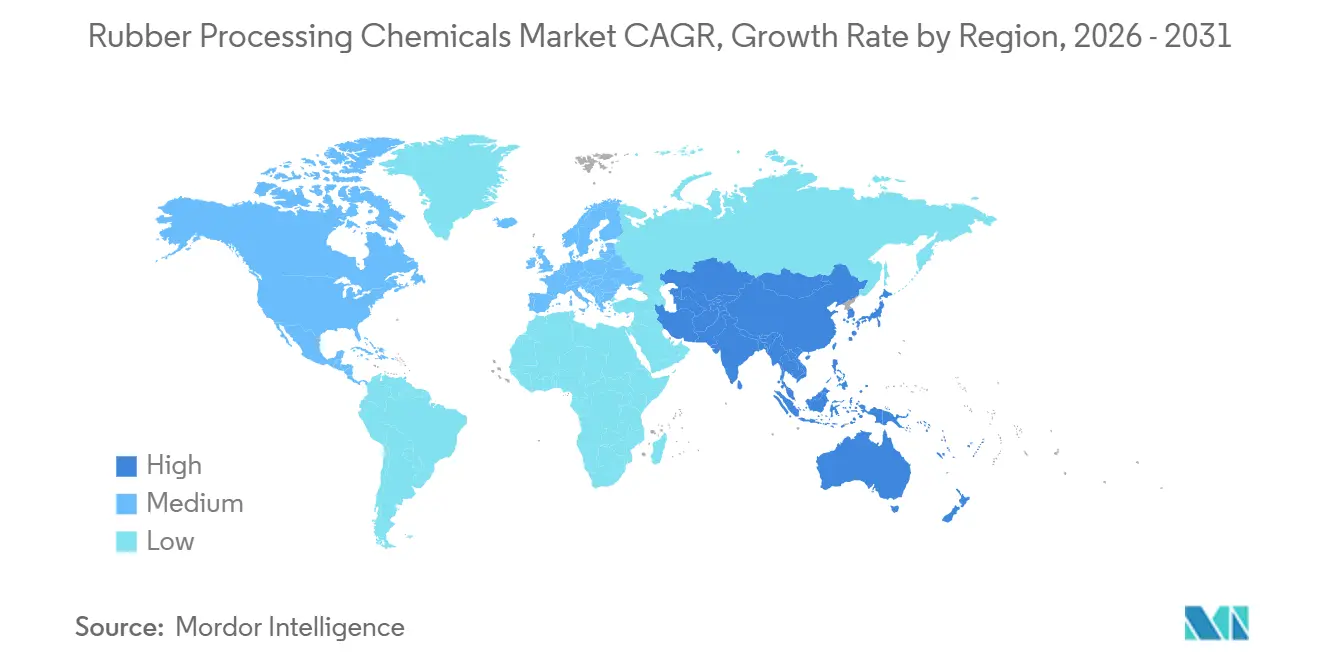
APAC Rubber Processing Chemicals Market
Asia-Pacific accounted for 46.84% of the rubber processing chemicals market share in 2025 and is forecast to grow at a 7.02% CAGR through 2031. China is driving demand because of its tire production base and its position in accelerator and antioxidant supply. Chinese producers compete strongly in the commodity accelerator and antioxidant categories. India is an important growth market as domestic tire capacity expands. BIS certification requirements influence procurement by requiring approved products and suppliers.
APAC and North America Rubber Processing Chemicals Market
Japan and South Korea contribute higher-value antidegradant and accelerator chemistries. The region also supports specialty rubber materials used in advanced tire compounds. Thailand and Indonesia provide additional demand through export-oriented production of gloves, hoses, and industrial rubber goods. North America is growing steadily, supported by automotive demand and more local supply of processing promoters. LANXESS expanded its Bushy Park facility in South Carolina during 2025, reducing dependence on imports from Germany and China.
EMEA and South America Rubber Processing Chemicals Market
Europe faces a slower demand environment because compliance costs and uneven automotive production affect purchasing decisions. It still offers opportunities for low-VOC and Substances of Very High Concern (SVHC)-free specialty chemicals. Germany, the United Kingdom, and France remain important centers for premium tires and specialty industrial rubber goods. South America and Middle-East, and Africa benefit from infrastructure, mining, agriculture, and industrial development. Brazil and Argentina support tire replacement and industrial rubber demand. Saudi Arabia is expanding downstream manufacturing capacity under industrialization programs, while South Africa supports regional demand through automotive assembly and mining.

Competitive Landscape
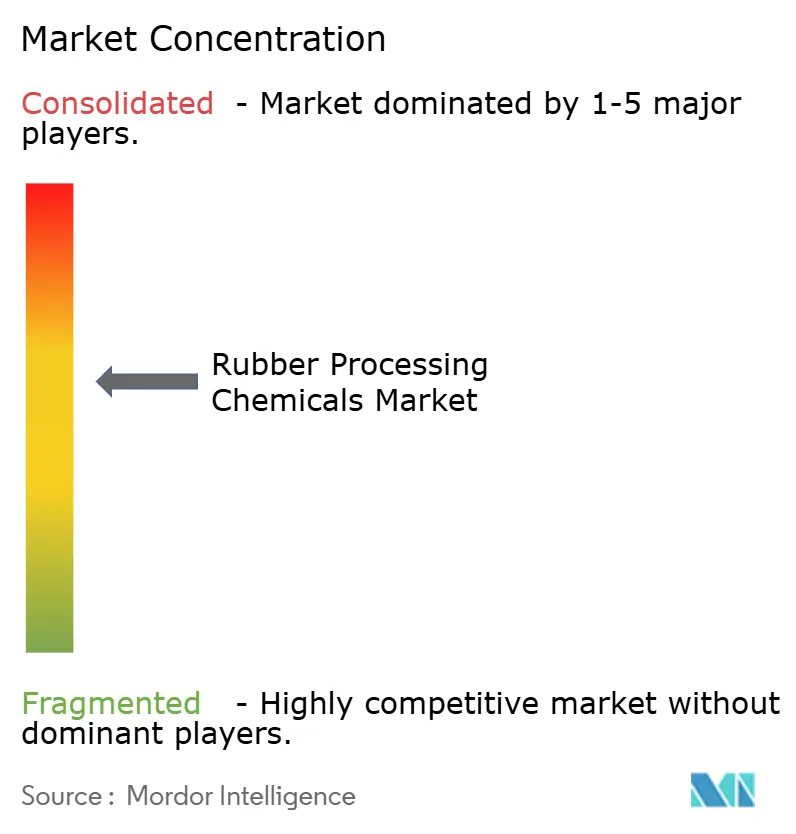
The rubber processing chemicals market is moderately concentrated. Western specialty suppliers compete through formulation depth, regulatory documentation, and application engineering. Asian producers, particularly Chinese companies, compete through cost and scale in commodity accelerators and antidegradants. LANXESS, Arkema, Solvay, and Sumitomo Chemical are prominent suppliers in specialty segments. Kemai Chemical, Shandong Yanggu Huatai Chemical, and China Petrochemical Corporation hold meaningful positions in high-volume Asian supply.
LANXESS commercialized Vulkanox 4060 in 2026 as an alternative antidegradant to 6PPD for tire compounds. The company stated that the material offers oxidative aging protection and an improved environmental profile, with a REACH registration for volumes above 1,000 tons. LANXESS also raised rubber additives prices by 15% to 50% effective March 11, 2026, citing higher energy, critical raw material, and logistics costs. These moves show how product qualification and input-cost management influence supplier positioning.
Solvay inaugurated a bio-circular silica facility in Livorno, Italy, in January 2026 for rubber applications[2]Solvay, “2025 Q4 Earnings Roadshow Presentation,” Solvay, solvay.com.. This investment adds sustainability provenance to a material used in silica-reinforced tire compounds. Other openings include SVHC-free processing aids, non-nitrosamine accelerator systems, and additive packages for recycled-rubber feedstocks. Suppliers with toxicology data, alternative chemistry platforms, and processing support are better placed to serve changing customer requirements. Competition also depends on whether a supplier can help a customer change a formulation without interrupting production. A tire or industrial-rubber compound is a balanced system, so an additive replacement can affect mixing behavior, cure timing, dispersion, aging resistance, and finished-product performance. This makes established technical relationships important when customers move away from restricted or higher-risk materials.
Rubber Processing Chemicals Industry Leaders
LANXESS
BEHN MEYER
Eastman Chemical Company
Arkema
Solvay
- *Disclaimer: Major Players sorted in no particular order
Rubber Processing Chemicals Market Companies Covered in this Report
- Arkema
- BEHN MEYER
- China Petrochemical Corporation
- Eastman Chemical Company
- Kemai Chemical Co., Ltd.
- Kumho Petrochemical
- LANXESS
- OUCHI SHINKO CHEMICAL INDUSTRIAL CO., LTD.
- PMC Rubber Chemicals
- Shandong Yanggu Huatai Chemical Co., Ltd.
- SI Group, Inc.
- Solvay
- Sumitomo Chemical Co., Ltd.
- Wacker Chemie AG
- Willing New Materials Technology Co., Ltd.

Recent Industry Developments in Rubber Processing Chemicals Market
- July 2026: Pirelli, Pyrum, Synthos, and BASF teamed up to recycle end-of-life scrap tires into secondary raw materials, integrating pyrolysis oil and recovered carbon black back into sustainable synthetic rubber and chemical processing.
- March 2026: LANXESS introduced Vulkanox 4060 (CCPD) at Tire Technology Expo 2026 in Hannover as a commercially scalable antidegradant alternative to 6PPD. The product offered comparable oxidative aging protection for tire compounds and an optimized environmental profile, helping tire manufacturers stabilize and improve process safety and material efficiency, reduce their ecological footprint, and enhance the efficiency of modern tires.


Global Rubber Processing Chemicals Market Report Scope
Rubber processing chemicals are essential additives mixed with natural or synthetic elastomers to modify their physical properties, improve manufacturing efficiency, and extend product lifespan. These chemical types include vulcanizing agents, accelerators, and fillers.
The Rubber Processing Chemicals Market is segmented by product type, formulation type, application, end-use industry, and geography. By product type, the market is segmented into antidegradants, accelerators, vulcanizing agents, processing aids and promoters, and other product types. By formulation type, the market is segmented into solid and liquid. By application, the market is segmented into tires and non-tire (belts and hoses, wires and cables, footwear, industrial rubber goods, and other applications). By end-use industry, the market is segmented into automotive and transportation, building and construction, industrial manufacturing, consumer goods, healthcare, and other end-use industries. The report also covers the market size and forecasts for rubber processing chemicals in 16 countries across major regions. For each segment, the market sizing and forecasts have been done on the basis of value (USD).
| Antidegradants |
| Accelerators |
| Vulcanizing Agents |
| Processing Aids and Promoters |
| Other Product Types |
| Solid |
| Liquid |
| Tires |
| Non-Tire |
| Belts and Hoses |
| Wires and Cables |
| Footwear |
| Industrial Rubber Goods |
| Other Applications |
| Automotive and Transportation |
| Building and Construction |
| Industrial Manufacturing |
| Consumer Goods |
| Healthcare |
| Other End-Use Industries |
| Asia-Pacific | China |
| India | |
| Japan | |
| South Korea | |
| Rest of Asia-Pacific | |
| North America | United States |
| Canada | |
| Mexico | |
| Europe | Germany |
| United Kingdom | |
| France | |
| Italy | |
| Russia | |
| Rest of Europe | |
| South America | Brazil |
| Argentina | |
| Rest of South America | |
| Middle-East and Africa | Saudi Arabia |
| South Africa | |
| Rest of Middle-East and Africa |
| By Product Type | Antidegradants | |
| Accelerators | ||
| Vulcanizing Agents | ||
| Processing Aids and Promoters | ||
| Other Product Types | ||
| By Formulation Type | Solid | |
| Liquid | ||
| By Application | Tires | |
| Non-Tire | ||
| Belts and Hoses | ||
| Wires and Cables | ||
| Footwear | ||
| Industrial Rubber Goods | ||
| Other Applications | ||
| By End-Use Industry | Automotive and Transportation | |
| Building and Construction | ||
| Industrial Manufacturing | ||
| Consumer Goods | ||
| Healthcare | ||
| Other End-Use Industries | ||
| By Geography | Asia-Pacific | China |
| India | ||
| Japan | ||
| South Korea | ||
| Rest of Asia-Pacific | ||
| North America | United States | |
| Canada | ||
| Mexico | ||
| Europe | Germany | |
| United Kingdom | ||
| France | ||
| Italy | ||
| Russia | ||
| Rest of Europe | ||
| South America | Brazil | |
| Argentina | ||
| Rest of South America | ||
| Middle-East and Africa | Saudi Arabia | |
| South Africa | ||
| Rest of Middle-East and Africa | ||


Key Questions Answered in the Report
What is the size of the rubber processing chemicals market?
The rubber processing chemicals market stands at USD 6.33 billion in 2026 and is projected to reach USD 8.54 billion by 2031.
Which product type held the largest share in 2025?
Antidegradants held the largest product share of 35.82% in 2025 because they protect rubber against heat, oxidation, ozone, and fatigue.
Which formulation type is expected to grow fastest?
Liquid is forecast to expand at a 6.52% CAGR through 2031 as continuous mixing and silica-filled compounds gain use.
Why are electric vehicles important for the demand for rubber additives?
Electric vehicle tires need compounds that manage higher loads, torque, heat, rolling resistance, and noise, which support specialty processing aids and antidegradants.
Page last updated on:





