
Round Balers Market Size and Share
Market Overview
| Study Period | 2022 - 2032 |
|---|---|
| Market Size (2027) | USD 6.19 Billion |
| Market Size (2032) | USD 8.73 Billion |
| Growth Rate (2027 - 2032) | 7.12 % |
| Fastest Growing Market | North America |
| Largest Market | Asia-Pacific |
| Market Concentration | Medium |
Major Players *Disclaimer: Major Players sorted in no particular order Image © Mordor Intelligence. Reuse requires attribution under CC BY 4.0. | |
Round Balers Market Analysis by Mordor Intelligence
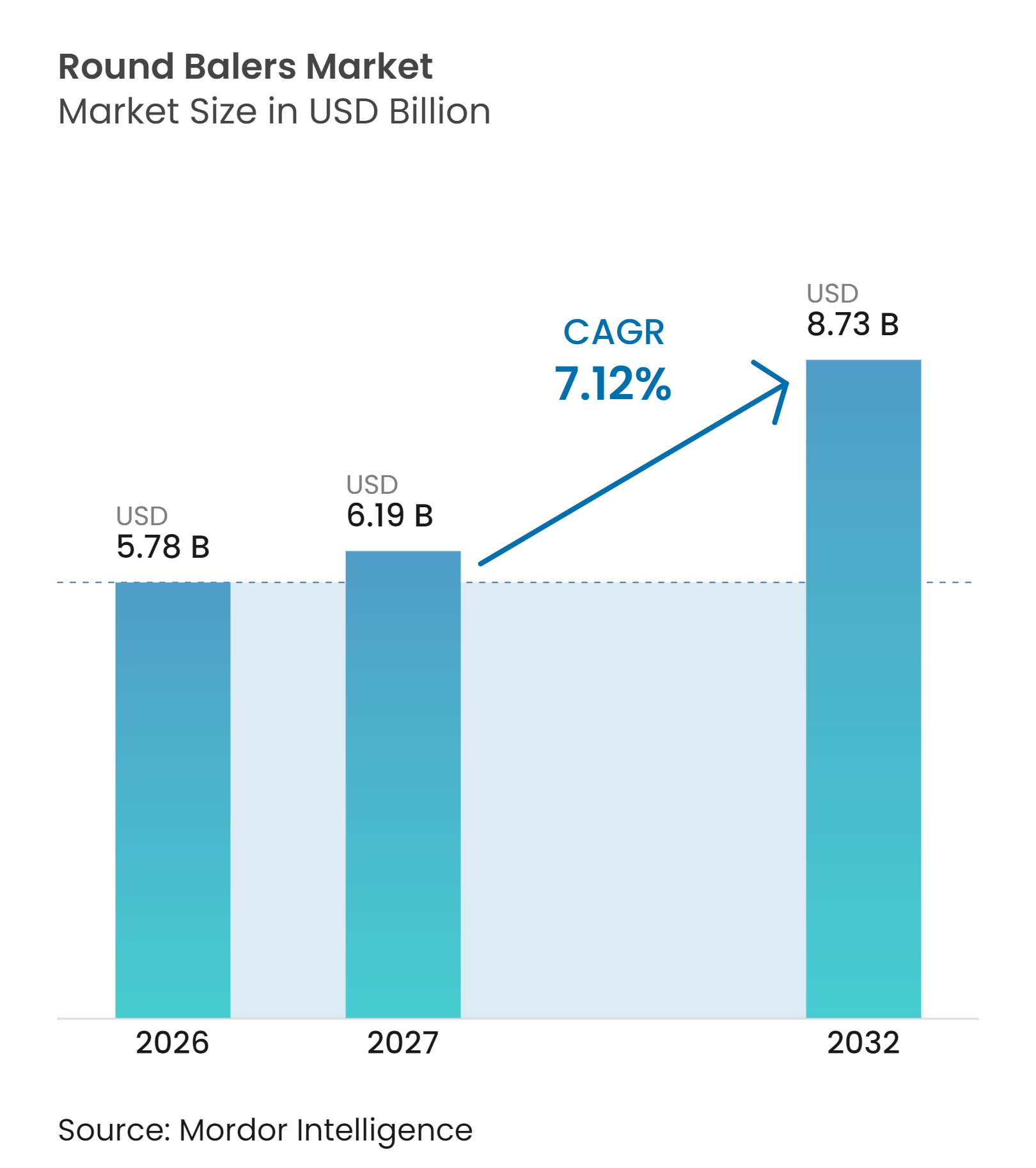
The round balers market size was valued at USD 5.78 billion in 2026 and is projected to grow from USD 6.19 billion in 2027 to USD 8.73 billion by 2032, at a CAGR of 7.12% during the forecast period. Market growth is supported by expanding livestock production, mechanized forage harvesting, and increasing demand for efficient crop residue collection and storage. Dairy and livestock operations require reliable baling equipment to handle hay, straw, and silage, while the growing utilization of biomass is creating additional applications for round balers. Limited availability of farm labor and contractor services is also influencing equipment purchasing decisions. However, high machinery costs, seasonal utilization, and narrow harvesting windows can constrain equipment ownership, particularly among smaller farms, leading some operators to rely on equipment-sharing arrangements and custom-hire services.
Key Report Takeaways
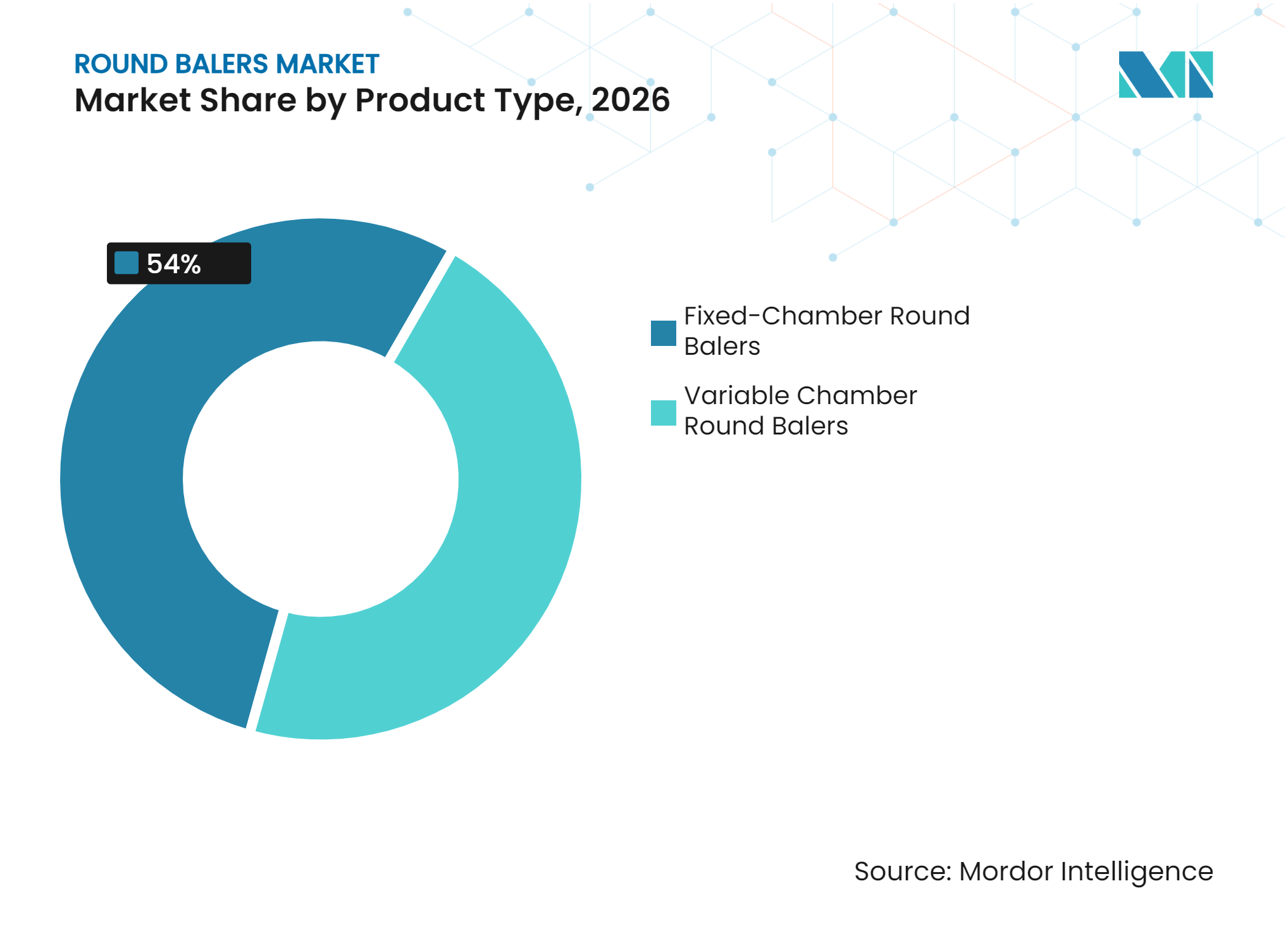
- By product type, fixed-chamber round balers accounted for the largest 54.0% of the round balers market share in 2026, and it is forecast to grow at the fastest CAGR of 8.9% from 2027 to 2032.
- By bale size, large round bales accounted for the largest share at 46.0% in 2026, while the round balers market size for medium round bales is projected to grow at the fastest CAGR of 7.4% from 2027 to 2032.
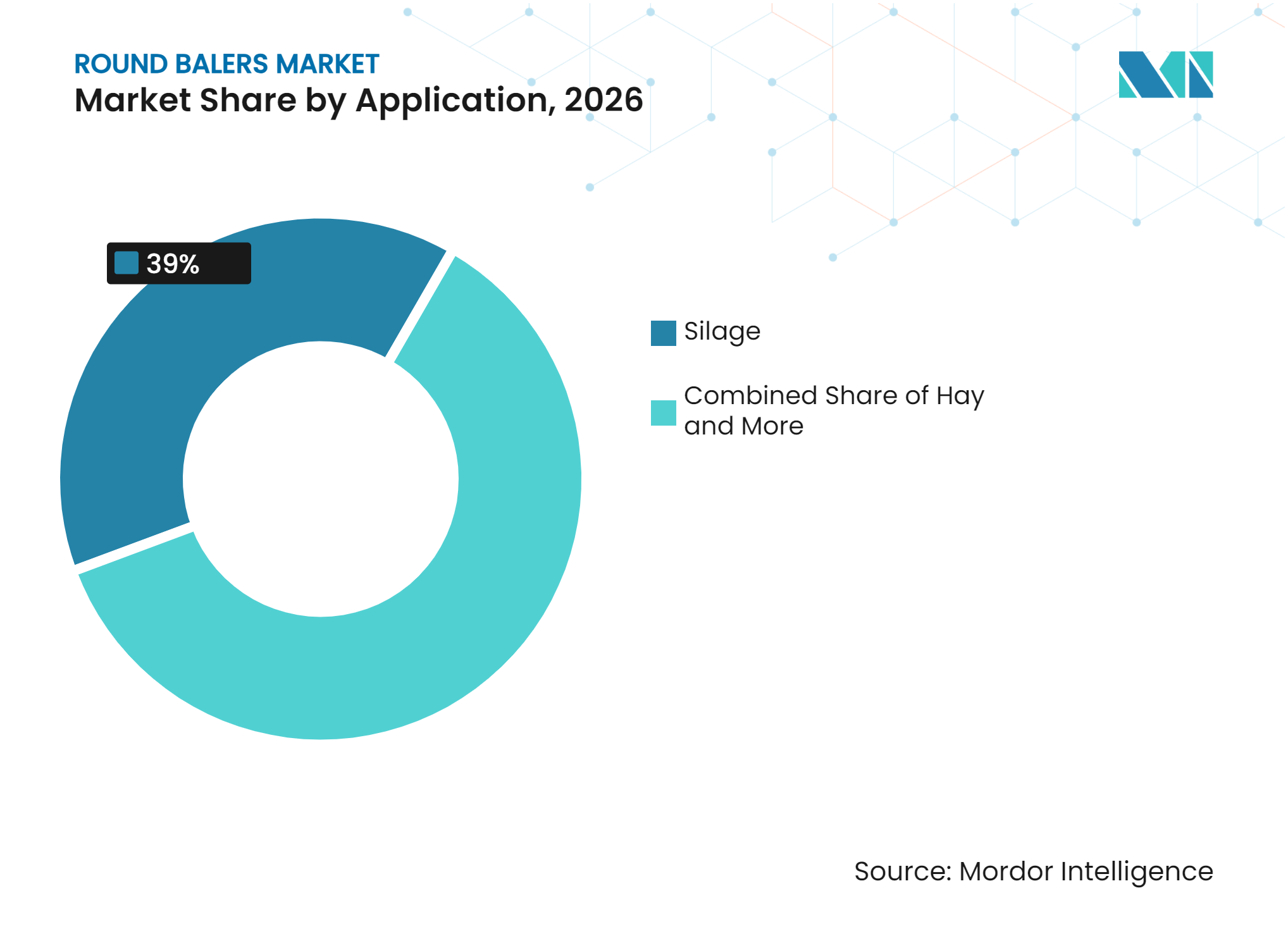
- By application, silage accounted for the largest share at 39.0% in 2026, while hay is forecast to grow at the fastest CAGR of 7.6% from 2027 to 2032.
- By end user, dairy farms accounted for the largest share at 31.0% in 2026, while agricultural contractors are projected to grow at the fastest CAGR of 8.8% from 2027 to 2032.
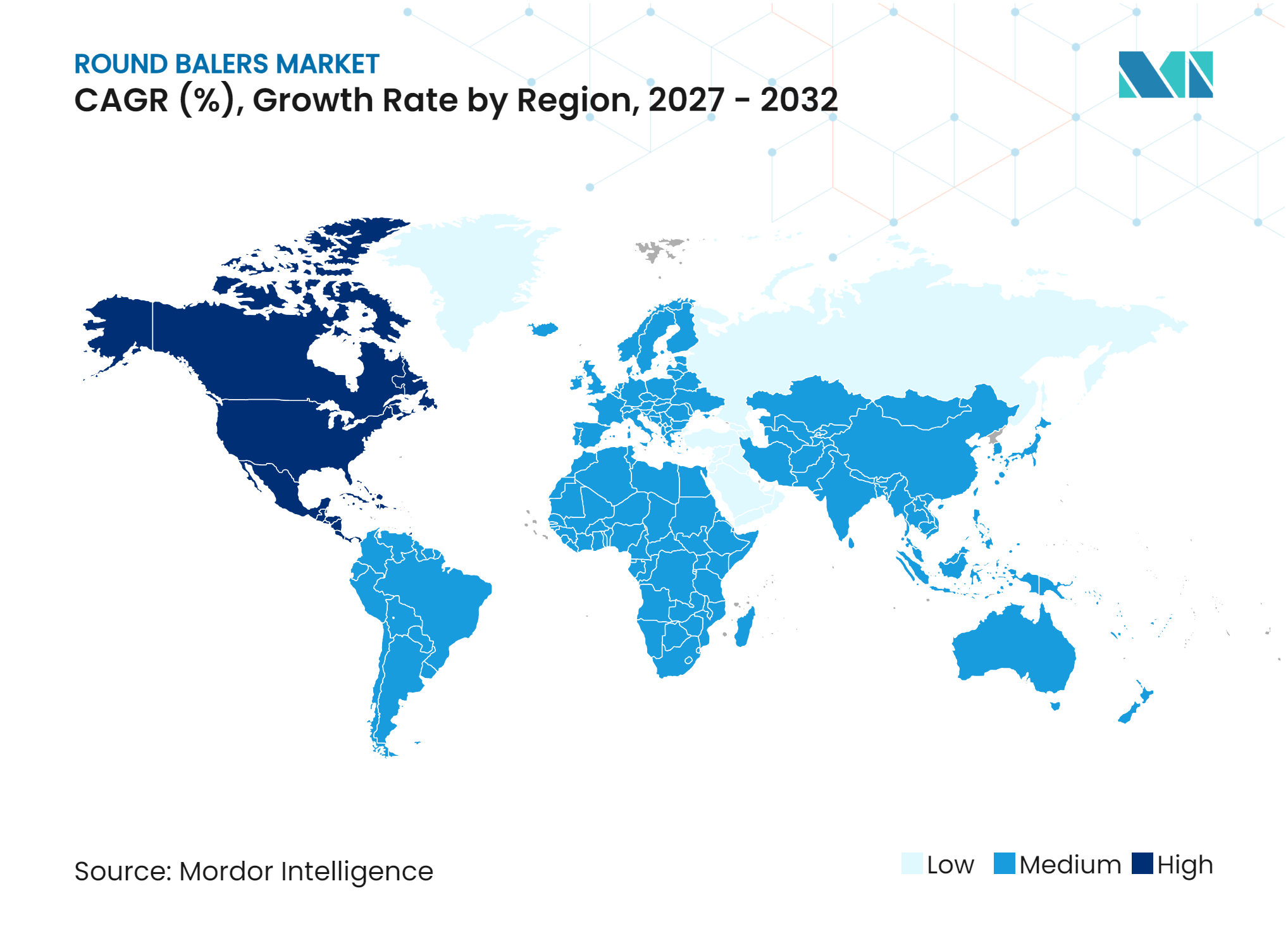
- By geography, Asia-Pacific accounted for the largest share at 39.4% in 2026, while North America is projected to grow at the fastest CAGR of 11.0% from 2027 to 2032.
Note: Market numbers in this report are based on Mordor Intelligence's proprietary estimation framework, which combines nine months of actuals with Q4 projections for base year 2026.
Market Trends and Insights
Drivers Impact Analysis of Round Balers Market*
| Driver | (~) % Impact on CAGR Forecast | Geographic Relevance | Impact Timeline |
|---|---|---|---|
| Expansion of Livestock and Dairy Production | +2.0% | Global, led by South Asia, Sub-Saharan Africa, and South America | Long term (≥ 4 years) |
| Farm Mechanization and Labor Substitution | +1.6% | Asia-Pacific, South America, and Africa | Medium term (2-4 years) |
| Demand for Higher Bale Density and Better Forage Preservation | +0.9% | North America and Europe | Medium term (2-4 years) |
| Adoption of Automation, Moisture Sensing, and Bale Documentation | +0.7% | North America, Europe, and Australia | Short term (≤ 2 years) |
| Growth of Silage and Crop-Residue Utilization | +1.1% | Asia-Pacific, Europe, and South America | Long term (≥ 4 years) |
| Rising Contractor and Custom-Harvesting Utilization | +0.8% | North America, Europe, and Australia | Short term (≤ 2 years) |
| Source: Mordor Intelligence | |||
Expansion of Livestock and Dairy Production
The round balers market benefits from expanding livestock and dairy production, which increases the need for forage harvesting, storage, and feed preservation. In its 2025 Agricultural Outlook, the Organization for Economic Co-operation and Development (OECD) and the Food and Agriculture Organization of the United Nations (FAO) projected milk production to grow at 1.8% annually, reaching 1,146 million metric tons by 2034[1]. Higher dairy output requires reliable feed supplies, thereby supporting demand for balers that efficiently collect and compress hay, straw, and forage. This relationship supports continued growth in the round baler market.
Farm Mechanization and Labor Substitution
Farm mechanization and labor substitution support drive demand for round balers by automating crop collection and compression, reducing manual handling, and enabling fewer workers to complete baling during short harvesting windows. In July 2025, India's Ministry of Agriculture and Farmers Welfare reported that the Sub-Mission on Agricultural Mechanization provides financial assistance of 40–50% to farmers[2]. The scheme also promotes custom hiring centers, allowing farms to access machinery without having to own it individually. These measures can reduce barriers to equipment acquisition and encourage the adoption of labor-saving balers among farms facing labor shortages.
Demand for Higher Bale Density and Better Forage Preservation
Demand for better forage preservation supports the round balers market, as dairy and beef operations seek consistent bale formation and moisture control to protect feed quality during storage. In November 2025, Virginia Tech Extension advised that hay should contain 15% to 18% moisture during baling. This guidance highlights the importance of baler systems that help operators monitor moisture content and form bales, as moisture levels that are too high or too low can cause heat damage, dry matter loss, and mold spoilage. These quality requirements support demand for round balers with moisture-monitoring and bale-control features.
Adoption of Automation, Moisture Sensing, and Bale Documentation
The adoption of automation and moisture-sensing technologies is improving bale quality monitoring and reducing reliance on manual inspection, which is driving demand for round balers. In September 2025, researchers from the University of Modena and Reggio Emilia published a study in Review of Scientific Instruments demonstrating a microwave-based system for real-time, non-destructive moisture measurement in agricultural bales. Tests on straw bales validated the relationship between measured microwave attenuation and moisture content. These technologies support automated quality control, enabling commercial operators to monitor forage conditions and driving demand for technologically advanced round balers.
Restraints Impact Analysis of Round Balers Market*
| Restraint | (~) % Impact on CAGR Forecast | Geographic Relevance | Impact Timeline |
|---|---|---|---|
| High Initial Capital and Financing Burden | -1.2% | Africa, developing Asia-Pacific markets, Middle East, and South America | Long term (≥ 4 years) |
| Seasonal Utilization and Long Payback Periods | -0.8% | Europe, North America, and temperate South America | Medium term (2-4 years) |
| Maintenance Complexity and Dependence on Skilled Operators | -0.5% | Africa, Asia-Pacific, and Middle East | Long term (≥ 4 years) |
| Weather-Sensitive Harvest Windows and Crop Moisture Variability | -0.5% | Europe, North America, and South America | Short term (≤ 2 years) |
| Source: Mordor Intelligence | |||
High Initial Capital and Financing Burden
The high capital cost of round baling equipment can discourage direct ownership, particularly among agricultural contractors and biomass collection operators with limited investment capacity. The Council on Energy, Environment and Water (CEEW), in its 2025 study of paddy straw supply chains in Punjab, reported that round baling machinery costs between INR 21 lakh and INR 85 lakh per machine (USD 22,140 to USD 89,830), depending on capacity[3]. This cost range can limit equipment acquisition by smaller operators and increase reliance on custom hiring services, restricting direct ownership and restraining growth in the round baler market.
Seasonal Utilization and Long Payback Periods
Seasonal utilization can constrain round baler ownership because operating activity is concentrated around crop-specific harvesting periods, while purchase, financing, maintenance, and storage costs continue throughout the year. Farms with limited acreage or fewer annual harvesting requirements may not generate sufficient machine hours to recover their investment within an acceptable payback period, making individual ownership financially challenging, particularly for smaller operators. As a result, some farms may rely on agricultural contractors and custom-hiring services to access baling equipment when needed, limiting direct purchases and constraining growth in the round baler market.
*Our forecasts treat driver/restraint impacts as directional, not additive. The impact forecasts reflect baseline growth, mix effects, and variable interactions.
Round Balers Market Segment Analysis
By Product Type:
Fixed-Chamber Round Balers Equipment Combines Leadership and GrowthFixed-chamber round balers accounted for the largest 54.0% of the round balers market share in 2026, and are forecast to grow at the fastest CAGR of 8.9% from 2027 to 2032. Their fixed-diameter chamber produces bales of consistent dimensions, supporting predictable handling and storage practices. The relatively straightforward chamber design appeals to farms seeking dependable baling equipment without the added adjustability of variable-chamber systems. These characteristics drive demand among livestock farms and operators with established bale-size requirements, particularly where purchase cost, maintenance access, and operating simplicity influence machinery selection.
Variable-chamber round balers are suited to operators who require flexibility in producing bales of varying diameters to match crop conditions, storage capacity, and handling requirements. Their adjustable chamber design allows users to control bale size and density for different forage types and customer specifications. This versatility makes them relevant to agricultural contractors, commercial hay producers, and mixed-farming operations handling multiple crops. The ability to accommodate varied baling requirements supports their adoption among operators seeking greater equipment flexibility across different harvesting assignments.



By Bale Size:
Large Round Bales Lead While Medium Round Bales GrowsLarge round bales accounted for the largest share at 46.0% in 2026, owing to their suitability for commercial forage production and livestock operations. Their greater capacity reduces the number of individual bales required for a given quantity of harvested material, simplifying field collection, transport, and storage where suitable handling equipment is available. These characteristics are relevant to large dairy and beef cattle farms that manage substantial forage volumes. Demand is further supported by operations that coordinate baling with loaders, bale handlers, transport equipment, and organized feed-storage systems.
The round balers market for medium round bales is forecast to grow at the fastest CAGR of 7.4% from 2027 to 2032, reflecting their suitability for farms that require a balance between bale capacity and handling flexibility. Their dimensions accommodate a range of tractor and loader capabilities, making them relevant to mixed-livestock farms and commercial hay producers. Small round bales continue to serve operations with more limited storage space, smaller livestock requirements, or specialized handling preferences. The availability of different bale sizes allows equipment buyers to select machinery based on farm scale, labor arrangements, transport capacity, and forage-management practices.
By Application:
Silage Leads While Hay Records the Fastest GrowthSilage accounted for the largest share at 39.0% in 2026, reflecting its importance as conserved feed for dairy and beef cattle operations. Round balers used for silage are typically integrated with wrapping systems that protect harvested forage during fermentation and storage. Consistent bale formation and appropriate wrapping are important for limiting air exposure and maintaining feed quality. These requirements support demand for baler-wrapper combinations and equipment capable of handling high-moisture forage. Dairy farms and commercial livestock producers therefore remain key customers for round balers configured for silage production.
Hay is forecast to grow at the fastest CAGR of 7.6% from 2027 to 2032, supported by its role in feeding dairy cattle, beef cattle, horses, and other livestock. Round balers provide a practical method of compressing dried forage for storage, transport, and seasonal feeding. Straw applications also support equipment demand when crop residues are collected for animal bedding, feed, or biomass use. Cornstalk, rice straw, wheat straw, maize residue, and other crop residues broaden the application base. Their suitability depends on local crop systems, collection practices, residue-management policies, and the availability of downstream users.

By End User:
Dairy Farms Lead Value While Agricultural Contractors Add VolumeDairy farms accounted for the largest share at 31.0% in 2026, reflecting their recurring requirement for stored forage and silage to support livestock feeding programs. These operations use round balers to collect and preserve hay and other forage crops, with equipment selection influenced by herd size, land availability, and feeding practices. Farms with larger forage requirements may prioritize baling capacity, bale consistency, and compatibility with wrapping and handling systems. Demand also reflects the need to coordinate harvesting with feed inventories and seasonal forage availability across dairy production systems.
Agricultural contractors are forecast to grow at the fastest CAGR of 8.8% from 2027 to 2032, supported by their role in providing baling services to farms without specialized machinery. Contractors can deploy equipment across multiple customers and harvesting locations, spreading utilization across a broader operating base. Beef cattle farms, horse and equestrian operations, mixed livestock farms, and commercial hay producers also contribute to demand through their distinct forage requirements. Biomass and crop residue processors use baling equipment to collect and consolidate agricultural residues, linking end-user demand with local feed, bedding, and biomass supply chains.
Geography Analysis
Asia-Pacific
Asia-Pacific accounted for the largest share at 39.4% in 2026, supported by its extensive agricultural base, livestock production, and crop residue management requirements. India, China, and Australia represent distinct demand centers, with machinery needs shaped by farm structure, crop mix, and mechanization levels. Dairy and beef production support forage baling, while rice, wheat, and maize cultivation create opportunities for collecting straw and other residues. Equipment adoption varies across the region, with custom-hiring services and local machinery distribution influencing access for farms that cannot justify individual ownership.
North America
North America is forecast to grow at the fastest CAGR of 11.0% from 2027 to 2032, supported by established hay and forage production, commercial livestock operations, and agricultural contracting services. The United States and Canada have large-scale farms that use mechanized harvesting and bale-handling systems to manage forage requirements. Demand is driven by equipment replacement, contractor fleet investment, and the need to complete harvesting within suitable weather windows. Mexico also contributes through livestock production and forage cultivation, although machinery purchasing patterns vary with farm size, access to financing, and local dealer coverage.
Europe, South America, Middle East and Africa
Europe remains an established market, supported by mechanized dairy and beef production, forage conservation practices, and demand for integrated baler-wrapper combinations. Germany, France, Ireland, and the United Kingdom sustain equipment demand through intensive livestock operations and established agricultural machinery networks. Brazil and Argentina drive demand in South America through beef and dairy production, while livestock farming and forage cultivation support demand in the Middle East, particularly Türkiye. Africa presents opportunities through agricultural mechanization and crop-residue collection, although financing constraints, fragmented farm structures, and limited after-sales service can restrict adoption.
Competitive Landscape
Market Concentration
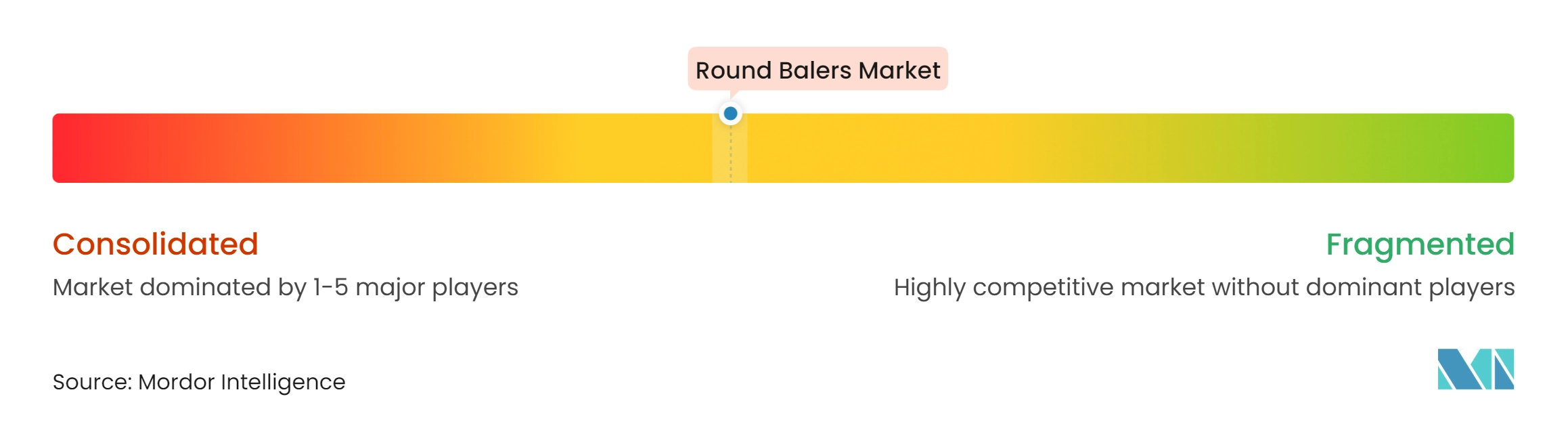
The round balers market is moderately consolidated in 2026, with Deere & Company, CLAAS KGaA mbH, McHale Engineering Holdings Unlimited Company, CNH Industrial N.V., and KUHN SAS (Bucher Industries AG) being the key players. These manufacturers compete on product breadth, dealer networks, equipment reliability, and support for different forage applications. Specialist producers also participate by addressing particular crop conditions and operating requirements. Product differentiation increasingly centers on automation, bale monitoring, chamber design, wrapping integration, and service availability across agricultural regions.
Competitive positioning is shaped by manufacturers' ability to serve both individual farms and agricultural contractors with equipment suited to varied harvesting conditions. Established brands benefit from dealer relationships, replacement-part availability, and product portfolios covering fixed-chamber and variable-chamber configurations. Manufacturers also differentiate through ease of operation, maintenance requirements, bale-density control, and compatibility with tractors and downstream handling equipment. In markets where financing and access to services influence purchasing decisions, distribution coverage remains important alongside machine specifications. Regional competitors and specialist manufacturers can address local crop requirements, while larger suppliers use broader product ranges to serve diverse customer groups.
Product innovation remains an important competitive factor as manufacturers improve productivity, automation, and bale-quality monitoring. Deere & Company introduced its next-generation fixed- and variable-chamber round balers in June 2025, incorporating connectivity features and optional real-time moisture monitoring. The V452R and V462R variable-chamber models offer a 15% increase in driveline power intake, which the manufacturer states translates into an 8% increase in field productivity. These developments illustrate how established manufacturers use powertrain improvements and digital capabilities to differentiate their equipment and meet operational efficiency requirements.
Round Balers Industry Leaders
-
Deere & Company
-
CLAAS KGaA mbH
-
McHale Engineering Holdings Unlimited Company
-
CNH Industrial N.V.
-
KUHN SAS (Bucher Industries AG)
- *Disclaimer: Major Players sorted in no particular order
Round Balers Market Companies Covered in this Report
- Deere & Company
- CNH Industrial N.V.
- CLAAS KGaA mbH
- AGCO Corporation
- Vermeer Corporation
- KUHN SAS (Bucher Industries AG)
- Maschinenfabrik Bernard KRONE GmbH and Co. KG (Bernard Krone Holding SE and Co. KG)
- McHale Engineering Holdings Unlimited Company
- Kubota Corporation
- PÖTTINGER Landtechnik GmbH
- GÖWEIL Maschinenbau GmbH
- MASCHIO GASPARDO S.p.A.
- IHI Agri-Tech Corporation (IHI Corporation)
- Orkel AS
- SITREX S.p.A.
Recent Industry Developments in Round Balers Market
- September 2026: Vermeer Corporation introduced four 605 S-series round baler models, expanding its product lineup with Rancher, Signature, Premium, and Cornstalk Special variants that feature enhanced automation, moisture and bearing-temperature monitoring, and bale-density control.
- January 2026: CLAAS KGaA mbH inaugurated two new assembly lines at its Metz Woippy facility in France, strengthening manufacturing capabilities and supporting serial production of the CEREX variable chamber round baler for agricultural customers.
- November 2025: CNH Industrial N.V. launched the Case IH RB6 variable-chamber round baler series, featuring standard ISOBUS compatibility, upgraded chain drives, triple-seal bearings, and optional FieldOps telematics for bale location and moisture monitoring.
Global Round Balers Market Report Scope
The round balers market report is segmented by product type (fixed-chamber round balers and variable-chamber round balers), by bale size (small round bales, medium round bales, and large round bales), by application (hay, silage, straw, cornstalk, rice straw, wheat straw, maize residue, and other crop residues), by end user (dairy farms, beef cattle farms, horse and equestrian operations, mixed livestock farms, agricultural contractors, commercial hay producers, and biomass and crop-residue processors), and by geography (North America, South America, Europe, Asia-Pacific, the Middle East, and Africa). The market forecasts are provided in terms of value (USD).
Segmentation Overview
| Fixed-Chamber Round Balers |
| Variable Chamber Round Balers |
| Small Round Bales |
| Medium Round Bales |
| Large Round Bales |
| Hay |
| Silage |
| Straw |
| Cornstalk |
| Rice Straw |
| Wheat Straw |
| Maize Residue |
| Other Crop Residues |
| Dairy Farms |
| Beef Cattle Farms |
| Horse and Equestrian Operations |
| Mixed Livestock Farms |
| Agricultural Contractors |
| Commercial Hay Producers |
| Biomass and Crop-Residue Processors |
| North America | United States |
| Canada | |
| Mexico | |
| Rest of North America | |
| South America | Brazil |
| Argentina | |
| Rest of South America | |
| Europe | Germany |
| France | |
| United Kingdom | |
| Italy | |
| Spain | |
| Russia | |
| Rest of Europe | |
| Asia-Pacific | China |
| India | |
| Japan | |
| Australia | |
| South Korea | |
| Rest of Asia-Pacific | |
| Middle East | Turkey |
| Saudi Arabia | |
| United Arab Emirates | |
| Rest of Middle East | |
| Africa | South Africa |
| Egypt | |
| Kenya | |
| Rest of Africa |
| By Product Type | Fixed-Chamber Round Balers | |
| Variable Chamber Round Balers | ||
| By Bale Size | Small Round Bales | |
| Medium Round Bales | ||
| Large Round Bales | ||
| By Application | Hay | |
| Silage | ||
| Straw | ||
| Cornstalk | ||
| Rice Straw | ||
| Wheat Straw | ||
| Maize Residue | ||
| Other Crop Residues | ||
| By End User | Dairy Farms | |
| Beef Cattle Farms | ||
| Horse and Equestrian Operations | ||
| Mixed Livestock Farms | ||
| Agricultural Contractors | ||
| Commercial Hay Producers | ||
| Biomass and Crop-Residue Processors | ||
| By Geography | North America | United States |
| Canada | ||
| Mexico | ||
| Rest of North America | ||
| South America | Brazil | |
| Argentina | ||
| Rest of South America | ||
| Europe | Germany | |
| France | ||
| United Kingdom | ||
| Italy | ||
| Spain | ||
| Russia | ||
| Rest of Europe | ||
| Asia-Pacific | China | |
| India | ||
| Japan | ||
| Australia | ||
| South Korea | ||
| Rest of Asia-Pacific | ||
| Middle East | Turkey | |
| Saudi Arabia | ||
| United Arab Emirates | ||
| Rest of Middle East | ||
| Africa | South Africa | |
| Egypt | ||
| Kenya | ||
| Rest of Africa | ||
Key Questions Answered in the Report
What is the projected value of the round balers market by 2032?
The round balers market is forecast to reach USD 8.73 billion by 2032.
Which round baler product type leads demand?
Fixed-chamber round balers lead with the largest 54.0% in 2026 and are forecast to grow at the fastest CAGR of 8.9% from 2027 to 2032.
Which region will grow fastest through 2032?
North America is forecast to grow at the fastest CAGR of 11.0% from 2027 to 2032.
What limits adoption of premium round balers?
High purchase prices, limited financing, seasonal use, maintenance demands, and weather-related harvest risks remain key barriers.