
Romania Biostimulants Market Size and Share
Market Overview
| Study Period | 2021 - 2031 |
|---|---|
| Forecast Data Period | 2026 - 2031 |
| Base Year Market Size (2025) | USD 18.73 Million |
| Market Size (2026) | USD 20.21 Million |
| Market Size (2031) | USD 29.56 Million |
| Growth Rate (2026 - 2031) | 7.90 % |
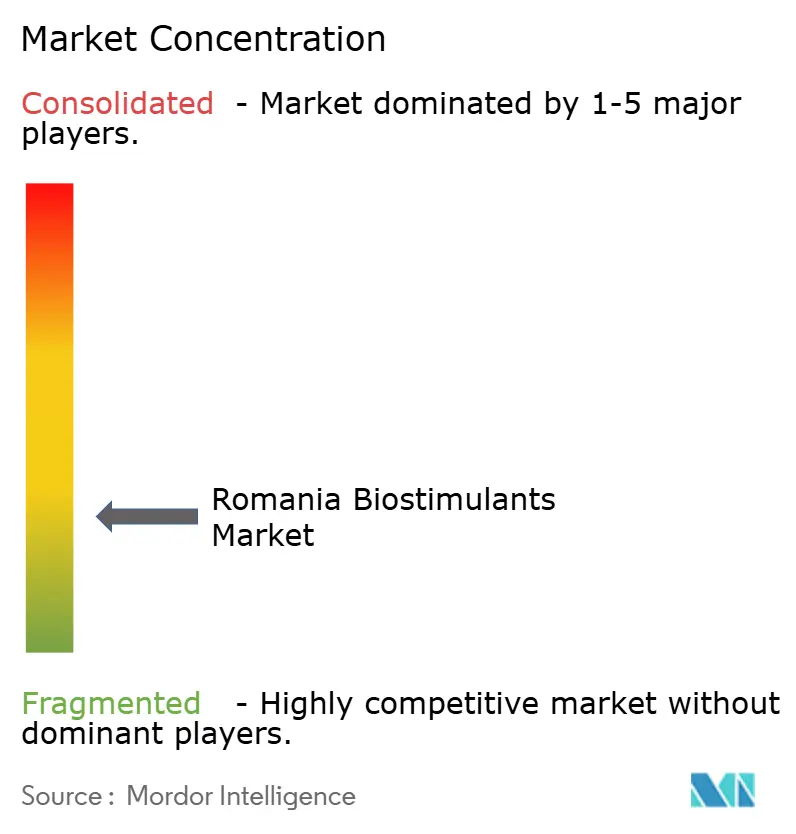
| Market Concentration | Low |
Major Players *Disclaimer: Major Players sorted in no particular order Image © Mordor Intelligence. Reuse requires attribution under CC BY 4.0. | |
Romania Biostimulants Market Analysis by Mordor Intelligence
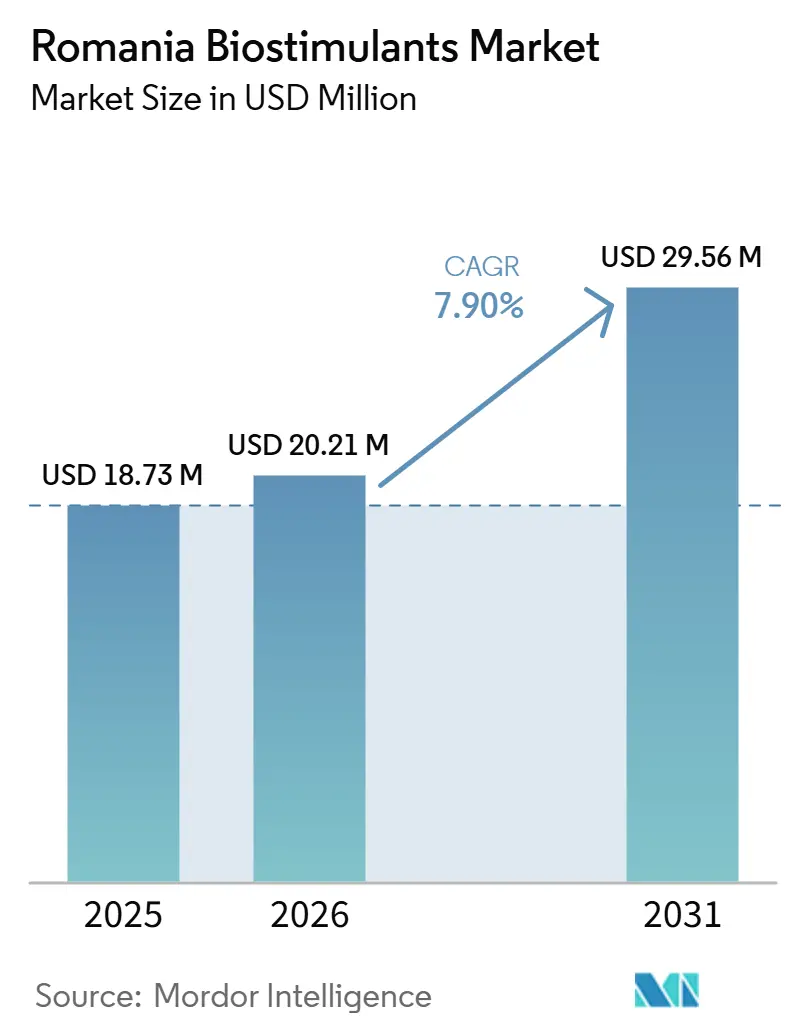
The Romania biostimulants market size is projected to expand from USD 18.73 million in 2025 and USD 20.21 million in 2026 to USD 29.56 million by 2031, registering a CAGR of 7.9% between 2026 and 2031. The regulatory setting also supports adoption because Romania operates under the same Conformité Européenne (CE) marking rules as the rest of the European Union, and the Common Agricultural Policy (CAP) 2023 to 2027 framework links farm support to the adoption of sustainable practices. Climate pressure is adding urgency because drought is now the largest source of agricultural loss across Europe, while southern, southeastern, and western Romania have also recorded notable warming and increased land degradation. The market is also supported by ongoing investment from biological input suppliers, which is improving product availability, manufacturing scale, and distributor confidence across Europe. These conditions give the Romania biostimulants market a growth path tied more to farm resilience, compliance, and crop quality than to one-off shifts in seasonal input spending.
Key Report Takeaways
- By form, amino acids accounted for the largest share of the Romanian biostimulants market in 2025, at 55.3%, while humic acid is the fastest-growing form with 7.2% CAGR through 2031.
- By crop type, row crops accounted for 48.2% of Romania's biostimulants market size in 2025, while horticultural crops are the fastest-growing segment and are forecast to expand at an 8.2% CAGR through 2031.
Note: Market size and forecast figures in this report are generated using Mordor Intelligence’s proprietary estimation framework, updated with the latest available data and insights as of January 2026.
Romania Biostimulants Market Trends and Insights
Drivers Impact Analysis*
| Driver | (~) % Impact on CAGR Forecast | Geographic Relevance | Impact Timeline |
|---|---|---|---|
| European Union farm to fork pressure on synthetic input reduction | +2.0% | National, aligned with European Union policy and crop compliance requirements | Medium term (2-4 years) |
| Organic and residue-free crop production expansion | +1.5% | National, with stronger relevance in Transylvania, Banat, and organic clusters | Medium term (2-4 years) |
| Precision nutrition adoption in high-value romanian crops | +1.0% | Strongest in western horticulture and premium produce systems | Medium term (2-4 years) |
| Climate volatility increasing abiotic stress management need | +1.8% | National, with strongest pressure in southern, southeastern, and western Romania | Short term (≤ 2 years) |
| Export-grade compliance requirements from retail and buyers | +0.8% | National, with earlier gains in export-oriented produce corridors | Medium term (2-4 years) |
| Microbial fermentation cost declines improving formulation economics | +1.2% | Indirect national benefit through European supply chains and importer networks | Long term (≥ 4 years) |
| Source: Mordor Intelligence | |||
European Union Farm To Fork Pressure on Synthetic Input Reduction
The Romania biostimulants market is benefiting from the Farm to Fork policy because growers are under pressure to reduce nutrient losses and dependence on synthetic inputs. In 2025, Agricultural and Food Economics found that Romania could face greater economic strain during the implementation of the Farm to Fork strategy because agriculture carries a comparatively greater weight in national output. That matters because growers need tools that help preserve output while policy direction becomes stricter across the European Union. The Romania biostimulants market, therefore, sits within a policy setting that simultaneously pushes for efficiency, resilience, and compliance. This makes biological crop inputs more relevant to farm programs that need to maintain yields without deviating from the broader regulatory path.
Organic and Residue-Free Crop Production Expansion
The Romania biostimulants market is experiencing growth due to the expansion of organic and low-residue crop systems across the country. Farms transitioning to organic or residue-sensitive production require inputs that enhance nutrient uptake, root health, and stress management while complying with certification standards. These systems are gaining traction as consumers and regulatory bodies increasingly prioritize sustainable and environmentally friendly agricultural practices. The Romania biostimulants market is well-positioned to support this transition, as biostimulants align with both certified programs and retailer expectations for cleaner production systems. Additionally, biostimulants offer solutions that help farmers improve crop resilience to environmental stressors, such as drought and soil salinity, which are becoming more prevalent due to climate change. This creates a more stable demand foundation, driven by structural changes in farming practices and market access, rather than a short-term seasonal buying cycle. The market's adaptability to these evolving agricultural needs further strengthens its potential for sustained growth in the coming years.
Precision Nutrition Adoption in High-Value Romanian Crops
The Romania biostimulants market is gaining support from more targeted nutrition practices in premium crop systems. Horticultural growers work with a much tighter link between input use, product quality, and selling price, so biological inputs are easier to justify where fruit set, shelf life, and visual quality affect returns. In June 2024, Corteva, Inc. reported that its biological product Utrisha N, based on Methylobacterium symbioticum, was used across 7,400 hectares at a Romanian farm, which shows that biological nutrition has moved beyond small trials in at least part of the market[1]Source: Corteva Agriscience Romania, “Romanian and Moldovan Farmers Strengthen Their Knowledge of Biological Products” Corteva Agriscience Romania, corteva.com. This matters because once growers build a repeatable program around plant response and crop quality, adoption becomes less experimental and more operational. The Romania biostimulants market is therefore being shaped by growers who measure input value at the crop and field level rather than only against bulk fertilizer spending. That pattern is strongest in higher-value vegetables, orchards, and vineyards, where biological inputs fit more easily into existing foliar and fertigation practices than in broadacre grain farming.
Climate Volatility Increasing Abiotic Stress Management Need
The Romania biostimulants market is being supported by worsening crop stress conditions across key producing areas. The European Environment Agency reported in 2025 that drought accounts for 54% of agricultural losses across Europe, confirming that climate damage is no longer a temporary issue in the farm economy[2]Source: European Environment Agency, “Building Climate-Resilient Agriculture in Europe, An Economic Perspective,” European Environment Agency, eea.europa.eu. The Romanian biostimulants market is adapting to these challenges, as growers seek solutions to safeguard yields, improve nutrient efficiency, and support crop recovery amid increasingly unstable weather conditions. Biostimulants play a crucial role in mitigating the adverse effects of climate change by improving plant resilience and optimizing resource use. This demand is particularly significant as climate issues impact both premium and large-scale field crops, despite differences in their capacity to invest in additional inputs. The growing awareness among farmers of the benefits of biostimulants, coupled with the need to maintain productivity amid environmental stressors, is driving their adoption across a range of crops.
Restraints Impact Analysis*
| Restraint | (~) % Impact on CAGR Forecast | Geographic Relevance | Impact Timeline |
|---|---|---|---|
| Inconsistent farmer ROI perception across crop segments | -0.8% | National, with sharper effect in smallholder and mixed-crop areas | Medium term (2-4 years) |
| Limited shelf life and storage stability of certain formulations | -0.5% | National, with stronger effect in remote distribution networks | Medium term (2-4 years) |
| Fragmented field validation and agronomic trial coverage | -0.6% | National, across major crop types and soil conditions | Medium term (2-4 years) |
| Price premium versus conventional fertilizers and nutrient inputs | -0.9% | National, with strongest effect in southern and eastern row crop zones | Medium term (2-4 years) |
| Source: Mordor Intelligence | |||
Inconsistent Farmer ROI Perception Across Crop Segments
The Romania biostimulants market still faces a trust gap around return on investment (ROI), especially outside higher-value crop systems. In broadacre grain farming, annual input choices are often judged against thin margins and visible short-term yield effects, which makes biological products harder to position when results depend on season, soil, and crop stress. This is a bigger issue in cereals and oilseeds than in horticulture because produce growers can often connect input spending more clearly to sale price, grade, and shelf performance. The Romania biostimulants market therefore advances unevenly across crop segments, even when growers recognize the need for better stress management. Climate pressure has increased interest in farm resilience, but that does not automatically translate into faster product uptake when cash discipline remains strict. Until suppliers present more locally relevant and repeatable outcome data, perceived value will remain stronger in premium crop systems than in large field crops.
Limited Shelf Life and Storage Stability of Certain Formulations
The Romania biostimulants market also faces practical limitations in storage and handling. Some biological and liquid formulations require tighter control over temperature, logistics, and warehouse conditions than conventional dry inputs, which creates friction in rural distribution systems. This matters in Romania because the market is still import-dependent, so product quality must be preserved through transport, storage, and dealer networks before it reaches the farm. The Romania biostimulants market can therefore lose momentum when distributors prefer products with easier inventory management and longer storage windows. Shelf stability is especially important in regions where dealers serve a mix of farm types and seasonal demand is less predictable. Even when agronomic performance is accepted, handling complexity can slow stocking decisions and reduce willingness to promote certain products aggressively.
*Our forecasts treat driver/restraint impacts as directional, not additive. The impact forecasts reflect baseline growth, mix effects, and variable interactions.
Segment Analysis
By Form: Amino Acids Anchor Current Demand, Humic Acid Signals the Transition
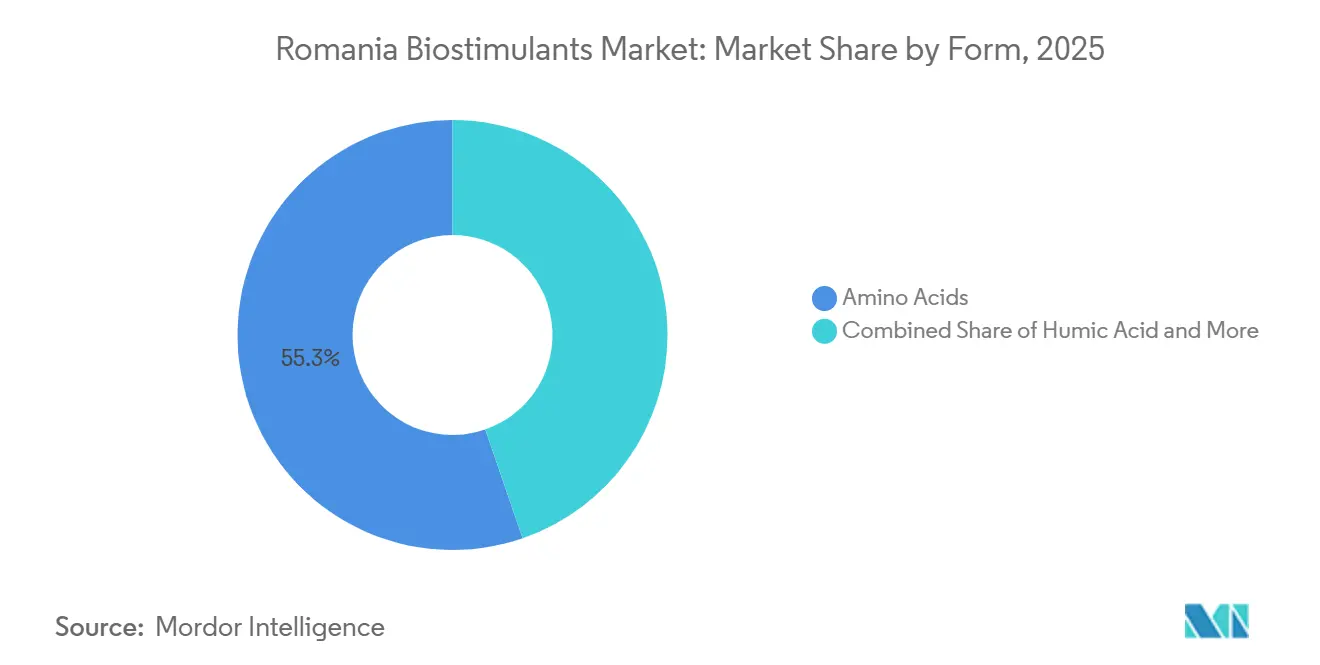
Amino acids accounted for 55.3% of the Romania biostimulants market in 2025, making them the largest form segment by current revenue. Their position reflects long use in foliar nutrition programs for fruits and vegetables, where growers value visible crop response and compatibility with established spray schedules. Amino acid products also fit farms that want better nutrient use, plant recovery, and stress support without changing the rest of the agronomic program too sharply. In the Romania biostimulants industry, this makes amino acids the most familiar entry point for distributors and growers who are still building confidence in biological crop inputs. Other biostimulants, including multi-component biological products, still account for a smaller share, yet they align with the longer-term direction of the Romanian biostimulants market as regulatory and climate pressures push growers toward broader biological crop programs.
Humic acid is the fastest-growing form, with a 7.2% CAGR through 2031, pointing to a shift toward soil-centered solutions as water stress and land degradation remain major farm concerns. This category is gaining attention because it is closely linked to soil health, nutrient retention, and root performance, all of which matter more as drought frequency increases. BASF SE and Syngenta AG are both expanding biological production capacity, and that broader supply-side investment should help improve the affordability and reach of multiple formulation types over time. Protein hydrolysates remain important in premium crop systems because growers use them where crop quality and stress response carry a direct commercial value. Seaweed extracts and fulvic acid serve narrower roles, but they remain strategically relevant in vineyards, orchards, and farms that are moving toward lower-residue or organic production.



By Crop Type: Horticultural Crops Accelerate on Export Compliance, Row Crops Define the Volume Base
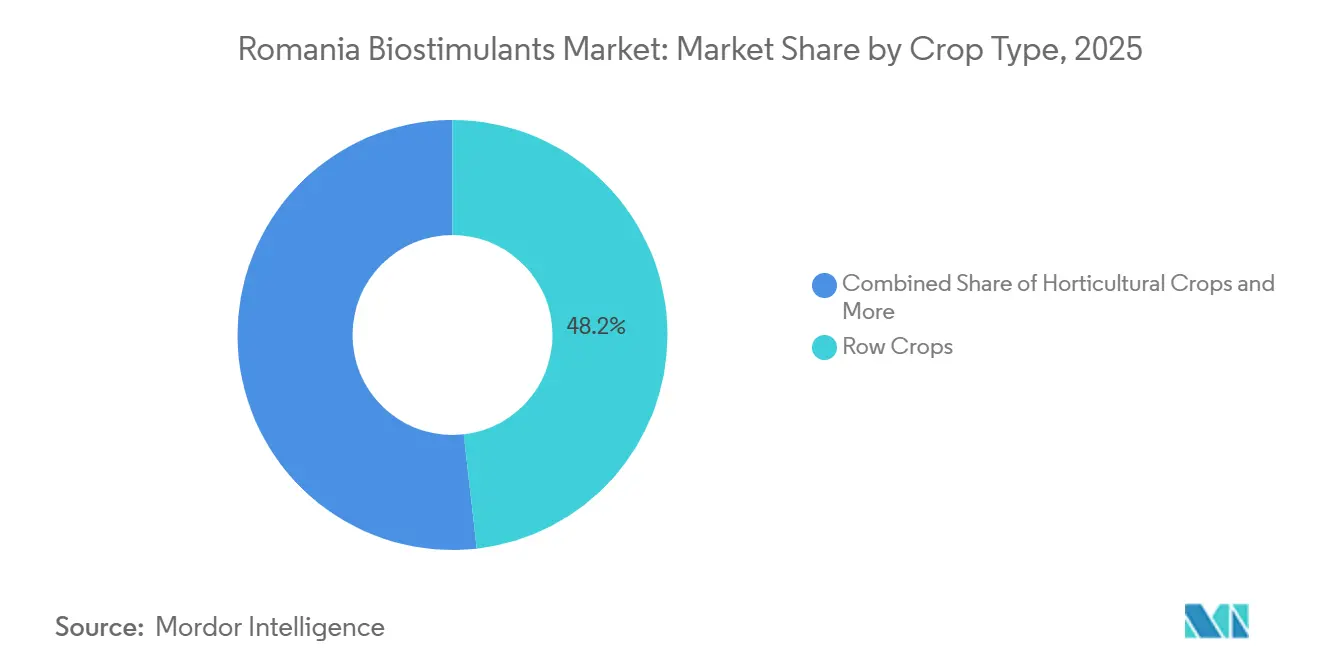
Row crops were the largest crop segment with 48.2% share in 2025, reflecting the scale of wheat, corn, sunflower, and rapeseed cultivation across Romania. Their importance lies in land coverage and national crop structure rather than in the most advanced use of biostimulants. That means the largest segment contributes the bulk of the Romania biostimulants market, even though adoption remains more price-sensitive and more dependent on local proof of performance. Broadacre growers often need a stronger case around yield stability and nutrient efficiency before they commit to repeated use at scale. Horticulture can absorb premium products more easily because crop quality and sales channels reward better performance more directly. Row crops, by contrast, offer wider acreage and a larger installed base, but they need simpler economics and stronger local evidence before adoption broadens. The Romania biostimulants market, therefore, grows first through premium and compliance-driven crop systems, then through more gradual entry into larger field acreage.
Horticultural crops are the fastest-growing crop segment and are forecast to expand at an 8.2% CAGR through 2031, giving them the clearest growth profile in the current mix. This segment of the Romania biostimulants market is supported by higher crop value per hectare, greater direct exposure to buyer quality standards, and a better fit with foliar and fertigation programs already used in orchards, vegetables, and vineyards. Cash crops occupy a smaller but still meaningful position because processors and buyers in those chains often value uniformity, crop quality, and measured agronomic outcomes. In the Romania biostimulants industry, horticulture is the fastest-growing area for new adoption, while row crops remain the largest platform for future scaling once price and validation barriers ease.
Geography Analysis
Romania remains at an earlier stage of adoption than many Western European peers. Romania is the 5th-largest agricultural producer in the European Union by utilized area, and that gives agricultural input decisions an unusually important role in national farm policy and rural development. The country also benefits from a harmonized market framework because Conformité Européenne (CE)- marked fertilizer and biological products can move through the European Union system without the country-by-country re-registration barriers seen outside the bloc. That reduces entry friction for international suppliers and helps the Romania biostimulants market draw from broader European product pipelines.
Western Romania remains the largest adoption zone in practical terms because Banat and nearby areas combine stronger horticultural intensity, better distributor access, and closer links to export-oriented crop systems. The Romania biostimulants market is more established because growers are more exposed to quality-sensitive value chains and advisory networks that support product use. Transylvania is also important because orchards, vineyards, and premium vegetable systems can more easily accommodate higher-value biological programs than bulk field-crop operations. Tulcea County has a different demand profile because it is close to European Union action-plan levels for organic farming, which supports input systems that meet certified production requirements. These clusters matter because the Romania biostimulants market does not expand evenly across the country, and demand is stronger where crop value, certification needs, and advisory support overlap.
Southern and southeastern Romania face the strongest climate stress, which should keep them central to longer-term demand even if near-term farm spending stays constrained. Research published in Sustainability found that these regions are among the most exposed to heat increase, drought, and desertification pressure, which raises the value of products tied to abiotic stress management. The European Environment Agency also showed that drought remains the largest driver of agricultural losses across Europe, providing the Romanian farm sector with a strong reason to seek more stable crop management programs. The Romania biostimulants market, therefore, has its clearest immediate commercial base in the west and its deepest long-run need in drought-prone southern and southeastern regions. This geographic pattern supports steady expansion because compliance-led and climate-led adoption are advancing simultaneously across different parts of the country.
Competitive Landscape
The Romania biostimulants market is highly fragmented and remains heavily dependent on imported products, so competition in 2025 will be shaped by portfolio breadth, distributor reach, and the ability to support growers with practical agronomic guidance. The largest competitive group includes Syngenta AG, BASF SE, UPL Limited, Koppert Biological Systems B.V., and Valagro S.p.A., all of which can leverage broader crop-input relationships to place biological products alongside more established farm offerings. A second group includes specialist European manufacturers such as Valagro S.p.A., Biolchim S.p.A., Italpollina S.p.A., and Tradecorp International S.A., which have extensive experience with biostimulants and stronger historical ties to horticultural channels. The Romania biostimulants market favors companies that can combine compliant products with crop-specific advisory support, as growers still need clear evidence before expanding use across larger acreages.
The most visible strategic move has been capacity expansion. Syngenta's 2025 opening of a 22,000 m² biologicals manufacturing facility in South Carolina, with an annual capacity of 16,000 metric tons of biostimulants, together with its earlier integration of Valagro's biological expertise, strengthens the company's global production network and accelerates the commercialization of biological products. This expanded manufacturing capacity enhances the availability of biostimulants across international markets, including Europe, enabling Romanian growers to access a broader portfolio of advanced biological solutions[3]Source: Syngenta AG, “Syngenta to Become Global Leader in Biologicals, Expanding Nature-Inspired Solutions for Farmers,” Syngenta, syngenta.com. In 2024, Corteva Agriscience expanded its portfolio in Romania by introducing a new range of biological products, including Harbest, Utrisha N, BioForge, Keylate B, StarterMn Platinum, and SugarMover Zn, to support sustainable crop production across row crops, horticulture, vineyards, and orchards. These moves matter because the Romania biostimulants market is still developing, and suppliers that combine manufacturing confidence with local commercial follow-through are more likely to gain distributor trust.
Competition in the Romania biostimulants market is increasingly centered on pricing, product accessibility, and expansion into underpenetrated row-crop segments. In 2025, Koppert Biological Systems B.V. transferred the management of its biostimulant and fertilizer portfolio to REKA Group B.V., while maintaining distribution through its subsidiaries during the transition. The market remains fragmented, with global manufacturers and specialized biological companies competing across different crop segments. As no single supplier holds a dominant position across all biostimulant categories, companies must complement product availability with strong local distribution, technical support, and farmer engagement to strengthen their market position.
Romania Biostimulants Industry Leaders
Syngenta AG
BASF SE
UPL Limited
Koppert Biological Systems B.V.
Valagro S.p.A.
- *Disclaimer: Major Players sorted in no particular order

Recent Industry Developments
- March 2026: CICh Năvodari, Romania's sole producer of professional biostimulants and technological fertilizers, has secured an updated Integrated Environmental Permit and launched a 2026 plan to develop new biostimulants for specialty crops like viticulture, orchards, and protected vegetables. This builds on its Terram and Nutrifolium lines to meet Romania's growing demand for locally made, crop-specific nutrition programs.
- February 2025: Syngenta Crop Protection and Ceres Biotics signed a global commercialization agreement for Vixeran, a microbial biostimulant that fixes atmospheric nitrogen in plant tissues. The agreement expanded an earlier EU-focused launch to global markets. Vixeran entered Romania's distribution network in the 2026 crop season, targeting cereal and sunflower growers.
- January 2024: Corteva Agriscience expanded its portfolio in Romania by introducing a new category of biological products following its acquisitions of Stoller and Symborg. The new biological portfolio includes Harbest, Utrisha N, BioForge, Keylate B, StarterMn Platinum, and SugarMover Zn, supporting sustainable crop production across row crops, horticulture, vineyards, and orchards.


Romania Biostimulants Market Report Scope
Biostimulants are natural or biologically derived substances and microorganisms that promote plant growth, improve nutrient efficiency, enhance stress tolerance, and boost crop quality. They are used in agriculture to enhance plant resilience to abiotic stresses such as drought, salinity, and heat, thereby contributing to sustainable crop productivity.
The Romania biostimulants market report is segmented by form into amino acids, fulvic acid, humic acid, protein hydrolysates, seaweed extracts, and other biostimulants, and by crop type into cash crops, horticultural crops, and row crops. The market forecasts are provided in terms of value (USD) and volume (Metric Tons).
| Amino Acids |
| Fulvic Acid |
| Humic Acid |
| Protein Hydrolysates |
| Seaweed Extracts |
| Other Biostimulants |
| Row Crops |
| Horticultural Crops |
| Cash Crops |
| By Form | Amino Acids |
| Fulvic Acid | |
| Humic Acid | |
| Protein Hydrolysates | |
| Seaweed Extracts | |
| Other Biostimulants | |
| By Crop Type | Row Crops |
| Horticultural Crops | |
| Cash Crops |


Key Questions Answered in the Report
What is the projected value of Romania biostimulants by 2031?
The report projects Romania biostimulants to reach USD 29.56 million by 2031 from USD 20.21 million in 2026, with a 7.9% CAGR over 2026 to 2031.
Which crop group is expanding the fastest in Romania?
Horticultural crops are the fastest segment, with a projected CAGR of 8.2% through 2031, supported by export compliance needs and higher value per hectare.
Which form leads current demand in Romania?
Amino acids are the largest form segment, holding 55.3% share in 2025 because they fit established foliar programs and are already familiar to growers.
Why are biological inputs becoming more relevant for Romanian farms?
The main reasons are organic area growth, climate stress, tighter residue expectations, and broader policy pressure to improve nutrient efficiency and reduce synthetic dependence.
Which regions create the strongest demand conditions?
Western Romania offers the clearest commercial base because of horticulture and export links, while southern and southeastern regions show the deepest long-term need because drought pressure is more severe there.
Page last updated on:





