
Robotics Components Market Size and Share
Market Overview
| Study Period | 2020 - 2031 |
|---|---|
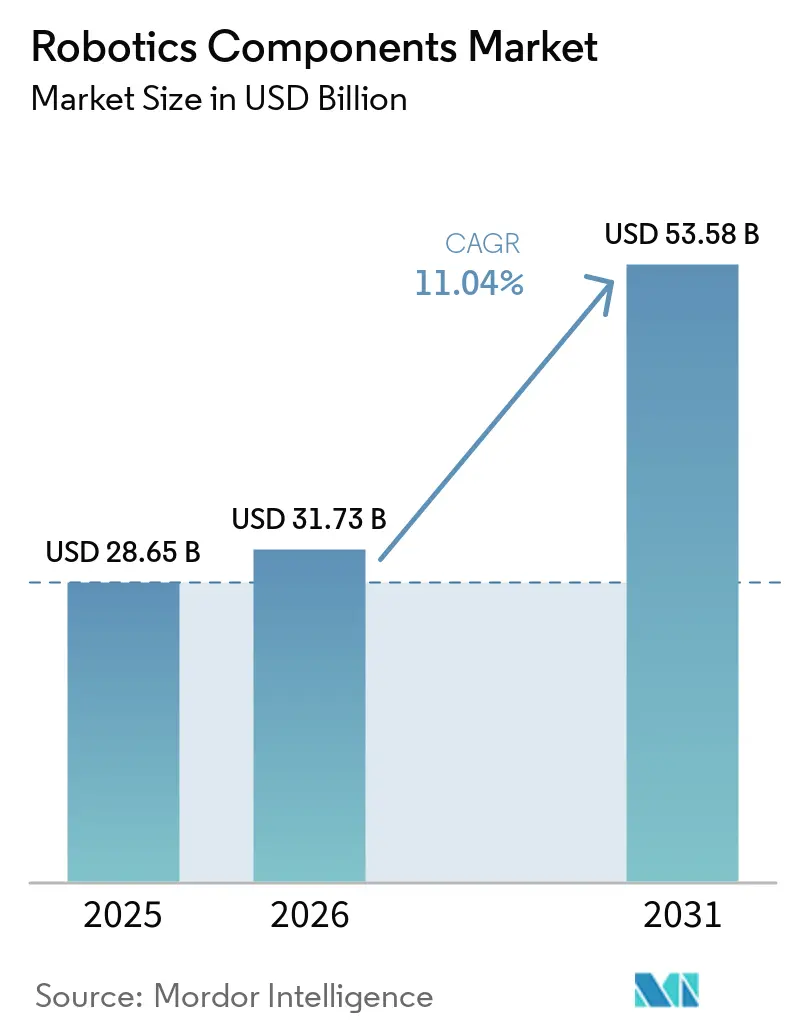
| Market Size (2026) | USD 31.73 Billion |
| Market Size (2031) | USD 53.58 Billion |
| Growth Rate (2026 - 2031) | 11.04 % |
| Fastest Growing Market | Middle East and Africa |
| Largest Market | Asia-Pacific |
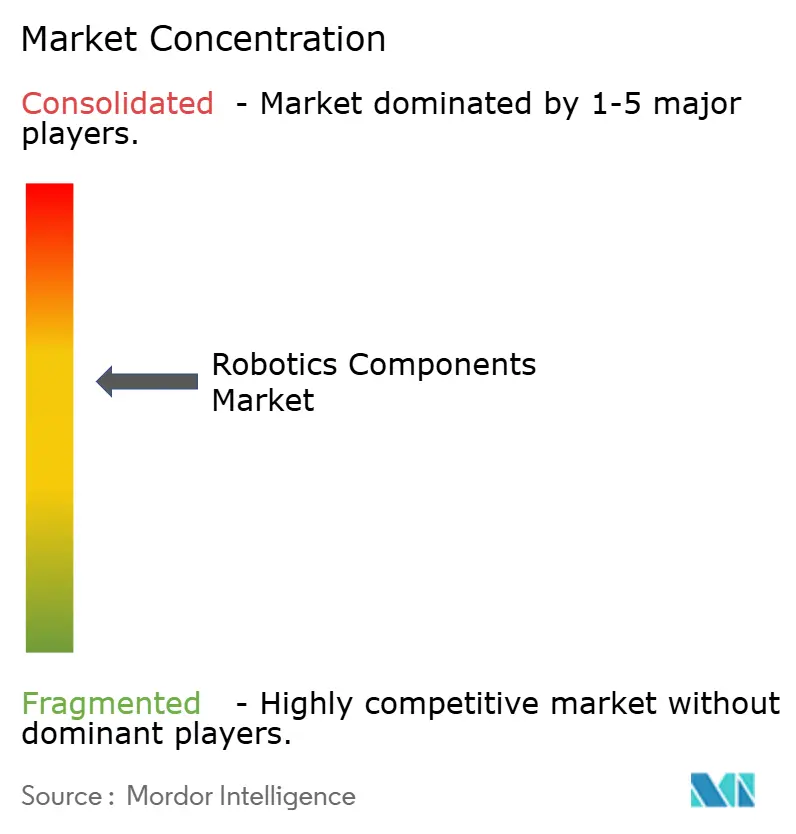
| Market Concentration | Medium |
Major Players *Disclaimer: Major Players sorted in no particular order Image © Mordor Intelligence. Reuse requires attribution under CC BY 4.0. | |
Robotics Components Market Analysis by Mordor Intelligence
The robotics components market size is projected to expand from USD 28.65 billion in 2025 to USD 31.73 billion in 2026, and to USD 53.58 billion by 2031, registering a CAGR of 11.04% between 2026 and 2031. Labor shortages, manufacturing relocation programs, and wider use of sensors, actuators, and control systems with embedded artificial intelligence are supporting demand. Record industrial robot installations in 2025 increased the installed base that requires motors, drives, gearboxes, sensors, and replacement parts. Longer lead times for precision gearboxes and actuators also limit supply, which supports pricing for specialized components. Competition is strongest in standard motors and drive electronics, where Chinese suppliers are adding pressure on established mid-market suppliers. Reshoring investment in North America and Europe creates an opening for suppliers capable of meeting high specifications for semiconductor, battery, and advanced manufacturing projects.
Key Report Takeaways
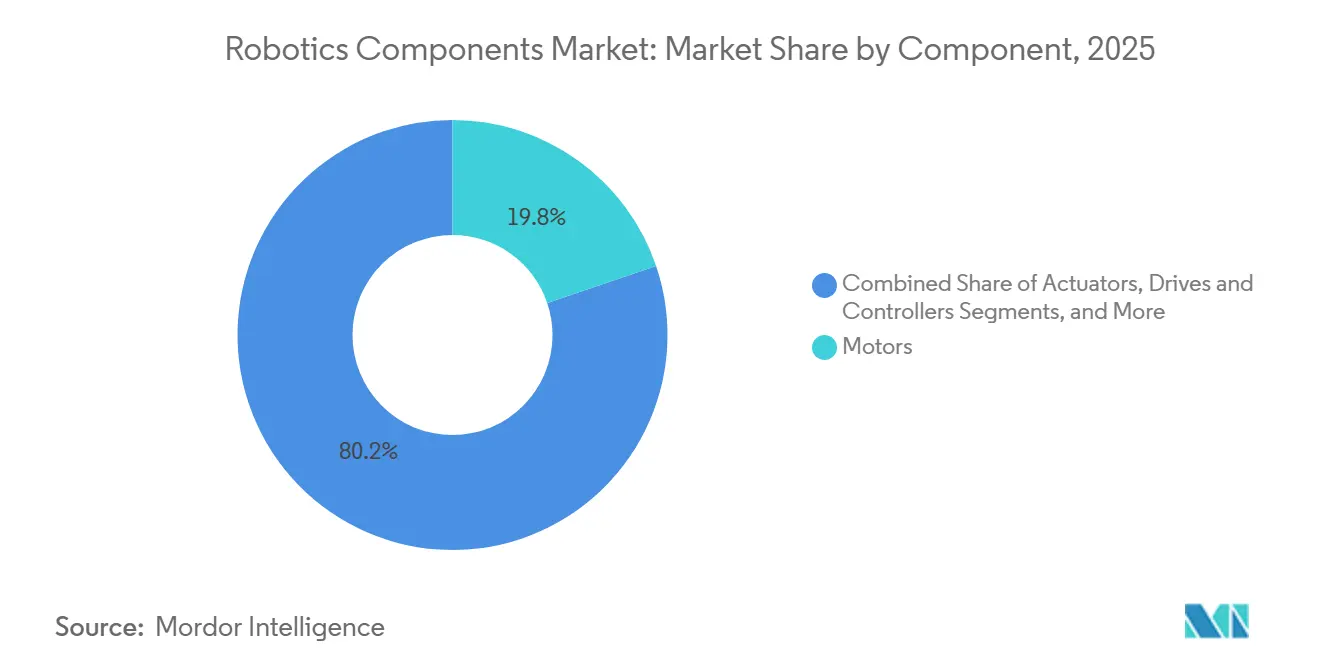
- By component, motors held 19.75% share of the robotics components market in 2025, while machine vision systems are projected to expand at a 13.51% CAGR through 2031.
- By robot type, industrial robots accounted for 63.21% share of the robotics components market in 2025, while collaborative robots are projected to expand at a 13.25% CAGR through 2031.
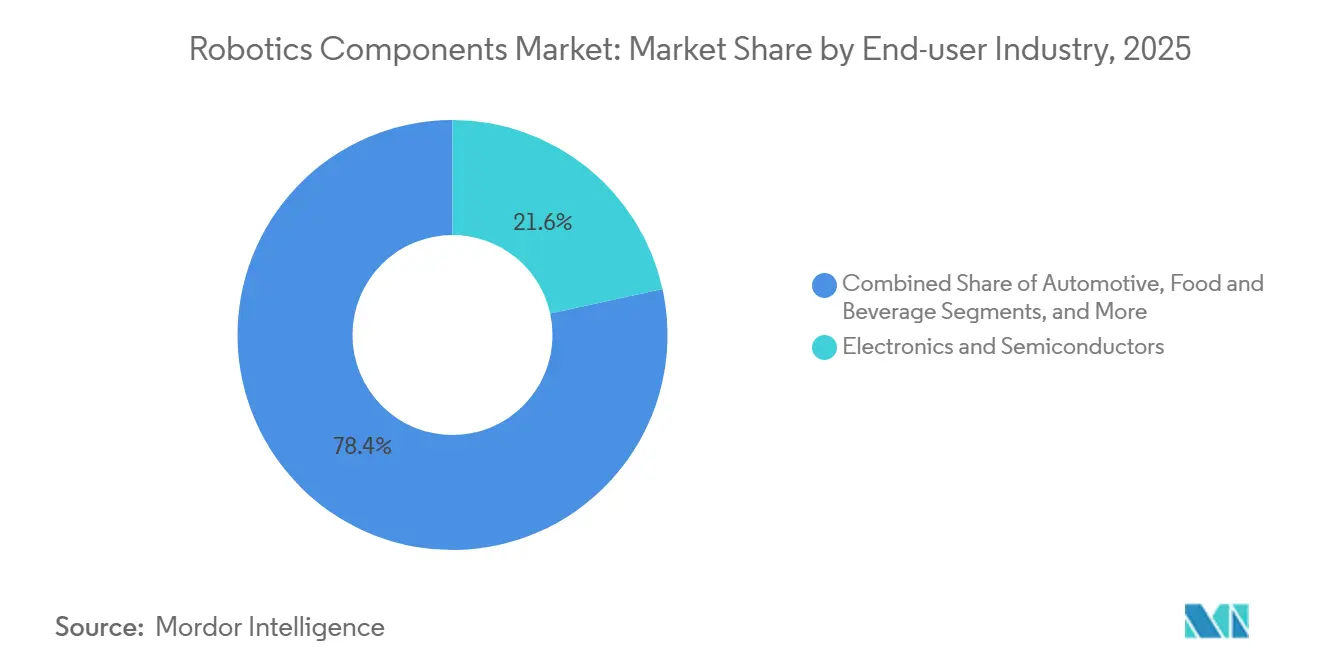
- By end-user industry, electronics and semiconductors held 21.57% share of the robotics components market in 2025, while healthcare and medical devices are projected to expand at a 14.62% CAGR through 2031.
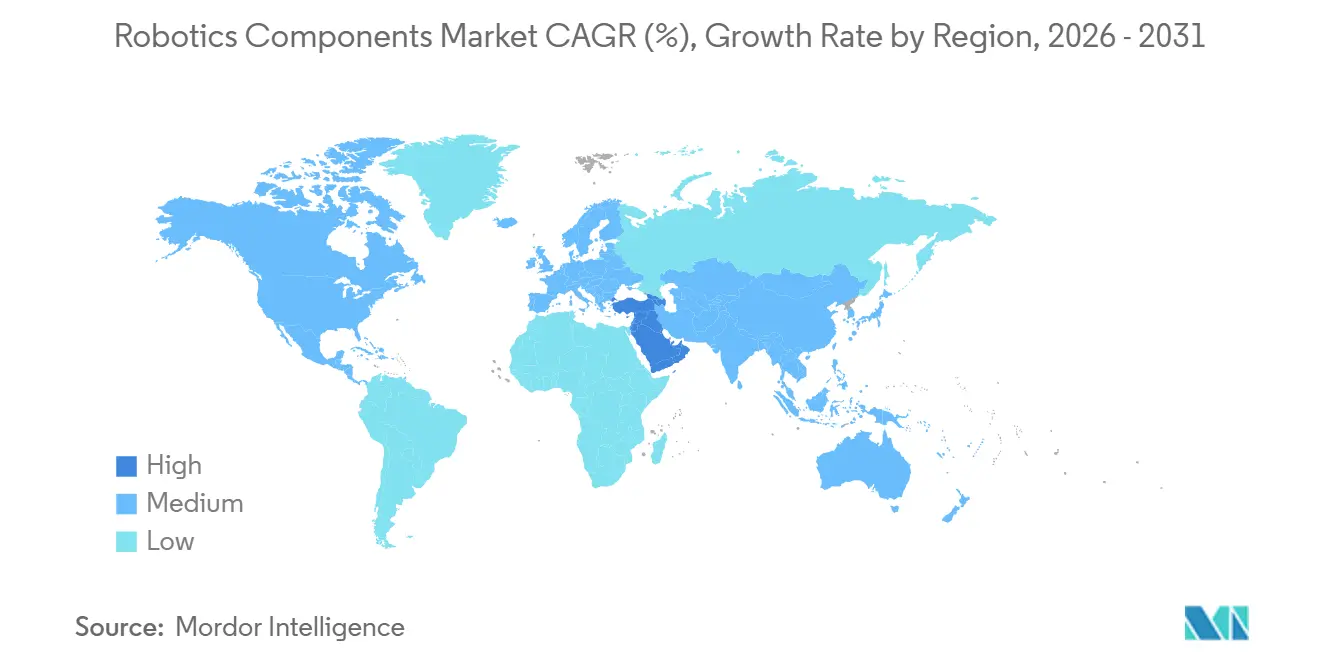
- By geography, Asia-Pacific accounted for 59.14% share of the robotics components market in 2025, while the Middle East and Africa are projected to expand at a 13.73% CAGR through 2031.
Note: Market size and forecast figures in this report are generated using Mordor Intelligence’s proprietary estimation framework, updated with the latest available data and insights as of January 2026.
Market Trends and Insights
Drivers Impact Analysis of Robotics Components Market*
| Driver | (~) % Impact on CAGR Forecast | Geographic Relevance | Impact Timeline |
|---|---|---|---|
| Labor Shortages and Rising Manufacturing Wages | +2.5% | Global, concentrated in North America, Japan, South Korea, and Germany | Long term (≥ 4 years) |
| AI-Enabled Perception and Edge Motion Control | +2.0% | North America, East Asia, and Western Europe | Medium term (2-4 years) |
| Reshoring, Nearshoring, and Factory Automation Incentives | +1.8% | North America and Europe, with spillover to Asia-Pacific | Medium term (2-4 years) |
| Expansion of High-Mix Electronics and Semiconductor Production | +1.5% | Asia-Pacific, centered on China, South Korea, and Taiwan, with spillover to the United States and Europe | Medium term (2-4 years) |
| Collaborative and Humanoid Robot Commercialization | +1.2% | Global, with fastest uptake in China and selected early-adopter United States manufacturers | Short term (≤ 2 years) |
| Sensor Fusion for Autonomous Logistics and Inspection | +0.8% | North America and Europe, with early gains in the United Arab Emirates and Singapore | Short term (≤ 2 years) |
| Source: Mordor Intelligence | |||
Labor Shortages and Rising Manufacturing Wages
Demographic decline is creating durable demand for automation in several major manufacturing economies. South Korea, Japan, Germany, and China are facing smaller working-age populations while remaining major users of industrial robots. South Korea had the highest robot density worldwide, and the United States recorded 38,000 industrial robot installations in 2025, its third-highest annual total.[1] These conditions make replacement of repetitive manual work a longer-term operating decision rather than a cyclical purchase. The Robotics components market benefits as more robots are installed, requiring motors, actuators, drives, and control electronics. Automation suppliers can therefore plan around demand from a wider group of plants, including facilities that have struggled to recruit and retain production workers.
AI-Enabled Perception and Edge Motion Control
Artificial intelligence is moving closer to the robot through embedded vision, control, and motion hardware. NVIDIA stated that its Cosmos 3 Edge policy model produces 32 robotic actions per inference at 15 Hz on Jetson Thor hardware. Bosch Rexroth added an optional Hailo-8 accelerator to its ctrlX COREplus platform for local machine vision and inspection workloads. Festo introduced GripperAI in June 2026 to identify gripping points for unfamiliar and randomly positioned items without prior programming or templates. For robotics components market suppliers, these capabilities raise demand for integrated sensors, processors, controllers, and end effectors, and they increase the value of systems designed for local processing. They also shift supplier competition toward component packages that can process data locally and respond quickly in unstructured settings.
Reshoring, Nearshoring, and Factory Automation Incentives
Public investment programs are supporting a multi-year cycle of factory construction and automation spending. The CHIPS Program Office supported more than 90 domestic manufacturing projects, many of which require automation for wafer handling, inspection, and cleanroom processes. Research by the Federal Reserve Bank of San Francisco found that firms exposed to trade uncertainty showed a stronger tendency to invest in reshoring and automation. The Robotics components market is positioned to benefit from projects in semiconductors, batteries, and advanced electronics, as these facilities use high-specification motion and sensing systems. The benefit extends beyond initial equipment purchases as factories need replacement parts, upgrades, and maintenance support. Suppliers with proven cleanroom, safety, and precision capabilities are better placed to participate in this capital spending cycle.
Expansion of High-Mix Electronics and Semiconductor Production
Electronics and semiconductor production require precise motion control, sensing, and visual inspection at sustained throughput. The electronics sector accounted for 24% of global industrial robot installations in 2024, up 1 percentage point from 2023. Wafer packaging, flip-chip placement, and optical inspection require force-controlled grippers, precise servo positioning, and 3D vision systems. Bosch Rexroth stated that demand for microchips is on track to double by 2030 from 2023 levels. Samsung Electronics said it will deploy more than 50,000 NVIDIA graphics processing units in an AI Megafactory and use Jetson Thor for semiconductor robotics automation. The robotics components market is therefore supported by projects that favor high-precision servo drives, force-torque sensors, and vision systems over standard industrial components.
Restraints Impact Analysis of Robotics Components Market*
| Restraint | (~) % Impact on CAGR Forecast | Geographic Relevance | Impact Timeline |
|---|---|---|---|
| High Upfront Cost and Lengthy Automation Payback | -1.8% | Global, most pronounced in South America, the Middle East and Africa, and South and Southeast Asia | Long term (≥ 4 years) |
| Scarcity of Robotics Integration and Validation Talent | -1.4% | North America and Europe, with spillover to Asia-Pacific | Medium term (2-4 years) |
| Precision Gearbox, Actuator, and Rare-Earth Supply Constraints | -1.2% | Global, most acute for North American, European, and non-Chinese Asia-Pacific buyers | Short term (≤ 2 years) |
| Functional Safety, Cybersecurity, and Liability Compliance Burden | -0.8% | Europe and North America | Medium term (2-4 years) |
| Source: Mordor Intelligence | |||
High Upfront Cost and Lengthy Automation Payback
Capital costs remain a major obstacle for the robotics components market, particularly among small- and mid-sized manufacturers with shorter planning horizons. A six-axis industrial robot cell with vision, end effectors, and safety enclosures commonly requires USD 100,000 to USD 300,000 upfront. Payback can take 3 to 7 years, depending on utilization and labor savings. Robotics-as-a-service models reduce this barrier by shifting spending toward recurring operating payments. Warehousing and logistics providers represented 60% of North American robotics orders in the first quarter of 2026, partly reflecting subscription-based deployments.[2] Specialized gearboxes, custom actuators, and tailored sensors remain less suited to service-based models, which continues to slow adoption in cost-sensitive applications.
Scarcity of Robotics Integration and Validation Talent
The availability of skilled personnel for integration and validation limits the deployment of robotics components in the robotics market. Integration of artificial intelligence-enabled systems requires risk assessments, functional tests, and process-specific validation before use in live production. This need is particularly acute in regulated manufacturing settings, where reliability and traceability are essential. The constraint can delay projects even when the necessary hardware is available. It also increases the importance of component suppliers that provide integration support, documentation, and application-specific tools. The Robotics components market, therefore, faces a deployment bottleneck distinct from component supply that can temper purchase decisions among new users.
*Our forecasts treat driver/restraint impacts as directional, not additive. The impact forecasts reflect baseline growth, mix effects, and variable interactions.
Robotics Components Market Segment Analysis
By Component:
Motors Lead, While Machine Vision AcceleratesMotors accounted for 19.75% of the Robotics components market share in 2025 because every robot type requires a source of joint torque and velocity. Servo motors and brushless direct-current motors are widely used across industrial, collaborative, and service robots. Machine vision systems are projected to expand at a 13.51% CAGR through 2031 as inspection moves from rule-based optics toward artificial intelligence-enabled 3D analysis. SICK released its Triton Floor-LOC localization system in June 2026, which combines camera position data and LiDAR into a single output for dynamic logistics environments.[3] This move toward sensor fusion raises the technical content and value of vision systems. Sensors and end effectors also gain importance as collaborative and humanoid deployments require force feedback and flexible gripping.
Within the robotics components market, actuators, drives and controllers, power transmission components, control electronics, communication components, and power supplies account for the remaining revenue base. Nidec Drive Technology highlighted FLEXWAVE strain-wave and KINEX cycloidal gear architectures at Automate 2026 to address different payload needs. Bosch Rexroth said ctrlX OS supports application-based deployment of artificial intelligence vision and motion control workloads directly on the controller. Industrial Internet of Things architectures require dependable networking and uninterrupted power, while suppliers increasingly combine motor, gear, encoder, and sensing functions into a single actuator package. This integration increases unit value and makes separate component purchases less attractive for integrators working under time constraints.

By Robot Type:
Industrial Robots Anchor Volume, While Collaborative Robots Lead GrowthIndustrial robots accounted for 63.21% of the Robotics components market size by revenue in 2025, supported by their established use in automotive welding, semiconductor handling, and palletizing. Global industrial robot installations reached 621,000 units in 2025, a record total and a 15% increase from 2024. Asia accounted for 79% of installations, while installations in the Americas increased by 13%. Food-sector installations in the United States increased by 30% in 2025, while warehouse and logistics installations increased by 41% in non-manufacturing uses. Service robots contribute a smaller but more diverse component of demand base in logistics, health care, and agriculture.
Collaborative robots are projected to expand at a 13.25% CAGR through 2031, the fastest pace among robot types in the robotics components market. Yaskawa launched the MOTOMAN-HC35 collaborative robot in July 2026, featuring a 35 kg payload and a 2,030 mm reach for larger workpieces. FANUC began customer fulfillment for the 11 kg CRX-3iA collaborative robot in April 2026 for welding, assembly, and inspection in limited spaces. Humanoid robots have fewer deployed units but require compact actuators, gearboxes, and sensing systems, giving suppliers a path to demand where integration and precision matter more than shipment volumes. Manufacturers in high-mix operations are likely to favor these platforms where fixed, caged automation is difficult to use.
By End-User Industry:
Electronics and Semiconductors Lead, While Health Care Scales FastestElectronics and semiconductors held 21.57% of revenue in 2025, supported by high robot intensity in display, memory, and chip production. The segment relies on robots for packaging, wire bonding, automated optical inspection, and other back-end processes. Automotive remained a substantial user because welding, painting, and chassis assembly lines have high robot density, while aerospace and defense applications require precise, reliable servo systems. Food and beverage producers need stainless, ingress-protected components that can withstand wash-down conditions. Logistics and warehousing applications rely heavily on sensor fusion, LiDAR navigation, and fast-cycle end effectors.
Health care and medical devices are projected to expand at a 14.62% CAGR through 2031, the fastest pace among end-user industries in the robotics components market. Aging populations, surgical robotics, and pharmaceutical cleanroom automation support this outlook, and Stäubli presented its refined Sterimove cleanroom robot concept in 2026 after 4 years of work with a major pharmaceutical company. The system illustrates the extended validation needs of medical applications, including sterility, contamination control, and ingress protection. Oversonic Robotics signed a supply agreement with STMicroelectronics in December 2025 to deploy cognitive humanoid robots for semiconductor production and logistics at global plants, beginning in Malta. These demanding uses raise demand for specialized motion, sensing, and end-effector components.
Geography Analysis
APAC Robotics Components Market
Asia-Pacific accounted for 59.14% of revenue in 2025 because it is the largest installation region and an important production base for precision gearboxes, servo motors, and industrial sensors. Asia accounted for 79% of global industrial robot installations in 2025, and installations across the region increased 13%. China, Japan, and South Korea contributed the most to regional volumes. China has a cost advantage in standard motors and drive electronics, while Japan retains strength in precision strain-wave gearboxes and RV reducers. India is adding demand through electronics assembly and automotive production, while South Korea’s automated electronics sector requires vision systems, sensors, and precision actuators.
North America and Europe Robotics Components Market
North America and Europe are the next-largest demand areas in the robotics components market, but their current conditions differ. United States robot installations reached 38,000 units in 2025, up 11% from 2024. Warehousing and logistics providers represented 60% of North American orders in the first quarter of 2026. Canada recorded 6% growth in installations in 2025, while Mexico saw its third consecutive annual decline, and Europe’s industrial robot installations fell 14% amid weaker investment, high energy costs, and challenging economic conditions.[4] Updated machinery and cybersecurity requirements add costs for suppliers, although higher standards can protect established European vendors from lower-specification imports.
MEA and South America Robotics Components Market
The Middle East and Africa are projected to expand at a 13.73% CAGR through 2031, the fastest regional pace in the robotics components market, as suppliers seek to capture demand in previously underserved geographies. Industrial diversification, e-commerce logistics investment, and local manufacturing development support demand, while Saudi Arabia’s Vision 2030 and the United Arab Emirates’ Dubai Robotics and Automation Program direct capital toward petrochemicals, food processing, and logistics. South America remains a smaller developing region led by Brazil and Argentina, where adoption is concentrated in automotive and food processing, and robotics-as-a-service can reduce initial costs for mid-sized food manufacturers. Infrastructure gaps and foreign exchange volatility still constrain purchasing decisions across much of the region.
Competitive Landscape
The Robotics components market is moderately concentrated at the technology layer, where Japanese suppliers hold strong positions in precision gearboxes, servo motors, and motion control. FANUC Corporation, Yaskawa Electric Corporation, Nabtesco Corporation, and Harmonic Drive Systems have specialized manufacturing knowledge that is difficult to replicate at a commercial scale. Nabtesco controlled 60% of the global RV reducer segment for six-axis industrial robots and began a USD 140 million capacity expansion in Tsuruga, Japan, in late 2024. The facility is expected to add 30% to RV reducer output by late 2027, while control platforms and connected software tools increasingly drive system competition in the robotics components market. ABB Ltd., Siemens AG, and Bosch Rexroth AG are building application-based control platforms that combine safety, motion control, artificial intelligence inference, and industrial connectivity.
Bosch Rexroth has positioned ctrlX OS as an open runtime that combines safety, motion control, artificial intelligence inference, and industrial internet of things functions. SCHUNK created a modular Robot PLUS end-of-arm portfolio to reduce the bespoke engineering needed for robotic integration.[5] Niron Magnetics and Moog Inc. announced a December 2025 partnership to develop and test rare-earth-free iron nitride magnet actuator designs. The work responds to supply risk for heavy rare earths used in high-temperature NdFeB magnets. Parker Hannifin reported record fiscal 2026 results and raised its adjusted segment operating margin target to 30% by fiscal 2031.
Chinese component suppliers are moving into mid-tier brushless direct-current motors, brushless servo drives, and cycloidal reducers by offering lower prices and faster delivery cycles, while Taiwanese precision gear producers are expected to reach commercial-scale output of precision reducers by 2027. The strongest opportunities are in rare-earth-free actuators, integrated hardware and software for humanoid joints, and service networks for the expanding installed base. The robotics components market will favor companies that integrate mechanical precision, embedded computing, and artificial intelligence capabilities into a single actuator package. This makes supplier partnerships and platform compatibility as important as standalone component specifications.
Robotics Components Industry Leaders
-
ABB Ltd.
-
FANUC Corporation
-
Yaskawa Electric Corporation
-
Siemens AG
-
Bosch Rexroth AG
- *Disclaimer: Major Players sorted in no particular order
Robotics Components Market Companies Covered in this Report
- ABB Ltd.
- FANUC Corporation
- Yaskawa Electric Corporation
- Siemens AG
- Bosch Rexroth AG
- Harmonic Drive Systems Inc.
- Nabtesco Corporation
- Kollmorgen Corporation
- Maxon International AG
- Nidec Corporation
- SCHUNK SE & Co. KG
- ATI Industrial Automation, Inc.
- Festo SE & Co. KG
- SMC Corporation
- THK Co., Ltd.
- SICK AG
- Stäubli International AG
- Parker Hannifin Corporation
- Rockwell Automation, Inc.
- OnRobot A/S
Recent Industry Developments in Robotics Components Market
- August 2026: FANUC Corporation began mass production of the DR/8-16B Stainless long-reach parallel link robot for food industry applications, extending its stainless-steel lineup to an 8 kg payload at 1,600 mm operating range, designed for hygienic automation in food production environments where wash-down resistance is critical.
- July 2026: Yaskawa Electric Corporation launched the MOTOMAN-HC35 collaborative robot with a 35 kg payload capacity and a 2,030 mm reach, targeting large-workpiece handling in automotive and general manufacturing environments affected by declining labor availability.
- July 2026: Nabtesco Corporation announced a strategic investment in Alva Industries, a Norwegian advanced motor technology company, to gain access to next-generation actuation technologies and explore synergies in precision motion control systems for the robotics components market. The investment addressed component designs that can serve future motion-control requirements and broaden Nabtesco’s technology options.
- June 2026: Festo launched GripperAI, an artificial intelligence-powered software solution that enables robots to handle mixed, unfamiliar, and randomly positioned items without custom programming or template loading. The release targeted flexible manufacturing and logistics handling applications, where component selection must accommodate varying item shapes and positions.
Global Robotics Components Market Report Scope
The robotics components market encompasses hardware components that enable the motion, sensing, control, power management, communication, and end-of-arm functionality of robotic systems used across industrial, collaborative, and service robots. Market size includes OEM and replacement sales of actuators, motors, drives and controllers, sensors, machine vision systems, end effectors, power transmission components, control electronics, power supply components, and communication modules. It excludes revenue from complete robotic systems, software platforms, robot integration and engineering services, maintenance services, peripherals not dedicated to robots, and general-purpose industrial automation components not specifically designed or sold for robotic applications.
The Robotics Components Market Report is Segmented by Component (Actuators, Motors, Drives and Controllers, Sensors, Machine Vision Systems, End Effectors, Power Transmission Components, Control Electronics, Power Supply Components, and Communication Components), Robot Type (Industrial Robots, Service Robots, and Collaborative Robots), End-User Industry (Automotive, Electronics and Semiconductors, Healthcare and Medical Devices, Aerospace and Defense, Food and Beverage, Logistics and Warehousing, and Other End-user Industries), and Geography (North America, South America, Europe, Asia-Pacific, and Middle East and Africa). The Market Forecasts are Provided in Terms of Value (USD).
Segmentation Overview
| Actuators |
| Motors |
| Drives and Controllers |
| Sensors |
| Machine Vision Systems |
| End Effectors |
| Power Transmission Components |
| Control Electronics |
| Power Supply Components |
| Communication Components |
| Industrial Robots |
| Service Robots |
| Collaborative Robots |
| Automotive |
| Electronics and Semiconductors |
| Healthcare and Medical Devices |
| Aerospace and Defense |
| Food and Beverage |
| Logistics and Warehousing |
| Other End-user Industries |
| North America | United States | |
| Canada | ||
| Mexico | ||
| South America | Brazil | |
| Argentina | ||
| Rest of South America | ||
| Europe | Germany | |
| United Kingdom | ||
| France | ||
| Italy | ||
| Spain | ||
| Rest of Europe | ||
| Asia-Pacific | China | |
| Japan | ||
| India | ||
| South Korea | ||
| Rest of Asia-Pacific | ||
| Middle East and Africa | Middle East | Saudi Arabia |
| United Arab Emirates | ||
| Turkey | ||
| Rest of the Middle East | ||
| Africa | South Africa | |
| Nigeria | ||
| Rest of Africa | ||
| By Component | Actuators | ||
| Motors | |||
| Drives and Controllers | |||
| Sensors | |||
| Machine Vision Systems | |||
| End Effectors | |||
| Power Transmission Components | |||
| Control Electronics | |||
| Power Supply Components | |||
| Communication Components | |||
| By Robot Type | Industrial Robots | ||
| Service Robots | |||
| Collaborative Robots | |||
| By End-user Industry | Automotive | ||
| Electronics and Semiconductors | |||
| Healthcare and Medical Devices | |||
| Aerospace and Defense | |||
| Food and Beverage | |||
| Logistics and Warehousing | |||
| Other End-user Industries | |||
| By Geography | North America | United States | |
| Canada | |||
| Mexico | |||
| South America | Brazil | ||
| Argentina | |||
| Rest of South America | |||
| Europe | Germany | ||
| United Kingdom | |||
| France | |||
| Italy | |||
| Spain | |||
| Rest of Europe | |||
| Asia-Pacific | China | ||
| Japan | |||
| India | |||
| South Korea | |||
| Rest of Asia-Pacific | |||
| Middle East and Africa | Middle East | Saudi Arabia | |
| United Arab Emirates | |||
| Turkey | |||
| Rest of the Middle East | |||
| Africa | South Africa | ||
| Nigeria | |||
| Rest of Africa | |||
Key Questions Answered in the Report
What is the size of the robotics components market?
The Robotics components market was USD 31.73 billion in 2026 and is projected to reach USD 53.58 billion by 2031 at an 11.04% CAGR.
Which component category leads robotics component revenue?
Motors led component revenue with a 19.75% share in 2025, supported by demand across industrial, collaborative, and service robots.
Which robot type is expected to expand fastest?
Collaborative robots are projected to expand at a 13.25% CAGR through 2031 as manufacturers adopt flexible automation for high-mix work.
Which end-user sector has the highest demand for robotics components?
Electronics and semiconductors led with a 21.57% share in 2025 because chip and electronics production need precise handling, inspection, and motion systems.
Which region has the strongest outlook for robotics components?
The Middle East and Africa is projected to expand at a 13.73% CAGR through 2031, supported by industrial diversification and logistics investment.
What factors limit robotics component adoption?
High upfront project costs, payback periods of 3 to 7 years, limited integration talent, and shortages of specialized components can delay deployments in the robotics components market. These constraints are particularly relevant for smaller manufacturers and new automation users across many industrial applications, especially facilities that lack internal engineering teams and must depend on outside integrators for commissioning, validation, and continuing technical support.