
Rheology Modifiers Market Size and Share
Market Overview
| Study Period | 2021 - 2031 |
|---|---|
| Market Size (2026) | USD 8.80 Billion |
| Market Size (2031) | USD 10.93 Billion |
| Growth Rate (2026 - 2031) | 4.43 % |
| Fastest Growing Market | Asia-Pacific |
| Largest Market | Asia-Pacific |
| Market Concentration | Low |
Major Players *Disclaimer: Major Players sorted in no particular order Image © Mordor Intelligence. Reuse requires attribution under CC BY 4.0. | |
Rheology Modifiers Market Analysis by Mordor Intelligence
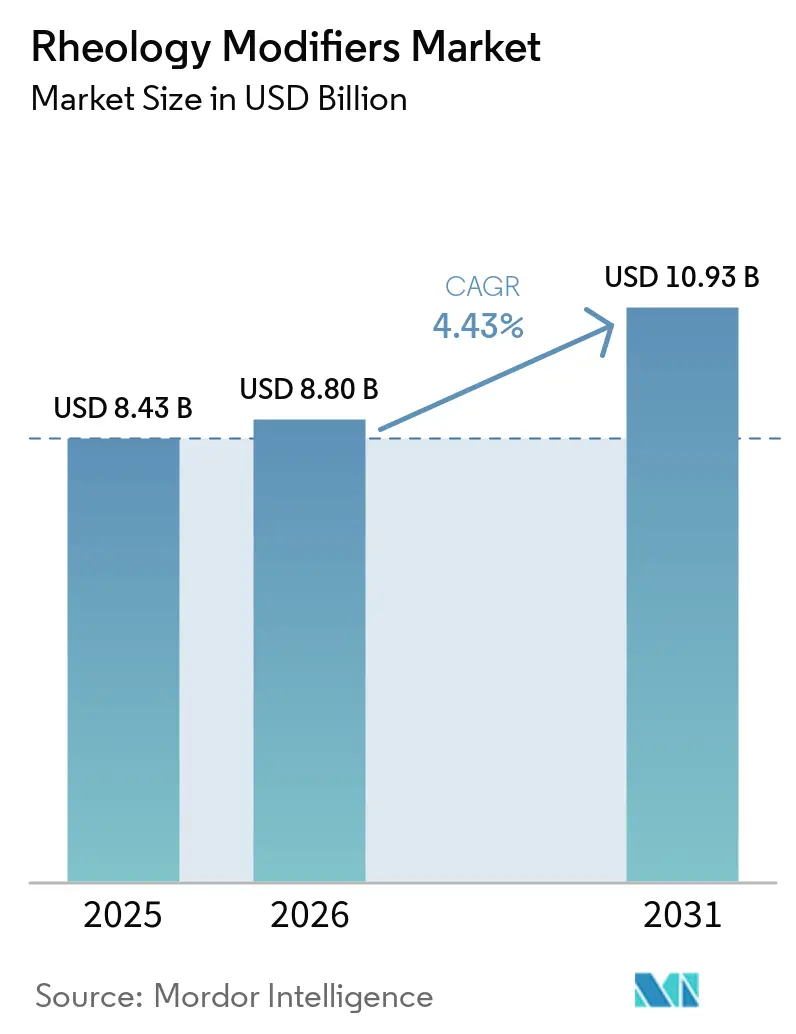
The Rheology Modifiers Market size was valued at USD 8.43 billion in 2025 and is estimated to grow from USD 8.80 billion in 2026 to reach USD 10.93 billion by 2031, at a CAGR of 4.43% during the forecast period (2026-2031). The rheology modifiers market is supported by the replacement of solvent-borne formulations in paints, coatings, adhesives, and personal care products. Construction activity in Asia-Pacific and the Middle East supports demand for architectural, protective, and maintenance coatings. Volatile organic compound (VOC) rules in North America and Europe continue to move formulators toward waterborne systems. Personal care brands are also seeking naturally derived ingredients that provide the required texture and sensory performance. Suppliers are responding through bio-based materials, certified sourcing, and formulation support that can help customers meet changing requirements.
Key Report Takeaways
- By type, organic rheology modifiers held 64.23% of the rheology modifiers market share in 2025 and are projected to advance at a 4.86% CAGR through 2031.
- By chemistry, cellulosic held 31.54% of the rheology modifiers market share in 2025, while associative is projected to advance at a 4.98% CAGR through 2031.
- By form, liquid held 57.82% of the rheology modifiers market share in 2025 and is projected to advance at a 5.15% CAGR through 2031.
- By application, paints and coatings held 38.17% of the rheology modifiers market share in 2025, while cosmetics and personal care are projected to advance at a 5.27% CAGR through 2031.
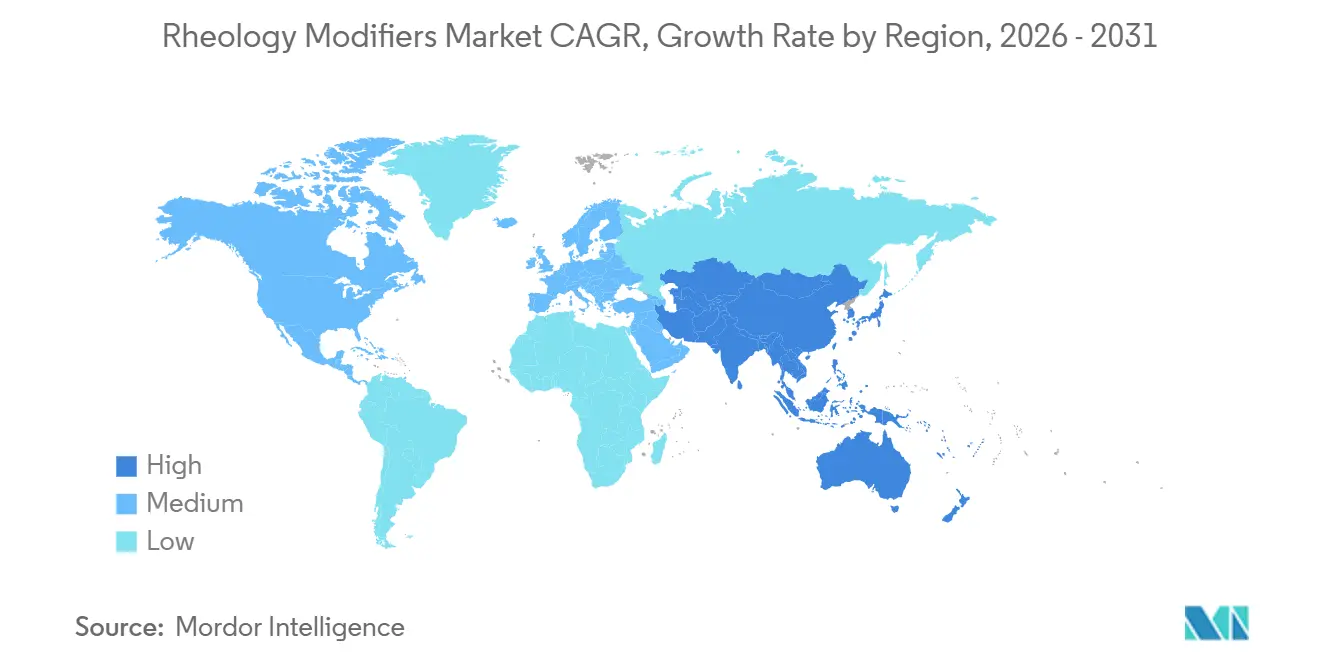
- By geography, Asia-Pacific held 35.70% of the rheology modifiers market share in 2025 and is projected to advance at a 5.06% CAGR through 2031.
Note: Market size and forecast figures in this report are generated using Mordor Intelligence’s proprietary estimation framework, updated with the latest available data and insights as of January 2026.
Market Trends and Insights
Drivers Impact Analysis of Rheology Modifiers Market*
| Driver | (~) % Impact on CAGR Forecast | Geographic Relevance | Impact Timeline |
|---|---|---|---|
| Low-VOC Waterborne Formulation Shift | +1.2% | Global, concentrated in North America & EU | Medium term (2-4 years) |
| Expansion of Paints and Coatings in Construction and Industrial Maintenance | +1.0% | Asia-Pacific core, spillover to Middle East and Africa | Long term (≥ 4 years) |
| Personal Care Reformulation Toward Sensory and Natural Textures | +0.7% | Global, strongest in Europe & Asia-Pacific | Medium term (2-4 years) |
| Higher-Purity Rheology Control in EV Batteries and Electronics | +0.5% | Asia-Pacific & North America | Short term (≤ 2 years) |
| Tropical-Climate Viscosity Stability Requirements | +0.3% | ASEAN, India, Brazil, Middle East and Africa | Long term (≥ 4 years) |
| Source: Mordor Intelligence | |||
Low-VOC Waterborne Formulation Shift
Regulatory requirements are changing the performance needs for rheology modifiers in coatings. The U.S. Environmental Protection Agency finalized amendments to the national volatile organic compound emission standards for aerosol Coatings on January 6, 2025[1]. The U.S. framework also limits architectural coatings through Section 183(e) of the Clean Air Act. California’s South Coast Air Quality Management District applies Rule 1113 limits that reach 50 grams per liter for some coating categories. The European Union’s Decopaint Directive and its Chemicals Strategy for Sustainability also favor water-based coating systems. The rheology modifiers market benefits because waterborne products require reliable viscosity under high-shear mixing, temperature changes, and colorant dilution.
Expansion of Paints and Coatings in Construction and Industrial Maintenance
Construction activity across the Asia-Pacific region provides a large demand base for architectural and protective coatings. India’s USD 134 billion federal infrastructure allocation for 2025-26 supported transport and public works activity. Each coated surface requires controlled application viscosity, sag resistance, and workable open time. These functions link construction and industrial maintenance demand directly to the rheology modifiers market. Protective coatings used on industrial assets also require performance under demanding operating conditions.
Personal Care Reformulation Toward Sensory and Natural Textures
Personal care formulators expect a rheology modifier to deliver more than viscosity. The ingredient may need to provide a defined skin feel, support transparency or opalescence, and meet naturality or biodegradability expectations. Microfibrillated cellulose and bio-derived cellulose derivatives are important materials in this change. Ashland’s Natrathix bio cellulose uses wood pulp certified by the Forest Stewardship Council and Programme for the Endorsement of Forest Certification. The material supports thickening and emulsion stabilization without the stringiness associated with xanthan gum in premium product formats. The rheology modifiers market, therefore, gains from a higher value placed on texture and ingredient sourcing.
Higher-Purity Rheology Control in EV Batteries and Electronics
Battery cell production requires consistent slurry viscosity during mixing, filtration, and electrode coating. The materials used in these processes must also meet strict requirements for ionic purity and particle-size control. The International Energy Agency reported nearly 22 million electric cars produced globally in 2025, and China accounted for nearly three-quarters of that output. Global output is projected to reach 23 million units in 2026. New battery plants in North America and Europe increase qualification work for battery-grade additive suppliers. This creates a specialized source of demand within the rheology modifiers market. Traceability systems and purity certifications, therefore, matter alongside product performance.
Restraints Impact Analysis of Rheology Modifiers Market*
| Restraint | (~) % Impact on CAGR Forecast | Geographic Relevance | Impact Timeline |
|---|---|---|---|
| Petrochemical, Mineral, and Energy-Cost Volatility | -0.9% | Global, most acute in North America & Europe | Short term (≤ 2 years) |
| Microplastics and Biodegradability Compliance Burden | -0.5% | EU core, spillover to North America & APAC | Medium term (2-4 years) |
| Declining Print Volumes and Conventional Ink Demand | -0.3% | North America, Europe, Japan | Long term (≥ 4 years) |
| Source: Mordor Intelligence | |||
Petrochemical, Mineral, and Energy-Cost Volatility
Rheology modifier production depends on petrochemical, mineral, and energy inputs. Acrylic acid is used in alkali-swellable emulsion (ASE) and hydrophobically modified alkali-swellable emulsion (HASE) thickener production. Polyisocyanates are used in Hydrophobically modified Ethylene oxide URethane (HEUR) production, while organoclay quality depends on energy-intensive calcination. Higher crude oil prices or European natural gas costs can quickly pressure specialty additive margins. Coating customers in construction often resist price increases because their own margins are limited. This exposes the rheology modifiers market to short-term pressure on both prices and purchasing decisions.
Microplastics and Biodegradability Compliance Burden
Commission Regulation (EU) 2023/2055 restricts intentionally added synthetic polymer microparticles at concentrations above 0.01% by weight[2]. Its scope expanded to industrial end uses on October 17, 2025, and European Chemicals Agency reporting requirements began in 2026. The regulation includes different transition periods by application. Rinse-off cosmetics received a 4-year phase-out period, while some industrial uses have longer derogations. The resulting compliance calendar creates legal, reformulation, and product-qualification work for the rheology modifiers market.
*Our forecasts treat driver/restraint impacts as directional, not additive. The impact forecasts reflect baseline growth, mix effects, and variable interactions.
Rheology Modifiers Market Segment Analysis
By Type:
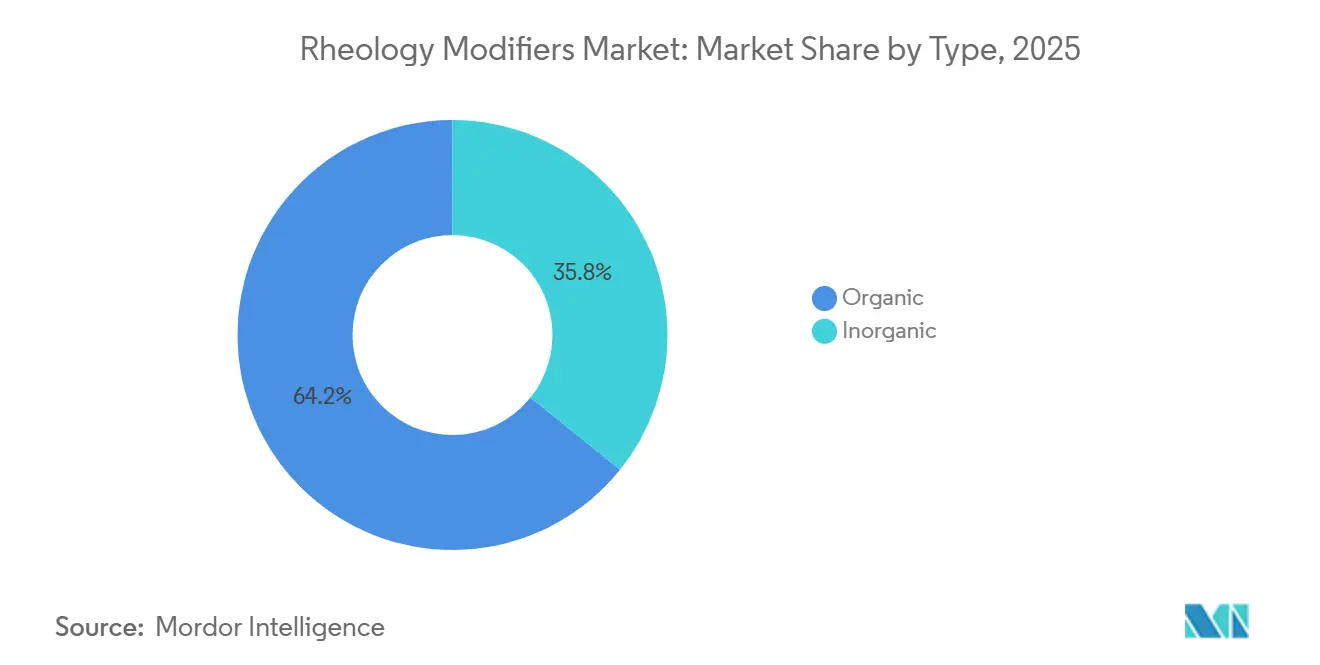
Organic Leads Both Demand and GrowthOrganic held 64.23% of the rheology modifiers market size in 2025 and is projected to advance at a 4.86% CAGR through 2031. This category includes cellulosic ethers, acrylic copolymers, associative polyurethanes, natural gums, and bio-derived polymers. These materials use carbon-based structures that interact with water or oil phases to build viscosity. Their formulation flexibility supports use across coatings, personal care, construction materials, and home care products. The share reflects long-standing demand for polymer-based thickeners with broad viscosity and shear-control capabilities. The rheology modifiers market continues to favor organic products where waterborne systems and natural ingredient requirements are expanding.
Inorganic modifiers include organoclays, fumed silica, attapulgite, and synthetic hectorite. They remain important for elevated temperature uses, opacity contributions, and non-aqueous systems. Battery slurries and high-solid industrial coatings are key uses where inorganic materials provide the required thermal stability. Organic modifiers are gaining from bio-based cellulose in personal care and associative thickener demand in waterborne coatings. BASF launched biomass-balanced Rheovis PU 1333 MB and Rheovis HS 1169 MB for architectural coatings in July 2026. The rheology modifiers market gives suppliers room to serve both broad organic demand and specialized inorganic applications.
By Chemistry:
Cellulosic Leadership Meets Associative GrowthCellulosic held a 31.54% share in 2025. Hydroxyethyl cellulose (HEC) and carboxymethyl cellulose (CMC) are widely used in architectural paints, construction mortars, and personal care formulations. These materials offer established performance and cost-effective viscosity control. Associative is projected to advance at a 4.98% CAGR through 2031. HEUR and HASE products are gaining in waterborne coatings because they can improve flow, leveling, brush application, roller application, and film formation. This shift supports demand within the rheology modifiers market.
Acrylic chemistry remains important because of its flexibility in ASE systems. Its growth faces pressure from European microplastics requirements and related reformulation work. Clays and fumed silica fill narrower but growing roles in battery slurries and high-solid industrial coatings. Cellulosic products retain their position because construction and coating volumes continue to require dependable thickening. The category also benefits from new bio-based cellulose derivatives for personal care and home care. The chemistry mix is therefore changing through both associative polymer adoption and innovation within established cellulosic materials.
By Form:
Liquid Benefits from Waterborne AdoptionLiquid held a 57.82% share in 2025 and is projected to advance at a 5.15% CAGR through 2031. These products are supplied as pre-dispersed or solution forms that can be added directly to waterborne formulations. They reduce the need for grinding and dispersion steps during production. Liquid products can provide consistent activity under ambient processing conditions. Their use also avoids dust-handling issues associated with powder materials. The rheology modifiers market benefits as liquid products align with expanding waterborne coatings, adhesives, sealants, and personal care formulations.
Solid modifiers include powder HEC, powder CMC, hydroxypropyl methylcellulose (HPMC) grades, and granulated organoclays. Dry-mix materials such as tile adhesives, renders, and self-leveling compounds use powder HPMC before water is added at the job site. Fumed silica and organoclay powders also support oil and gas drilling fluids and battery electrode processing. Solid products remain necessary where anhydrous processing makes liquid forms unsuitable. The choice between liquid and solid formats is therefore defined mainly by application requirements. Liquid products are growing faster because waterborne systems are expanding across several large end uses.
By Application:
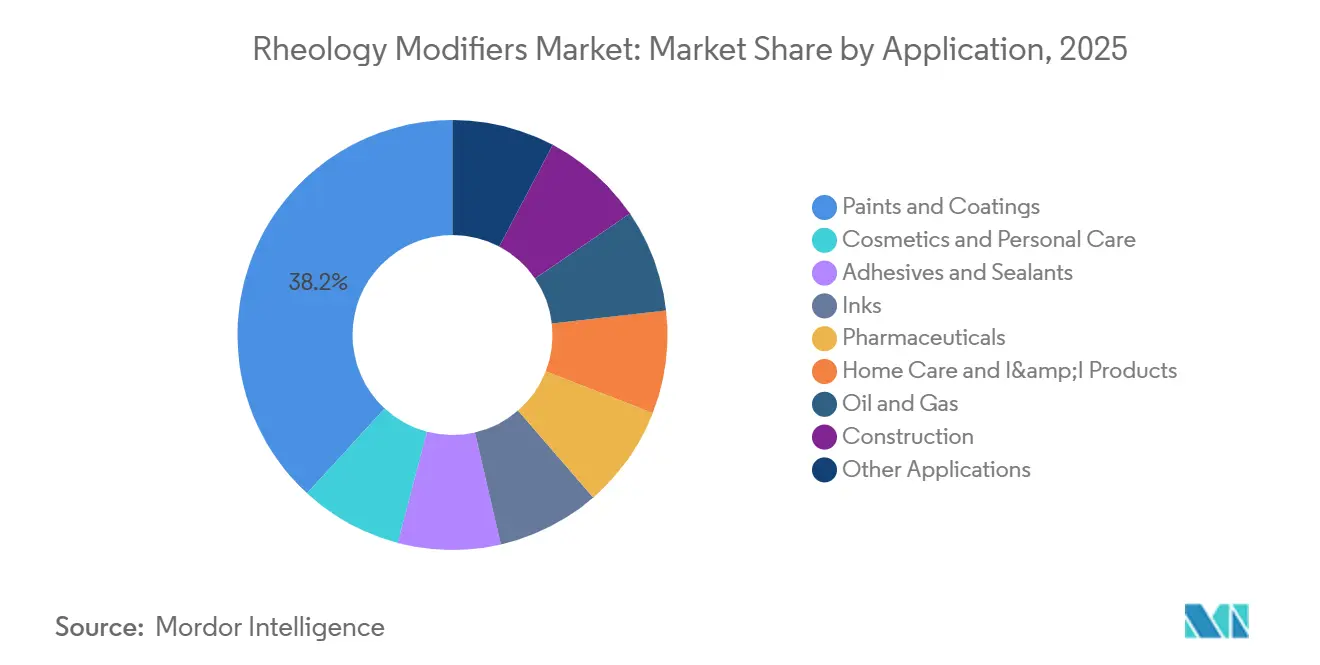
Paints and Coatings Lead While Personal Care Grows FasterPaints and coatings held a 38.17% share in 2025, while cosmetics and personal care are projected to advance at a 5.27% CAGR through 2031. Architectural coatings consume high volumes of cellulosic and acrylic thickeners. Construction activity, repainting needs, and industrial maintenance work support the segment. Its product mix generally has lower value intensity per kilogram than personal care or pharmaceutical applications. Cosmetics and personal care require precise rheological performance in products such as face serums, anhydrous balms, and color cosmetics.
Adhesives and sealants use associative thickeners to provide sag resistance and open-time control in construction and industrial bonding. Pharmaceutical grades of HPMC and HEC have strict purity requirements set by the United States Pharmacopeia and the European Pharmacopoeia. Home care and industrial and institutional products are a growing application for materials that combine viscosity control with additional functional benefits. Oil and gas formulations use organoclay and fumed silica when high temperatures and pressures would reduce the performance of conventional polymers. Construction materials such as tile adhesives, plasters, and self-leveling compounds use high-volume powder HPMC and CMC grades. Conventional ink demand remains under pressure, which limits a historical application for cellulosic thickeners.

Geography Analysis
APAC Rheology Modifiers Market
Asia-Pacific held 35.70% share in 2025 and is projected to advance at a 5.06% CAGR through 2031. China supports regional demand through large paint and coatings production and extensive construction chemical consumption. Japan and South Korea add demand for electronics-grade fumed silica and automotive coating additives. India is a growing demand center for protective and decorative coatings. The National Highways Authority of India spent USD 29.0 billion during fiscal 2025-26 on infrastructure expansion. This supported the use of coatings in transport and related construction activities.
North America Rheology Modifiers Market
ASEAN countries, including Vietnam, Indonesia, and Thailand, add demand as manufacturing investment increases in industrial maintenance painting. High temperatures and humidity in Southeast Asia and South Asia increase the need for stable thickener performance. These climate conditions can shift demand toward specialty associative grades. North America has a mature and technically demanding profile that is shaped by volatile organic compound compliance. The U.S. Environmental Protection Agency’s 2025 aerosol coating standards reinforce the region’s existing move toward waterborne formulations. The region also supports demand for premium bio-derived thickeners through global personal care brands.
EMEA and South America Rheology Modifiers Market
Europe’s chemical rules and sustainability priorities continue to influence product selection. The Decopaint Directive and the Chemicals Strategy for Sustainability encourage waterborne coating architectures. Arkema converted its European acrylic thickener lines to bio-sourced inputs in April 2025. South America draws demand from construction coatings and personal care products, led by Brazil and Argentina. The Middle East and Africa demand is linked to Gulf infrastructure, industrial maintenance coatings, and developing construction activity. High ambient temperatures in the Middle East favor thermally stable associative thickeners and fumed silica grades.
Competitive Landscape
The rheology modifiers market is highly fragmented, with the top five players including BASF, Dow, Lubrizol, Arkema, and CLARIANT. These companies have proprietary thickener platforms, global manufacturing networks, and long-standing customer relationships. Their formulation support capabilities are important because customers need additives validated in specific systems. Regional producers in China and India compete strongly in commodity cellulosic and clay products. This keeps margins limited in applications centered on architectural coatings. Premium associative and bio-based areas provide greater scope for global suppliers to differentiate.
Sustainability has become a central area of competition. BASF introduced biomass-balanced Rheovis products for architectural coatings in July 2026, using certified renewable raw materials through a mass-balance approach. Arkema converted its European acrylic thickener range to bio-based inputs in April 2025. These moves place traceability and certification alongside chemistry as supplier selection factors. Downstream brands also apply sustainable sourcing requirements to additive supply chains. This can favor suppliers with verifiable environmental credentials.
BASF also debuted Efka PX 4720 at the American Coatings Show in May 2026 for ultra-matte, 100% solvent-free ultraviolet coating systems. High-purity materials for electric vehicle battery slurries represent a developing opportunity because automotive qualification creates high switching costs. Tropical-climate-specific HEUR grades also address a defined requirement for paint producers in Southeast Asia and India. Bio-based microfibrillated cellulose is another area where smaller innovators can compete in personal care applications. The market remains open to regional and specialized suppliers because end-use requirements vary widely. The competitive position of each supplier depends on performance, regulatory support, certified sourcing, and service capability.
Rheology Modifiers Industry Leaders
-
BASF
-
Dow
-
Lubrizol
-
Arkema
-
CLARIANT
- *Disclaimer: Major Players sorted in no particular order

Rheology Modifiers Market Companies Covered in this Report
- Arkema
- Ashland
- BASF
- BYK-Chemie GmbH
- Cabot Corporation
- Cargill, Incorporated
- CLARIANT
- Croda International Plc
- Dow
- Elementis PLC
- Evonik Industries AG
- LANXESS
- Lubrizol
- Nouryon
- Wacker Chemie AG
Recent Industry Developments in Rheology Modifiers Market
- July 2026: BASF expanded its certified biomass balance portfolio for architectural coatings with Dispex AA 4145 MB, Rheovis PU 1333 MB, and Rheovis HS 1169 MB, offering the same performance as conventional additives with a lower product carbon footprint. The launch strengthened the adoption of sustainable rheology-modifying additives in architectural coating formulations.
- March 2026: CLARIANT presented its agricultural solutions at the China International Agrochemical & Crop Protection Exhibition (CAC) 2026, highlighting specialty chemical solutions for crop protection and agricultural formulations. The development supports continued innovation in rheology modifiers used to improve viscosity, suspension, and formulation stability in agricultural products.
Global Rheology Modifiers Market Report Scope
Rheology modifiers are additives used to control the flow, viscosity, stability, and deformation behavior of formulated products. They help maintain desired consistency and performance during processing, storage, and use.
The Rheology Modifiers Market is segmented by type, chemistry, form, application, and geography. By type, the market is segmented into organic and inorganic. By chemistry, the market is segmented into cellulosic, acrylic, associative, clays, fumed silica, and other chemistries. By form, the market is segmented into liquid and solid. By application, the market is segmented into paints and coatings, cosmetics and personal care, adhesives and sealants, inks, pharmaceuticals, home care and I&I products, oil and gas, construction, and other applications. The report also covers the market size and forecasts for rheology modifiers in 15 countries across major regions. For each segment, the market sizing and forecasts have been done on the basis of value (USD).
Segmentation Overview
| Organic |
| Inorganic |
| Cellulosic |
| Acrylic |
| Associative |
| Clays |
| Fumed Silica |
| Other Chemistries |
| Liquid |
| Solid |
| Paints and Coatings |
| Cosmetics and Personal Care |
| Adhesives and Sealants |
| Inks |
| Pharmaceuticals |
| Home Care and I&I Products |
| Oil and Gas |
| Construction |
| Other Applications |
| Asia-Pacific | China |
| India | |
| Japan | |
| South Korea | |
| ASEAN Countries | |
| Rest of Asia-Pacific | |
| North America | United States |
| Canada | |
| Mexico | |
| Europe | Germany |
| United Kingdom | |
| France | |
| Italy | |
| NORDIC Countries | |
| Rest of Europe | |
| South America | Brazil |
| Argentina | |
| Rest of South America | |
| Middle East and Africa | Saudi Arabia |
| South Africa | |
| Rest of Middle East and Africa |
| By Type | Organic | |
| Inorganic | ||
| By Chemistry | Cellulosic | |
| Acrylic | ||
| Associative | ||
| Clays | ||
| Fumed Silica | ||
| Other Chemistries | ||
| By Form | Liquid | |
| Solid | ||
| By Application | Paints and Coatings | |
| Cosmetics and Personal Care | ||
| Adhesives and Sealants | ||
| Inks | ||
| Pharmaceuticals | ||
| Home Care and I&I Products | ||
| Oil and Gas | ||
| Construction | ||
| Other Applications | ||
| By Geography | Asia-Pacific | China |
| India | ||
| Japan | ||
| South Korea | ||
| ASEAN Countries | ||
| Rest of Asia-Pacific | ||
| North America | United States | |
| Canada | ||
| Mexico | ||
| Europe | Germany | |
| United Kingdom | ||
| France | ||
| Italy | ||
| NORDIC Countries | ||
| Rest of Europe | ||
| South America | Brazil | |
| Argentina | ||
| Rest of South America | ||
| Middle East and Africa | Saudi Arabia | |
| South Africa | ||
| Rest of Middle East and Africa | ||
Key Questions Answered in the Report
What is the size of the rheology modifiers market?
The rheology modifiers market stands at USD 8.80 billion in 2026 and is projected to reach USD 10.93 billion by 2031.
What is driving demand for rheology modifiers?
Waterborne coatings, construction and maintenance activity, natural personal care formulations, and battery and electronics manufacturing support demand.
Which type held the largest share in 2025?
Organic held a 64.23% share in 2025.
Which application is expected to grow fastest through 2031?
Cosmetics and personal care are projected to advance at a 5.27% CAGR through 2031, supported by demand for sensory performance and naturally derived ingredients.