
Reusable Period Underwear Market Size and Share
Market Overview
| Study Period | 2021 - 2031 |
|---|---|
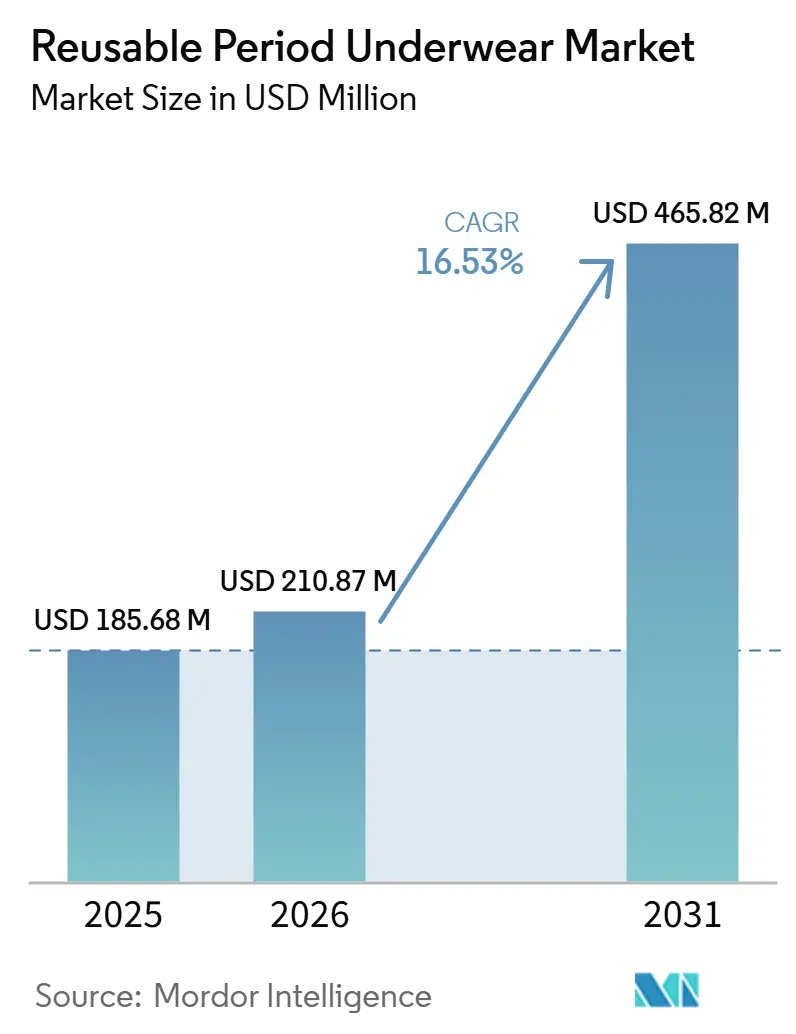
| Market Size (2026) | USD 210.87 Million |
| Market Size (2031) | USD 465.82 Million |
| Growth Rate (2026 - 2031) | 16.53 % |
| Fastest Growing Market | Asia-Pacific |
| Largest Market | North America |
| Market Concentration | Low |
Major Players *Disclaimer: Major Players sorted in no particular order Image © Mordor Intelligence. Reuse requires attribution under CC BY 4.0. | |
Reusable Period Underwear Market Analysis by Mordor Intelligence
The reusable period underwear market size is projected to expand from USD 185.68 million in 2025 and USD 216.37 million in 2026 to USD 465.82 million by 2031, registering a CAGR of 16.53% between 2026 and 2031. The period underwear market is moving beyond a specialist sustainable-living purchase as menstrual health discussion becomes more visible in consumer, school, and institutional settings. Reusable products also address the waste created by single-use menstrual supplies, which supports willingness to consider a higher initial purchase price. Retail availability is broadening from direct-to-consumer websites into pharmacies, supermarkets, and convenience formats, giving buyers more ways to try the category. A 2025 comparative assessment published in the Bulletin of the World Health Organization placed period underwear second among menstrual product categories for environmental sustainability across 8 indicators, behind menstrual cups. The period underwear market therefore depends on brands pairing credible material safety claims with dependable product performance and wider retail access.
Key Report Takeaways
- By product type, hipster styles held 32.17% of the reusable period underwear market share in 2025, while bikini styles are projected to grow at a 19.15% CAGR through 2031.
- By absorbency, medium products accounted for 42.39% of the reusable period underwear market size in 2025, while heavy products are forecast to expand at an 18.04% CAGR through 2031.
- By material, conventional fabrics held 75.43% of reusable period underwear market share in 2025, while organic variants are projected to grow at a 17.85% CAGR through 2031.
- By distribution channel, pharmacies and drug stores accounted for 54.36% of the reusable period underwear market size in 2025, while online retail is projected to grow at an 18.25% CAGR through 2031.
- By geography, North America accounted for 45.38% of the reusable period underwear market size in 2025, while Asia-Pacific is projected to grow at an 18.62% CAGR through 2031.
Note: Market size and forecast figures in this report are generated using Mordor Intelligence’s proprietary estimation framework, updated with the latest available data and insights as of January 2026.
Market Trends and Insights
Drivers Impact Analysis of Reusable Period Underwear Market*
| Driver | (~) % Impact on CAGR Forecasts | Geographic Relevance | Impact Timeline |
|---|---|---|---|
| Growing Awareness of Menstrual Health and Hygiene | +3.5% | Global | Medium term (2-4 years) |
| Sustainability-Led Switching from Disposable Menstrual Products | +3.0% | North America and Europe leading; Asia-Pacific emerging | Medium term (2-4 years) |
| Increasing Preference for Comfortable and Leak-Proof Protection | +2.5% | Global | Short term (≤2 years) |
| Technological Advancements in Textile Materials | +2.0% | Global, with early gains in North America and Europe | Medium term (2-4 years) |
| Celebrity Endorsements and Influencer Marketing | +1.5% | North America, Europe and Asia-Pacific | Short term (≤2 years) |
| Growing Demand for Multi-Purpose Intimate Apparel | +1.0% | North America and Europe | Long term (≥4 years) |
| Source: Mordor Intelligence | |||
Growing Awareness of Menstrual Health and Hygiene
Menstrual health awareness is becoming a more direct input into purchase decisions, expanding demand for reusable products in established and developing economies. World Health Assembly Resolution WHA76.17 called on member states to address the risks from chemicals, pollution, and waste in hygiene products, adding institutional support to public discussion of safer and reusable choices[1]Source: World Health Organization, “WHA76.17, Chemicals, Pollution, Waste and Health,” World Health Assembly, who.int.. A 2025 Bulletin of the World Health Organization article noted that only 40 countries reported on menstrual health management, which leaves substantial scope for education in Sub-Saharan Africa, South Asia, and Southeast Asia. In France, period underwear use rose from 7% in 2021 to 45% in 2025 when social acceptance and access to products improved. This pattern supports the role of pharmacy guidance, school distribution programs, and clear consumer education in reducing hesitation around reusable care. The period underwear market can benefit when brands establish a presence in those touchpoints before buyers form durable purchasing habits.
Sustainability-Led Switching from Disposable Menstrual Products
The environmental argument for reusable menstrual care is supported by lifecycle research that consumers can apply to daily purchasing decisions. The 2025 WHO review found that reusable options can reduce impacts associated with raw materials, manufacturing, waste, and water use compared with single-use alternatives. The European Union uses 49 billion single-use menstrual products each year, while the United Kingdom produces more than 200,000 metric tons of period-product waste annually, reinforcing the scale of the disposal issue described in the supplied research. Period underwear can be used for 2 to 3 years and can replace up to 200 disposable pads per pair during its use life. The initial cost can therefore be assessed against repeated spending on disposable supplies over the same period. Sustainability claims must still be supported by product evidence because buyers who seek lower-waste options can also scrutinize material safety and chemical disclosures.
Increasing Preference for Comfortable and Leak-Proof Protection
Comfort and confidence in leak protection remain central to first-time trial, especially when consumers expect all-day wear without visible bulk. Period underwear uses moisture-wicking fabrics, absorbent cores, and waterproof back layers to manage fluid while preserving an underwear-like fit. The heavy absorbency tier is forecast to grow at an 18.04% CAGR through 2031, showing rising acceptance among buyers with heavy or unpredictable flows. This group has the greatest consequences from product failure and can become frequent purchasers when performance meets expectations. Product formats designed for sport, overnight use, and other high-movement settings extend leak-proof technology beyond conventional intimate apparel. The period underwear market can build confidence when products clearly explain capacity, fit, washing, and the uses for which each absorbency level is intended.
Technological Advancements in Textile Materials
Material development is changing the balance between absorbency, dryness, wash durability, and garment thickness in reusable underwear. A 2025 U.S. patent application described a washable absorbent undergarment with an activated-carbon moisture barrier for odor control, showing continued technical development in the category[2]Source: United States Patent and Trademark Office, “Washable Absorbent Undergarment, Publication No. 20250205091,” Patent Application Publication, uspto.gov.. The supplied research also identifies PTT-based elastic fibers and hollow-cross-section viscose as examples of fibers designed to improve moisture management. These approaches may support slimmer products without removing the capacity needed for heavier flows. Material innovation is especially relevant to products used overnight, during physical activity, or under fitted clothing, where comfort and discretion are important. Brands with secured material sourcing or exclusive development arrangements have more scope to distinguish their products from garments made with standard textile inputs.
Restraints Impact Analysis of Reusable Period Underwear Market*
| Restraint | (~) % Impact on CAGR Forecasts | Geographic Relevance | Impact Timeline |
|---|---|---|---|
| Consumer Concerns Regarding Absorbency and Leakage | -1.5% | Global | Medium term (2-4 years) |
| Competition from Alternative Menstrual Products | -1.5% | Global | Medium term (2-4 years) |
| Concerns About Product Safety and Chemical Content | -1.0% | North America & Europe | Short term (≤2 years) |
| Lack of Standardized Performance Regulations | -0.5% | Global | Long term (≥4 years) |
| Source: Mordor Intelligence | |||
Consumer Concerns Regarding Absorbency and Leakage
Concerns about reliable absorbency remain a major barrier for buyers considering their first period underwear purchase. The concern is particularly strong among people with heavy or unpredictable flows because the personal cost of leakage in public settings can be high. Claims such as heavy flow can vary by brand, and buyers do not always have a standardized measure that allows a direct comparison before purchase. This issue can be more visible in pharmacies and supermarkets, where shoppers may not receive the detailed fit, care, and first-wash guidance available through direct online channels. Clear capacity ratings, washing instructions, and trial guarantees can reduce uncertainty and help shoppers evaluate whether a product fits their needs. Wider category trust will require consistent product disclosures, credible testing, consumer feedback, and better performance communication across the period underwear market.
Competition From Alternative Menstrual Products
Period underwear competes with disposable supplies and a broad range of reusable products, including cups, discs, and washable pads. A 2025 Spanish survey reported that menstrual underwear was used by 27.08% of respondents using reusable menstrual products, compared with 60.30% for menstrual cups. Cups can remain in use for up to 10 years, compared with 2 to 3 years for period underwear, which supports their long-term value proposition. France’s 2026 reimbursement framework covers both products, widening trial but not automatically creating a reason to choose one category over the other. Dedicated brands also face competition from established lingerie companies with existing manufacturing systems, retail relationships, and customer recognition. The period underwear industry needs to communicate distinct benefits in fit, familiarity, comfort, and use occasions rather than relying only on a reusable product message.
*Our forecasts treat driver/restraint impacts as directional, not additive. The impact forecasts reflect baseline growth, mix effects, and variable interactions.
Reusable Period Underwear Market Segment Analysis
By Product Type:
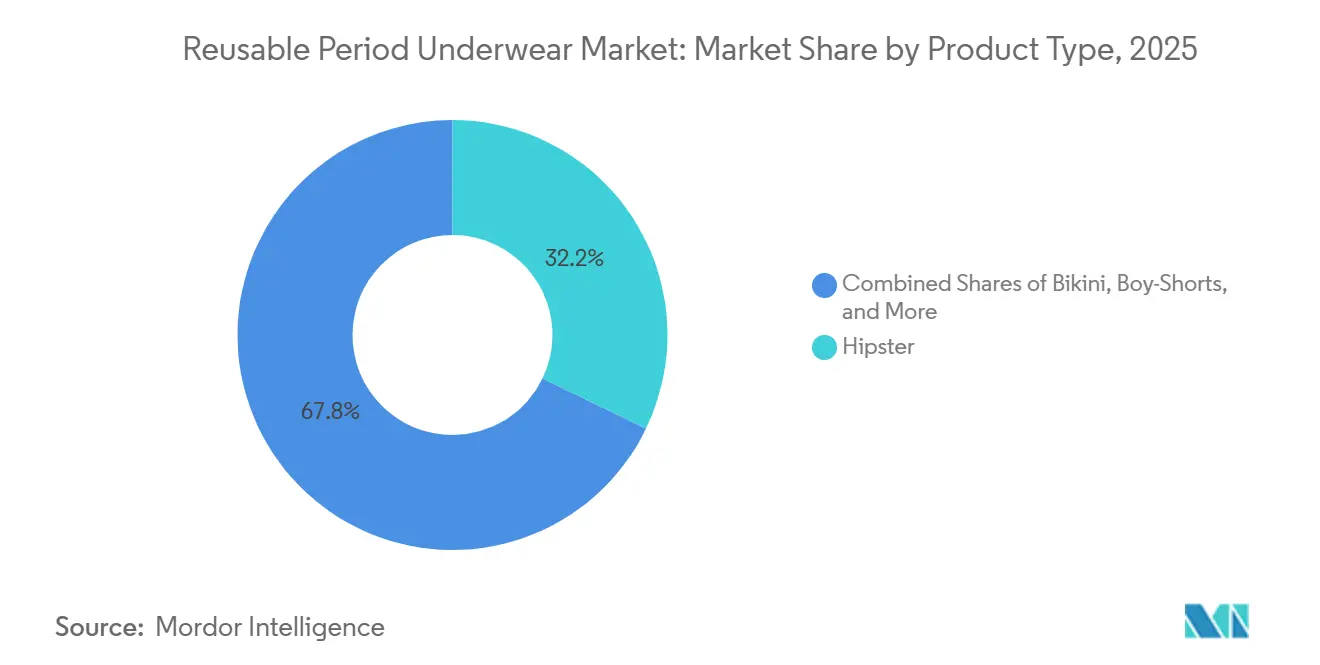
Hipster Style Leads While Bikini Cuts Gain Everyday AppealHipster styles held 32.17% of the period underwear market size in 2025, making them the largest product format. Their mid-rise waist, fuller seat coverage, and familiar silhouette make the style easier to understand for first-time buyers. The format serves a wide set of users, including adolescents, adults, and perimenopausal consumers. It also gives brands a reliable core item for pharmacy and supermarket ranges. Full coverage supports all-day protection and may reduce the perceived change from ordinary underwear. That familiarity lowers the practical and emotional barrier to trying reusable protection. Hipster products are therefore likely to remain important in retail assortments even as other silhouettes gain attention. Their role is primarily to provide a straightforward entry point into the period underwear market.
Bikini styles are projected to grow at a 19.15% CAGR from 2026 to 2031, the highest rate among product types. The faster rate suggests that users who accept the core function of leak-proof underwear are seeking options that fit their existing lingerie preferences. Bikini cuts can offer a lighter visual profile while retaining the absorbent layers required for menstrual care. High-waist products appeal to overnight users and postpartum buyers who may prefer greater abdominal coverage and security. Boy shorts appeal to consumers seeking inner-thigh coverage during movement and active use. Other formats include cycling shorts, postpartum briefs, and thong styles that use the same underlying absorbent construction. These formats allow manufacturers to extend product lines without requiring an entirely new production platform. The range of styles shows that the period underwear market is serving a broader set of wear occasions.



By Absorbency:
Medium Products Lead as Heavy Protection Gains TrustMedium absorbency products accounted for 42.39% of the period underwear market size in 2025, making them the standard option for everyday flow. They balance capacity with the lower bulk that many buyers expect from an underwear product. For many users, medium protection provides enough coverage for routine daytime use without the perceived weight of higher-capacity designs. This position makes the tier important for consumer education and repeat purchasing. It is also a practical starting point for buyers who are unfamiliar with reusable menstrual products. Light products serve a separate entry role for panty-liner replacement, discharge management, and lighter days. They widen the customer base beyond consumers who need heavy menstrual protection. A full absorbency range helps brands respond to different needs during the same cycle.
Heavy products are forecast to grow at an 18.04% CAGR from 2026 to 2031, the fastest rate across absorbency levels. Growth in this tier indicates stronger buyer confidence that reusable products can meet more demanding protection needs. The supplied research notes that heavy menstrual bleeding affects 1 in 4 menstruating women globally, creating a sizable group for which reliable performance matters greatly. Heavy-flow users historically had strong reasons to avoid a product that could fail in public or overnight. Products that demonstrate capacity, dryness, fit, and wash durability can reduce this resistance. Proof Inc.’s Leak-Loc technology and Lovekins’ SlimTech glueless absorption platform reflect product development directed at high-capacity protection. As confidence improves, buyers may move from medium to heavy products for selected days or overnight use. This movement can create repeat demand for brands that offer connected products across the absorbency range.
By Material:
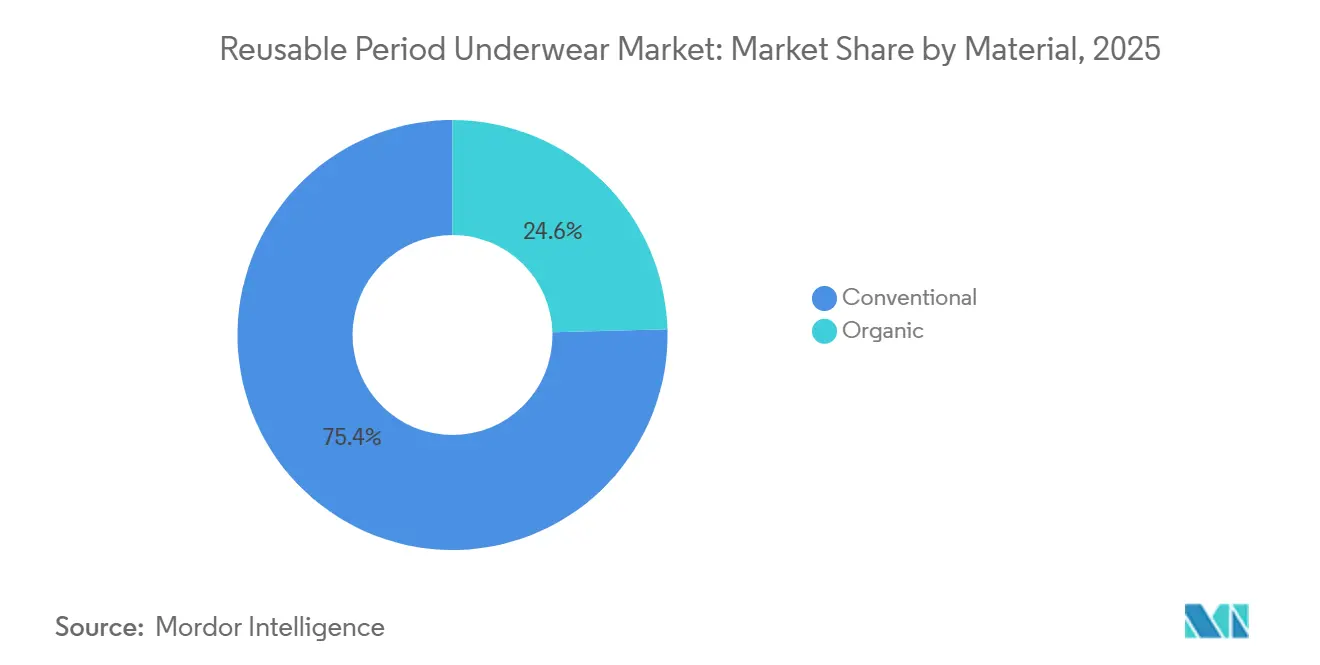
Conventional Fabrics Lead While Organic Options Serve Premium DemandConventional fabrics held 75.43% of the period underwear market share in 2025, supported by established supply chains and lower production costs. Nylon, polyester, and TPU-laminate blends are commonly used across moisture-wicking layers, absorbent cores, and waterproof barriers. These engineered materials perform distinct functions in a multi-layer garment and can be difficult to replace without affecting cost, fit, or fluid management. Their current position also reflects the scale of existing textile procurement systems. Conventional materials therefore remain important to the availability of products across different price points. Buyers can find these products in the leading retail channels and in a wide range of styles. Material composition remains relevant because intimate apparel is in direct contact with the body for extended periods. The period underwear market must therefore balance performance needs with clear information about material selection.
Organic variants are projected to grow at a 17.85% CAGR from 2026 to 2031 as premium buyers seek clearer material sourcing and certification. These consumers often assess GOTS and Oeko-Tex Standard 100 credentials alongside supplier transparency statements. A University of Notre Dame study published in July 2025 found intentional PFAS fluorination in 33.00% of tested period underwear products. The finding increases the value of reliable testing and understandable chemical disclosures. France’s 2026 pharmacy reimbursement conditions require 95.00% GOTS-certified organic cotton and Oeko-Tex Standard 100 Class 2 certification for eligible products, according to the supplied research. Certification can support consumer confidence, retail access, and eligibility for public reimbursement programs. It can also help brands prepare for tighter disclosure expectations in North America and Europe. Organic materials remain a premium part of the period underwear industry, while conventional textiles continue to supply most current volume.
By Distribution Channel:
Pharmacies Provide Trust While Online Retail Expands AccessPharmacies and drug stores accounted for 54.36% of period underwear market share in 2025, making them the largest distribution channel. Buyers often view pharmacies as credible places to purchase intimate hygiene products and seek reassurance when choosing a new format. The channel can provide visibility alongside other menstrual care items and can reduce the distance between product awareness and purchase. France’s 2026 reimbursement program covers 35.00% to 45.00% of the retail price for eligible period underwear purchased through pharmacies by women under 26 and social aid beneficiaries, according to the supplied research. This arrangement reinforces pharmacies as an access point for products that meet required certifications. Pharmacy distribution can also support a clearer connection between menstrual health information and reusable product availability. For brands, the channel requires dependable supply, compliant product information, and packaging that explains use simply. It remains a core route to scale in the period underwear market.
Online retail is projected to grow at an 18.25% CAGR from 2026 to 2031, the fastest distribution rate in the supplied data. Direct-to-consumer websites can offer fit guides, absorbency calculators, care instructions, subscriptions, and first-use information that are difficult to present fully on a physical shelf. These tools can address uncertainty before purchase and give brands a direct relationship with buyers. Supermarkets and hypermarkets serve more price-sensitive and volume-led shoppers, while also creating incidental exposure for people who may not search online. The supplied research cites WUKA’s expansion to more than 1,800 Tesco stores, including 1,300 Tesco Express locations, with an entry price of GBP 9.95. Specialty intimate apparel retailers and sports stores add further access as period-proof products expand into activewear-related formats. Each channel plays a separate role, with physical retail supporting awareness and online retail supporting education and range depth. A balanced channel strategy can help the period underwear market reach both first-time and experienced buyers.
Geography Analysis
North America Reusable Period Underwear Market
North America held 45.38% of the period underwear market size in 2025 and remained the largest regional market. The region combines strong product awareness, a developed direct-to-consumer brand base, pharmacy availability, and broad retail infrastructure. These routes operate together rather than replacing one another, giving consumers several ways to learn about and purchase reusable underwear. Knix opened its first U.S. store in New York City in 2025, illustrating the movement from a digital-first category toward a more visible physical retail presence. Canada follows many U.S. patterns, while Mexico has room to expand as urban incomes and e-commerce logistics improve. California’s AB 1817 textile PFAS restriction took effect in January 2025, and Vermont had already prohibited PFAS in menstrual products, increasing the importance of verified materials in these markets[3]Source: California Legislature, “Assembly Bill 1817, Product Safety, Perfluoroalkyl and Polyfluoroalkyl Substances,” California Legislative Information, legislature.ca.gov..
Europe Reusable Period Underwear Market
Europe is the second-largest regional market, and regulatory approaches have a strong influence on product demand and retail requirements. Proposed Ecolabel criteria for absorbent hygiene products and Nordic Swan Ecolabel discussions favor products with recognized material and safety credentials. France is a key example of mature demand, with 1.20 million units sold and EUR 21.20 million in sales during the 12 months to April 2025, according to the supplied research. Period underwear accounted for 4.80% of French menstrual-protection revenue during that period. The country’s pharmacy reimbursement framework also gives certified products a defined route to consumers. In the United Kingdom, WUKA’s rollout into Tesco convenience locations at a GBP 9.95 entry price shows the role of accessible retail pricing. Germany, the Netherlands, Scandinavia, and Spain remain important markets where sustainability credentials influence trust and listing decisions.
The Americas, EMEA and APAC Reusable Period Underwear Market
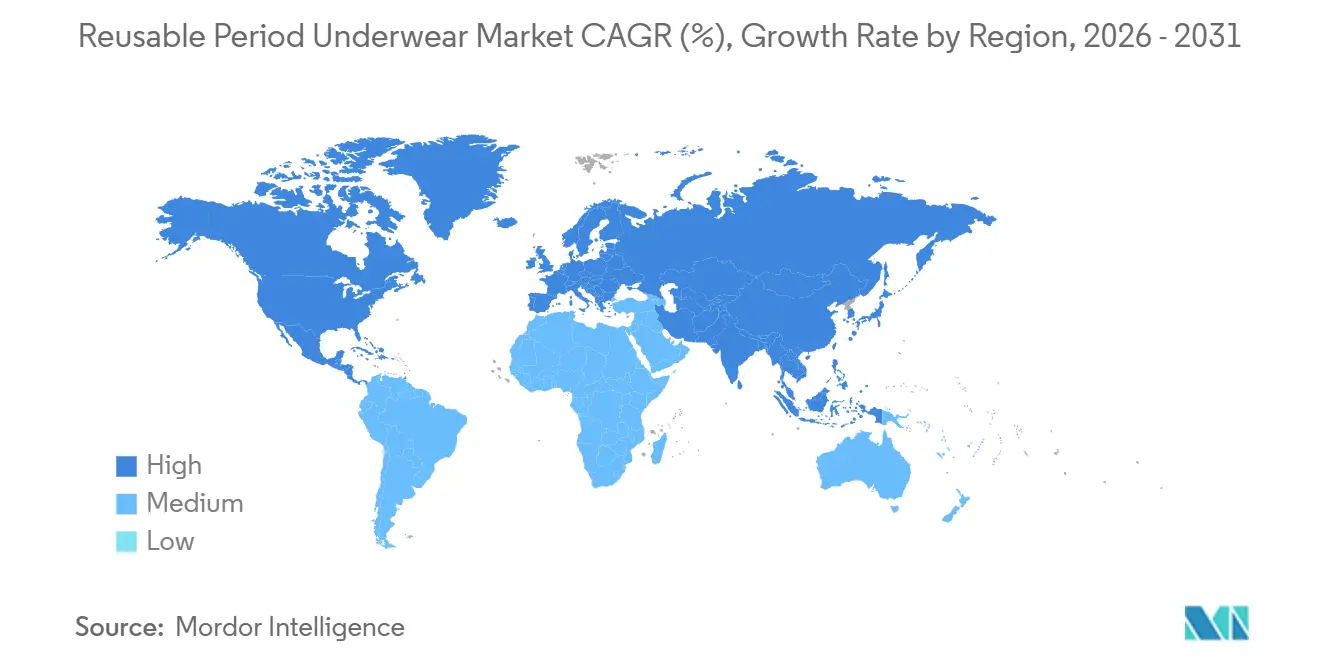
Asia-Pacific is forecast to grow at an 18.62% CAGR from 2026 to 2031, making it the fastest-growing region in the period underwear market. China’s online platforms, including Tmall and JD.com, give brands access to urban women aged 18 to 35 and enable targeted retail activity. India’s menstrual health initiatives and nonprofit programs are widening awareness beyond Tier 1 cities, while digital communities support product discovery. Japan, South Korea, and Australia support premium demand where material certifications and transparent brand practices can carry more weight. South America, led by Brazil and Argentina, is at an earlier stage of development but benefits from improving online commerce and rising female workforce participation. The Middle East and Africa, including the UAE and South Africa, are also developing through better logistics and health-focused menstrual wellness awareness. These regions provide longer-term growth opportunities, while North America and Europe remain the immediate centers of established demand.

Competitive Landscape
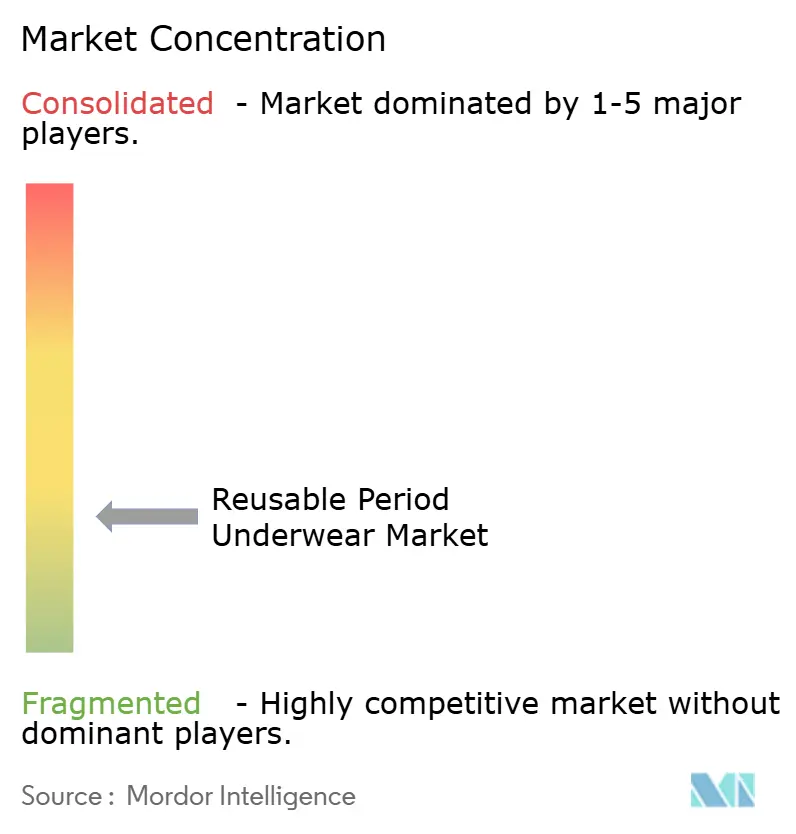
The reusable period underwear market has a market concentration score of 3 out of 10 because no leading supplier has sufficient combined control of pricing, technology standards, or channel access to dominate the category. Dedicated brands including THINX, Modibodi, WUKA, Saalt, and Ruby Love helped establish multi-layer absorbency products and remain important category specialists. They compete with low-priced marketplace sellers and with larger personal care and lingerie companies that have stronger manufacturing scale and retail relationships. This structure creates room for product development but can make sustained profitability more difficult for smaller specialists. Brands need to win consumer trust through performance, fit, safety communication, and practical availability rather than relying on a single advantage. The competitive environment is consequently fragmented across both product formats and sales channels. Material credibility has become a more visible part of that competition following heightened scrutiny of PFAS in reusable menstrual products.
Essity completed the acquisition of Edgewell Personal Care’s North American feminine care business in Q1 2026 for USD 340.00 million, covering Carefree, Stayfree, Playtex, o.b., and a Dover, Delaware manufacturing facility NASDAQ.COM. The transaction gives Essity broader capability to connect its Knix leak-proof underwear business with established feminine care distribution. This is a meaningful example of a larger company using an existing portfolio and retail base to strengthen its position in reusable protection. Modibodi’s February 2026 co-launch with PUMA Group of a period underwear swimwear range is another example of a specialist using a sportswear partnership to reach adjacent buyers. The collaboration places leak-proof product technology in a performance setting rather than limiting it to a conventional intimate apparel context. WUKA’s retail expansion to more than 1,800 Tesco locations is a third example, using physical availability to reach consumers beyond direct online channels. These moves reflect different approaches to scale, including portfolio integration, partnerships, and wider retail presence.
Competition also depends on how brands manage technical product development and evidence of material safety. The U.S. patent application for a washable absorbent undergarment with an activated-carbon odor-control barrier illustrates continuing development in functional textile architecture. Proprietary materials and product construction can support differentiation when buyers compare comfort, absorbency, discretion, and wash durability. At the same time, third-party testing, GOTS certification, and Oeko-Tex Standard 100 certification can improve confidence among consumers and retail partners. Brands that disclose PFAS testing can address a concern that is difficult to resolve through marketing language alone. Large companies have advantages in procurement and distribution, while specialists can respond quickly to specific use cases such as sport, postpartum recovery, and teen products. The period underwear market will remain open to several models because no single brand currently sets the terms for the whole category.
Reusable Period Underwear Industry Leaders
THINX Inc.
Knix Wear Inc.
Victoria’s Secret & Co.
Marks & Spencer Group plc
The Period Company
- *Disclaimer: Major Players sorted in no particular order
Reusable Period Underwear Market Companies Covered in this Report
- THINX Inc.
- Knix Wear Inc.
- Modibodi Pty Ltd.
- WUKA Ltd.
- Saalt, LLC
- Dear Kate, Inc.
- Ruby Love Inc.
- Proof
- Aisle
- Essity AB
- The Period Company
- Flux Undies
- Lunapads International Products Ltd.
- Rael Inc.
- FANNYPANTS
- Neione
- Elia Lingerie
- Unicharm Corporation
- Victoria’s Secret & Co.
- Marks & Spencer Group plc

Recent Industry Developments in Reusable Period Underwear Market
- June 2026: WUKA launched the Lunafly Collection, the UK's first heavy-flow period-proof competition swimwear range, developed in collaboration with three-time Olympian and Commonwealth Champion Hannah Miley MBE. The collection includes a competition legsuit, racer-back swimsuit, and bikini set engineered for competitive swimmers and club athletes, marking the first extension of period-proof technology into performance aquatic apparel
- May 2025: Proof introduced its new Postpartum High-Rise Brief, expanding its reusable leakproof underwear portfolio beyond menstrual care into postpartum recovery. Designed specifically for new mothers, the washable underwear features the company's Leak-Loc Layer technology, providing up to 12 hours of protection against postpartum bleeding.
- March 2024: Mahina, a menstrual health brand by Eicher Goodearth Private Limited, launched its reusable leak-proof period underwear designed to provide a sustainable alternative to disposable menstrual products. The collection features a three-layer absorbent gusset, bonded seam technology for enhanced leak protection, and reusable construction that lasts up to 100 washes.


Global Reusable Period Underwear Market Report Scope
| Bikini |
| Hipster |
| High Waist |
| Boy Shorts |
| Other Product Types |
| Light |
| Medium |
| Heavy |
| Organic |
| Conventional |
| Supermarkets/Hypermarkets |
| Pharmacies and Drug Stores |
| Online Retail Stores |
| Other Distribution Channels |
| North America | United States |
| Canada | |
| Mexico | |
| Rest of North America | |
| Europe | Germany |
| United Kingdom | |
| France | |
| Italy | |
| Spain | |
| Netherlands | |
| Sweden | |
| Poland | |
| Belgium | |
| Rest of Europe | |
| Asia-Pacific | China |
| India | |
| Japan | |
| Australia | |
| South Korea | |
| Vietnam | |
| Indonesia | |
| Thailand | |
| Singapore | |
| Rest of Asia-Pacific | |
| South America | Brazil |
| Argentina | |
| Chile | |
| Peru | |
| Colombia | |
| Rest of South America | |
| Middle East and Africa | United Arab Emirates |
| Saudi Arabia | |
| South Africa | |
| Nigeria | |
| Egypt | |
| Morocco | |
| Turkey | |
| Rest of Middle East and Africa |
| By Type | Bikini | |
| Hipster | ||
| High Waist | ||
| Boy Shorts | ||
| Other Product Types | ||
| By Absorbancy | Light | |
| Medium | ||
| Heavy | ||
| By Material | Organic | |
| Conventional | ||
| By Distribution Channels | Supermarkets/Hypermarkets | |
| Pharmacies and Drug Stores | ||
| Online Retail Stores | ||
| Other Distribution Channels | ||
| By Geography | North America | United States |
| Canada | ||
| Mexico | ||
| Rest of North America | ||
| Europe | Germany | |
| United Kingdom | ||
| France | ||
| Italy | ||
| Spain | ||
| Netherlands | ||
| Sweden | ||
| Poland | ||
| Belgium | ||
| Rest of Europe | ||
| Asia-Pacific | China | |
| India | ||
| Japan | ||
| Australia | ||
| South Korea | ||
| Vietnam | ||
| Indonesia | ||
| Thailand | ||
| Singapore | ||
| Rest of Asia-Pacific | ||
| South America | Brazil | |
| Argentina | ||
| Chile | ||
| Peru | ||
| Colombia | ||
| Rest of South America | ||
| Middle East and Africa | United Arab Emirates | |
| Saudi Arabia | ||
| South Africa | ||
| Nigeria | ||
| Egypt | ||
| Morocco | ||
| Turkey | ||
| Rest of Middle East and Africa | ||


Key Questions Answered in the Report
What is the forecast growth rate for reusable period underwear through 2031?
The reusable period underwear market is forecast to grow at a 16.53% CAGR from 2026 to 2031, reaching USD 465.82 million by 2031.
Which product style has the largest sales share?
Hipster styles led product types with a 32.17% share in 2025 because their fit and coverage resemble everyday underwear.
Which absorbency level is growing most quickly?
Heavy absorbency products are projected to expand at an 18.04% CAGR through 2031 as buyers seek more dependable protection for demanding use cases.
Which region is expected to grow fastest?
Asia-Pacific is projected to grow at an 18.62% CAGR through 2031, supported by digital retail, increasing incomes, and menstrual health awareness.
Page last updated on:





